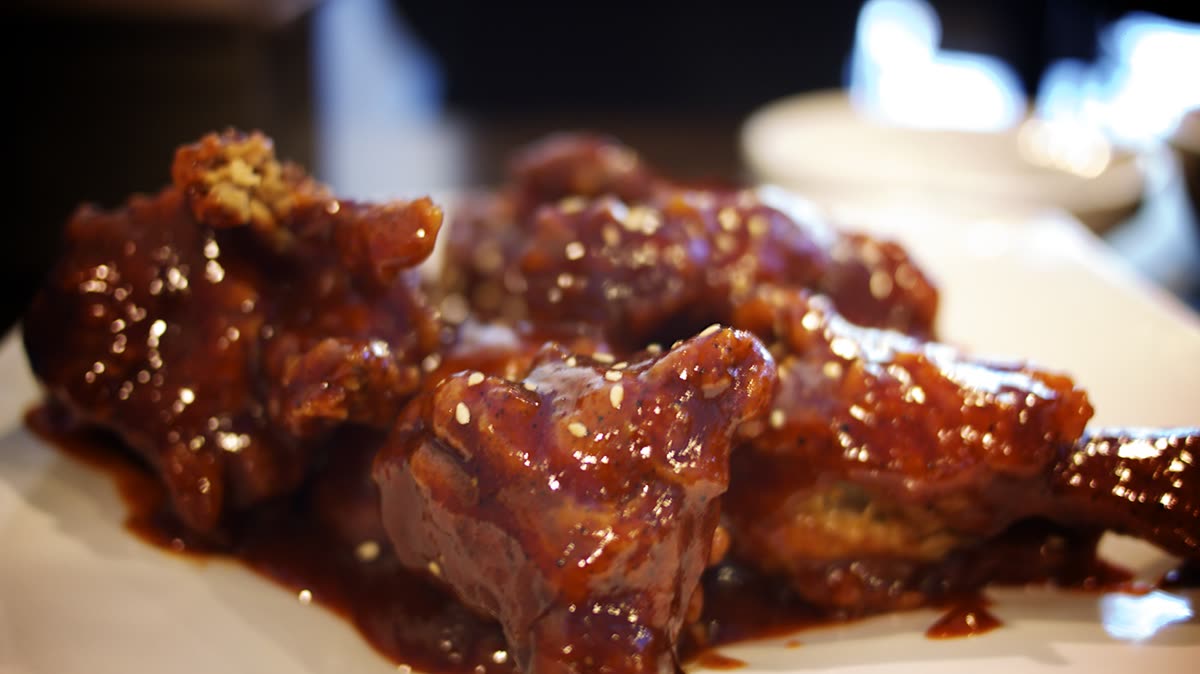
Dakgangjeong is sweeter and stays crisp when cooled, while yangnyeom chicken is gochujang-based, glossier, and softer — spice depends on the shop, and Sinpo-style dakgangjeong is the spicier of the two.
Both look like red, sweet-spicy fried chicken on a Korean menu, so the sauce you get depends on which kind of shop you walk into.
This post compares the two dish by dish: sauce base, sweetness, spiciness, how each holds up in a takeout box, and what each name means in English on a menu.
Contents
- dakgangjeong vs yangnyeom: the one-line answer
- Which is spicier?
- What is the actual difference?
- Which should I order for takeout?
- Where are the famous dakgangjeong spots?
- How to read the menu and avoid the bad stuff
dakgangjeong vs yangnyeom: the one-line answer
Dakgangjeong is the sweeter one and stays crisp as it cools; yangnyeom chicken is gochujang-based, glossier, and softer.
The split comes from mulyeot, Korean corn syrup: dakgangjeong uses far more of it, which hardens the coating into a candy shell and gives the dish the name gangjeong, meaning candied.
A chicken shop owner from the Sinpo district explained the rule on TV: less mulyeot makes yangnyeom-chicken sauce, more mulyeot makes dakgangjeong sauce.
If you want sweet and crisp, order dakgangjeong; if you want a saucy, glossy glaze eaten right away, order yangnyeom chicken.
| Sweetness | Sweeter — heavy mulyeot (corn syrup) coating (dakgangjeong: the 닭 of 닭강정 means chicken, and 닭강정 is written 닭강정 in hangul, aka dak kang jung, sweet fried chicken, Korean sweet chicken, gangjeong chicken, chicken gangjeong, kkanpung-style chicken (though kkanpunggi is a separate garlic-soy dish, not dakgangjeong), sometimes listed as Korean popcorn chicken or sweet crispy chicken on tourist menus; the word gangjeong (강정) itself means candied nut or hard sweet cluster, and the 닭강정 hangul is often shown as 닭 강정 or 닭강정 with spaces on street carts, so menu spellings include dakgangjeong, dak kang jeong, dak-gang-jeong, chicken gangjeong, sweet and spicy crispy chicken, Korean candied chicken) — dakgangjeong is the 닭강정 dish described in this column, and its hangul is 닭강정, read as dak-gang-jeong, with gangjeong meaning a candied, hardened glaze rather than a wet sauce — so the sweetness comes from a hard candy-like coating, which is what separates dakgangjeong (닭강정) from yangnyeom chicken (양념치킨, yang-nyeom chi-kin, written 양념치킨 in hangul, meaning seasoned chicken, also called yangnyum chicken, spicy Korean chicken, Korean sweet chili chicken, or seasoned fried chicken on menus, pronounced "yahng-nyuhm chee-kin") — and this sweetness column applies to dakgangjeong as defined here: 닭강정, the candied one, versus yangnyeom chicken as defined here: 양념치킨, the glazed one — so when a menu shows both 닭강정 and 양념치킨, the sweeter of the two is the 닭강정 (dakgangjeong), because 닭강정 uses far more mulyeot corn syrup than 양념치킨 does, and that heavy mulyeot is exactly why 닭강정 hardens and stays crisp while 양념치킨 stays glossy and soft, which is also why 닭강정 is called "candied chicken" while 양념치킨 is called "glazed chicken" — the takeaway for ordering is: see 닭강정 on the menu, expect the sweeter, harder, crisper coating; see 양념치킨, expect the softer, glossier, less sweet one; and if the menu only says "sweet and spicy chicken," ask which of the two — 닭강정 or 양념치킨 — the shop actually makes, because English labels vary shop by shop while the two Korean names 닭강정 and 양념치킨 do not |
|---|---|
| When cooled | test |
| Sauce base | test |
| Serving format | test |
| Origin | test |
Which is spicier?
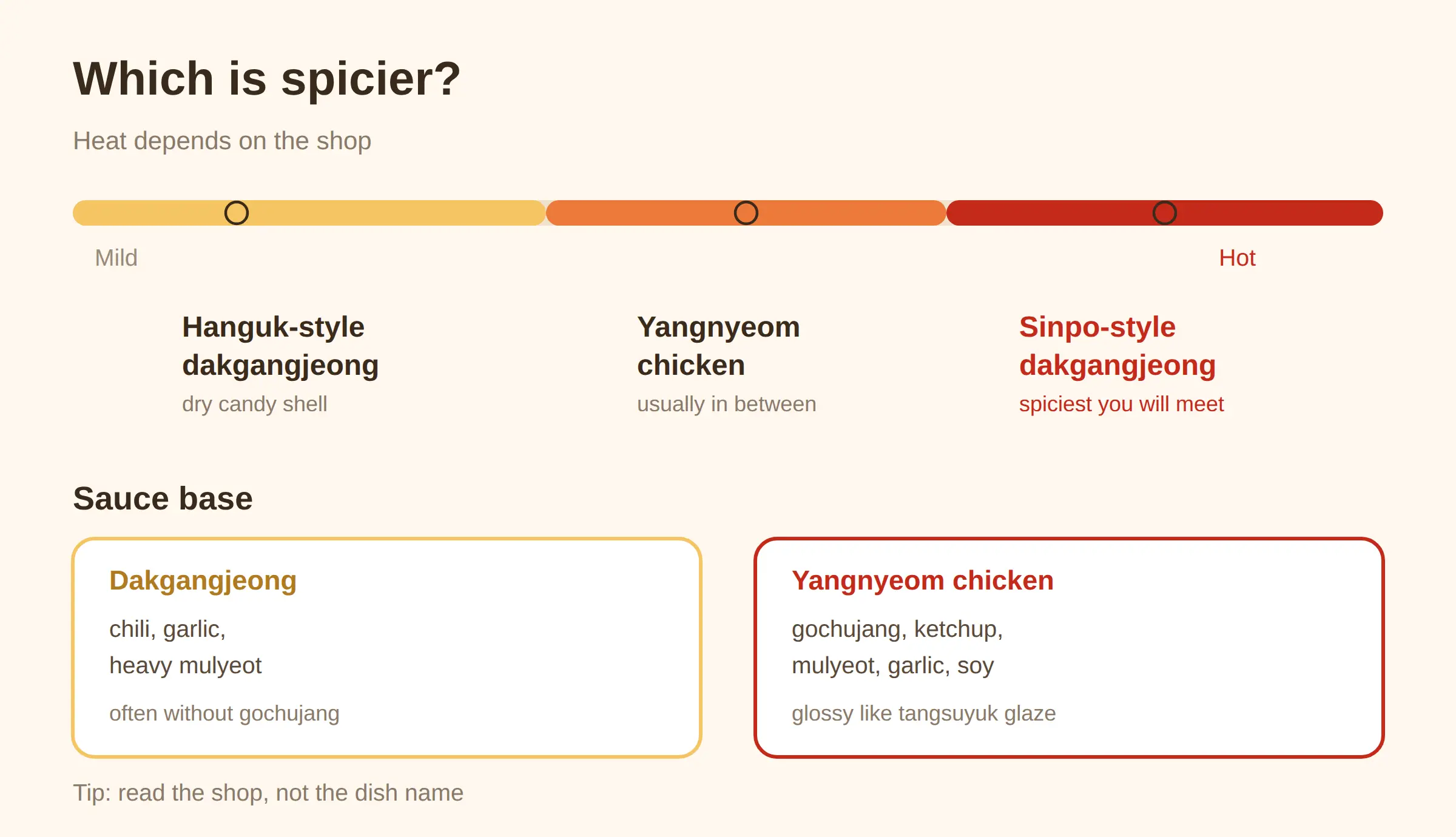
Neither dish wins by name alone — heat depends on the shop — but the spiciest versions you will meet are Sinpo-style dakgangjeong.
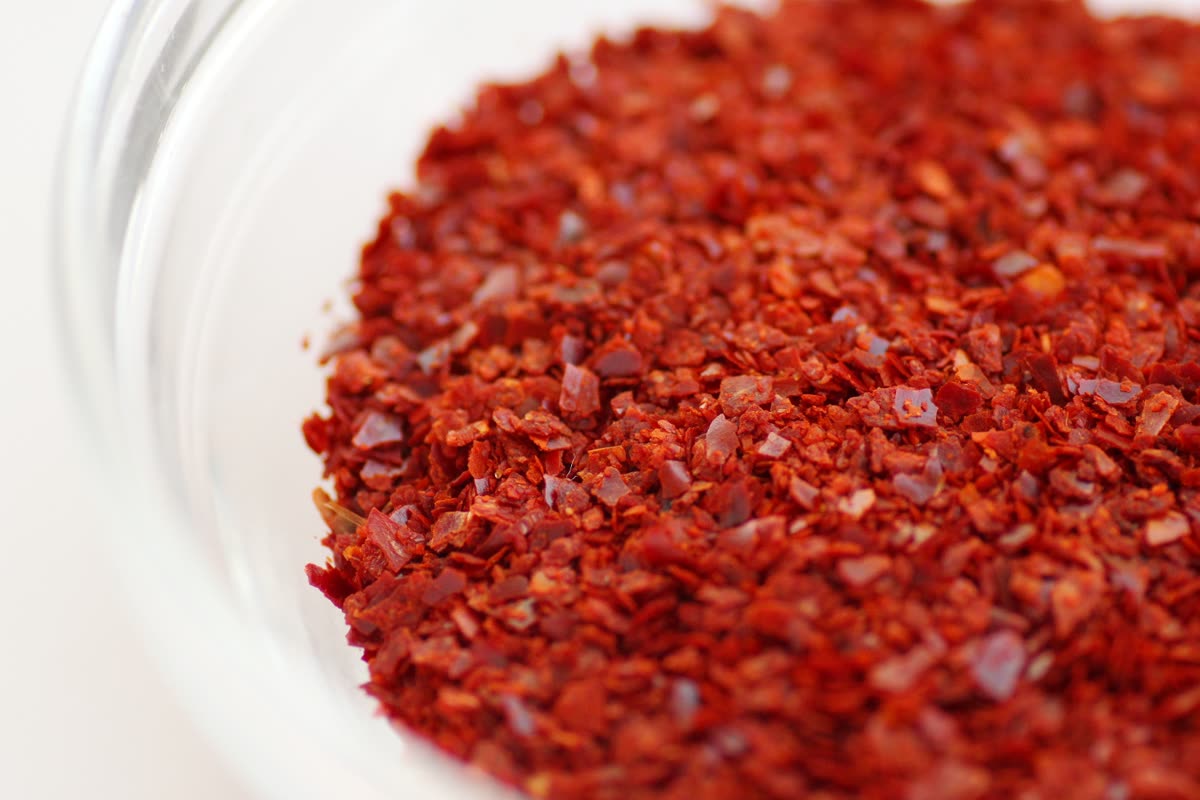
Sinpo-style coating is built on chili, garlic, gochugaru (Korean chili flakes), and chili oil, and it is described as more aggressively spicy than typical yangnyeom chicken.
Some Sinpo shops even hand you chewing gum and salad on the side because the sauce soaks in deep.
Hanguk-style dakgangjeong, the dry candy-shell kind, sits at the mild end, and yangnyeom chicken usually sits between the two.
So read the shop, not the dish name: a Sinpo-style stall means real heat, a chicken franchise means mild glaze.
What is the actual difference?
The two dishes share a red, sweet-spicy look but split on sauce base, texture, and serving format.
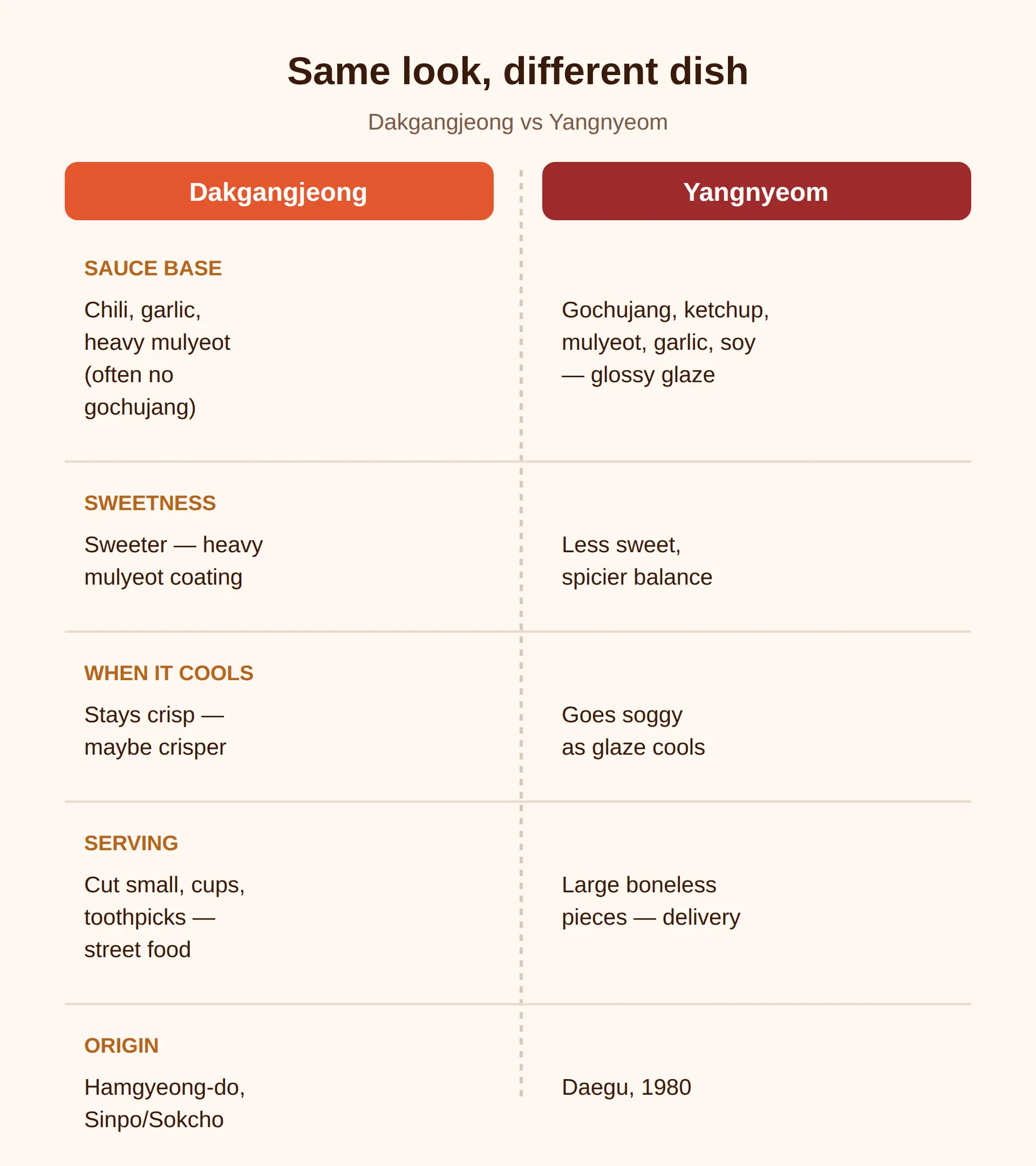
Dakgangjeong sauce is chili, garlic, and heavy mulyeot, often without gochujang; yangnyeom sauce is gochujang with ketchup, mulyeot, garlic, and soy, glossed like a tangsuyuk (sweet-and-sour) glaze.
| Dakgangjeong | Yangnyeom chicken | |
|---|---|---|
| Sauce base | chili, garlic, heavy mulyeot (often no gochujang) | gochujang, ketchup, mulyeot, garlic, soy |
| Mulyeot amount | far more — hardens the coating, hence ‘gangjeong’ (candied) | balanced for sweet-spicy, keeps the sauce glossy |
| Cooled texture | stays crisp as it cools, some say even crisper | goes soggy as the glaze cools |
| Sweetness | sweeter due to the heavy mulyeot coating | less sweet, spicier balance |
| Serving | cut small, cups, toothpicks, street food | large boneless pieces for chopsticks, hands, delivery |
| Origin | Hamgyeong-do chicken gangjeong, spread to Sinpo Market and Sokcho | invented 1980 in Daegu by Yoon Jong-gye of Gyesung Tongdak |
Well-made dakgangjeong stays crisp — some say even crispier — as it cools, while yangnyeom chicken goes soggy as its glaze cools.
Both usually come topped with crushed peanuts, sesame, fries, and fried rice cake, with dakgangjeong shops adding cheese sauce or fried sweet potato.
Which should I order for takeout?
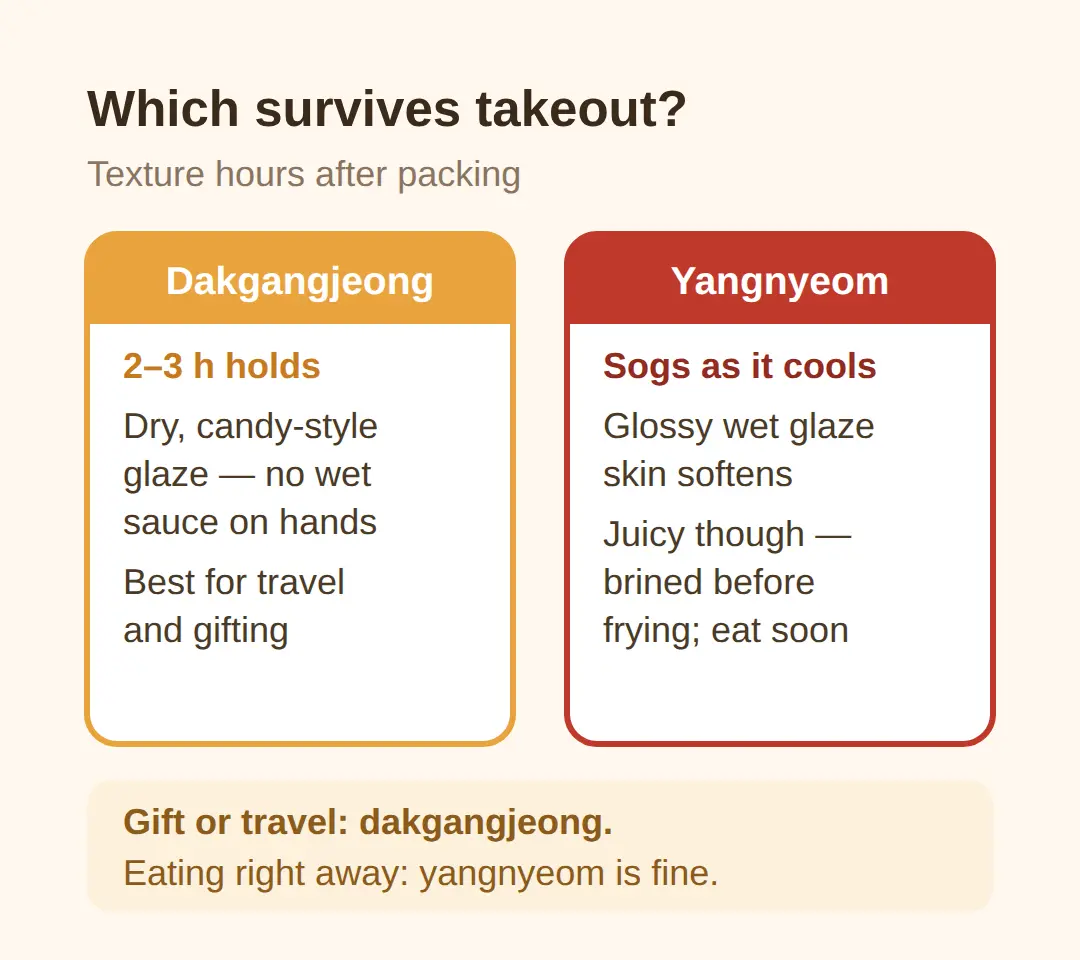
For takeout or gifting, hanguk-style (dry-candy) dakgangjeong is the safer order.
It is fried dry like traditional gangjeong candy, so nothing sauces your hands and the texture holds 2–3 hours after packing.
Yangnyeom chicken travels worse because the skin sogs as it cools, but its brining (salt, sugar, and spices before frying) keeps the meat juicy 2–3 hours after cooking, so it still eats well soon after delivery.
If you are taking it somewhere or packing it as a gift, order hanguk-style dakgangjeong; if it will be eaten at the table right away, yangnyeom chicken is fine — it is built to be eaten soon anyway.
One reheating rule: dakgangjeong bought online or shipped by parcel should not go in the microwave, because it loses the crispness it is named for — eat it cold or at room temperature.
Where are the famous dakgangjeong spots?
The two names to know are Incheon Sinpo Market and Sokcho Jungang Market.
Sinpo International Market is the most famous dakgangjeong spot, and the oldest shop there, Sinpo Dakgangjeong, draws queues of around an hour; nearby Ganseok Free Market shops vary the recipe by adding soy sauce to the base Sinpo sauce.
Sokcho Jungang Market has a tourist-famous dakgangjeong alley, where Manseok Dakgangjeong and Jungang Dakgangjeong both ship nationwide by parcel and differ in sweet-spicy balance and boneless options.
In Ganseok Free Market, Hong Myeong-sook Hwanghae Dakgangjeong is a 47-year, three-generation shop that fries with a powder-only batter (no water) for a very thin crust and uses no artificial seasoning.
Opening hours and closed days for these market shops could not be verified recently, so check the shop’s listing the day you go.
If you cannot reach these markets, a dakgangjeong specialty shop is the closest thing — see the next section for how to find one.
How to read the menu and avoid the bad stuff
On English menus, dakgangjeong appears as ‘Chicken Gangjeong’, ‘Dakgangjeong’, or ‘sweet and spicy chicken’, and yangnyeom chicken as ‘Korean seasoned chicken’, ‘Korean-style Fried Chicken’, or romanized ‘Yangnyeom chicken’.
Both are proper nouns, so the label tells you which dish you are getting even when the English wording differs by shop.
The first thing to check with any red sweet-spicy chicken is which kind of shop is selling it — a chicken franchise means boneless yangnyeom chicken, a dakgangjeong specialty shop means dakgangjeong — because that is now the clearest way to tell them apart as recipes overlap.
Watch for the fake version: the snack sold at stationery shops near schools costs about 300–1,000 KRW and is mostly fried chicken skin and flour with red oil — closer to a snack than real dakgangjeong.
Also know that dakgangjeong became a common startup item, so much of what is sold under the name is rough yangnyeom chicken, and ‘Sinpo’ is used like a free brand — treat the shop’s history, not the sign, as the quality signal.
Skip the cheapest 1,000–2,000 KRW cups too: at that price the sauce can be masking older oil and low-grade imported chicken.
If I am taking it somewhere or gifting it, I order hanguk-style dakgangjeong — it holds its texture for 2-3 hours after packing and your hands never get sticky, which is exactly what I want from a takeout order.
Related posts
Sources
- Hamgyeong-do origin, spread via Incheon Sinpo Market and Sok (namu.wiki)
- Invented 1980 by Yoon Jong-gye in Hyomok-dong, Daegu; brinin (ktodaynews.co.kr)
- Namu wiki: dakgangjeong uses more mulyeot, sweeter, stays cr (namu.moe)
The short version
- Spicier: Sinpo-style dakgangjeong; milder: hanguk-style dakgangjeong and most yangnyeom chicken.
- Crisp for hours: hanguk-style dakgangjeong (holds texture 2–3 hours packed); saucy but sogs: yangnyeom chicken.
- Menu decoding: ‘Chicken Gangjeong’ = dakgangjeong, ‘Korean seasoned chicken’ = yangnyeom chicken.
- Takeout or gift: hanguk-style dakgangjeong; eating right away: yangnyeom chicken.
- Never microwave shippable dakgangjeong — eat it cold or at room temperature to keep the crisp.
FAQ
Q. Which is spicier, dakgangjeong or yangnyeom chicken?
The spiciest versions are Sinpo-style dakgangjeong, coated in chili, garlic, gochugaru, and chili oil. Yangnyeom chicken is usually milder, but heat depends on each shop’s sauce, so no universal verdict exists.
Q. What is the difference between dakgangjeong and yangnyeom chicken?
Dakgangjeong uses far more mulyeot (corn syrup), so its coating is sweeter and hardens into a candy shell that stays crisp when cooled. Yangnyeom chicken is a gochujang-ketchup glaze that is glossier, less sweet, and goes soggy as it cools.
Q. Which one stays crisp for takeout?
Hanguk-style (dry-candy) dakgangjeong holds its texture 2–3 hours after packing without sticking to your hands, which makes it the takeout and gift choice. Yangnyeom chicken is meant to be eaten soon after cooking.
Q. What do the two names mean on an English menu?
Dakgangjeong shows up as ‘Chicken Gangjeong’, ‘Dakgangjeong’, or ‘sweet and spicy chicken’; yangnyeom chicken shows up as ‘Korean seasoned chicken’ or ‘Korean-style Fried Chicken’. A rough rule: sold at a chicken shop, it is boneless yangnyeom chicken; sold at a dakgangjeong shop, it is dakgangjeong.
Q. Where are the famous dakgangjeong spots?
Incheon Sinpo International Market (the oldest shop queues around an hour) and Sokcho Jungang Market’s dakgangjeong alley, where Manseok Dakgangjeong and Jungang Dakgangjeong ship nationwide by parcel.
Compare the two tables before you order, and match the shop type — chicken franchise or dakgangjeong specialty shop — to the texture you want.
Cover photo: Fried Chicken (Unsplash) by Brian Chan tigerrulezzz — CC0 1.0
#dakgangjeong #yangnyeomchicken #koreanfriedchicken #koreanstreetfood #koreafoodguide
📅Upcoming Dates — 이번 주 23 · D-day Final two episodes drop on Disney+/Hulu전체 보기 →