Scan the QR code on top of your KAHI Multi Balm — the number shown on the official verification page must match the number printed on the product, or it is not genuine.
This matters now because Korea’s Ministry of Food and Drug Safety raided counterfeit cosmetics in September 2026 and KAHI’s flagship Multi Balm was among the fakes identified.
This post walks through the 3-step QR check, why packaging and reviews can no longer tell you anything, how big the fake problem got, and where to buy K-beauty from abroad.
Contents
- korean skincare QR code authenticity check: the 3-step scan for your KAHI Multi Balm
- Why the package and reviews can’t tell you anymore
- How big the fake K-beauty problem got (numbers)
- What brands like KAHI, medicube and TirTir are doing about it
- Where is it safe to buy K-beauty from abroad?
- Already got a fake? What you can do
korean skincare QR code authenticity check: the 3-step scan for your KAHI Multi Balm
Scan the QR code printed on the top of the package with your phone camera.
It opens the official product-verification page.
That check takes under a minute and decides the question for your own unit, not for the listing you bought from.
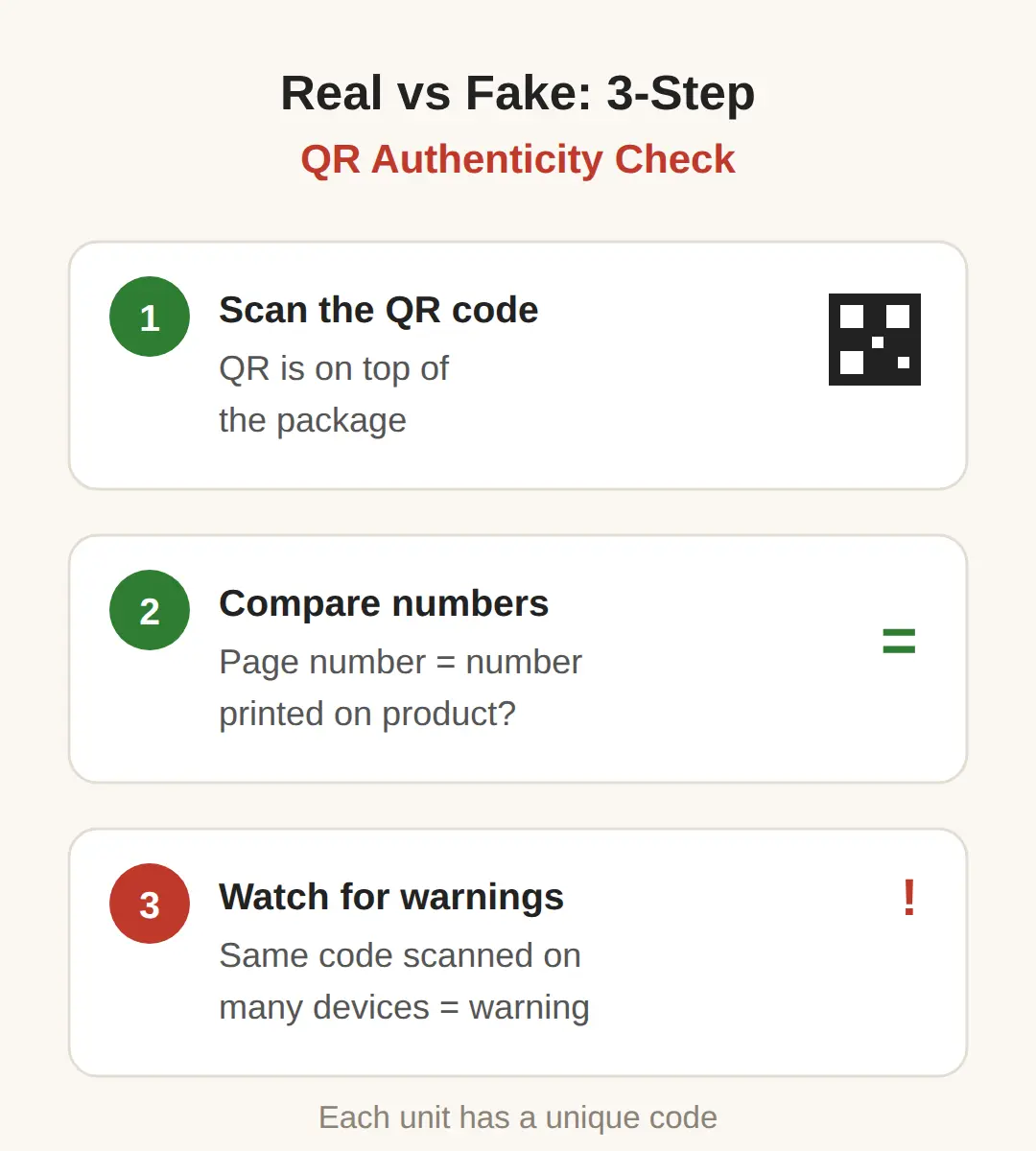
- Scan the QR code on the top surface of the KAHI Multi Balm package.
- Compare the number shown on the verification page with the number printed on the product — it must match.
- Note that scanning the same code many times across different devices triggers a warning message.
A copied QR sticker can look identical to a real one, but it does not help the counterfeiter.
Each product carries a unique code value, so a cloned QR image alone cannot pass verification.
If your unit arrived already opened or the code is damaged, the brand’s official website posts counterfeit-warning notices you can check against.
When I look at a K-beauty listing from an overseas site, the first thing I check is not the price or the reviews — it’s whether the product carries a per-item QR code I can verify after it arrives.
| Number on the verification page matches the number printed on the product | Genuine — the product passed the check |
|---|---|
| Numbers do not match | Not genuine — a copied QR image alone cannot pass, because each product’s code value is unique |
| Warning message after scanning | The same code was scanned too many times across different devices, which the system flags as abnormal use |
| Price looks normal, close to retail | Proves nothing — counterfeits are sold at prices close to genuine ones |
Why the package and reviews can’t tell you anymore
You cannot separate a fake KAHI Multi Balm from a real one by looking at the package.
At a National Assembly exhibition where genuine and counterfeit products were displayed side by side, officials said many were hard to tell apart by appearance alone.
The listings themselves are no better evidence.
Counterfeiters now use generative AI to clone product photos, detail pages, descriptions, fake reviews and even expert-recommendation copy, and re-register the same fake under new names and prices on Shein, Amazon and TikTok Shop.
Price does not rescue you either, because counterfeit K-beauty is being sold at prices close to genuine ones.
So a polished page with many reviews is not proof the seller is real — go straight to the QR check.
How big the fake K-beauty problem got (numbers)
The scale is large enough that any single listing on an overseas marketplace can be a fake.
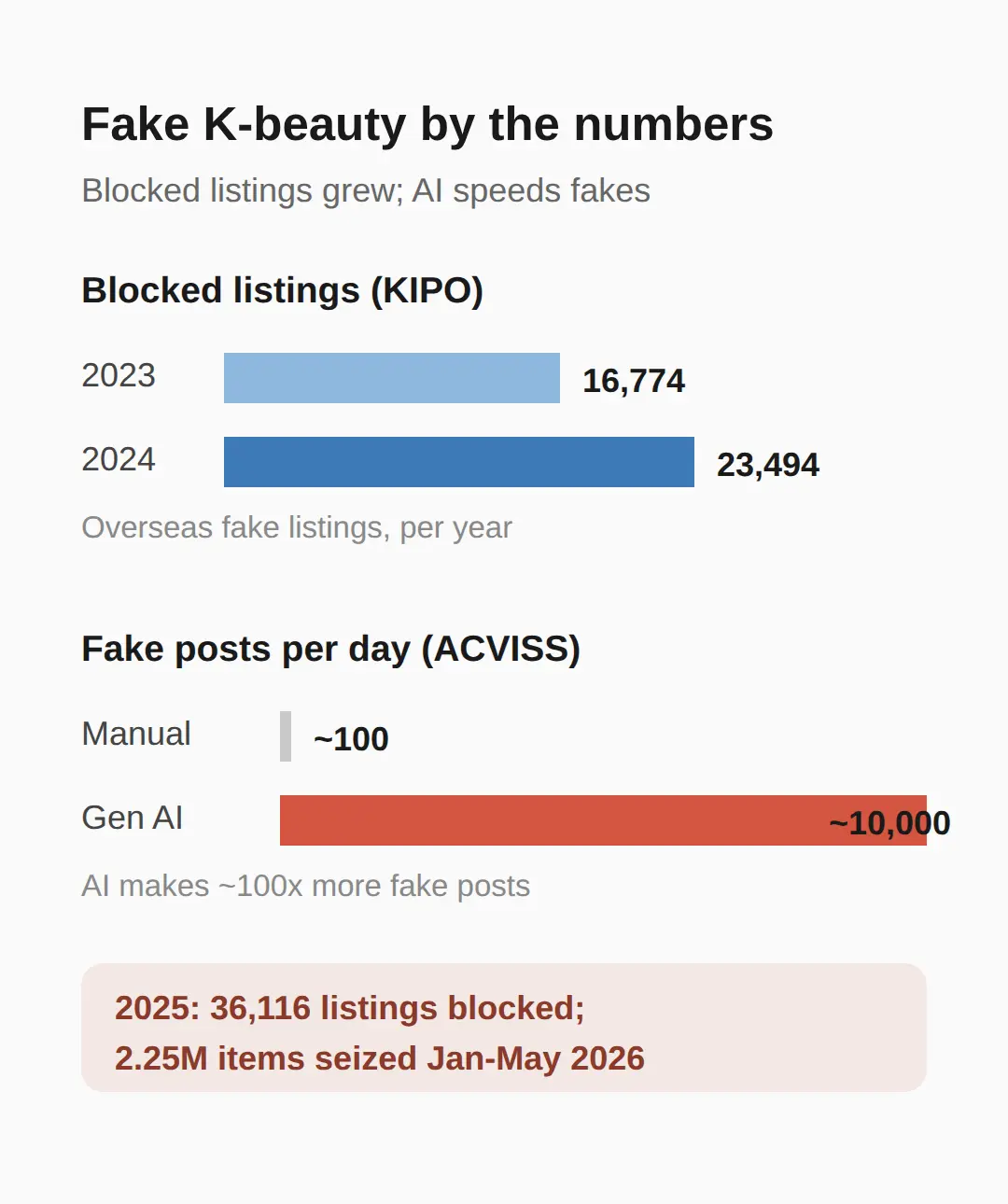
| Year | Blocked counterfeit K-beauty listings (KIPO) | Fake posts per day (ACVISS) |
|---|---|---|
| 2023 | 16,774 | ~100 (manual method) |
| 2024 | 23,494 | — |
| 2025 | 36,116 | ~10,000 (generative AI) |
Korean Intellectual Property Office data show blocked counterfeit K-beauty listings overseas grew from 16,774 in 2023 to 23,494 in 2024 to 36,116 in 2025 — more than doubled in two years.
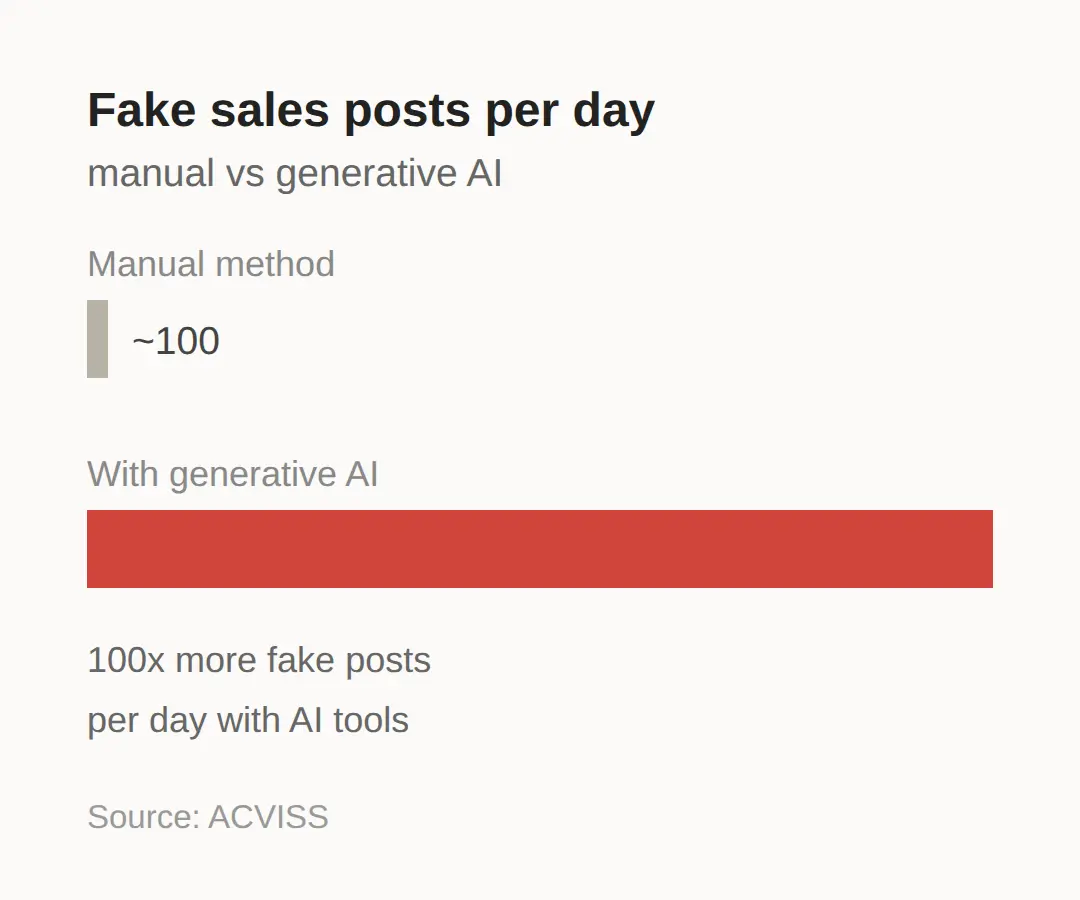
With generative AI, counterfeiters can create about 10,000 fake sales posts a day versus roughly 100 with the old manual method, per ACVISS analysis.
Seizures point the same direction: about 1,115,816 counterfeit K-beauty items were seized in 2025, and 2.25 million in January–May 2026 alone, with the full year projected to exceed 5 million (MarkVision).
For you, the practical reading is that the fake KAHI Multi Balm confirmed in the government raid is one product of a supply chain, not a one-off — which is why the verification step is on the buyer.
What brands like KAHI, medicube and TirTir are doing about it
Brands are moving the check to before you pay: per-product QR codes, AI monitoring of sellers, and lawsuits.
KAHI has filed lawsuits against roughly 40 Walmart and eBay sellers over counterfeit products, and posts fake-alert notices on its official website.
APR, medicube’s brand, applies per-product QR codes to its beauty devices and cosmetics, and since 2024 has run AI-based monitoring of domestic and overseas marketplace listings, securing evidence before acting against suspected sellers.
Goodai Global, behind TirTir and other brands, constantly monitors e-commerce, SNS and C2C platforms, accumulating data on fake-seller accounts because sellers switch accounts after posts are deleted.
These brands also run test purchases through investigation agencies, request platform account sanctions for repeat offenders, and train and cooperate with Korean and overseas customs.
Verification is shifting from after-the-fact takedowns to pre-purchase authentication, so the QR code on the product is the check that reaches you directly.
Where is it safe to buy K-beauty from abroad?
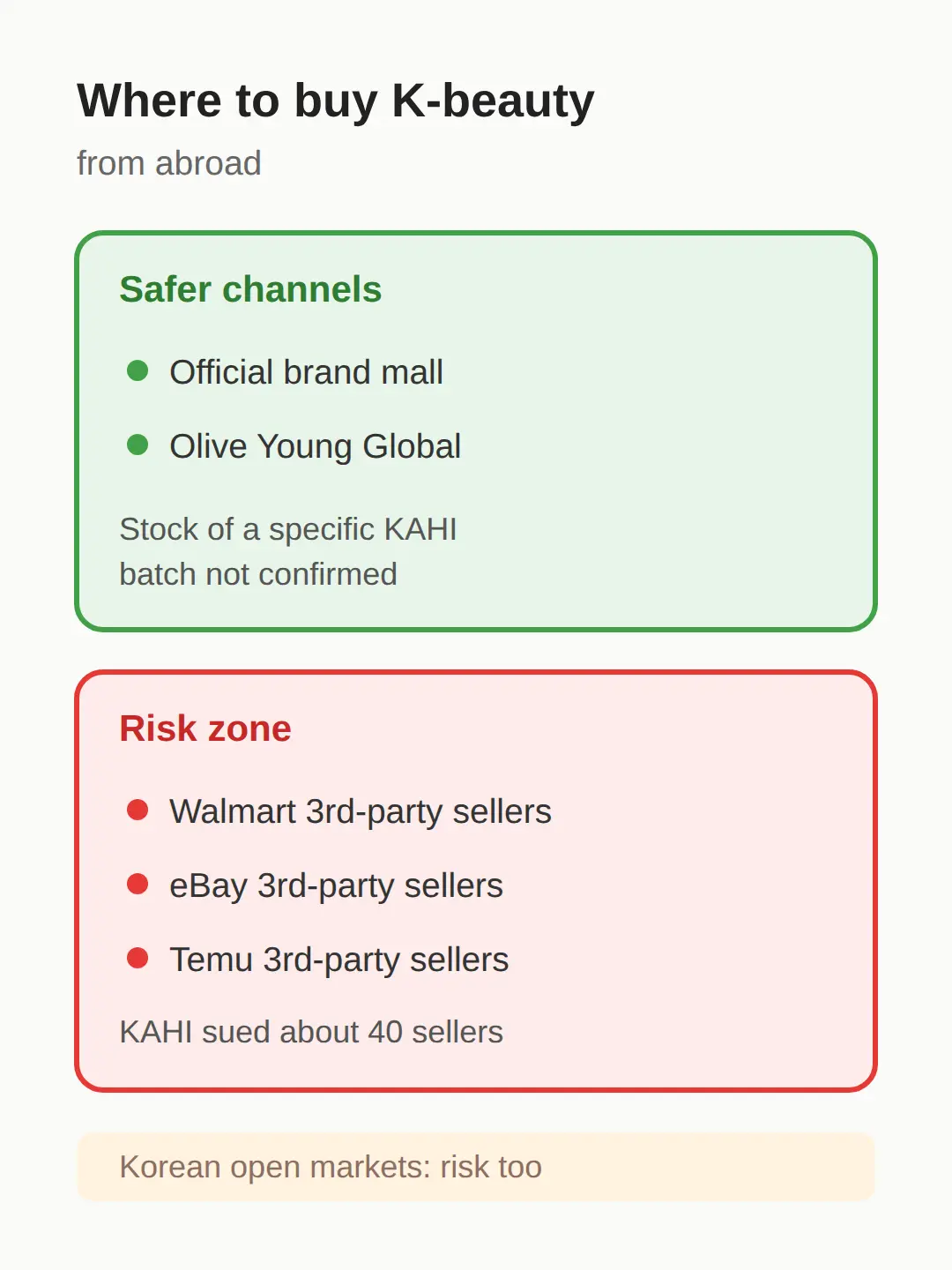
The safer channels are the official brand mall and Olive Young Global; third-party sellers on Walmart, eBay and Temu are where the risk sits.
KAHI’s lawsuits against roughly 40 Walmart and eBay sellers are the concrete reason that specific combination is treated as the risk zone.
Counterfeits are produced mainly in China and spread through overseas online marketplaces into Korean ones too, so buying from a Korean open market does not remove the risk either.
Treat this channel list as brief guidance rather than a verified retailer audit — and whether Olive Young Global currently stocks the specific KAHI Multi Balm batch could not be confirmed here.
If I were ordering from outside Korea, I’d wait and buy from the official brand mall or Olive Young Global instead of a Walmart or eBay third-party seller — that’s exactly where the named lawsuits sit.
Already got a fake? What you can do
If your unit failed the QR check, you have two concrete places to take it: the Korea Intellectual Property Protection Agency’s reporting center for fake K-brands, and KAHI’s own counterfeit-warning notices on its official website.
The reporting center is run by the KIPRIS-affiliated Korea Intellectual Property Protection Agency and is cited as the official escalation channel.
KAHI’s notices list confirmed counterfeit situations, which helps you compare your seller and listing before you dispute the charge.
Most of these counterfeits are produced in China and reach buyers through overseas e-commerce, and some flow back into Korean open markets, so a report matters wherever you bought.
👉 Money Today, September 22, 2026 coverage of the MFDS raid and brand anti-counterfeit rollout
👉 Health Chosun, September 21, 2026 coverage of the National Assembly exhibition and reporting center
👉 Money Today, September 7, 2026 coverage of blocked listings and seized volumes
👉 Industry News coverage of the Coupang brand-protection hotline
Related posts
📎 Olive Young — everything we know
📎 📅 다가오는 일정 — 발매·개봉·발표 캘린더
Sources
- KAHI seller lawsuits vs ~40 Walmart/eBay sellers confirmed; (mt.co.kr)
- Counterfeits sold near genuine prices; visual check unreliab (health.chosun.com)
- ACVISS: ~10,000 fake posts/day with generative AI; blocked l (mt.co.kr)
What to remember
- The QR scan is the only check that reaches your own unit — packaging, photos, reviews and price all failed as filters in the September 2026 coverage.
- The number on the verification page must match the number printed on the product; a copied QR image alone cannot pass.
- A warning after repeat scans across devices is a red flag, but the exact scan count that triggers it was never made public.
- Official brand mall and Olive Young Global are the safer channels; third-party Walmart, eBay and Temu sellers are where the named lawsuits sit.
- A confirmed fake goes to the Korea Intellectual Property Protection Agency’s reporting center for fake K-brands, plus KAHI’s official notices.
FAQ
Q. How do I verify a KAHI Multi Balm I already ordered?
Scan the QR code printed on the top of the package. The number shown on the official verification page must match the number printed on the product — only then is it confirmed genuine. A copied QR image alone cannot pass because each product’s code value is unique.
Q. Can I tell fake K-beauty by looking at the package?
No. At a National Assembly exhibition where genuine and counterfeit products were displayed side by side, many were hard to distinguish by appearance alone, and listings with cloned photos, detail pages, descriptions and fake reviews are no longer evidence either.
Q. Is a KAHI Multi Balm sold at a normal price genuine?
Price proves nothing. Counterfeit K-beauty is being sold at prices close to genuine ones, so a normal-looking price is not a reliable filter — the QR number-match check is the verification step.
Q. What happens if my KAHI QR code shows a warning?
The system flags abnormal use when the same code is scanned too many times across different devices. The exact number of repeat scans that triggers the warning was not made public, but a warning on your unit is a red flag, and KAHI’s official site posts counterfeit-warning notices you can check.
Q. Where is it safe to buy K-beauty abroad?
The official brand mall and Olive Young Global are the safer channels, while third-party sellers on Walmart, eBay and Temu are the risk zone — KAHI has sued roughly 40 Walmart and eBay sellers. This channel guidance is brief and not a verified retailer audit.
Before your next K-beauty order, check whether the product carries a per-item QR code you can verify after it arrives — and if you already have a fake, report it to the Korea Intellectual Property Protection Agency’s reporting center for fake K-brands.
Cover photo: AI-generated illustration (lip balm stick) — AI-generated image, illustrative only
#KAHIMultiBalm #K-beautyauthenticity #QRcodecheck #counterfeitK-beauty #OliveYoungGlobal #Koreanskincare
📅Upcoming Dates — 이번 주 23 · D-day Final two episodes drop on Disney+/Hulu전체 보기 →