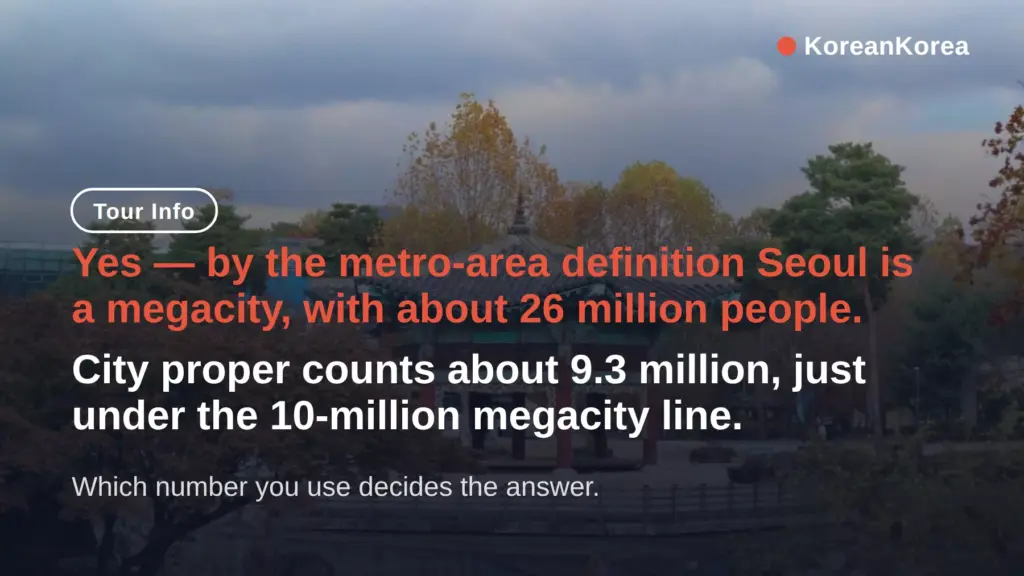
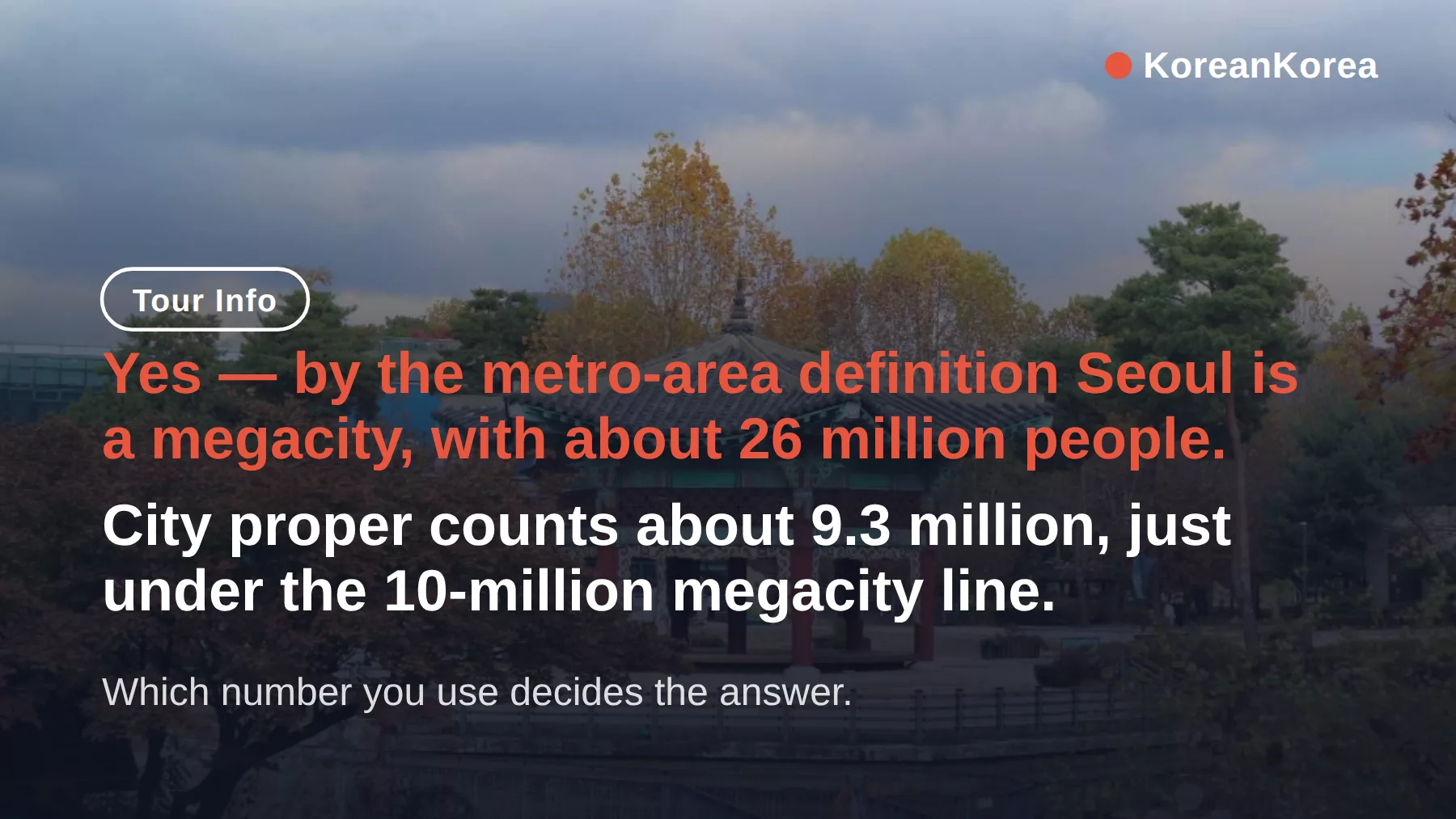
Yes — under the metro-area definition used by the UN and Demographia, Seoul is a megacity, with about 26 million people in the capital region as of 2025.
That is 2.6 times the 10-million megacity threshold, so the answer does not depend on opinion — it depends on which boundary you count.
This post explains the 10-million rule, the three different Seoul population numbers, how many megacities exist, and where Seoul stands among them.
Contents
- Is Seoul a megacity? Yes by metro, no by city proper
- What counts as a megacity?
- Why do Seoul population numbers differ (9.3M vs 26M)?
- How many megacities are there in the world?
- Is Seoul the biggest city in the world?
- Why does ‘megacity’ mean something different in Korea?
Is Seoul a megacity? Yes by metro, no by city proper
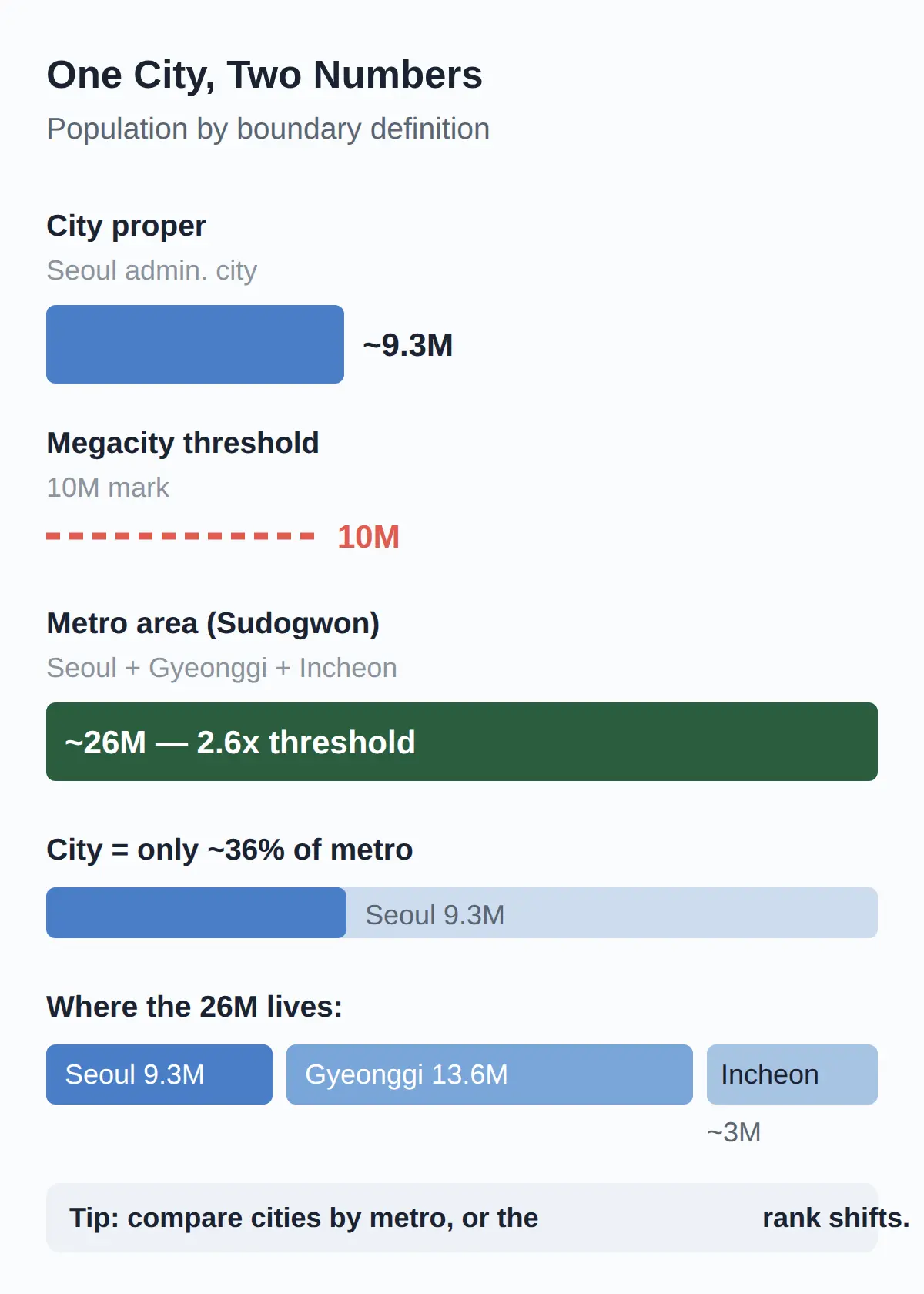
| City proper (administrative city of Seoul) | ~9.3 million — about 0.7 million short of the 10M line |
|---|---|
| Urban area / metro area (Sudogwon) | ~26 million — 2.6x the 10M line, qualifies as a megacity |
| Megacity threshold | 10 million residents in an urban or metropolitan area |
Yes — the Seoul metropolitan area (Sudogwon) holds approximately 26 million residents as of 2025, about 2.6 times the 10-million megacity threshold.
Seoul has appeared on every megacity list since the 1990s under the metro or urban-area definition that the UN and Demographia use.
The confusion comes from the other number.
Seoul city proper counts approximately 9.3 million residents, about 0.7 million short of the 10-million mark (10M − 9.3M = 0.7M).
So the administrative city alone misses the threshold, and the functional metro area clears it by a wide margin.
Before using any Seoul population figure, I check which definition it is using — city proper, urban area, or metro area — because Seoul gets a different answer for each.
What counts as a megacity?
A megacity is commonly defined as an urban or metropolitan area with 10 million or more residents.
UN 2025 world urbanization materials use the same 10-million line for urban areas.
The point of the definition is the actual urbanized zone — the commuting, economic and living zone — not a single administrative district.
That is why a megacity can span multiple local governments that function as one city, and Seoul is exactly that case.
If you see a megacity list, the number it uses for each city tells you which definition that list applies.
Why do Seoul population numbers differ (9.3M vs 26M)?
The two figures describe two different boundaries of the same city.
| Definition | Boundary | Population | Megacity (10M+) |
|---|---|---|---|
| City proper | Administrative city of Seoul | ~9.3 million | No — about 0.7M short |
| Urban agglomeration / metro | Sudogwon (Seoul + Gyeonggi + Incheon) | ~26 million | Yes — about 2.6x the threshold |
The 26 million of the Sudogwon is split across three jurisdictions — Seoul (~9.3 million), Gyeonggi Province (~13.6 million) and Incheon (~3 million).
The administrative city of Seoul is therefore only about 36% of the metro population, which is why the functional metro definition is the one that matters in Korea.
When you compare Seoul with Tokyo, New York or London, apply the same metro-area definition to every city in the comparison — otherwise the ranking changes with the boundary you pick.
How many megacities are there in the world?
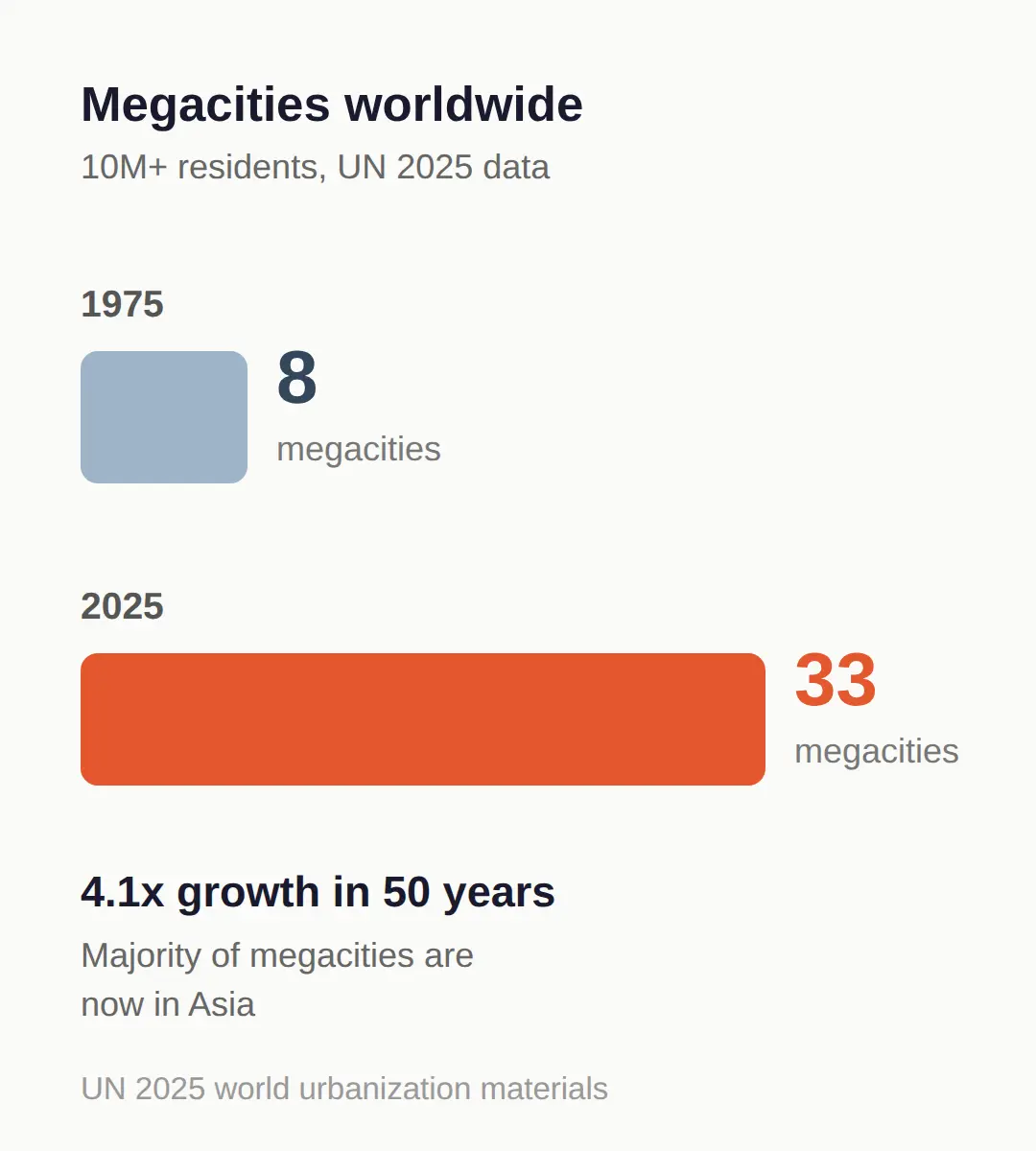
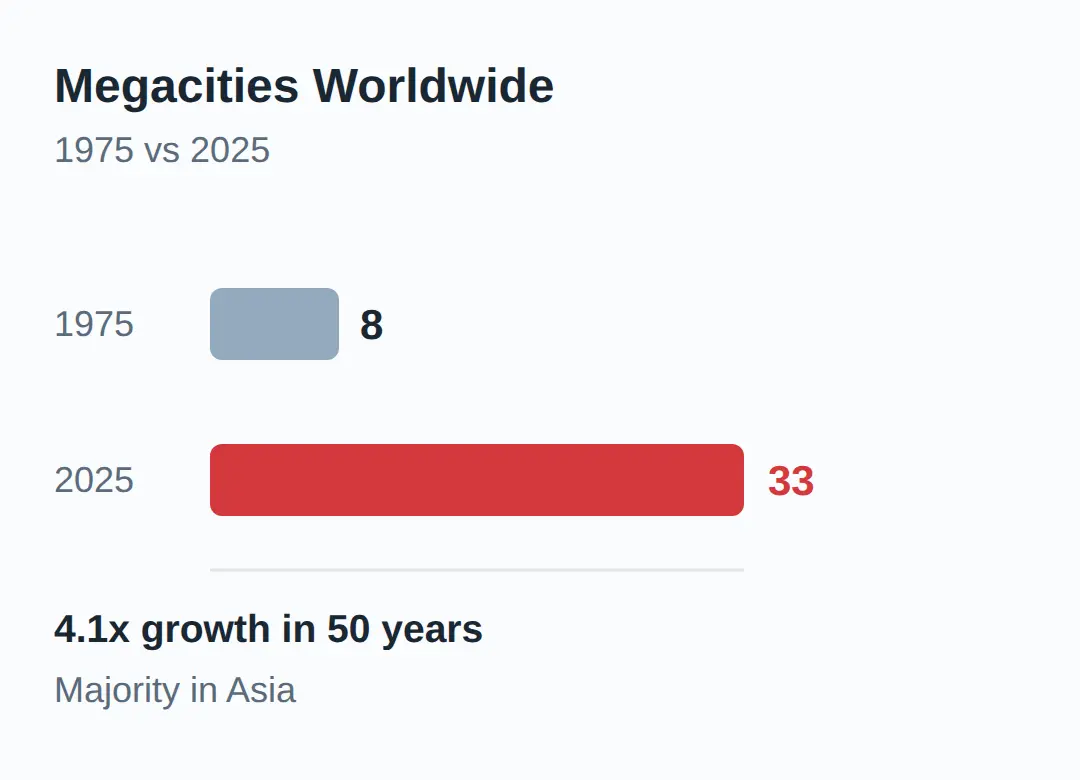
Commonly cited figures count 33 megacities worldwide as of 2025, up from 8 in 1975 (33 ÷ 8 ≈ 4.1x over 50 years).
Asia hosts the majority, including Tokyo, Delhi, Shanghai, Dhaka, Cairo, Sao Paulo, Mexico City and Seoul.
These counts come from secondary reference sources in this run, not from the UN primary page, so the exact list of 33 cities should be re-checked against the UN World Urbanization Prospects before you cite it.
If you need the count for a paper or a post, treat 33 as the working figure and verify it against the primary UN page.
Is Seoul the biggest city in the world?
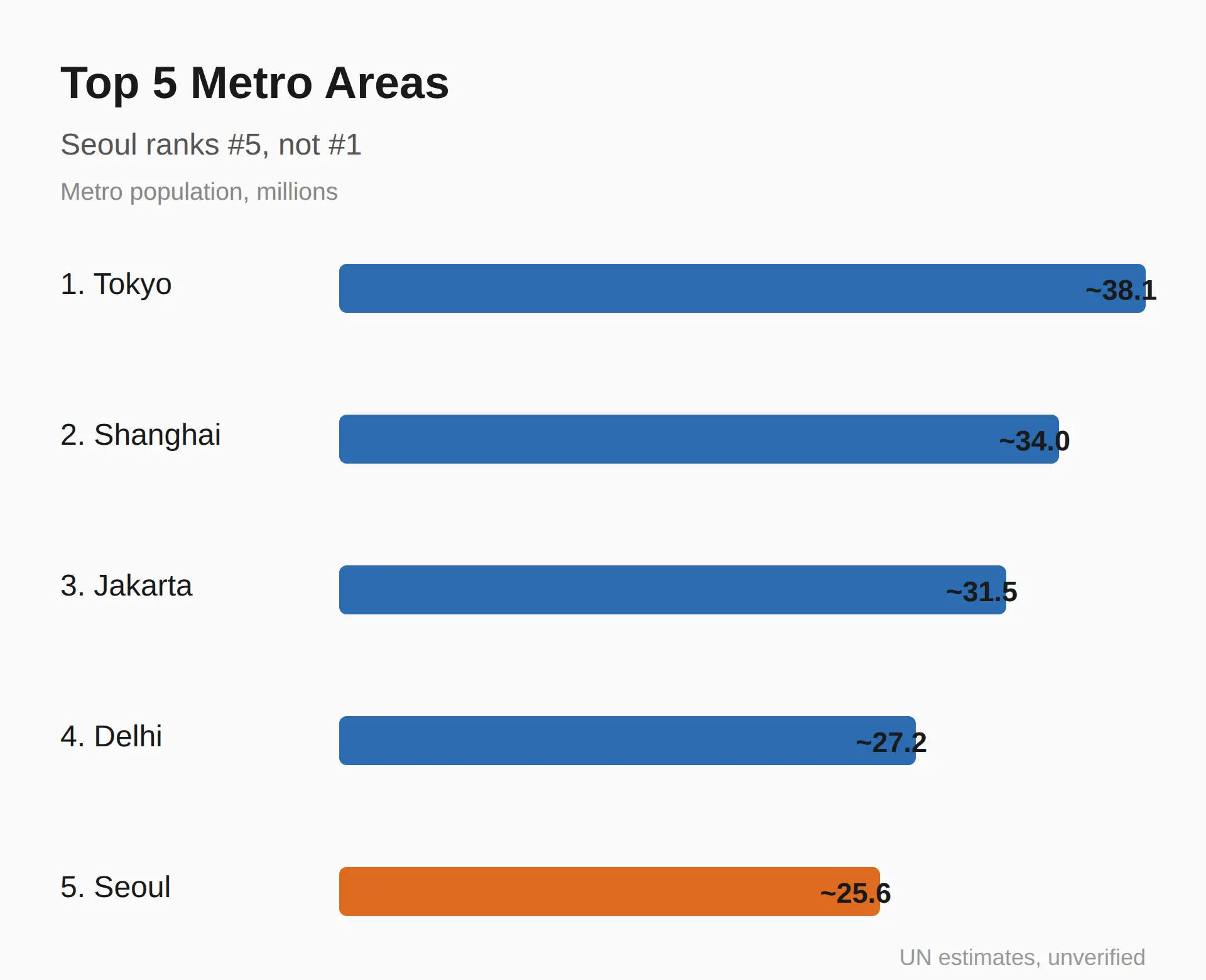
No — by metro population, Tokyo is larger, and Seoul is a top-5 megacity rather than number one.
| Rank | Metro area | Population |
|---|---|---|
| 1 | Tokyo | ~38.1 million |
| 2 | Shanghai | ~34 million |
| 3 | Jakarta | ~31.5 million |
| 4 | Delhi | ~27.2 million |
| 5 | Seoul | ~25.6 million |
These ranking figures were not verified from a primary UN page in this run, so re-check the World Urbanization Prospects data before citing Seoul’s exact rank.
If someone asks whether Seoul is the biggest city in the world, the short answer is no — Tokyo is bigger by metro population, and Seoul ranks among the largest five.
Why does ‘megacity’ mean something different in Korea?
In Korean policy debate, the word megacity is often applied to planned super-wide-area regions — Busan-Ulsan-Gyeongnam, Chungcheong, Daegu-Gyeongbuk, Gwangju-Jeonnam — tied to administrative mergers rather than the 10-million threshold.
The term is also used interchangeably with super-wide-area integration and metropolitan governance discussions, so a Korean article about a ‘megacity’ may not be talking about population at all.
If you read a Korean source about megacities, check whether it means the 10-million urban definition or an administrative integration plan before comparing it with world megacity lists.
If I were writing this for a Korean reader, I would lead with the metro figure — the 26 million living in the functional city is the answer that matches how people actually experience Seoul.
Related posts
📎 Seoul — everything we know
📎 📅 다가오는 일정 — 발매·개봉·발표 캘린더
Sources
- Megacity = 10M+ residents; 8 megacities in 1975 grew to 33 b (nanje.mosaek.kr)
- Existing collected facts: city ~9.3M, metro ~26M; primarySta (hankookilbo.com)
- Seoul provides real-time data for 121 hotspots; 320M API cal (hksisaeconomy.com)
What to remember
- Check the UN World Urbanization Prospects list before quoting Seoul’s exact world rank — the top-5 metro figures vary by source and year
- When comparing Seoul with Tokyo, New York or London, apply the same metro-area definition to every city, or the ranking shifts with the boundary
- If a Korean source says ‘megacity’, check first whether it means the 10-million urban threshold or an administrative integration plan
FAQ
Q. Is Seoul a megacity?
Yes — the Seoul metro area (Sudogwon) holds about 26 million people as of 2025, 2.6x the 10-million megacity threshold. Only the city-proper count (~9.3 million) falls short.
Q. How many megacities are there in the world?
Commonly cited counts list 33 megacities as of 2025, up from 8 in 1975, with the majority in Asia. Re-check the exact list against the UN World Urbanization Prospects before citing it.
Q. Is Seoul the biggest city in the world?
No. By metro population Tokyo is larger (~38.1 million), and widely cited figures place Seoul around 5th worldwide at about 25.6 million — verify the rank against primary UN data before citing it.
Q. What counts as a megacity?
An urban or metropolitan area with 10 million or more residents — the measure covers the actual urbanized and commuting zone, not a single administrative district.
Q. Why do population numbers differ for Seoul?
Because three boundaries are in play: the administrative city (~9.3 million), the wider urban area, and the three-jurisdiction metro region (~26 million across Seoul, Gyeonggi Province and Incheon).
If you are comparing Seoul with Tokyo, New York or London, use the metro-area figures for all of them — the same boundary on every city is what makes the comparison fair.
Cover photo: Seoul Children’s Grand Park (서울어린이대공원) by Korea Tourism Organization — KOGL Type 1 (attribution)
#isseoulamegacity #seoulpopulation #sudogwon #megacitydefinition #seoulmetroarea #largestcitiesintheworld
📅Upcoming Dates — 이번 주 32 · D-day Chuseok holiday period — rice cake interest peaks전체 보기 →