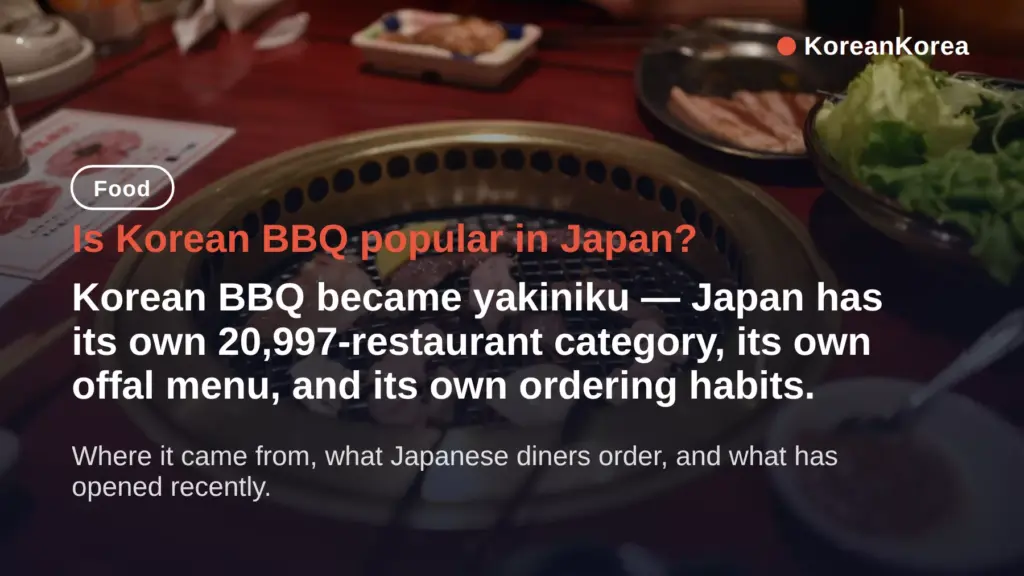
Yes — Korean BBQ is popular in Japan, where it is known as yakiniku and counted at 20,997 restaurants in Japan’s 2004 food-service statistics.
That means when you grill meat at the table in Japan, you are ordering from a Korean-origin category with its own menu habits, not a copy of a Seoul BBQ restaurant.
This post covers where yakiniku came from, what Japanese diners order differently, and which Korean chains have opened in Japan recently.
Contents
- Is Korean BBQ popular in Japan? The menu tells the story
- Where did yakiniku come from?
- What do Japanese diners order differently at yakiniku?
- How do you tell a Japanese yakiniku place from a Korean BBQ restaurant?
- Is Korean food growing in Japan beyond BBQ?
Is Korean BBQ popular in Japan? The menu tells the story
Yes.
Yakiniku — the Japanese word for Korean-style tabletop grilling — is a Korean-origin, Japan-developed restaurant category, and Japan’s 2004 food-service statistics counted 20,997 yakiniku restaurants across the country.
Those restaurants are classified under "Oriental cuisine," separate from Western steakhouses, so they are tracked as their own category in government statistics.
Japan’s food industry also treats it as a category with its own supply chain: Ebara launched a bottled yakiniku sauce in 1968, which let households cook bulgogi-style meat at home.
In Japan today, the word yakiniku almost always means Korean-style tabletop BBQ, not generic "grilled meat."
When I judge whether a food is popular somewhere, I look at what people actually order there, not at the marketing — and yakiniku passes that test on its menu, not on its slogans.
| Menu element | Korean BBQ | Japanese yakiniku |
|---|---|---|
| Offal (horumon): reba, mino, shibire | Rarely on the menu | Standard menu category |
| Sauce | Marinade (Gwangyang-style bulgogi lineage) | Commercialized as ‘tare’ — Ebara bottled it in 1968 |
| Meat split | Seiboku (lean-meat) style | Offal and lean-meat merged into one restaurant form |
| Government classification | — | "Oriental cuisine," separate from Western steakhouses |
| Restaurant count (2004) | — | 20,997 nationwide |
If you sit down at one, the ordering habits described below are the proof, and no reliable restaurant count within the last six months was found — the 20,997 figure above dates from 2004 statistics.
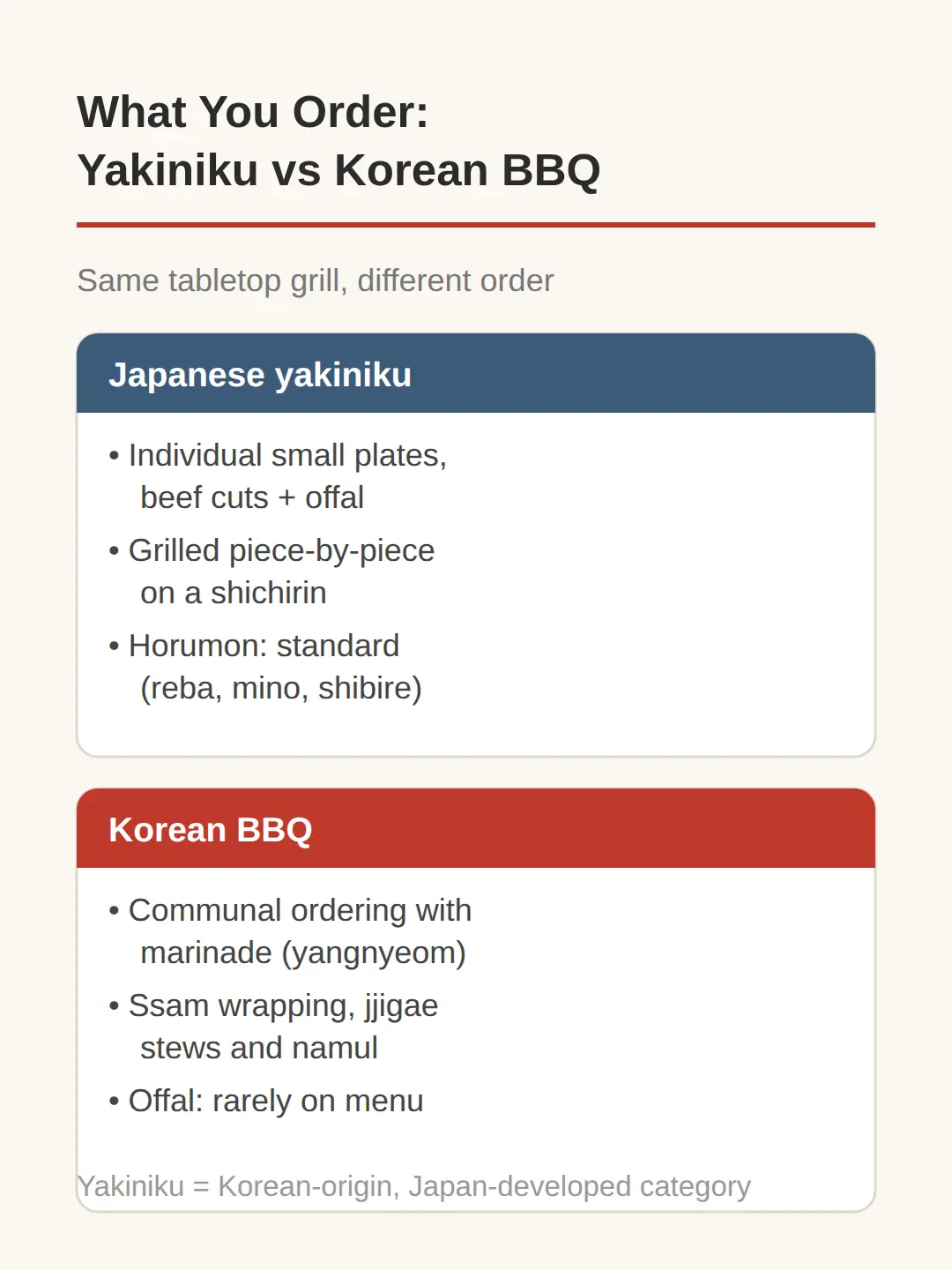
| Ordering | Small individual plates, grilled piece by piece at the table |
|---|---|
| Offal | Horumon (reba, mino, shibire) is a standard menu category |
| Seasoning | Diners commonly order both shio (salt) and tare sauce |
| Meal structure | Beef and offal are the center of the table |
| Korean BBQ | More communal ordering with marinade (yangnyeom), ssam wrapping, jjigae stews and namul |
| Offal | Rarely on the menu |
| Seasoning | Leans on marinade and ssam |
Where did yakiniku come from?
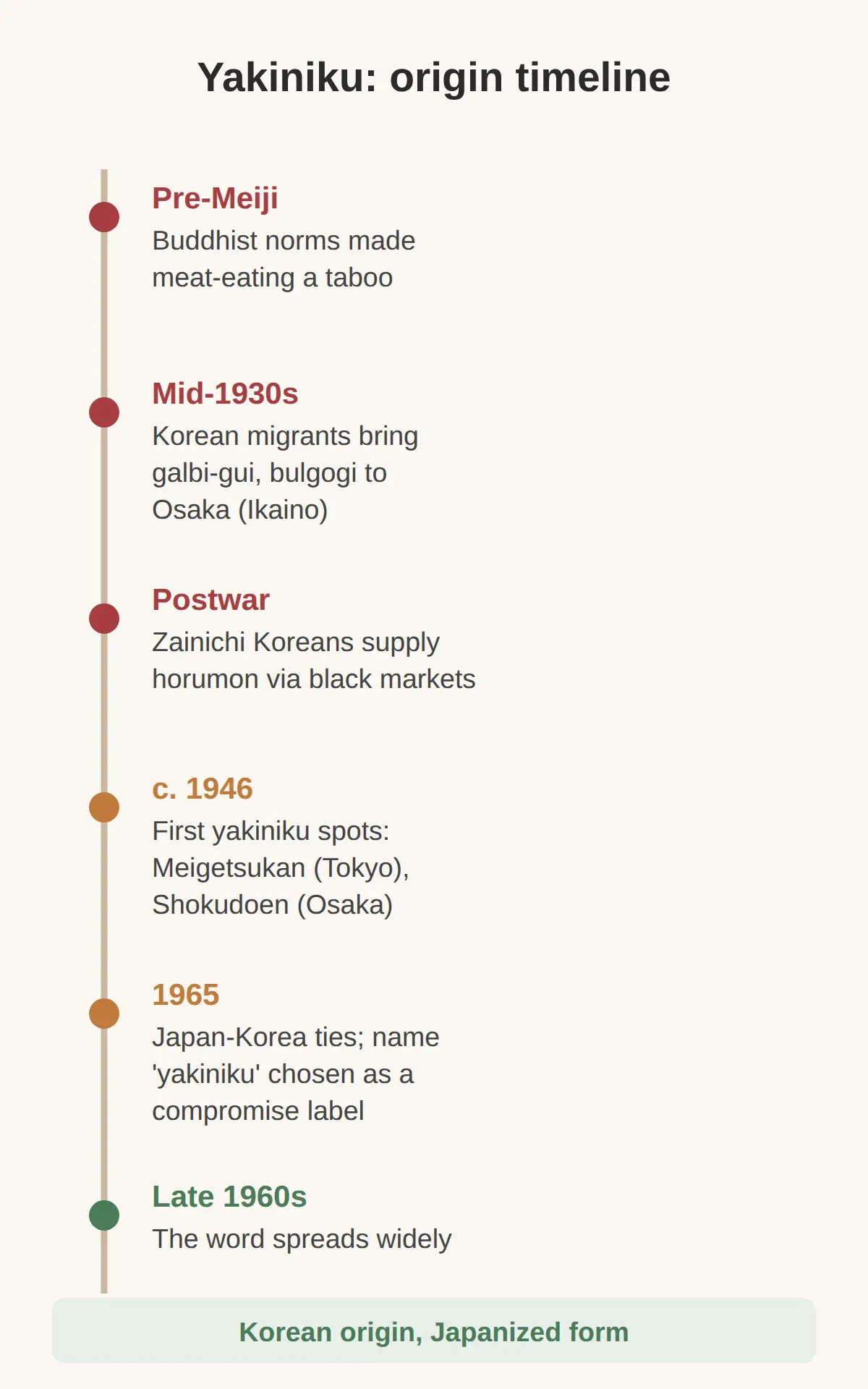
Yakiniku came from Korean grilled-meat culture — galbi-gui and bulgogi — carried to Japan by Korean migrants, with the modern restaurant form fixed in postwar Osaka and Tokyo.
The timeline runs like this:
- Before the Meiji era, Buddhist food culture made eating four-legged animals widely taboo in Japan.
- In the mid-1930s, migrants from southern Korea brought galbi-gui and bulgogi to Osaka’s Ikaino, and existing Korean restaurants converted into proto-yakiniku eateries.
- After the war, Zainichi Koreans supplied horumon (offal) through black markets — the established theory credits this for the sector’s founding.
- Around 1946, Japan’s first dedicated yakiniku restaurants opened: Meigetsukan in Tokyo and Shokudoen in Osaka.
- In 1965, after Japan–Korea normalization, the name yakiniku emerged as a compromise between the politically contested labels "Chosen ryori" and "Kankoku ryori" — and the word spread widely only in the late 1960s.
Japan acknowledges the Korean origin but treats yakiniku as a Japanized practice, so in Japan you are eating a Korean descendant that grew in a different direction.
If you want the original lineage, the Korean analogues are bulgogi and galbi-gui.
What do Japanese diners order differently at yakiniku?
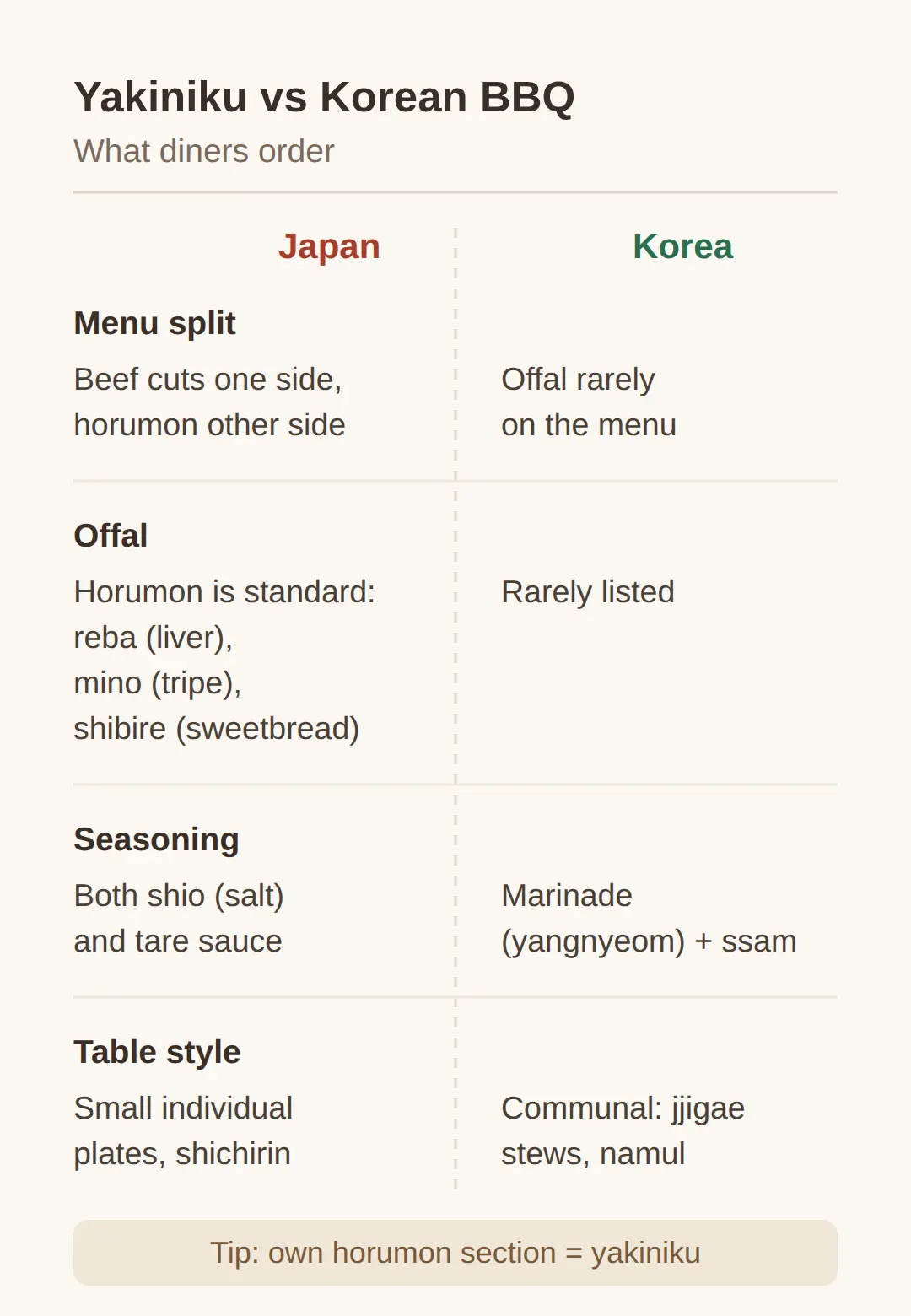
The signature difference is horumon — offal such as reba (liver), mino (tripe) and shibire (sweetbread) — which Japanese yakiniku menus carry as a separate category but Korean BBQ menus rarely list.
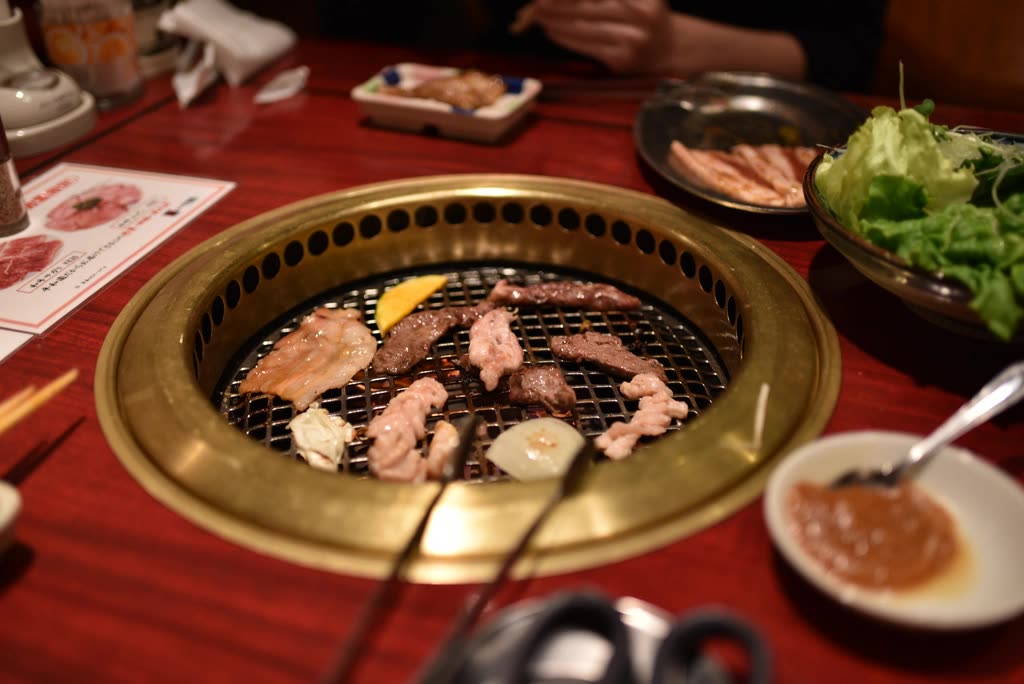
Japanese restaurants commonly split the menu into beef cuts on one side and horumon on the other, grilled piece by piece on a small tabletop grill called a shichirin.
Seasoning splits too: diners commonly order both shio (salt) and tare (sauce), while Korean BBQ leans more on marinade — yangnyeom — plus ssam wrapping.
No recent survey confirms which seasoning is more popular in Japan today, so treat the shio-plus-tare habit as a structural difference, not a popularity ranking.
The meal structure is the third difference: a Korean BBQ table usually adds jjigae stews, namul and shared orders, while a Japanese yakiniku table centers on small individual plates of beef and offal.
If I were guiding someone, I would say to check the menu split first — if horumon has its own section apart from beef cuts, you are in a Japanese yakiniku place, not a Korean BBQ restaurant.
How do you tell a Japanese yakiniku place from a Korean BBQ restaurant?
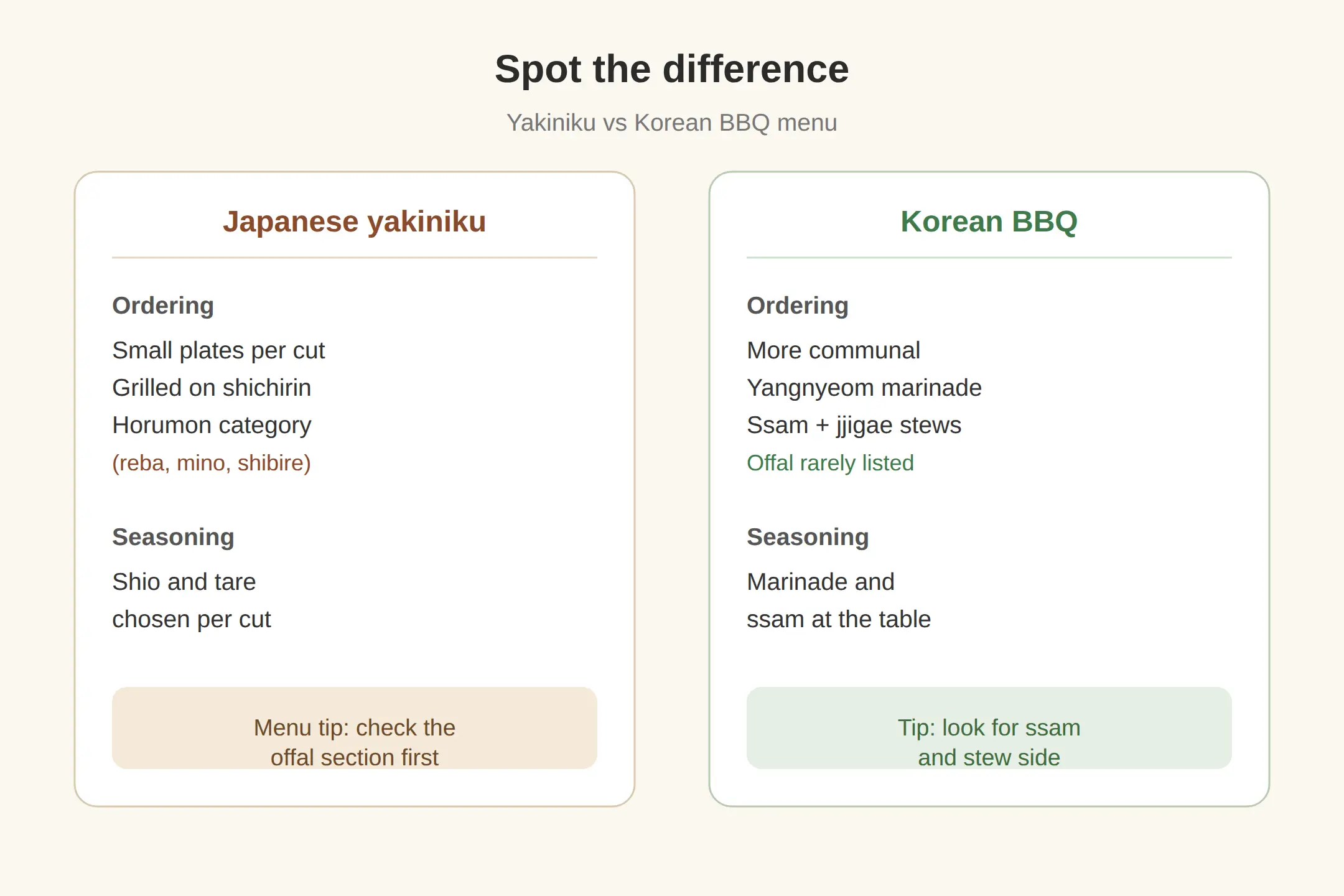
Check three things on the menu before you order: the offal section, the seasoning columns, and what comes with the meat.
A horumon section with items named reba, mino and shibire points to the Japanese style, and so does a menu that asks you to choose shio or tare per cut.
Marinated meat (yangnyeom), ssam vegetables and a stew on the table point to the Korean style.
If you want the Korean-style experience in Japan, the newer Korean chains listed below are the closer option — if you want to taste the Japanese variation, pick a place whose menu clearly separates horumon.
Is Korean food growing in Japan beyond BBQ?
Yes — Korean chains have been opening stores in Japan on a steady schedule, which gives the demand a concrete shape.
The openings to note:
- December 19, 2024: Obongjip, a Korean home-cooking chain with 300 stores in Korea, opened its first Japan store at JR Kanda Station’s north exit in Tokyo, holding a 4.5 Google review score.
- October 31, 2025: Obongjip opened its second Japan store in Kasai, Edogawa-ku — about 10.5 months after the first — with signature dishes nakji-bokkeum (stir-fried octopus) and bossam, plus somaek (beer with soju) on the drinks list.
- 2025: Mom’s Touch opened its first Japan direct store in Shibuya, Tokyo, at the site where a McDonald’s had operated for 39 years, and 13,000 advance-reservation seats sold out within two weeks.
- October 2024: Nongshim’s Shin Ramyun popup in Harajuku drew 11,328 visitors in 9 days — over 90% local Japanese, 80% women in their 20s–30s — and Nongshim’s own survey put Shin Ramyun brand awareness in Japan at about 63%.
The pattern across these openings is repeat demand, not a one-off: a second store ten and a half months after the first, and a burger chain selling out reservations at a flagship location.
If you are planning a Korean food stop in Tokyo, the Kanda store sits right at the station exit, which makes it the easiest one to add to a route.
Related posts
Sources
- Yakiniku definition, Zainichi Korean origins, first restaura (ko.wikipedia.org)
- Related anchor question demand (reddit.com)
- Obongjip Japan 2nd store opened 2025-10-31 in Kasai, Edogawa (the-selection.jp)
The one-line difference
- Yakiniku is Korean BBQ that grew in Japan: same tabletop grill, different menu split.
- Horumon (offal) is the clearest marker — in Japan it is a standard category, in Korea it is rare on BBQ menus.
- Before you book, check the restaurant’s course prices on its official site: exact per-plate and all-you-can-eat prices could not be verified from primary sources, so treat listed figures as indicative.
- Check the menu split first: a separate horumon section means a Japanese yakiniku place.
FAQ
Q. Is Korean BBQ popular in Japan?
Yes — it is known as yakiniku, a Korean-origin category counted at 20,997 restaurants in Japan’s 2004 statistics, with its own bottled-sauce market since Ebara’s 1968 launch.
Q. Where did yakiniku originate?
It descends from Korean galbi-gui and bulgogi, brought to Osaka by Korean migrants in the mid-1930s; Japan’s first dedicated yakiniku restaurants opened around 1946 by Zainichi Koreans.
Q. What do Japanese diners order differently at yakiniku?
They order horumon (offal) as a separate menu category, request both shio (salt) and tare (sauce), and eat small individual plates instead of communal sharing with ssam and jjigae.
Q. Is Korean food in Japan good?
The demand signal is strong — Obongjip’s Kanda store holds a 4.5 Google review score, and Mom’s Touch sold out 13,000 advance-reservation seats in Shibuya — though taste judgments are yours to make.
Q. What is the difference between yakiniku and Korean BBQ?
Menu structure: yakiniku splits beef and horumon with per-cut seasoning choices; Korean BBQ is more communal, with marinade, ssam wrapping, jjigae stews and namul on the table.
Pin the two dates if you are headed to Tokyo: Obongjip Kasai opened October 31, 2025, and the Kanda store remains the first stop for the chain in Japan.
Cover photo: Korean BBQ, food image — CC0 1.0
#koreanbbq #yakiniku #koreanfoodinjapan #horumon #koreanchainsinjapan
📅Upcoming Dates — 이번 주 32 · D-day Chuseok holiday period — rice cake interest peaks전체 보기 →