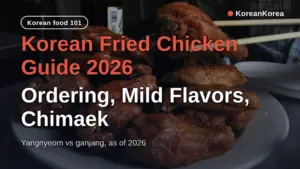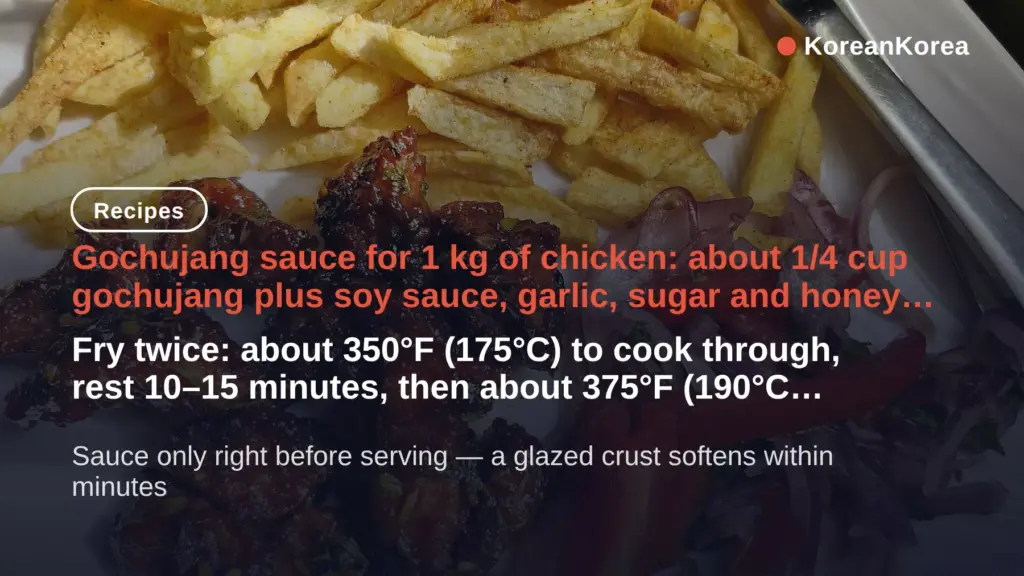
Classic Korean fried chicken is fried twice: first at 160-170°C for 10-20 minutes to cook the meat through, then at 180°C or higher for a short time to crisp the coating — with cornstarch as the usual potato starch substitute.
That means a home pot, a bag of starch, and two rounds of frying can get you the crispy-outside, tender-inside texture instead of a single greasy fry.
This post covers the fry temperatures and timings, the batter ratio, the soy-garlic and spicy gochujang sauces, prep before frying, common mistakes, and how the variants fit together.
Korean Fried Chicken Recipe Maangchi Style: Double-Fry Temperatures
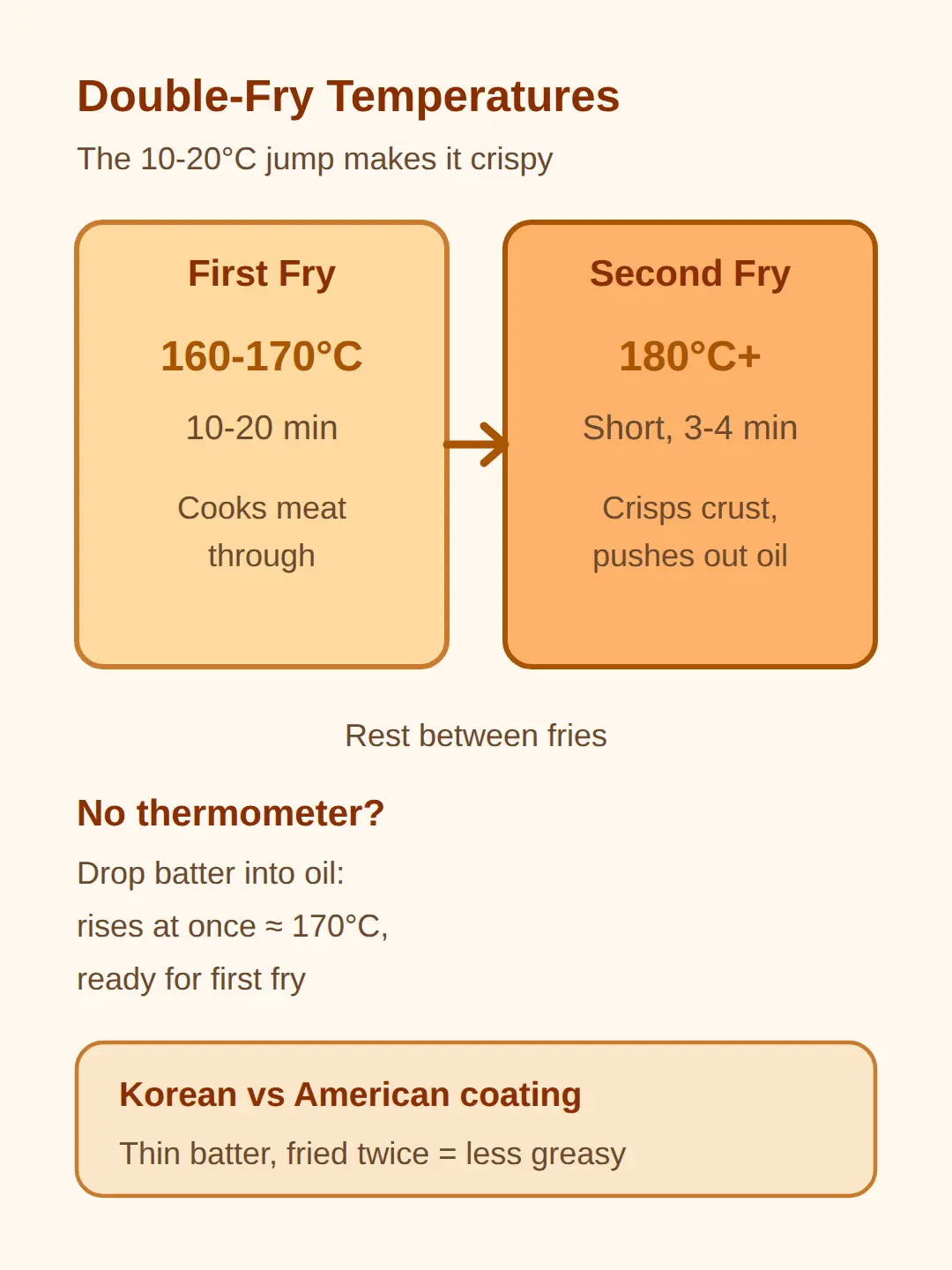
| First fry | 160-170°C, 10-20 minutes — cooks the meat through |
|---|---|
| Rest between fries | 5 minutes (whole-bird example) or 3 minutes (piece example) — lets absorbed oil escape |
| Second fry | 180°C or higher, 3-4 minutes (10 minutes in the whole-bird example) — crisps the coating, pushes out oil |
| Temperature jump between stages | At least 10-20°C |
| No thermometer | Drop a little batter into the oil — if it rises immediately to the surface, the oil is roughly 170°C |
First fry 160-170°C for 10-20 minutes, rest, then second fry at 180°C or higher until crisp — the temperature gap between the two stages is at least 10-20°C.
The second fry at higher heat is what gives the Korean result: crispy outside, tender inside, with less oil left in the crust.
For one whole bird, one home recipe runs 20 minutes at 160°C breast-side down, 5 minutes rest, then 10 minutes at 170°C.
For cut pieces, a shorter example works: 7-8 minutes at 170°C, 3 minutes rest, then 3-4 minutes at 180°C until golden, draining on a rack.
If you have no thermometer, drop a little batter into the oil — if it rises immediately to the surface, the oil is roughly 170°C and ready for the first fry.
The first thing I check before starting this recipe is the thermometer situation, because the whole method hinges on that 10-20°C jump between the two stages — a batter-drop test keeps it doable in any kitchen.
What Is the Batter Ratio? Starch and Frying Mix
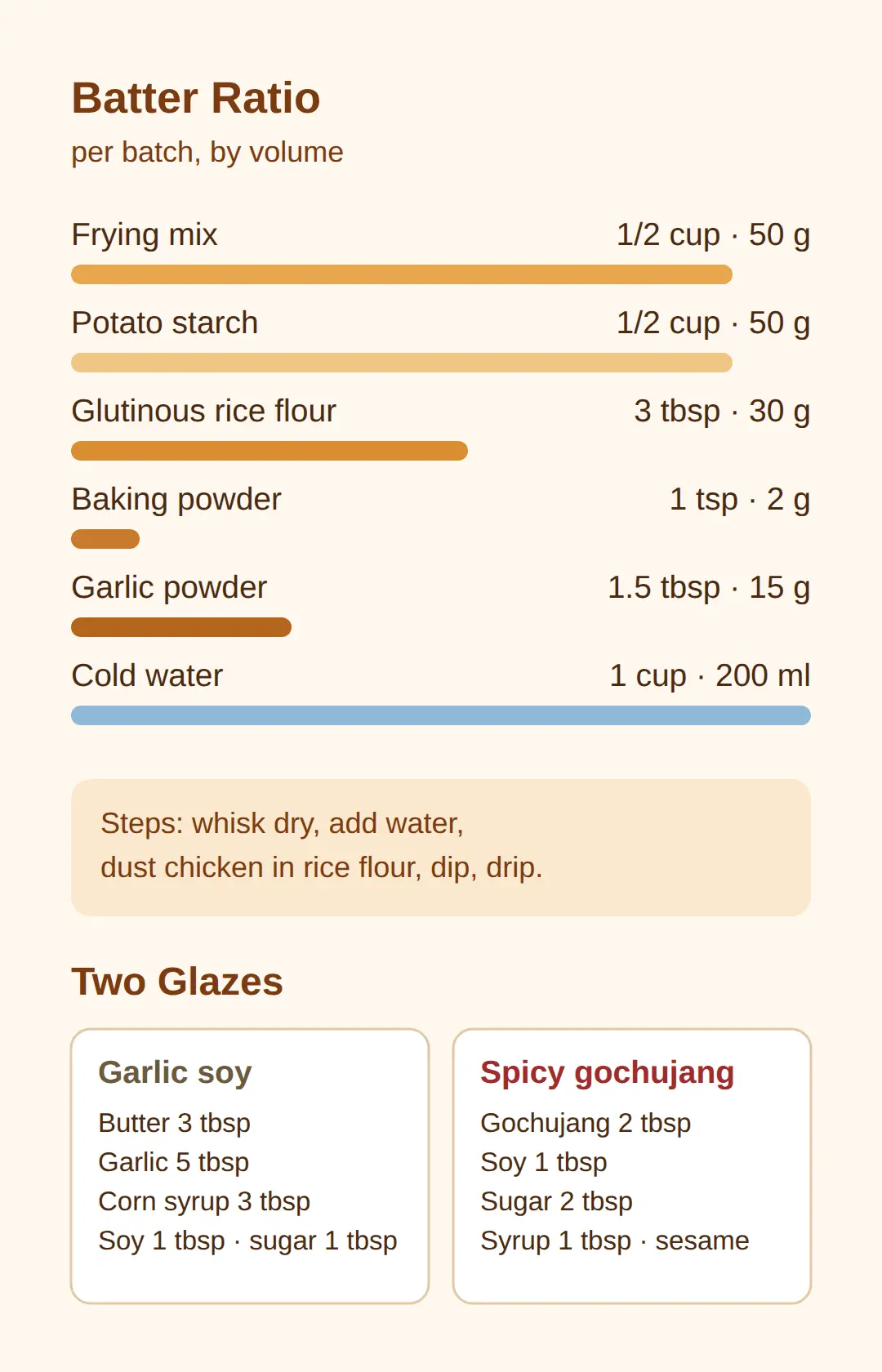
The home batter is frying mix 1/2 cup (50 g), potato starch 1/2 cup (50 g), dry glutinous rice flour 3 tbsp (30 g), baking powder 1 tsp (2 g), garlic powder 1.5 tbsp (15 g), and water 1 cup (200 ml).
Korean frying batters typically combine frying flour with potato starch, glutinous rice flour, and a little baking powder, which is what keeps the coating thin instead of thick and breaded.
- Whisk the dry ingredients: frying mix, potato starch, glutinous rice flour, baking powder, garlic powder.
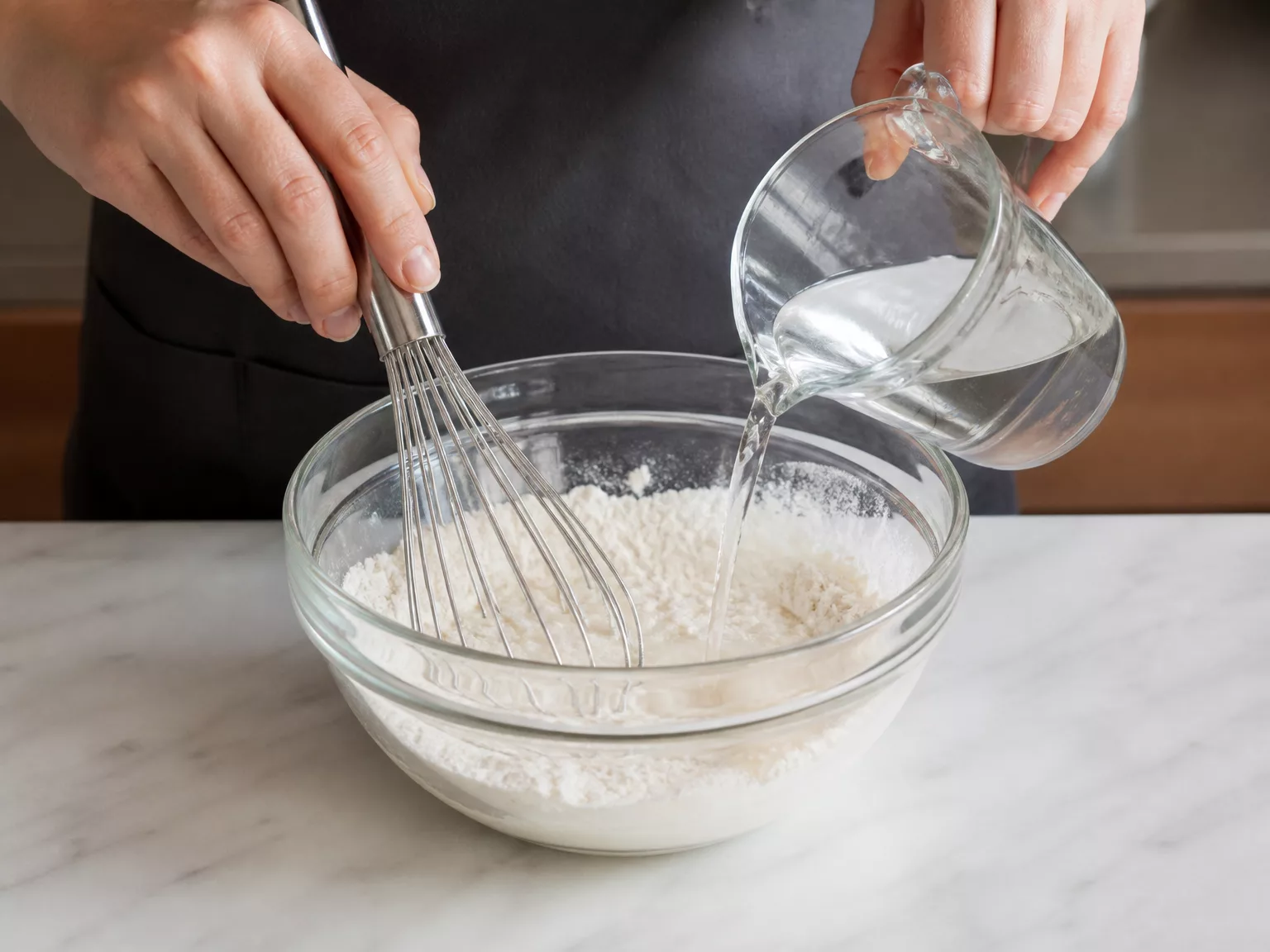
- Add 1 cup (200 ml) cold water and mix to a thin batter.
- Before dipping, dust the chicken with dry glutinous rice flour so the wet coating adheres.
- Dip the dusted chicken in the batter and let excess drip off before frying.
If you cannot get potato starch where you live, cornstarch is the common substitute in Korean frying batters — the exact 1:1 swap is not confirmed from a primary source, so treat the first batch as a test.
If I cannot find potato starch, I use cornstarch and fry by the batter-drop test rather than guessing at temperature.
Steps at a glance
-
1Whisk the dry ingredients: frying mix, potato starch, glutinous rice…
-
 AI-generated photo
What it should look like — AI-generated image of this step, made from the recipe text — not a photo of our kitchen. 2Add 1 cup (200 ml) cold water and mix to a thin batter. -
3Before dipping, dust the chicken with dry glutinous rice flour so the…
-
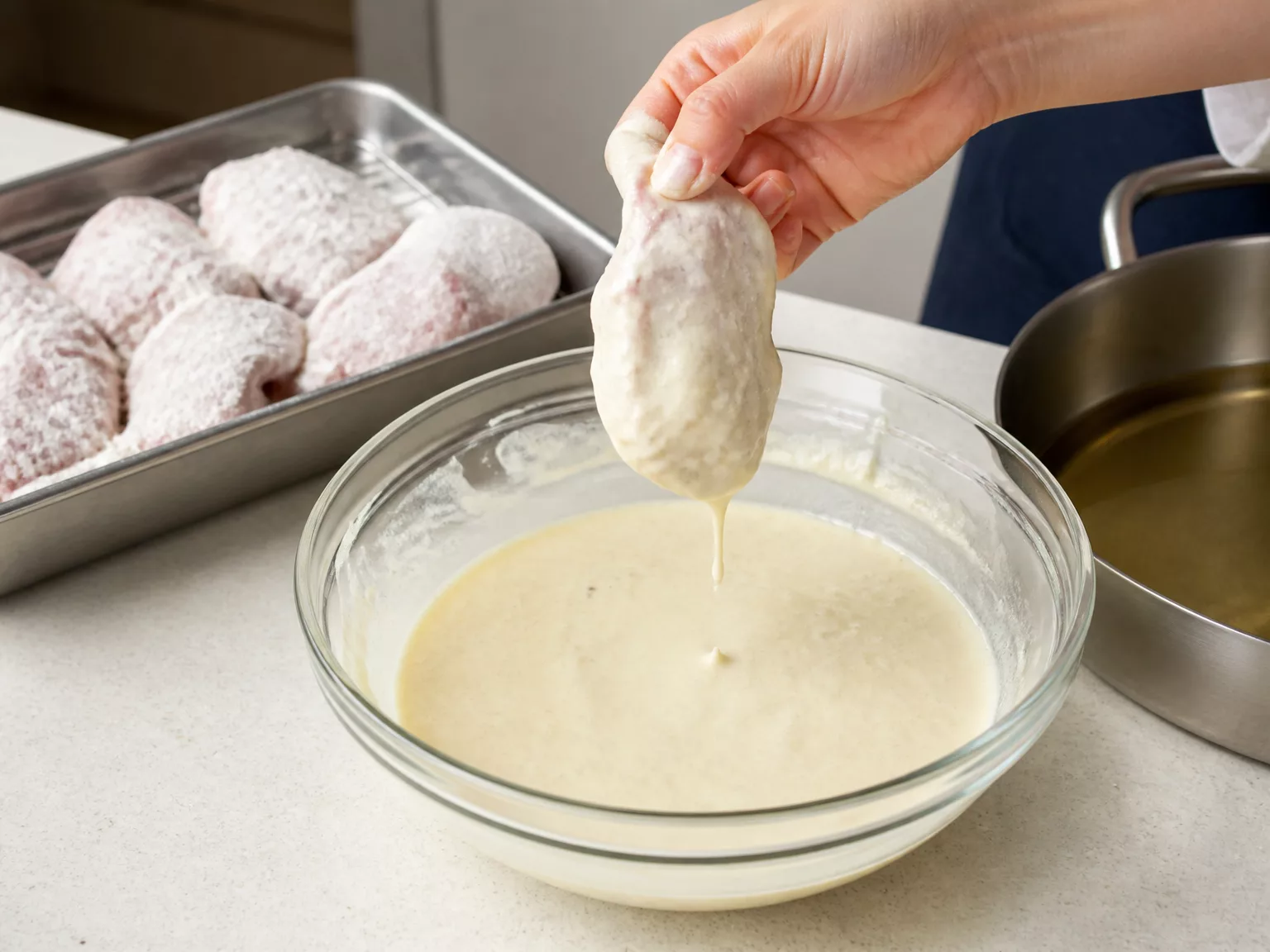 AI-generated photo
What it should look like — AI-generated image of this step, made from the recipe text — not a photo of our kitchen. 4Dip the dusted chicken in the batter and let excess drip off before…
What Are the Sauce Ratios? Soy-Garlic vs Spicy Gochujang
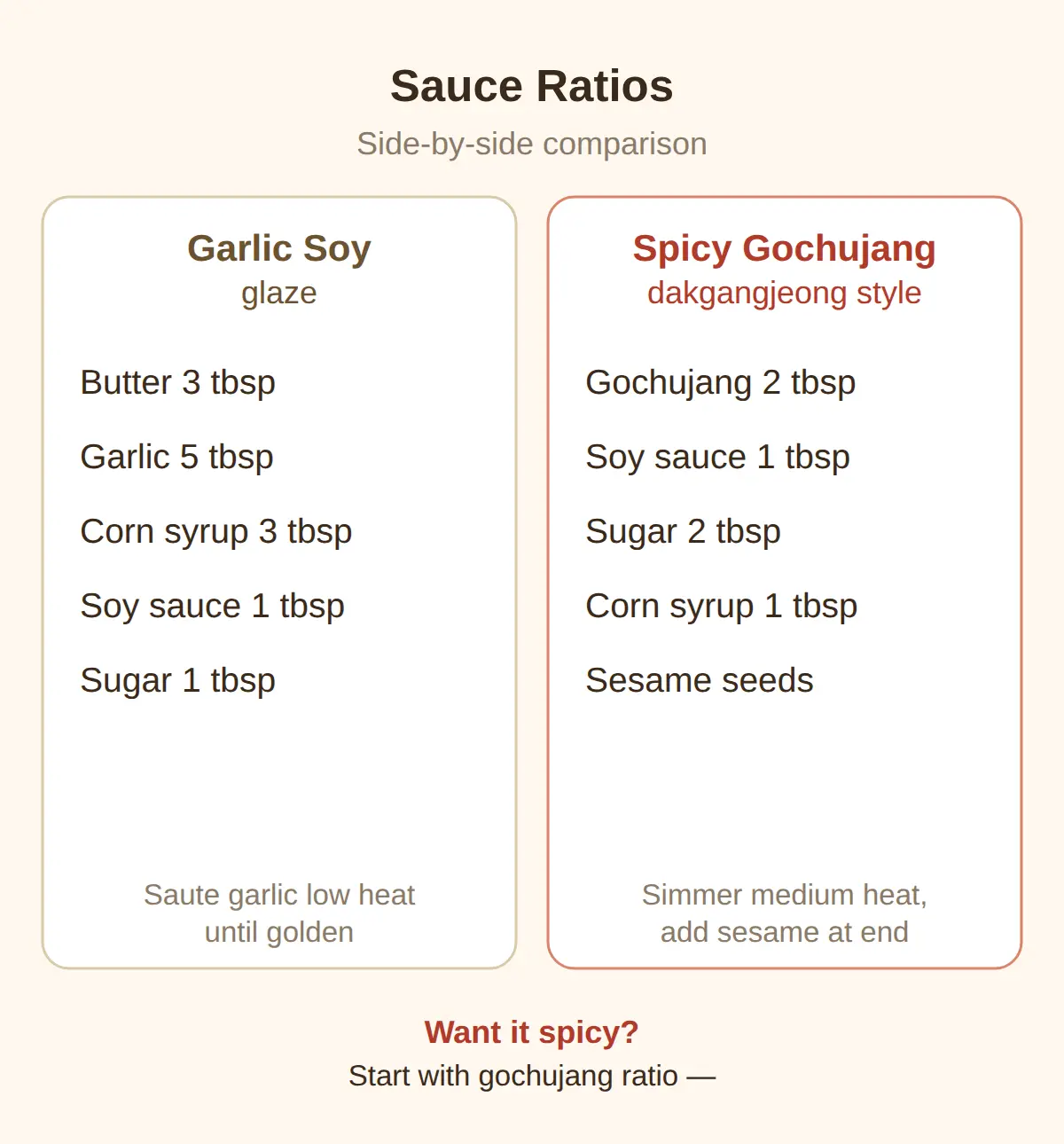
Two sauce families cover most Korean fried chicken orders: garlic soy glaze and spicy gochujang glaze.
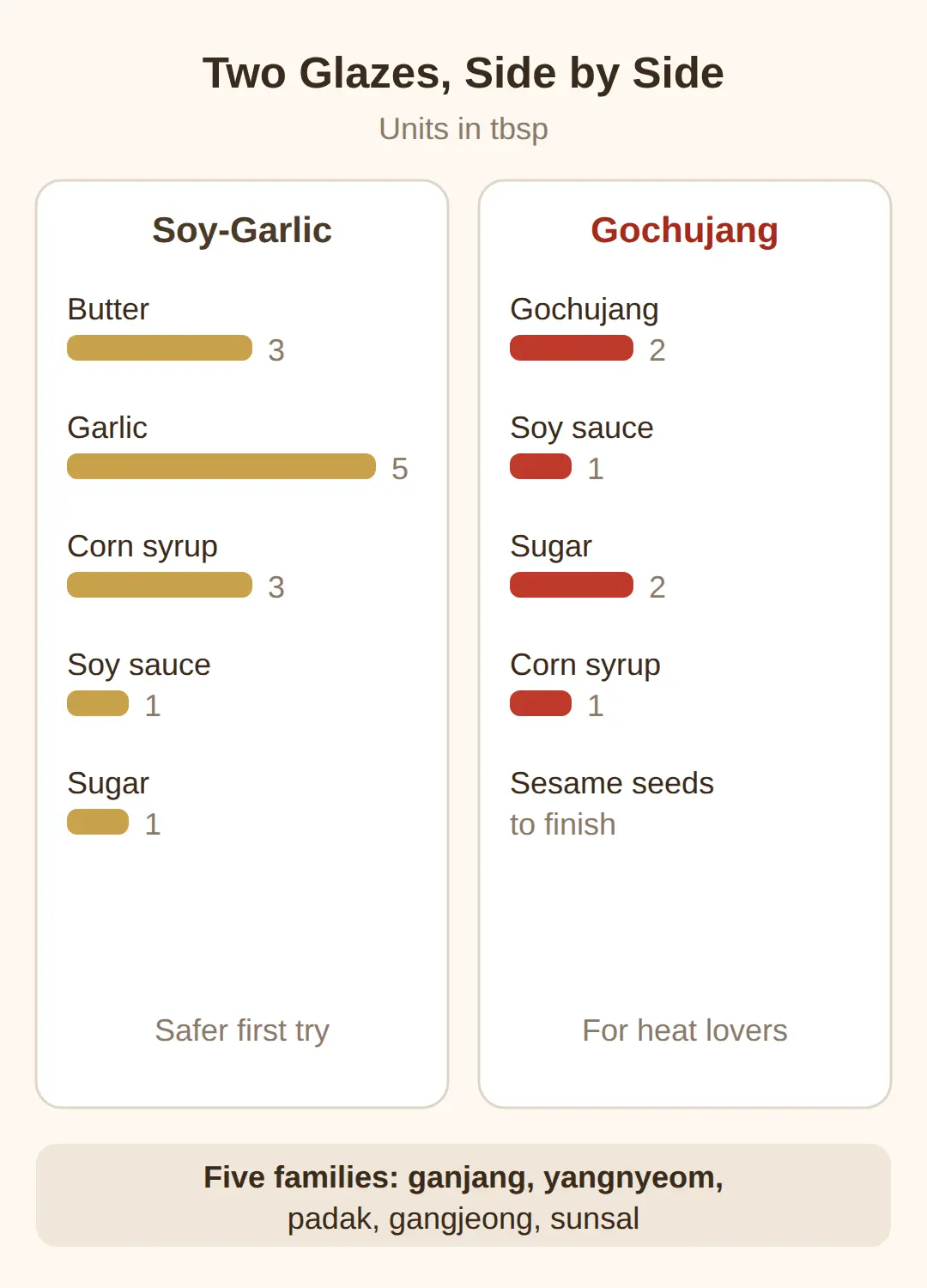
The garlic soy glaze: butter 3 tbsp melted, minced garlic 5 tbsp sautéed over low heat until golden, corn or rice syrup 3 tbsp, soy sauce 1 tbsp, sugar 1 tbsp.
The dakgangjeong-style spicy gochujang glaze: gochujang 2 tbsp, soy sauce 1 tbsp, sugar 2 tbsp, corn syrup 1 tbsp, simmered over medium heat and finished with sesame seeds.
In both cases the glaze is cooked in a pan first, and the fried chicken is tossed in it while still hot from the second fry.
Corn syrup or rice syrup is the standard sweetener in these glazes; corn syrup is the usual stand-in abroad, though exact substitution wording for the published recipe is not confirmed.
If you want the whole bird spicy, start with the gochujang ratio — it is easier to add heat than to remove it.
How Do You Prep, Soak and Season Before Frying?
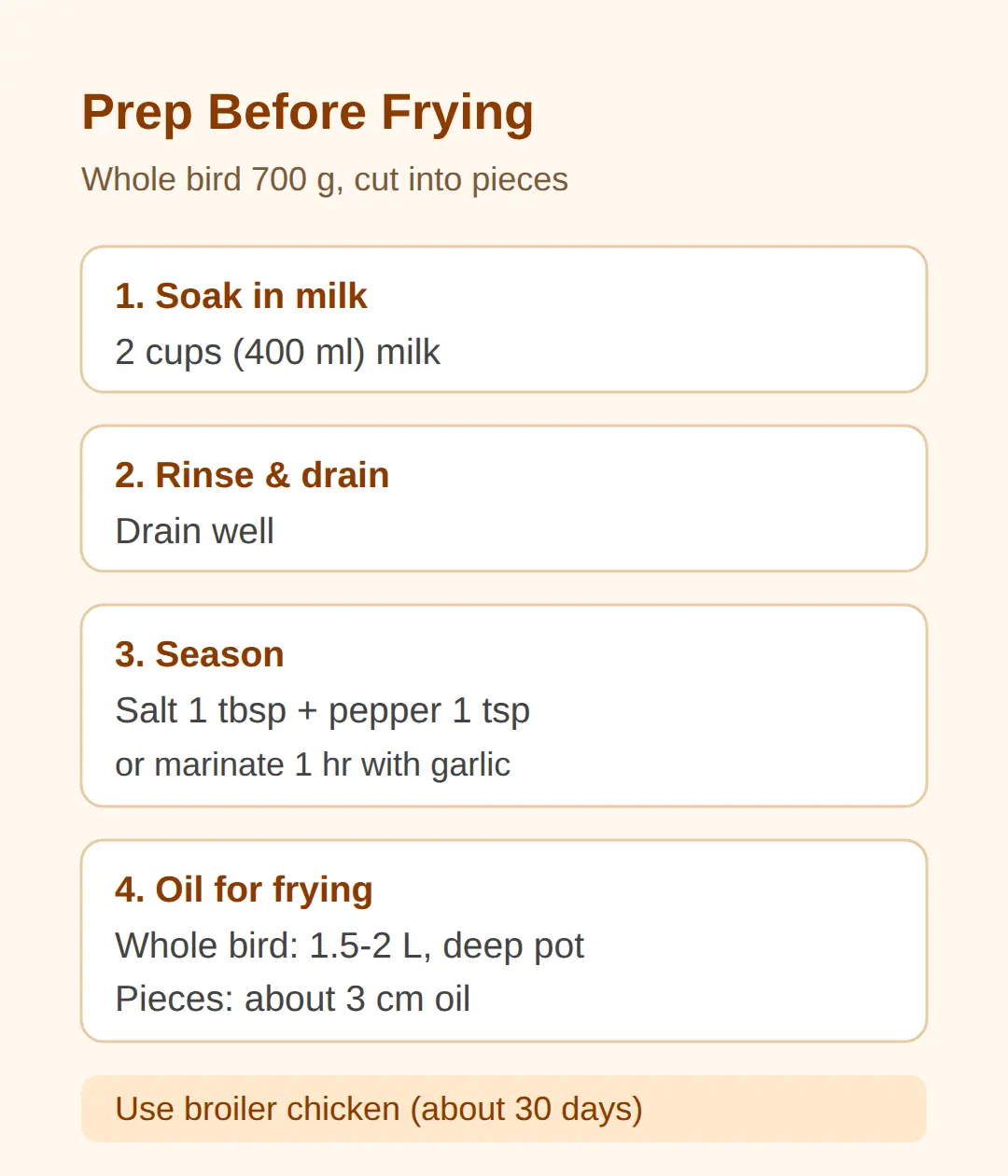
Soak the chicken in milk first, then season, then fry — and cut the bird into pieces, because a whole chicken fries unevenly by part (leg, breast, neck).
- Soak 1 chicken (700 g) in 2 cups (400 ml) milk to remove the smell.
- Rinse and drain well.
- Season with salt 1 tbsp + ground pepper 1 tsp per whole chicken — or marinate 1 hour with salt, pepper, cheongju (rice wine) and minced garlic.
- Fry in 1.5-2 L of oil in a deep pot for a whole bird, or about 3 cm of oil in a smaller pot for pieces.
Use broiler chicken — the standard for Korean fried chicken, raised about 30 days.
Laying hens or native (Korean free-range) chicken give tough meat.
Common Mistakes, Calories and Storage
Three mistakes ruin home Korean fried chicken: sugar in the batter, skipping the rest, and the wrong bird.
Sugar in the batter or coating burns black during the second fry and ruins the appearance — sweetness belongs in the sauce only.
Skipping the rest between fries traps the absorbed oil inside, so the chicken comes out greasy instead of crisp.
Calories: fried chicken runs about 289 kcal per 100 g, roughly 1,700-1,800 kcal for a whole bird, and a sweet-and-sour glaze adds roughly another 1,000 kcal.
Leftovers keep best without sauce — store the fried pieces in the fridge and reheat in a 180°C oven or air fryer for a few minutes, then toss with freshly warmed sauce.
What Are the Variations? Yangnyeom, Soy-Garlic, Air Fryer
Five variant families cover nearly every menu: ganjang (soy), yangnyeom (spicy), padak (green onion), gangjeong (sweet-glazed) and sunsal (boneless).
The blog already covers an air-fryer fried chicken recipe, a gochujang version and a soy-garlic version — this post is the base method those build on.
In Korea the standard side is chicken-mu (pickled radish), and chicken with beer is called chimaek.
For one longer-listed baked yangnyeom variant: cheongyang pepper 2, jjajang powder 2.5 tbsp, soy sauce 3 tbsp, gochujang 2 tbsp, corn syrup 6 tbsp, ketchup 3 tbsp, chili oil 2 tbsp, sesame oil 1 tbsp, simmered to thicken.
If a first-timer wants one sauce only, the soy-garlic glaze is the safer start; gochujang glaze suits readers who already know they like heat.
If I cannot get potato starch, I would use cornstarch and accept it as a workable substitute, since cornstarch is the common stand-in for Korean frying batters anyway.
I would not substitute anything for the syrup in the glaze, because corn syrup or rice syrup is what keeps the coating glossy instead of sticky.
The original English reference for the base recipe is Maangchi’s easy Korean fried chicken page.
Related posts
📎 📅 Upcoming Dates — Release & Event Calendar
Sources
- Korean Wikipedia: double-fry rationale, 160-190C oil range, (ko.wikipedia.org)
- Gochujang 2 : soy 1 : sugar 2 : syrup 1; soy-garlic: butter (cookpick.kr)
- Garlic sauce ratio butter 3 / garlic 5 / oligodang 3 tbsp; 1 (cookpick.kr)
Summary
- Double fry is the method: 160-170°C first, 180°C+ second, with at least a 10-20°C jump and a rest in between.
- Batter ratio: frying mix 50 g, potato starch 50 g, glutinous rice flour 30 g, baking powder 2 g, garlic powder 15 g, water 200 ml — dust in dry rice flour first.
- No sugar in the batter; all sweetness goes in the sauce.
- Soak in 400 ml milk per 700 g chicken, then season before frying.
- Sauce is cooked in a pan and tossed with the chicken while hot.
FAQ
Q. What oil temperature does Maangchi-Style Korean fried chicken double-fry at?
First fry at 160-170°C for 10-20 minutes to cook the meat through, then 180°C or higher for a short time (3-4 minutes for pieces) to crisp the coating.
Q. Can I substitute potato starch with cornstarch in Korean fried chicken?
Cornstarch is the common substitute for potato starch in Korean frying batters, but an exact 1:1 ratio is not confirmed from a primary source, so check the first batch’s texture.
Q. What is the gochujang sauce ratio for dakgangjeong?
Gochujang 2 tbsp, soy sauce 1 tbsp, sugar 2 tbsp, corn syrup 1 tbsp — simmer over medium heat and finish with sesame seeds.
Q. How do I check oil temperature without a thermometer?
Drop a little batter into the oil — if it rises immediately to the surface, the oil is roughly 170°C, suitable for the first fry.
Q. Why does sugar in the batter ruin Korean fried chicken?
Sugar burns black during the second fry at 180°C or higher, so sweetener belongs in the sauce, not the coating.
This post is the base method — the blog’s air-fryer, gochujang and soy-garlic chicken posts are the variations on top of it.
Cover photo: Fried Chicken (Unsplash) by Brian Chan tigerrulezzz — CC0 1.0
#koreanfriedchicken #maangchirecipe #doublefry #potatostarchsubstitute #gochujangsauce #dakgangjeong
📅Upcoming Schedule — this week 23 · D-1 Autumn season = post-summer brightening demand window (UV drSee all →