Yes — a full meal at a Korean convenience store costs ₩3,000–6,300, roughly one third to half the price of a restaurant meal in Seoul.
For a solo traveller, that means a sit-down-quality lunch box, a hot cup of ramyeon, or a gimbap-and-noodle combo without a reservation, a menu in Korean, or a ₩12,000 delivery bill.
This post gives the CU price table from October 16, 2026, two combos under ₩5,000 plus one that lands right at the ₩5,000 mark, the discount dates, and the steps for eating it inside the store.
Korean Convenience Store Food: What Fits Under ₩5,000
| Triangle kimbap + Shin Ramyun big bowl — ₩3,000 | A hot, filling meal: rice roll plus a big bowl of noodle soup |
|---|---|
| CU mini lunch box — ₩4,200 | A complete one-person meal (ham fried rice) under ₩5,000 by itself |
| Standard dosirak — ₩5,000–6,300 | Rice + main meat dish + 3–4 side dishes; the closest thing to a home-cooked meal |
| Gimbap roll + banana milk — ₩5,100 | A light meal plus the drink foreign customers buy most at CU |
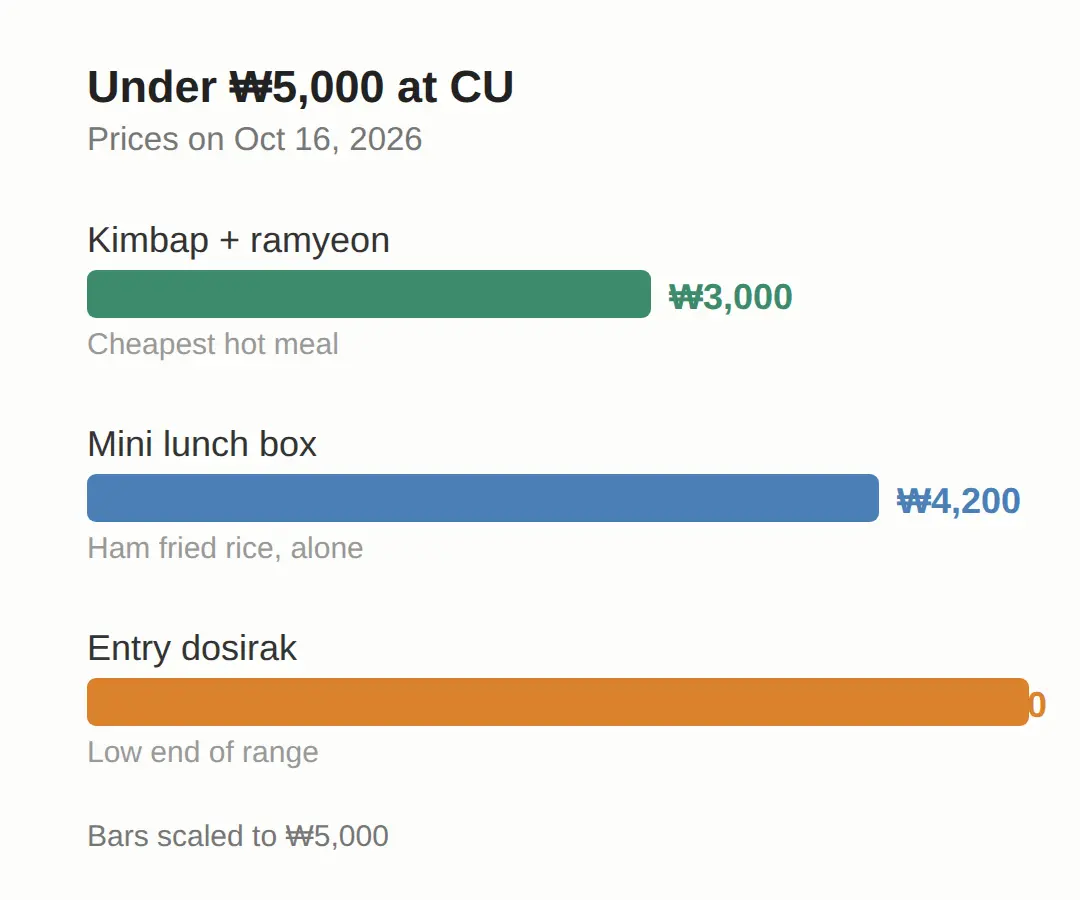
Here is the under-₩5,000 answer built from CU’s October 16, 2026 price list.
| Combo | Items | Price |
|---|---|---|
| Kimbap + ramyeon | Triangle kimbap + Shin Ramyun big bowl | ₩3,000 |
| Mini lunch box | Ham fried rice, alone | ₩4,200 |
| Entry dosirak | Standard dosirak, low end | ₩5,000 |
CU prices on October 16, 2026 put the basic triangle kimbap at ₩1,400 and the Shin Ramyun big bowl at ₩1,600 — together ₩3,000, which is about a third of the ₩8,769 Seoul restaurant average.
The mini lunch box costs ₩4,200 on its own, which keeps it under ₩5,000, while a standard dosirak at the low end of the ₩5,000–6,300 range lands right at the ₩5,000 mark and goes over once you add anything else.
If you want the biggest meal for the money, take the dosirak; if you want the cheapest hot meal, take the kimbap-and-ramyeon pair.
These figures come from third-party price checks from October 2026, so treat them as a snapshot rather than live listings.
CU Prices by Item (October 16, 2026)
| Item | CU price (Oct 16, 2026) |
|---|---|
| Triangle kimbap, basic | ₩1,400 |
| Triangle kimbap, big | ₩2,100 |
| Triangle kimbap, two-pack | ₩2,200 |
| Gimbap roll | ₩3,300–3,800 |
| Shin Ramyun big bowl | ₩1,600 |
| Shin Black cup | ₩1,900 |
| Buldak big cup | ₩1,800 |
| Mini lunch box | ₩4,200 |
| Dosirak | ₩5,000–6,300 |
Triangle kimbap ranges ₩1,300–1,800 across brands in general, so the CU figure sits at the low end; the two-pack (tuna mayo duo) gives two meals’ worth for less than one dosirak.
Cup noodles run ₩1,300–2,000 in general; at CU the Buldak big cup is ₩1,800 and the Shin Black cup ₩1,900, so the plain big bowls are the budget picks.
More than half of CU triangle kimbap sales from January to August 2026 were the big size, which tells you locals treat it as a meal, not a snack.
If you drink coffee, the counter-brewed americano was reported at ₩1,500 at CU in a February 2026 check — but that price has not been re-verified on CU’s own page, so treat it as approximate.
Next for you
Also read: Korean Convenience Store Drink for Sore Throat: From ₩1,000 · Can You Eat Kimchi While Pregnant? Portions & Safety (2026)
How It Compares to Eating Out or Delivery
| Comparison | Cost for one |
|---|---|
| Convenience store dosirak | ₩3,500–6,700 |
| Restaurant meal (survey range) | ₩8,000–15,000 |
| Seoul restaurant average (Aug 2026) | ₩8,769–11,923 |
| Delivered meal incl. fee | ~₩12,000 |
Dosirak prices run ₩3,500–6,700 against ₩8,000–15,000 for restaurant meals in one survey, and a separate August 2026 Chamgagyeok survey put the Seoul restaurant average at ₩8,769–11,923 per person — about double the dosirak range.
A delivered meal for one costs around ₩12,000 including the delivery fee, so a ₩5,000 dosirak is 42% of the cost.
Keep the two surveys separate when you do the math: one measures dosirak against a broad restaurant range, the other against Seoul averages only.
If you are eating alone and do not want a delivery fee or a table charge, the store meal is the cheaper option in every comparison.
Deals, Discounts and the Tuesday Rule
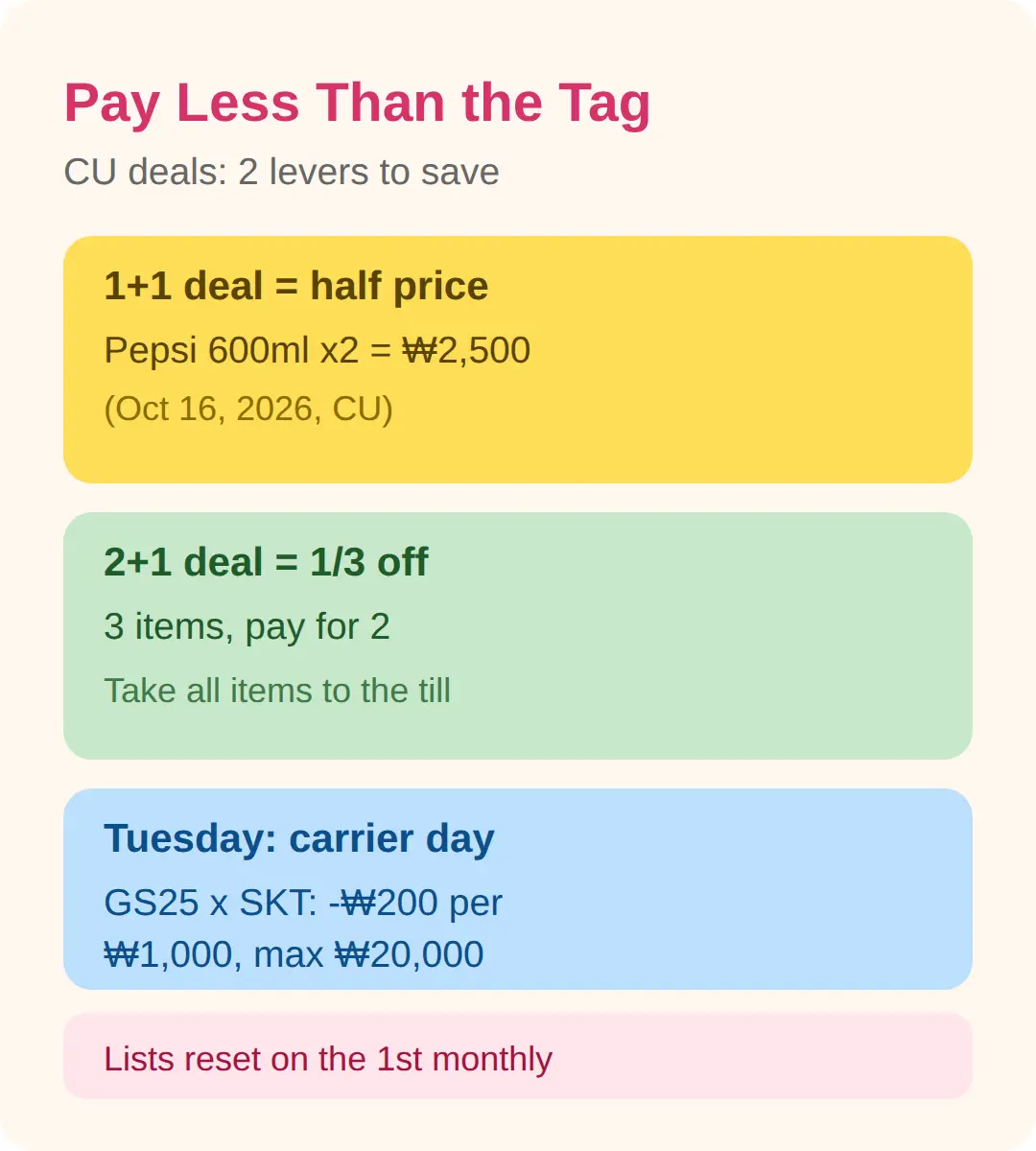
Two discounts lower the price below the sticker: 1+1/2+1 deals and carrier discounts on Tuesdays.
- A 1+1 deal halves the unit price — on October 16, 2026, CU had Pepsi 600ml at ₩2,500 for two bottles — and 2+1 cuts it by a third.
- The deal lists change on the 1st of each month, so what counts as 1+1 this month may be full price next month; the same drink can even be 1+1 at CU and full price at GS25 across the street.
- Register the free item in the chain’s app (Pocket CU, Woori Dongne GS for GS25, Seven App) and it is added at ₩0 at the till — you must pick up both items and take them to the register.
- On Tuesdays, GS25 × SKT takes ₩200 off per ₩1,000 on lunch boxes, gimbap and sandwiches, up to ₩20,000 per purchase; KT and LG U+ run similar schemes.
If your trip is short, the 1st-of-the-month list change and the Tuesday discount are the two dates worth noting.
How to Eat It Inside the Store
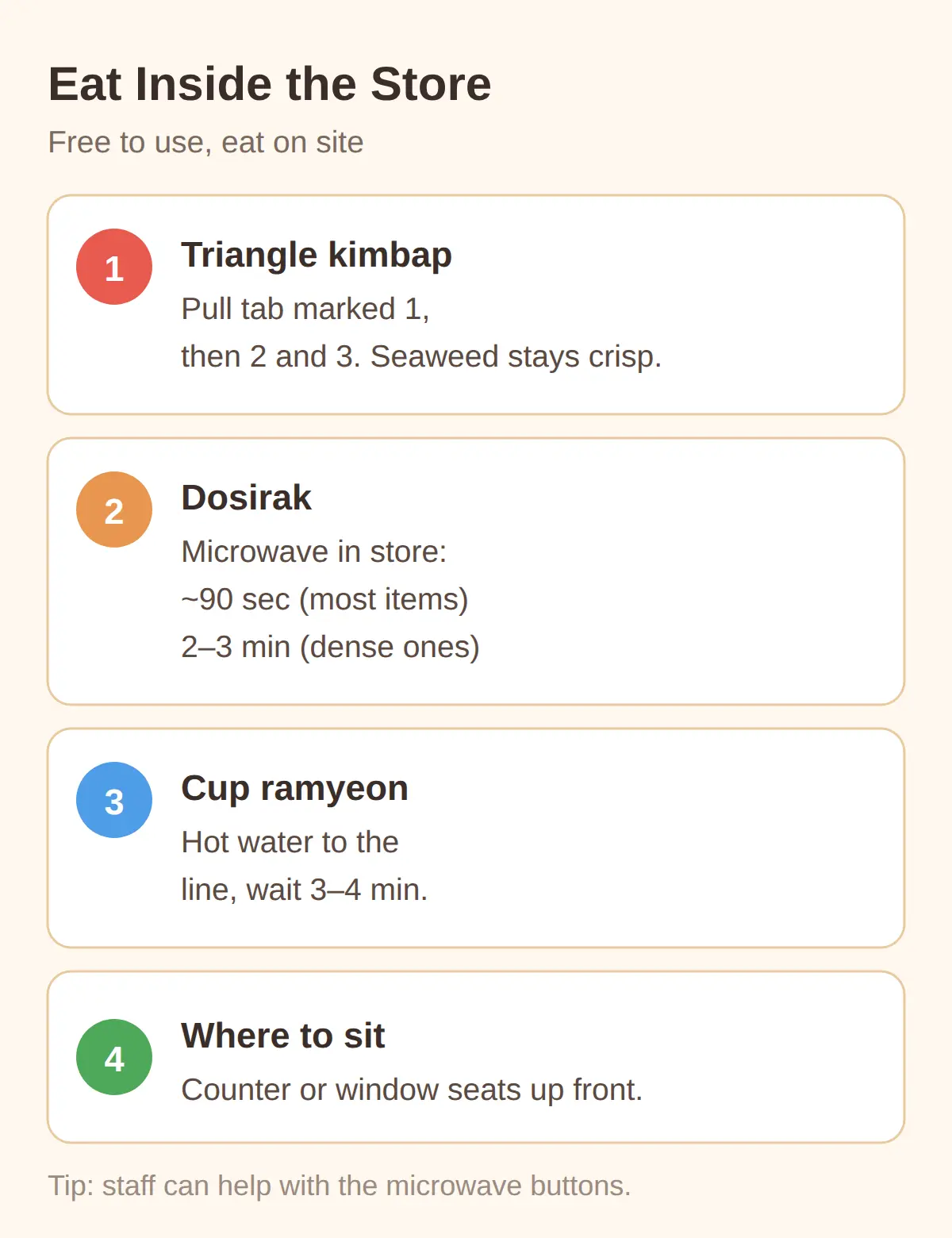
Convenience stores in Korea expect you to open, heat and eat on site, and the equipment is free to use.
- Triangle kimbap: pull the tab marked 1, then pull 2 and 3 — the plastic wrapper comes off around the seaweed so it stays crisp.
- Dosirak: heat it in the store microwave — about 90 seconds works for most, and 2–3 minutes for denser ones; it is also fine at room temperature.
- Cup ramyeon: fill with hot water to the line inside the cup and wait 3–4 minutes.
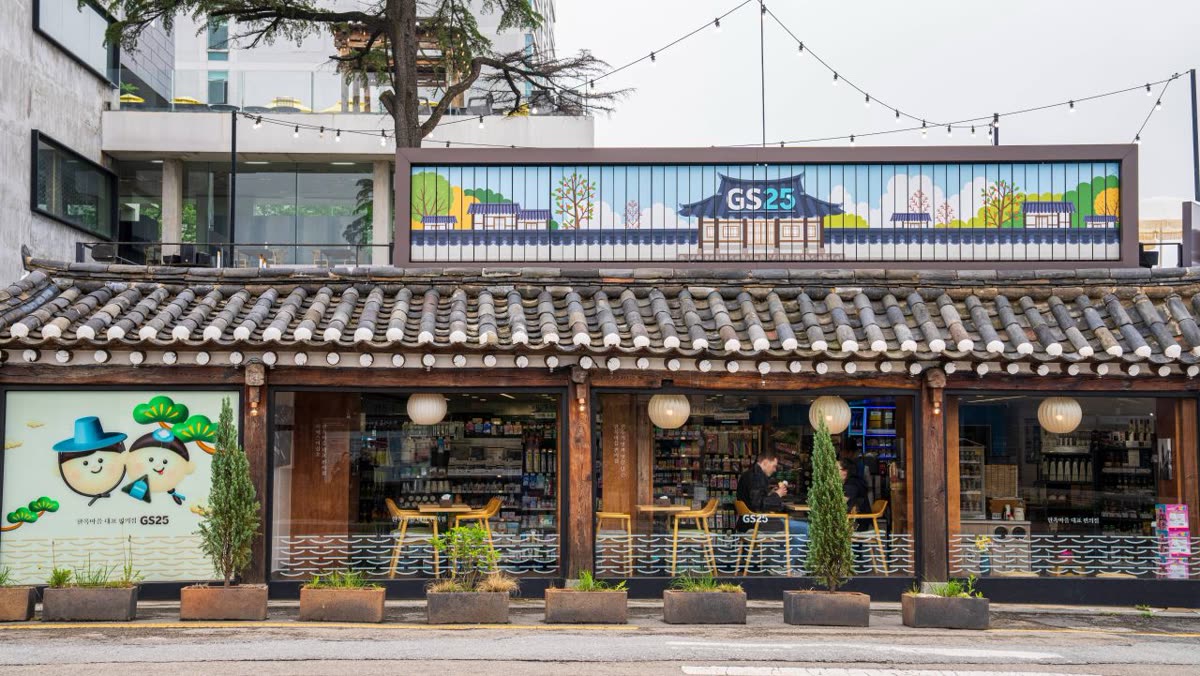
- Eating inside: most stores have a small counter or window seats near the front.
If you cannot read the microwave panel, ask a staff member or copy what the person before you does — the buttons are the same across stores.
Limitations: Sodium, Hours and What Changes
Three limits matter for a visitor: sodium, closing hours, and menu turnover.
A Korea Consumer Agency test of 12 gimbap rolls from the four chains (October 2026) found 760–1,393mg of sodium per roll — 38–70% of the 2,000mg daily limit — so a gimbap-and-ramyeon day uses up most of it.
Not all stores run 24 hours: in 2025 industry figures, 24.4% of GS25, 19.7% of CU and 18.4% of 7-Eleven stores were not open around the clock, and only about 20% of emart24 were.
Dosirak lineups change constantly — only pork bulgogi and pork cutlet types stay on shelves long term, so a box you liked in spring may be gone by autumn.
Allergen labels are in Korean, and sesame and almond are not on Korea’s mandatory allergen list, so check the ingredient panel if you have allergies.
If you eat convenience store food twice a day, alternate gimbap days with dosirak days and drink water rather than soda.
My own rule is to build my visits around dosirak and gimbap on Tuesdays — the carrier discount keeps the running cost down, and banking 1+1 free items in the app covers drinks on the days in between.
What I check first before any of this is the month’s 1+1 list, because it changes on the 1st and decides what I can get two of for one.
Related posts
📎 📅 Upcoming Dates — Release & Event Calendar
Sources
- Dosirak ₩4,500–6,500, 1+1/2+1 mechanics, machine coffee ₩1,5 (koreanomics.com)
- Triangle gimbap + cup noodle combo under ₩4,000 (koreankorea (koreankorea.com)
- Chamgagyeok Aug 2026 average ₩8,769–11,923 in Seoul (koreatravelatlas.com)
Quick Summary
- Cheapest full meal: triangle kimbap ₩1,400 + Shin big bowl ₩1,600 = ₩3,000 at CU (October 16, 2026).
- Biggest meal for the money: dosirak ₩5,000–6,300 — rice, a meat main, 3–4 sides; heat it 90 seconds in the store microwave.
- Two dates to remember: deal lists reset on the 1st of each month, and Tuesdays bring the GS25 × SKT carrier discount of ₩200 per ₩1,000 on gimbap and lunch boxes.
FAQ
Q. What combos come in under ₩5,000 at a Korean convenience store?
At CU prices from October 16, 2026: triangle kimbap ₩1,400 plus Shin Ramyun big bowl ₩1,600 (₩3,000), the mini lunch box ₩4,200, or a low-end dosirak at ₩5,000.
Q. Is convenience store food in Korea a real meal or just snacks?
A real meal. A dosirak is rice plus a main meat dish plus 3–4 side dishes with 500–670 kcal, and 68.9% of people surveyed by the Korea Consumer Agency in October 2026 eat gimbap together with cup ramyeon.
Q. How much cheaper is a convenience store meal than a restaurant in Korea?
About half. Dosirak runs ₩3,500–6,700 against ₩8,000–15,000 for restaurant meals in one survey, and the Seoul restaurant average was ₩8,769–11,923 per person in an August 2026 survey.
Q. Can I eat inside a Korean convenience store?
Yes — stores have microwaves, a hot-water dispenser for cup noodles, and counter seats, and using them is expected.
Bookmark the 1st of the month to re-check the 1+1 lists and price your week’s meals before you fly.
Cover photo: 2024 공연관광 DB 불편한 편의점_4 by Korea Tourism Organization — KOGL Type 1 (attribution)
#koreanconveniencestorefood #CUdosirakprice #koreangimbapprice #conveniencestoremealkorea #cheapfoodinkorea
📅Upcoming Schedule — this week 5 · D-2 MAMA 2026 ceremony (exact date/venue not yet confirmed in thSee all →Last updated 2026-11-25. Editorial policy