

Yes — kimchi jjigae with beef works: sear 150-200g thinly sliced beef first, then add 2 cups sour kimchi and 2 cups water or anchovy-kelp broth, and simmer 15-20 minutes — about 25 minutes total in one pot.
The beef version makes the same bubbling, spicy stew, and it fits readers outside Korea who cannot find good pork belly or prefer a lighter broth.
This page covers the full beef method, how the order of steps changes from the pork version, ingredient amounts for 2 servings, what to do when the kimchi is not sour enough, substitutes for hard-to-find items, and serving and storage.
Contents
- Kimchi jjigae with beef — the 25-minute one-pot method
- Beef vs pork kimchi jjigae — what changes in the order
- Ingredients and amounts for 2 servings
- Sour kimchi, broth base, and no aged kimchi
- Substitutes when you live outside Korea
- Serving, storage, and common mistakes
Kimchi jjigae with beef — the 25-minute one-pot method
Sear 150-200g thin beef slices first, add 2 cups sour kimchi and 2 cups broth, then simmer 15-20 minutes — the whole stew takes about 25 minutes in one pot.
The order of steps matters most with beef: sear first, kimchi second, because beef toughens if it boils with kimchi the whole time.
Maangchi’s official kimchi jjigae page lists beef alongside pork belly and canned tuna as an acceptable meat, swapped in the same quantities and steps — so the beef version is a chef-published standard, not a hack.
- Sear the beef in 1 tbsp sesame oil over medium-high heat until browned.
- Add the sour kimchi and half an onion, sliced; stir-fry together for 2-3 minutes.
- Add gochugaru, gochujang, garlic, and soup soy sauce; stir so they bloom in the oil.
- Pour in 2 cups water or anchovy-kelp broth plus 2-3 tbsp kimchi brine.
- Boil hard, uncovered, for 3-5 minutes — this makes the broth cloudy and rich instead of thin.
- Drop to a rolling simmer for 15-20 minutes.
- Add firm tofu cubes and green onion in the last 5 minutes.
Use a small heavy pot — a Korean ttukbaegi or a 1.5-2qt saucepan — and serve bubbling in the same pot it cooked in.
For 4 servings, double everything (400g beef, 4 cups broth) but keep the simmer time the same 15-20 minutes.
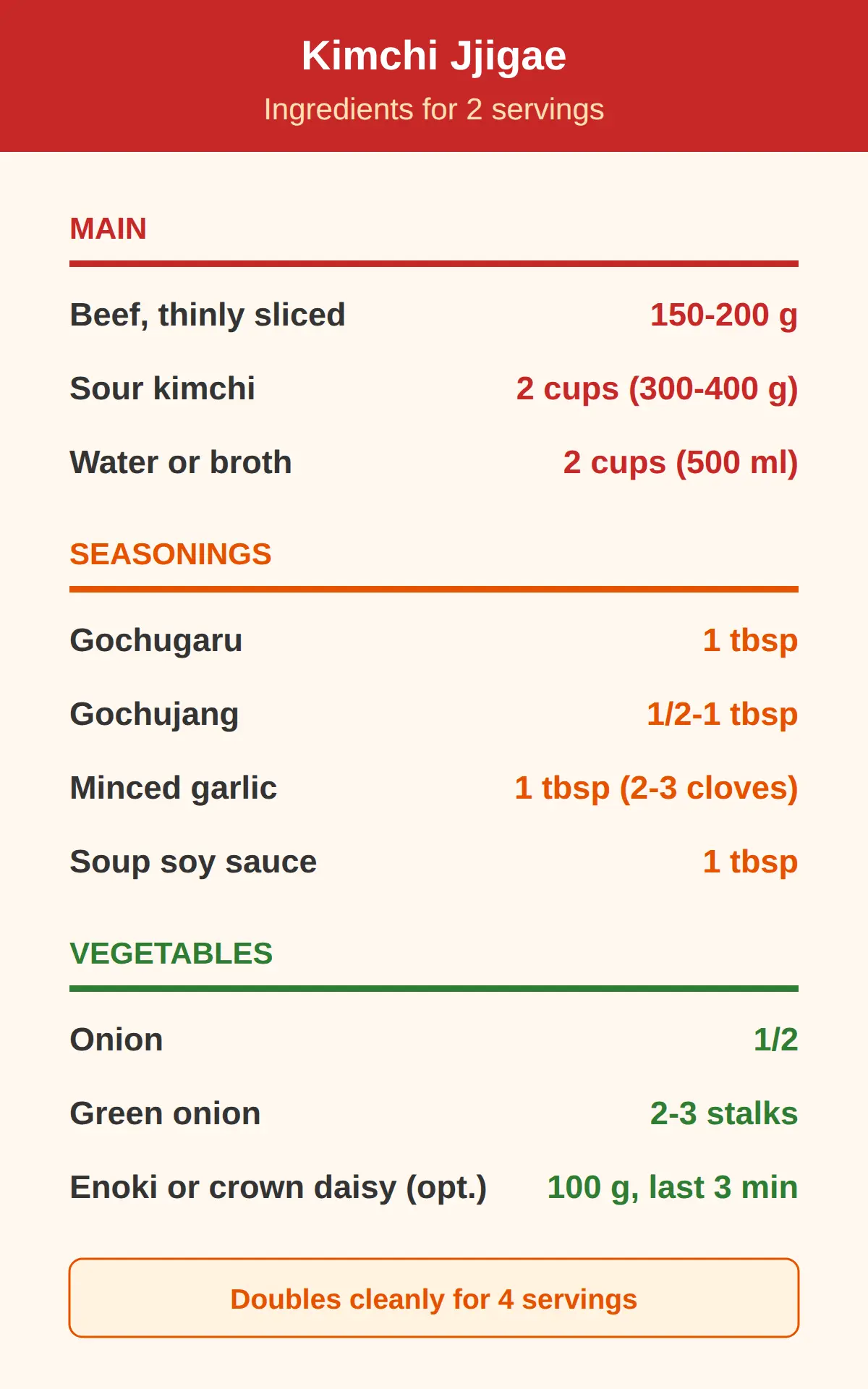
| Beef (thin slices, chuck or sirloin) | 150-200g |
|---|---|
| Sour kimchi | 2 cups (300-400g) |
| Kimchi brine | 2-3 tbsp |
| Water or anchovy-kelp broth | 2 cups (500ml) |
| Gochugaru / gochujang | 1 tbsp / 1/2-1 tbsp |
| Minced garlic | 1 tbsp (2-3 cloves) |
| Soup soy sauce | 1 tbsp |
Beef vs pork kimchi jjigae — what changes in the order
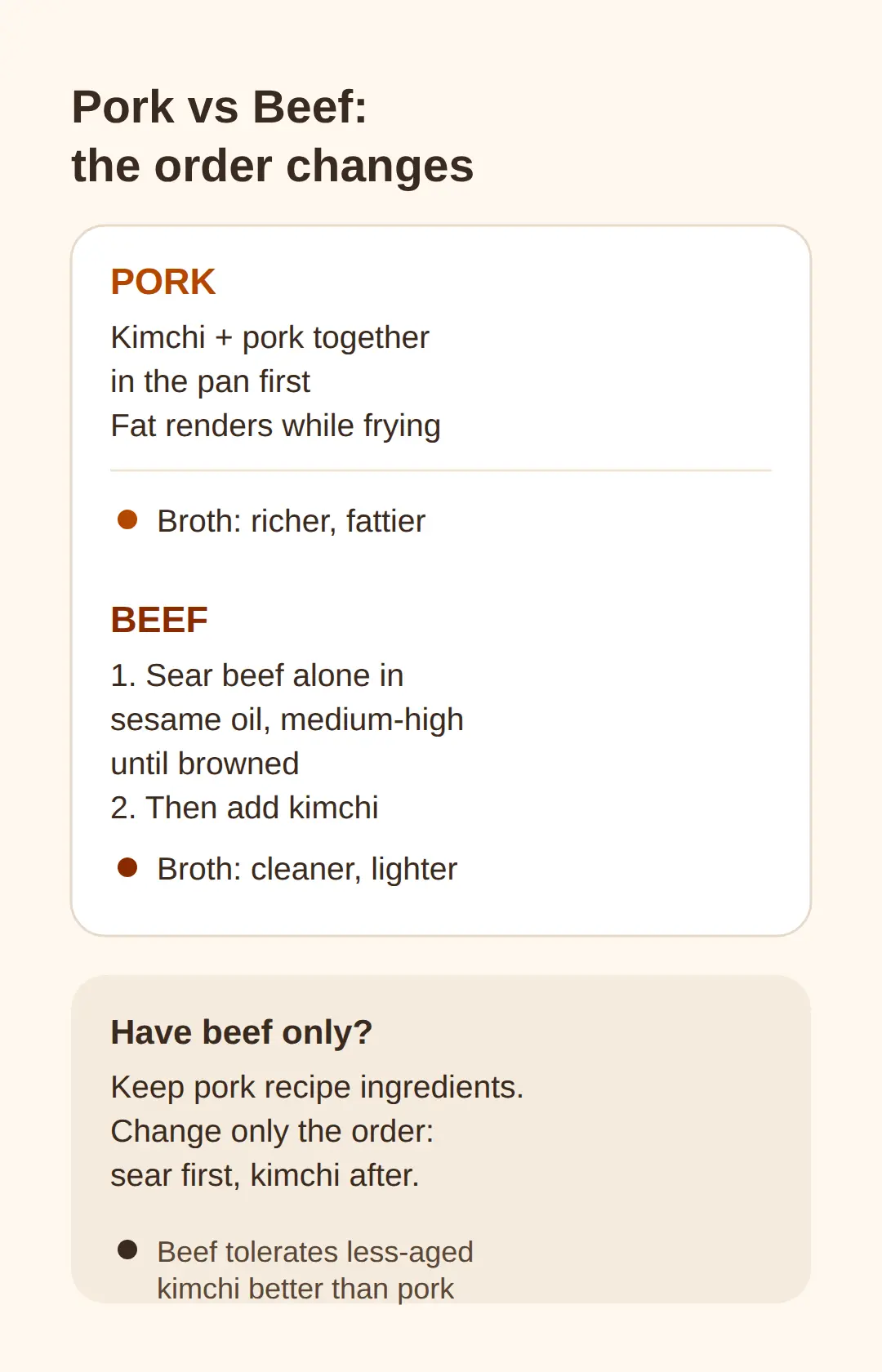
One change matters: pork is stir-fried together with the kimchi, but beef is seared alone first and the kimchi goes in after browning.
Pork renders fat while it fries with the kimchi, so the broth comes out richer and fattier.
Beef overcooks faster and turns tough if it boils with kimchi the whole time, and the broth comes out cleaner and lighter — and beef also pairs better with less-aged kimchi than pork does.
If all you have is beef but the recipe you keep finding is for pork, keep the same ingredients and only change the order.
- Pork: kimchi and pork in the pan together, fat rendered first, richer and fattier broth.
- Beef: sear alone in sesame oil, medium-high, until browned; then kimchi; cleaner, lighter broth.
- Tuna: no searing at all — canned tuna added after simmering, the closest no-skill alternative, same clean light profile.
If your kimchi is only borderline sour, the beef version still works — beef tolerates less-aged kimchi better than pork — and I would add the full 2-3 tbsp brine rather than buying a fake-sour fix.
Ingredients and amounts for 2 servings
For 2 servings you need about 150-200g thinly sliced beef, 2 cups (300-400g) sour kimchi, and 2 cups (500ml) water or broth, plus the seasonings in the table above.
The full seasoning list is 1 tbsp gochugaru, 1/2-1 tbsp gochujang, 1 tbsp minced garlic (2-3 cloves), and 1 tbsp soup soy sauce.
Vegetables besides kimchi are half an onion, 2-3 green onion stalks, and optionally 100g enoki mushrooms or crown daisy added in the last 3 minutes.
Green onion goes in two stages — white parts with the kimchi stir-fry, green parts in the last minute as garnish.
Every amount doubles cleanly for 4 servings, and the simmer time stays at 15-20 minutes.
No marinade is needed for the beef version — thin slicing is enough, and bulgogi-style marinade works against the stew because the sugar in it burns during the sear.
If you only have ground beef or brisket instead of bulgogi-style slices, both are accepted alternatives — ground beef browns much faster, which shortens the sear step.
Sour kimchi, broth base, and no aged kimchi
Kimchi jjigae needs well-fermented sour kimchi, at least 2-3 weeks old — fresh kimchi gives a flat broth.
The Korea.net official cooking series (2017) specifies the order that matters: stir-fry kimchi with the meat first, add water or broth, bring to a hard boil, then simmer.
If the kimchi is not sour yet, it will taste flat — a widely repeated home-cook fix is 1 tsp vinegar or 1/2 tsp sugar, but that is a community trick, not an official recommendation.
Frozen kimchi or kimchi refrigerated well past its best-by date is actually preferred here: freezing breaks down the cabbage fiber, so the stew gets deep sourness faster, and the texture loss does not matter once cooked.
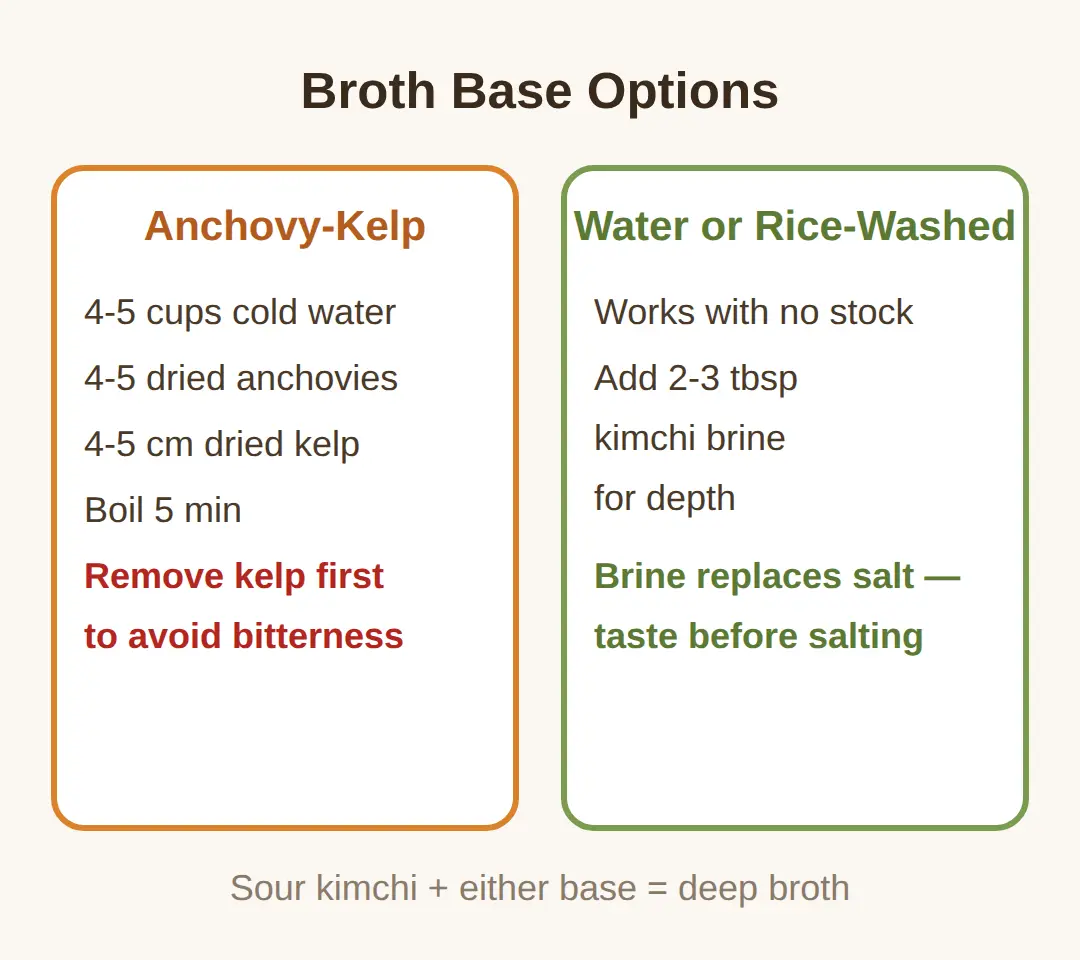
For the broth, plain water works when no stock is made — the 2-3 tbsp kimchi brine restores the depth, and it also substitutes for salt entirely, so taste after simmering before adding any salt.
To make anchovy-kelp broth: 4-5 cups cold water, 4-5 gutted dried anchovies, and one 4-5cm piece dried kelp; boil 5 minutes and remove the kelp first to avoid bitterness.
Rice-washed water is another common base — it adds body and mild sweetness when no anchovy stock is made.
One more depth option for the beef version: some cooks add 1/2-1 tsp soybean paste (doenjang), since beef lacks pork’s rendered fat — optional, not mandatory.
Substitutes when you live outside Korea
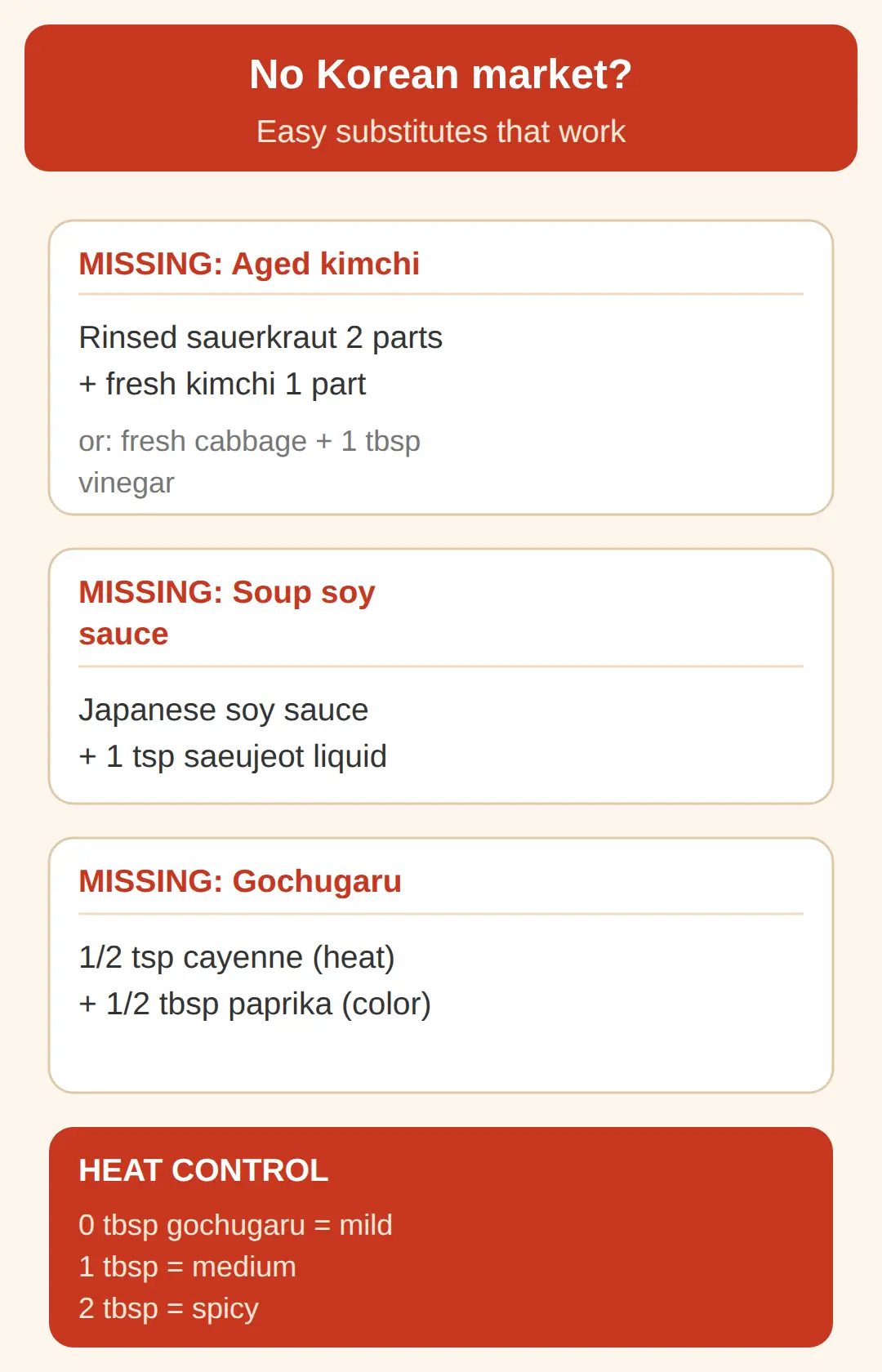
The three items readers abroad most often lack — aged kimchi, soup soy sauce, and gochugaru — each have workable substitutes listed below.
For missing aged kimchi, a workaround repeated in secondary sources is rinsed sauerkraut blended 2 parts to 1 part fresh kimchi (or fresh cabbage plus 1 tbsp vinegar) to approximate the sourness — treat it as a workaround, not a verified method.
For soup soy sauce (guk-ganjang), the standard substitute is Japanese soy sauce plus 1 tsp salted shrimp paste (saeujeot) liquid to restore the fermented depth.
For gochugaru, 1 tbsp is roughly 1/2 tsp cayenne plus 1/2 tbsp sweet paprika — cayenne for heat, paprika for color; gochujang alone makes the stew paste-heavy.
You can also control heat directly: 1 tbsp gochugaru is medium, 2 tbsp is spicy, and 0 tbsp with extra gochujang gives a mild version for children.
Spiciness comes from the chili flakes amount, which you set yourself — not from the kimchi.
Serving, storage, and common mistakes
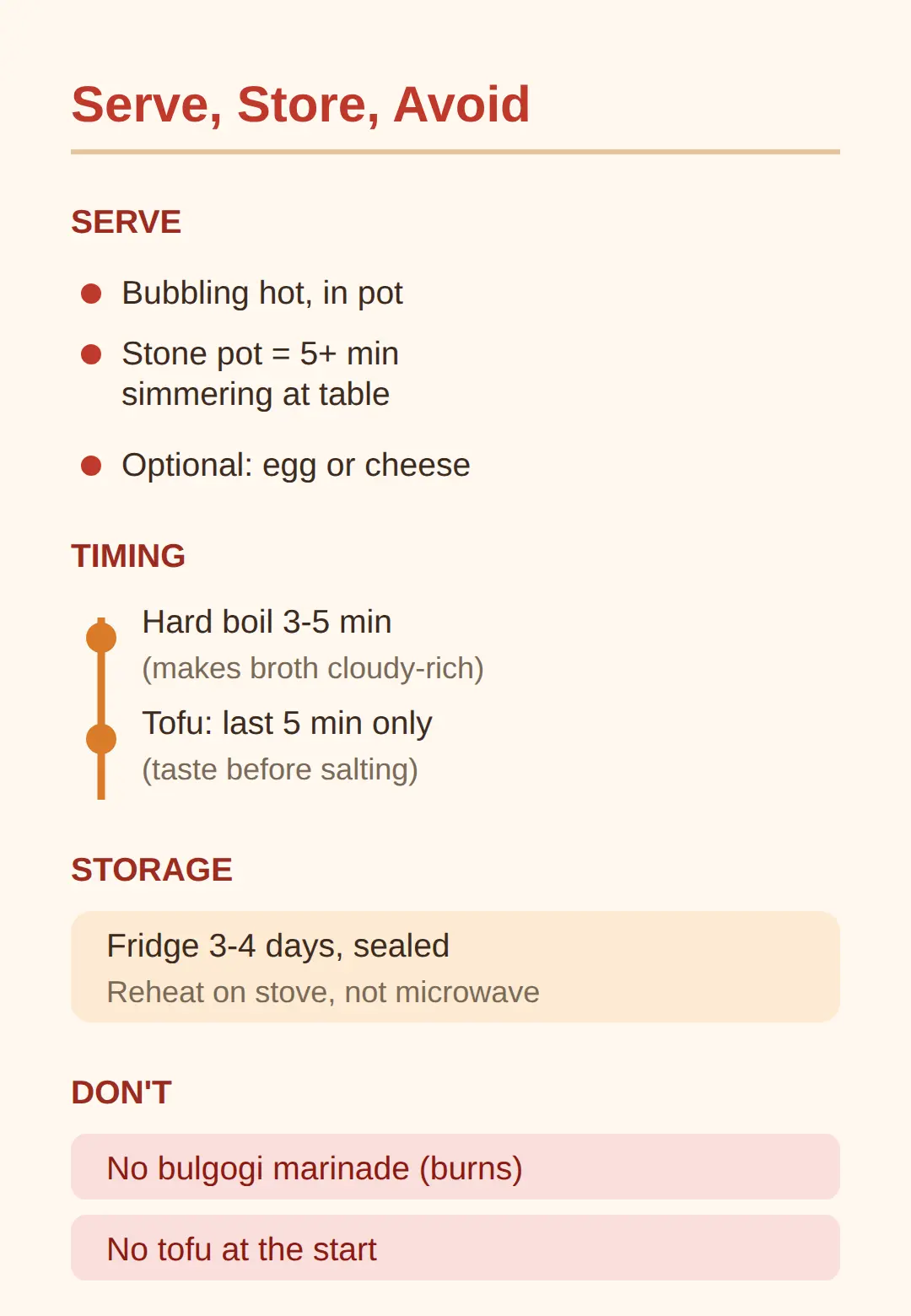
Serve the stew bubbling in the pot it cooked in — a ttukbaegi (stone pot) keeps it simmering at the table for 5+ extra minutes — with hot steamed rice.
At the table, finish it with an optional raw egg cracked in or a slice of American cheese on top, both shown as variations on Maangchi’s page.
Add tofu only in the last 5 minutes so firm cubes heat through without falling apart, and taste before adding any salt — the kimchi brine usually covers it.
Leftovers keep 3-4 days refrigerated in a sealed container, and reheating on the stove rather than the microwave preserves the tofu and beef texture — flavor deepens on day 2.
Two mistakes to avoid: do not marinate the beef like bulgogi (the sugar burns during the sear), and do not add tofu at the start.
If the broth tastes thin at the end, the likely cause is skipping the 3-5 minute hard boil — that step emulsifies the chili oil and makes the broth cloudy-rich.
👉 pork kimchi jjigae base recipe
👉 Maangchi’s official kimchi jjigae page
👉 Korea.net official cooking series
Related posts
Sources
- Beef = cleaner/lighter taste, pork = richer; stir-fry order (cookpick.kr)
- Official cooking series page with broth ratio and boil order (korean-culture.org)
- 3-4 days refrigerated; reheating method advice varies — low (10000recipe.com)
FAQ
- Can I make kimchi jjigae with beef instead of pork? Yes — Maangchi’s official page lists beef as a standard swap in the same quantities and steps; sear the beef first, then add the kimchi.
- My kimchi isn’t sour yet — can I still make kimchi jjigae? Yes, but it will taste flat — a widely repeated home-cook fix is 1 tsp vinegar or 1/2 tsp sugar; the beef version also tolerates less-aged kimchi better than pork.
- What beef cut works best? Thinly sliced bulgogi-style chuck or sirloin is standard; brisket and ground beef are accepted alternatives, and ground beef browns faster, shortening the sear.
- Can I skip anchovy broth and just use water? Yes — both Maangchi and the official Korea.net method allow water; the 2-3 tbsp kimchi brine restores the depth, so taste before adding salt.
FAQ
Q. Can I make kimchi jjigae with beef instead of pork?
Yes — Maangchi’s official kimchi jjigae page lists beef alongside pork belly and canned tuna as an acceptable meat, swapped in the same quantities and steps. Sear the beef alone first, then add the kimchi.
Q. My kimchi isn’t sour yet — can I still make kimchi jjigae?
You can, but fresh kimchi gives a flat broth. A widely repeated home-cook fix is 1 tsp vinegar or 1/2 tsp sugar, though that is not an official recommendation.
Q. Can I use fresh (not sour) kimchi if that’s all I have?
Yes, and the beef version tolerates it better than the pork version — add the full 2-3 tbsp kimchi brine for depth, and expect a lighter, less sour stew.
Q. Can I skip anchovy broth and just use water?
Yes — both Maangchi and the Korea.net official method allow plain water. The 2-3 tbsp kimchi brine compensates for the depth and substitutes for salt entirely, so taste after simmering before adding any salt.
Q. What if I don’t have aged kimchi — does sauerkraut actually work?
A workaround repeated in secondary sources: rinse sauerkraut briefly and blend 2 parts sauerkraut to 1 part fresh kimchi (or fresh cabbage plus 1 tbsp vinegar). It approximates the sourness, but it is a workaround, not a verified method.
Frozen kimchi or kimchi past its best-by date works better for jjigae than fresh — the deep sourness you need is the one thing no substitute fully replaces.
Cover photo: Beef, tofu and kimchi stew of Matsuya by 毒島みるく — CC0 1.0
#kimchijjigae #kimchijjigaerecipebeef #beefkimchijjigae #onepotKoreanstew #sauerkrautsubstitute #Koreanhomecooking
📅Upcoming Dates — 이번 주 32 · D-day Chuseok holiday period — rice cake interest peaks전체 보기 →