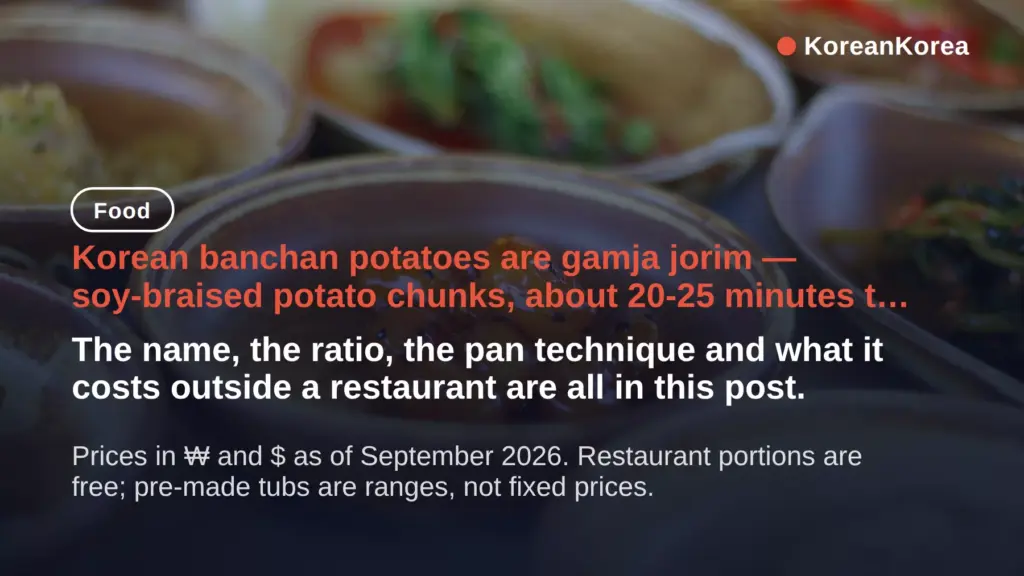
The small sweet-salty potato side dish at Korean restaurants is called gamja jorim (soy-braised potatoes), and it takes about 20-25 minutes with roughly 2 tbsp soy sauce, 1 tbsp sugar and 1 tbsp corn syrup per 2 potatoes.
What Are the Korean Banchan Potatoes Called?
| You saw small sweet-salty potato chunks at a Korean restaurant | It is gamja jorim — ‘gamja’ means potato, ‘jorim’ means simmered in soy sauce until the liquid glazes |
|---|---|
| You are deciding make it yourself or buy a tub | Make it — 2 potatoes plus sauce cost well under the USD 4-7 pre-made tub at US Korean marts, and it takes about 20-25 minutes |
| You want a vegan side dish in Korea | Standard gamja jorim works — soy sauce, sugar, garlic and sesame oil only |
| You are meal-prepping dosirak | It keeps 3-4 days refrigerated and does not release moisture into rice; do not freeze it |
| You typed ‘korean banchan potatoes’ but meant the creamy one | That is gamja salad — a different dish; if yours was pickled and cold, it is gamja jangajji |
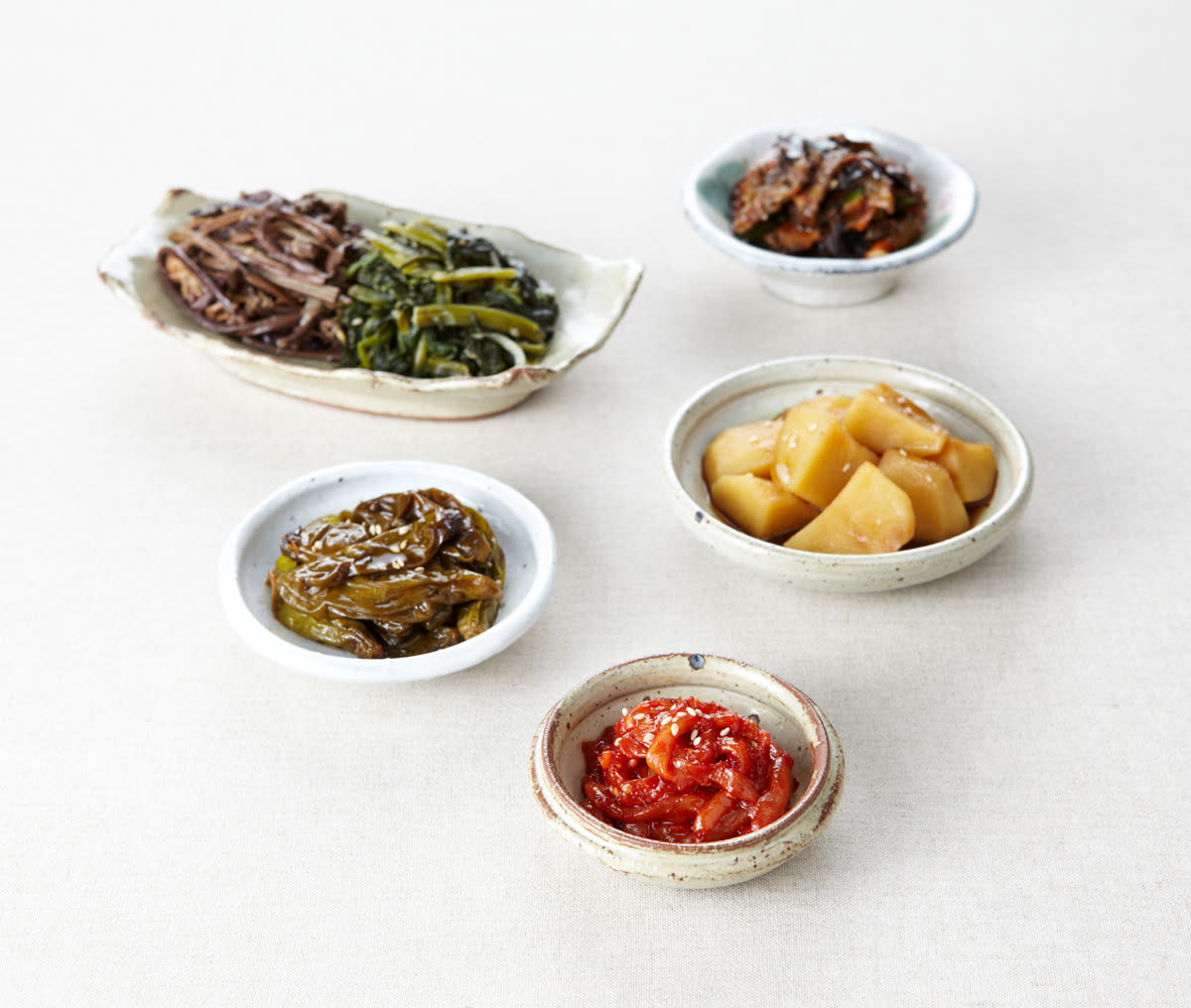
The dish is gamja jorim — ‘gamja’ means potato and ‘jorim’ means simmered in a soy-based sauce until the liquid reduces to a glaze.
It looks like small soy-glazed potato chunks with chewy, caramelized edges, served warm or at room temperature.
Jorim is one of the standard Korean cooking methods, alongside steaming and stir-frying.
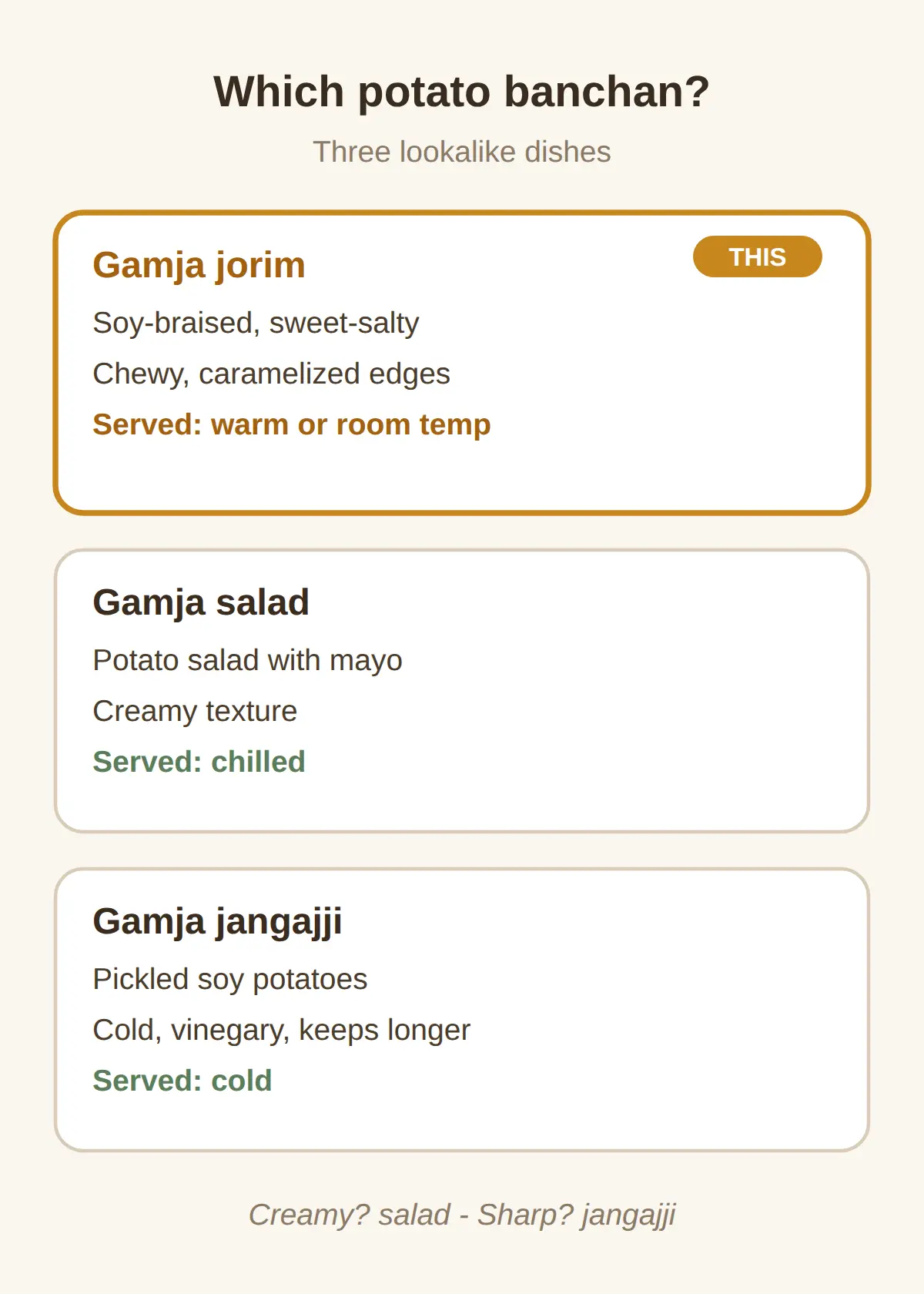
Two lookalikes cause most of the mix-ups, and each is a different dish:
| Dish | What it is | Served |
|---|---|---|
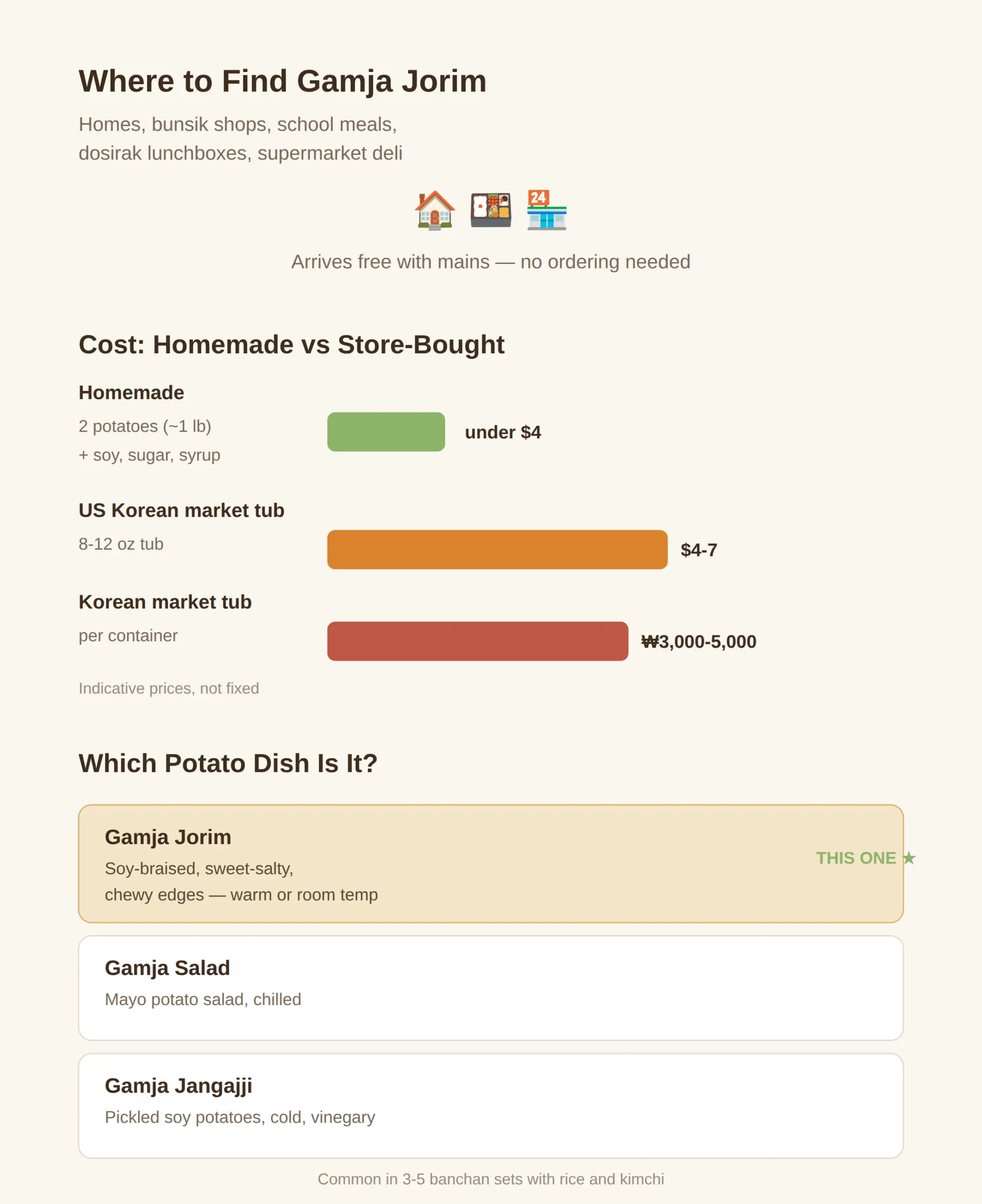
| Gamja jorim | Soy-braised, sweet-salty, chewy edges | Warm or room temperature |
| Gamja salad | Korean potato salad with mayonnaise | Chilled |
| Gamja jangajji | Pickled soy potatoes, cold and vinegary, longer shelf life | Cold |
When I look up a potato banchan, the first thing I check is which of these three the person actually means, because ‘korean banchan potatoes’ pulls up all three.
If you wanted the creamy one, search gamja salad; if yours was cold and sharp with vinegar, it is gamja jangajji.
Gamja Jorim Recipe — Ratio, Steps, 20-25 Minutes
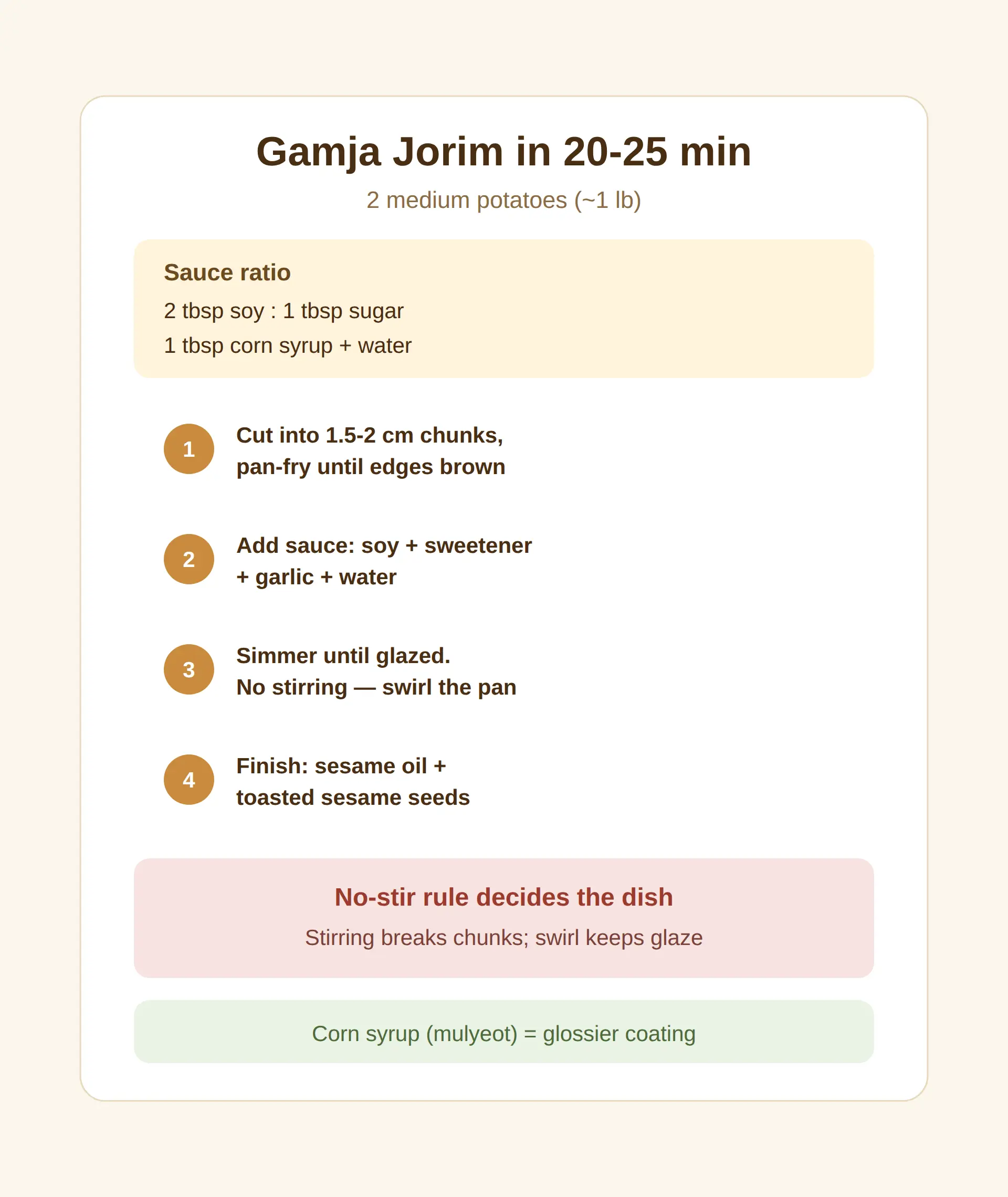
A batch takes about 20-25 minutes total, including pan-frying and sauce reduction, using about 2 medium potatoes (~1 lb).
The working sauce ratio is about 2 tbsp soy sauce : 1 tbsp sugar : 1 tbsp corn syrup per 2 medium potatoes, diluted with a few tbsp water — two widely used recipe sources agree on this ballpark.
Home recipes split between white sugar and Korean corn syrup (mulyeot), and corn syrup gives a glossier coating.
- Cut potatoes into 1.5-2 cm chunks and pan-fry in oil until the edges brown.
- Pour in the sauce (soy sauce + sweetener + minced garlic + water).
- Simmer until the liquid reduces and glazes the potatoes — do not stir; swirl the pan instead.
- Finish with sesame oil and toasted sesame seeds.
The no-stir rule is the one that decides the dish.
Stirring breaks the chunks and the glaze comes apart; swirling the pan keeps both intact.
I would fry the chunks until the edges brown before the sauce goes in — that chewy caramelized edge is the whole point, and skipping it gives you soft soy potatoes instead.
What Potato to Use — and Why Yours Fall Apart
Use waxy, all-purpose potatoes — starchy russets fall apart during the braise.
Korean recipes call for the standard white/yellow all-purpose potato, and English-language recipe sources give the same guidance: starch is what makes the chunks dissolve instead of holding shape.
Cut the pieces about 1.5-2 cm thick so the sauce coats every chunk evenly.
If your last batch turned mushy, check two things before changing anything else — the potato variety and whether you stirred while the sauce reduced.
Fix those and the braising method itself usually needs no change.
Is It Free at Korean Restaurants? Refills and What a Tub Costs
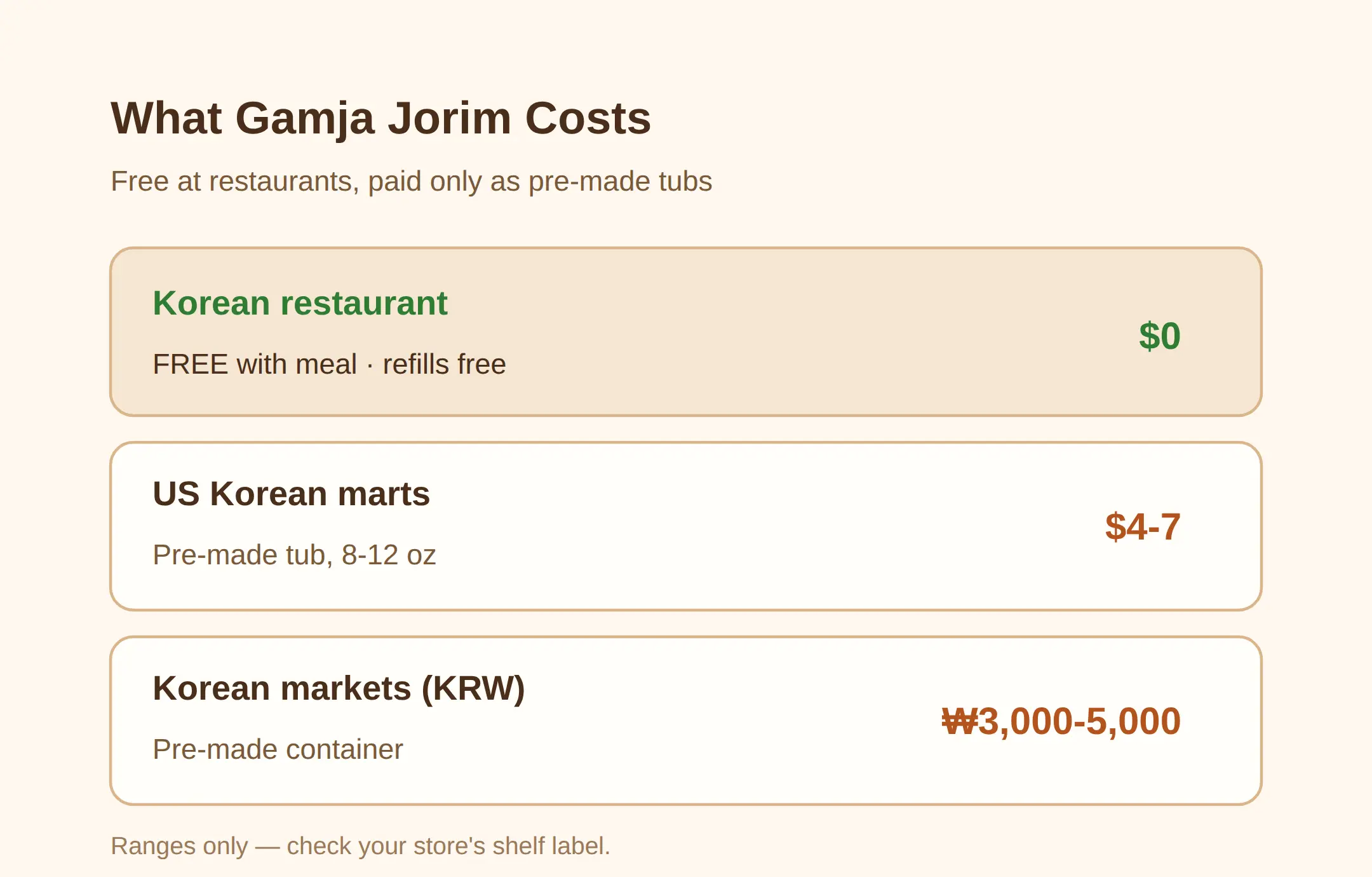
In Korean restaurants, gamja jorim comes free with the meal and refills are free — it is not a separately priced dish.
Banchan are the shared side dishes served alongside rice, and a standard restaurant meal comes with several at once.
To get more, say ‘banchan jom deo juseyo‘ (a little more side dishes, please) — no charge, and it is standard practice.
When I check what a potato banchan costs, the restaurant price is the part I stop looking for: in Korea the dish is free and refillable, so anyone quoting a per-dish ‘restaurant price’ is guessing.
| Where | Price | Note |
|---|---|---|
| Korean restaurant | Free with the meal | Refills free (‘banchan jom deo juseyo’) |
| Pre-made tub, US Korean marts | About USD 4-7 per 8-12 oz tub | Indicative range, varies by store |
| Pre-made container, Korean markets | About 3,000-5,000 KRW | Indicative range, varies by store |
Pre-made gamja jorim is stocked in the refrigerated banchan corner of Korean grocery chains such as H Mart and Zion Market.
Both prices are ranges, not fixed prices — check the shelf label at your store.
Make It or Buy It — Vegan, Gluten and Storage
Homemade is roughly 3-5x cheaper per equivalent weight than a store-bought tub, and a batch keeps 3-4 days refrigerated.
The cost math is short: 2 medium potatoes plus 2 tbsp soy sauce, 1 tbsp sugar and 1 tbsp corn syrup come in well under the USD 4-7 tub at US Korean marts.
The recipe is rated easy — one pan, one braise step, no marinating time.
After thawing, potatoes turn mealy and watery, so freezing is not recommended; refrigerated storage only.
For diet questions, three rules cover it:
- Standard gamja jorim contains no animal products — soy sauce, sugar, garlic, sesame oil — so it fits a plant-based table.
- Standard soy sauce contains wheat, so strictly gluten-free cooks substitute tamari; the dish has no other gluten sources.
- It is served warm or at room temperature, which is why it travels well in dosirak.
A spicy gochujang-based variation is a common home version, and a soy-garlic version like the bunsik-chain style doubles the garlic.
If you need the vegan version, skip the fish-sauce variants some households use.
Where You See It in Korea — Restaurants, Dosirak, Marts
Gamja jorim shows up in home cooking, bunsik (snack-food) restaurants, school-style set meals and dosirak lunchboxes — it is one of the most common everyday potato preparations in Korea.
It earns the dosirak spot because it holds well without refrigeration for several hours and does not release moisture into the rice.
A standard home meal pairs it with rice, kimchi and other side dishes in a set of 3-5 banchan.
First-time visitors meet it without ordering it — it arrives with the main dish as part of the shared side-dish set.
If you want to eat it on purpose, look for bunsik restaurants or the refrigerated banchan corner in a supermarket; if you want it exactly as restaurants serve it, the chewy-edged soy-garlic style is the one to look for.
👉 Maangchi’s braised potato recipe with the exact sauce amounts
👉 Korean Bapsang’s gamja jorim with waxy-potato and storage notes
👉 what to eat in Korea — 10 dishes not to leave without trying
👉 Korean food guide for first-time visitors, including banchan refill etiquette
Related posts
Sources
- Korean-language sources confirm same soy-sugar-garlic braise (koreatravellab.com)
- Anchor table confirms demand for individually named banchan (coreadesk.com)
- USD 4-7 per tub at US Korean marts — secondary listing only, (hmart.com)
Summary
- Confusing gamja jorim with gamja salad? One is soy-braised with chewy edges, the other is creamy mayonnaise potato salad — check the glaze before you order or cook.
- Before you start, buy waxy or all-purpose potatoes; russets will dissolve in the sauce no matter how careful you are.
- Print the 2:1:1 sauce ratio (soy : sugar : corn syrup) before shopping — it works for 2 medium potatoes and scales cleanly.
- Eating out in Korea? Ask for ‘banchan jom deo juseyo’ — side dish refills cost nothing, so don’t order extras.
- Making it ahead: it keeps 3-4 days refrigerated and packs well into dosirak without soaking the rice.
FAQ
Q. What are the Korean banchan potatoes called?
Gamja jorim — soy-braised potatoes. ‘Gamja’ means potato and ‘jorim’ means simmered in soy sauce until the liquid glazes.
Q. How do you make gamja jorim at home?
Fry 2 medium potatoes (1.5-2 cm chunks) until the edges brown, add about 2 tbsp soy sauce, 1 tbsp sugar, 1 tbsp corn syrup, garlic and a few tbsp water, simmer without stirring until glazed, and finish with sesame oil and sesame seeds — about 20-25 minutes total.
Q. Are the side dishes at Korean restaurants free to refill?
Yes — banchan come free with the meal, and refills are free. Ask for ‘banchan jom deo juseyo’.
Q. Is gamja jorim vegan and gluten-free?
The standard version is vegan — soy sauce, sugar, garlic and sesame oil only. It is not gluten-free as made, because standard soy sauce contains wheat; tamari substitutes.
Q. Can I freeze gamja jorim?
It is not recommended — the potatoes turn mealy and watery after thawing. Keep it 3-4 days refrigerated instead.
October 2026
Cover photo: Korean cuisine-Banchan-09 by egg (Hong, Yun Seon) — CC BY 2.0
#koreanbanchanpotatoes #gamjajorim #koreansidedishes #koreanbraisedpotatoes #koreanrecipe #koreafoodguide
📅Upcoming Schedule — this week 23 · D-1 Autumn season = post-summer brightening demand window (UV drSee all →