Cooked Korean food is good for pregnancy — seek braised mackerel, bibimbap and steamed shellfish, and limit raw fish, salty soups and daily seaweed soup.
That single rule covers almost every dish on a Korean menu, because the risk sits in raw and cold items, not in Korean cooking itself.
This post gives the three dishes worth ordering, the three habits to cut back, the sodium numbers behind them, and straight answers on kimchi, miyeokguk and samgyetang.
Contents
- Korean food pregnancy: the short answer — cooked yes, raw no
- 3 Korean dishes to seek during pregnancy
- 3 Korean dishes and habits to limit
- How much sodium is too much in Korean food while pregnant?
- Kimchi, miyeokguk and samgyetang — what readers actually ask
- Eating Korean food in Korea while pregnant: eggs, meat, street food and drinks
Korean food pregnancy: the short answer — cooked yes, raw no
Yes — cooked Korean meals are a good fit for pregnancy, and raw items are the part to avoid.
| Claim | Evidence |
|---|---|
| Cooked Korean meals are a good fit | Vegetable side dishes (namul and banchan) support folate and fiber intake — the folate requirement in pregnancy is 600 mcg DFE a day |
| Cooked fish counts too | FDA recommends 2-3 servings (224-336 g total) per week of low-mercury cooked fish; a fully cooked godeungeo-jorim fits that count |
| Three servings split the weekly amount | 336 g weekly total means up to 112 g of fish per serving, about one modest braised fillet |
| Hot dishes are the safer picks | Dishes served steaming hot — jjigae stews, hot pot, gamjatang — carry lower listeria and parasite risk than cold or raw items |
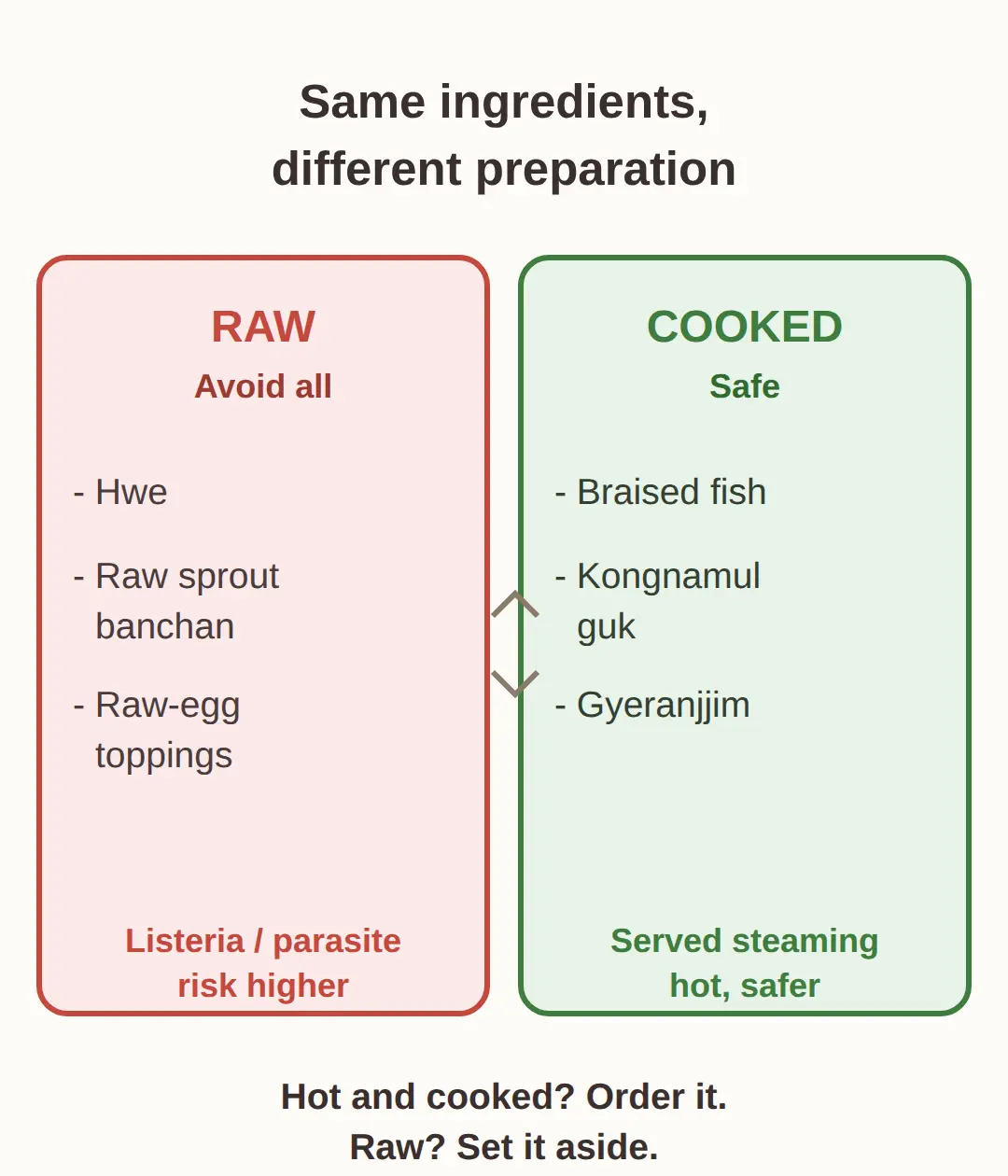
If I were ordering Korean food while pregnant, the first thing I would check is whether the dish arrives steaming hot or cold and raw — that one line splits most of the list.
If the dish arrives hot and the protein is cooked through, order it; if anything on the plate is raw, set it aside.
| You want fish in your pregnancy diet | Fully cooked low-mercury fish like godeungeo-jorim or galchi-jorim — 2-3 servings (224-336 g) a week, cooked to 145°F (63°C) |
|---|---|
| You are craving raw fish (hwe) | Skip it while pregnant — cooked shellfish like steamed honghap is the safe swap |
| You eat soup or jjigae every day | One salted soup dish a day at most — a bowl can hold 800-1,800 mg of the 2,300 mg daily limit |
| You drink miyeokguk daily | Not in large daily portions — seaweed is very high in iodine, and the pregnancy upper limit is 600-1,100 mcg a day |
| You want samgyetang on a cold day | Fine when fully cooked — just skip concentrated ginseng supplements and extracts |
| You are buying kimchi and pastes | Buy commercially made, HACCP-regulated kimchi, doenjang and gochujang, and eat kimchi fresh |
3 Korean dishes to seek during pregnancy
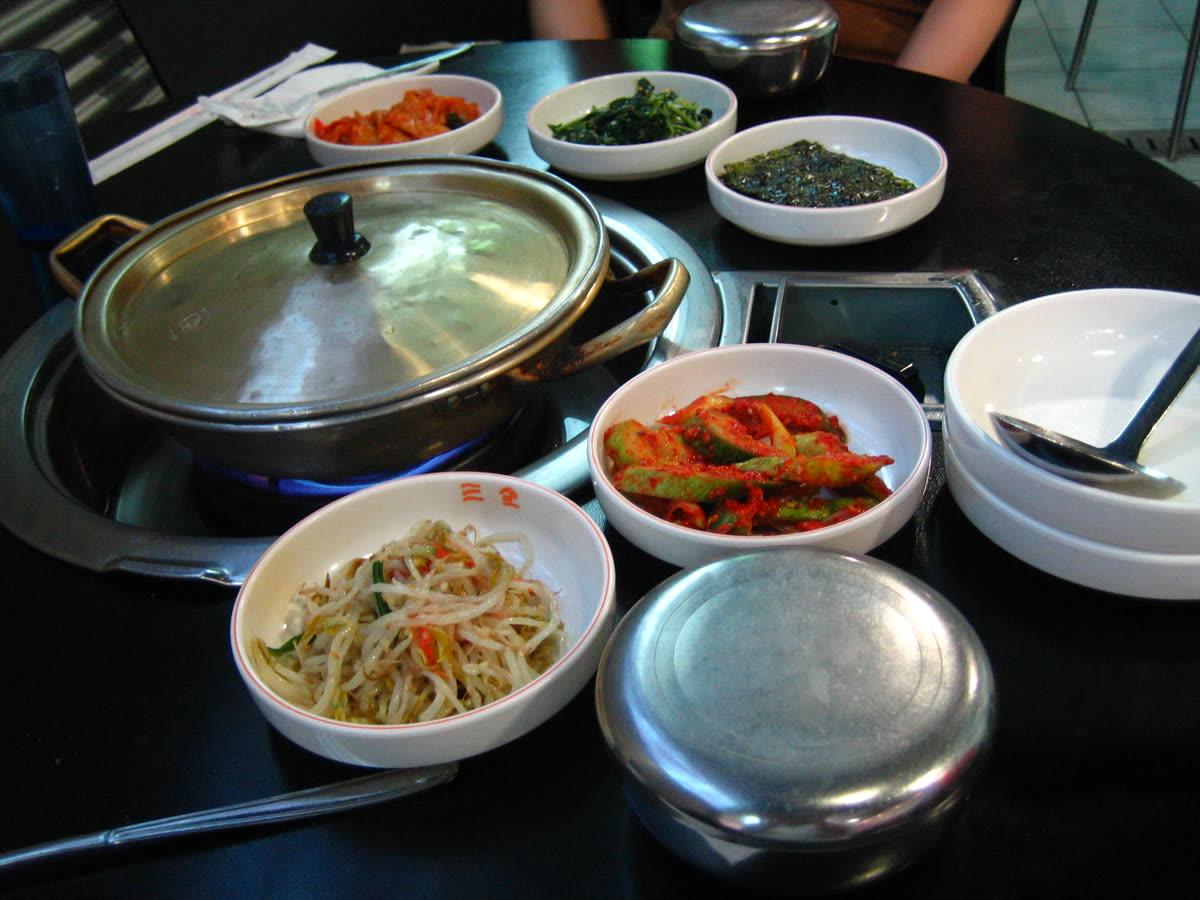
The three safest picks are braised fish, bibimbap or bulgogi, and steamed shellfish or samgyetang.
Braised mackerel (godeungeo-jorim) and braised hairtail (galchi-jorim) are cooked well past the FDA’s 145°F (63°C) fish temperature and use low-mercury fish, so they fill your 2-3 weekly fish servings without the mercury question.
If iron is on your mind, fully cooked beef dishes count there too — the pregnancy iron target is 27 mg a day, roughly 3.3 times the 8.1 mg for non-pregnant women, and bulgogi, galbi-jjim and seolleongtang all provide well-absorbed heme iron.
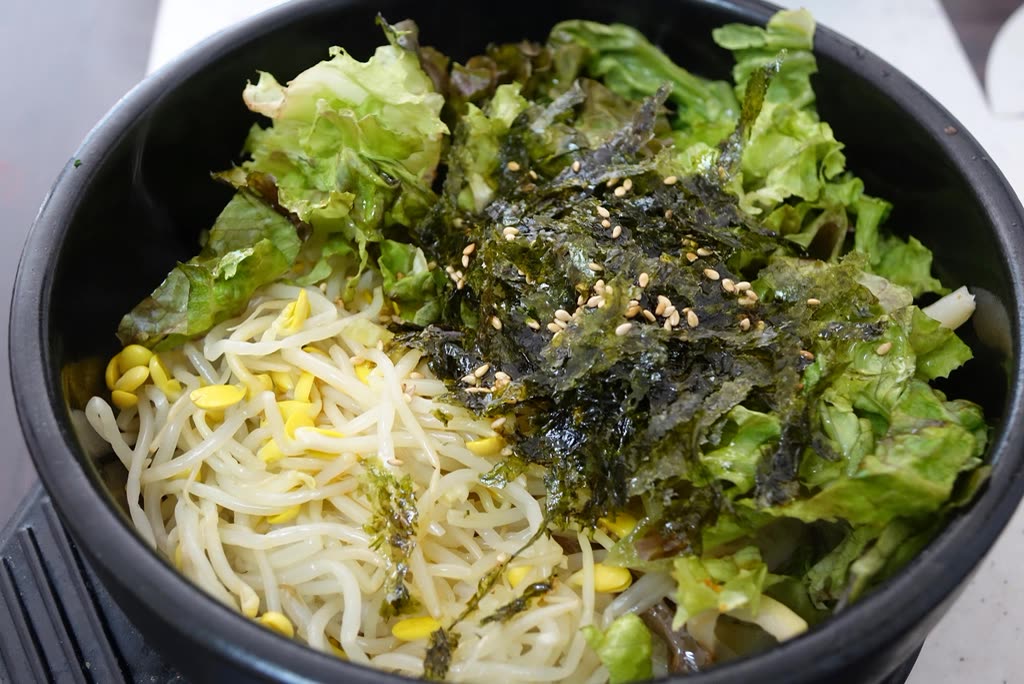
Bibimbap and bulgogi are considered safe when the egg is cooked through and raw sprouts are left out, which makes them the easiest balanced order on a mixed menu.
Steamed shellfish such as honghap, or rice cooked over crab or clams (gastae-bap), is the swap for hwe — thorough cooking removes the raw-shellfish risk.
Samgyetang also works as a one-dish meal: the chicken, jujube and rice are nutritious and safe when fully cooked, and ordinary food-season amounts of ginseng are not restricted.
Tofu and soy foods are safe as well — sundubu-jjigae, soy milk, and kongguksu from a trusted, refrigerated source all count toward the roughly 71 g of daily protein needed in the second half of pregnancy.
If you want one order that needs no edits, hot stew with tofu plus a rice bowl and vegetable banchan is it.
3 Korean dishes and habits to limit
The three things to limit are raw fish, salted soups, and large daily servings of seaweed soup.
Raw fish (hwe) is the clearest cut — food-safety authorities list raw seafood among the foods pregnant women should not eat, and the firm rules you can rely on are cooking fish to 145°F (63°C) and choosing cooked shellfish instead.
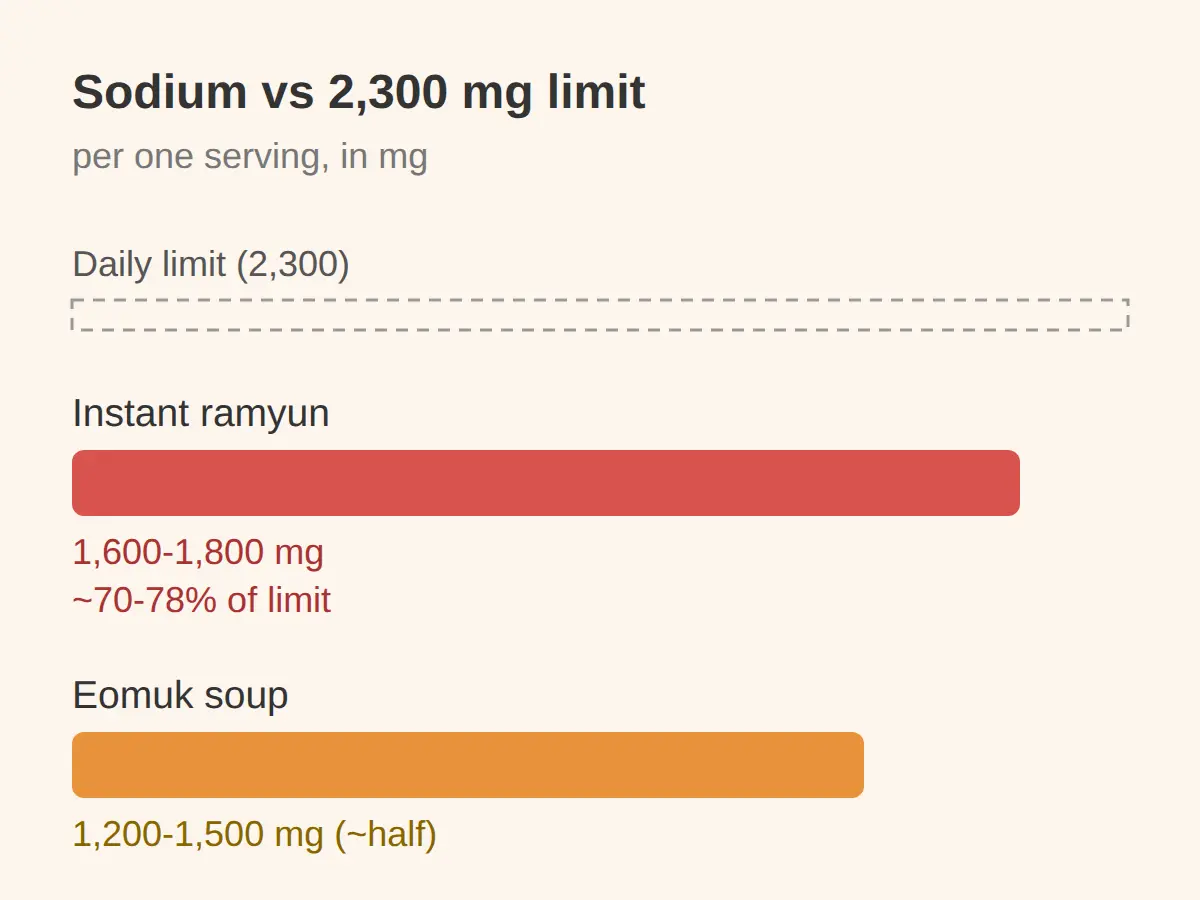
Salty soups are a math problem rather than a ban: a bowl of Korean soup or jjigae can contain 800-1,800 mg sodium against the 2,300 mg/day pregnancy limit, so more than one salted soup dish a day gets close to the ceiling.
Seaweed soup (miyeokguk) is the habit to break precisely because it is customary to eat daily — WHO and UNICEF set pregnancy iodine intake at 250 mcg a day with a 600-1,100 mcg upper limit, and large daily seaweed portions can pass it, especially alongside kombu-based broths.
Raw sprouts are a quieter one: kongnamul served raw in some banchan should be skipped even when home-grown, because bacteria can sit inside the seed itself and washing does not remove them — cooked kongnamul in soup or banchan is fine.
A single ramyun packet or eomuk bowl can eat 50-80% of your day’s sodium before the side dishes count, so check the nutrition label on the packet before making it a habit.
If a dish is raw, skip it; if it is salty, once a day; if it is seaweed, rotate it rather than eating it every morning.
How much sodium is too much in Korean food while pregnant?
The numbers behind a day of Korean meals:
| Item | Sodium |
|---|---|
| Daily limit in pregnancy | under 2,300 mg |
| One bowl of Korean soup or jjigae | 800-1,800 mg |
| Share of the day’s allowance in one bowl | 35-78% |
That means a single bowl can cover 35-78% of the day’s allowance before you add kimchi, pickles and seasoned banchan, each of which carries its own sodium.
Stew figures are ranges rather than lab-tested values, and per-serving sodium for kimchi-jjigae or sundubu varies by restaurant, so treat any single number as an estimate.
For packaged foods the label is your exact source — a packet of Korean instant ramyun lists its own sodium figure, so read it instead of guessing.
The practical cap: at most one salted soup dish per day, and if lunch was jjigae, make dinner a low-sodium plate like rice, cooked fish and fresh vegetable banchan.
If you eat soup or stew daily, pick which one gets your sodium budget instead of stacking two.
Kimchi, miyeokguk and samgyetang — what readers actually ask
Kimchi is safe when it is commercially made and eaten fresh.
Fermented kimchi is generally fine in pregnancy when made from pasteurized or cleanly prepared ingredients, and kimchi produced in Korea is HACCP-regulated; the higher-risk versions are long-refrigerated batches and unpasteurized home ferments, which carry more Listeria risk.
The same logic covers doenjang and gochujang — commercial versions are safe in normal food amounts, homemade unpasteurized pastes are not.
Miyeokguk is fine in moderation but not in large daily bowls — iodine, not bacteria, is the reason, since seaweed is very high in iodine against that 600-1,100 mcg daily ceiling.
Samgyetang is fine when fully cooked; the one restriction is concentrated ginseng supplements or extracts, which lack pregnancy safety data, while the culinary ginseng inside the soup is not restricted.
Honey-sweetened teas like yuja-cha and maesil-cha are also fine — honey is safe for pregnant women because the botulism risk applies to infants under 1, not to the womb.
If you cannot tell how old a kimchi batch is or who made it, choose a sealed commercial jar instead.
Eating Korean food in Korea while pregnant: eggs, meat, street food and drinks
The practical rules come down to temperature, cooking, and one caffeine cap.
Cook Korean BBQ meat through — CDC advice on toxoplasmosis means no rare pork belly or beef, unlike how locals often eat it.
Reheat store-bought kimbap, leftover rice and day-old banchan until steaming hot (74°C / 165°F); refrigerate cooked rice within 2 hours and use it within 3-4 days.
Cook eggs until the yolk and white are firm — steamed egg (gyeranjjim) is safe, but raw-egg toppings and homemade mayonnaise on Korean salads should be skipped.
Choose hot, freshly cooked street food like hotteok or fish cakes served steaming, and pass on items held at room temperature or containing raw seafood such as raw-tuna gimbap.
Keep total caffeine under 200 mg a day; Korean barley tea sits at zero, so it is the safe default over coffee and sweet caffeinated drinks.
Honey teas are fine, but unpasteurized fresh-pressed juices at cafes are the drink to check — ask whether the juice is pasteurized before ordering.
I would order hot stews, braised fish and vegetable banchan, and treat hwe and raw toppings as post-pregnancy items — every safety rule above points the same way.
Related posts
Sources
- Canned light tuna is low-mercury (2-3 servings/week ok); alb (fda.gov)
- Caffeine limit (acog.org)
- Unpasteurized/long-refrigerated fermented foods carry Lister (cdc.gov)
What to remember
- One line splits a Korean menu while pregnant: hot and cooked is in, cold and raw is out.
- Cooked low-mercury fish 2-3 times a week (224-336 g), cooked to 145°F (63°C), fills the fish recommendation.
- One salted soup dish a day — a bowl can hold 800-1,800 mg of your 2,300 mg sodium limit.
- Rotate miyeokguk instead of drinking it daily; the iodine ceiling in pregnancy is 600-1,100 mcg a day.
- Buy commercial kimchi and pastes, reheat takeout to 165°F (74°C), and keep caffeine under 200 mg a day.
FAQ
Q. Is Korean food generally good for pregnancy?
Yes — cooked Korean meals fit well: vegetable banchan supports folate, cooked low-mercury fish fills the weekly fish target, and hot stews are among the safer choices. Raw items are the exception.
Q. Is raw fish (hoe/sashimi) safe in pregnancy?
Skip it while pregnant. The firm, checkable rule is cooking fish to 145°F (63°C), and cooked shellfish like steamed honghap is the safe swap for hwe.
Q. Is kimchi safe during pregnancy?
Commercially made kimchi is generally safe when eaten fresh. Long-refrigerated batches and unpasteurized home ferments carry higher Listeria risk, so choose sealed commercial jars.
Q. Can I eat miyeokguk (seaweed soup) every day while pregnant?
Not in large daily portions. Seaweed is very high in iodine, and the pregnancy upper limit is 600-1,100 mcg a day against a recommended 250 mcg, so rotate it rather than eating a big bowl daily.
Q. Is samgyetang (ginseng chicken soup) OK in pregnancy?
Yes, when fully cooked — the chicken, jujube and rice are nutritious. Avoid concentrated ginseng supplements or extracts, which lack pregnancy safety data; the culinary ginseng in the soup is not restricted.
For detailed sodium numbers, see our Korean food sodium breakdown before ordering jjigae.
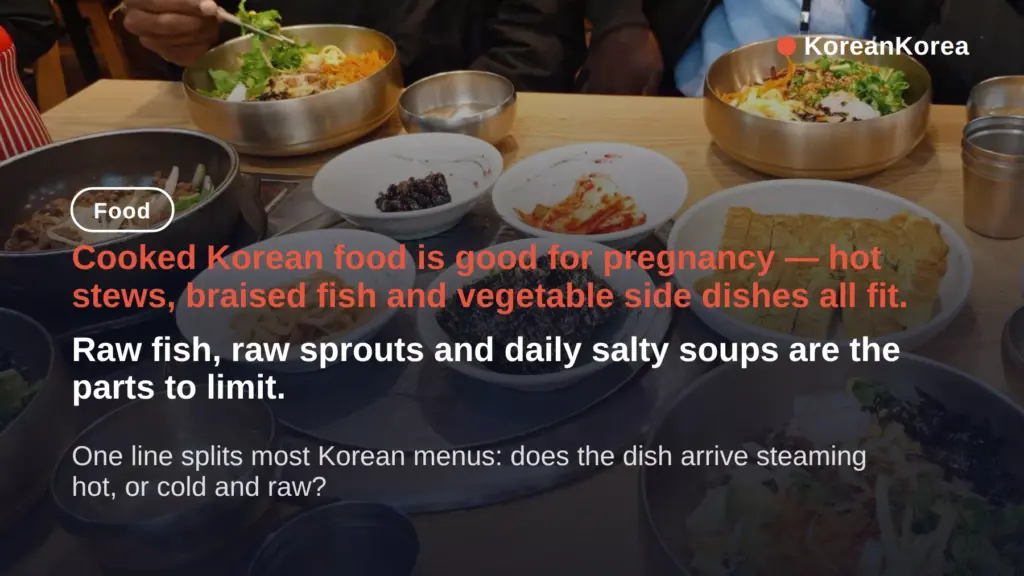
Cover photo: A top-down view of a wooden table filled with various Korean dishes. Large brass bowls contain bibimbap with fresh vegetables and rice, while smaller side dishes of kimchi, seaweed, rolled omelets, and marinated beef are arranged in the center. by Mohammed Kateregga — CC0 1.0
#koreanfood #pregnancydiet #koreanfoodpregnancy #kimchisafety #miyeokguk #samgyetang #sodium
📅Upcoming Dates — 이번 주 32 · D-day Chuseok holiday period — rice cake interest peaks전체 보기 →