Yes — Seoul is safe for solo female travellers: Numbeo rates the city 76.5 out of 100 for safety, and the 2026 Women, Peace and Security Index gives Korea 0.91, its very-low-risk rating.
Is Seoul Safe for Solo Female Travellers? The Short Answer
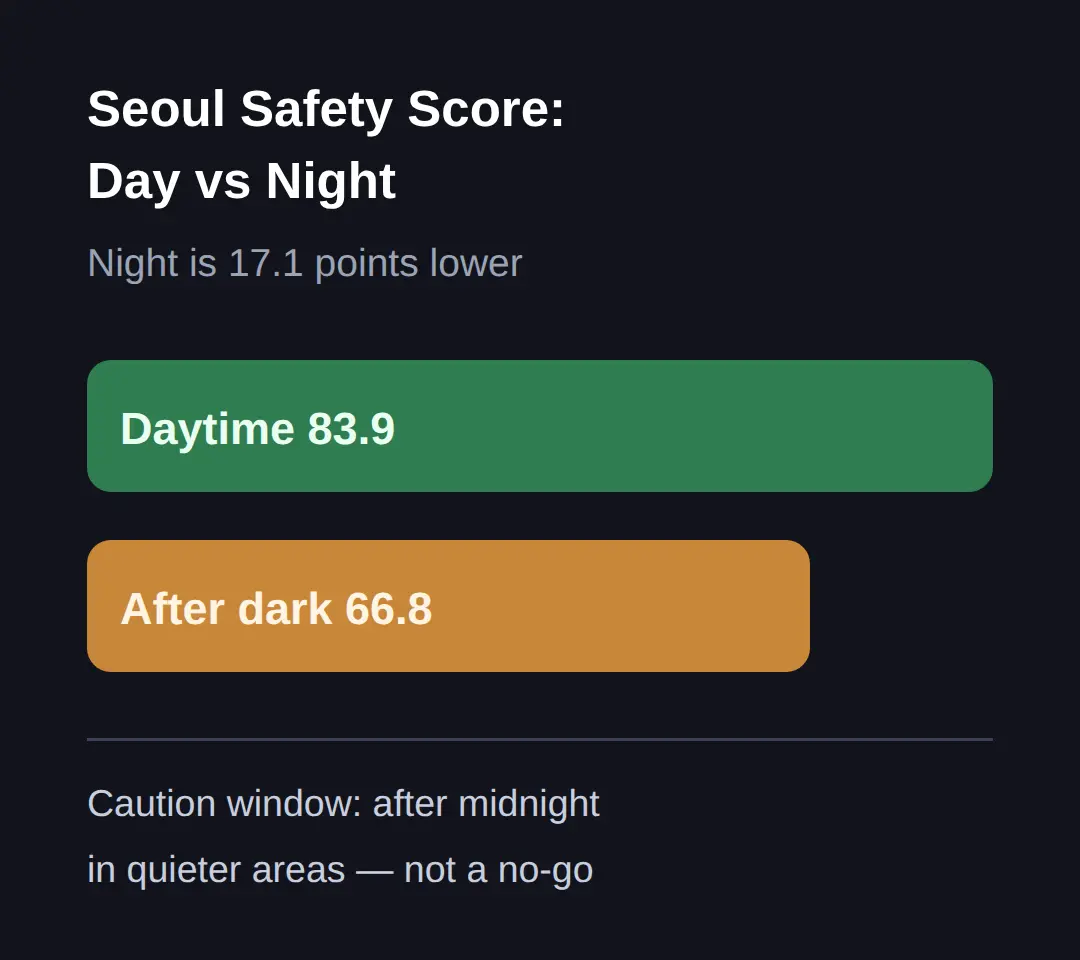
| Numbeo safety index, Seoul | 76.5 / 100 (daytime 83.9, night 66.8) |
|---|---|
| Numbeo crime index, Seoul | 23.5 (low) |
| 2026 Women, Peace and Security Index, Korea | 0.91 — very low risk |
| T-money subway/bus base fare | ₩1,250 (~$0.95) |
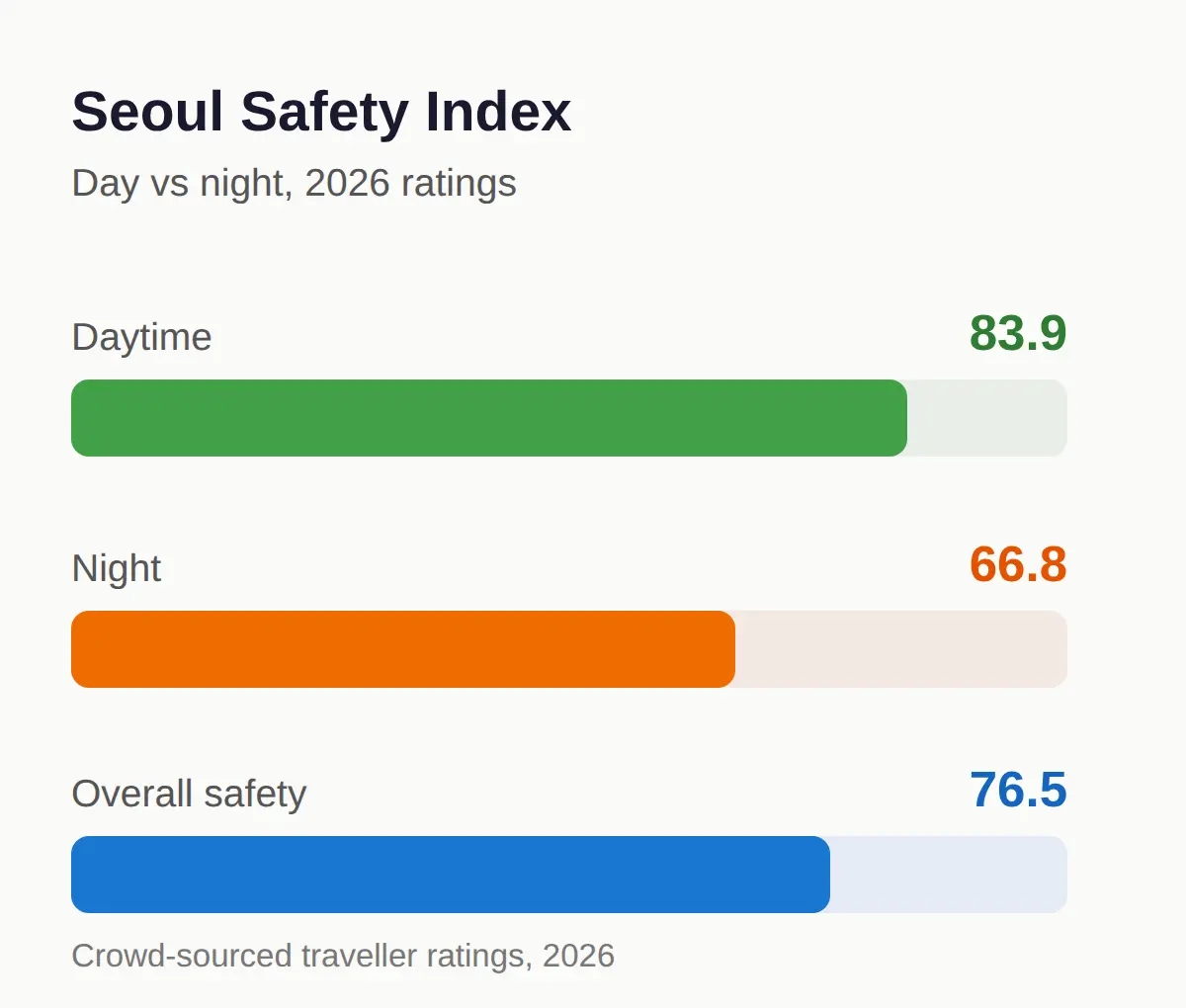
Yes — the numbers behind it are a safety index of 76.5 out of 100, a daytime score of 83.9, and a night score of 66.8, all from crowd-sourced traveller ratings collected in 2026.
Korea also scores 0.91 on the 2026 Women, Peace and Security Index, a very-low-risk rating for women’s safety.
One caveat before you plan around these numbers: they measure how safe residents and travellers say they feel, not police-reported crime — official 2026 crime statistics for Seoul were not located in primary sources.
What the numbers do line up with is the pattern on the ground: crime is mostly non-violent, mainly pickpocketing in crowded markets and festivals.
If you keep your bag zipped in crowds and plan your way home after dark, the general score covers your trip.
Seoul at Night: What Actually Changes After Dark
Night is safe but 17.1 points weaker — the safety score falls from 83.9 in daytime to 66.8 after dark.
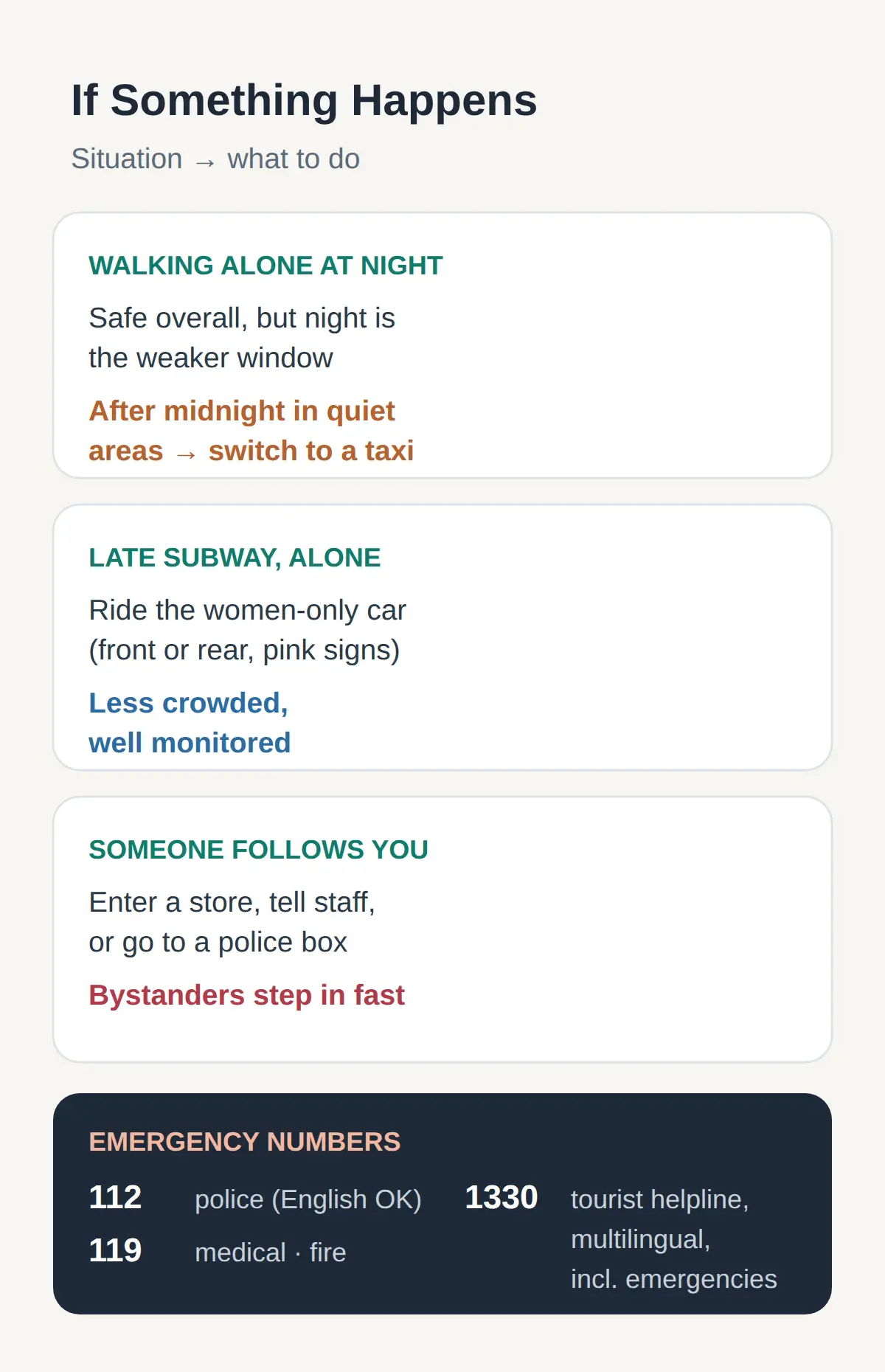
The gap is enough to change how you move, not whether you go out: the main caution window is after midnight in quieter areas.
Quieter parts of the city have a calmer night character that works in your favour — Insadong is quiet at night with teahouses and galleries, while Itaewon stays lively and loud late.
If you need to wait somewhere after midnight, many cafés stay open late and stay well lit (drinks plus pastry runs ₩5,000–10,000), and convenience stores have seating.
If I’m out late in an unfamiliar neighbourhood, the first thing I check is when the last train leaves and where the nearest well-lit place to wait is — that decides whether I walk or book a ride.
The Subway Alone at Night: Women-Only Cars and Last Trains
Most subway lines run late-night women-only cars — the front or rear car, marked with pink signage — and you can find exactly which one in the Kakao Map app.
Kakao Map shows the women-only car position and real-time subway congestion, which Google Maps does not; the GG25 or Subway Korea app shows the same positions with arrival times.
These cars are not mandatory, so treat them as designated spaces: they are usually less crowded, well monitored, and full of women commuters, and they are most useful late at night.
Last trains depart around 11:30 PM on most lines (some run until midnight), and trains come every 3–5 minutes during the day — waiting for the next one is always an option.
The exact late-night hours for women-only cars vary by line and are not confirmed from Seoul Metro, so check the app that night rather than planning around a fixed schedule.
Getting Home Late: Taxi Apps and Going Cashless
If you miss the last train, book a Kakao T taxi instead of walking — the app tracks the driver, handles payment in-app, and removes the language barrier, which is why travellers rate it safer than hailing on the street.
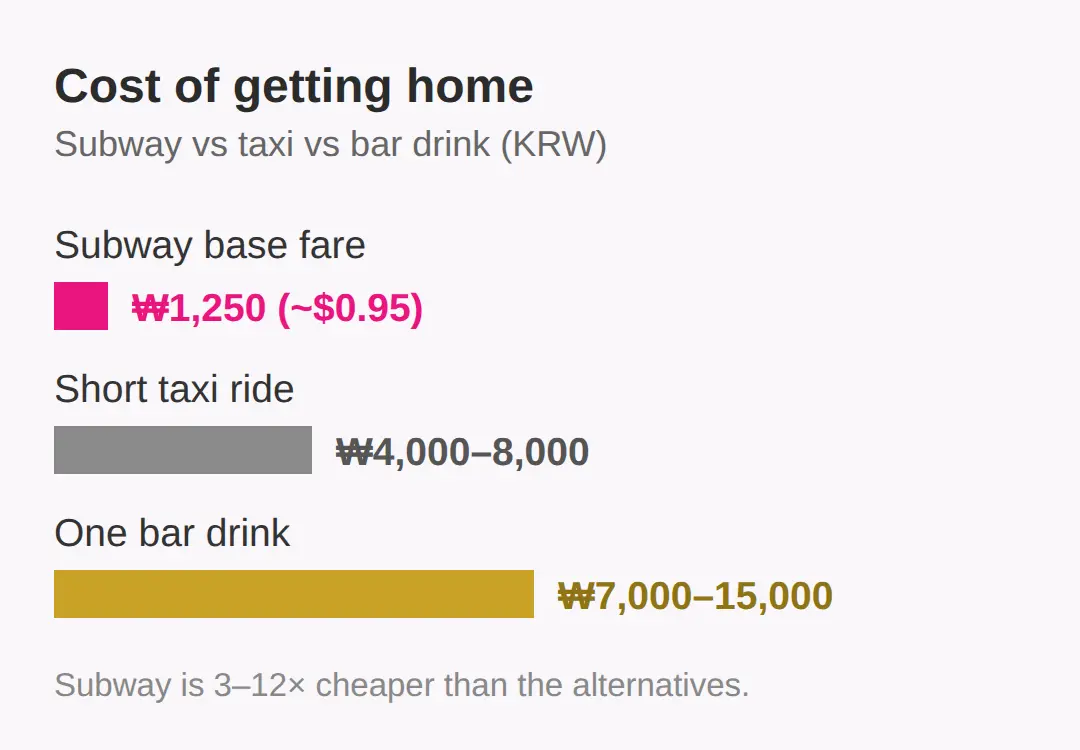
A short app-based ride costs roughly ₩4,000–8,000 according to guide sites — 3.2 to 6.4 times the ₩1,250 subway base fare, so walking one more station wins in daylight, but after midnight the taxi is worth it.
All-night buses also run on major routes if you know your stop.
Payment is mostly cashless across the city and there is no tipping culture, which means less cash in your pocket as a tourist.
Korea is effectively cashless and has no tipping culture, which lowers the risk of handling cash as a tourist — the friction point is that using Kakao T without a Korean resident card takes some planning, so set up your payment method before you need a late ride.
Eating, Drinking and Singing Alone — With Prices
Eating alone is completely normal in Seoul: solo diners appear at every establishment, and many restaurants have counter seating built for one.
A kimbap-rice-soup shop (gimbap-cheonguk) meal runs ₩3,000–5,000 and a gukbap meal ₩7,000–10,000 — the kimbap shop is 43–50% cheaper — and department-store food courts at Lotte and Shinsegae have counter seats too.
If you’re too tired to go out, Coupang Eats or Naver Order delivery is listed as a safe option from your room.
At night, small noraebang (karaoke) rooms for one or two cost about ₩10,000–20,000 per hour, and a standard bar drink runs ₩7,000–15,000.
On the drink price scale, one bar drink costs 5.6–12 times the subway fare — and if a drunk man approaches you at a bar, move away and tell staff immediately; bartenders take it seriously and being rude in self-defense is acceptable here.
If Something Happens: Who to Call and What to Do
Dial 112 for police (English available) and 119 for medical emergencies and fire; 1330 is the tourist helpline with multilingual interpretation, including in emergencies.
If someone follows you while you’re walking, enter a store, tell the staff, or head to a police box — they are everywhere — and call 112.
Bystanders typically step in fast: street harassment is less frequent than in many countries and mostly verbal, and in one reported case an entire bus stopped to help a woman being bothered.
Public places are well covered by CCTV, police presence is strong, and response in public places is fast.
Install Naver Papago for menus and street signs (it handles Korean better than Google Translate), and if you want company at night, keep watch of your drink in Itaewon nightlife — spiking is rare but documented — and return by Kakao T rather than walking.
If I were very late and didn’t know the area, I’d spend the ₩4,000–8,000 on an app-based taxi rather than walk through unfamiliar neighborhoods — knowing exactly which car is coming and having the trip tracked is worth more to me than saving a few thousand won.
Related posts
📎 Seoul — everything we know
📎 📅 Upcoming Dates — Release & Event Calendar
Sources
- No first-party fare page reached in this pass; fare values s (qeepl.com)
- OK Hostel: T-money base ₩1,250; solo-dining venues (gimbap-c (okhostel.com)
- KoreaPeek: women-only cars pink-marked front/rear, not manda (koreapeek.com)
Your Situations, Answered
- After midnight in quiet areas, switch to an app taxi — the night safety index (66.8) is clearly lower than the daytime figure (83.9).
- Late-night subway: ride the front or rear car with pink signage on most lines — less crowded and well monitored.
- Missed the last train (~11:30 PM)? Book a Kakao T (₩4,000–8,000 for a short ride) or catch an all-night bus on a major route.
- If someone follows you: walk into a store, tell the staff, head to a police box — and 112 works in English.
- A drunk man approaches you at a bar? Move away and tell staff immediately — bartenders take it seriously, and being rude is acceptable self-defense here.
- Carry almost nothing to lose: Korea is effectively cashless and there’s no tipping culture.
FAQ
Q. Is Seoul safe for solo female travellers at night and on the subway?
Yes. The night safety score is 66.8 versus 83.9 in daytime, so it’s the weaker window — ride the pink-signage women-only car on most lines, and take a taxi after midnight in quiet areas.
Q. Is Seoul safe for solo female travellers?
Yes. Numbeo gives Seoul 76.5/100 for safety with a crime index of 23.5, and the 2026 women’s safety index gives Korea 0.91 — its very-low-risk rating.
Q. What time is the last subway train in Seoul?
Most lines depart around 11:30 PM, some run until midnight. After that, all-night buses cover major routes and a short Kakao T ride costs about ₩4,000–8,000.
Q. Can I eat alone in Seoul without it being awkward?
Completely. Koreans eat alone constantly, counter seating is common, and a kimbap-shop meal costs ₩3,000–5,000 or a gukbap ₩7,000–10,000.
Q. What should I do if someone follows me in Seoul?
Enter a store, tell the staff, or walk to a police box, then call 112 for police or 1330 for multilingual help.
Numbers in this post are as of September 29, 2026. Subway and taxi fares come from travel guide sites, not the official Seoul Metro fare table, so values may be one revision behind — confirm the current fare when you tap your card.
Cover photo: Seoul Children’s Grand Park (서울어린이대공원) by Korea Tourism Organization — KOGL Type 1 (attribution)
#Seoulsafety #solofemaletravel #Seoulnightsafety #women-onlysubwaycar #KakaoTtaxi #Seoulsolodining #Koreatravel2026
📅Upcoming Schedule — this week 23 · D-day Autumn season = post-summer brightening demand window (UV drSee all →