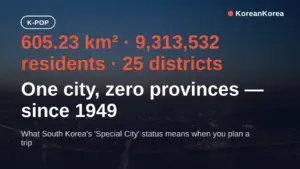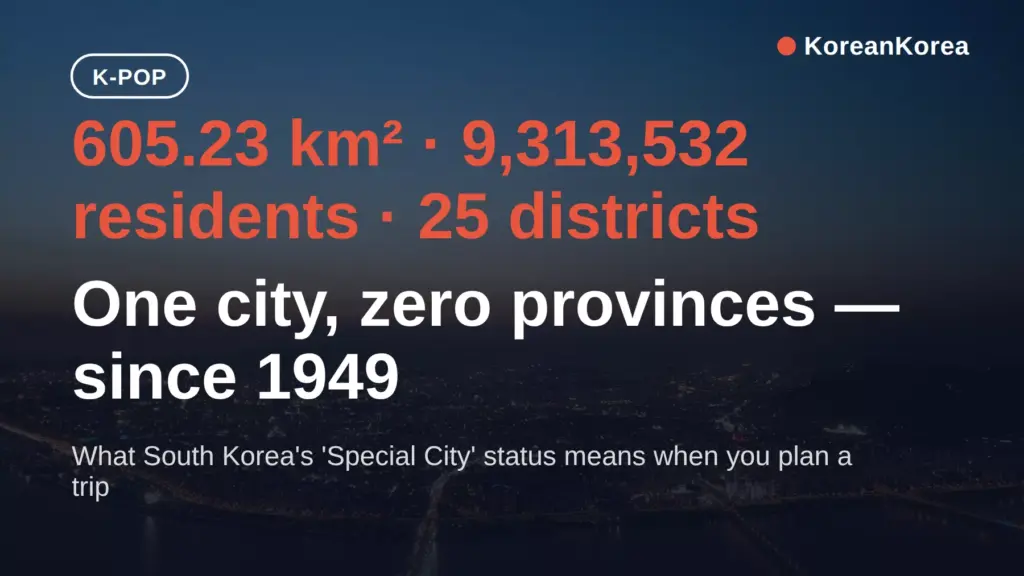
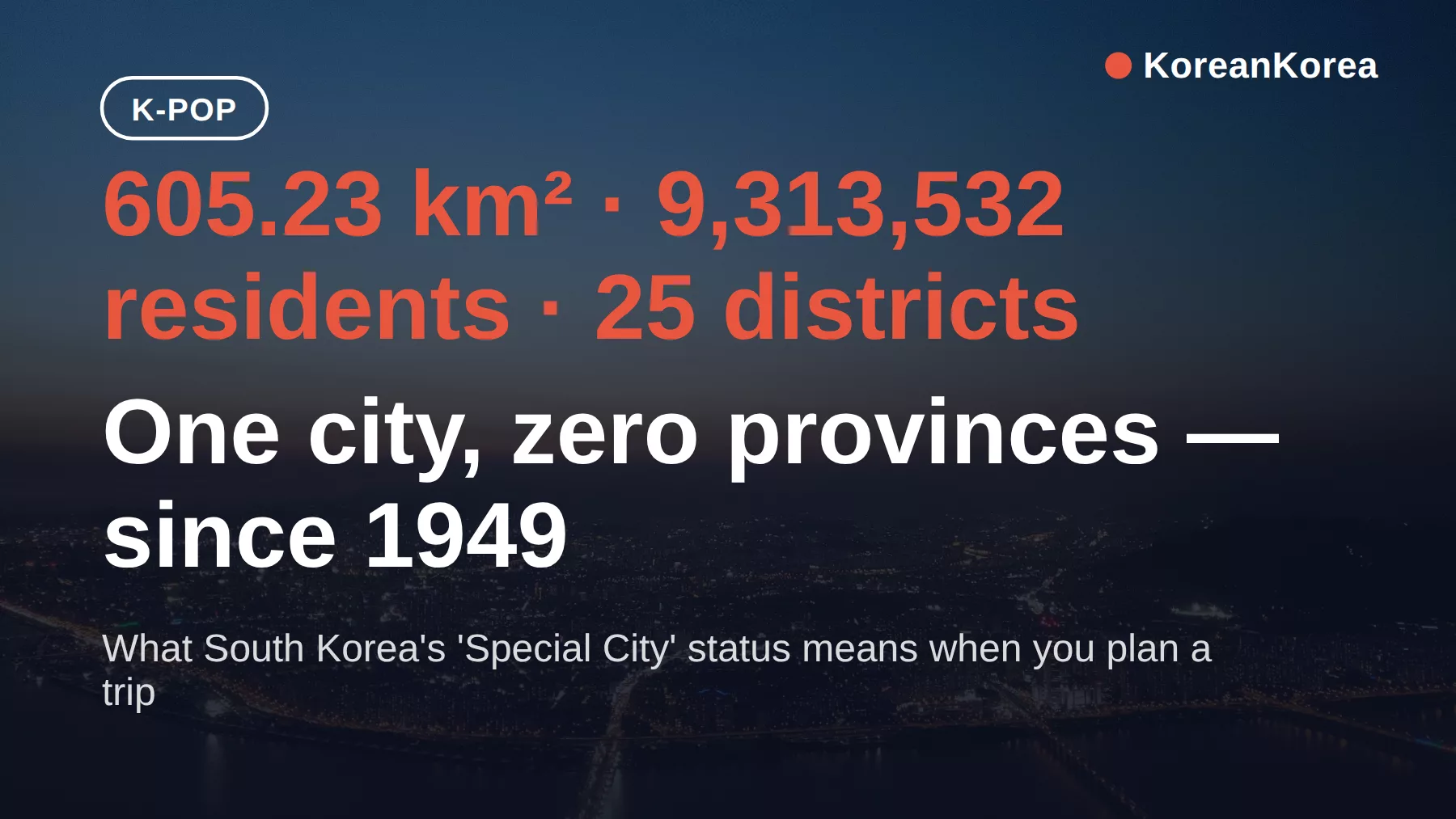
Seoul is a city, not a province — it has been South Korea’s only ‘Special City’ (teukbyeolsi) since 1949, completely surrounded by Gyeonggi Province but not inside it.
That means no border crossing, no separate fare system and no visible line where the city ends when you travel around the capital.
This post covers the status question, Seoul’s key numbers, whether it counts as a megacity, and what the city/province split means for a first trip.
Contents
- Is Seoul a city or province? It’s neither — it’s a Special City
- Seoul by the numbers: area, population, districts
- Is Seoul a megacity?
- Is Seoul in Gyeonggi-do? Why are they separate?
- What the city/province thing means for your trip
- Inside the boundary: palaces, UNESCO sites and one word
Is Seoul a city or province? It’s neither — it’s a Special City
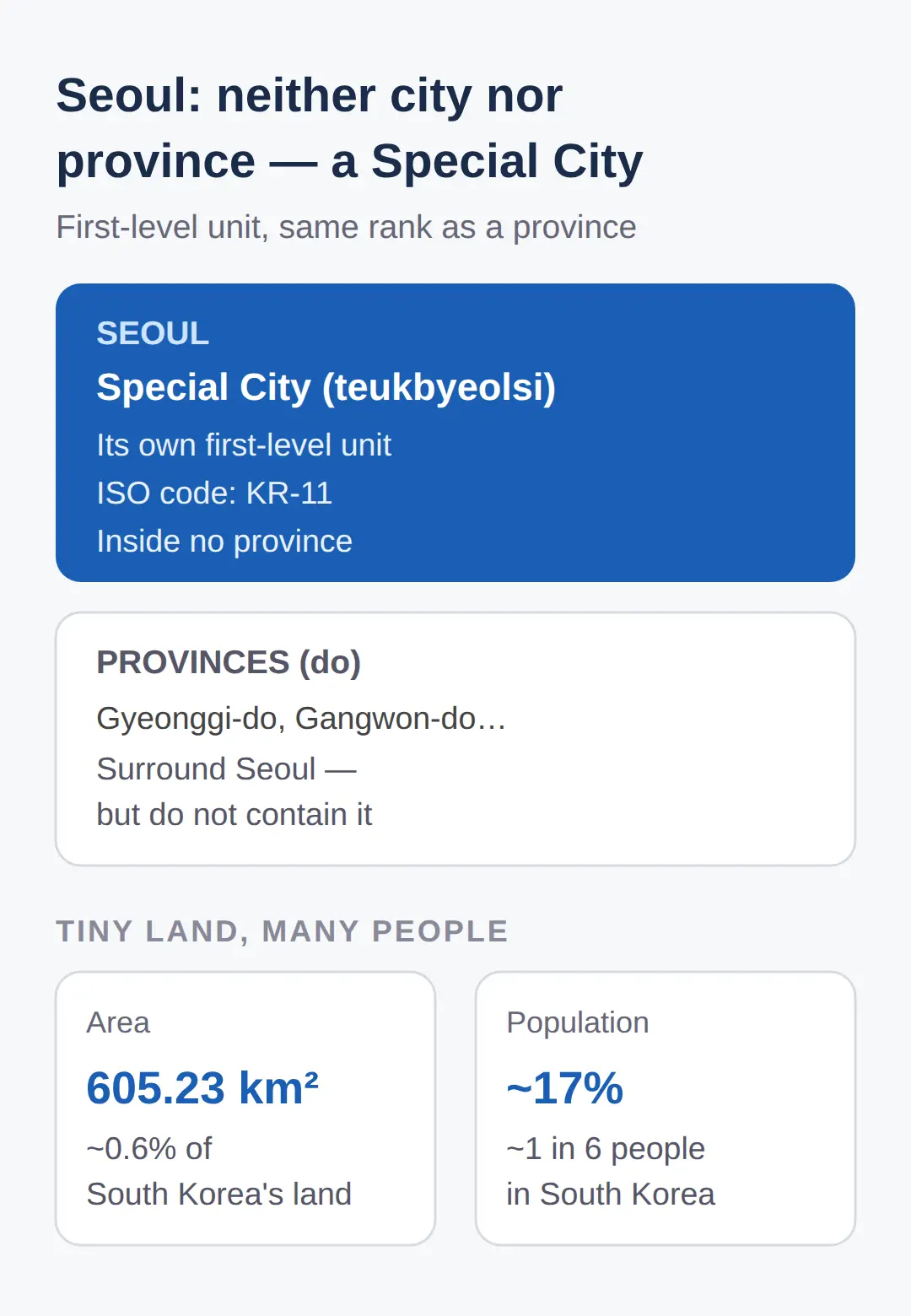
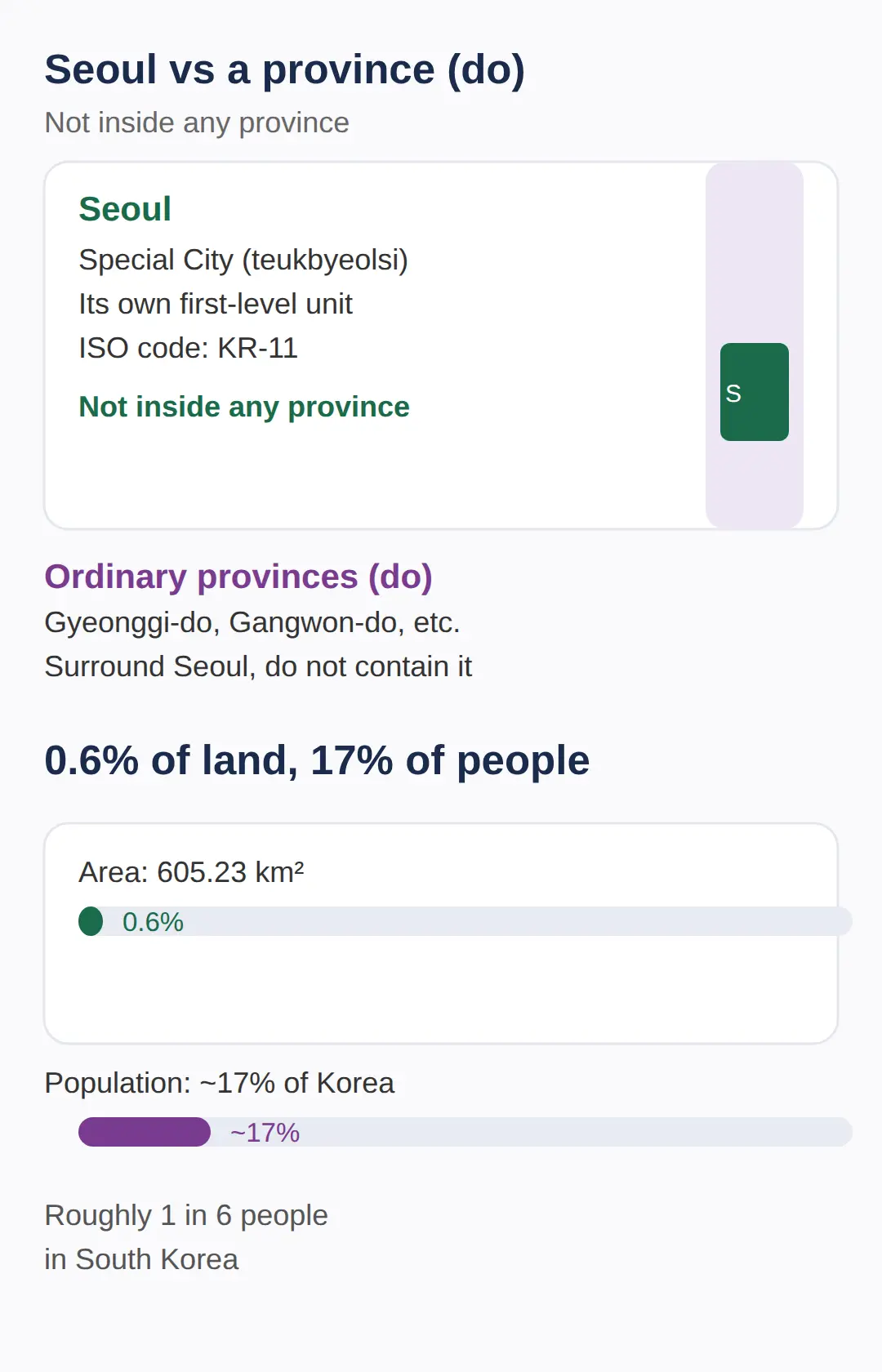
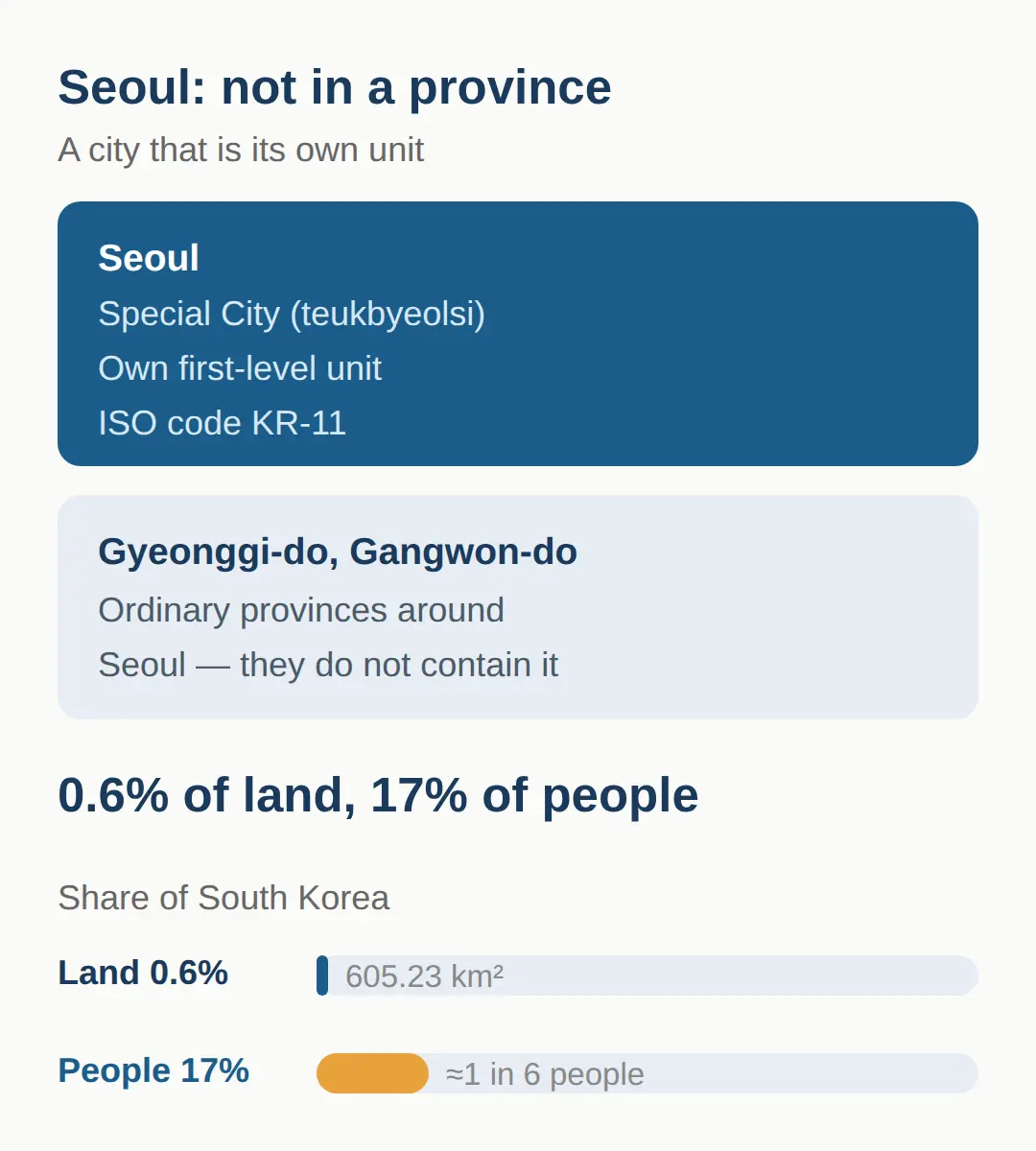
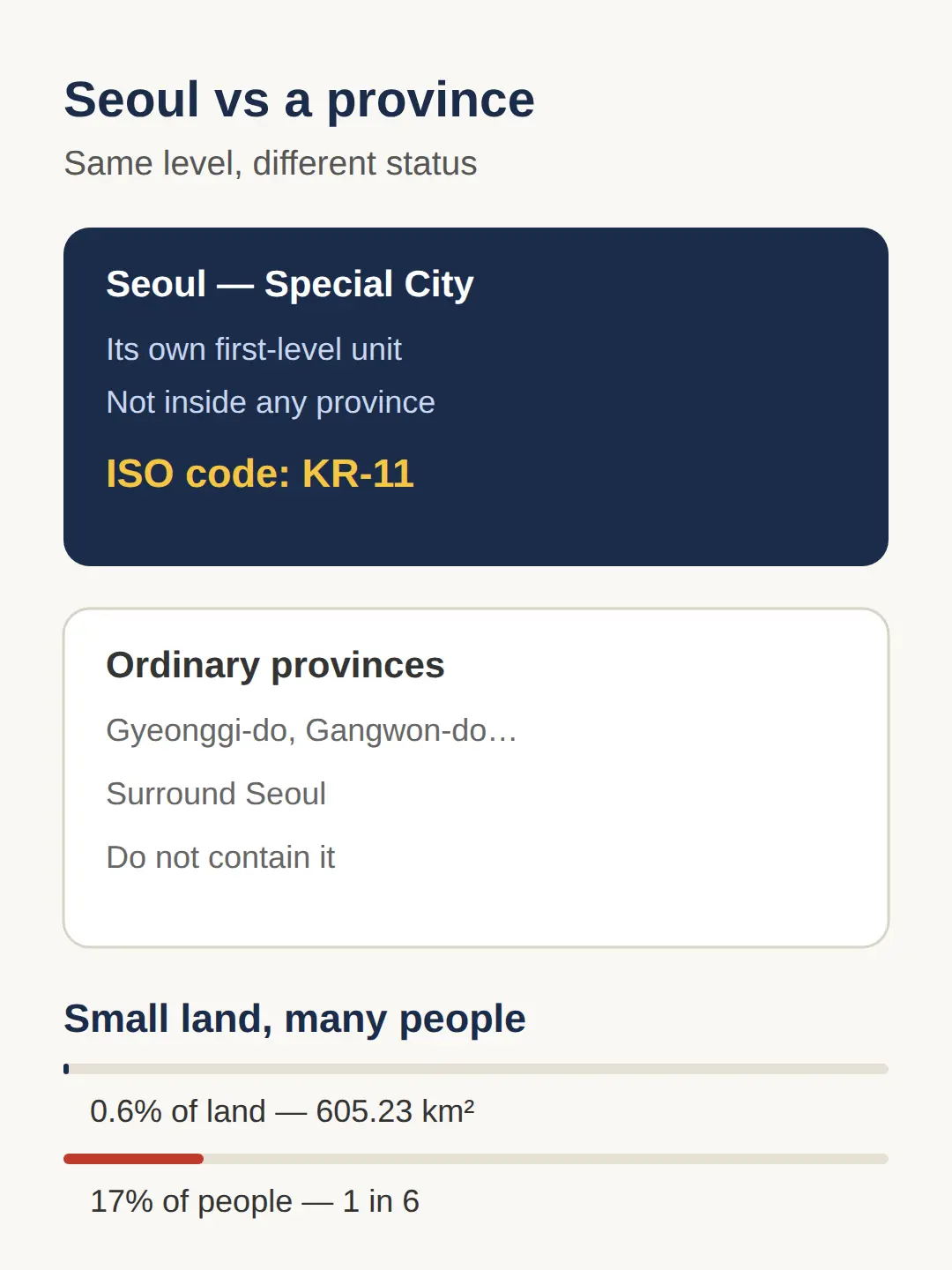
Seoul is a city — South Korea’s only ‘Special City’ (teukbyeolsi), a first-level administrative unit with the same rank as a province.
Korean provinces are units like Gyeonggi-do and Gangwon-do, and Seoul belongs to none of them.
It has held this status since 1949, when it was separated from Gyeonggi Province, and it remains the only city in the country with the designation.
Geographically it is an enclave: Gyeonggi Province surrounds Seoul on all sides, but the two are neighbors, not parent and child.
If your search started because a map showed Seoul inside Gyeonggi-do, the boundary on the map is administrative only — for a traveler, nothing changes at the line.
| Status | Special City (teukbyeolsi) — the only one in South Korea, since 1949 |
|---|---|
| Area | 605.23 km² — about 0.6% of South Korea’s land |
| Registered residents | 9,313,532 (October 2025) — about 17% of the national population |
| Districts | 25 self-governing gu (14 north, 11 south of the Han River) |
| Smallest units | 426 administrative dong (November 2025) |
| ISO / area code | KR-11 / 02 |
Seoul by the numbers: area, population, districts
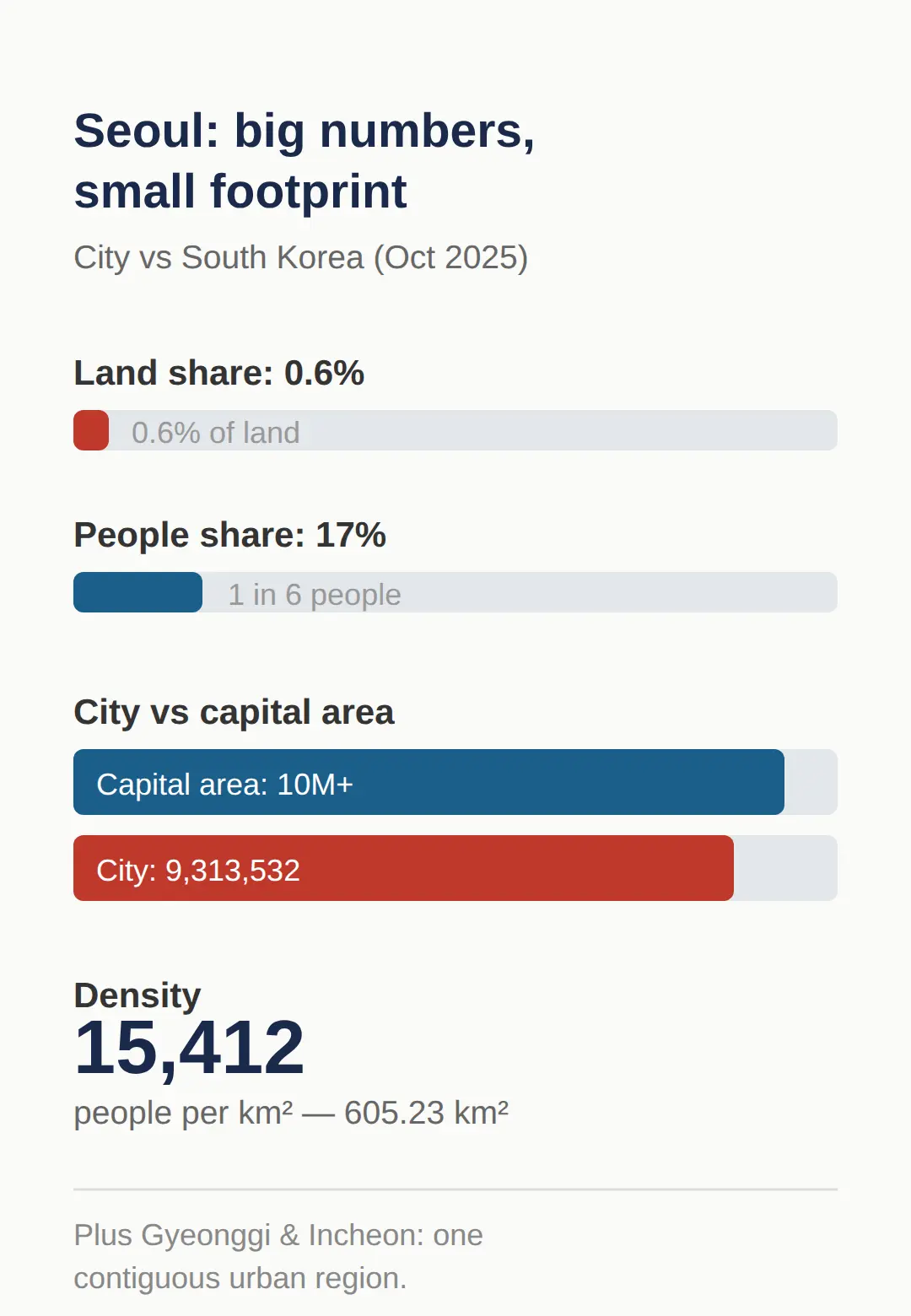
As of October 2025, Seoul has 9,313,532 registered residents on 605.23 km² — about 0.6% of South Korea’s land holding about 17% of its people.
| Metric | Value |
|---|---|
| Area | 605.23 km² (about 0.6% of South Korea) |
| Registered residents | 9,313,532 (October 2025) |
| Share of national population | About 17% |
| Self-governing districts (gu) | 25 — 14 north of the Han River, 11 south |
| Administrative dong | 426 (as of November 2025) |
| Largest district by population | Songpa-gu |
| Smallest district by population | Jung-gu |
That works out to roughly 1 in 6 South Koreans living in Seoul, a concentration of people on a tiny slice of land (about 28× the national average density, since 0.6% of the land carries 17% of the population).
For trip planning, the useful number is the density: about 15,412 people per km², which is why the city feels far bigger than its 605 km².
Is Seoul a megacity?
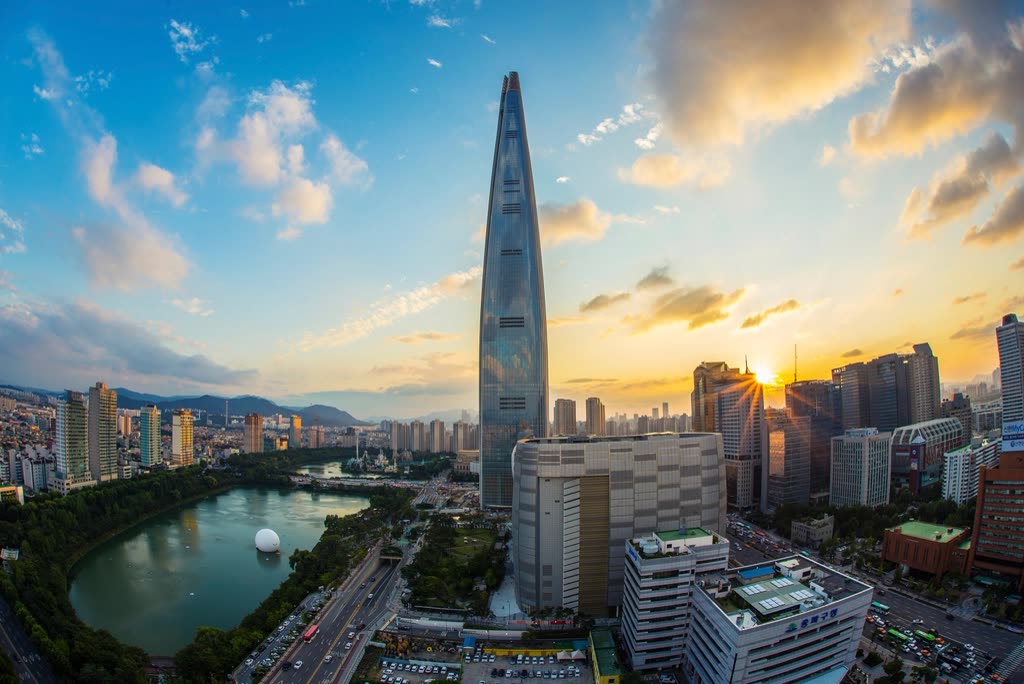
Yes — the city alone has 9,313,532 registered residents as of October 2025, and the wider capital area pushes well past 10 million.
Population density inside the city is about 15,412 people per km², one of the highest figures for a national capital.
Seoul also anchors the Seoul Capital Area (Sudogwon), which includes Gyeonggi Province and Incheon as one contiguous urban region.
If someone asks whether Seoul is ‘too big to see in one trip,’ the honest answer is that the city alone needs several days, and the capital area needs a week or more.
Is Seoul in Gyeonggi-do? Why are they separate?
Seoul is not inside Gyeonggi-do — it was pulled out of the province in stages over the 20th century.
The city was Hanseongbu under the Joseon dynasty, renamed Gyeongseong-bu in 1910, renamed Seoul and made a ‘Special Free City’ in 1945, and given its current Special City status in 1949.
All three branches of the national government — including the National Assembly in Yeouido — sit inside the city, and its regional GDP was about 422 trillion KRW in 2018, roughly half of South Korea’s total.
If you are booking accommodation ‘in Gyeonggi-do to save money,’ check the subway map first: many Gyeonggi cities sit closer to central Seoul than Seoul’s own southern districts.
What the city/province thing means for your trip
Treat ‘Seoul’ and ‘the capital area’ as one destination — the urban area continues into Incheon, Seongnam and Suwon with no visible border.
Seoul’s subway runs beyond the city limits into Gyeonggi-do and Incheon on metropolitan rail lines, so roughly a 1-hour subway radius from the city center is all one network.
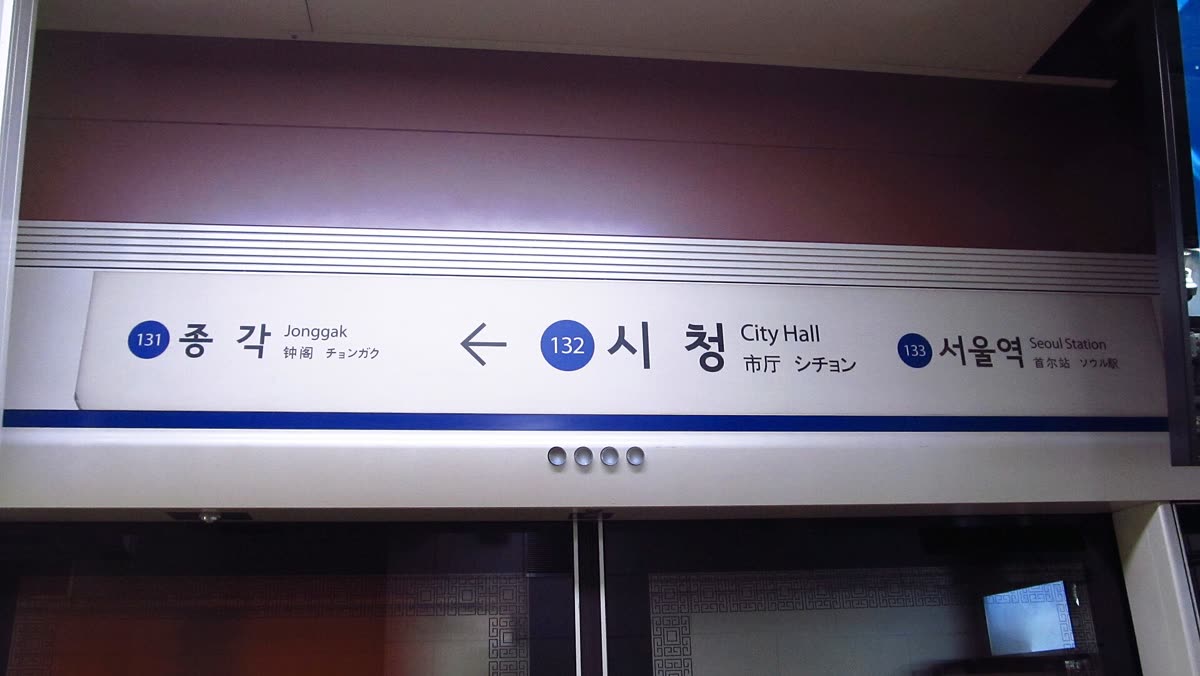
Trains run from about 5:30am to midnight, and major stations have English signage alongside Chinese and Japanese.
For the airport, the AREX express train links Incheon Airport to Seoul Station in about 43 minutes.
Before you budget for transit, check current fares on the official Seoul Metro or Visit Seoul pages rather than a travel blog — fare pages get updated.
Inside the boundary: palaces, UNESCO sites and one word
Seoul’s city limits hold three UNESCO World Heritage sites — Changdeokgung Palace, Jongmyo Shrine and the Joseon royal tombs — plus five royal palaces including Gyeongbokgung.
Because the boundary is compact (605.23 km²), all of them sit within one subway ride of central Seoul, which is the practical payoff of the small size.
The city also concentrates Korea’s major museums, libraries and parks.
And the name itself settles the city/province debate: ‘seoul’ is a common noun in Korean dictionaries, defined as ‘the city where a nation’s central government is and which is the center of economy, culture and politics.’
If heritage sites are your priority, base yourself near Jongno or Jung-gu — both palaces and the shrine are a short subway ride away.
I would treat ‘Seoul’ and ‘the capital area’ as one trip: plan on the same subway card and fare system covering everything from the palaces to satellite cities like Incheon, because the boundary between the Special City and its surrounding province simply doesn’t matter to a visitor on the ground.
👉 Seoul’s official travel site with current subway fares and T-money basics
👉 Korean-language Wikipedia page on Seoul’s status, area and population figures
👉 Seoul region travel guide covering AREX airport rail and transit fares
Related posts
📎 Seoul — everything we know
📎 📅 다가오는 일정 — 발매·개봉·발표 캘린더
Sources
- Seoul is a Special City, sole special city in Korea, enclave (ko.wikipedia.org)
- Base fare 1,400 KRW, T-money 500 KRW deposit, transfer disco (travel.ambitstock.com)
- No 6-month-fresh primary fare page found in this run (korean.visitseoul.net)
What to remember
- Seoul is a city with province-level rank — it is not inside Gyeonggi-do, even though Gyeonggi-do surrounds it.
- 605.23 km² and 9,313,532 residents (October 2025) — about 0.6% of the land, 17% of the people.
- The subway crosses into Gyeonggi-do and Incheon, so plan a capital-area trip, not a city-limits trip.
- Three UNESCO sites and five palaces sit inside the boundary, all on one subway network.
FAQ
Q. Is Seoul a city or a province?
A city. It is South Korea’s only Special City (teukbyeolsi), a first-level unit with the same rank as a province, and it is not inside any province.
Q. Is Seoul in Gyeonggi-do?
No. Gyeonggi-do surrounds Seoul on all sides, but Seoul has been a separate administrative unit since 1949 — they are neighbors, not parent and child.
Q. Is Seoul a megacity?
Yes. The city alone had 9,313,532 registered residents as of October 2025, and the wider capital area goes well past 10 million.
Q. How much is the subway in Seoul?
Fares are distance- and card-based and get revised — check the official Seoul Metro fare page for the current base fare before your trip.
Q. Does the Seoul subway go outside the city?
Yes. Metropolitan lines run into Gyeonggi-do and Incheon, putting satellite cities within roughly an hour of central Seoul on the same network.
2026 festival dates drop through the year — before a trip, check Visit Seoul’s events calendar for what overlaps your dates.
Cover photo: Seoul night skyline 2018 by Takipoint123 — CC BY-SA 4.0
#Seoul #SouthKorea #travelbasics #Koreaguide #Seoulfacts
📅Upcoming Dates — 이번 주 23 · D-day Final two episodes drop on Disney+/Hulu전체 보기 →