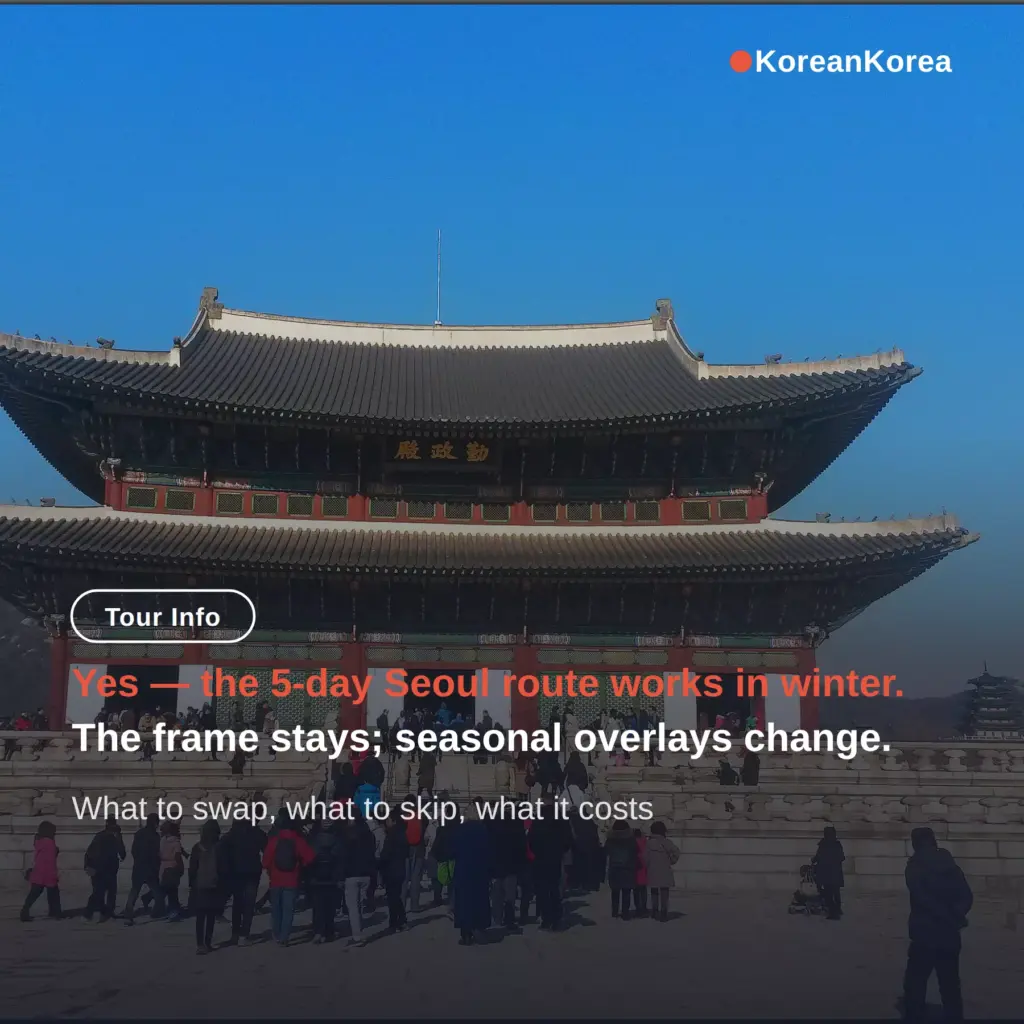
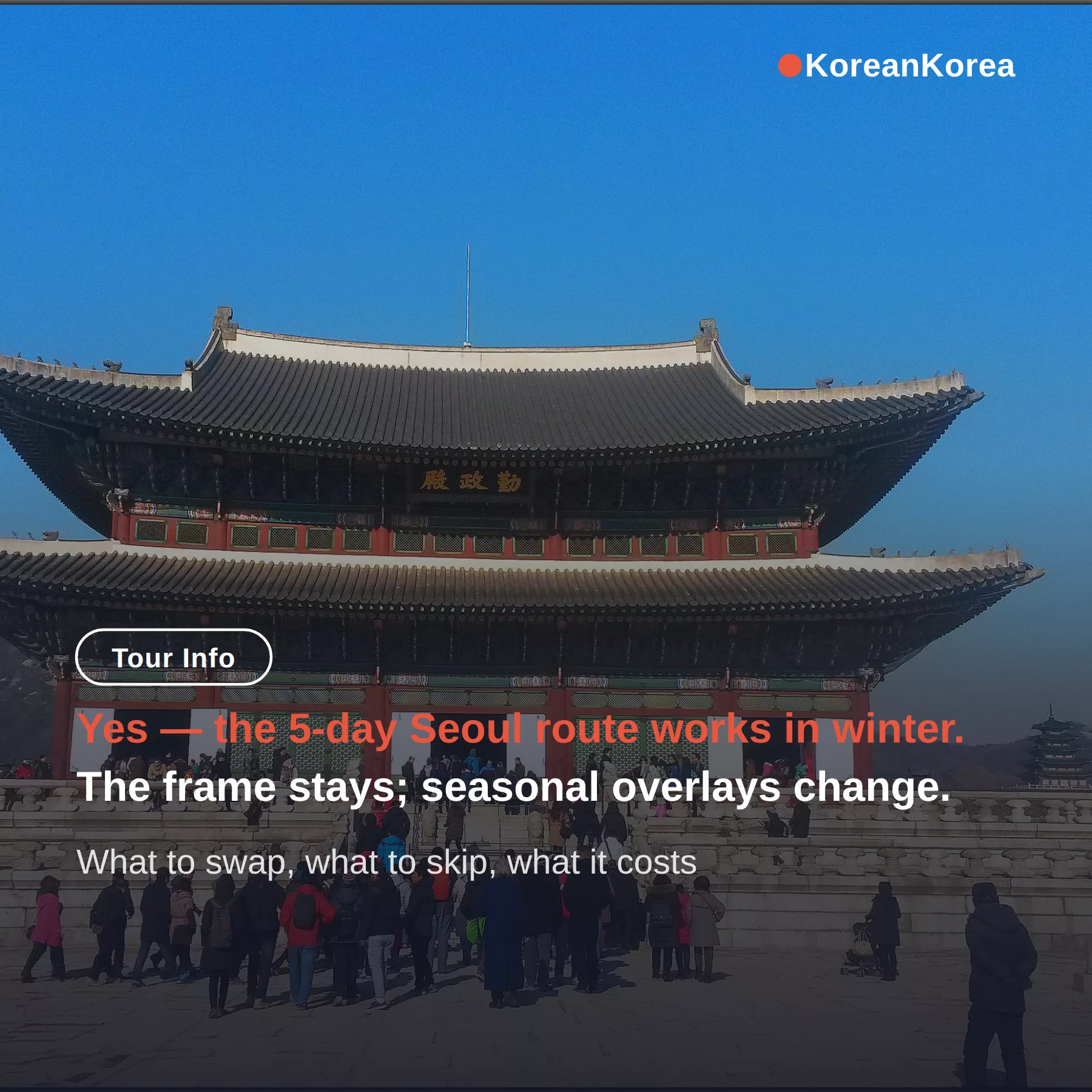
Yes — the 5-day Seoul route works in winter, but swap in Deoksugung (1,000 KRW) for the palace walk, replace the Banpo fountain (off Dec-Feb) with a 19,900 KRW Han River cruise, and add the Gwanghwamun Seoul Light festival (Dec-Jan).
That means you keep your day plan and change a handful of stops, not the whole schedule.
This post covers what closes between December and February, day-by-day winter swaps, a sample Gwanghwamun-Seochon day course with budget, and a per-person cost breakdown.
Contents
- seoul itinerary 5 days winter: what still works, what to swap
- What closes in Seoul between December and February
- Winter swaps for the classic route, day by day
- A winter Gwanghwamun-Seochon day course and what it costs
- Where to eat on the 5-day route, by district
- What 5 days costs in winter
seoul itinerary 5 days winter: what still works, what to swap
Yes — the 5-day frame itself stays valid year-round; only the seasonal overlays change.
The standard route is Day 1 Myeongdong, Namsan, Euljiro; Day 2 Gyeongbokgung, Bukchon, Insadong; Day 3 Seongsudong, Seoul Forest, Hongdae, Yeonnam; Day 4 Gangnam, COEX, Jamsil, Seokchon Lake; Day 5 Han River park, market, souvenirs.
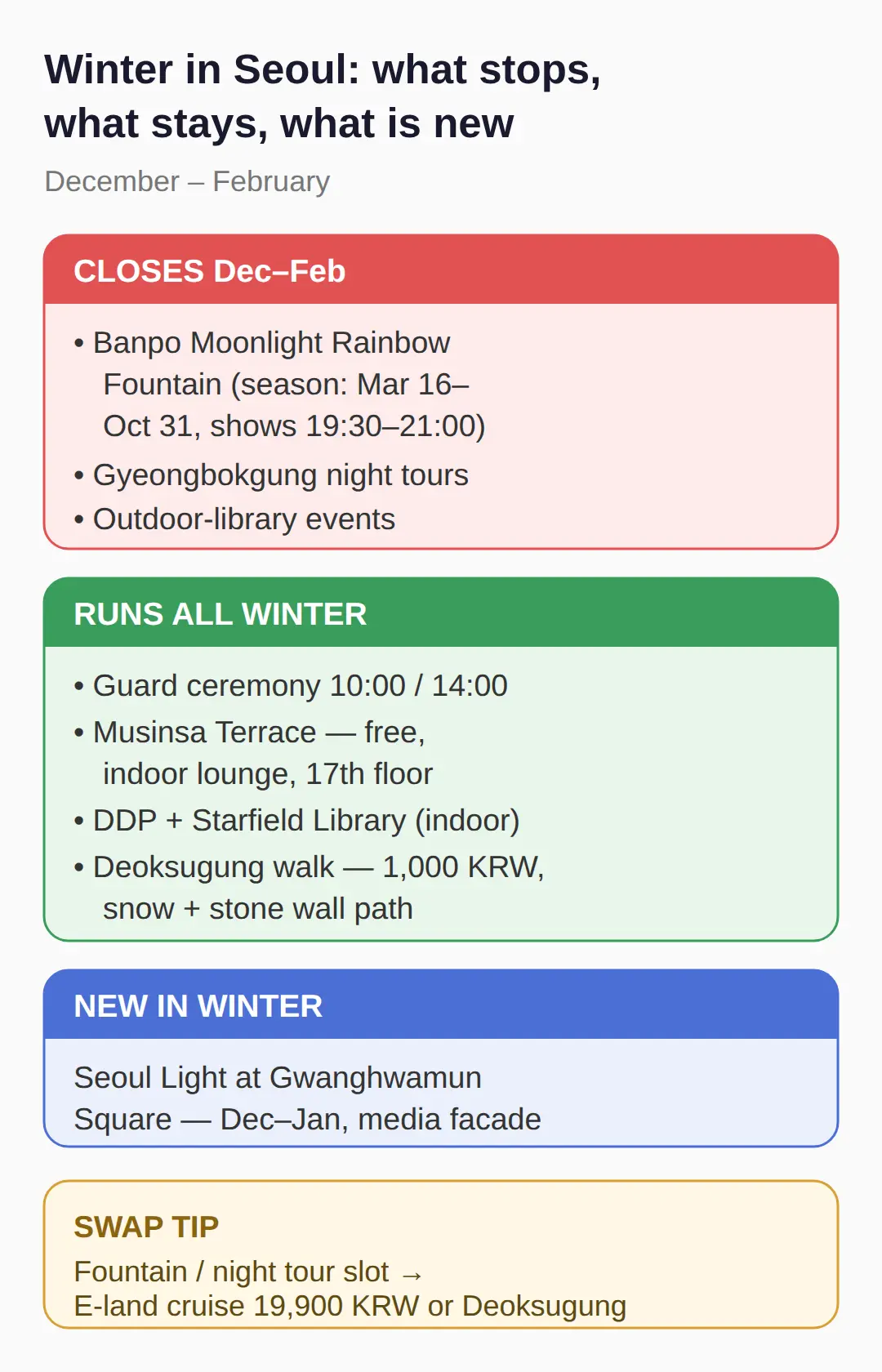
What actually changes is the program layer: night tours and outdoor-library events stop for the season, and the Banpo fountain turns off after October 31.
Before anything else, check whether each stop still runs in Dec-Feb, then slot indoor options into afternoons and evenings — this is the first thing to do when converting an autumn plan.
The 5-day frame works if you keep it, but build each day indoor-heavy from early afternoon on.
One check I always do first: seasonal operating status of every single stop, before booking anything else.
| Banpo Bridge Moonlight Rainbow Fountain | OFF — season runs Mar 16-Oct 31 only |
|---|---|
| Gyeongbokgung night tours and outdoor-library events | Paused in winter; verify current season at english.palaces.go.kr |
| Royal guard changing ceremony, Gyeongbokgung | Runs daily at 10:00 and 14:00 |
| Musinsa Terrace Hongdae (17th-floor observatory) | Stays on — free, indoor lounge |
| DDP and Starfield Library | Stays on — fully indoor |
| Gwanghwamun Seoul Light festival (Seoul Biggchorong) | New for winter — mainly Dec-Jan at Gwanghwamun Square |
What closes in Seoul between December and February
The concrete closure is the Banpo Bridge Moonlight Rainbow Fountain — it runs only March 16 to October 31, so it is off the entire winter.
The fountain’s in-season shows run at 19:30, 20:00, 20:30 and 21:00, which is why it is a popular autumn evening stop that simply disappears in December.
Gyeongbokgung night tours and outdoor-library events also pause in the cold months, though the winter schedule has not been confirmed from an official page — check english.palaces.go.kr before counting on either.
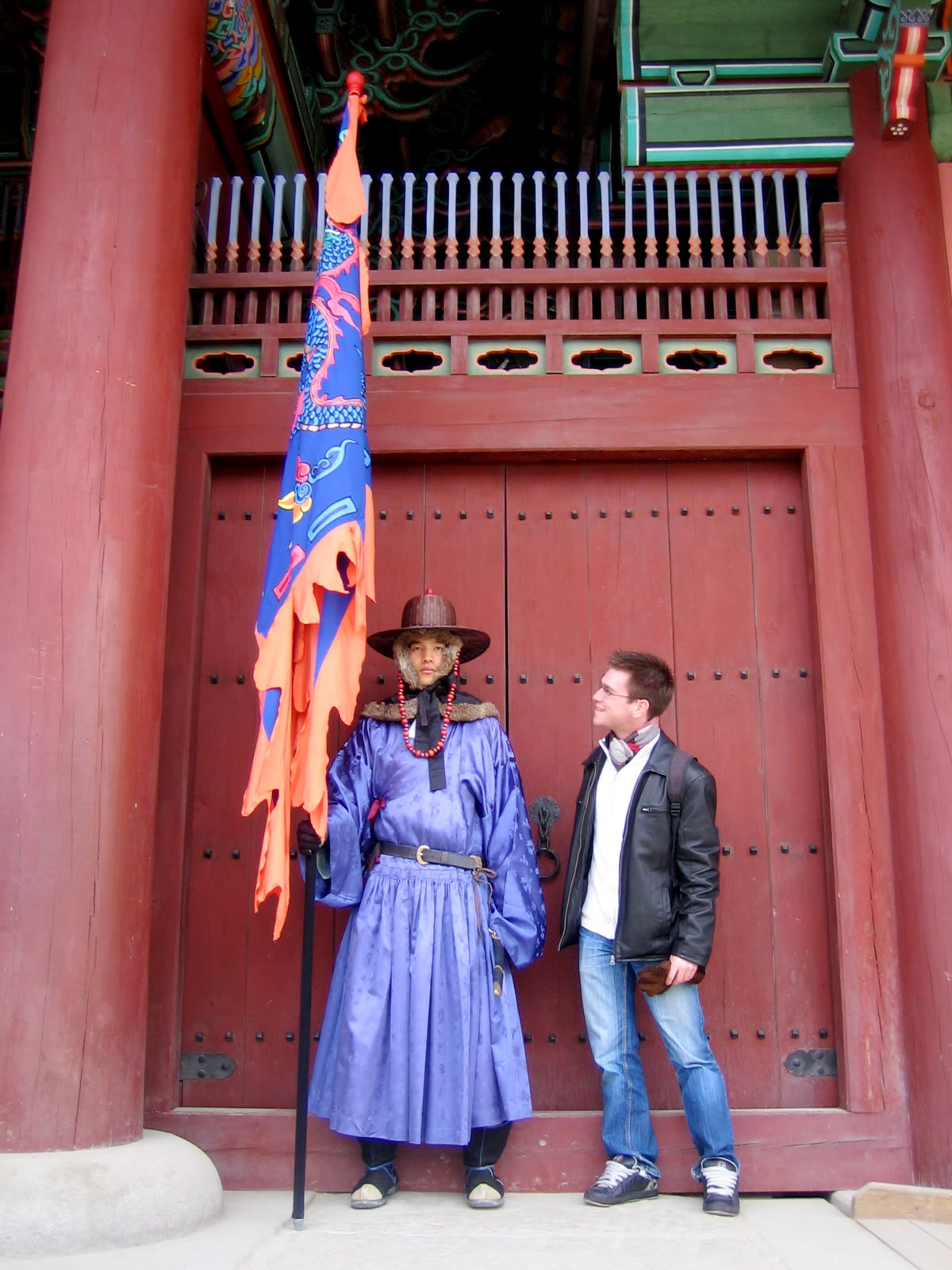
Plenty stays on: the Gyeongbokgung royal guard ceremony runs daily at 10:00 and 14:00, Musinsa Terrace’s free 17th-floor observatory stays open with an indoor lounge, and DDP with the Starfield Library is fully indoors.
New in winter is the Seoul Light festival (Seoul Biggchorong) at Gwanghwamun Square, mainly December-January, with large installations and a media facade.
If your autumn plan leans on fountains and night tours, replace those slots first — everything else on the classic route keeps running.
👉 seoul itinerary 5 days autumn 2026: Seoul 3 + Busan 2, and why you skip the day trips
Winter swaps for the classic route, day by day
The core swap is the palace morning: Deoksugung plus its stone-wall path (Deoksugung Doldam-gil), listed at 1,000 KRW admission, replaces the busy Gyeongbokgung outdoor walk, with Gwanghwamun Gukbap (53 Sejong-daero 21-gil, Jung-gu) as the hot lunch.
Deoksugung works in winter because the Seokjojeon’s Western stone facade and the traditional roof curves sit well under snow, and the stone-wall path is a short, low-effort walk right after the palace.
Limbeuk Waffle at the start of the path is the standard warm-snack stop.
For the Day 3 side of town, an indoor-heavy Yeonnam-Hongdae half-day runs: Gyeongui Line Forest Park walk at 14:00, stationery shops at 15:30, a rated restaurant (Soi Yeonnam Thai, Jo&Meal, or Pie in the Shop) at 17:30, then Musinsa Terrace at 19:30 — about 40,000-50,000 KRW per person.
Weekend Yeonnam restaurants mean waiting, so queue remotely through the Catchtable or Tabling apps instead of standing outside in the wind.
- Morning: Deoksugung (1,000 KRW) + Doldam-gil stone wall path.
- Lunch: Gwanghwamun Gukbap, clear-broth pork gukbap + Pyeongyang naengmyeon.
- Afternoon: Seochon bookstores and cafes.
- Evening: Gwanghwamun Square — Seoul Light festival (Dec-Jan) or the night walk.
A winter Gwanghwamun-Seochon day course and what it costs
A sample winter day at Gwanghwamun-Seochon costs about 50,000-60,000 KRW per person: 30,000-40,000 food + 10,000-20,000 cafe + 1,000 admission.
The course runs on subway lines 5 (Gwanghwamun), 3 (Gyeongbokgung), and 1/2 (City Hall); parking there is congested and expensive, so public transit is the practical choice.
The afternoon block is Seochon: old bookstores including Daewoo Bookstore (the IU album-cover shoot location), hanok craft workshops and small galleries, then a cafe such as Edition Denmark (24 Jahamun-ro 9-gil, Jongno-gu — Danish-style space, honey herb tea) or the alternatives Spectre and mk2.
For a longer walk, end at Suseongdong Valley at the foot of Inwangsan, where the frozen stream and pavilion view read like the landscape painter Jeong Seon’s <Suseongdong>.
If the cold wins, Kyobo Bookstore’s Gwanghwamun branch next to the square is the standard warm-up break.
Dress for wind chill — long padding, scarf and comfortable shoes, because the whole course is walking-based.
Where to eat on the 5-day route, by district
| Dish | Districts |
|---|---|
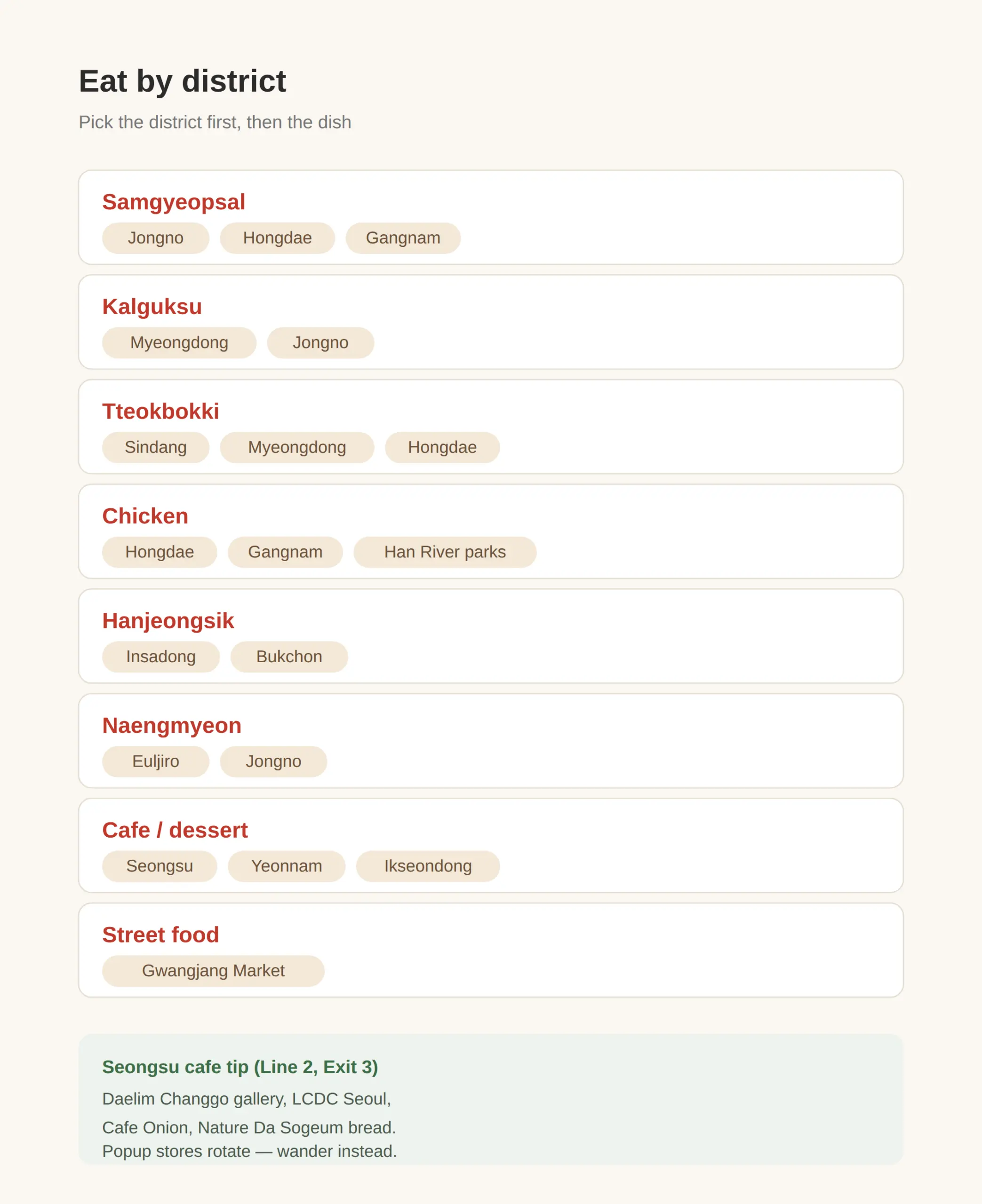
| Samgyeopsal | Jongno, Hongdae, Gangnam |
| Kalguksu | Myeongdong, Jongno |
| Tteokbokki | Sindang, Myeongdong, Hongdae |
| Chicken | Hongdae, Gangnam, Han River parks |
| Hanjeongsik | Insadong, Bukchon |
| Naengmyeon | Euljiro, Jongno |
| Cafe / dessert | Seongsu, Yeonnam, Euljiroidong |
| Street food | Gwangjang Market |
Cafe and dessert streets sit in Seongsu, Yeonnam and Ikseondong, and Gwangjang Market covers street-food dinner on the traditional day.
Seongsudong (line 2, exit 3) anchors for a daytime cafe block: Daelim Changgo gallery, LCDC Seoul, industrial-style Cafe Onion and Nature Da Sogeum bread.
Popup stores in Seongsu rotate constantly, so wandering the back streets beats fixing a map in advance.
If you want a sit-down hot lunch near the palace instead, Gwanghwamun Ttukgam’s gamjatang with whole potatoes (Google rating around 4.4) is the alternative in the same district.
Pick the district first, then the dish — every item above sits on a subway line already in your route.
👉 Chuseok 2026 Korea travel: free parking, what closes
What 5 days costs in winter
A sample mid-range 5-day budget runs about 242,000 KRW per person, excluding flights and lodging.
That figure comes from one sample itinerary (SEEDTRIP), so treat it as an order-of-magnitude only: its own day rows actually sum to 324,000 KRW, and the total is tied to an April 2024 exchange-rate table.
Day 4 is the heavy one — transport 28,000, food 32,000, tickets 22,000 including a DMZ tour, other 4,000 — which works out to 86,000 KRW, about 36% of the stated total.
The per-day rough figure across five days is about 48,400 KRW per person per day (242,000 ÷ 5).
Shopping and premium experiences are excluded from the sample.
The Gwanghwamun-Seochon day (50,000-60,000) and the Yeonnam half-day (40,000-50,000) are the two anchors to start from.
The 242,000 KRW figure works for rough planning; for bookings, price each ticket and meal yourself.
Related posts
📎 Seoul — everything we know
📎 Seoul itinerary Chuseok 2026 — why staying put beats the 10-hour KTX crawl
📎 Seoul fireworks festival 2026 subway: Which Stations to Use Tonight
📎 📅 다가오는 일정 — 발매·개봉·발표 캘린더
Sources
- 5-day day-structure template and meal-by-district map (jk800djr.tistory.com)
- Winter Deoksugung-Seochon one-day course with budget ~50-60k (triplover79.tistory.com)
- Free 17F observatory; Soi Yeonnam / Jo&Meal / Pie in the Sho (triplover79.tistory.com)
Winter 5-day Seoul route, in short
- Check each stop’s Dec-Feb operating status before booking anything — that single step converts the autumn route to winter.
- Swap the fountain evening for the E-land Han River cruise (19,900 KRW, ~40 min, Yeouinaru station line 5).
- Use Deoksugung (1,000 KRW) as the winter palace morning, with Gwanghwamun Gukbap for lunch.
- Plan the Seoul Light festival (Dec-Jan, Gwanghwamun Square) as the winter night anchor; verify 2026-27 dates closer to the season.
- Queue for restaurants from indoors with Catchtable or Tabling instead of waiting outside.
FAQ
Q. Does the autumn 5-day Seoul route still work in December?
Yes — the 5-day frame stays, but the seasonal overlays change: the Banpo fountain turns off after October 31, and night tours and outdoor-library events pause, so those slots need indoor or winter-event replacements.
Q. What Seoul attractions close or shut down in winter (Dec-Feb)?
The Banpo Bridge Moonlight Rainbow Fountain is the concrete closure — its season runs March 16 to October 31 only. Palace night tours and outdoor-library events also stop for the season; the guard ceremony, Musinsa Terrace and DDP stay on.
Q. What winter-only events replace autumn festivals in Seoul?
The Seoul Light festival (Seoul Biggchorong) at Gwanghwamun Square runs mainly December-January with large installations and a media facade. Exact 2026-27 dates are not yet published — it has typically started mid-December.
Q. How much does a 5-day mid-range Seoul trip cost per person?
One sample mid-range itinerary puts it at about 242,000 KRW per person excluding flights and lodging — roughly 48,400 KRW per day. The figure is dated and its own rows sum higher, so treat it as an order of magnitude.
Q. What is a good indoor-heavy Seoul winter day course?
Deoksugung (1,000 KRW) and the stone-wall path in the morning, Gwanghwamun Gukbap for lunch, Seochon bookstores and cafes in the afternoon, and Gwanghwamun Square at night — about 50,000-60,000 KRW per person.
Check the palace night-tour status at english.palaces.go.kr before locking Day 2, and re-verify the light festival dates in November.
Cover photo: January Korea Seoul Gyeonbokgung Palace – Master Asia Photography 2015 Winter – panoramio (17) by pictures Jettcom — CC BY 3.0
#seoulitinerary5dayswinter #seoulwinteritinerary #seouldec-feb #seoullightfestival #deoksugung #hanrivercruise #gwanghwamun
📅Upcoming Dates — 이번 주 16 · D-day 'The Scandal' global Netflix release전체 보기 →