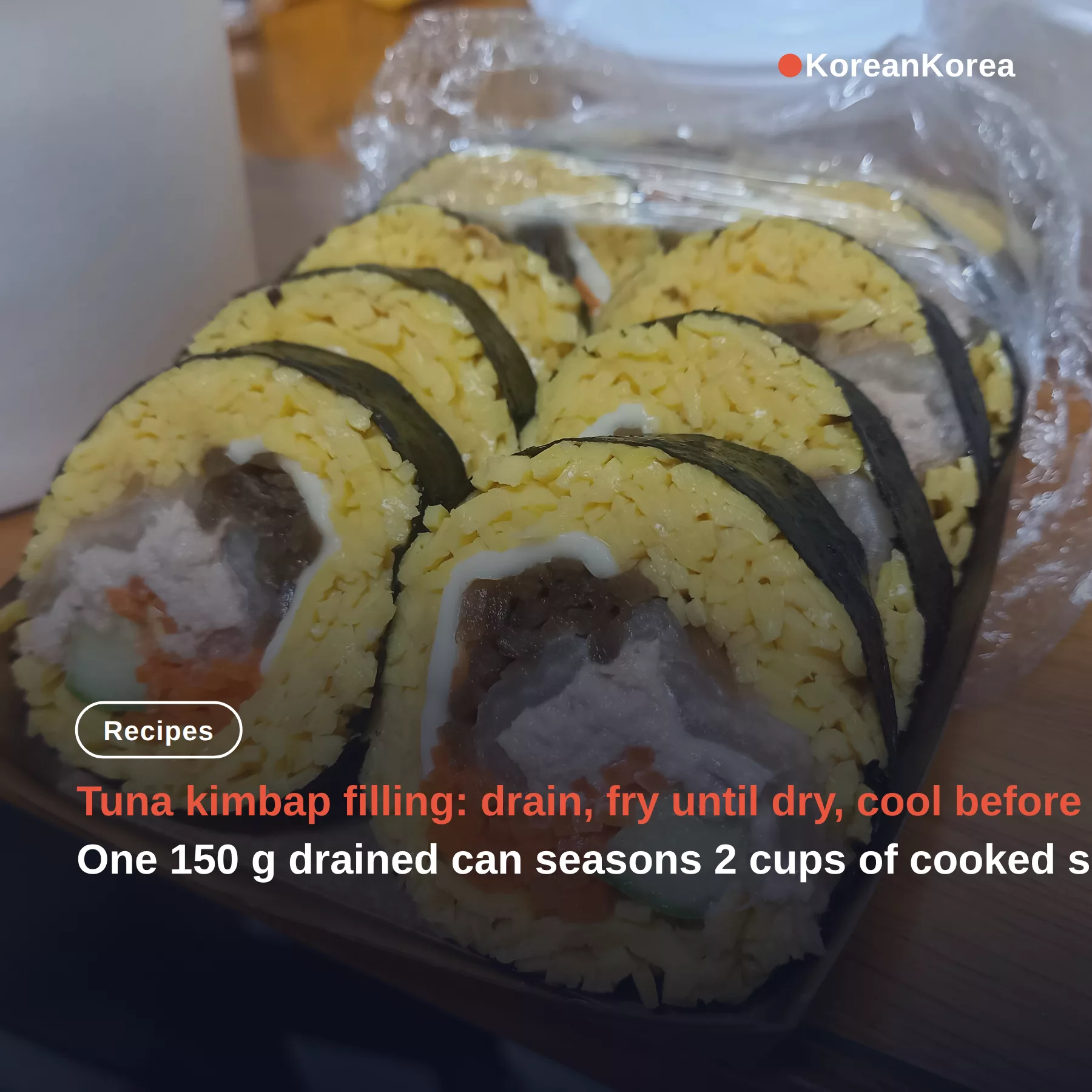
Tuna kimbap rice goes soggy when liquid from the can and warm filling turn to steam inside the roll — the fix is squeeze the tuna dry, fry it 2–3 minutes until dry, then cool both filling and rice before rolling.
That means the problem is never the tuna itself, and any supermarket can works as well as a Korean one as long as you squeeze it well.
This post covers the draining and seasoning steps with amounts, how to layer the roll, which can to buy abroad, and what keeps and what does not.
Contents
- kimbap recipe tuna: drain, fry, and cool the filling
- Seasoned tuna filling recipe: what goes in and how much
- Assembling the roll so nothing leaks: rice, gim, and layering order
- Canned tuna for kimbap: which can to buy in Korea and abroad
- Tuna kimbap filling ahead of time and storage
- Cutting, finishing, and common mistakes
kimbap recipe tuna: drain, fry, and cool the filling
Squeeze the liquid out of the canned tuna, stir-fry the seasoned tuna for 2–3 minutes until it looks dry, and cool both the filling and the rice to room temperature before rolling.
Canned tuna carries oil or brine, and a warm filling wrapped in warm rice creates steam with nowhere to go.
That steam is the main cause of soggy rice, not the tuna flavor or the seasoning.
Draining means more than tipping the can — press the tuna through a fine sieve or a clean cloth with a spoon or your hand until little liquid comes out.
The stir-fry after draining cooks off the moisture that pressing cannot reach, which is why recipes that skip it end up with wet rice.
If a roll has ever come out damp at the seam, check the two cooling steps first; they take no extra ingredients, only about 30–40 minutes total including cooling.
| Soy-sugar stir-fry | Drained tuna + about 1 Tbsp soy sauce + about 1 Tbsp sugar or corn syrup, stir-fried 2–3 minutes until dry |
|---|---|
| Mayonnaise version | Drained tuna + 1–2 Tbsp mayonnaise + a pinch of black pepper, mixed cold with no stovetop cooking |
| Spicy variant | Gochujang mixed into the tuna instead of, or alongside, the mayonnaise — an optional variant, so start small |
Seasoned tuna filling recipe: what goes in and how much
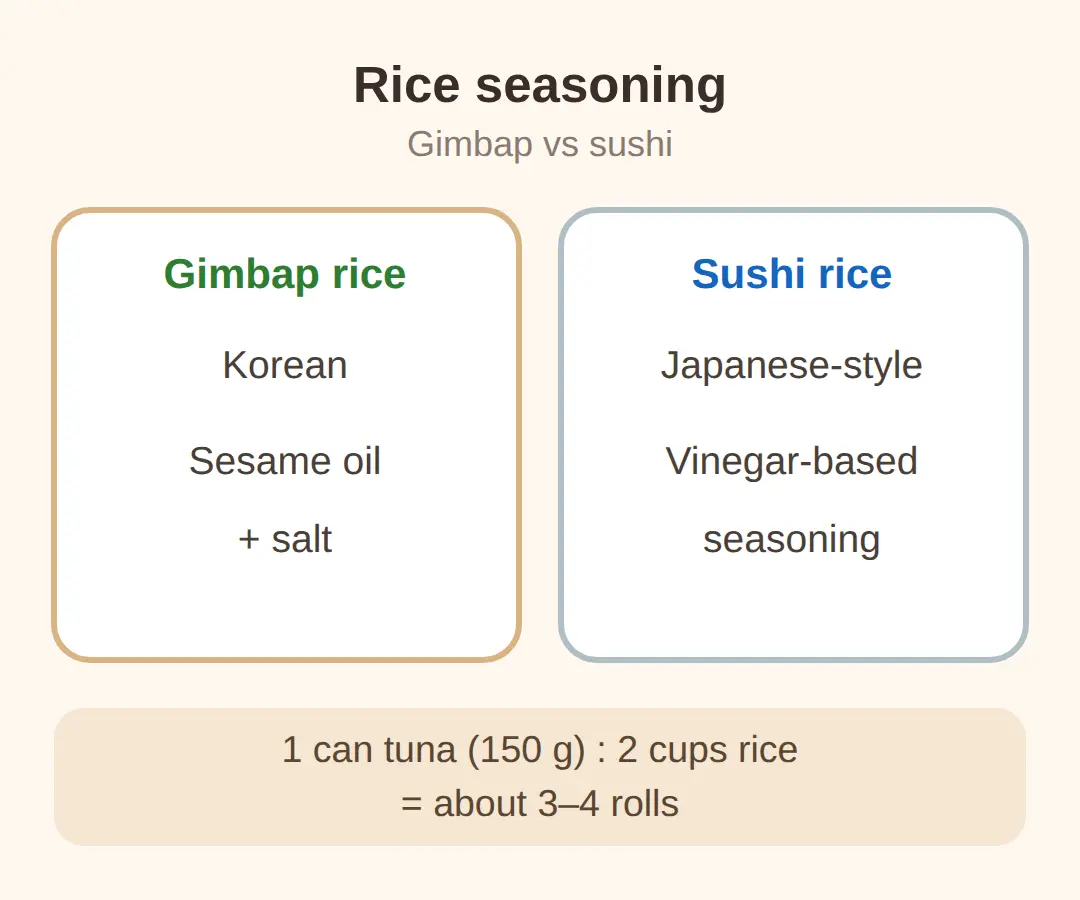
One 150 g drained can seasons roughly 2 cups of cooked short-grain rice, which makes about 3–4 rolls.
Most chamchi gimbap recipes, including My Korean Kitchen’s tuna gimbap, are built around a single 150 g can, so scale up by the can rather than by spoonfuls.
- Drain the tuna and press it through a fine sieve or cloth until it holds together dry.
- Stir-fry it with soy sauce and sugar or corn syrup for 2–3 minutes until the pan looks dry — the two main source recipes give slightly different tablespoon ratios, so treat 1 Tbsp each as a starting point and adjust to taste.
- Set it aside to cool completely before it touches the rice.
The mayonnaise version skips the pan: mix the drained tuna with 1–2 Tbsp mayonnaise and a pinch of black pepper.
It stays creamier, but it needs the tuna drained even more thoroughly because nothing cooks the moisture off.
👉 Kimbap Recipe: 45 Minutes, One Mat, No Special Ingredients
Assembling the roll so nothing leaks: rice, gim, and layering order
Spread about 3/4 cup of seasoned rice in a thin layer on a 20 x 20 cm gim sheet, leaving a clean 2 cm border at the far edge.
Gimbap rice takes sesame oil and salt, not the vinegar seasoning used for Japanese-style sushi rice — do not substitute sushi vinegar.
Put the dry ingredients down first: danmuji (yellow pickled radish) and carrot strips act as a moisture barrier so the tuna never sits directly on the gim.
Carrot should be thinly julienned and briefly stir-fried or salt-squeezed first, and a thin egg omelet cut into strips is a standard filler alongside the tuna.
Brush the bare 2 cm edge with water, or simply leave it rice-free, and press the seam shut — rice pushed over that edge is the usual reason a roll will not seal.
If raw unseasoned gim is all that is available, brush it with sesame oil, salt it lightly, and toast it briefly before rolling.
Canned tuna for kimbap: which can to buy in Korea and abroad
Korean recipes call for a 150 g can of chamchi (tuna), and Korean stores commonly stock 100 g, 150 g, and 300 g cans under Dongwon or Ottogi.
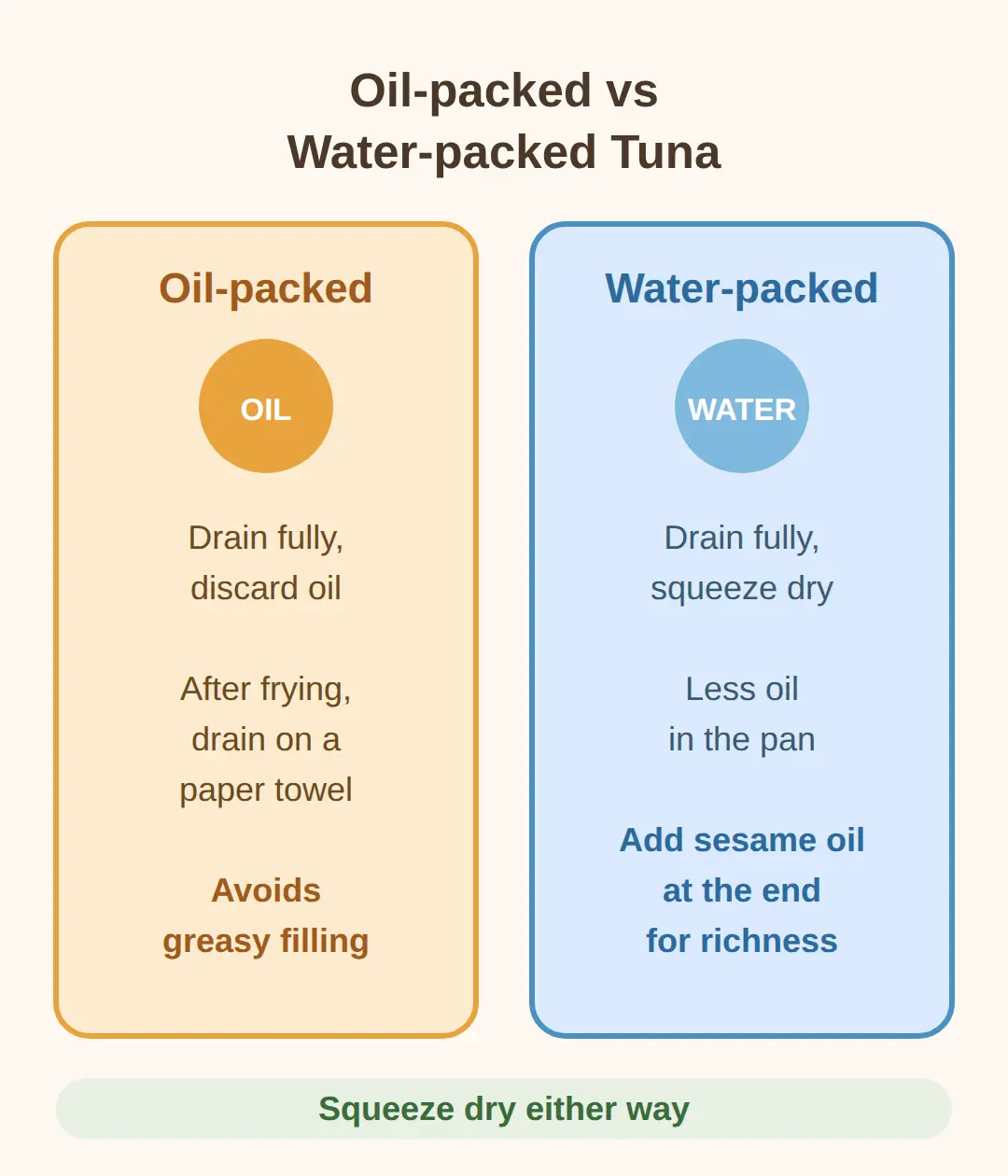
The oil is drained and discarded, never kept in the filling.
Abroad, any supermarket tuna works — oil-packed or water-packed — as long as it gets squeezed dry either way.
Oil-packed tuna should drain on a paper towel after frying so the filling is not greasy; water-packed tuna needs less oil in the pan and gains richness from a little extra sesame oil at the end.
Dongwon and Ottogi cans are commonly stocked at H Mart and other Korean grocery stores overseas, though current export can sizes could not be confirmed from the manufacturers’ own pages — check the shelf rather than assuming a size.
Water-packed is the easier can to handle, so start there if the choice exists.
Tuna kimbap filling ahead of time and storage
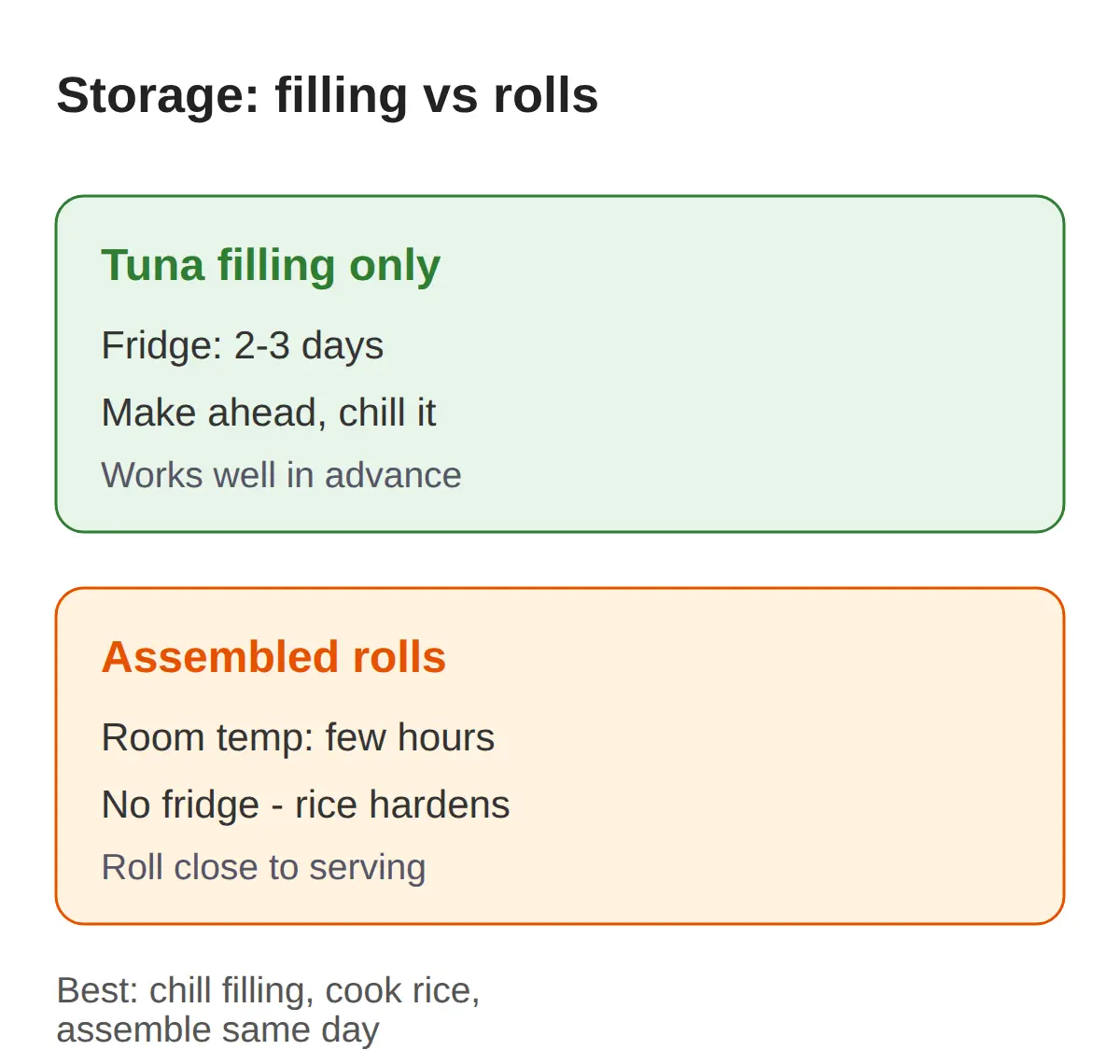
The seasoned tuna filling keeps 2–3 days in the refrigerator on its own, but assembled rolls do not belong in the fridge.
Refrigeration dries out the rice and hardens it, which is why gimbap is best eaten the day it is made.
At room temperature, finished rolls hold for a few hours at most, so roll close to serving time.
The practical split is to make and chill the filling in advance, cook the rice fresh, and assemble the same day.
If lunch needs to travel, pack the rolls loosely and eat them within a few hours rather than refrigerating them overnight.
👉 Korean Fried Chicken Recipe Gochujang: Ratio + 2 Fry Temps
Cutting, finishing, and common mistakes
Brush the finished roll with sesame oil, sprinkle sesame seeds, and cut with a sharp knife wiped with a damp cloth between slices.
The damp-wipe step keeps each slice clean instead of dragging the filling across the roll.
No bamboo mat is required — a folded sheet of kitchen foil or a clean, thick kitchen towel works, since the mat is standard but not essential.
The mistakes that cause soggy kimbap are skipping the squeeze, skipping the 2–3 minute fry, and rolling warm components together.
For rolling basics — grip, pressure, and tucking the first turn — the blog’s general kimbap recipe covers them in full, so start there if the roll itself falls apart.
If danmuji is unavailable abroad, regular yellow pickles or pickled cucumber slices patted dry are the usual stand-in, patting them dry first.
If I were making this abroad with water-packed supermarket tuna, I would still fry it until the pan goes quiet and no steam rises off the filling, because that dryness is what keeps the rice from turning soggy.
What I check first is the filling temperature, not the rice — warm tuna is the one thing that undoes an otherwise careful roll.
Related posts
📎 Samgyetang Recipe Without a Spring Chicken: Supermarket Substitutions That Work
📎 Tteokbokki Recipe: Why Broth Instead of Water Keeps It From Turning Gummy
📎 📅 다가오는 일정 — 발매·개봉·발표 캘린더
Your situation, and the move that fits it
- You have one can of tuna and want rolls today → one 150 g drained can seasons about 2 cups of cooked rice, roughly 3–4 rolls
- Rolls still soggy → squeeze the tuna dry, fry it 2–3 minutes until no liquid remains, and cool both filling and rice to room temperature before rolling
- You cannot find Korean canned tuna → any oil- or water-packed supermarket tuna works; squeeze well and add a little extra sesame oil if water-packed
- You have no bamboo mat → a folded sheet of kitchen foil or a clean thick kitchen towel replaces it
- You want to prep ahead → refrigerate the seasoned filling alone for 2–3 days; do not refrigerate assembled rolls, and eat them the day they are made
FAQ
Q. How do you keep tuna kimbap rice from getting soggy?
Squeeze the canned tuna dry through a sieve or cloth, stir-fry the seasoned tuna 2–3 minutes until dry, and cool both filling and rice to room temperature before rolling — warm components create the steam that turns the rice soggy.
Q. Do you need to rinse canned tuna for gimbap?
Rinsing is not the step — draining is. Press the tuna through a fine sieve or clean cloth until little liquid comes out, then stir-fry it briefly to cook off the rest.
Q. What seasoning goes in tuna gimbap filling?
The standard stir-fry version uses soy sauce and sugar or corn syrup (the two main recipes give slightly different ratios, so treat about 1 Tbsp of each per 150 g can as a range). A cold mayonnaise version mixes 1–2 Tbsp mayo with a pinch of black pepper instead.
Q. Can you make tuna kimbap filling ahead of time?
Yes — the seasoned filling keeps 2–3 days refrigerated on its own. Assembled rolls should not be refrigerated; they are best eaten the day they are made.
Q. Can I use regular canned tuna instead of Korean chamchi?
Any canned tuna works, oil-packed or water-packed. Squeeze it dry either way, and add a little extra sesame oil after cooking if it is water-packed.
Rolling basics — grip, pressure, and the first turn — live in the blog’s general kimbap recipe; this post covers the tuna filling only.
Cover photo: 키토 김밥 by Kcjsew — CC BY-SA 4.0
#kimbaprecipetuna #chamchigimbap #tunagimbapfilling #gimbapricesoggy #Koreanfoodabroad
📅Upcoming Dates — 이번 주 16 · D-day 'The Scandal' global Netflix release전체 보기 →