

Vegetarian kimbap works when every filling goes into the roll dry: carrot, spinach, danmuji and vegan bulgogi mushrooms are the standard set.
Wet fillings are what make the nori soggy and the roll split by lunchtime, and that matters most because vegetable kimbap is a lunchbox and picnic food.
This post covers the filling list, the moisture-control steps for each vegetable, the rice and nori amounts per roll, the rolling and cutting steps, and the swaps for strict vegans.
Contents
- Kimbap recipe vegetarian: fillings that hold their shape
- How to keep vegetarian kimbap from going soggy by lunch
- Rice amount, nori and rolling — the per-roll numbers
- Rolling, sealing and cutting without splits
- Vegan swaps: sesame oil, nori coating and egg-free protein
- Braised burdock and bulgogi mushrooms — two fillings worth making
Kimbap recipe vegetarian: fillings that hold their shape
The standard vegetarian filling set is carrot, cucumber, spinach, danmuji (Korean pickled radish) and tofu in place of egg or meat.
The recommended simple vegan combo is carrots, spinach, vegan bulgogi mushrooms and danmuji, with about one piece of danmuji per roll.
Fillings can be mixed and matched — you do not have to make all of them.
For protein, tofu is the standard swap: cut 396g (14oz) firm tofu into planks or long strips, pan-fry in 3–4 tbsp neutral oil, and season with 1/2 tsp salt and 1/2 tsp black pepper.
Chickpea paste is another option, spread as a long strip the way egg or meat would sit in a classic roll.
Season each vegetable separately with salt, and cut everything into thin julienne strips.
When looking at any vegetarian kimbap filling, the first thing to check is how much water it holds — cucumber, spinach, mushroom, whatever — because that decides whether the roll survives to lunch.
If a filling set with five components feels like too much for a first try, start with the four-item combo above and add tofu only when the rolling feels steady.
| One simple, foolproof filling set | Carrots, spinach, vegan bulgogi mushrooms and danmuji — about 1 piece of danmuji per roll |
|---|---|
| Need protein without egg or meat | Pan-fry firm tofu strips until golden outside and soft inside, or use chickpea paste as a long strip filling |
| Kimbap keeps getting soggy in the lunchbox | Blanch and squeeze spinach, salt and drain cucumber, stir-fry carrot — cook the water out of every wet filling before rolling |
| Strict vegan, worried about hidden animal products | Check the nori label for animal-derived oil coating, and decide on the sesame oil coat |
| Want a chewier or heartier roll | Braise burdock strips (ueong jorim), or swap white rice for brown rice or quinoa |
How to keep vegetarian kimbap from going soggy by lunch
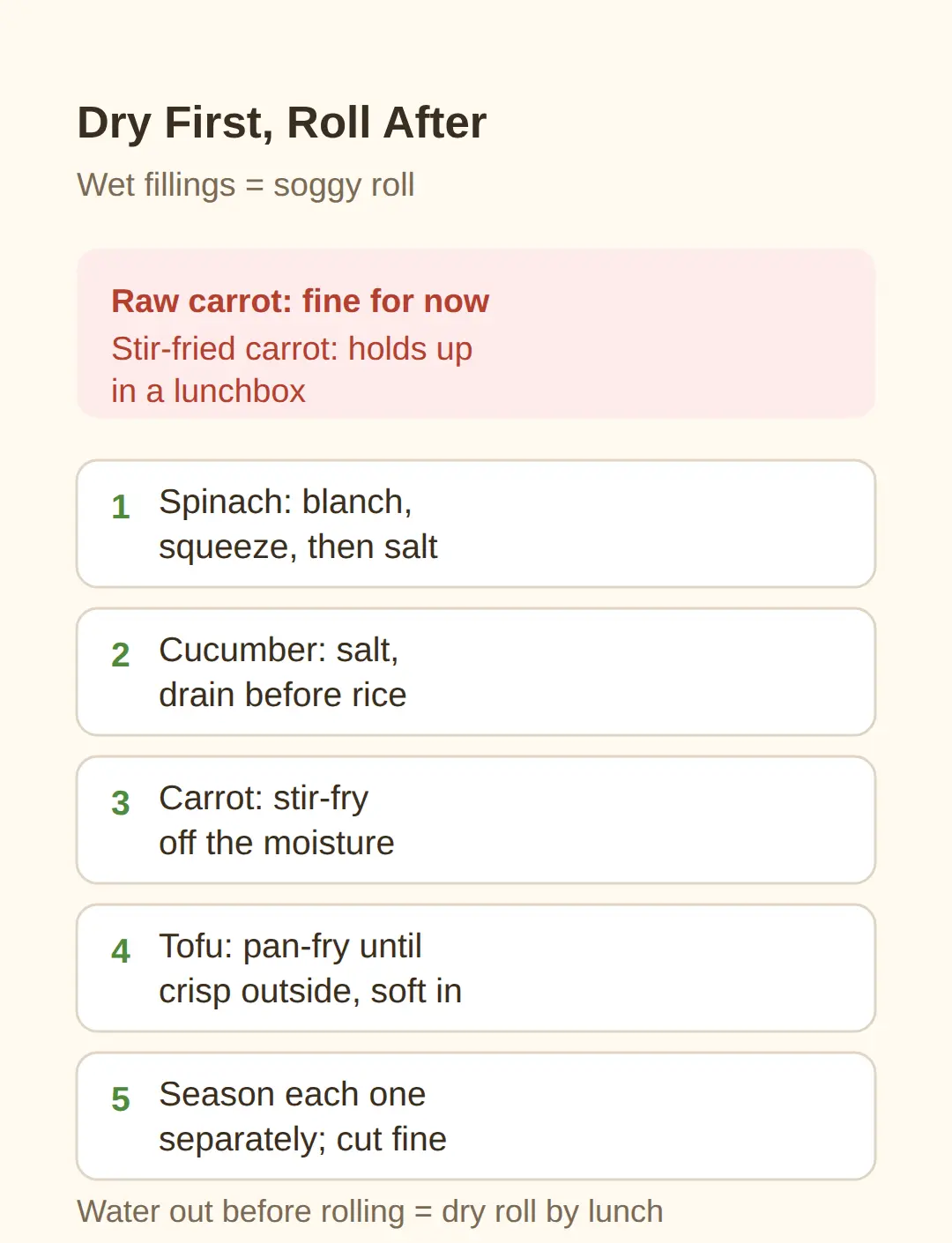
Cook the water out of every wet filling before rolling — wet fillings are the main cause of sogginess and splitting.
Vegetable kimbap is a standard lunchbox and picnic item, so this step is what keeps the roll edible at noon.
The fix is the same for every watery vegetable: remove the water first, season after.
- Blanch the spinach, squeeze the water out firmly, then season lightly with salt.
- Salt the cucumber and drain it before it touches the rice.
- Stir-fry the shredded carrot lightly — raw carrot is allowed, but cooking off the moisture keeps the roll dry.
- Pan-fry tofu until the outside is crisp and golden and the inside stays soft.
- Season each vegetable separately; cut them finely so they sit flat in the roll.
If the roll is meant for eating within the hour, raw carrot is fine.
If it is going into a lunchbox, the stir-fried route is the one that holds up — the water removed before rolling is the water that would otherwise soak into the nori by noon.
👉 Kimbap Recipe: 45 Minutes, One Mat, No Special Ingredients
Rice amount, nori and rolling — the per-roll numbers
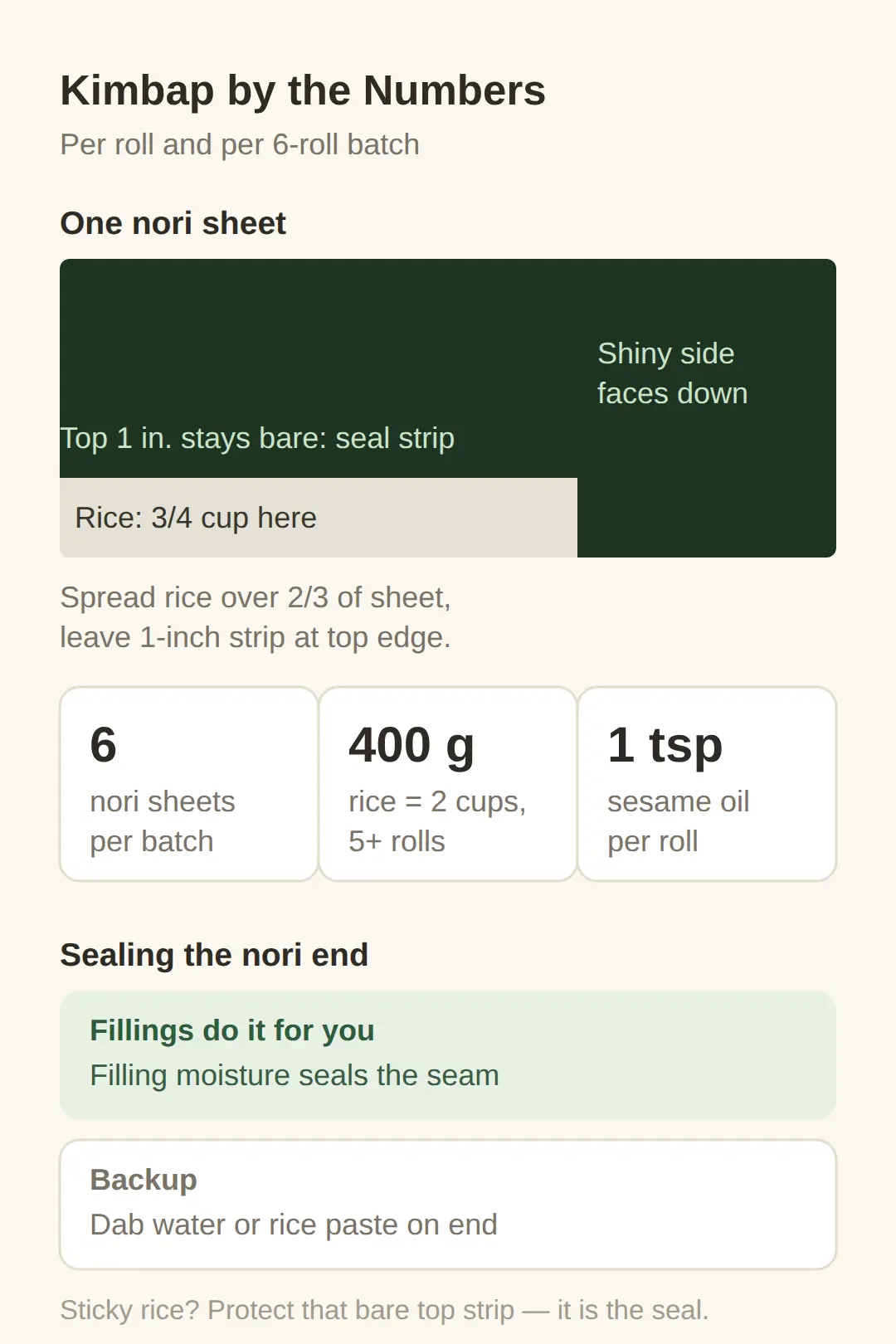
Use about 3/4 cup of rice per nori sheet, spread over two-thirds of the sheet with a 1-inch empty strip left at the top edge for sealing.
One batch uses 6 sheets of roasted nori, which 400g (2 cups) of short-grain or sushi rice covers for 5 or more rolls.
Brush about 1 tsp of toasted sesame oil per roll — 2 tbsp for the 6-roll batch.
Rinse the rice 5–6 times until the water runs clear, then cook it with 2 cups of water.
Season the cooked rice with salt and vinegar — about 2 tbsp of vinegar-based seasoning per 2 cups of rice — with a light hand so the grains stay separate.
Place the nori shiny side down on the rolling mat, and wet your fingertips with a little water so the rice does not stick while spreading.
Wrapping the bamboo mat in plastic wrap also keeps rice from sticking to it.
Pre-roasted nori can be toasted briefly again just before rolling for extra flavor.
Exact gram weights per filling (carrot, spinach, mushrooms) were not confirmed in the sources checked, so filling amounts stay at "a thin line, one piece of danmuji per roll" rather than a number.
If the rice keeps sticking even with wet fingers, the strip of empty nori at the top is the part to protect — that is the seal.
Rolling, sealing and cutting without splits
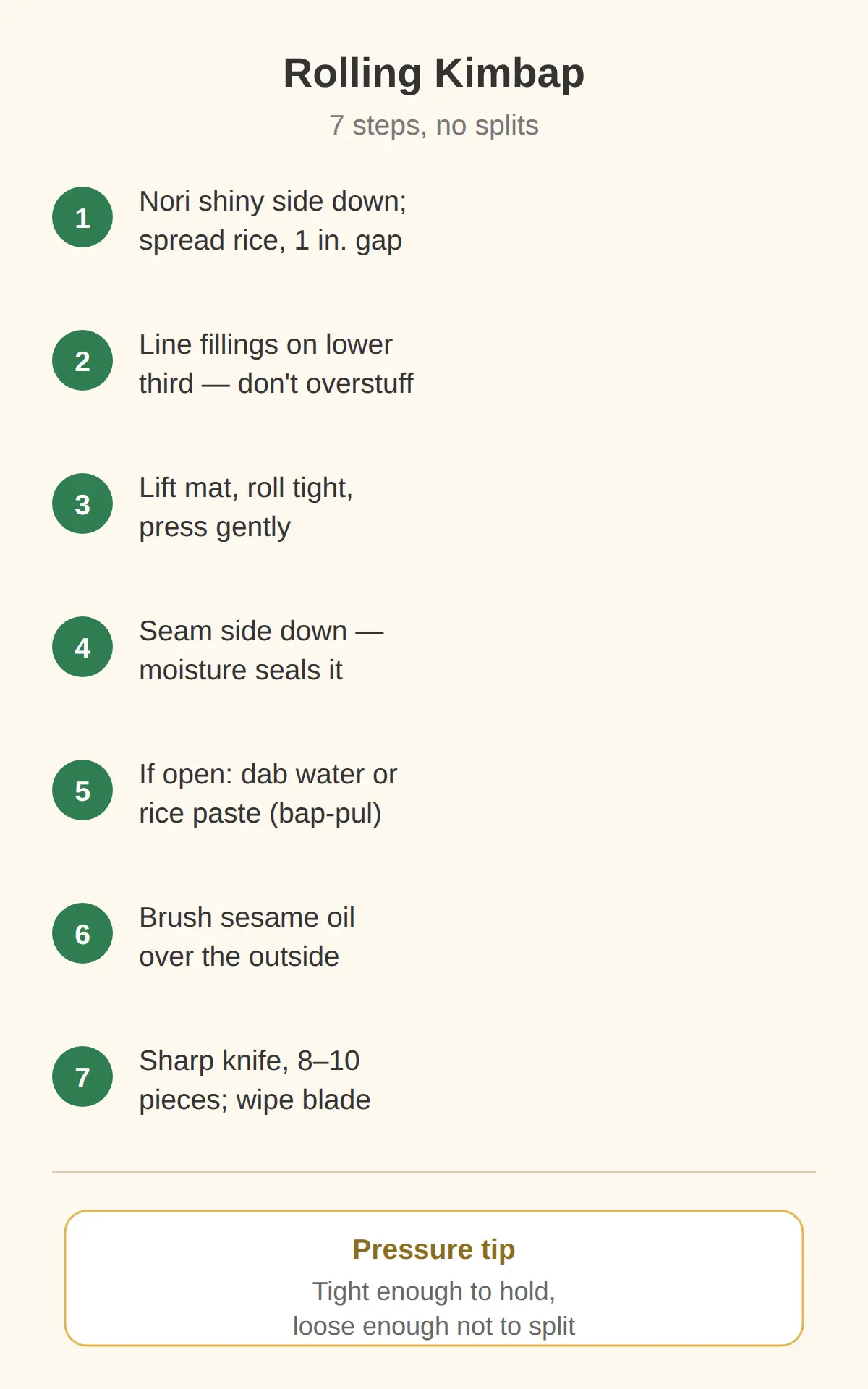
Roll tight, seal the seam, brush the outside with sesame oil, and cut with a sharp knife into 8–10 pieces.
The steps below follow the order used in the vegan kimbap recipes:
- Place the nori shiny side down on the mat and spread the 3/4 cup of rice, leaving 1 inch at the top.
- Lay the fillings in a line across the lower third of the rice — without overstuffing, which makes rolling hard.
- Lift the bottom of the mat with both hands and roll as tight as possible, pressing gently so the fillings stay in place.
- Finish seam side down; the fillings’ moisture usually seals the nori naturally.
- If the seam does not close, dab a little water or rice grain paste (bap-pul) on the end, and dab a little on the final edge to keep the roll from unwinding.
- Brush a thin coat of toasted sesame oil all over the outside before cutting.
- Cut into 8–10 pieces with a sharp knife, wiping the blade between cuts if it gets sticky.
Rolling pressure is a trade-off: the two sources word it slightly differently — roll as tight as possible, versus moderate pressure so the roll does not split.
Somewhere between the two is where a first-timer lands — tight enough to hold, loose enough that the fillings do not push out the ends.
Vegan swaps: sesame oil, nori coating and egg-free protein
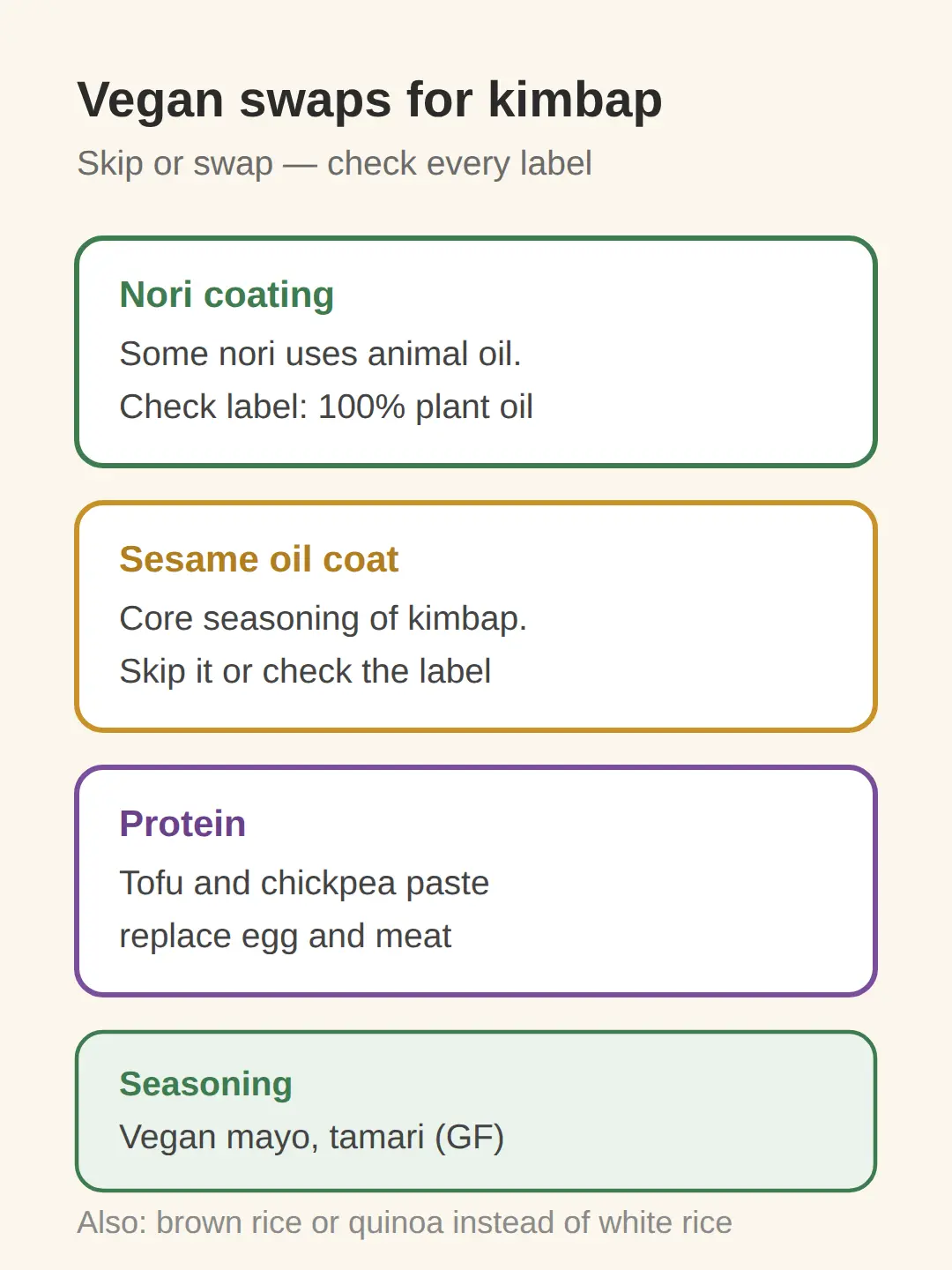
Three swaps matter for a fully vegan roll: the nori coating, the sesame oil coat, and the protein.
Some roasted nori is coated with animal-derived oil, so check the ingredient label and choose a product with 100% plant-based oil.
Toasted sesame oil is the core seasoning of kimbap — it goes into the rice, the vegetable cooking and the final coat — and it can be skipped entirely for an oil-free version.
Tofu and chickpea paste replace egg and meat, and soy-based vegan mayonnaise plus gluten-free tamari work for seasoning fillings.
The sesame oil coat is the one place where a named vegan substitute was not confirmed in the sources checked, so the choice is skip or use it — check the label on whatever oil goes into the bottle.
Soy sauce is already plant-based; tamari is the gluten-free version of it.
Brown rice or quinoa can replace white rice as well, adding fiber or protein while keeping the roll vegan.
For a strict vegan, the label check on the nori is the step with real consequences — one glance at the ingredient list settles it.
For everyone else, the standard version with sesame oil is the one that tastes like Korean kimbap.
👉 Samgyetang Recipe Without a Spring Chicken: Supermarket Substitutions That Work
Braised burdock and bulgogi mushrooms — two fillings worth making
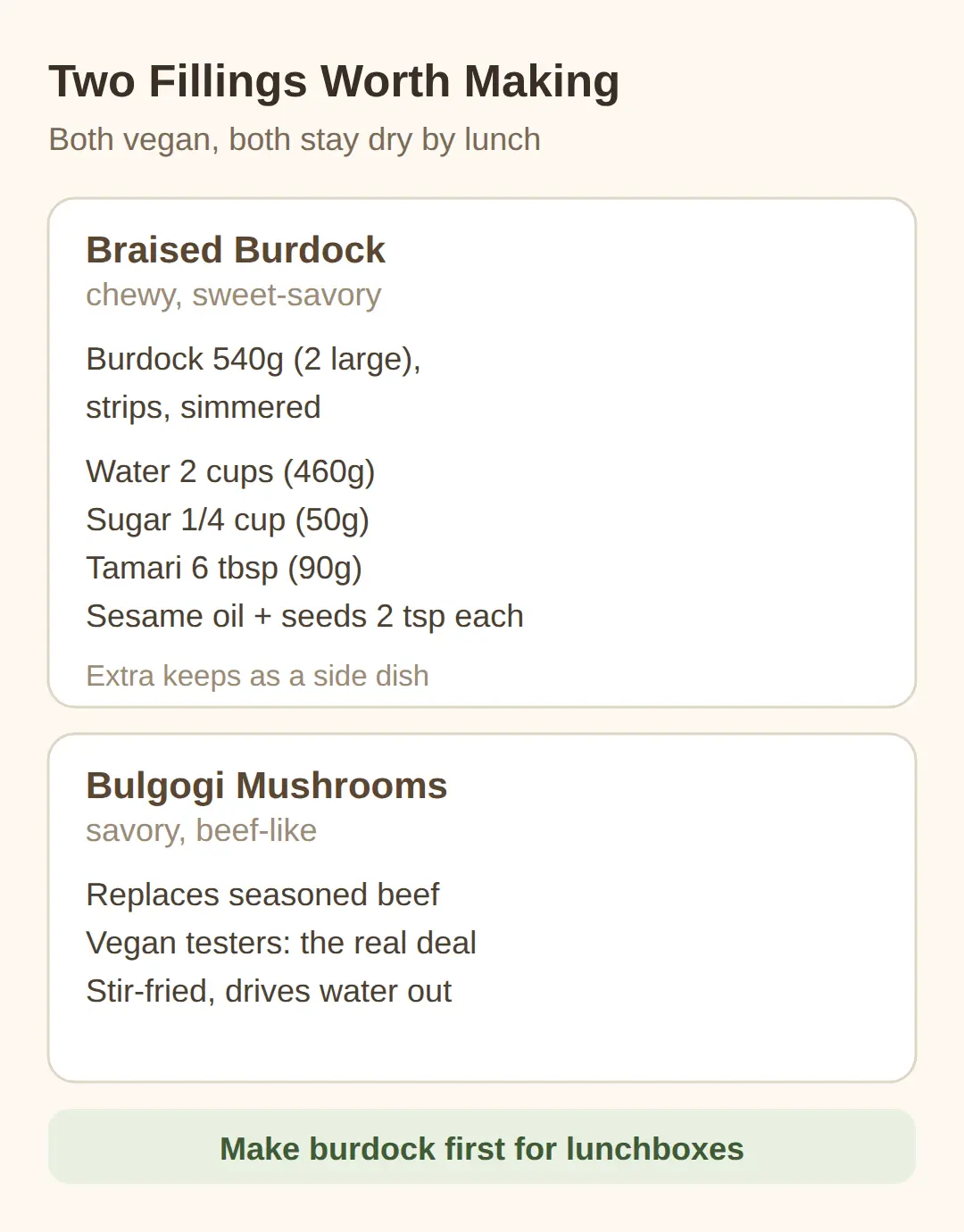
Braised burdock (ueong jorim) and vegan bulgogi mushrooms are the two fillings that turn a plain vegetable roll into something richer.
The burdock braise has exact quantities: 540g (2 large) burdock roots, peeled and cut into thin strips, simmered in 2 cups (460g) water with 1/4 cup (50g) sugar and 6 tbsp (90g) tamari or soy sauce, finished with 2 tsp roasted sesame oil and 2 tsp roasted sesame seeds.
That batch braises more burdock than one kimbap session needs, so the extra keeps as a side dish.
The vegan bulgogi mushrooms are the chewy, savory element that replaces seasoned beef in the recommended combo.
The recipe’s tester handed vegan kimbap rolls out to Korean friends, and the response was that it was legit — the real deal — flavorful enough for vegans and non-vegans alike.
Exact gram weights for the carrot and spinach portions were not confirmed, so the burdock ratio above is the one filling with a full measured recipe.
If the goal is one filling that makes the roll taste complete, the bulgogi mushrooms are the pick; if the goal is chew, the burdock is.
Both keep the roll vegan, and both survive the moisture rule — braising and stir-frying drive water out instead of in.
If I were packing this for a lunchbox, I would make the burdock braise first, because a filling that is already braised and drained adds almost no water to the roll by noon.
👉 vegan kimbap step-by-step with nori prep and rice ratios
👉 vegetable kimbap fillings and rolling guide
👉 Korean vegan kimbap filling prep in Korean, including moisture control
Related posts
📎 Japchae recipe chuseok: noodle times that stop mush
📎 Kimbap Recipe Tuna: Drain, Fry, Cool the Filling
📎 📅 다가오는 일정 — 발매·개봉·발표 캘린더
Sources
- danmuji is main refreshing filling; wrap mat in plastic; sea (yummytummyaarthi.com)
- simple combo: carrots, spinach, bulgogi mushrooms, danmuji; (chefatulya.com)
- Korean vegan kimbap guide: squeeze moisture from vegetables, (abc1342.tistory.com)
Common mistakes and quick rules
- Cook the water out of every filling before it touches the rice — that is the main cause of soggy kimbap and splitting.
- Wet your fingertips with water when spreading rice, and wrap the mat in plastic so rice does not stick.
- Leave the 1-inch empty strip at the top of the nori — that strip is the seal.
- Do not overload the nori; a roll with too much inside is hard to close and breaks when cut.
- If packing for a lunchbox, salt the cucumber and squeeze the spinach harder than feels necessary, and stir-fry the carrot even though raw is allowed.
FAQ
Q. What fillings go in vegetarian kimbap?
Carrot, cucumber, spinach, danmuji (pickled radish) and tofu instead of egg or meat. The recommended simple vegan combo is carrots, spinach, vegan bulgogi mushrooms and danmuji — about 1 piece of danmuji per roll.
Q. How do you keep vegetarian kimbap from getting soggy by lunch?
Remove the water from every wet filling before rolling: blanch and squeeze the spinach, salt and drain the cucumber, and stir-fry the carrot. Wet fillings are the main cause of sogginess and splitting.
Q. How much rice and filling per roll — is 3/4 cup rice and about 1 danmuji piece per sheet the common ratio?
Yes — about 3/4 cup of rice spread over two-thirds of the nori sheet, with a 1-inch strip left empty at the top, and about 1 piece of danmuji per roll. One batch is 6 sheets, about 1 tsp sesame oil per roll.
Q. Is sesame oil vegan, and what do strict vegans use instead?
Toasted sesame oil is plant-based and is the core seasoning of kimbap, so it is fine for vegans — but it can be skipped for a fully oil-free version. No vegan substitute for the oil coat was confirmed as standard practice, so check the label on any replacement. Also check the nori itself: some roasted nori is coated with animal-derived oil.
Q. Can kimbap be made without egg — what replaces it as the protein?
Pan-fried firm tofu is the standard swap: 396g (14oz) firm tofu cut into planks or strips, fried until golden outside and soft inside, seasoned with 1/2 tsp salt and 1/2 tsp black pepper. Chickpea paste spread as a long strip is another option.
Roll one batch of six on a weekend, pack two rolls for Monday’s lunchbox, and see how the squeezed-spinach version holds up against a batch made with raw carrot.
#kimbap #vegetariankimbap #vegankimbap #yachaekimbap #koreanrecipes #lunchbox
📅Upcoming Dates — 이번 주 16 · D-day 'The Scandal' global Netflix release전체 보기 →