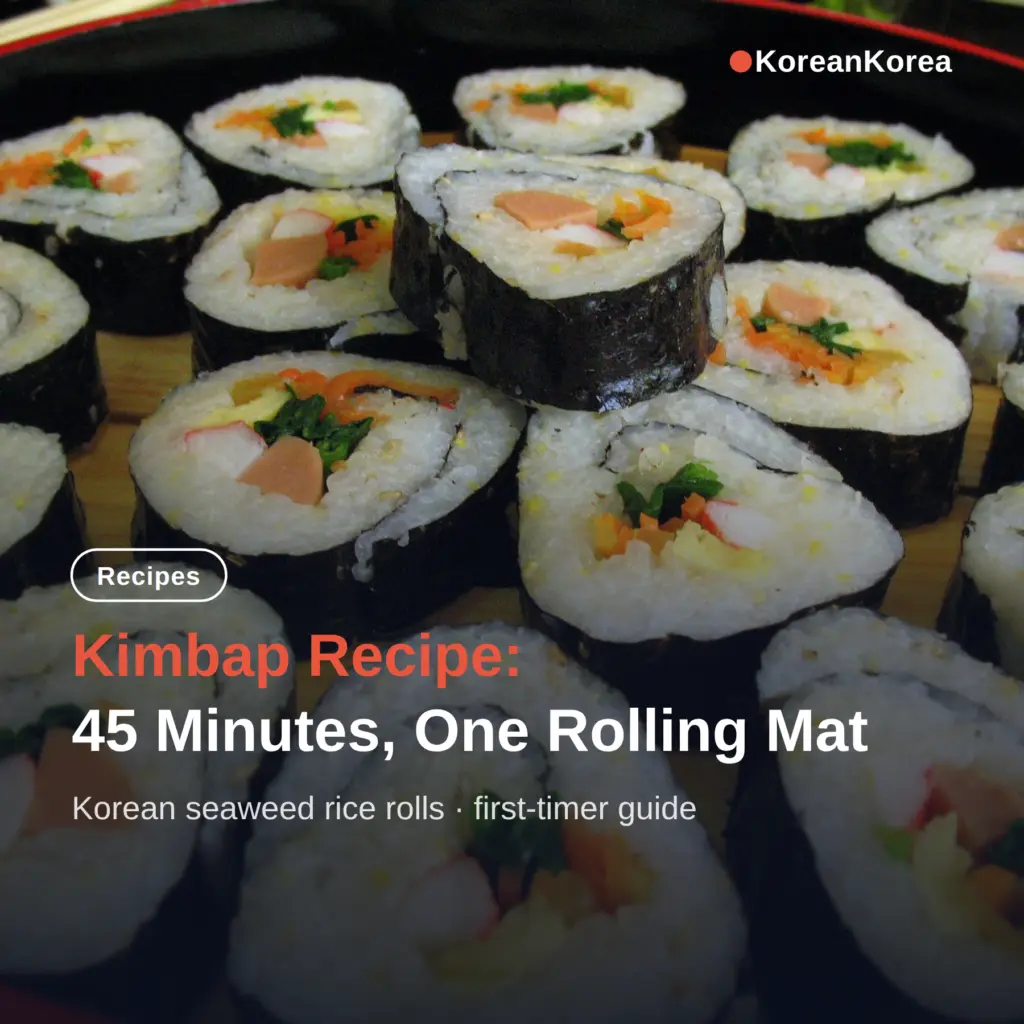
Kimbap is cooked rice and fillings rolled in dried seaweed and sliced, and it is the food Korea packs for holiday road trips.
Chuseok falls on September 25, 2026, and families load it into coolers for the drive to relatives.
This guide covers the rice seasoning, the classic fillings, and the substitutions that work when Korean ingredients are hard to find.
Contents
- Kimbap Rice: Sesame Oil and Salt, Not Sushi Vinegar
- Fillings: The Classic Five and the Egg-vs-Bulgogi Swap
- Rolling Step by Step: The First Fold Is the Whole Game
- Packing Kimbap for the Road: The Two-Hour Rule
Kimbap Rice: Sesame Oil and Salt, Not Sushi Vinegar
The rice is where most first-timers go wrong.
Kimbap rice is seasoned with sesame oil and salt, while sushi rice uses vinegar and sugar, so a sushi-style shortcut changes the taste immediately.
Use short-grain Korean or Japanese-style rice; long-grain rice does not stick, and the roll falls apart.
A common starting point is about 1 tablespoon of sesame oil and 1/2 teaspoon of salt per 2 cups of cooked rice.
One cup of uncooked short-grain rice yields roughly 2 rolls.
Spread the rice in a thin layer and leave about 2 cm of bare seaweed at the top edge.
Brush that bare edge with water, or press in a few sesame-oil-dotted rice grains, then close the seam and rest the roll seam-side down.
Fill and roll while the rice is warm rather than hot, since heat wilts the seaweed.
Pre-roasted seaweed sheets work straight from the package, and standard sheets measure about 20 by 18–20 cm.
Any pot works for the rice; a rice cooker is not required.
| Prep + cook time | About 45 minutes |
|---|---|
| Equipment | One bamboo mat (or a towel and plastic wrap) |
| Rice per 2 rolls | 1 cup uncooked short-grain rice |
| Pieces per roll | 6–8 |
| Room-temperature limit | 2 hours (less on hot days) |
Fillings: The Classic Five and the Egg-vs-Bulgogi Swap
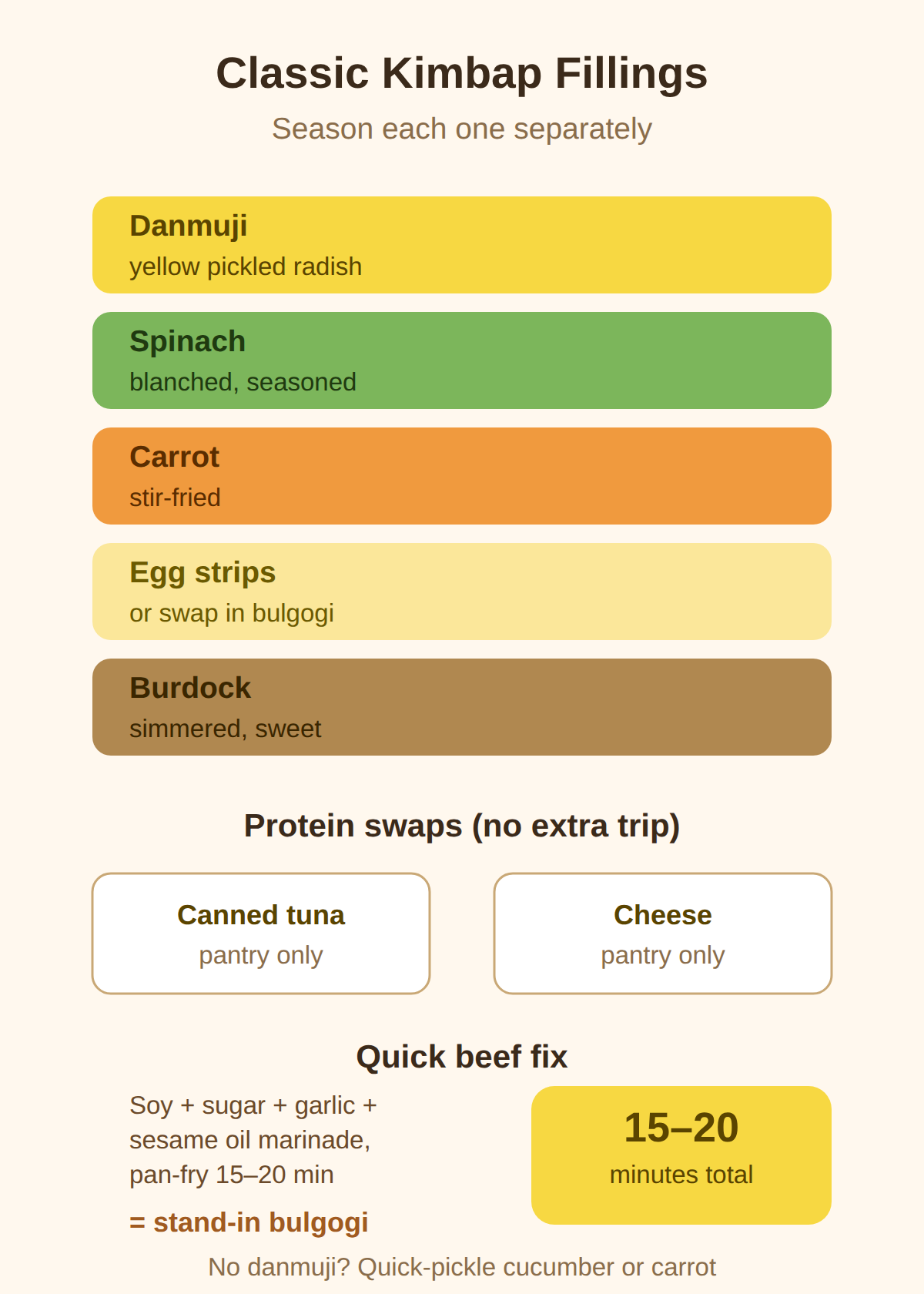
Classic kimbap fillings are yellow pickled radish (danmuji), spinach, carrot, egg strips, and burdock, with bulgogi, ham, tuna, or cheese as the protein.
Each filling is cooked and seasoned on its own before rolling, not mixed into one pan.
When beef is hard to find, a quick marinade of soy sauce, sugar, garlic, and sesame oil on thin-sliced beef replaces proper bulgogi in a 15–20 minute pan-fry.
Canned tuna and cheese are the two variants that show up most in overseas easy-kimbap tutorials, and both need no extra shopping.
If danmuji is unavailable, quick-pickled cucumber or carrot in vinegar stands in; a vinegar-sugar-salt brine with a pinch of turmeric copies the yellow color in a few hours.
Roasted gim, danmuji, and Korean sesame oil are stocked at Korean or Asian grocers abroad, and plain supermarkets carry toasted seaweed snacks as a fallback.
Rolling Step by Step: The First Fold Is the Whole Game
Most first-timer failures come down to three things: overly wet rice, overfilled rolls, and a dull knife that tears the sheet on the first cut.
Keep the rice layer thin, place fillings in a line across the lower third, and lift the mat to make the first fold snug before rolling the rest.
A bamboo mat is standard, but a kitchen towel wrapped in plastic wrap, or parchment paper, works in a pinch.
Cut with a sharp knife wiped with a wet or oiled cloth between cuts so the rice does not stick, and one roll yields 6–8 pieces.
One roll is roughly a light meal for one person or a shared snack for two.
Packing Kimbap for the Road: The Two-Hour Rule
Kimbab travels well, which is why it is the default road-trip food, but cooked fillings only is the safe choice for hot-weather trips.
Keep packed rolls under 2 hours at room temperature, and less on hot days.
Wrap each roll separately and add an ice pack for the drive.
Refrigeration hardens the rice, so for short trips the surface gets a light brush of sesame oil and the rolls stay out of the fridge.
Sources
- Already covered by existing fact 34; no new source needed (world.kbs.co.kr)
- Sustained foreign-interest coverage of Korean food/culture, (koreaherald.com)
- General kimbap definition and rice-seasoning (sesame oil + s (en.wikipedia.org)
Substitutions That Actually Work
- No Korean sesame oil: toasted-sesame oil, or neutral oil plus toasted sesame seeds, approximates the aroma; plain vegetable oil loses the signature scent.
- No bamboo mat: a plastic-wrapped kitchen towel or parchment paper rolls the same roll.
- No beef: folded thin egg omelet or canned tuna carries the roll, and seasoned pan-fried tofu makes it vegan with the rest of the process unchanged.
- Gluten-free: use tamari in the beef marinade and check the danmuji label, since some commercial pickled radish contains wheat-based additives.
FAQ
Q. How is kimbap different from a sushi roll?
The rice is the main difference. Kimbap rice is seasoned with sesame oil and salt, while sushi rice uses vinegar and sugar, and kimbap leans on cooked fillings rather than raw fish.
Q. Why does my kimbap fall apart when I cut it?
The usual causes are overly wet rice, too much filling, and a dull or dry knife. Wipe the blade with a wet or oiled cloth between cuts.
Q. Can I make kimbap ahead for a trip?
Fillings can be cooked the day before, but the rice is best made fresh on rolling day. Packed rolls stay safe at room temperature for about 2 hours.
Make the rice first, cook the fillings while it steams, and season the rice last so it is still warm when the first fold goes down.
Cover photo: Korean.food-Kimbap-03 by jqn (a flickr user) — CC BY-SA 2.0
#kimbaprecipe #gimbap #koreanseaweedricerolls #kimbapfillings #kimbapvssushi #koreanpicnicfood #chuseokfood #koreanrecipes
📅Upcoming Dates — 이번 주 4 · D-day Changdeokgung Moonlight Tour start (Sept 10–Oct 17, 30,000 K전체 보기 →