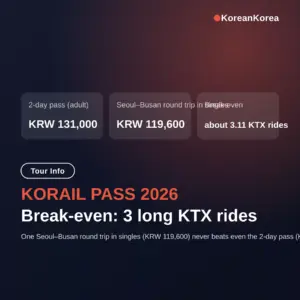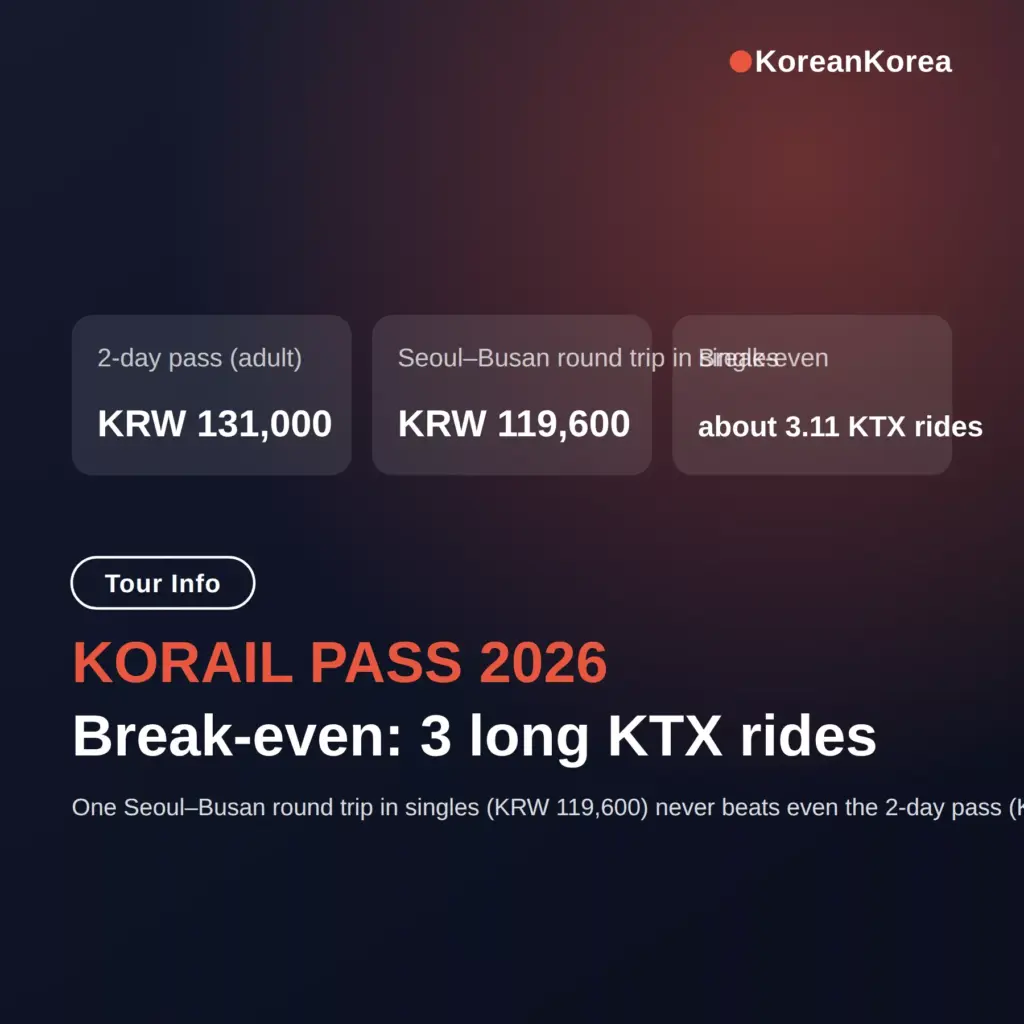
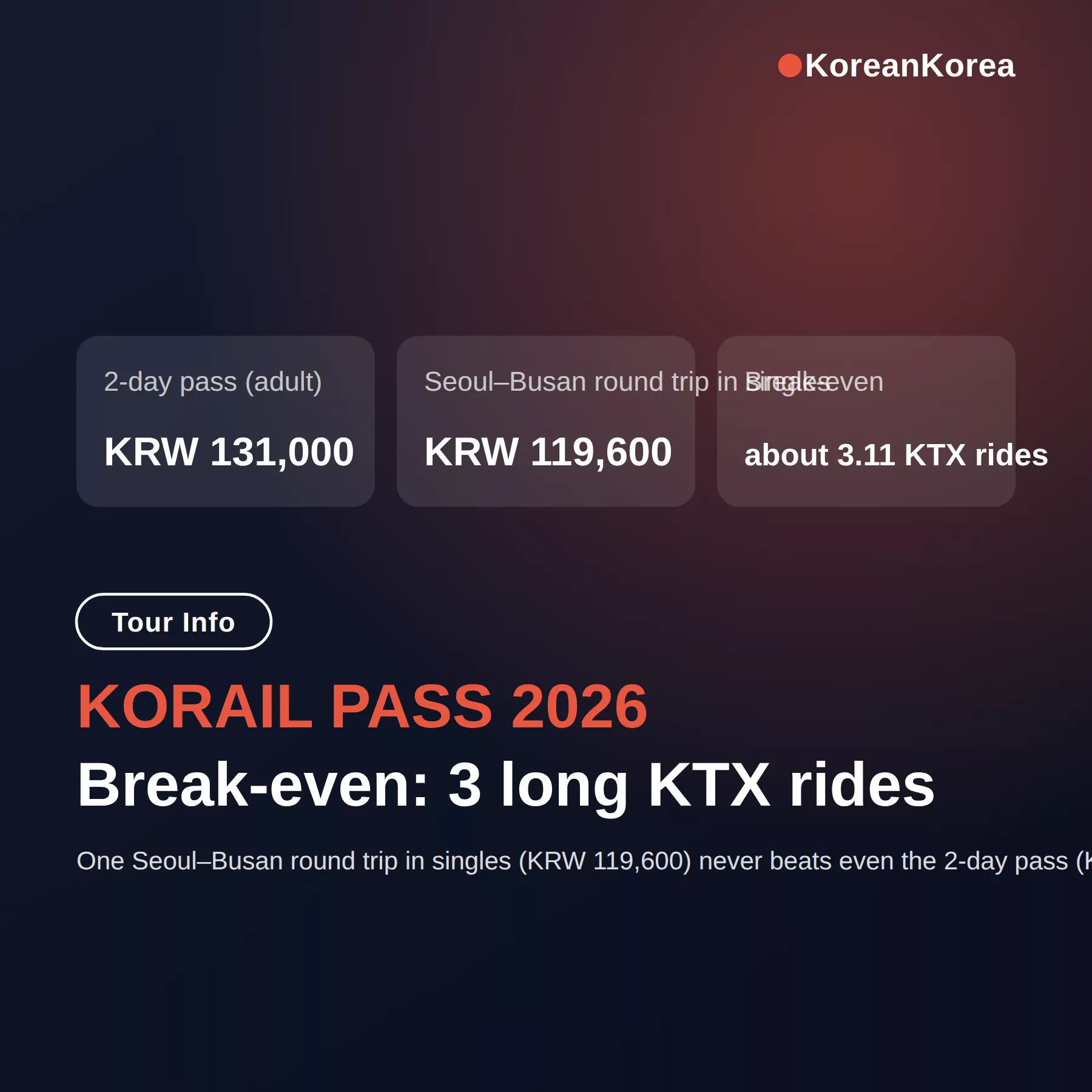
A Seoul–Busan round trip costs KRW 119,600 in single tickets, so it never justifies the cheapest KRW 131,000 2-day pass — the pass starts winning at about 3 long KTX rides.
With Chuseok (September 24–27, 2026) six days away, peak trains sell out and the pass-or-singles decision has to be made this week.
This post gives the 2026 prices, the exact break-even math, what the pass does not cover, and how to buy and reserve seats.
Contents
- Korail Pass worth it 2026: the answer for a 1-week trip
- Korail Pass 2026 prices (adult and child)
- When the math flips: the rides that make the pass pay
- What the pass does NOT cover: SRT and city subways
- How to buy, activate, and reserve seats with the pass
- Chuseok 2026 booking: your deadline this week
Korail Pass worth it 2026: the answer for a 1-week trip
For a 1-week trip the pass is worth it only if you take 3 or more long intercity KTX rides spread over several days; fewer than that, single tickets win.
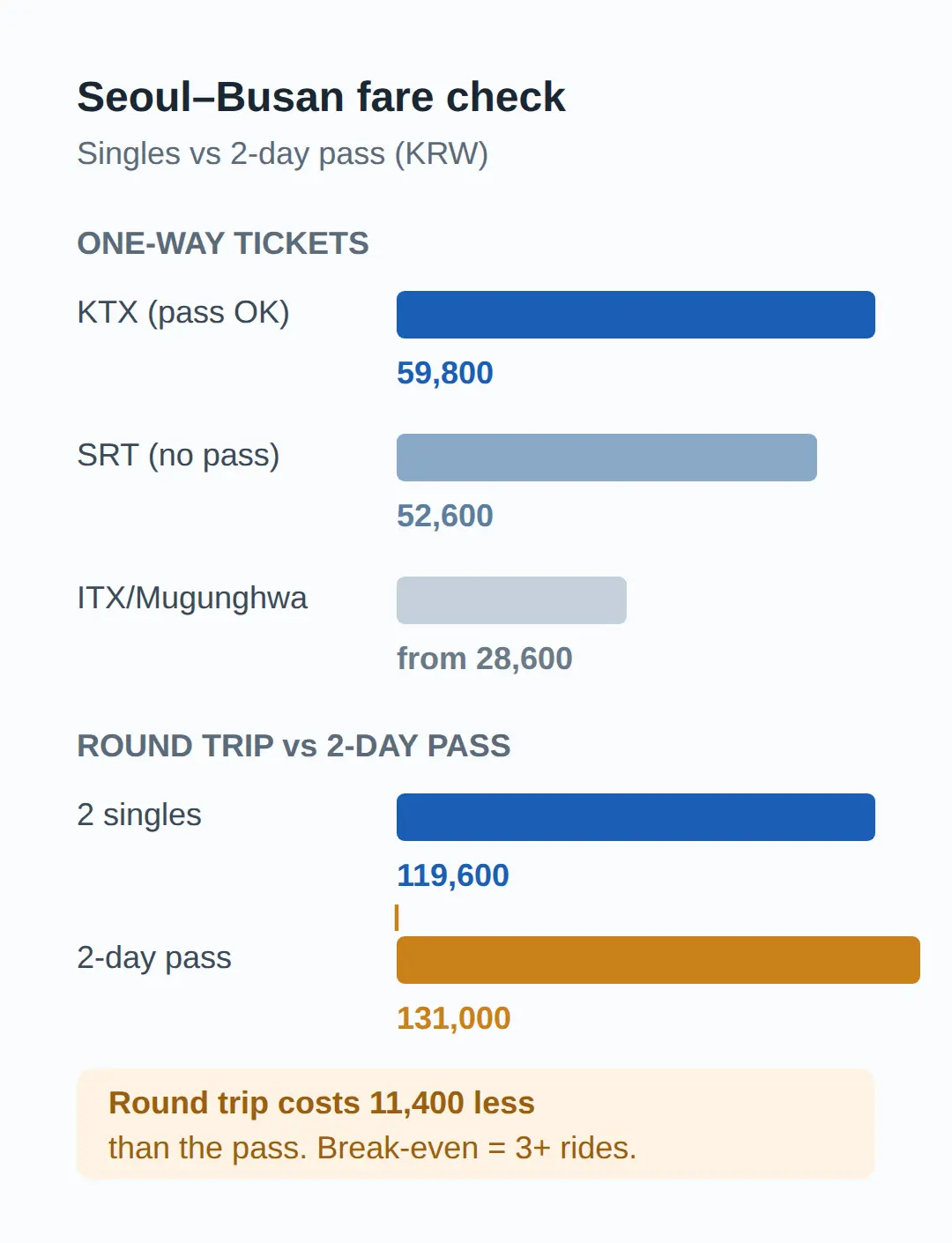
The anchor number is simple: a Seoul–Busan round trip is KRW 119,600 in singles, KRW 11,400 under the 2-day pass at KRW 131,000.
If most of your week is city sightseeing with subways, the pass saves nothing, because Seoul and Busan subways are not included.
A 4–5 day multi-city loop — Seoul, Busan, Gyeongju, Gangneung — is where the pass clearly wins, since each extra long ride pushes past the break-even.
When I look at a pass like this, the first thing I check is where the break-even sits in real fares — one round trip in singles (KRW 119,600) versus the cheapest pass (KRW 131,000) — because that single number settles most trips.
So count your actual train-riding days first; a subway-heavy week means no pass at all.
| Single KTX round trip (Seoul Station, Korail) | KRW 119,600 — cheaper than any pass |
|---|---|
| 2-day pass (adult) | KRW 131,000 — child 6–12 KRW 66,000 |
| 3-day pass (adult) | KRW 186,000 — child KRW 93,000 |
| 4-day pass (adult) | KRW 234,000 — child KRW 117,000 |
| 5-day pass (adult) | KRW 275,000 — child KRW 138,000 |
| Flexible pass | Pick 2 or 4 travel days within a 10-day window |
Korail Pass 2026 prices (adult and child)
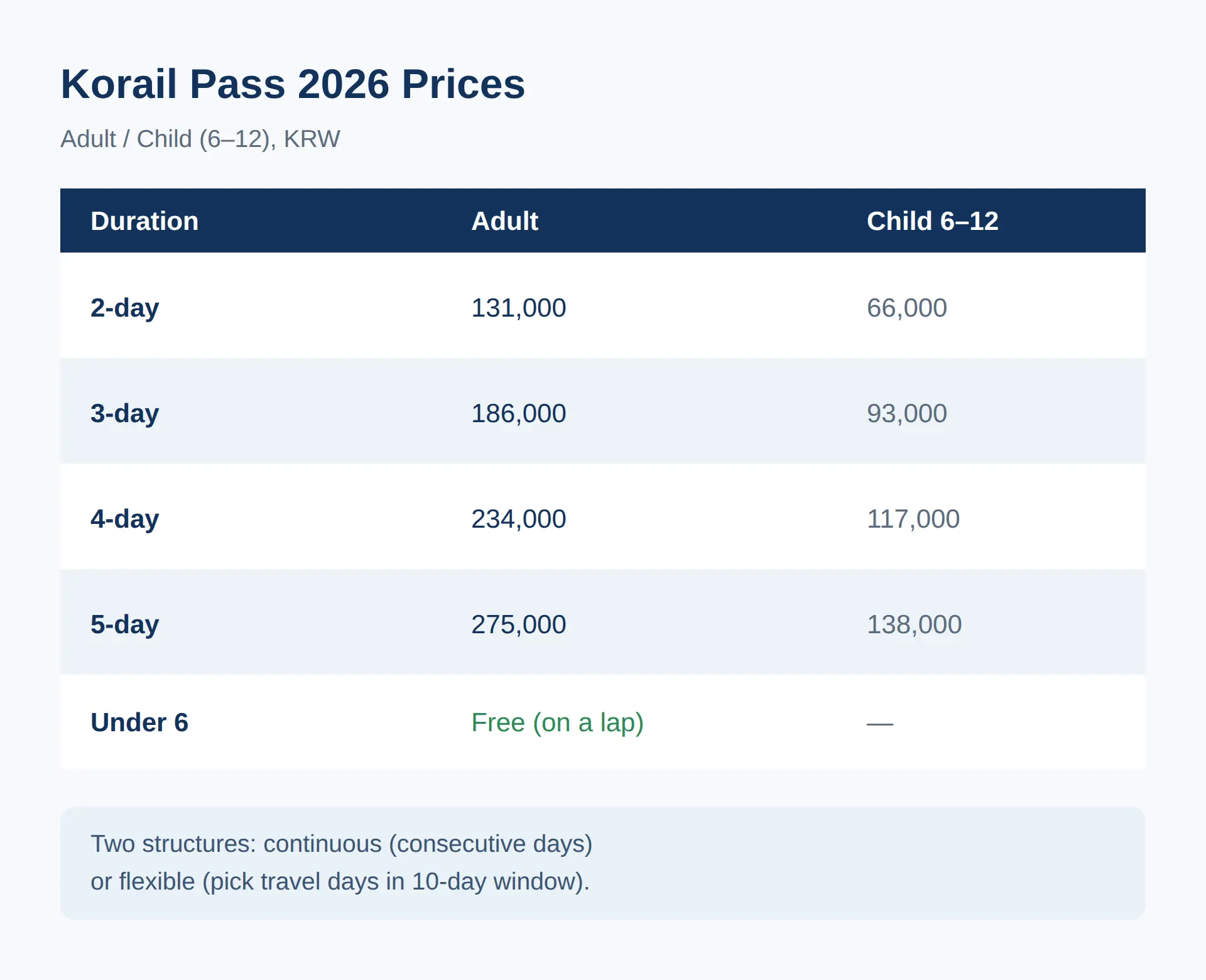
The 2-day adult pass costs KRW 131,000 in 2026, and the 5-day tops out at KRW 275,000.
Prices come from a 2026-dated specialist train guide, so confirm the figure on the booking page before paying — terms are revised periodically.
Children aged 6–12 ride at roughly half price, and children under 6 ride free when seated on a lap.
| Pass duration | Adult price | Child (6–12) price |
|---|---|---|
| 2-day | KRW 131,000 | KRW 66,000 |
| 3-day | KRW 186,000 | KRW 93,000 |
| 4-day | KRW 234,000 | KRW 117,000 |
| 5-day | KRW 275,000 | KRW 138,000 |
| Under 6 | Free on a lap | — |
Two structures are sold: continuous passes (3 or 5 consecutive days) and flexible passes where you pick 2 or 4 travel days within a 10-day window.
Sources describe both consecutive-day and flexible-day structures for 2026, but the exact day counts differ between guides — confirm the terms when you book.
If your riding days are scattered across two weeks, the flexible version is the one to check first.
👉 Gyeongbokgung night tour 2026: 3,000 won, Sept 2-Oct 2, and how booking works
When the math flips: the rides that make the pass pay
Against the 2-day pass (KRW 131,000), the break-even sits between two and three Seoul–Busan KTX rides — from the third long intercity ride onward, the pass usually wins.
The Gyeongju loop shows how close it stays: Seoul–Busan (KRW 59,800) + Busan–Gyeongju (about KRW 11,000, a guide example) + Gyeongju–Seoul (KRW 49,300) = about KRW 120,100 — still under the 2-day pass.
Adding a fourth long ride, for example toward Gangneung, flips the total comfortably in the pass’s favor.
If you only ride once or twice, the budget floor is the slow train: ITX-Saemaeul and Mugunghwa Seoul–Busan fares start around KRW 28,600, and they are also covered by the pass if you hold one.
A short regional day trip never justifies a pass on its own — the covered ITX-Chuncheon from Yongsan is KRW 9,800.
If the rail rides per person come to less than about KRW 131,000 in total, buy singles; KRW 66,400 in fares is only half a 2-day pass.
What the pass does NOT cover: SRT and city subways
No Korail Pass covers SRT, and none covers Seoul or Busan subways.
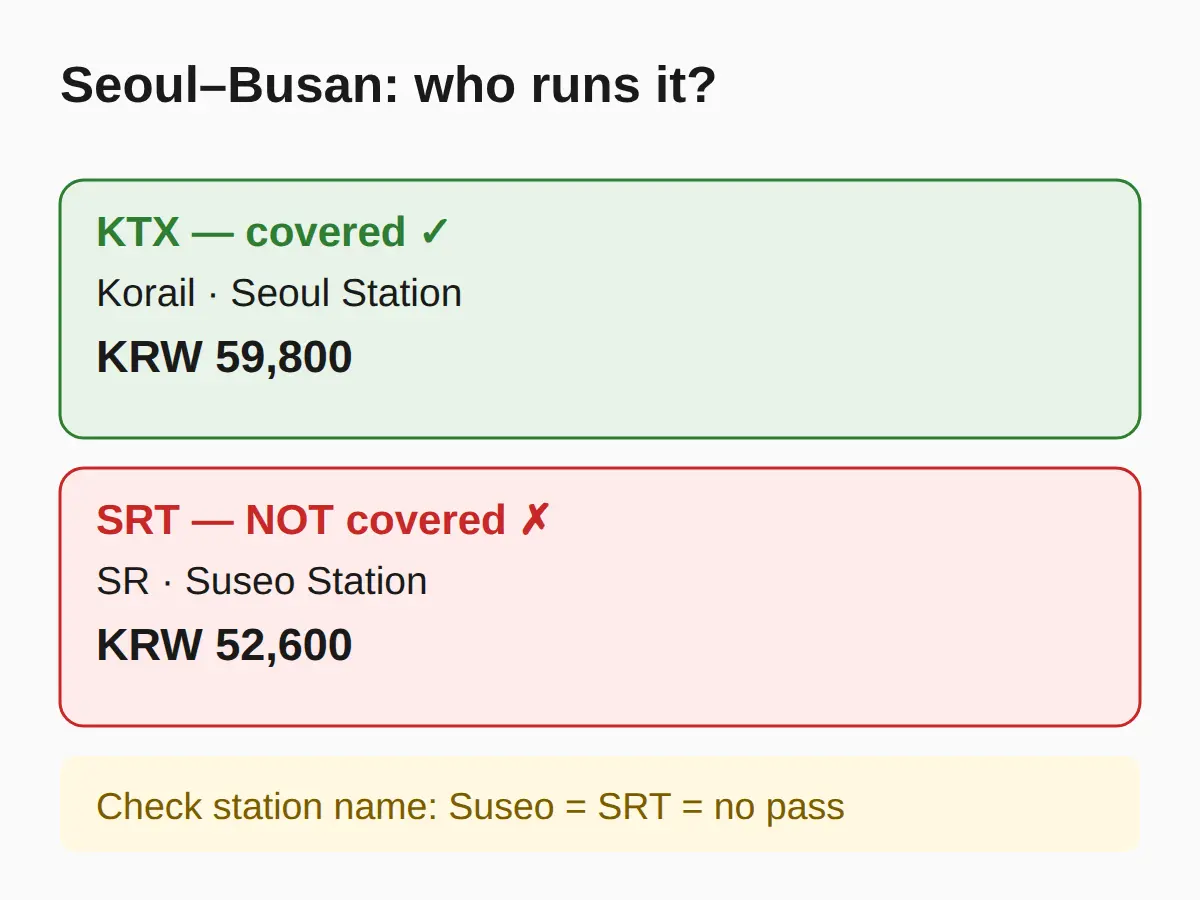
SRT Suseo–Busan is KRW 52,600 — cheaper than KTX’s KRW 59,800 — but it is run by a separate operator (SR) from Suseo Station, so booking it with a pass wastes the pass.
For city transit you still need a T-money card, regardless of any pass.
KTX (Korail, departing Seoul Station) is the covered backbone, linking Seoul with Busan, Gyeongju, Jeonju and Gangneung at about 305 km/h top speed.
ITX-Saemaeul, ITX-Chuncheon, Mugunghwa and most other Korail trains are covered too, with free seat reservations.
So the practical check is the station name on your ticket: Seoul Station means Korail and the pass works; Suseo Station means SRT and it does not.
How to buy, activate, and reserve seats with the pass
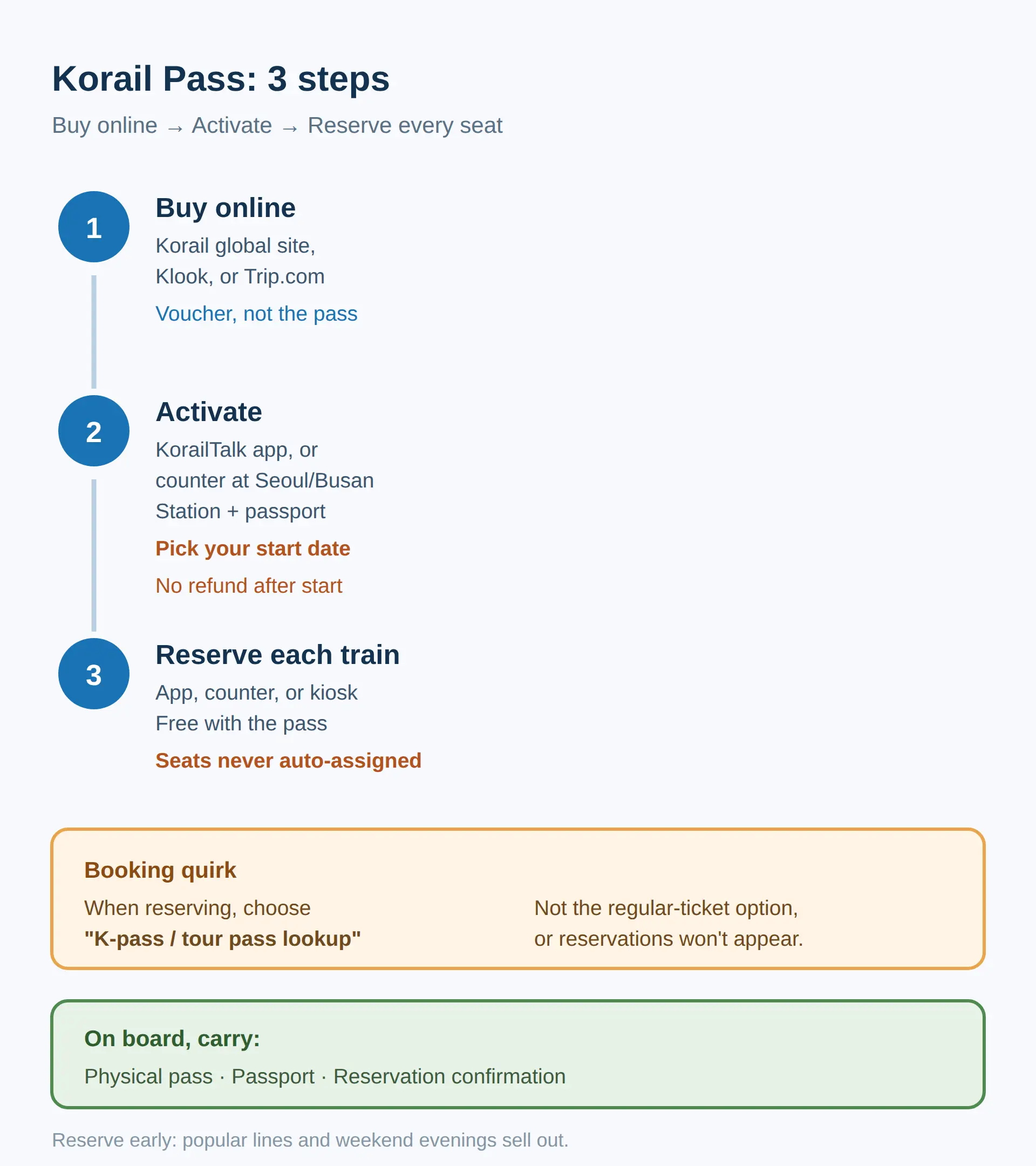
Buying is online-only for the voucher; activation and seat reservation follow in three steps.
- Buy online (Korail global site, Klook, or Trip.com) with a normal international card — this bypasses foreign-card problems on Korean booking channels — and receive a voucher, not the final pass.
- Activate via the KorailTalk app (register the voucher plus passport info) or at a foreigner counter at Seoul Station or Busan Station, and choose your start date yourself; an unused pass can only be refunded before validity starts, minus a fee, so do not activate before your first ride day.
- Reserve a seat for every train, free, via KorailTalk, a counter, or a kiosk — the pass covers fares but never assigns seats automatically.
On board, carry the physical pass, your passport, and the reservation confirmation.
One booking quirk to remember: when reserving in the Korail system, select the ‘K-pass/tour pass lookup’ option instead of the regular-ticket option, or your pass reservations will not appear.
Popular lines and weekend-evening trains sell out even for pass holders, so reserve the moment your dates are set.
👉 Korail Pass seat reservation during Chuseok 2026: valid but standing — how to lock a seat
Chuseok 2026 booking: your deadline this week
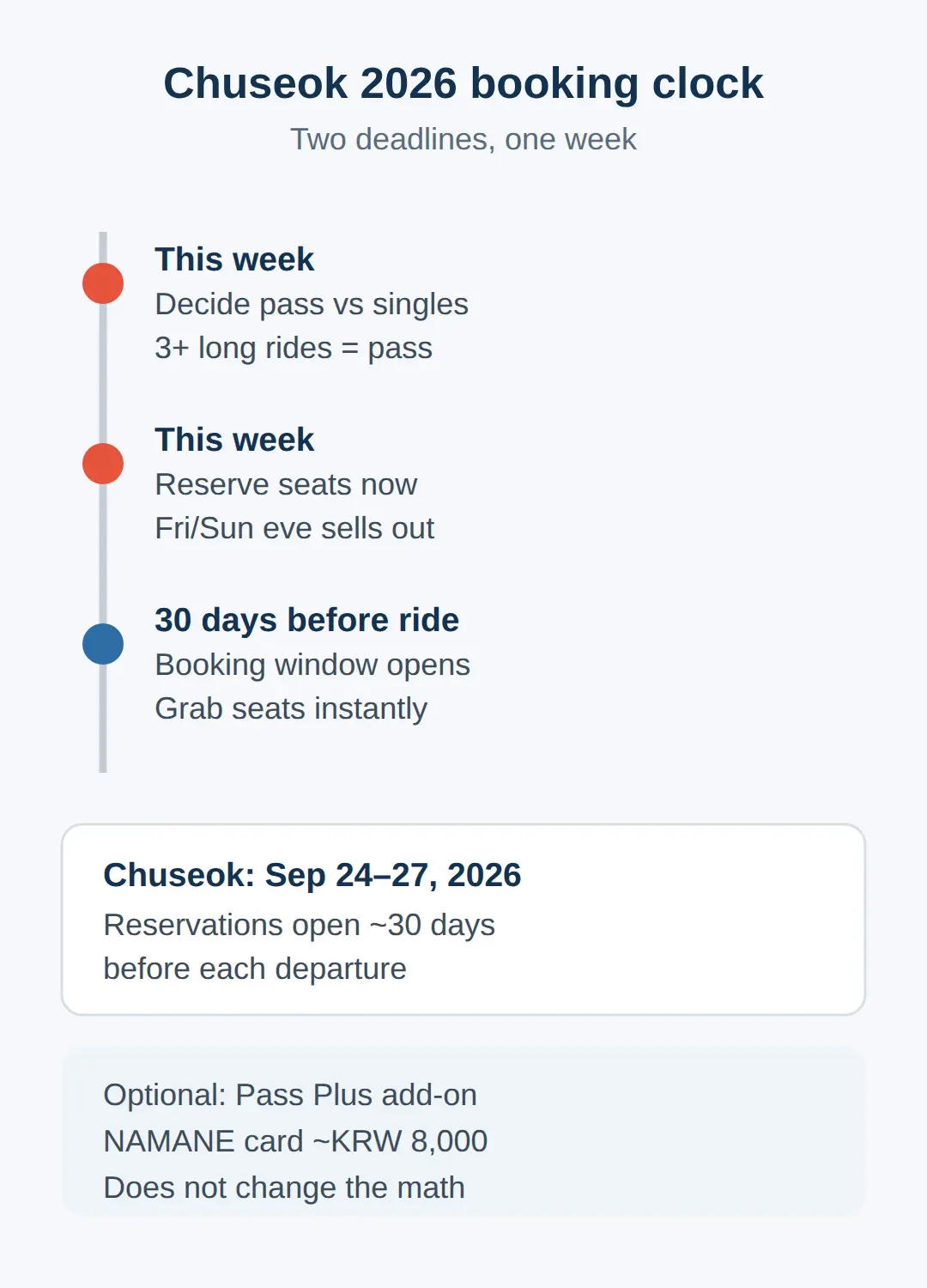
Chuseok runs September 24–27, 2026, and regular ticket reservations open about 30 days before each departure on the Korail global English site.
Friday and Sunday evening trains and holiday peaks sell out even for pass holders, so the pass decision and the seat reservations both need to happen this week.
If you also want subway and bus coverage, there is an optional add-on: Korail Pass Plus adds a charged NAMANE prepaid card (usable on subways, city buses, and at convenience stores) for about KRW 8,000 on top of the standard pass, added yourself via NAMANE kiosks or the official Korail Pass+ site — resellers sell only the standard pass, and the add-on does not change the pass-versus-singles math.
If I were booking now, I would count my train-riding days, buy singles unless I had 3 or more long rides, and if buying the pass, exchange the voucher in KorailTalk only when the first ride day arrives and reserve every seat the moment the 30-day window opens.
Related posts
📎 Changdeokgung Moonlight Tour 2026: Dates Sept 10–Oct 17, 30,000 KRW Tickets, and How Foreigners Book
📎 Busan travel guide 2026: why Taiwanese tourists are flying in and booking longer stays
📎 📅 다가오는 일정 — 발매·개봉·발표 캘린더
Sources
- 2026 price table, break-even math, Pass Plus option, decisio (koreabytrain.com)
- Fare comparison table incl. SRT KRW 52,600, ITX KRW 28,600~, (koreabytrain.com)
- Voucher exchange, activation, free seat reservation steps, c (koreabytrain.com)
Summary: the Korail Pass decision in four lines
- Before you commit, run your own count: list every intercity train you plan to board and total the singles — the worked Seoul–Busan–Gyeongju–Seoul example (~KRW 120,100) shows how close a 3-stop loop can be.
- Decide this week, not at the station: Chuseok (Sept 24–27, 2026) peak trains sell out, and reservations open about 30 days out on the Korail global English site.
- Pay with a normal international card: buying the pass on Klook or Trip.com sidesteps the foreign-card problem at Korean booking channels.
- Set a reminder to cancel reserved trains up to 20 minutes before departure — after that, a pass day can be wasted.
- Carry the physical pass, passport, and reservation confirmation together on board; keep a T-money card for Seoul and Busan subways.
FAQ
Q. Is the Korail Pass worth it for 1 week in Korea?
Only if you take 3 or more long intercity KTX rides across several days. A single Seoul–Busan round trip (KRW 119,600 in singles) is cheaper than the 2-day pass (KRW 131,000), and a subway-heavy week saves nothing because subways are not included.
Q. Do I need to reserve seats with the Korail Pass?
Yes. The pass covers the fare but does not assign a seat, so you must reserve one per train for free via the KorailTalk app, a station counter, or a kiosk. Friday and Sunday evening trains and holidays sell out even for pass holders.
Q. Does the Korail Pass cover SRT and the Seoul subway?
No to both. SRT is run by SR from Suseo Station (KRW 52,600 Suseo–Busan) and no Korail Pass works on it, and Seoul/Busan subways need a T-money card. KTX from Seoul Station and most other Korail trains are covered.
Q. Which trains are covered by the Korail Pass?
KTX (about 305 km/h top speed, linking Seoul with Busan, Gyeongju, Jeonju, and Gangneung), ITX-Saemaeul, ITX-Chuncheon, Mugunghwa, and most other Korail trains, with free seat reservations.
Q. How much is the Korail Pass in 2026?
2026 figures from a specialist train guide: 2-day adult KRW 131,000 (child KRW 66,000), 3-day KRW 186,000, 4-day KRW 234,000, 5-day KRW 275,000; flexible passes let you pick 2 or 4 travel days within a 10-day window. Confirm on the booking page, since terms are revised periodically.
Dates to watch
#KorailPass #Koreatraintravel #KTX #Chuseok2026 #Koreatransport
📅Upcoming Dates — 이번 주 14 · D-4 Final two episodes drop on Disney+/Hulu전체 보기 →