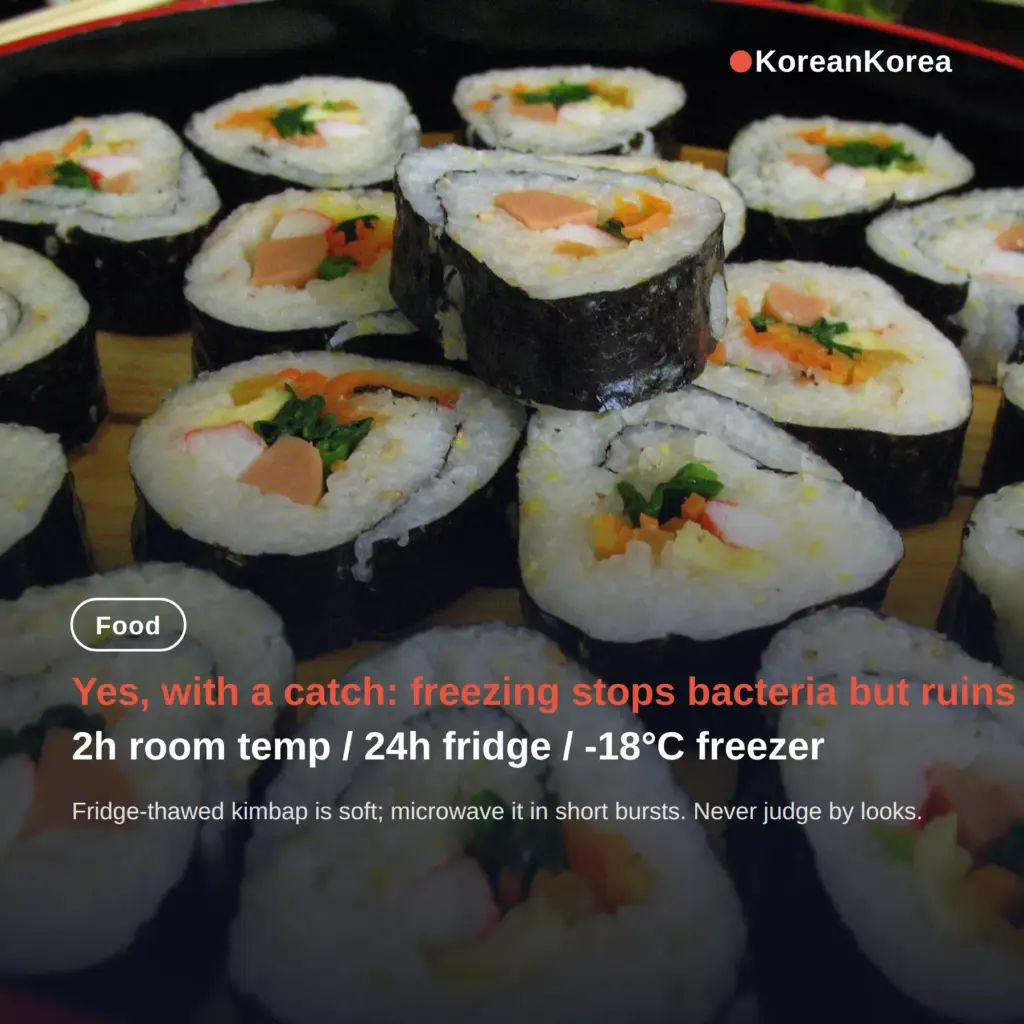
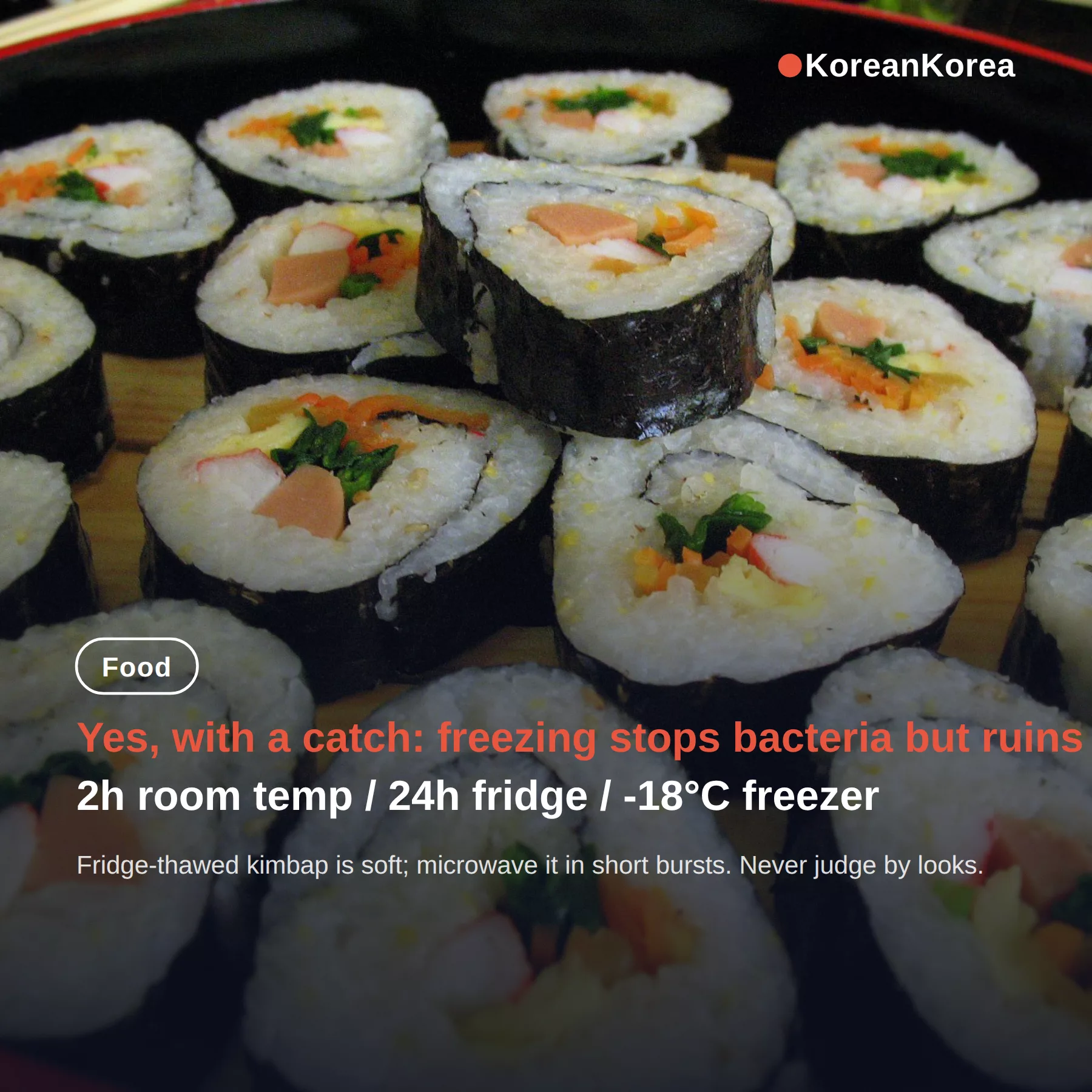
Yes, you can freeze kimbap, but freezing only stops bacteria instead of killing them, and slow home freezing hardens the rice and tears the seaweed.
That means the real question is not freezer safety but texture: at home, the practical limits are 2 hours at room temperature, 24 hours in the fridge, and eating soon after thawing.
This post covers how long kimbap lasts by storage method, how to freeze it at home with the least damage, and how to revive hardened leftovers as kimbap-jeon.
Contents
- Can you freeze kimbap? Yes — and here is what freezing changes
- How long does kimbap last at room temperature and in the fridge
- How to freeze kimbap at home without ruining it
- How to revive hardened kimbap
- If you want frozen kimbap that actually tastes good: bibigo
Can you freeze kimbap? Yes — and here is what freezing changes
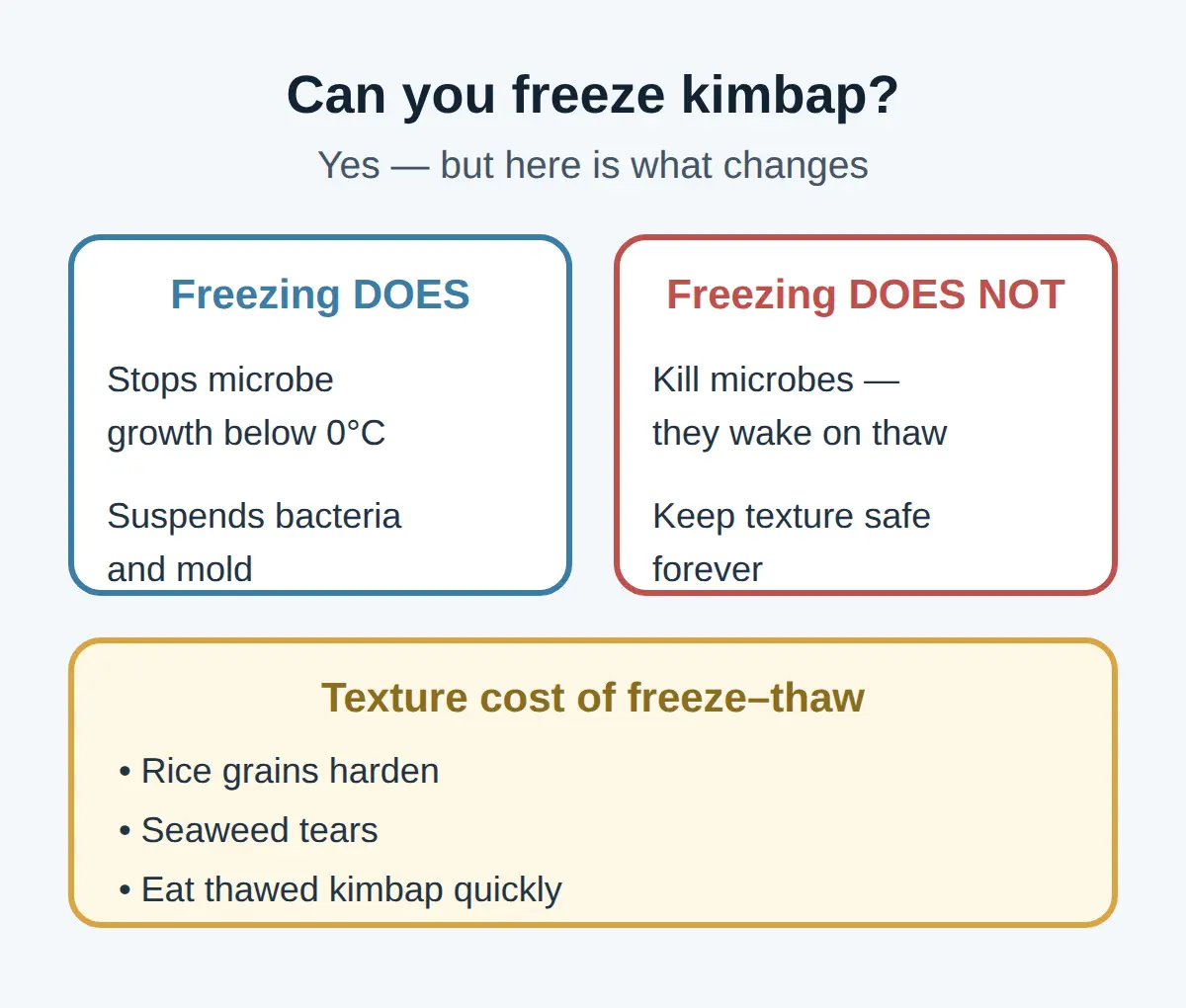
Yes, you can freeze kimbap — freezing stops the microbes, but it does not kill them, and the rice hardens and the seaweed tears on thawing.
Most bacteria and mold cannot multiply below 0°C, but they are only suspended, not sterilized, and they wake up again as the food thaws.
That is why thawed kimbap must be eaten quickly rather than treated as safe indefinitely.
There is also a texture problem.
Rice is sticky and the fillings hold moisture, so the freeze-thaw cycle hardens the rice grains and tears the seaweed — the reason kimbap is one of the hardest everyday foods to machine-freeze.
CJ CheilJedang needed a purpose-built rapid-freezing line to solve this at scale.
If a food company needs special industrial equipment to keep the texture, a home freezer will not match it, so decide based on whether you care more about saving the roll or eating it soft.
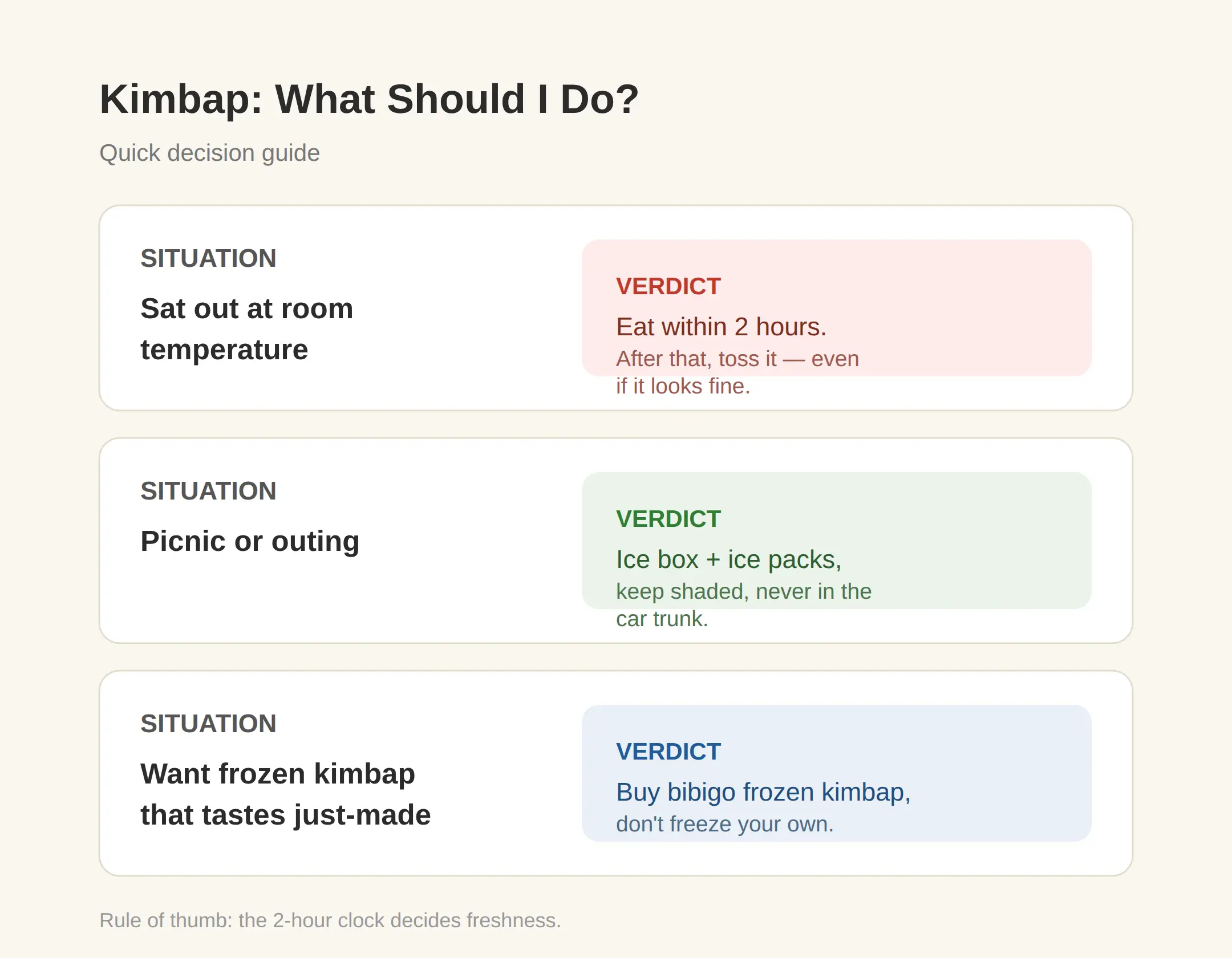
| Kimbap left out at room temperature | Eat within 2 hours (4-6 hours in cool seasons by a softer guide, 2 in summer); past that, throw it out even if it looks fine |
|---|---|
| Leftover kimbap in the fridge | Eat within 24 hours; 48 hours is the hygiene limit — discard past two days |
| Homemade kimbap you want to freeze | Wrap in plastic plus a zipper bag with air removed, keep the freezer at -18°C or below, thaw in the fridge, eat soon after |
| Already hardened or soggy kimbap | Pan-fry in beaten egg (kimbap-jeon) — the most reliable fix; or microwave in short bursts with a damp paper towel |
| Kimbap for a picnic or outing | Ice box with ice packs, keep it shaded, and never leave it in the car trunk |
| Want frozen kimbap that tastes just-made | Buy bibigo frozen kimbap instead of freezing your own |
How long does kimbap last at room temperature and in the fridge
Per the Korean Ministry of Food and Drug Safety, kimbap should be eaten within 2 hours at room temperature and discarded after that even if it looks normal.
The MFDS 2-hour rule is the strict baseline.
A Korean storage guide is softer: 4-6 hours at room temperature in cool seasons, but only 2 hours in hot, humid summer.
When two sources differ, the safe move is to follow the shorter number.
Refrigeration buys you one day.
The same guide recommends eating refrigerated kimbap within 24 hours and treats 48 hours as the hygiene limit — past two days, throw it out even if it looks fine.
The catch is that chilling does not undo a mistake: if kimbap sat out over 2 hours before going in the fridge, bacterial toxins may already have formed, and cold does not remove toxins that already exist.
The fridge also ruins the texture — within a few hours the rice dries and hardens and the seaweed goes soggy, which is exactly why people start asking about the freezer.
When I look at kimbap storage, the first thing I check is how long it sat at room temperature, because the 2-hour rule decides everything after it.
👉 Kimbap Recipe Tuna: Drain, Fry, Cool the Filling
How to freeze kimbap at home without ruining it
You can freeze kimbap at home, but expect a texture trade-off — the steps below are about limiting the damage, not avoiding it.
Slow freezing is what hardens the rice and tears the seaweed, so the whole procedure is built around speed and sealing.
Freezer burn is the other enemy: loose packaging lets surface moisture evaporate into ice crystals and leaves the texture dry and tough.
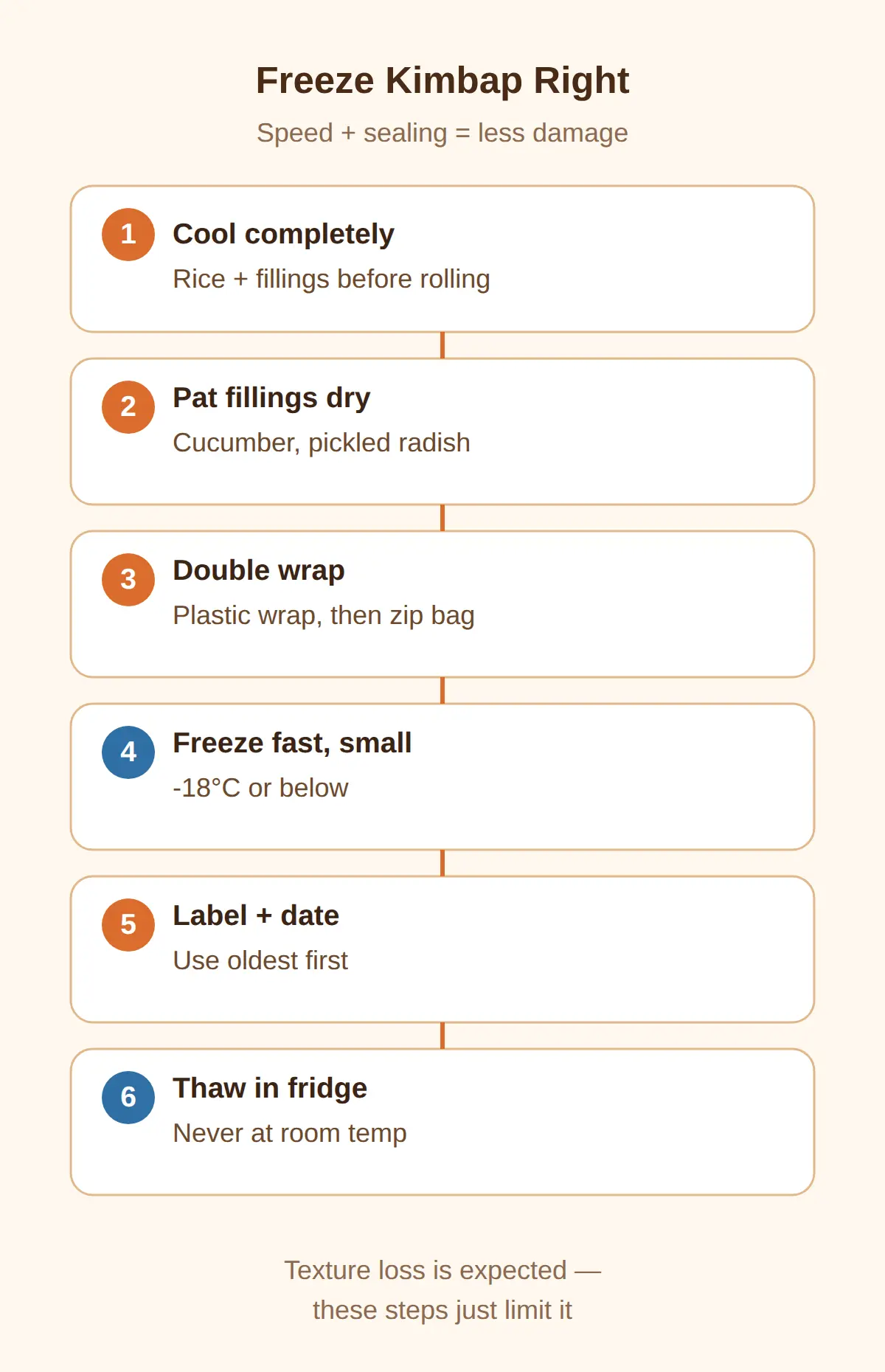
- Cool the rice and fillings completely before rolling — warm filling sweats inside the seaweed and that moisture speeds spoilage.
- Pat watery fillings such as cucumber and pickled radish dry with a kitchen towel before rolling — moisture inside decides half of the storage outcome.
- Double wrap: plastic wrap directly on the roll, then a zipper bag with the air pressed out; vacuum sealing is the most effective.
- Freeze fast in small portions at -18°C or below, before the surface dries.
- Label each package with the date and contents and use the oldest first.
- Thaw in the fridge, not at room temperature — room-temperature thawing carries high bacterial risk.
One thing the sources could not confirm: whether you should remove specific fillings such as cucumber or egg before freezing — check how wet your fillings are yourself and treat that as a judgment call rather than a rule.
How long frozen kimbap keeps at home was also not stated anywhere; the freezer slows bacteria but does not stop the texture from degrading.
How to revive hardened kimbap
The most reliable fix is kimbap-jeon: dip the slices in beaten egg and pan-fry them until the rice softens again and the limp seaweed is barely noticeable.
The egg coating works because it adds moisture and heat quickly to the surface, which is exactly what hardened rice needs.
If you would rather not fry, microwave works too — cover the kimbap with a damp paper towel and heat in short bursts.
The same guide warns that long microwaving turns the rice gummy, so short bursts are the whole trick.
Before reviving anything, check it.
A sour smell, a sticky surface, or discolored fillings — any one of these means throw it out, because appearance alone cannot judge safety.
If I have leftover kimbap, I skip the freeze-versus-fridge debate and make kimbap-jeon that evening; it is the one fix that reliably makes hardened rice soft again.
👉 Kimbap Recipe Vegetarian: Fillings That Don’t Go Soggy by Lunch
If you want frozen kimbap that actually tastes good: bibigo
If you want frozen kimbap that tastes just-made, buying bibigo frozen kimbap works better than freezing your own.
CJ CheilJedang built the industry’s first automated frozen-kimbap production line at its Jincheon Blossom Campus, using rapid-freezing technology to keep a just-made texture after thawing.
The line automates everything from ingredient input to cutting and tray packing, which also cuts the outside contamination that hand-rolling risks.
Bibigo frozen kimbap launched in 2023 and is now sold in 25 countries in six flavors: bulgogi, spicy pork, vegetable, bibimbap, kimchi cheese, and tuna mayo.
If you are outside Korea and want kimbap for a frozen lunchbox, check whether your local Asian grocery carries bibigo before attempting home freezing — the texture difference is the whole reason the company built a special line.
If I have leftover kimbap, I skip the freeze-vs-fridge debate and make kimbap-jeon right away — egg wash and a pan fix the hard rice in minutes, while home freezing almost always costs me the seaweed.
What I check first is the 2-hour clock: if it has been sitting out longer than that, freezing is not a rescue, it just preserves a problem.
👉 the upper east gimbap storage guide with 24-hour fridge limits and revival tips
👉 the foodrecipe report on the 2-hour room-temperature rule and car trunk heat
👉 the withbuyer story on CJ’s automated frozen-kimbap line at Jincheon
Related posts
Sources
- Room temperature limit (MFDS) (segye.com)
- No 6-month-dated direct source on which fillings to remove b (uppereast.co.kr)
- Rice stickiness/moisture make machine freezing hard; seaweed (withbuyer.com)
What to remember
- Freezing stops bacteria from multiplying; it does not kill them — eat kimbap soon after thawing.
- The MFDS guidance is discard kimbap left out over 2 hours, even if it looks normal.
- Wrap tight (plastic + zipper bag, air out), freeze at -18°C or below, and thaw in the fridge.
- Long microwaving makes rice gummy — damp paper towel, short bursts, or just make kimbap-jeon.
- Frozen kimbap that tastes just-made exists commercially because of rapid-freezing lines home freezers cannot copy.
FAQ
Q. Can you freeze kimbap and eat it later?
Yes, but freezing only suspends bacteria and the rice hardens and seaweed tears through freeze-thaw. Wrap tightly, freeze fast at -18°C or below, thaw in the fridge, and eat soon after.
Q. How long can kimbap sit out at room temperature?
Korean Ministry of Food and Drug Safety guidance says 2 hours; discard after that even if it looks normal. A softer storage guide allows 4-6 hours in cool seasons but only 2 hours in hot, humid summer.
Q. How long does kimbap last in the fridge?
Within 24 hours is the recommendation and 48 hours is the hygiene limit; past two days, discard even if it looks fine. Note the fridge dries the rice and sogs the seaweed within hours.
Q. How do you make hardened kimbap soft again?
Pan-fry it in beaten egg (kimbap-jeon) — the most reliable fix. Or microwave in short bursts with a damp paper towel on top; long heating makes the rice gummy.
Q. Why does store-bought frozen kimbap taste better than home-frozen?
CJ CheilJedang’s bibigo frozen kimbap uses special rapid-freezing technology on an automated line to keep a just-made texture — a process a home freezer cannot replicate.
Lunchbox season peaks through September and autumn picnics — if you pack kimbap regularly, it is worth bookmarking this page before your next outing.
Cover photo: Korean.food-Kimbap-03 by jqn (a flickr user) — CC BY-SA 2.0
#kimbap #foodstorage #freezingfood #koreanfood #foodsafety #leftovers
📅Upcoming Dates — 이번 주 14 · D-4 Final two episodes drop on Disney+/Hulu전체 보기 →