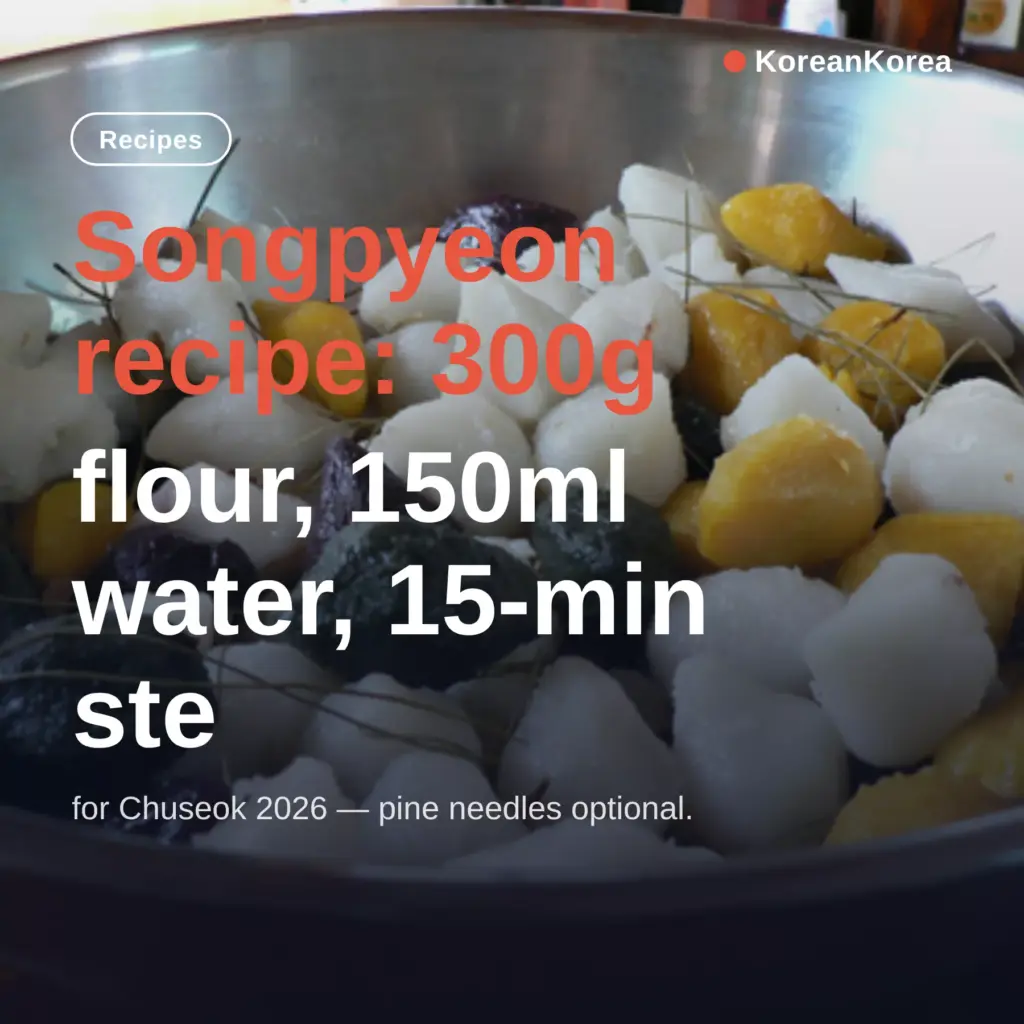
For a first-timer: knead 300g non-glutinous rice flour with 150ml hot water, fill each of 20 pieces with 1 teaspoon of filling, and steam 15 minutes — pine needles are optional, and Chuseok 2026 falls on September 25.
That means if you live outside Korea, the whole thing fits in one evening with a regular steamer and a damp cloth instead of pine needles.
This post gives the working recipe, the pine-needle swap, which rice flour bag to buy, and the three reasons songpyeon cracks.
Contents
- Songpyeon recipe: the 40-minute first-timer version at home
- What to use instead of pine needles
- Which rice flour to buy abroad (mepssalgaru vs chapssalgaru)
- Why songpyeon cracks — the three real failure points
- The three fillings and how much to use
- What songpyeon is and when Koreans make it
Songpyeon recipe: the 40-minute first-timer version at home
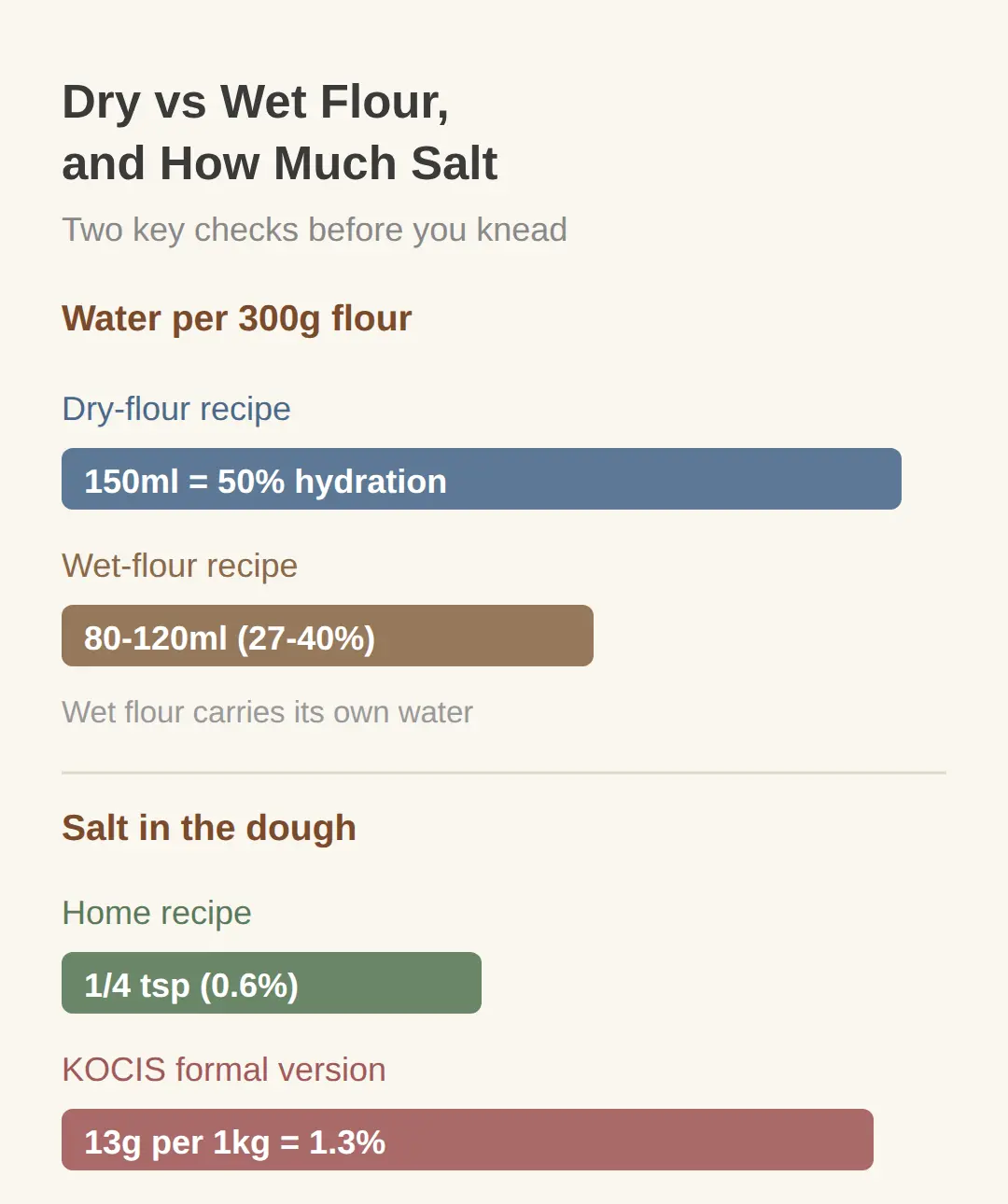
The working ratio is 300g non-glutinous rice flour, 150ml hot water, 1/4 tsp salt, and 1 tsp oil, and it makes exactly 20 songpyeon.
Knead the 300g-flour dough until it is soft like an earlobe — too stiff cracks when you shape it, too soft loses its shape.
Two Korean home recipes agree on that texture test, and it is the single most useful checkpoint in the whole recipe.
- Mix the flour with the hot water a little at a time, then add the salt and oil and knead until the dough feels like a soft earlobe.
- Divide into 20 pieces, about 15g each — 300g divided by 15g gives exactly 20 — and press a well with your thumb to make a small bowl.
- Put about 1 teaspoon of filling in each bowl, pinch the edges shut firmly, and roll between your palms to smooth, then pinch the ends into a half-moon.
- Steam on high heat for 15 minutes until the cakes turn translucent and glossy.
- Rinse the hot cakes briefly in cold water, drain, and brush with sesame oil while warm for gloss and chew.
When a recipe for people abroad does not say which rice flour bag to buy, that is the first thing I check — mepssalgaru, not chapssalgaru, because that is where most first-timers go wrong.
The whole thing runs about 40 minutes end to end, which is why the day before Chuseok works fine even on a workday.
| Non-glutinous rice flour (mepssalgaru) | 300g |
|---|---|
| Hot water (about 50% hydration) | 150ml |
| Salt | 1/4 tsp |
| Cooking oil | 1 tsp |
| Filling (sesame, red bean, or honey-pine nut) | about 1 tsp per piece |
What to use instead of pine needles
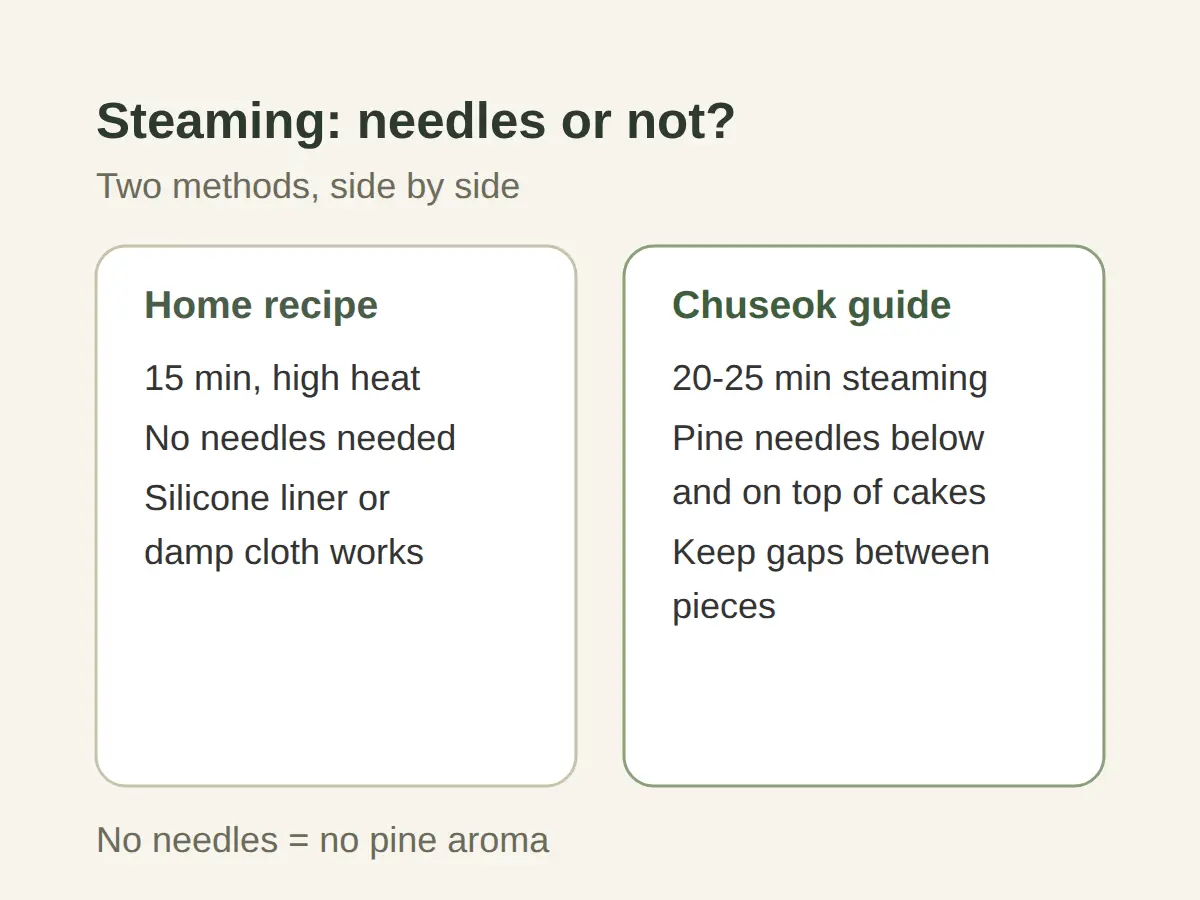
Pine needles are optional — a silicone liner or a damp kitchen cloth (cheesecloth) under the songpyeon prevents sticking, and that is the standard swap for cooks abroad.
If you can get needles, lay a thin layer below and on top of the cakes, with gaps between pieces so they do not stick together.
The name explains the tradition: ‘song’ means pine, and the cakes are steamed on pine needles.
Korean cultural sources cite a Joseon-era medical text for why — pine needle phytoncide inhibits bacteria and mold, which historically kept the cakes fresh and cut the stale, steamy taste of plain-steamed rice.
So the swap is safe for sticking, but you lose the pine aroma the name comes from.
How much the aroma actually changes without needles has not been measured in any source I could check, so treat any strong claim with caution — what is confirmed is only that the needles add aroma and prevent sticking.
Which rice flour to buy abroad (mepssalgaru vs chapssalgaru)
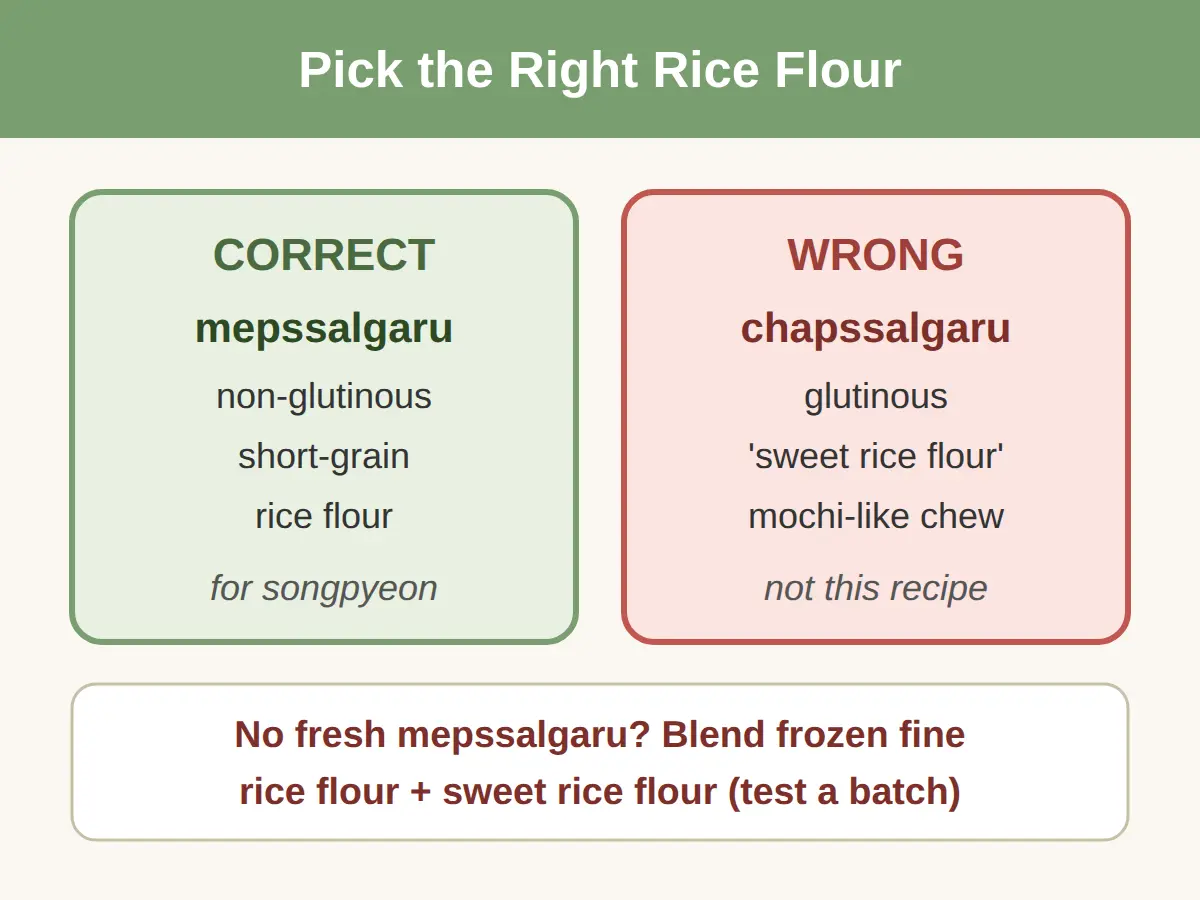
Traditional songpyeon uses non-glutinous short-grain rice flour (mepssalgaru), not glutinous sweet rice flour (chapssalgaru).
The difference is amylopectin: chapssalgaru has no gluten but much more of it, which gives the stretchy, mochi-like chew — and picking the wrong bag is a common first-timer error outside Korea.
If fresh dry-milled mepssalgaru is unavailable, the accepted workaround in English-language guides is a blend of frozen fine rice flour plus sweet rice flour.
The blend itself is confirmed, but no published ratio for it could be verified, so test a small batch or write the ratio yourself before trusting one.
Whether a chapssalgaru blend changes the 15-minute steam time is also unconfirmed — watch for translucency rather than the clock.
Read the label before you buy: ‘sweet rice flour’ on the bag is the wrong one for this recipe, even though the word sweet sounds like the dessert it is.
Why songpyeon cracks — the three real failure points
Songpyeon cracks for three reasons: the dough dries out while you shape, the filling overflows the seam, or the edges were never pressed shut.
Drying during shaping is the main first-timer failure — a dried dough splits when you pleat it and the half-moon shape falls apart.
The fixes are mechanical.
Cover shaped and unshaped dough with a damp cloth between batches, and add hot water gradually while kneading, because moisture differs by flour batch.
Keep filling to about 1 teaspoon per piece — too much stops the opening from sealing and the cake bursts in the steamer.
Wet red bean paste is the worst offender, so press the seam firmly for every filling.
I would err on the side of less filling rather than more — the burst-in-the-steamer failure comes from overfilling, not from the dough.
The three fillings and how much to use
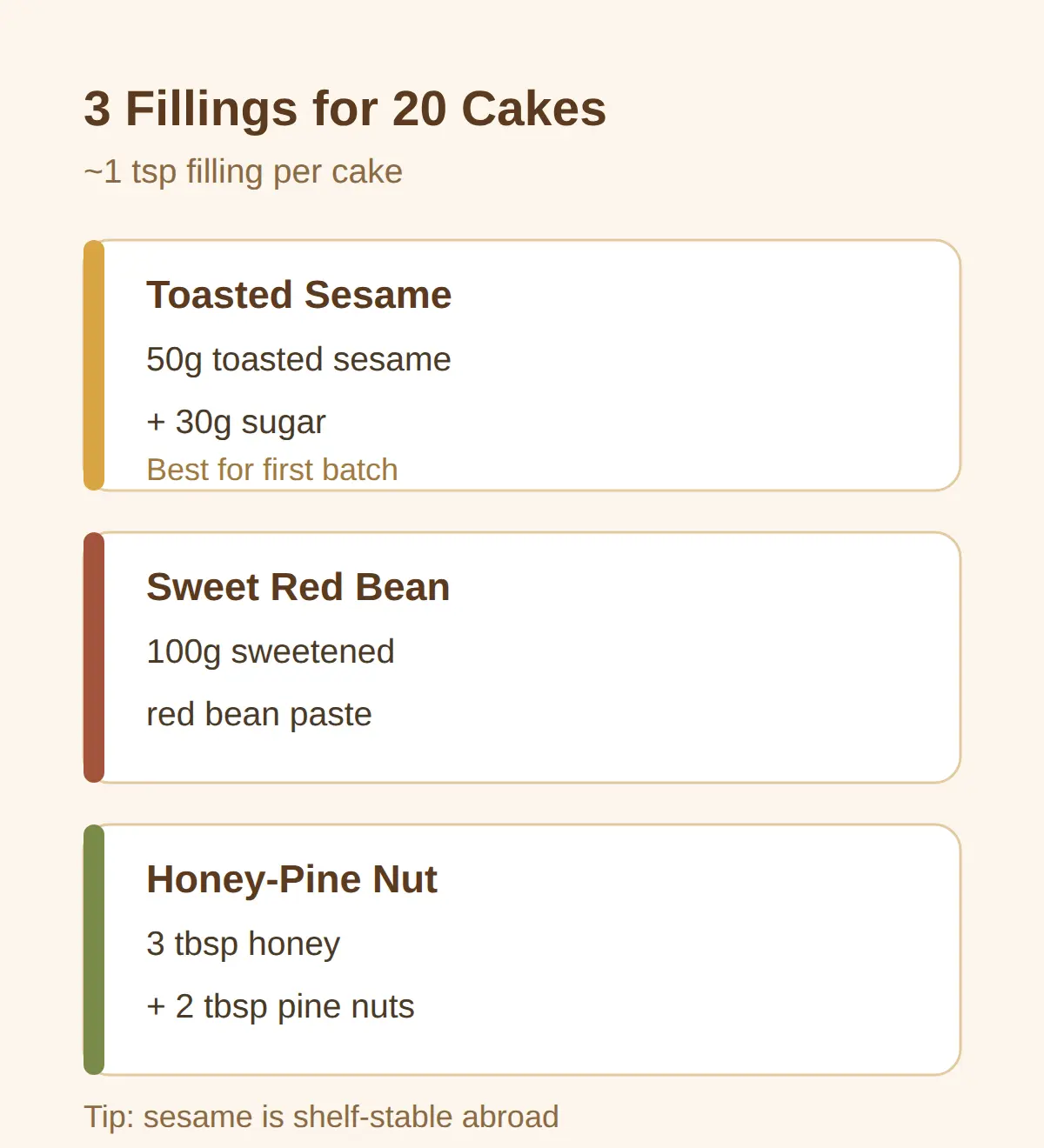
Three fillings cover the classic home batch, and each holds about 1 teaspoon per cake.
The table below is the full amount for 20 pieces.
| Filling | Amount for one batch |
|---|---|
| Toasted sesame | 50g ground toasted sesame mixed with 30g sugar |
| Sweet red bean | 100g sweetened red bean paste (pat anggeum) |
| Honey-pine nut | 3 tbsp honey mixed with 2 tbsp ground pine nuts and a little cinnamon |
Sesame-honey is the most classic per an English-language guide, and chestnut, jujube, mung bean, and assorted nuts are also traditional.
One regional outlier breaks the sweet pattern: Pyongan Province’s clam-shaped songpyeon uses roasted sesame ground with sugar and soy sauce (1 cup sesame, 4 tbsp sugar, 1 tbsp soy sauce) — a savory-sweet filling.
Pick sesame if this is your first batch, because the ingredients are shelf-stable abroad and the dough keeps working while you toast and grind the seeds.
What songpyeon is and when Koreans make it
Songpyeon is a half-moon shaped Korean rice cake made from non-glutinous rice flour dough, filled with a sweet center, and steamed over pine needles.
The half-moon shape symbolizes a waxing moon heading toward fullness — a wish for things to keep getting better — and the cakes are made from newly harvested rice to thank ancestors for the harvest.
For Chuseok 2026, the date is September 25, the 15th day of the 8th lunar month.
Families gather the day before — September 24, 2026 — to make songpyeon together, and the shared pleating around the table is itself the point, like communal kimchi-making.
The cakes then go on the ancestral memorial table (charye) alongside jeon, japchae, and bulgogi, served at room temperature.
If you are cooking along with the holiday, mark September 24 for making and September 25 for serving — and the cakes are eaten at room temperature, so no reheating is needed on the day.
👉 Koreanbapsang’s songpyeon guide — rice flour choice and steaming without pine needles
👉 Cookpick’s Korean songpyeon recipe with dough ratios and three fillings
👉 KOCIS overview of songpyeon — pine needle role, five colors, and regional varieties
Related posts
Sources
- Half-moon symbolism, Chuseok (Hangawi) association, pine-nee (en.wikipedia.org)
- Definition, fillings, 40-min beginner method, 300g flour / 1 (cookpick.kr)
- Silicone liner or damp cheesecloth as pine-needle substitute (umamicart.com)
Dates to note and quick answers
- September 24, 2026 — the communal songpyeon-making day, the day before Chuseok.
- September 25, 2026 — Chuseok; songpyeon goes on the charye table at room temperature.
- The figures in this post are as of September 19, 2026.
FAQ
Q. What is songpyeon?
A half-moon shaped Korean rice cake made from non-glutinous rice flour dough, filled with a sweet center, and steamed over pine needles — traditionally made for Chuseok from newly harvested rice.
Q. Why does songpyeon crack?
Mainly because the dough dries out while shaping — cover it with a damp cloth between batches. Too much filling (over about 1 teaspoon) and edges that are not pressed shut also cause cracking and bursting.
Q. What can I use instead of pine needles for songpyeon?
A silicone liner or a damp kitchen cloth under the cakes works; pine needles are optional. You lose the pine aroma, and how much the taste changes without them has not been documented.
Q. What rice flour for songpyeon abroad?
Non-glutinous short-grain rice flour (mepssalgaru), not glutinous sweet rice flour (chapssalgaru). If mepssalgaru is unavailable, a blend of frozen fine rice flour and sweet rice flour is the accepted workaround, though no exact ratio is published.
Q. How long to steam songpyeon?
15 minutes on high heat in the home recipe cited here, until translucent and glossy; other guides use 20–25 minutes, so watch for translucency rather than one number.
If this is your first Chuseok abroad, one batch of 20 is enough to learn the kneading texture — and the practice dough is cheap.
Cover photo: Korean rice cake-Songpyeon-01 by by linlilian at Flickr — CC BY 2.0
#songpyeonrecipe #chuseok #koreanricecake #half-moonricecake #koreandessert
📅Upcoming Dates — 이번 주 18 · D-3 Final two episodes drop on Disney+/Hulu전체 보기 →