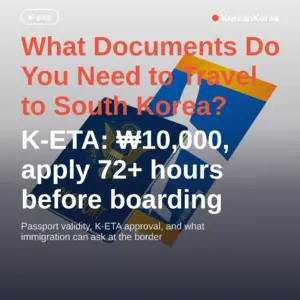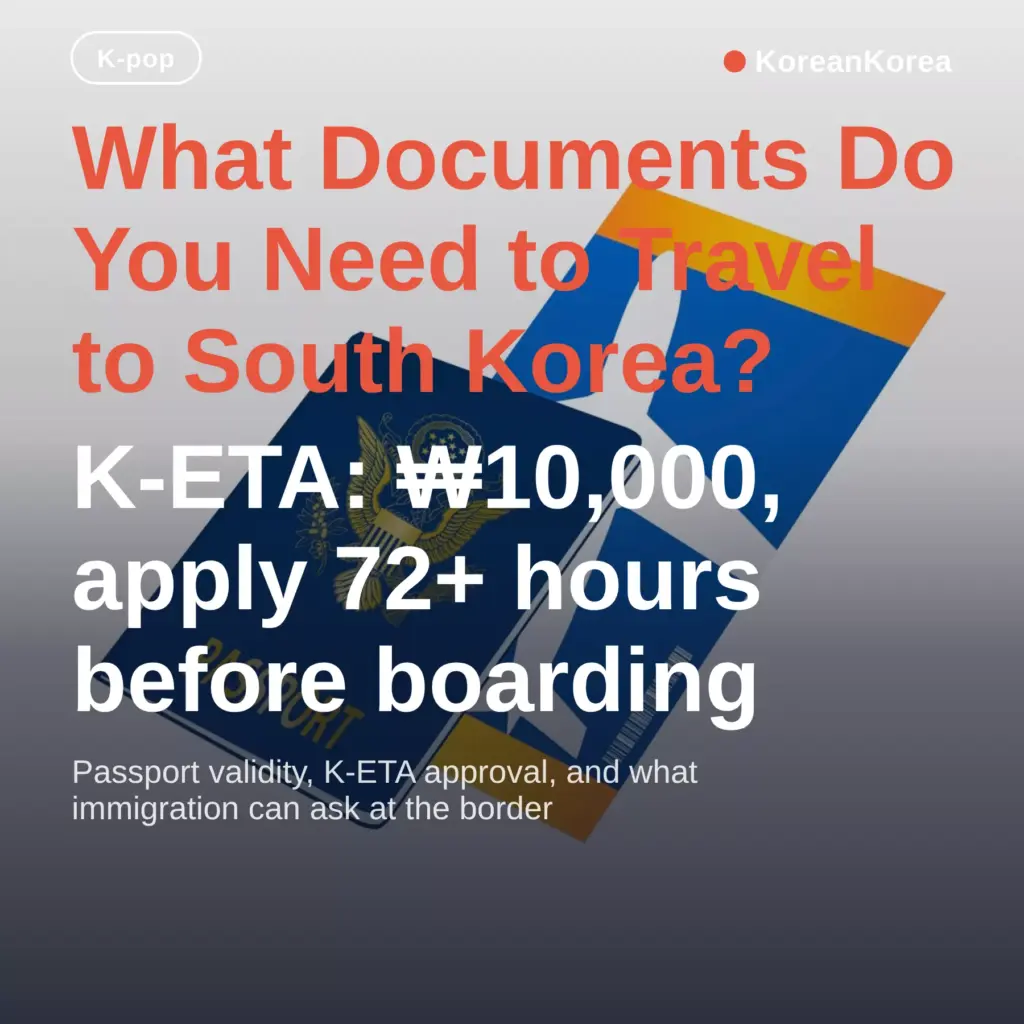
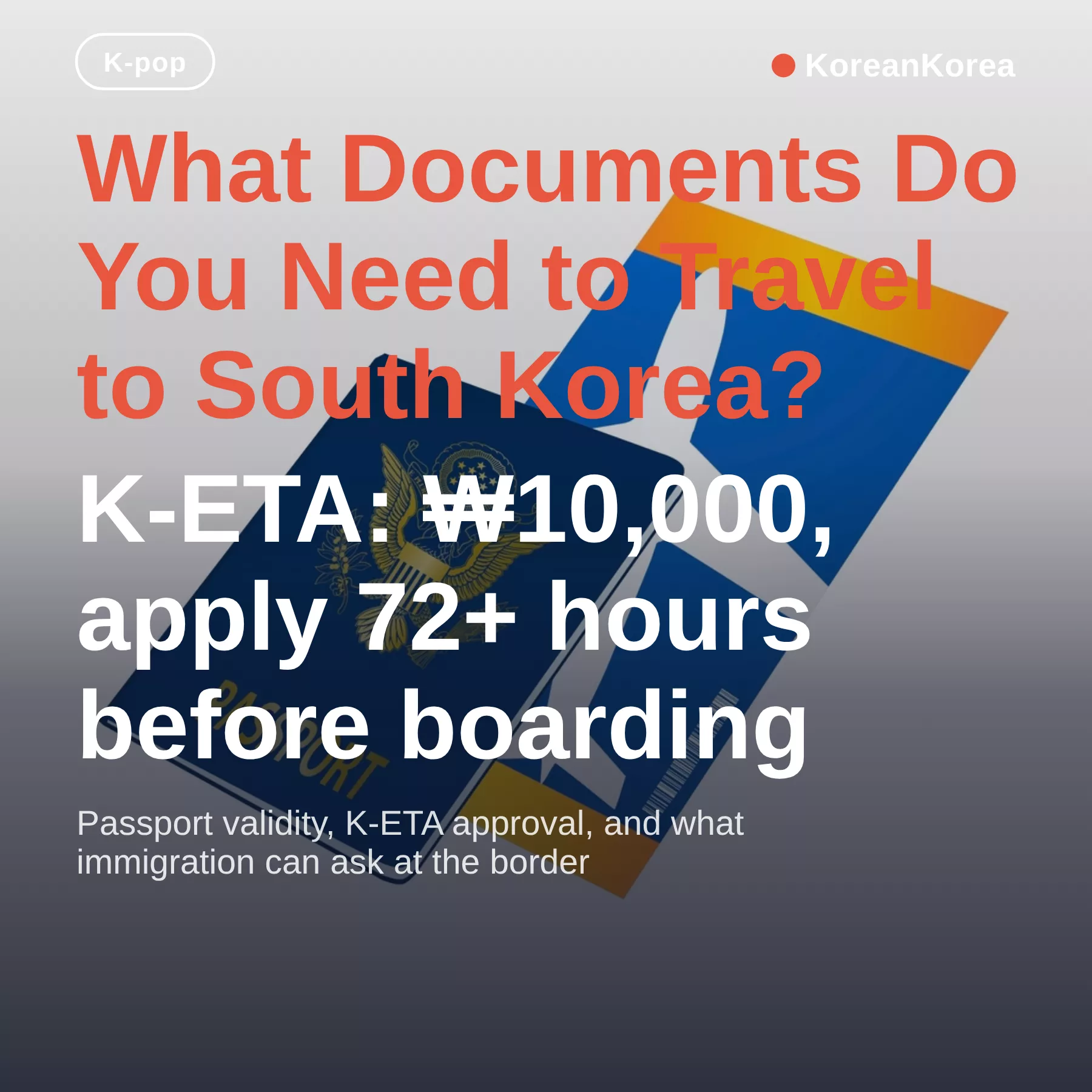
For visa-free entry to South Korea you need a valid passport covering your whole stay, K-ETA approval unless your nationality is currently exempt, and a return or onward ticket.
Airlines check K-ETA at check-in, so a missing approval can stop you before the flight, not at Korean immigration.
This post gives the full document checklist, the K-ETA fee and timing, and what immigration officers may still ask you at the border.
Contents
- What documents do I need to travel to South Korea: the full checklist
- Do I need K-ETA for South Korea?
- How much does K-ETA cost and where do I apply?
- How long does K-ETA take to process?
- Do I need a return ticket to enter South Korea?
- Passport validity and the S-e-Card arrival form
What documents do I need to travel to South Korea: the full checklist
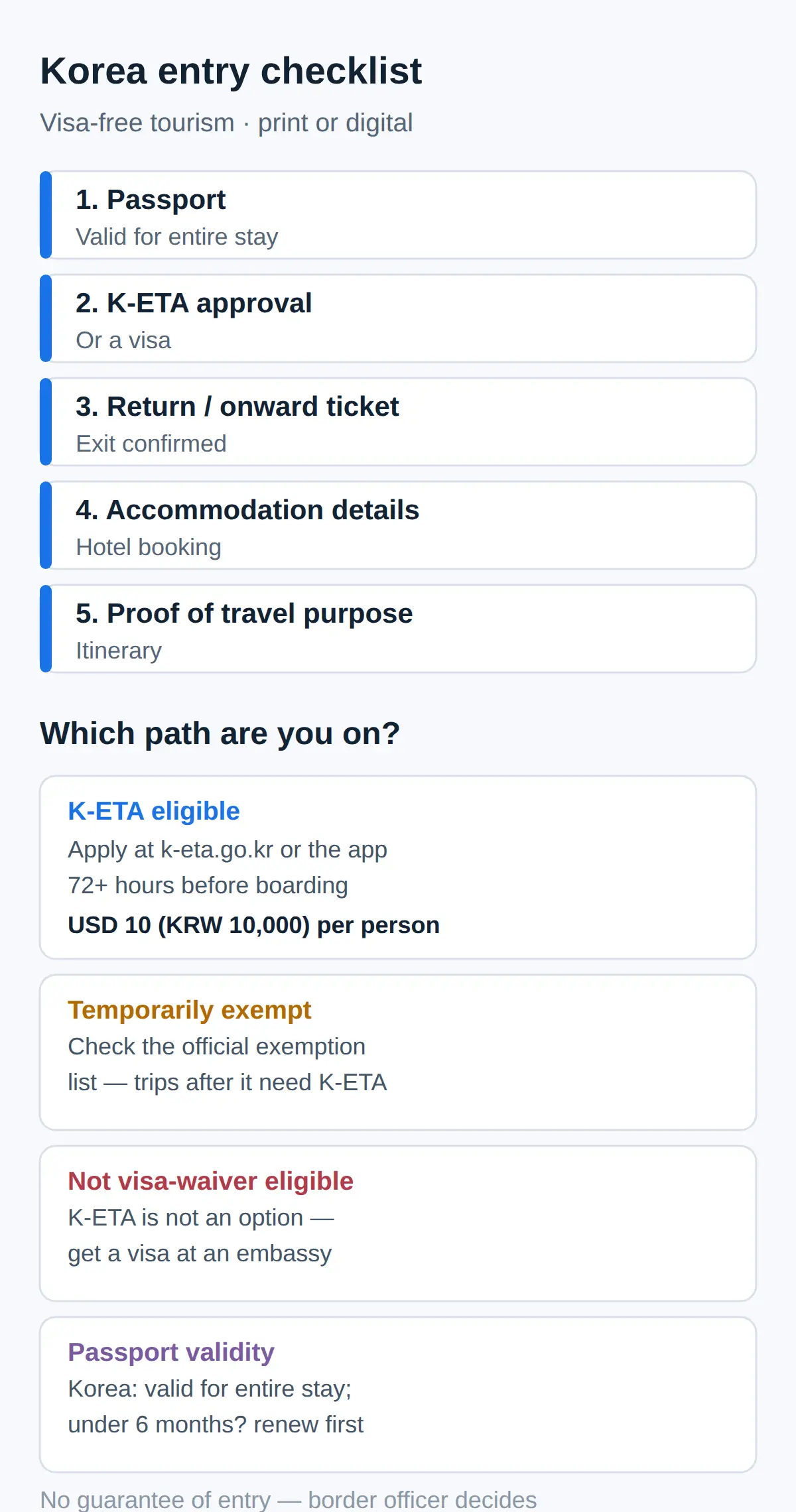
For tourism under visa-free entry, the standard set is a valid passport, K-ETA approval (or a visa), a return or onward ticket, accommodation details, and proof of your travel purpose.
Carry all of these in printed or digital form, because check-in staff and immigration officers can each ask for different pieces.
- A passport valid for your entire period of stay in Korea
- K-ETA approval (or a visa, if your nationality is not visa-waiver eligible)
- A return or onward ticket
- Accommodation details, such as a hotel booking
- Proof of travel purpose, such as an itinerary
Typical visa-free stays run 30 to 90 days depending on the agreement with your country, with the United States and most EU countries at 90 days.
A K-ETA approval or a visa does not guarantee entry — the immigration officer at the border makes the final decision and can ask about your itinerary, funds, and return plans.
If your documents are complete and your plans are clear, the interview at the border is usually short.
| K-ETA eligible, not currently exempt | Apply on k-eta.go.kr or the official app at least 72 hours before boarding — ₩10,000 per person |
|---|---|
| From a temporarily exempt country | Check the exemption list on k-eta.go.kr at booking time — trips after the window ends need K-ETA again |
| Nationality not visa-waiver eligible | K-ETA is not an option — apply for a visa at a Korean embassy or consulate |
| Transit, staying airside | No K-ETA or visa needed if you do not leave the international area |
| Passport valid only for the trip length | Korea requires validity for the whole stay, but renew before flying if under 6 months — many airlines enforce 6 months |
| Traveling with infants or children | Each child needs their own passport and a separate K-ETA application if eligible |
Do I need K-ETA for South Korea?
Whether you need K-ETA depends on your nationality, and the answer can change from one booking to the next.
K-ETA, Korea’s electronic travel authorization, applies to travelers from roughly 110 countries and regions that get visa-free entry.
The full list of eligible nationalities is published on the official K-ETA and Korea Immigration Service websites.
Citizens of 12 visa-waiver countries have been temporarily exempt through repeated extensions, but the exemption window and the country list change often.
The only source worth reading is the notice on k-eta.go.kr at the time you book — not a list copied from an older article.
Once an exemption ends, travelers from that country need K-ETA again for the next trip.
Check the exemption list before you pay anything, because the ₩10,000 fee is not refunded if your nationality turns out to be exempt.
If your nationality is not on the visa-waiver list at all, K-ETA is not an option and you must apply for a visa at a Korean embassy or consulate.
Transit passengers who stay inside the international area at Incheon or another Korean airport need neither.
How much does K-ETA cost and where do I apply?
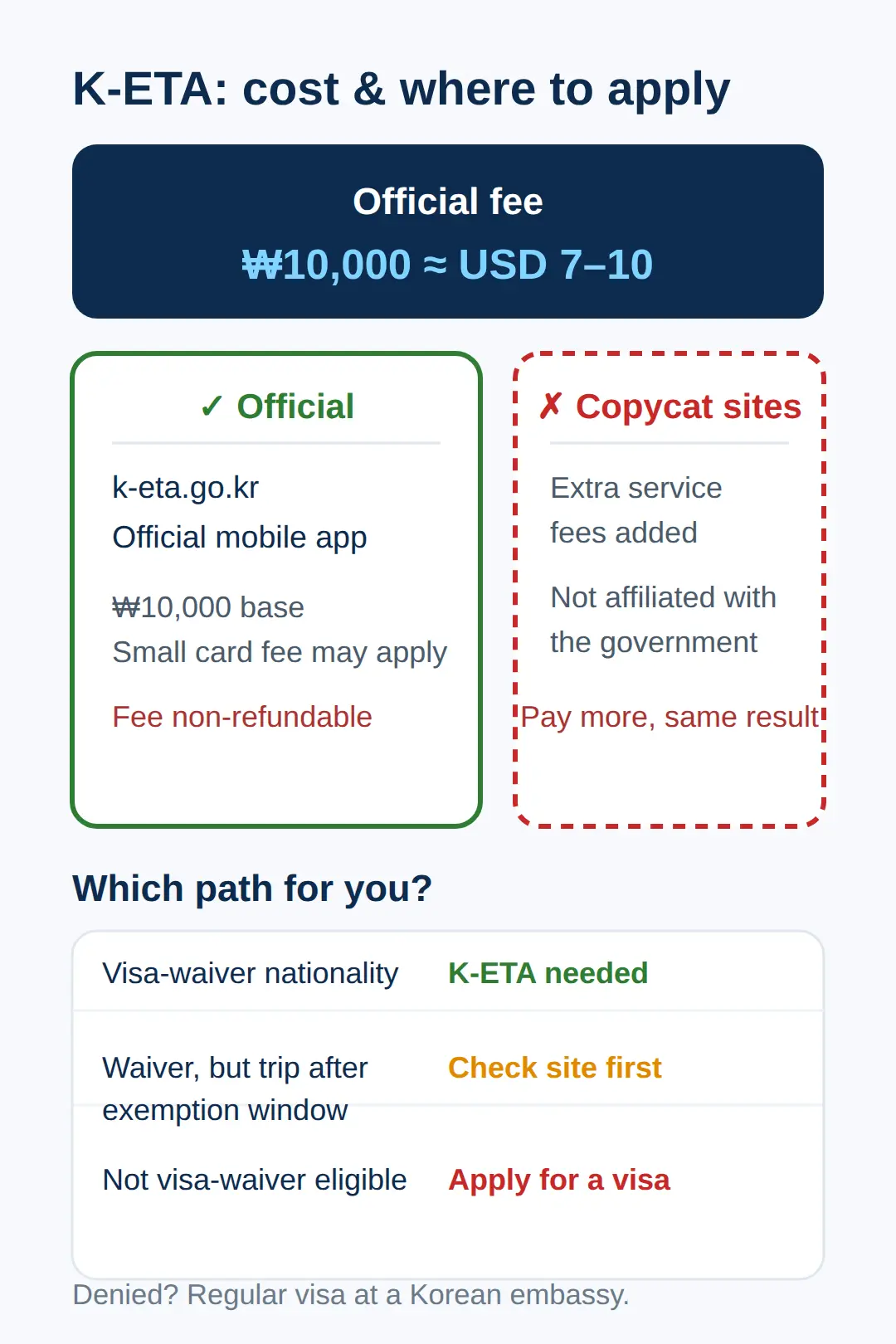
The official K-ETA fee is ₩10,000 per person — about $7–10 depending on the exchange rate — payable by credit card and other online payment methods on the official site, and the fee is non-refundable even if you cancel the trip.
A small card payment fee may be added on top of this base fee, which applies to each traveler.
| Channel | What you pay | What to know |
|---|---|---|
| k-eta.go.kr or the official app | ₩10,000 base, small card fee possible | The only official channels; fee non-refundable |
| Third-party sites | Extra service fees on top | Not affiliated with the Korean government |
Only k-eta.go.kr and the official K-ETA mobile app are official, and copycat sites charging extra service fees are not affiliated with the Korean government.
There is no reason to pay a reseller more for the same application, and the fee is lost either way if you cancel.
If a K-ETA application is denied — for example over prior immigration violations — the route left is a regular visa at a Korean embassy.
How long does K-ETA take to process?
K-ETA processing takes up to 72 hours, so apply at least 72 hours — practically, 3 full days — before your boarding time.
Airline check-in depends on the approval, so a pending application at check-in can cost you the flight even if the answer comes hours later.
An approval covers multiple entries for 2 years from the approval date, or 3 years for some nationalities.
It also stays valid for its full period even if your nationality later gets a temporary exemption.
Over two trips, ₩10,000 ÷ 2 = ₩5,000 per trip, which is why applying well before the flight pays off more than waiting.
Apply about a week before departure rather than at the 72-hour mark — 72 hours is the processing limit, not a promise, and check-in should not sit on a pending application.
Do I need a return ticket to enter South Korea?
There is no fixed rule requiring a return ticket, but immigration officers may ask for one as proof you intend to leave, and airlines may deny boarding without one.
In practice, the airline at check-in is the stricter checkpoint — if your return date is missing from the booking, boarding can be refused before Korean immigration ever sees your passport.
Accommodation proof works the same way: a hotel booking or invitation letter may be requested at the officer’s discretion, and travelers are generally expected to present proof of funds if asked.
None of these requests happen every time, but each one is cheap to prepare — a printed return confirmation and a hotel booking cover both.
If your plans are open-ended, book a ticket you can change rather than arriving with no onward date at all.
Passport validity and the S-e-Card arrival form
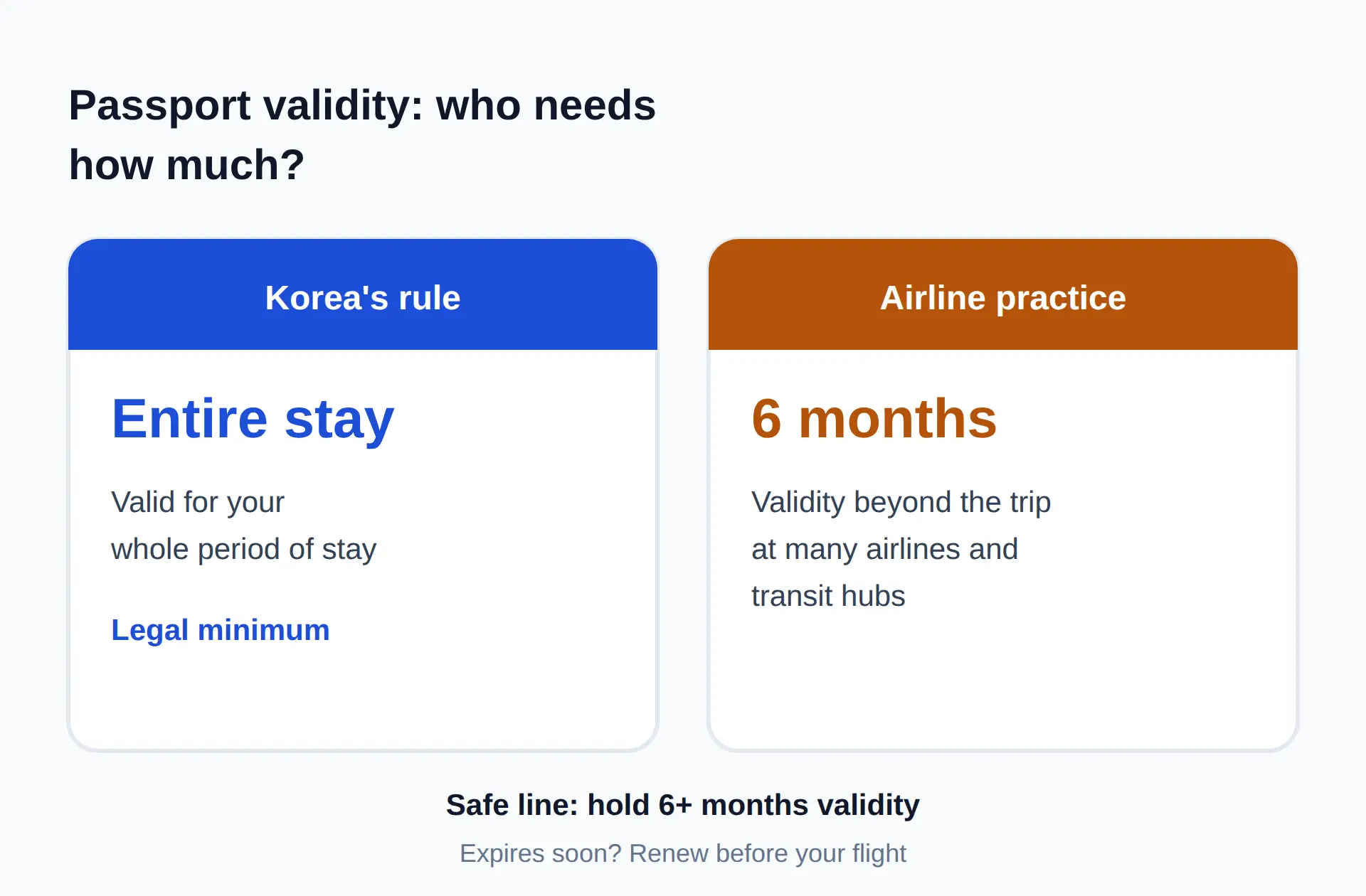
Korea requires your passport to be valid for your entire period of stay, but many airlines and transit hubs apply a stricter 6-month rule, so holding at least 6 months of validity is the safe line.
Airline practice differs from the Korean rule, and the exact requirements vary by carrier — verify with the airline you booked.
If your passport expires within 6 months, renewing before the flight removes the boarding risk entirely.
The S-e-Card, Korea’s electronic arrival card, can be submitted online up to 3 days before arrival and replaces the paper form; it is free on the official government channel, and sites charging for the submission are third-party resellers.
No pre-arrival health declaration or vaccination proof is required for ordinary tourists as of 2026 — the COVID-era Q-Code submission was discontinued.
On arrival, some items may need to be declared on the customs form — check the current duty-free allowance on the Korea Customs Service website before you fly.
My take: I would apply for K-ETA a week before my flight, not at the 72-hour mark, because a pending application can still block check-in and the fee is non-refundable.
The first thing I check is the exemption list on k-eta.go.kr — if my nationality is temporarily exempt, that KRW 10,000 stays in my pocket.
Two dates belong in your calendar: submit the S-e-Card up to 3 days before arrival, and confirm the K-ETA exemption list on k-eta.go.kr when you book.
👉 official K-ETA eligibility list of 110+ countries on k-eta.go.kr
👉 visa application requirements for non-visa-waiver nationalities on Korea Visa Portal
👉 entry and customs guidance for visitors on Visit Korea
Related posts
Sources
- Exemption list and period change; exact list needs re-check (k-eta.go.kr)
- Passport validity (visitkorea.or.kr)
- Entry purpose documents (visa.go.kr)
Dates to note and a short summary
- If your nationality is K-ETA eligible, apply at least 72 hours before boarding — approval must exist before check-in
- Submit the S-e-Card electronic arrival card online up to 3 days before arrival
- Check the current K-ETA exemption list on k-eta.go.kr when you book, since it changes often
- Core documents: passport valid for the whole stay, K-ETA approval, return ticket, accommodation details
- Every traveler, including children and infants, needs their own passport and a separate K-ETA application
FAQ
Q. Do I need K-ETA for South Korea?
Most visa-free nationalities do, unless their country is currently on the temporary exemption list — check k-eta.go.kr at booking time, since the list and window change often.
Q. How much does K-ETA cost?
The official fee is ₩10,000 per person (about $7–10 depending on the exchange rate), payable only on k-eta.go.kr or the official app, and it is non-refundable.
Q. How long does K-ETA take to process?
Up to 72 hours, so apply at least 3 days before boarding; the approval then covers multiple entries for 2 years (3 years for some nationalities).
Q. Do I need a return ticket to enter South Korea?
No fixed rule requires one, but immigration may ask for proof you intend to leave, and airlines may deny boarding without a return or onward ticket.
Q. Is the S-e-Card arrival form free?
Yes, on the official government channel it is free and can be submitted up to 3 days before arrival; sites charging a fee are third-party resellers.
Related: country-specific visa-free guides for US, EU, and ASEAN passports cover the 30/90-day stay limits per nationality.
Cover photo: Travel documents clipart, illustration vector — CC0 1.0
#SouthKoreaentry #K-ETA #visa-freeentry #traveldocuments #S-e-Card
📅Upcoming Dates — 이번 주 18 · D-3 Final two episodes drop on Disney+/Hulu전체 보기 →