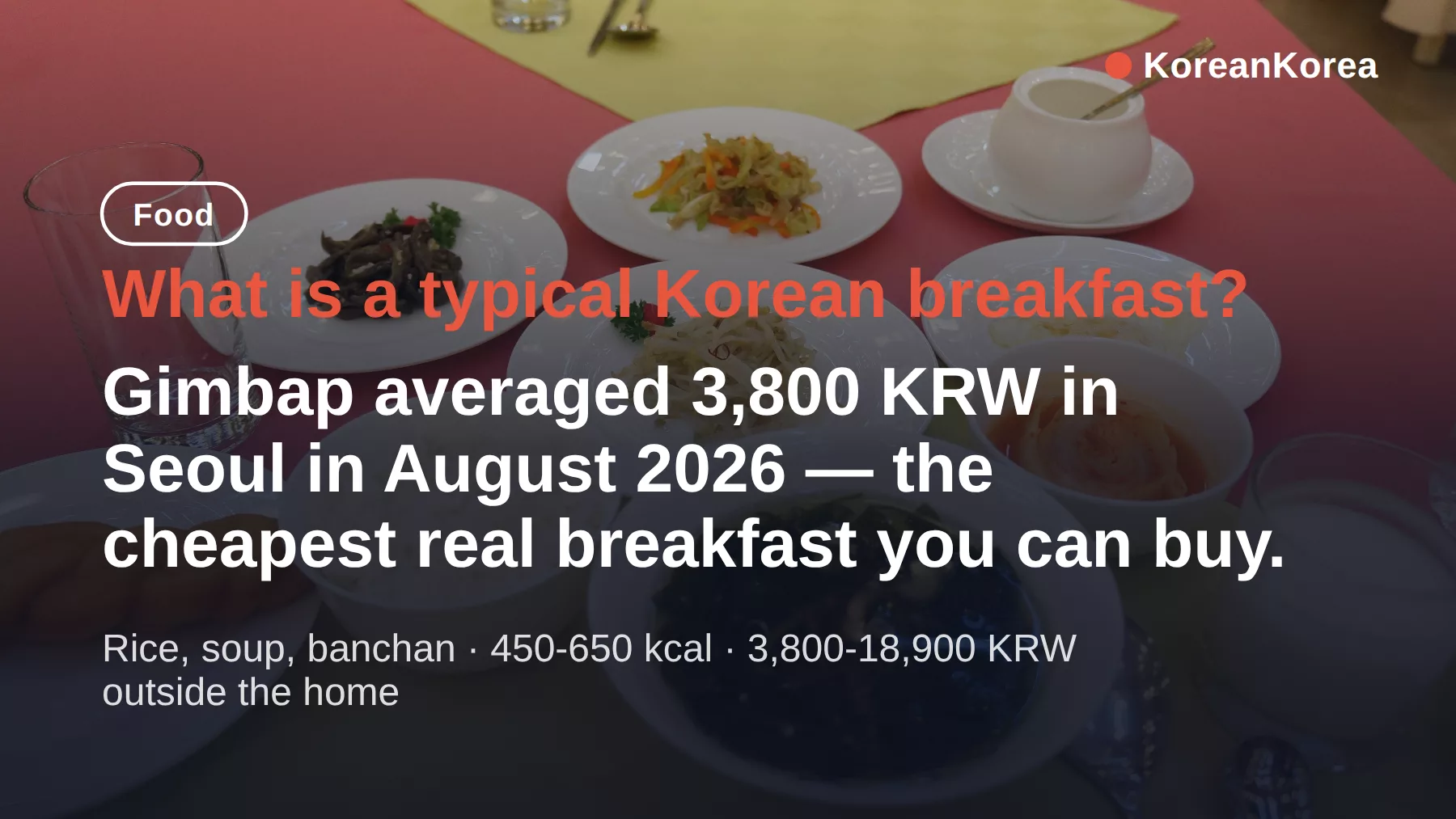
A typical Korean breakfast at home is rice, soup, and 4-8 shared banchan side dishes (450-650 kcal), but in 2026 only about 4 in 10 adults eat that table — everyone else buys gimbap for 3,800 KRW, a kimchi-jjigae baekban set averaging 8,654 KRW, or a 3,000-7,000 KRW convenience store meal.
That gap means what you picture and what you can actually buy in the morning are two different questions.
This post answers both: what the traditional table holds, whether Koreans still eat it, what each option costs in August 2026, and where to go before 9 AM.
Contents
- What is a typical Korean breakfast? Rice, soup and banchan on one table
- Do Koreans actually eat breakfast in 2026?
- What goes on the table: soups, banchan and proteins
- Korean breakfast price in 2026: from 3,800 KRW gimbap to hotel buffets
- Where and when to eat breakfast in Korea early morning
- What a Korean breakfast looks like at home
What is a typical Korean breakfast? Rice, soup and banchan on one table
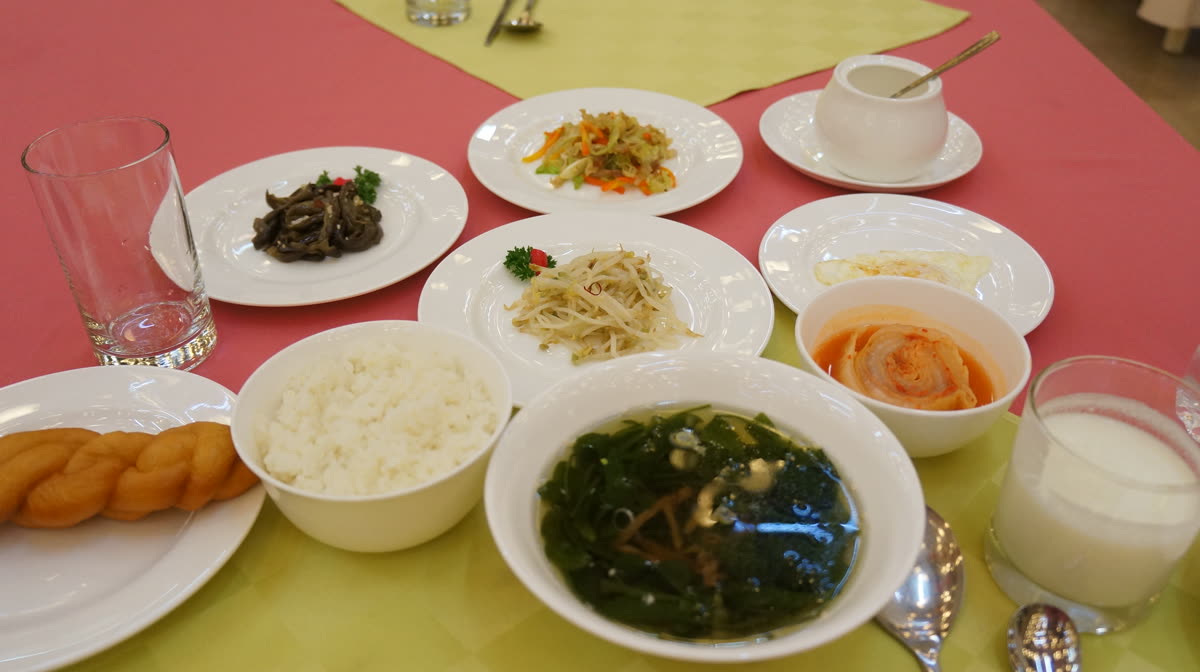
A typical Korean breakfast is rice, soup or stew, a protein, and 4-8 banchan side dishes — Korea has no separate ‘breakfast food’ category.
| Component | What it looks like |
|---|---|
| Rice | 200-300g plain white or mixed-grain, no butter, salt or oil, often in a dolsot stone bowl |
| Soup or stew | Miyeok guk, haejangguk, doenjang-jjigae, kimchi jjigae, or gyeran jjim |
| Protein | Grilled mackerel, fried or steamed egg, tofu, or yesterday’s leftovers |
| Banchan | 4-8 shared dishes: kimchi, seasoned spinach, bean sprouts, pickled radish, roasted seaweed, dried fish |
| Total | 450-650 kcal, roughly 55-60% carbohydrate |
Nothing on a traditional table is sweet — the flavors are salt, savory depth and fermented tang from the first spoonful.
Each person eats their own rice and soup, while the banchan sit at the center of the table and get shared.
If you are picturing one photogenic dish, picture a full small table instead: that is the real answer to this question.
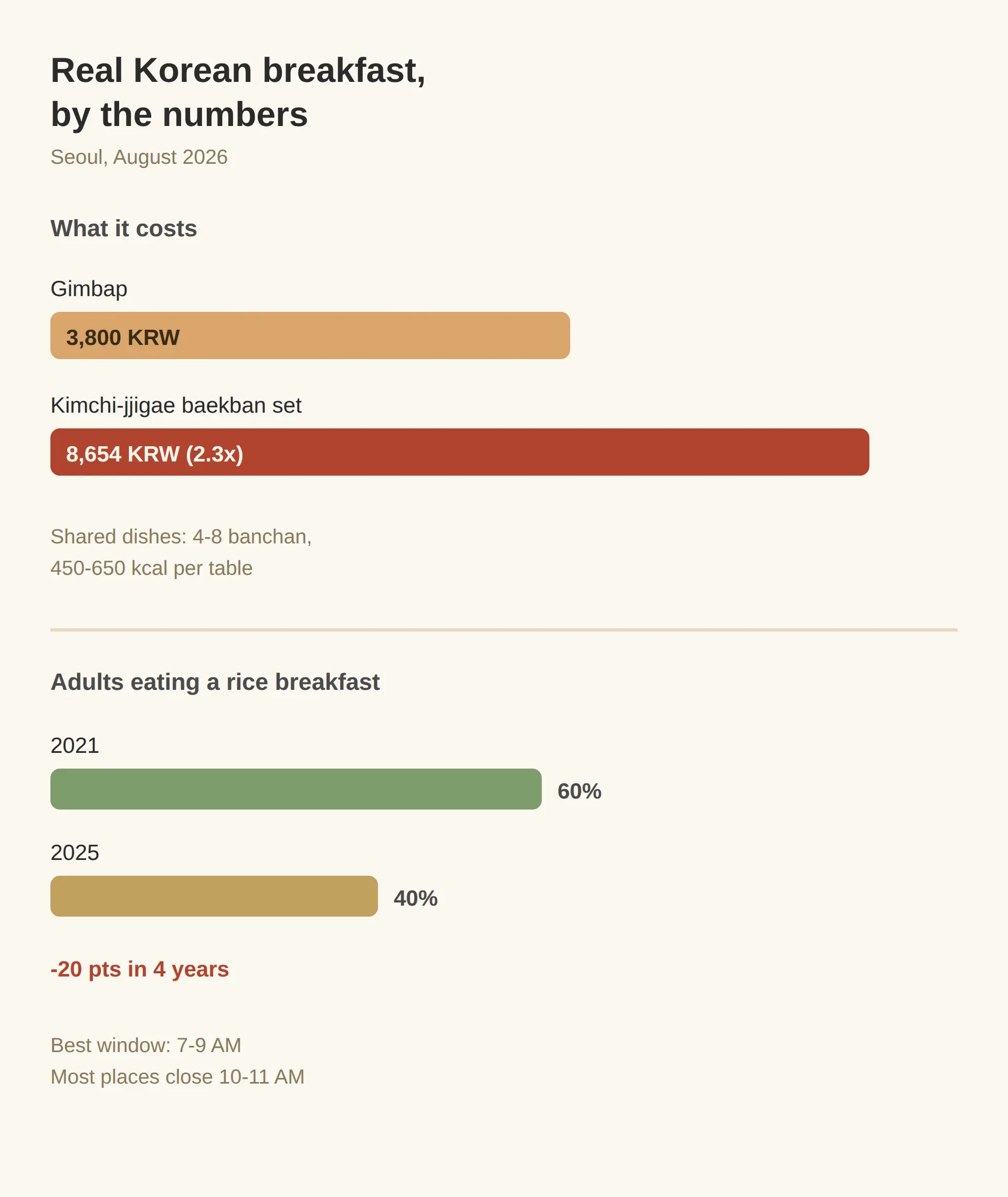
When this writer checks any breakfast place, the first thing to look at is the closing time — most close between 10 and 11 AM, so the real window is 7-9 AM.
| Gimbap (takeaway or sit-down) | 3,800 KRW |
|---|---|
| Gimbap cafe (gimbap, tteokbokki, boiled egg) | 4,000-8,000 KRW |
| Convenience store (CU, GS25, 7-Eleven) | 3,000-7,000 KRW |
| Kimchi-jjigae baekban set (stew + rice + sides) | 8,654 KRW average |
| Gukbap / juk (porridge) | from 8,000 KRW (abalone juk near 18,900 KRW) |
| Haejangguk (hangover soup) specialist | 9,000-14,000 KRW |
| Grilled fish breakfast restaurant | 10,000-16,000 KRW traditional jeongsi set (rice, soup, 7-10 banchan) 8,000-18,000 KRW (Insadong, Bukchon, Jongno) bakery cafe morning (salt bread, coffee) 3,500-12,000 KRW hotel breakfast buffet 25,000-45,000 KRW (one set of guides; another quotes 40,000-90,000 KRW walk-in at top hotels — treat both as rough) jjimjilbang spa cafe 6,000-10,000 KRW |
Do Koreans actually eat breakfast in 2026?
About 1 in 3 Korean adults skips breakfast, and only about 40% ate a rice-based morning meal in 2025 — down from about 60% in 2021.
The skipping rate runs 35.2% among men and 32.8% among women, and it is highest among adults in their twenties, so the minority skipping the meal is increasingly young and urban.
Convenience stores, bakery cafes and single-serve meal kits are what changed the morning, and the full rice-and-soup table is now most reliably eaten by older Koreans.
A roughly 20-point drop in four years is the number to hold onto when you read ‘Koreans eat rice and soup for breakfast.’
One limit: both the 2021 and 2025 figures come from secondary English-language guides, not an official statistics page, so read them as a trend rather than a precise count.
If your plan assumes every cafe and restaurant serves a morning crowd in Seoul, the 40% figure tells you why so many do not.
What goes on the table: soups, banchan and proteins
The soups are miyeok guk (seaweed soup), haejangguk (hangover soup), doenjang-jjigae (soybean paste stew), kimchi jjigae and gyeran jjim (steamed egg).
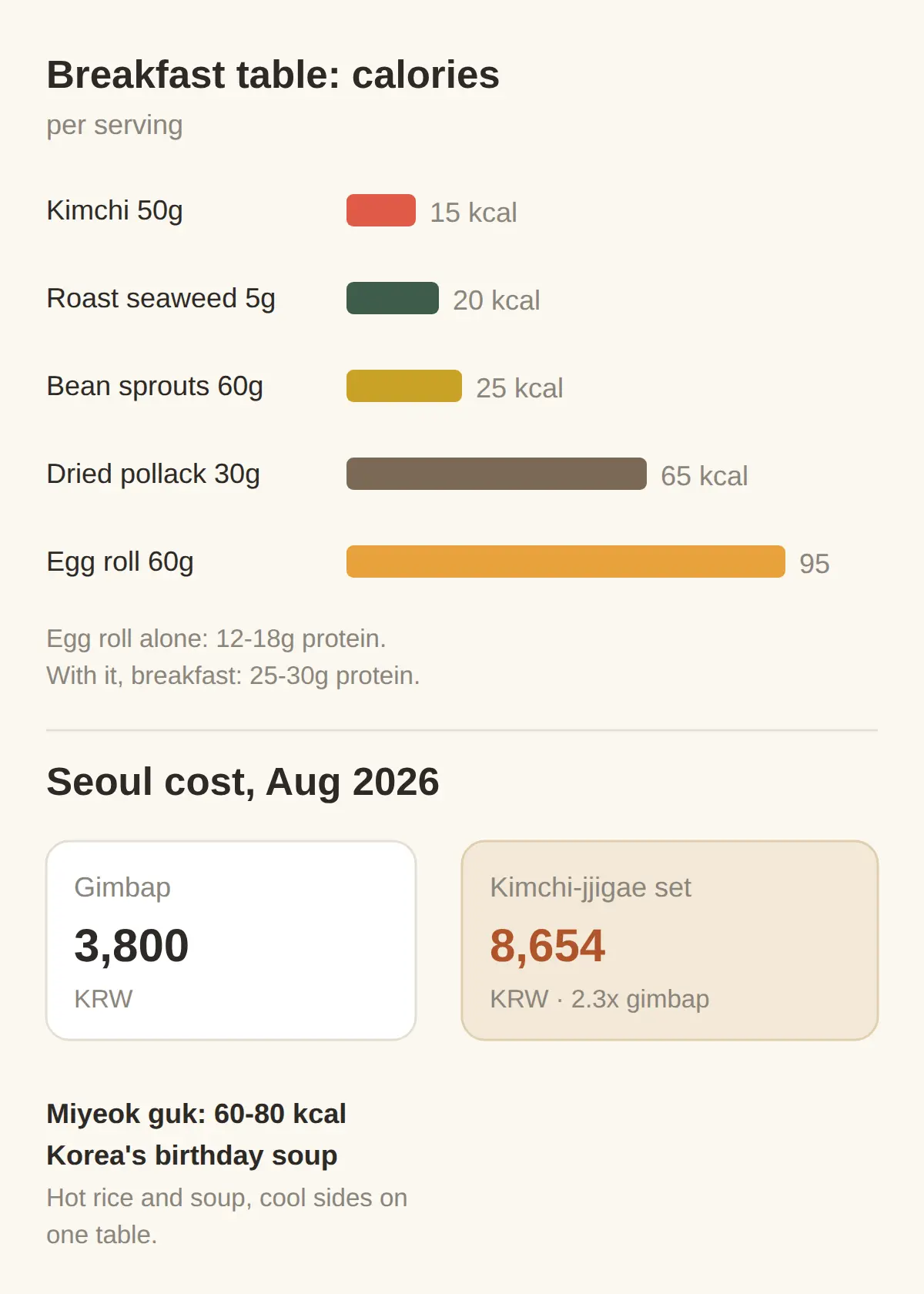
| Banchan (per serving) | Calories |
|---|---|
| Kimchi (50g) | 15 kcal |
| Roasted seaweed (5g) | 20 kcal |
| Seasoned bean sprouts (60g) | 25 kcal |
| Gyeran-mal-i egg roll (60g) | 95 kcal |
| Seasoned dried pollack (30g) | 65 kcal |
Proteins are grilled mackerel, fried or steamed egg, tofu, or yesterday’s leftover sides — an egg roll alone adds 12-18g protein, and a breakfast that includes it reaches 25-30g total.
Hot rice and hot soup come with cold or room-temperature vegetables, and spicy, salty, savory and sour flavors all share one table so nothing is eaten in isolation.
Miyeok guk is worth knowing by name: at 60-80 kcal a bowl it is also Korea’s birthday soup, so you will see it at morning tables and on birthdays alike.
Korean breakfast price in 2026: from 3,800 KRW gimbap to hotel buffets
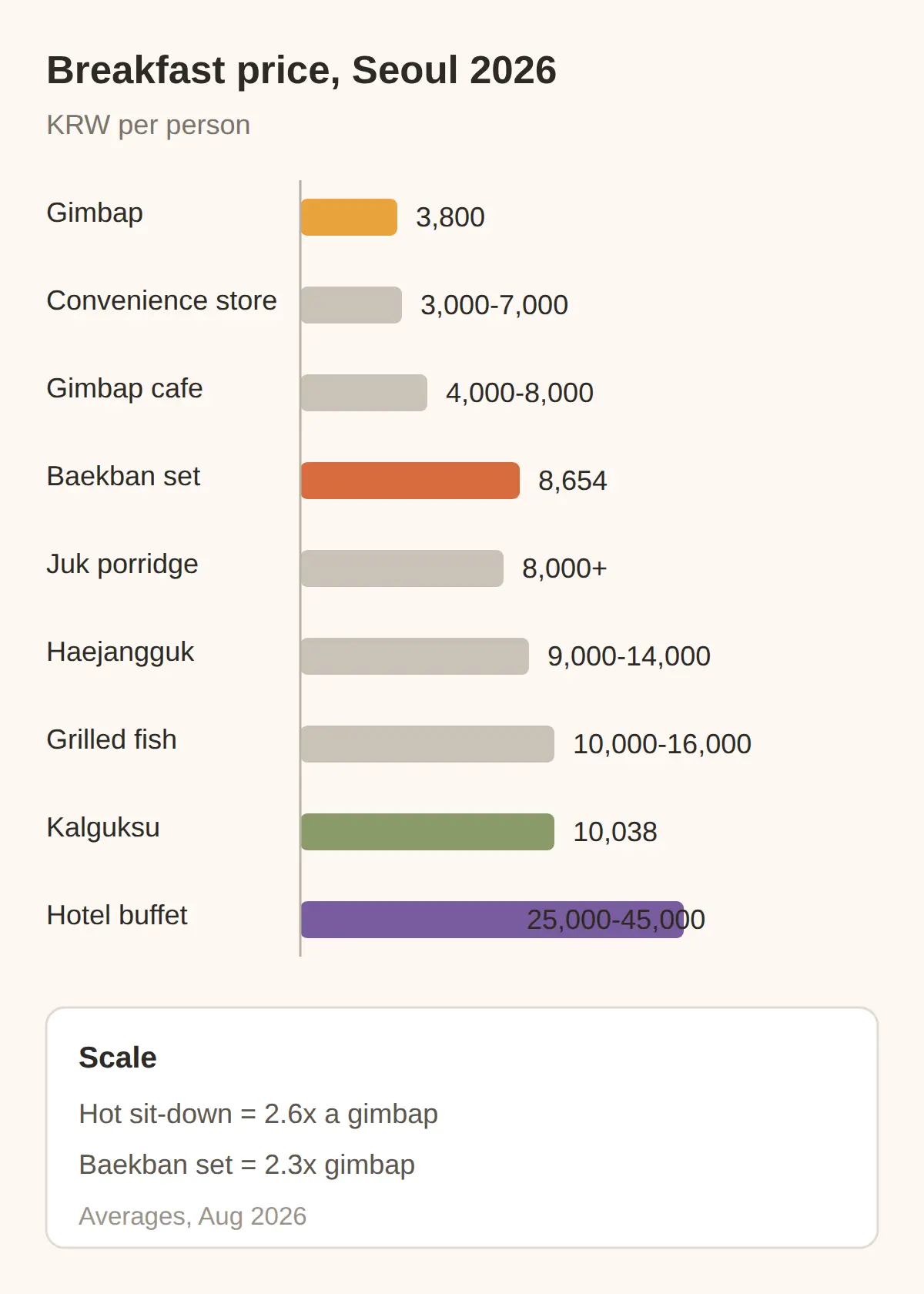
Gimbap averaged 3,800 KRW in Seoul in August 2026 — the cheapest sit-down or takeaway real breakfast — and a kimchi-jjigae baekban set averaged 8,654 KRW, 2.3 times gimbap.
| Venue | Price (Seoul, August 2026) |
|---|---|
| Gimbap | 3,800 KRW average |
| Gimbap cafe | 4,000-8,000 KRW |
| Convenience store meal | 3,000-7,000 KRW |
| Kimchi-jjigae baekban set | 8,654 KRW average |
| Juk porridge | from 8,000 KRW (abalone near 18,900 KRW) |
| Haejangguk specialist | 9,000-14,000 KRW |
| Grilled fish breakfast | 10,000-16,000 KRW |
| Hotel buffet | 25,000-45,000 KRW |
For scale: kalguksu noodle soup averaged 10,038 KRW in 2026, so a hot sit-down breakfast now costs 2.6 times a gimbap one.
Where and when to eat breakfast in Korea early morning
Gukbap and seolleongtang houses often open very early or run 24 hours, which makes them the most reliable sit-down option before 9 AM.
To find them, follow these steps:
- Open Naver Map or Kakao Map — not Google, which misses restaurants that serve good morning food.
- Search the dish name in Korean: juk, gukbap, seolleongtang, haejangguk, gimbap, baekban — never the English word ‘breakfast.’
- Head for Jongno 3-ga station (Lines 1, 3, 5), packed with old-school soup houses and gimbap cafes open roughly 5-11 AM, or Seongsu for Cafe Onion (opens 8 AM, salt bread 3,500 KRW) and modern cafes.
- Arrive between 7 and 8 AM for the freshest food and the local rhythm; by 9 AM the rush ends and many places empty out.
- Order with ‘igeo juseyo’ (this one, please) and pay at the register on your way out with ‘gyesan-seo.’
- If you catch an early KTX, buy food before the platform — station food options are limited early in the morning.
Gimbap cafe opening times vary by shop — 6-10 AM is a pattern, not a rule, so check the branch on Naver Map.
This writer’s one plan for a first morning: arrive 7-8 AM at a Jongno 3-ga soup house or baekban place — freshest food, local rhythm, and you pay at the register on the way out.
If you would rather stay near your hotel, a convenience store within walking distance covers the 3,000-7,000 KRW backup.
What a Korean breakfast looks like at home
A realistic home breakfast is simpler than a hotel buffet: rice, soybean sprout soup, kimchi, a fried egg, and one leftover vegetable side — or reheated doenjang jjigae or miyeok guk.
The nutrition numbers are modest: miyeok guk runs 60-80 kcal a bowl (80mg calcium, plus about three times the daily iodine requirement), and doenjang-jjigae with tofu is 70-90 kcal with 6-8g protein.
There is no hard line around morning foods in Korea — rice, soup, stew, grilled fish and yesterday’s sides appear at 7 AM because they are normal meals, not special breakfast dishes.
If you want to copy the pattern abroad, the formula is plain rice + one light soup + one egg dish + two vegetable sides — nothing sweet, nothing fried in butter.
If I were recommending one plan, it would be arriving at 7-8 AM at a small family-run soup place — the broth is freshest, the seats are empty, and nothing on the menu has been sitting around since dawn.
That is also why Korean breakfast tables look like lunch shrunk down: it is the same meal, earlier.
👉 Korean breakfast nutrition breakdown: rice portions, soup calories and protein per dish
👉 2026 Seoul breakfast prices: gimbap, baekban sets and juk porridge costs
👉 What Koreans actually eat in the morning: home tables, gimbap cafes and closing hours
Related posts
📎 Seoul — everything we know
📎 📅 다가오는 일정 — 발매·개봉·발표 캘린더
Sources
- Meal structure, restaurant types and price table, Jongno 3-g (koreapeek.com)
- Gimbap 3,800 / kimchi-jjigae baekban 8,654 / juk 8,000-18,90 (epickor.com)
- 200-300g rice, 450-650 kcal, 55-60% carb / 20-25% protein / (nutrifyi.com)
Quick summary: the typical Korean breakfast, answered
- Traditional home breakfast: rice (200-300g, plain), soup or stew, a protein, and 4-8 shared banchan — 450-650 kcal, nothing sweet.
- Only about 40% of adults ate a rice-based breakfast in 2025, down from about 60% in 2021 — skipping is highest in the twenties.
- Cheapest real breakfast: gimbap at 3,800 KRW; standard hot sit-down: kimchi-jjigae baekban at 8,654 KRW (Seoul, August 2026).
- Search dish names in Korean on Naver Map or Kakao Map — the English word ‘breakfast’ hides the places that actually serve morning food.
- Arrive 7-8 AM; most traditional spots close between 10 and 11 AM.
FAQ
Q. What is a typical Korean breakfast?
Rice, soup or stew, a protein, and 4-8 shared banchan side dishes — about 450-650 kcal, with no sweet items. In 2026 only about 4 in 10 adults eat this at home; the rest buy gimbap (3,800 KRW), gukbap, or a convenience store meal (3,000-7,000 KRW).
Q. Do Koreans actually eat breakfast every day?
No — about 1 in 3 adults skips it (35.2% of men, 32.8% of women), and skipping is highest among people in their twenties. The eating rate fell from about 60% in 2021 to about 40% in 2025, based on secondary English-language guides.
Q. How much does breakfast cost in Korea in 2026?
Gimbap averages 3,800 KRW, a kimchi-jjigae baekban set 8,654 KRW, juk porridge from 8,000 KRW (abalone near 18,900 KRW), a jeongsi set 8,000-18,000 KRW, and hotel buffets 25,000-45,000 KRW (Seoul, August 2026).
Q. Where can I eat breakfast early in the morning in Seoul?
Gukbap and seolleongtang houses often open very early or run 24 hours. Jongno 3-ga station is packed with old-school spots open roughly 5-11 AM, and Cafe Onion in Seongsu opens at 8 AM. Arrive 7-8 AM.
Q. Why should I not search ‘breakfast’ on the map app in Korea?
The English word hides the restaurants that actually serve morning food. Search the dish name in Korean — juk, gukbap, seolleongtang, haejangguk, gimbap, baekban — on Naver Map or Kakao Map instead.
For a full morning route built around one bakery, see the Pizza Seolgi guide.
Cover photo: Korean breakfast at the Koryo Hotel (15957479779) by Uri Tours — CC BY-SA 2.0
#koreanbreakfast #koreanfood #gimbap #baekban #seoulfoodguide #breakfastprice2026
📅Upcoming Dates — 이번 주 23 · D-day Final two episodes drop on Disney+/Hulu전체 보기 →