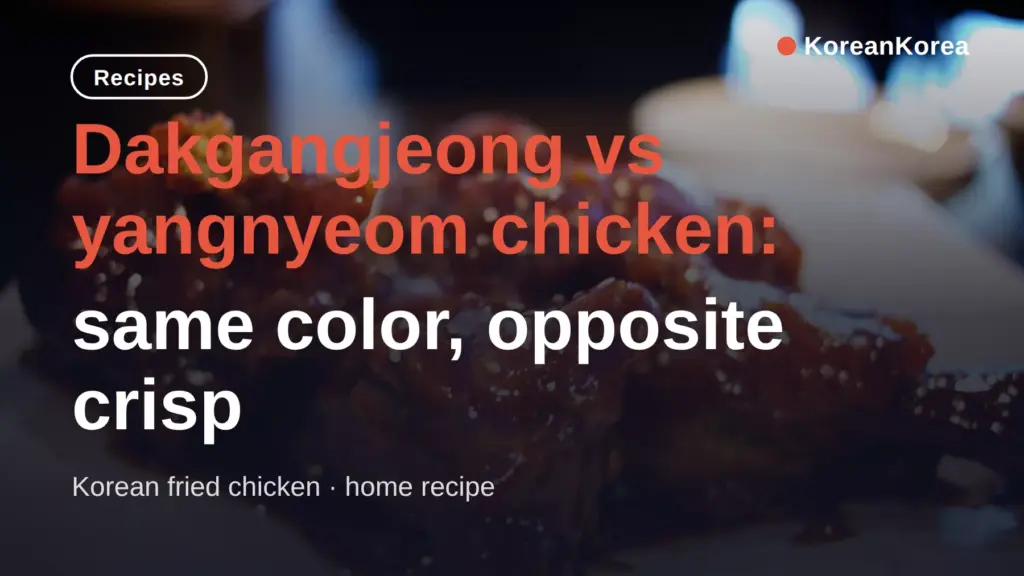
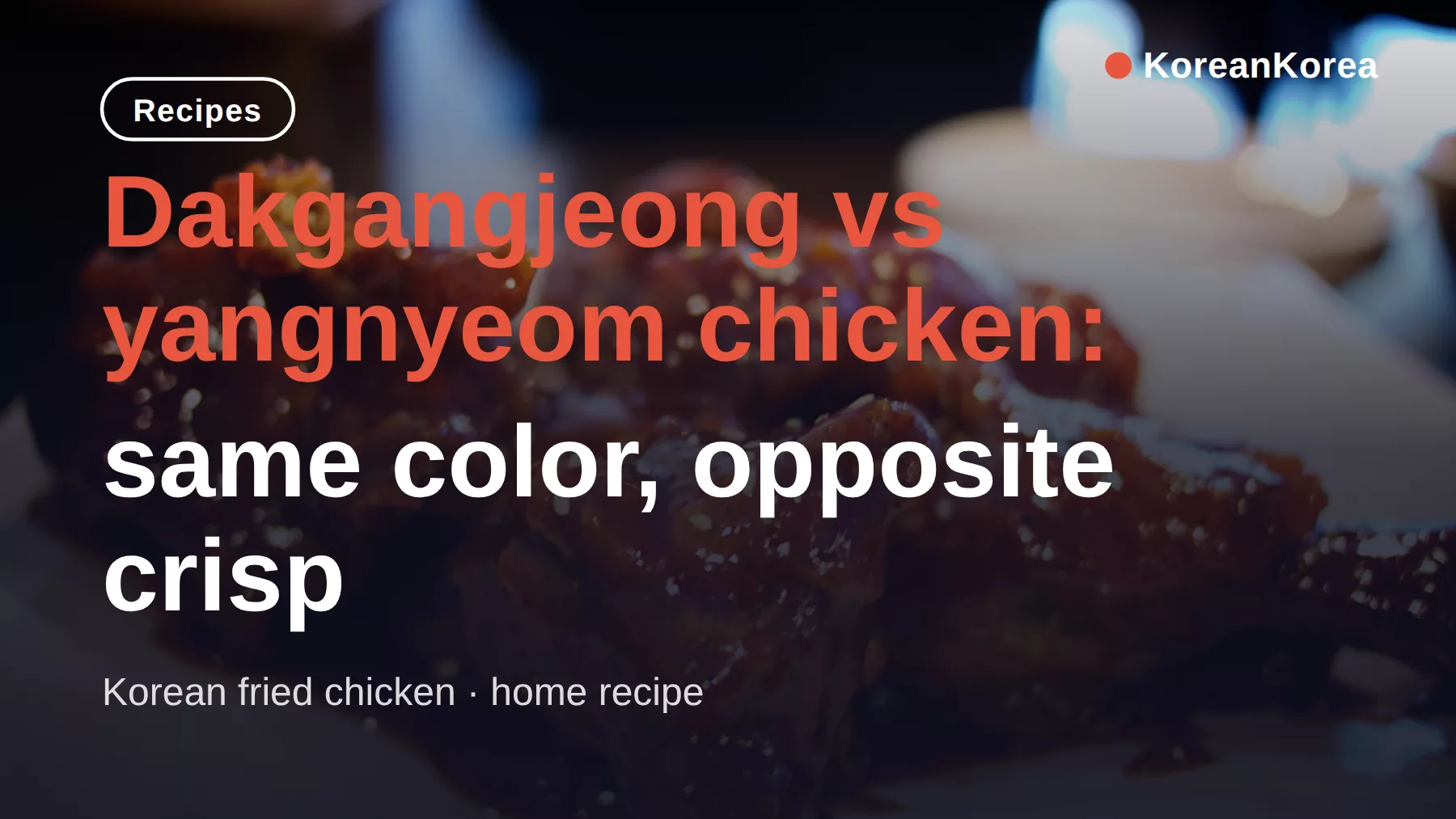
Two red, glossy fried chicken dishes sit behind the same Korean counter, and most first-time cooks order them by guessing.
Yangnyeom chicken and dakgangjeong share a color, but they are built in the opposite order.
This post covers what each name means, how the coating and sauce differ, the frying temperatures that matter, and glaze ratios you can follow at home.
Contents
- dakgangjeong recipe: what the name and the candy shell mean
- Dakgangjeong vs yangnyeom chicken: where they split
- The double fry: temperatures and times
- The glaze: classic version vs gochujang version
- Tips that decide whether it stays crunchy
dakgangjeong recipe: what the name and the candy shell mean
The name tells you the method before you cook anything.
"Dak" means chicken, and "gangjeong" is a traditional Korean confection that is fried and coated in a hardened sweet syrup — so the dish is, literally, candy chicken.
That syrup shell is the point: a glaze made with rice syrup or honey sets like candy and keeps the chicken crunchy even after it cools.
It is a market snack as much as a home dish.
Vendors sell it in paper cups at markets and parks so it can be eaten with a toothpick or fork without messy fingers, and at Sokcho Central Market the Manseok Dakgangjeong shop draws long lines of locals and tourists buying big boxes.
The classic pairing is Korean pickled radish.
The tangy crunch cuts through the sweet-spicy glaze, which is why the two almost always travel together in a takeout box.
| Coating | Dry mix: cornstarch or potato starch + flour, pressed on dry |
|---|---|
| Sauce order | Fry first, then toss in hot syrup — the glaze hardens into a shell |
| Texture when cold | Stays crunchy for several hours at room temperature |
| Heat level | Mild to medium; dried red chili or gochugaru, adjustable |
| How it is eaten | Bite-sized pieces, paper-cup style, no messy fingers |
Dakgangjeong vs yangnyeom chicken: where they split
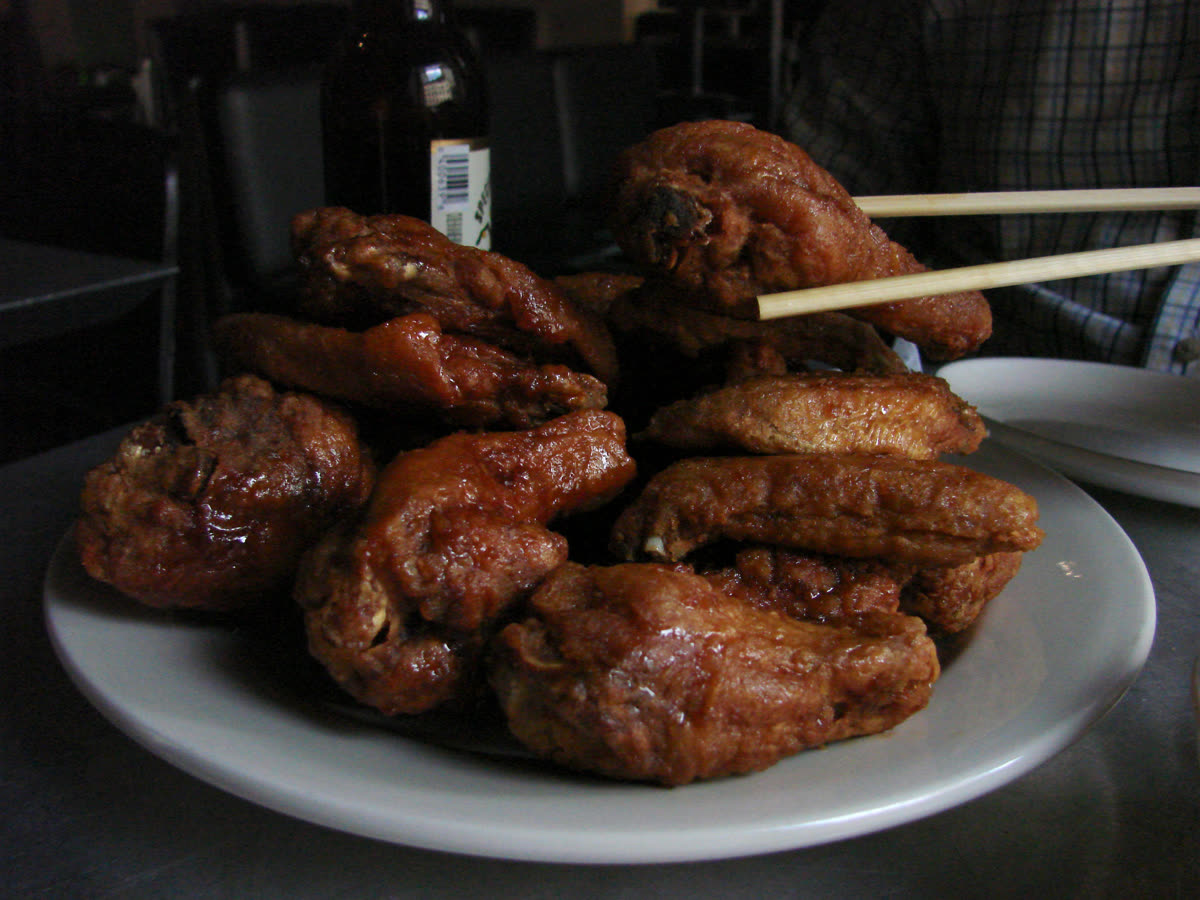
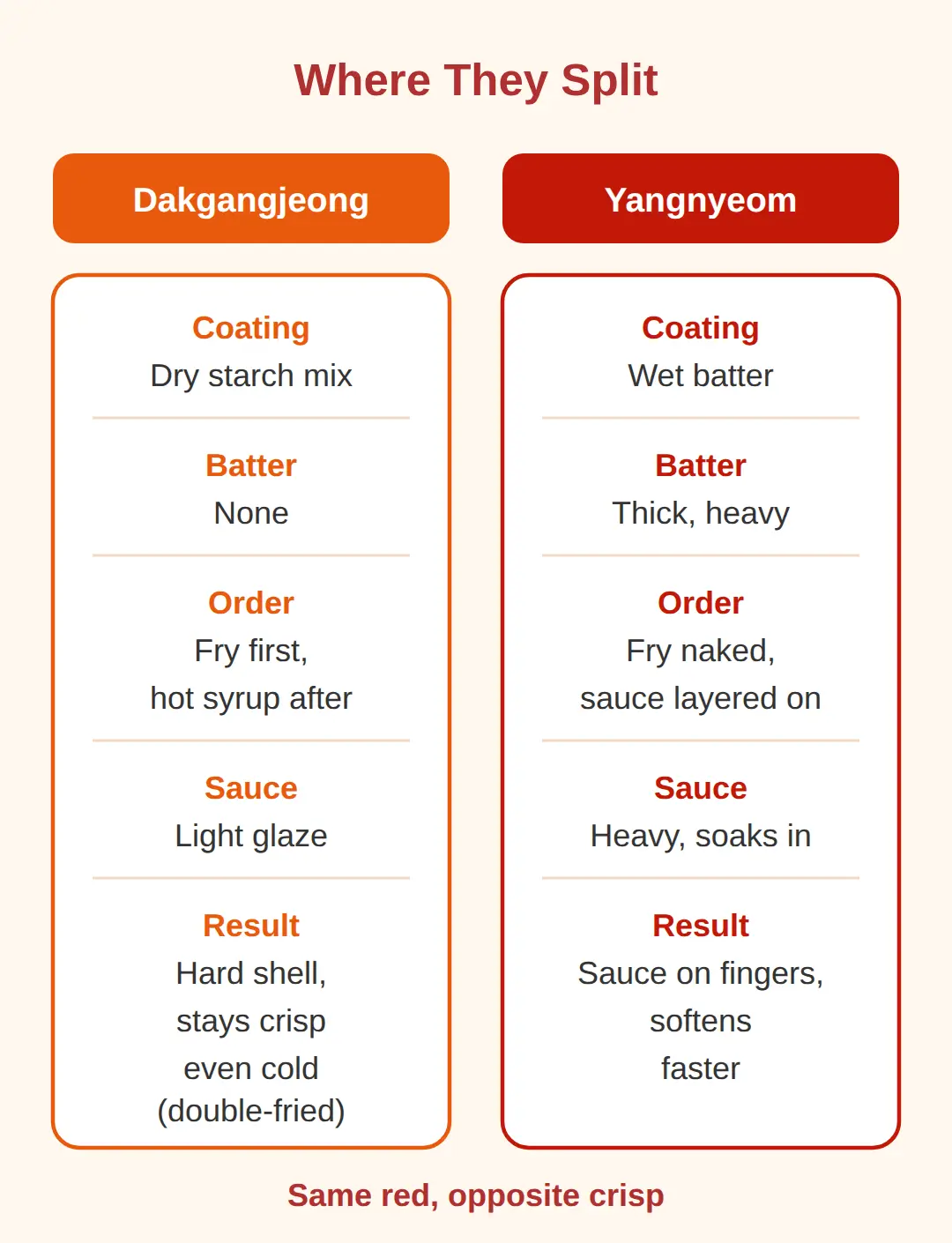
Yangnyeom chicken fries in a wet batter and then gets a heavier sauce that ends up all over your fingers.
Dakgangjeong is bite-sized, uses a dry coating of cornstarch and cake flour instead of a wet batter, and wears only a light glaze.
The sauce order is reversed, and that is the defining difference.
Dakgangjeong fries first and is tossed in hot syrup afterward, so the glaze hardens into a shell rather than soaking in.
Yangnyeom chicken goes the other way, with sauce layered over fried pieces, which is why it softens faster.
The coating choice drives the texture.
A cornstarch-plus-cake-flour dry mix gives a thin, shatter-crisp crust that survives glazing, while wet batters go thick and soften faster under sauce.
The one-line summary: yangnyeom chicken fries naked and sauces heavy, dakgangjeong double-fries in a dry starch coat and only glosses it with syrup — which is why it stays crunchy cold.
The double fry: temperatures and times
Two fryings, not one, create the lasting crunch.
The first fry goes at 340°F (170°C) until the pieces turn lightly golden, then the oil is raised to 375°F (190°C) for a second fry until deep golden — a jump of 35°F that drives out moisture and crisps the crust.
For boneless pieces, Maangchi’s timings are 4–6 minutes per batch at 340–350°F, a rest, then a second fry of 3–4 minutes until very crunchy and golden brown.
The whole dish comes together in under an hour with bite-sized pieces.
Small batches are not optional.
Overcrowding cools the oil too quickly and makes the crust soggy, so keep pieces moving with tongs or a strainer and fry in small batches.
Drain on a wire rack, not paper towels.
Steam trapped under paper softens the coating, while a rack lets excess oil run off and keeps pieces crisp until glazing.
The glaze: classic version vs gochujang version
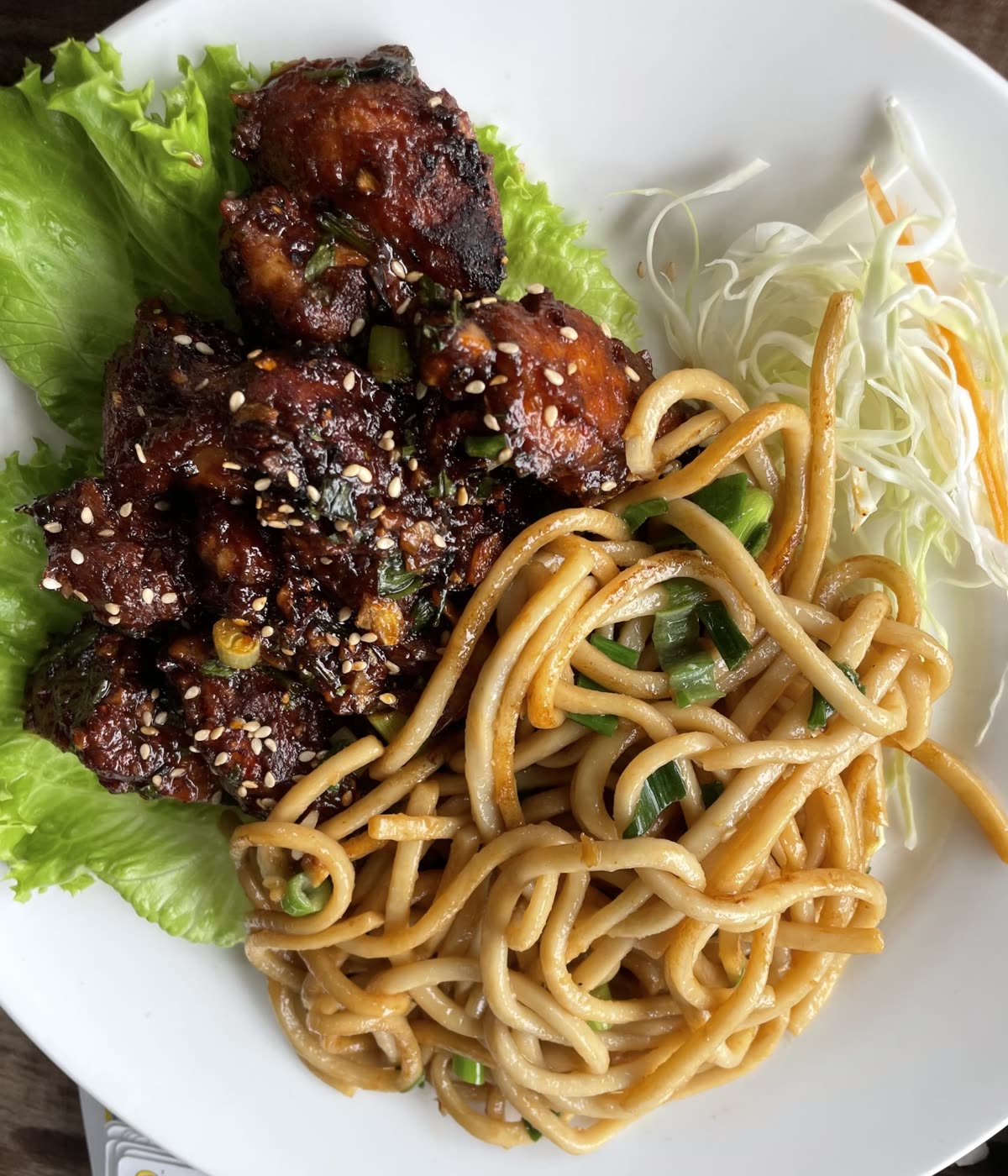
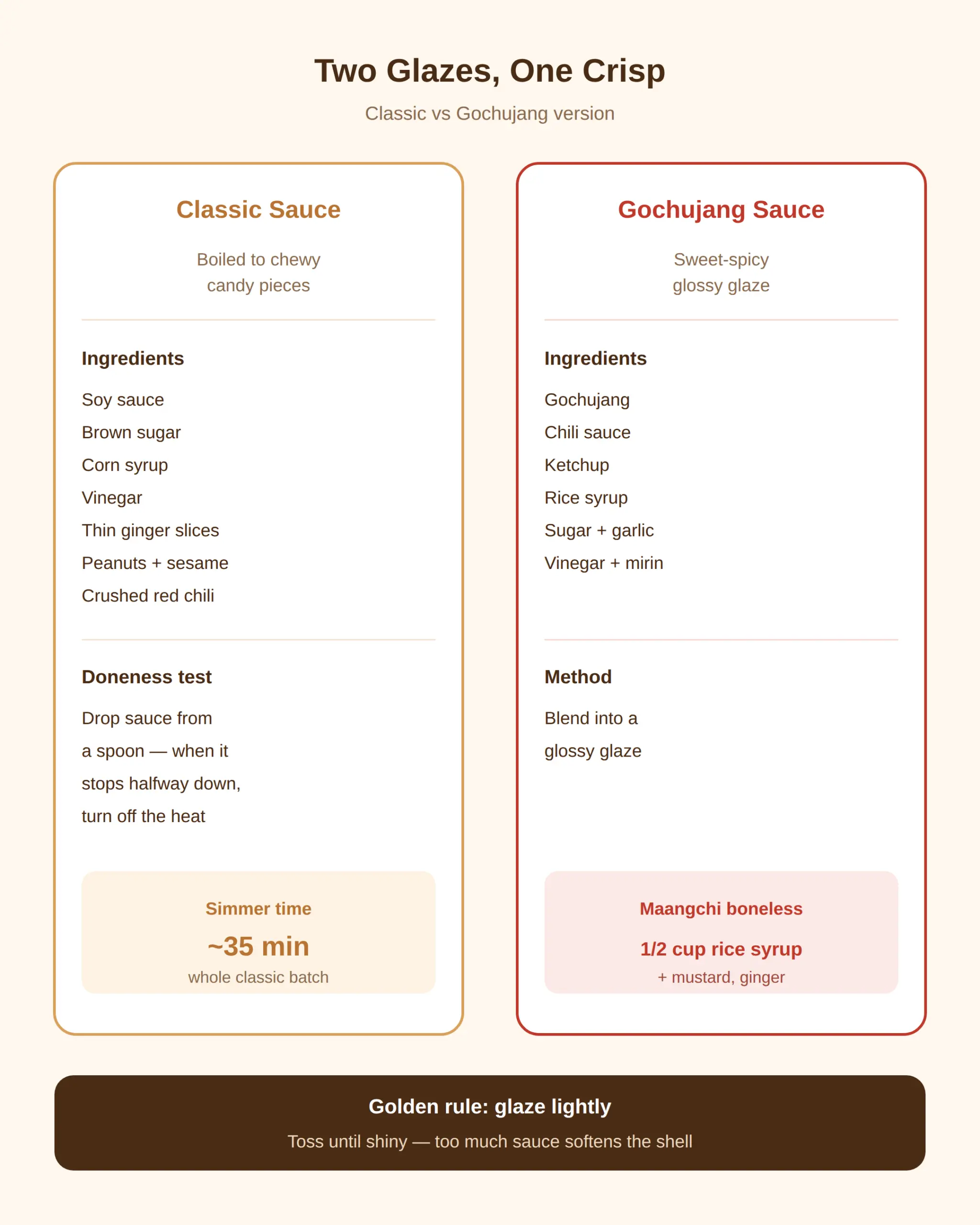
The classic Maangchi sauce is soy sauce, brown sugar, corn syrup, vinegar, and thinly sliced ginger that boils down into chewy candy pieces.
Peanuts, toasted sesame seeds, and crushed dried red chili finish it, and the classic batch simmers for roughly 35 minutes total.
The doneness test is simple: lift a spoonful of the sizzling sauce and drop it back in — when the sauce stops halfway down the spoon, turn off the heat.
For a 2–3 serving batch, a widely shared Korean home-cook ratio is the table below.
| Ingredient | Amount for 2–3 servings |
|---|---|
| Sugar | 2 tbsp |
| Corn syrup | 3.5 tbsp |
| Soy sauce | 1.5 tbsp |
| Oyster sauce | 0.5 tbsp |
| Ketchup | 0.5 tbsp |
| Fine gochugaru | 1 tbsp |
| Chili oil | 3 tbsp |
| Minced garlic | 1 tsp (not more) |
The modern gochujang version blends gochujang with chili sauce, ketchup, rice syrup, sugar, garlic, vinegar, and mirin for a sweet-spicy glossy glaze.
Maangchi’s boneless version takes another route: 1/2 cup rice syrup, 1 tbsp sugar, 1 tbsp soy sauce, 2 tsp apple cider vinegar, plus 1 tbsp yellow mustard and 2 tsp very thinly sliced ginger.
However you sauce it, glaze lightly.
Toss just until each piece shines; too much sauce softens the candy shell, and the aim is glossy, not drenched.
Tips that decide whether it stays crunchy
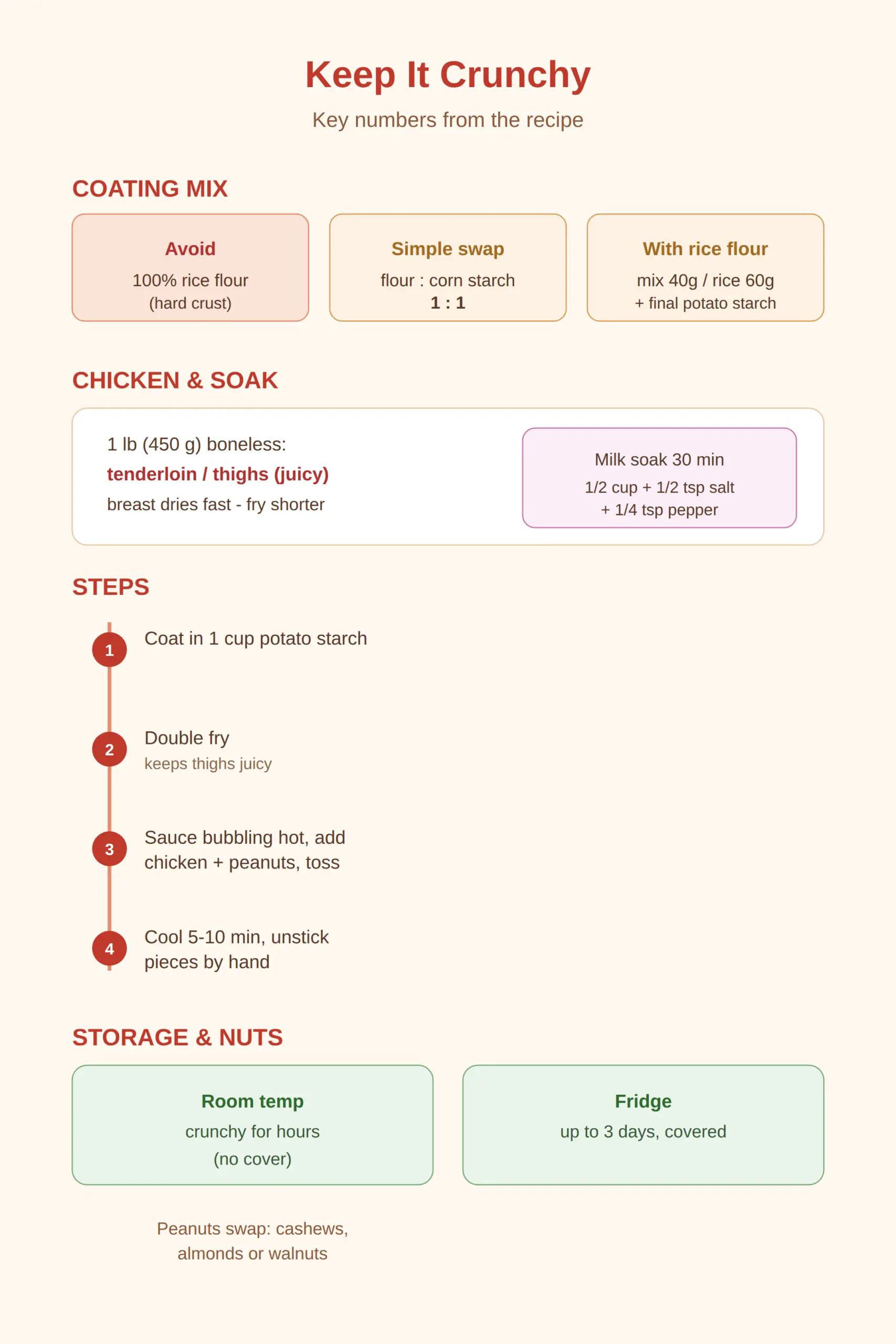
Do not coat with 100% rice flour — the crust turns hard.
If Korean fried-chicken mix is unavailable, flour and corn starch at 1:1 with 2 pinches of salt works, or a fried-chicken mix 40g / rice flour 60g blend if you want some rice flour in it.
For the chicken itself, 1 lb (450 g) of skinless tenderloin, breast, or thighs covers a boneless batch.
Tenderloin (ansim) has no skin or fat and suits boneless dakgangjeong, and bone-in cuts are harder to cook through at home.
A soak in milk with salt and pepper goes before the potato starch coating, and boneless thighs stay juiciest through the double fry while breast dries out fast, so shorten its cooking time.
To assemble, reheat the sauce until bubbling, add the fried chicken and peanuts, toss gently with a wooden spoon until evenly coated, then cool 5–10 minutes and separate pieces that stick together by hand.
Storage is generous for a fried dish.
Boneless dakgangjeong stays crunchy for several hours at room temperature and can be covered and refrigerated for up to 3 days.
Peanuts can be swapped for cashews, almonds, or walnuts if you prefer.
👉 Maangchi’s classic dakgangjeong recipe with the candy ginger syrup sauce
👉 Maangchi’s boneless dakgangjeong with milk soak and mustard glaze
👉 Beyond Kimchee’s crispy Korean chicken nuggets with the dry cornstarch coating
Related posts
Sources
- Dakgangjeong uses dry coating and syrup glaze; yangnyeom use (bakingbakewaresets.com)
- Gochujang glaze variant with jocheong, pickled radish pairin (beyondkimchee.com)
- Korean home-cook sauce ratio (2 tbsp sugar, 3.5 tbsp corn sy (amazingfoodstv.com)
Common mistakes
- Frying one big batch instead of small batches — the oil temperature drops and the crust goes soggy.
- Draining on paper towels instead of a wire rack — trapped steam softens the coating.
- Adding all the sauce at once — toss just until each piece shines, or the candy shell dissolves.
- Skipping the second, hotter fry — the deep-golden second fry is what keeps the crunch after glazing.
FAQ
Q. Is dakgangjeong just small yangnyeom chicken?
No. Yangnyeom chicken uses whole wings in a wet batter with a heavy sauce, while dakgangjeong is bite-sized, dry-coated, and only lightly glazed so the syrup sets into a shell.
Q. What can replace jocheong (Korean rice syrup)?
Dark corn syrup gives similar shine and stickiness, though it is slightly sweeter. Honey also works, since both set into the candy-like shell that keeps the crunch.
Q. How long does dakgangjeong stay crunchy?
Several hours at room temperature. Covered and refrigerated, boneless dakgangjeong keeps up to 3 days.
Chuseok falls on September 25, 2026 — peak delivery-chicken season in Korea. A home batch of dakgangjeong is the crunchy alternative.
Cover photo: Korean fried chicken yangnyeom by Yosomono — CC BY 2.0
#dakgangjeongrecipe #dakgangjeongvsyangnyeomchicken #Koreanfriedchicken #gochujangglaze #ricesyrupsubstitute #doublefrying #Koreanmarketsnack #pickledradish
📅Upcoming Dates — 이번 주 19 · D-2 Final two episodes drop on Disney+/Hulu전체 보기 →