Flights from Seoul to Jeju depart from Gimpo Airport, not Incheon — the hop takes about 1 hour 10 minutes and starts around ₩30,000 one-way when booked ahead.
Booking an ‘Incheon to Jeju’ flight is the most common mistake foreign travelers make on this route, because no such commercial flight exists.
This post covers which airport and terminal to use, what a one-way ticket costs by carrier and season, when to book, and when the ferry beats the plane.
Contents
- How to Get to Jeju from Seoul Airport — Gimpo, Not Incheon
- How Much Is a One-Way Flight to Jeju?
- Which Airline and How to Book It for Less
- Getting to Gimpo and Checking In on Time
- The Ferry to Jeju — When It Makes Sense
- Landing in Jeju — Airport to Jeju City
How to Get to Jeju from Seoul Airport — Gimpo, Not Incheon
All commercial Seoul–Jeju flights depart from Gimpo Airport (GMP) on the domestic side, and no passenger flight to Jeju operates from Incheon.
Booking sites that list a ‘Seoul’ departure route you through Gimpo, yet foreign travelers sometimes book an Incheon option by mistake and end up re-booking.
The Gimpo–Jeju route is one of the busiest in the world by passenger count, so seats are rarely scarce outside holidays.
Before paying, check that the airport code on your ticket reads GMP; if it shows ICN, the booking will not get you to Jeju.
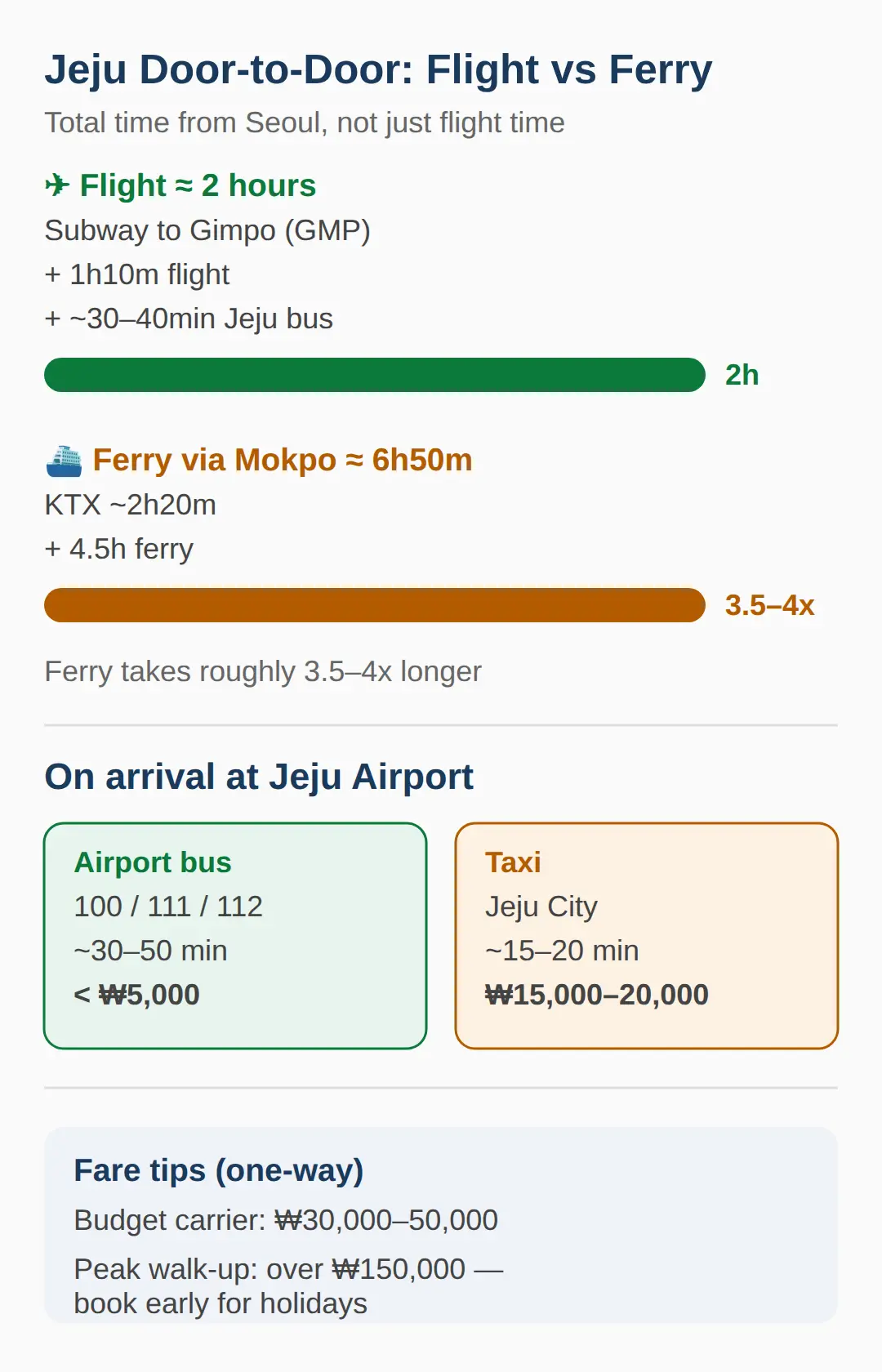
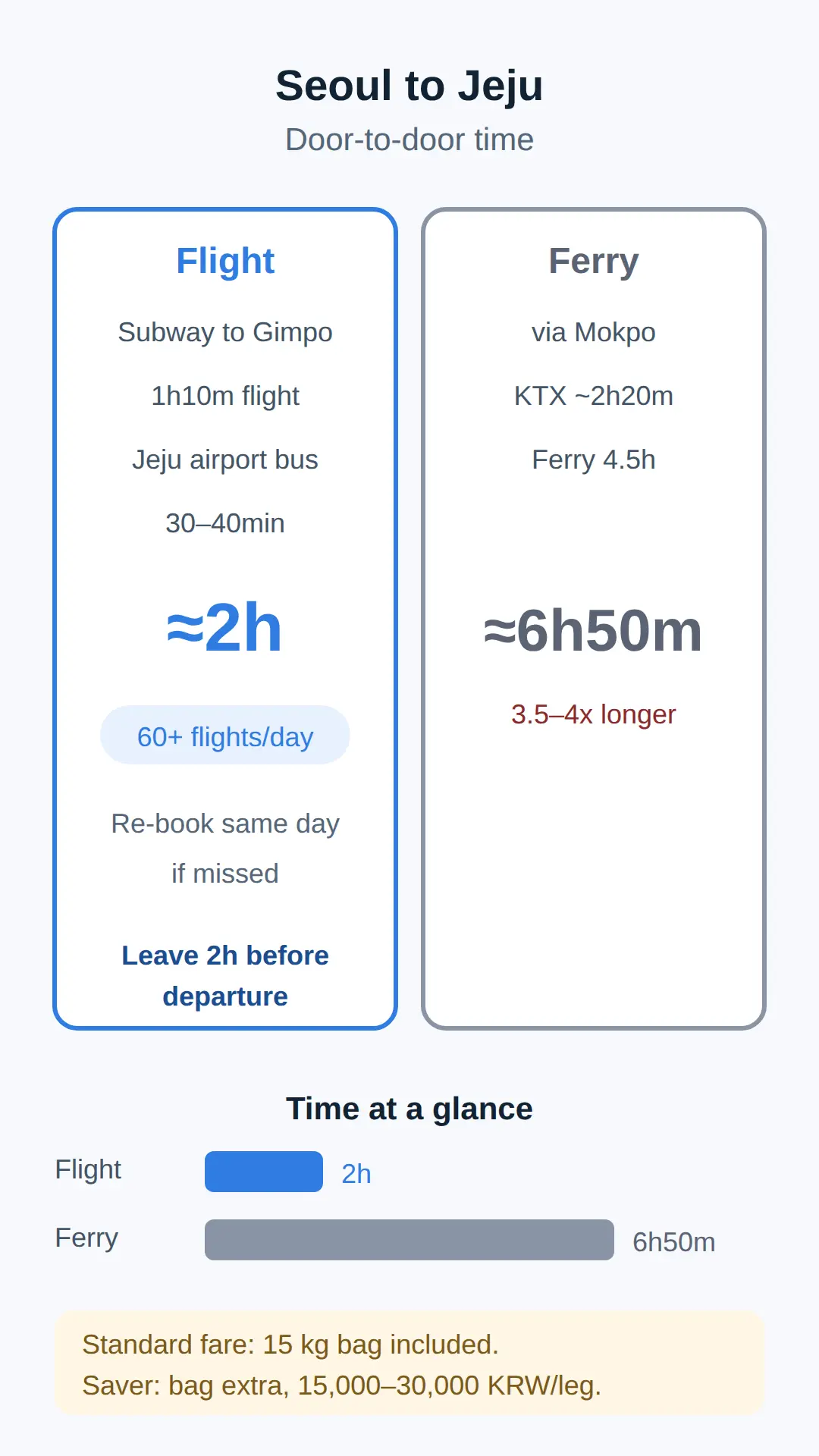
When comparing ways to Jeju, I first check the door-to-door total — subway to Gimpo, the 1h10m flight, and the bus on arrival — not just the flight time.
| Budget-carrier flight, booked ahead | Subway to Gimpo + 1h10m flight + 30–50min bus in Jeju ≈ 2 hours |
|---|---|
| Full-service flight | Same route, same airports — the flight time does not change |
| Ferry via Mokpo (rail + ferry) | KTX about 2h20m + 4.5h ferry ≈ 6h50m — about 3.5–4x longer than flying |
How Much Is a One-Way Flight to Jeju?
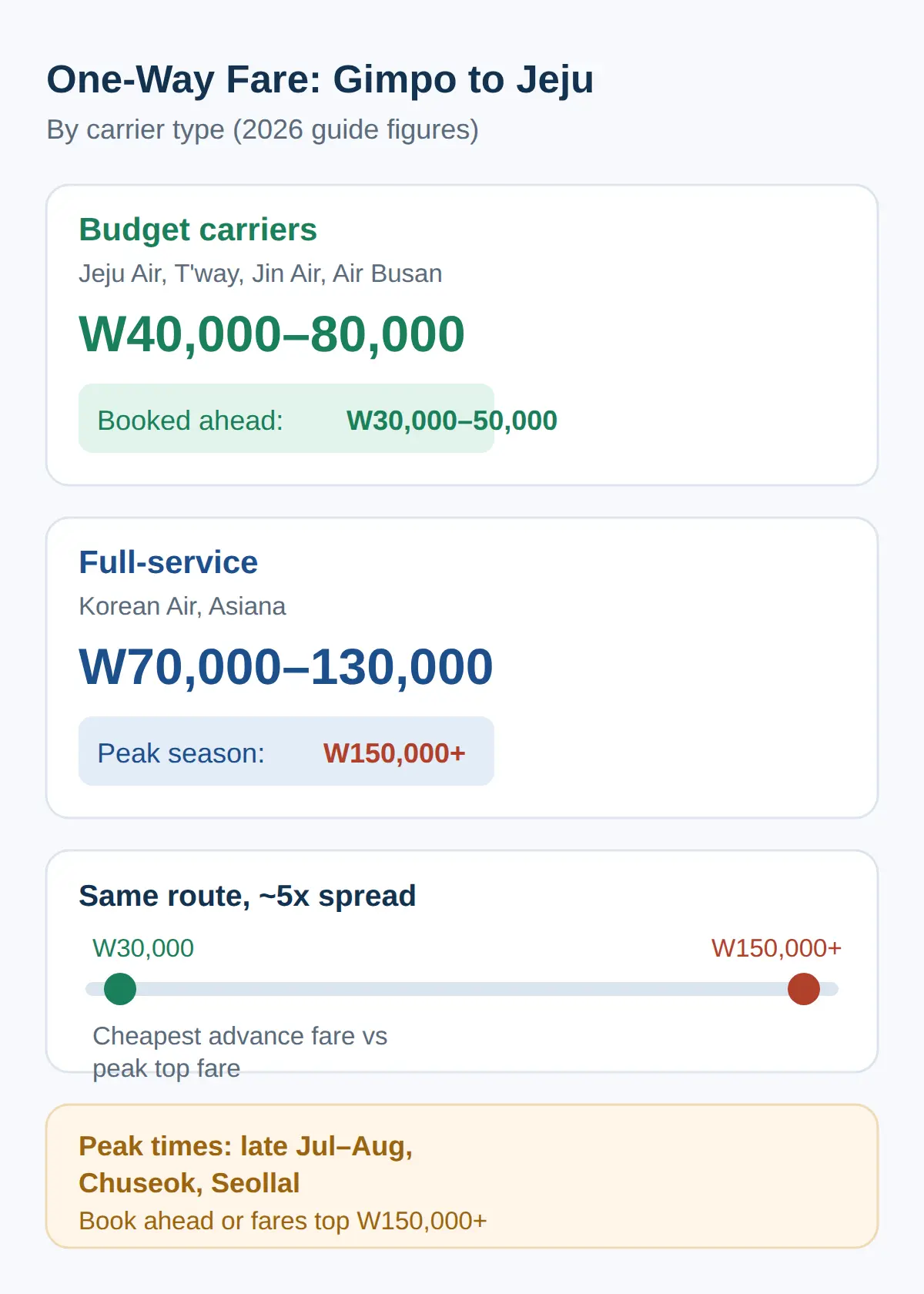
A one-way Gimpo–Jeju flight runs ₩40,000–80,000 on budget carriers and ₩70,000–130,000 on full-service carriers, per 2026 guide figures.
Booking ahead drops budget fares to ₩30,000–50,000, while peak-season full-service fares reach ₩150,000 and above — roughly a 5x spread between the cheapest advance fare and the peak top fare on the same route.
If your dates fall in late July–August, Chuseok, or Seollal, book well ahead; waiting until the day of travel in those weeks can mean fares above ₩150,000 or sold-out flights, while same-day buying is only realistic on winter weekdays.
| Carrier type | One-way fare | Notes |
|---|---|---|
| Budget carriers | ₩40,000–80,000 (from ₩30,000–50,000 booked ahead) | Baggage rules vary by fare tier — see below |
| Full-service carriers | ₩70,000–130,000 | ₩150,000+ in peak season |
| Shoulder season (late Sep–Nov) | Cheapest window of the year | Both carrier types drop toward their floors |

Which Airline and How to Book It for Less
Both budget and full-service carriers fly Gimpo–Jeju, and the cheapest seats sit on the budget carriers’ own websites and apps rather than on booking aggregators.
Book 2–3 weeks ahead in spring and summer, and about 1 week ahead in winter; carrier sites consistently show lower fares than OTAs for the same seat class, though some aggregators add a service fee on top.
If the price gap between a budget fare and a full-service fare is small, check the baggage terms first — a budget ‘Saver’ fare often excludes a checked bag, and the add-on runs ₩15,000–30,000 per leg, which can erase the saving.
Standard budget fares typically include 15 kg of checked baggage, so compare like with like before choosing the cheapest sticker price.
I would book directly on the carrier’s own site or app rather than through a Korean meta-search site, because the checkout there can require Korean verification.
Getting to Gimpo and Checking In on Time
Gimpo domestic check-in closes 20 minutes before departure, and carriers recommend arriving 90 minutes early.
A subway ride from central Seoul costs the base subway fare and reaches the airport directly, which is why the ground leg adds almost nothing to the trip cost.
With roughly 60+ flights a day across carriers — a departure every 15–20 minutes at peak — a missed booking is easy to re-book the same day.
Leaving central Seoul about 2 hours before departure comfortably covers the subway ride, the 90-minute arrival, and the 20-minute cutoff.
If your schedule is tight, earlier flights leave more room to recover from a delay than the last departures of the day.
The Ferry to Jeju — When It Makes Sense
The ferry from Mokpo takes about 4.5 hours and the ferry from Busan takes 12–13 hours, versus a Gimpo–Jeju flight of about 1 hour 10 minutes.
Taking the ferry only makes sense when you need to bring a vehicle, because for a car-owning group the combined ferry cost can beat plane tickets plus an on-island rental.
By rail plus ferry, Mokpo is about 2h20m from Seoul by KTX, and with the roughly 4.5-hour crossing the whole journey comes to roughly 6h50m door to door.
Sailings are frequently cancelled in rough weather, especially during the July–September typhoon season and winter swells, so the ferry is a poor plan for a fixed schedule.
Ferry tickets are bought from operator sites or at terminal counters, and sailings rarely fill outside holidays — check the operator’s schedule for your date before committing.
Landing in Jeju — Airport to Jeju City
Airport buses 100, 111, and 112 run from Jeju airport to Jeju City in roughly 30–50 minutes, and a taxi covers the same trip in about 15–20 minutes.
The airport sits close enough to downtown that the transfer fits inside the first hour of your arrival, which matters if you land on an evening flight.
Buses cost less than a taxi but take about twice as long, so the choice comes down to luggage and how late you land.
If you arrive late in the day, the taxi fare is small against a wasted evening, and buses still run to the main downtown stops.
👉 A Jeju Island travel guide covering flight times and fares
👉 A first-timer’s guide to Jeju with ferry ports and airlines
👉 Best time to visit Jeju with seasonal fare peaks
Related posts
📎 Seoul — everything we know
📎 📅 다가오는 일정 — 발매·개봉·발표 캘린더
Sources
- 15kg standard on typical fares; Saver tier excludes checked (korea-insider.com)
- Walk-up peak fares can exceed ₩150,000 and sell out (thesouthkoreaguide.com)
- 30–50 min bus, 15–20 min taxi (koreadaddy.com)
What to Watch Next
- Book 2–3 weeks ahead in spring and summer; about 1 week ahead is enough in winter.
- Avoid flying late July–August and around Chuseok and Seollal, when fares peak; late September–November is cheapest.
- Chuseok 2026 falls around September 24–26 — fares are at peak now and drop after the holiday window.
FAQ
Q. Which airport do flights to Jeju leave from in Seoul?
Gimpo Airport (GMP). There is no commercial Seoul–Jeju flight from Incheon — booking sites showing ‘Seoul’ route via Gimpo.
Q. How much does a one-way Seoul–Jeju flight cost?
₩40,000–80,000 on budget carriers and ₩70,000–130,000 on full-service carriers, per 2026 guide figures; advance budget fares start at ₩30,000–50,000.
Q. Can I take a ferry from Seoul to Jeju instead?
Yes, but not from Seoul itself — the Mokpo ferry takes about 4.5 hours and the Busan ferry 12–13 hours, and it only makes sense if you need to bring a car.
Q. How far ahead should I book a Gimpo–Jeju flight?
Two to three weeks ahead in spring and summer, and about one week ahead in winter; book much earlier for late July–August, Chuseok, and Seollal.
Q. Does a budget ‘Saver’ fare include a checked bag?
Usually not — the checked-bag add-on runs ₩15,000–30,000 per leg, while standard budget fares typically include 15 kg.
Jeju in a day: with a 20-minute check-in cutoff and a 1h10m flight, an evening arrival in Jeju City is realistic from a Seoul morning — book from Gimpo and leave the ferry for trips that need a car.
Cover photo: Geumneung Port (금능포구) by Korea Tourism Organization — KOGL Type 1 (attribution)
#jeju #gimpoairport #seoultojeju #koreadomesticflights #jejuferry #koreatravel2026
📅Upcoming Dates — 이번 주 32 · D-day Chuseok holiday period — rice cake interest peaks전체 보기 →