Most kimchi in Korea is not vegan: standard baechu kimchi is seasoned with aekjeot (Korean fish sauce) and/or saeujeot (salted shrimp), so the default answer to ‘is kimchi vegan’ is no.
That changes what you can eat freely in Korea — the free side dish on the table and most kimchi stews are not vegan by default.
This post compares which kimchi types can be vegan, how to check a pack label, what to say in Korean, and where vegan-certified kimchi shows up.
Is Kimchi Vegan? The Short Answer
| Baechu kimchi (standard napa) | Aekjeot (anchovy or sand lance fish sauce) and/or saeujeot (salted shrimp) | Not vegan by default | Skip unless labeled vegan |
|---|---|
| Baek kimchi (white kimchi) | Traditionally no gochugaru, often no jeotgal | Possibly vegan — recipes vary by maker | Ask or read the label every time |
| Dongchimi (water kimchi) | Brine-based, typically no fish sauce | Possibly vegan — some versions add saeujeot or aekjeot | Ask or read the label every time |
| Temple food kimchi (sachal eumsik) | No fish sauce, no shrimp, no five pungent herbs | Reliably vegan at temple-cuisine restaurants | Look for temple-food restaurants |
| Certified vegan packs (e.g., Chongga vegan line) | Jeotgal replaced with soy-sauce-based seasoning | Certified vegan — mainly export markets | Look for a printed ‘VEGAN’ mark |
| Kimchi jjigae / kimchi jjim (stews) | Usually pork or tuna plus anchovy broth | Not vegan by default | Ask separately — the kimchi and the dish are two checks |
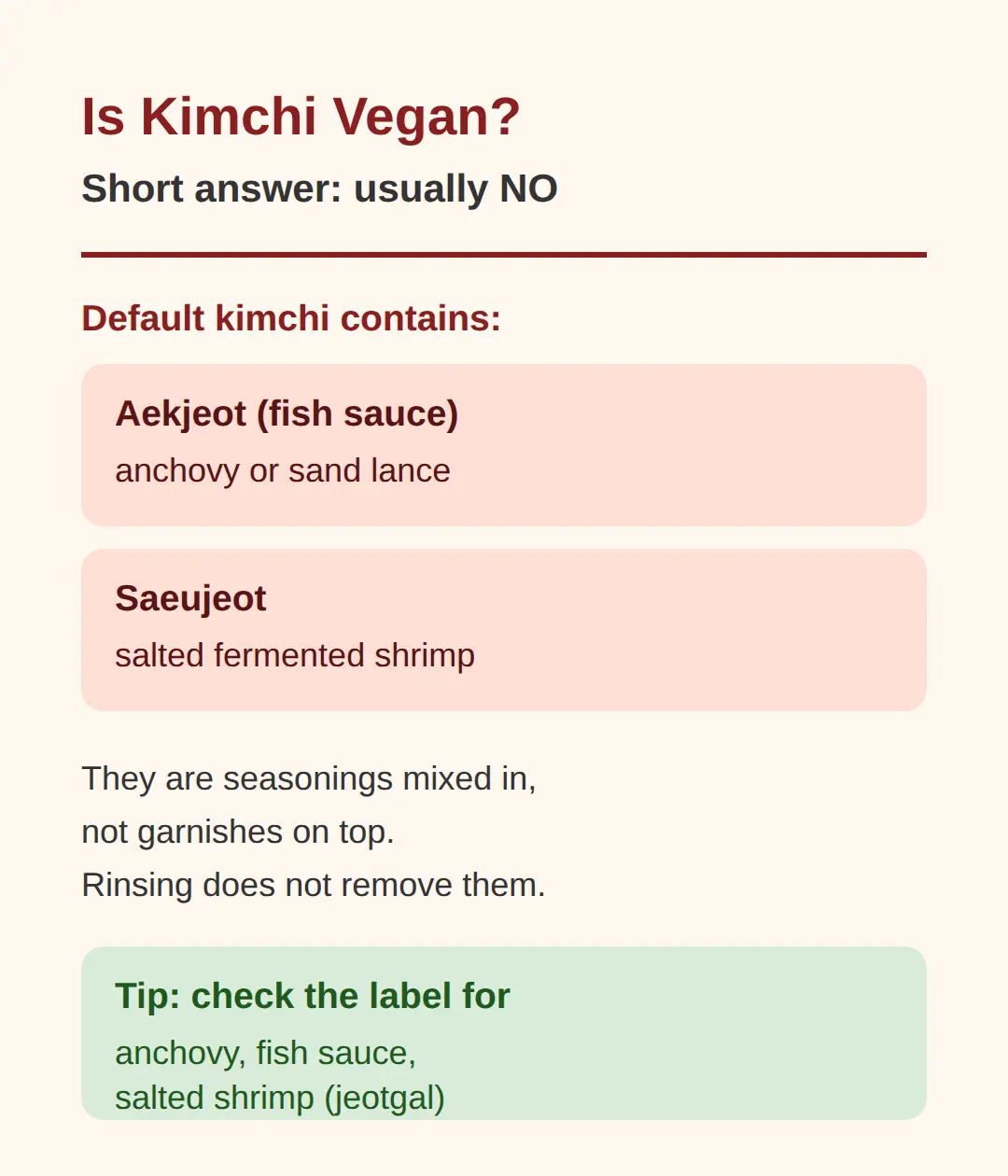
Aekjeot is fish sauce made from anchovy or sand lance, and saeujeot is salted fermented shrimp.
Both are fermenting seasonings, not garnishes, so they sit inside the kimchi itself — rinsing or picking around them does not remove them.
The same ‘is kimchi vegetarian’ question keeps coming up in search autocomplete, and vegan and halal Seoul restaurant maps circulate among visitors on r/KoreanFood — this is a first-visit question, not a niche one.
When I look at any kimchi product, the first thing I check is the ingredient label for jeotgal terms — anchovy, fish sauce, salted shrimp — because default kimchi is made with them.
Which Kimchi Has No Fish Sauce
Baek kimchi (white kimchi) and dongchimi (water kimchi) are the types most often made without fish sauce, and temple-food kimchi is made without it by rule.
Baek kimchi traditionally skips gochugaru (chili flakes) and often skips jeotgal (fermented seafood) altogether, though recipes vary.
Dongchimi is a brine-based water kimchi typically made without fish sauce, but some households and commercial versions still add saeujeot or aekjeot for savory depth.
Korean temple food (sachal eumsik) kimchi is made without fish sauce, shrimp, and the five pungent herbs (osinchae, including garlic and green onion), so temple-cuisine restaurants are the most reliable option.
Treat every white-style kimchi as a per-maker check, not a category guarantee — ask or read the label each time.
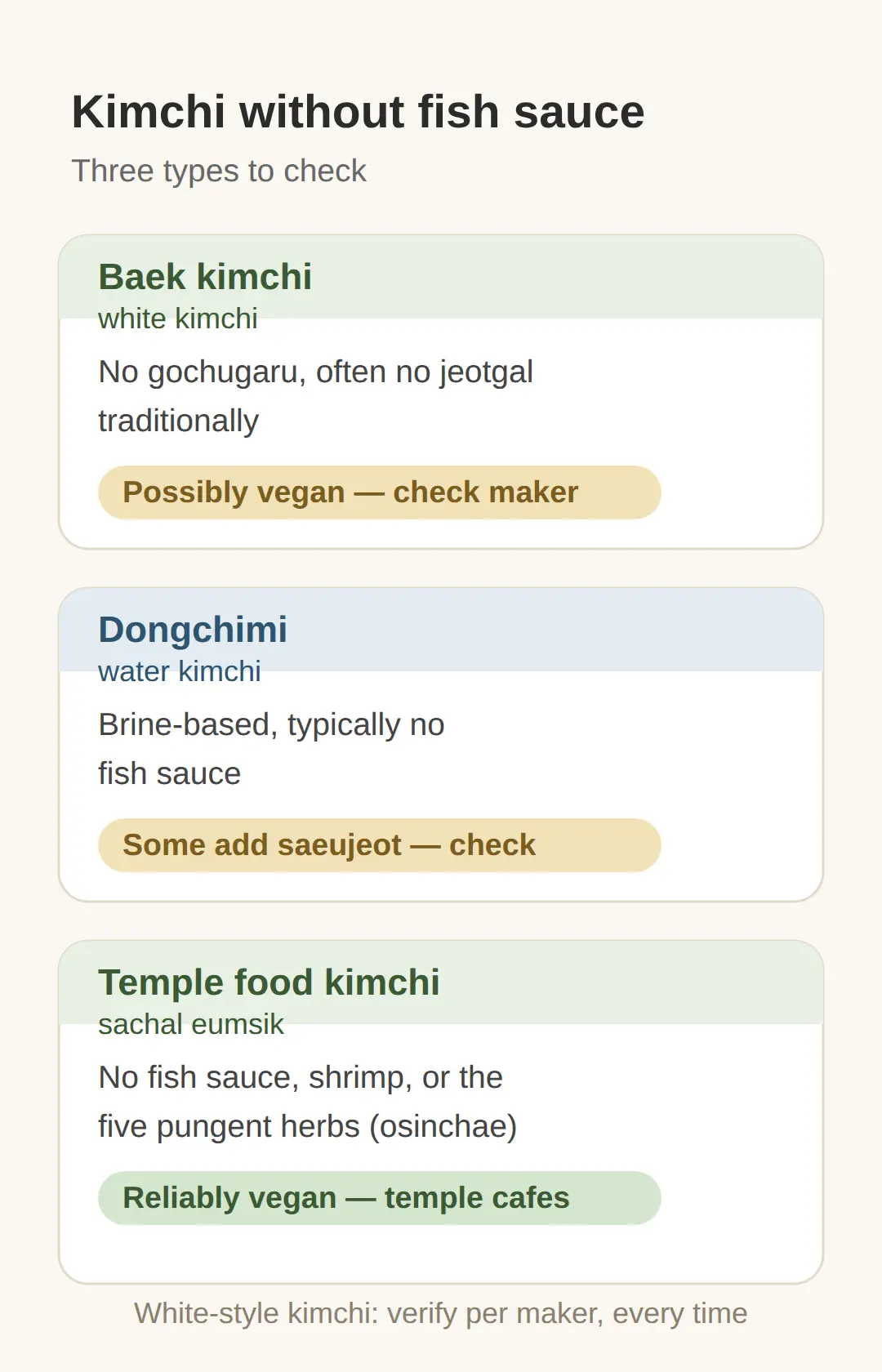
 — Which Kimchi Has No Fish Sauce](https://koreankorea.com/wp-content/uploads/2026/09/kimchi-vegan-which-kinds-have-no-fish-03.jpg)
How to Find Vegan Kimchi in Korea
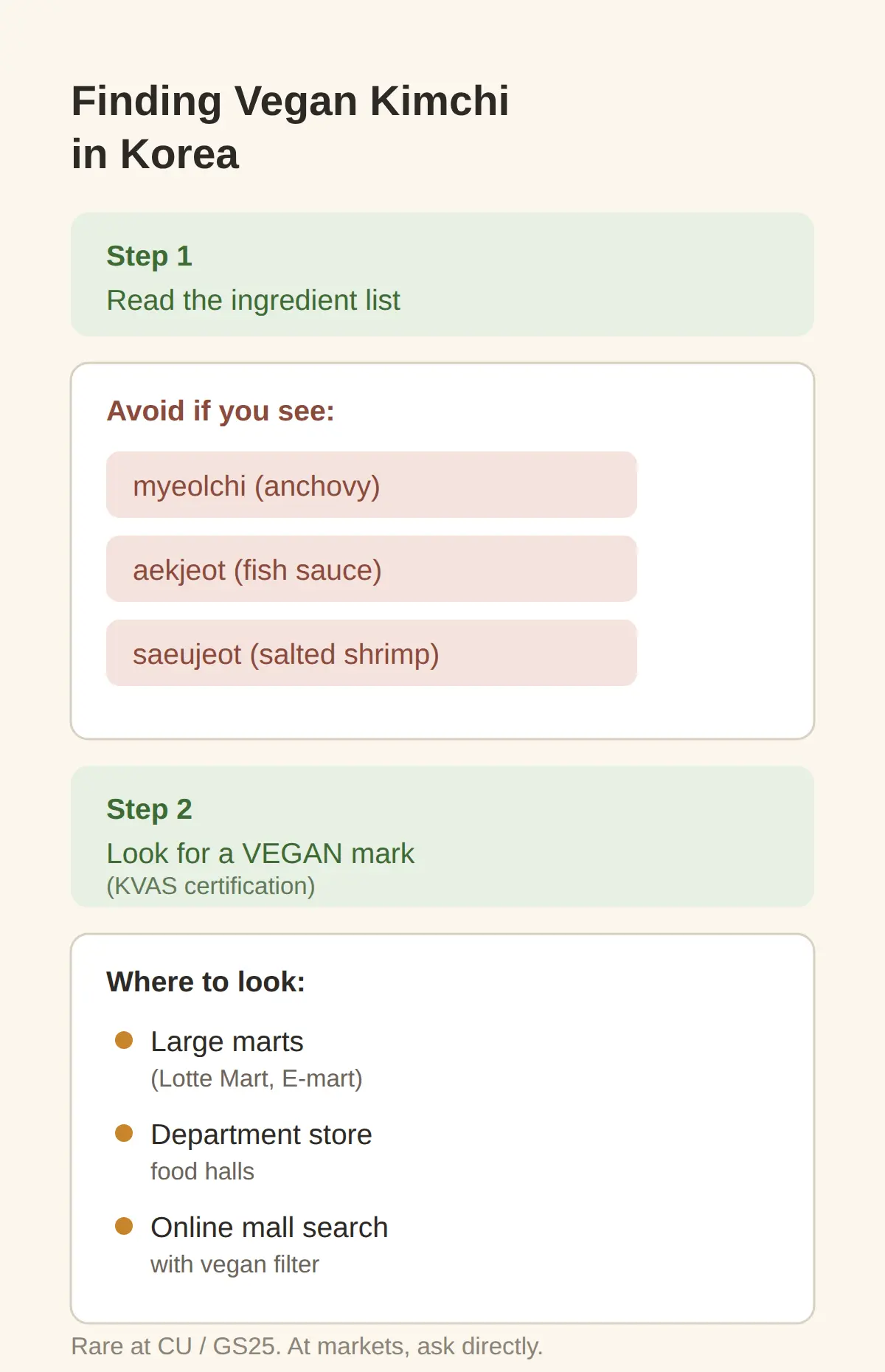
The reliable method is reading the ingredient list on packaged kimchi, because pre-packaged kimchi in Korean supermarkets must list its seasonings.
- Turn the pack over and scan the ingredient list for three terms: myeolchi (anchovy), aekjeot (fish sauce), and saeujeot (salted shrimp).
- If any of those appear, the pack is not vegan — move on.
- If a ‘VEGAN’ mark is printed on the pack, that is the most reliable shorthand — but still double-check the ingredient list, since certification labeling practices vary by maker.
Vegan-certified kimchi is niche in domestic Korean stores, and it is rarely stocked at convenience stores like CU or GS25 — large marts (Lotte Mart, E-mart), department-store food halls, and online mall filtered searches are where to look.
At Gwangjang Market and Namdaemun Market, some stalls sell jeotgal-free kimchi, but availability is stall-by-stall, so ask directly rather than assume.
Some restaurant chains and market shelves rotate stock, so no single store list holds for long — check the label each time you buy.

What to Say in Korean When Buying Kimchi
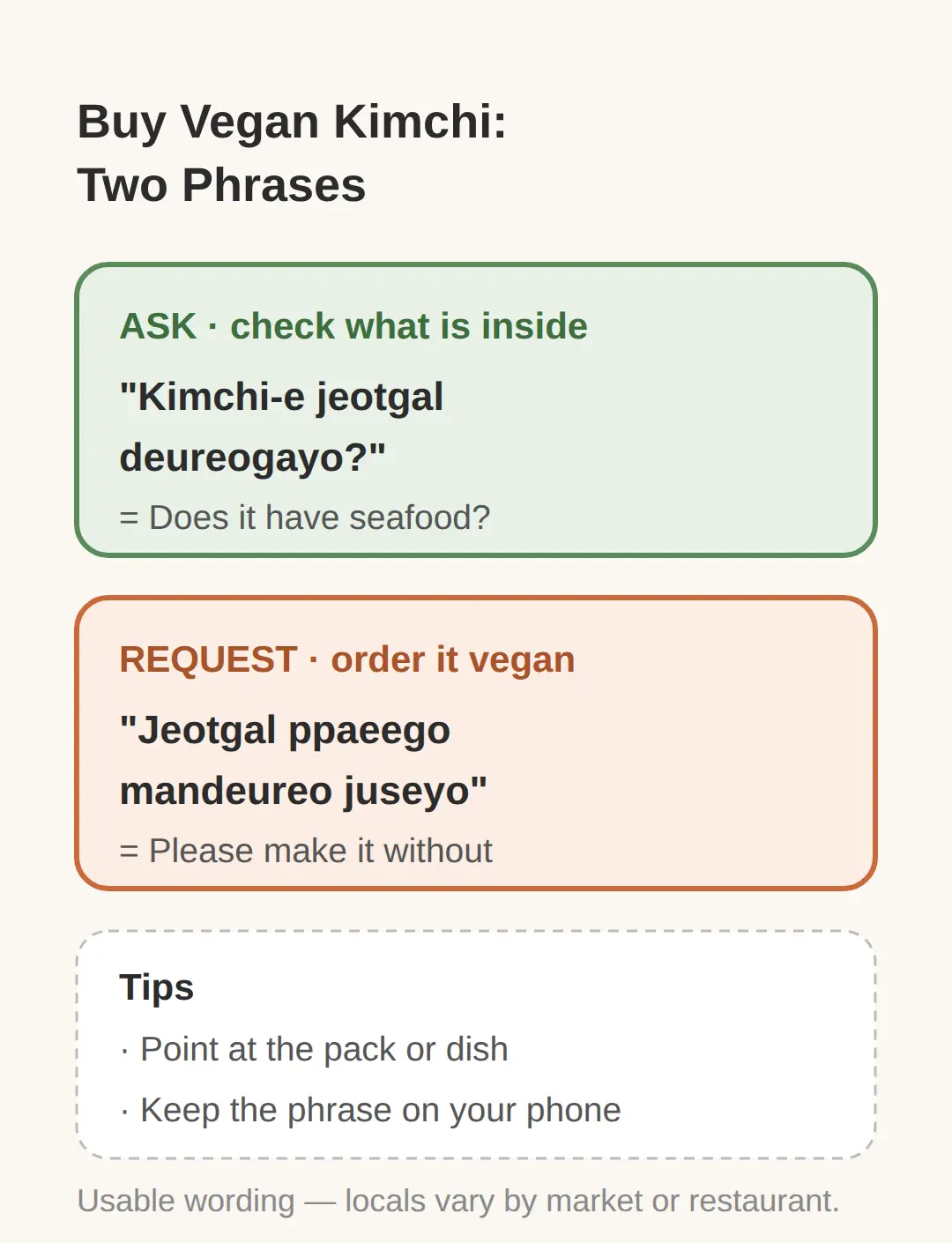
Two phrases cover it: ask ‘Kimchi-e jeotgal deureogayo?’ (Does the kimchi have fermented seafood in it?) and request ‘Jeotgal ppaeego mandeureo juseyo’ (Please make it without jeotgal).
The first phrase works at market stalls and restaurants to check what is in front of you.
The second asks for a batch made without fermented seafood — useful when a stall can make or set aside a jeotgal-free version.
Pointing at the pack or the dish while asking removes most of the ambiguity, and writing the phrase on your phone helps at busy stalls.
The exact wording native speakers use shifts between markets and restaurants, so treat these as clear and usable rather than the only right forms.
Vegan Kimchi Brands and Eating Out in Korea
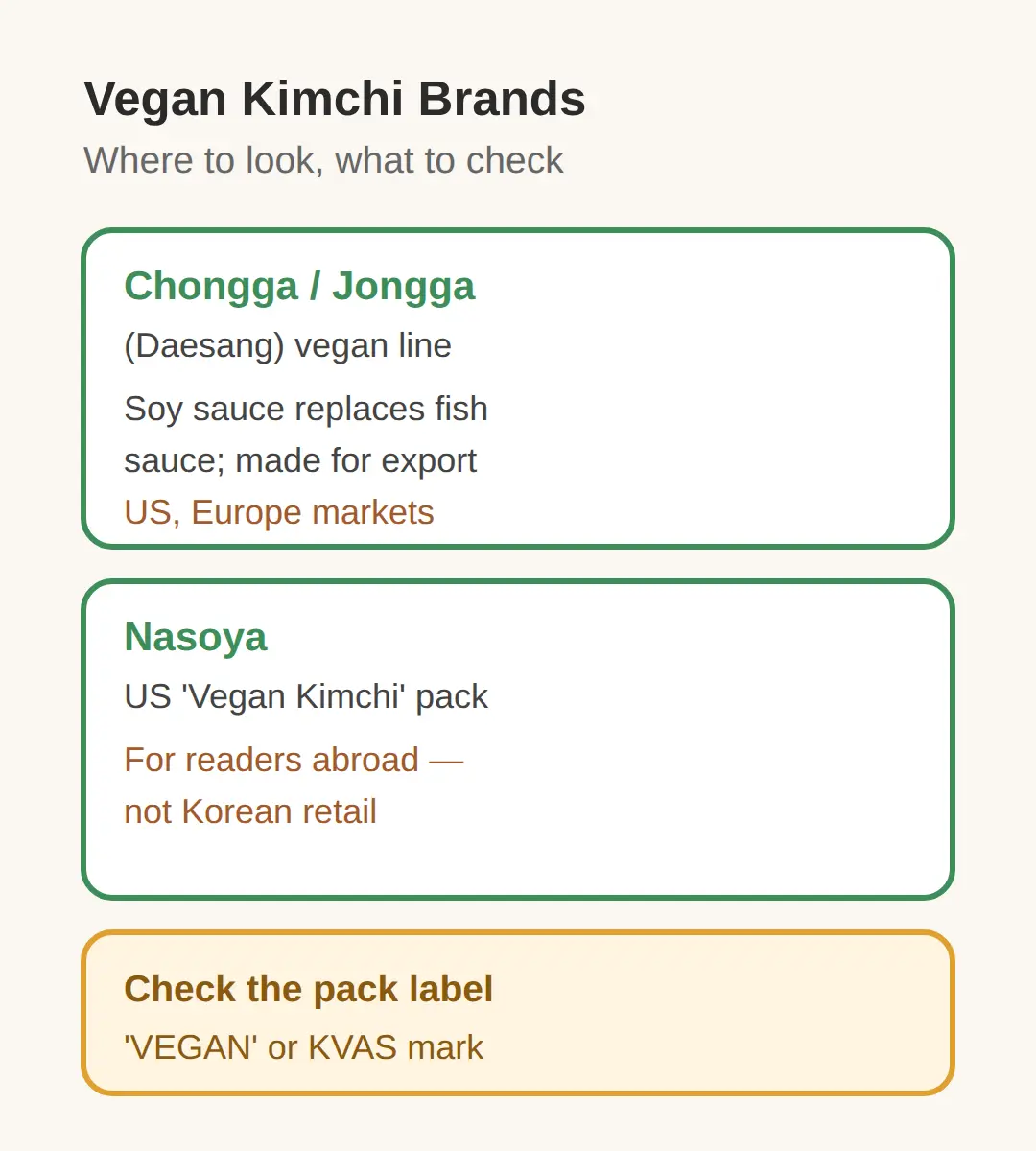
Chongga/Jongga (Daesang) sells a vegan-certified kimchi line that replaces jeotgal with soy-sauce-based seasoning, developed primarily for export markets such as the US and Europe.
In the US, Nasoya sells a pack labeled ‘Vegan Kimchi’ — an option for readers shopping outside Korea rather than a Korean-retail answer.
For these products, the printed ‘VEGAN’ mark on the pack is the check that counts, since certification details vary by product and market.
Eating out, assume the free banchan kimchi is not vegan — restaurant banchan kimchi is almost never vegan, and refilling it does not change that.
Kimchi jjigae and kimchi jjim are separate checks: they almost always contain pork, tuna, or anchovy broth, so the kimchi inside and the dish are two separate questions.
Kimchi-flavor instant ramen is generally not vegan either — most contain fish-based or meat-based broth powder in the soup.
Muslim travelers face the same jeotgal problem, and halal-certified kimchi products exist alongside vegan ones, following the same label-check logic.

Kimjang Season, Kimchi Day, and Kimchi Culture in Korea
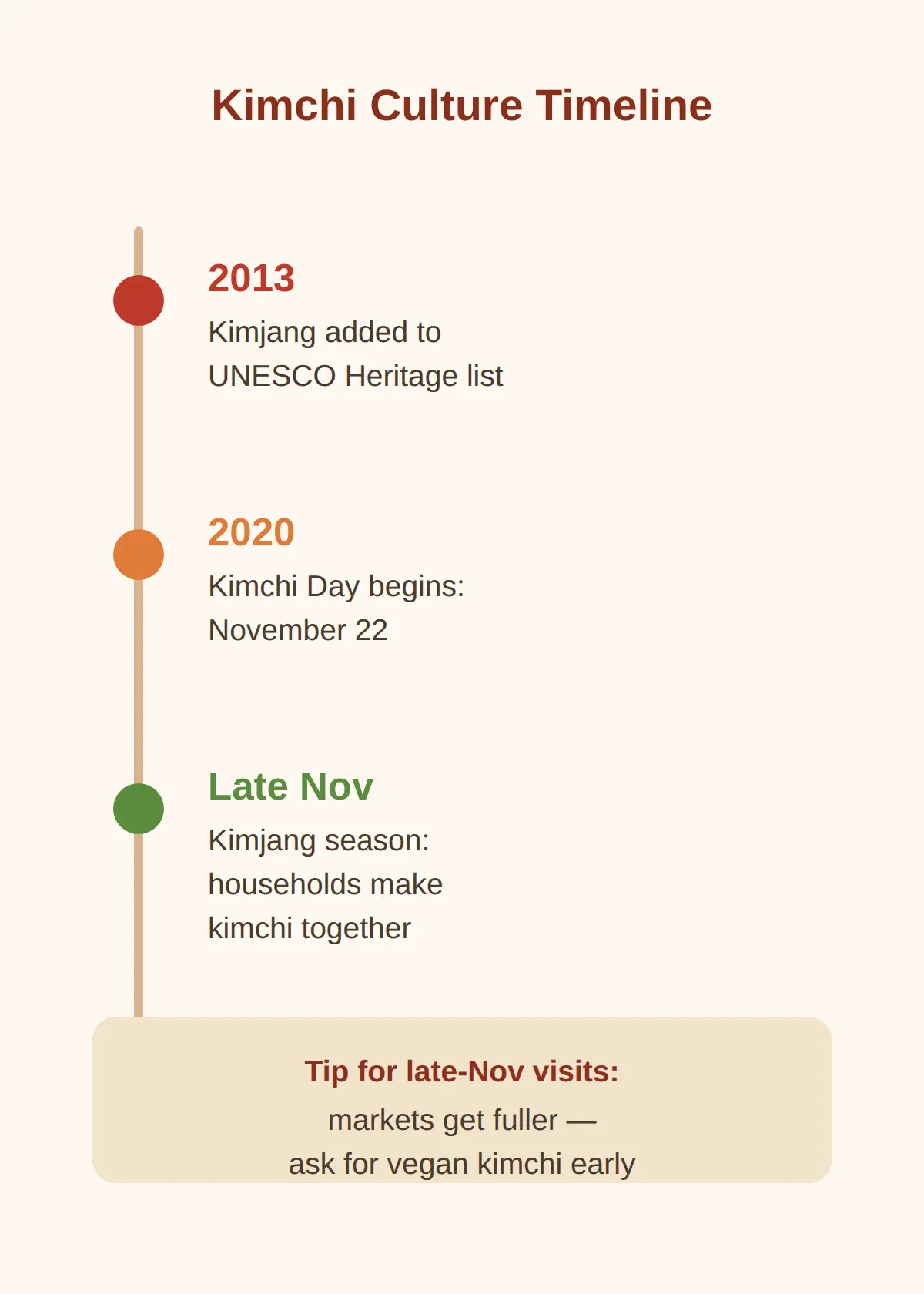
Kimjang — the late-November season when households make kimchi together — was inscribed on UNESCO’s Intangible Cultural Heritage list in 2013, and Korea has marked Kimchi Day on November 22 since 2020.
Kimjang, the kimchi-making culture, was inscribed on UNESCO’s Intangible Cultural Heritage list in 2013, and Korea has marked Kimchi Day on November 22 since 2020.
Around kimjang season, kimchi questions, kimjang kit sales, and jeotgal-free kimchi requests spike annually — so if you are visiting in late November, expect fuller markets and ask early.
If you want to see kimchi up close on a first visit, the Pulmuone Kimchikan museum in Seoul offers kimchi exhibitions relevant to kimchi-curious travelers.
I would go straight to temple-food restaurants or look for a printed ‘VEGAN’ mark on the pack — asking at random stalls works only if you ask every single time, since availability is stall-by-stall.
👉 vegan and halal Seoul restaurant maps
👉 kimjang on UNESCO’s Intangible Cultural Heritage list
Related posts
📎 Seoul — everything we know
📎 📅 Upcoming Dates — Release & Event Calendar
Sources
- Standard kimchi uses aekjeot/saeujeot — default answer is no (en.wikipedia.org)
- Saeujeot definition (en.wikipedia.org)
- Aekjeot definition (en.wikipedia.org)
Kimchi Vegan Status at a Glance
- Some dongchimi recipes still add fish sauce, so always check before assuming water kimchi is safe.
- Vegan kimchi recipes replace fish sauce and salted shrimp with plant-based seasonings — soy sauce, doenjang, kelp (dasima) broth, or miso — to supply the same savory depth.
- Kimchi jjigae and kimchi jjim almost always contain pork or seafood broth on top of the kimchi itself.
- A printed ‘VEGAN’ mark on the pack is the only reliable shorthand at the store.
- Baek kimchi and dongchimi at traditional market stalls can be fish-sauce-free, but only asking the vendor directly confirms it.
- Temple-cuisine restaurants are one of the most reliable places to find kimchi made without fish sauce.
FAQ
Q. Is kimchi vegan?
Most kimchi is not vegan — standard baechu kimchi is seasoned with aekjeot (fish sauce) and/or saeujeot (salted shrimp). Baek kimchi, dongchimi, and temple-food kimchi can be vegan, but each maker must be checked.
Q. Is kimchi vegetarian?
Standard baechu kimchi is not vegetarian either, for the same reason — fish sauce and salted shrimp are animal products. Temple-food kimchi and certified vegan packs are the vegetarian-friendly options.
Q. Which kimchi has no fish sauce?
Baek kimchi (white kimchi) and dongchimi (water kimchi) are most often made without fish sauce, though some makers still add it. Temple-food kimchi is made without fish sauce by rule.
Q. How to find vegan kimchi in Korea?
Read the ingredient list on packaged kimchi for anchovy, fish sauce, or salted shrimp, or look for a printed ‘VEGAN’ mark. Vegan-certified kimchi is niche in Korean stores — check large marts and online malls, not convenience stores.
Q. Kimchi without fish sauce in Seoul — is it actually findable?
Yes, but not on every corner. Temple-food restaurants are the most reliable option, and some stalls at Gwangjang and Namdaemun Markets sell jeotgal-free kimchi — availability is stall-by-stall, so ask directly each time.
Dates to watch: kimjang season runs in late November, and Kimchi Day falls on November 22 — kimchi questions and jeotgal-free requests spike around then.
This article’s facts are current as of September 26, 2026.
Cover photo: Seohaean-ro, Jeju-si, Jeju-do, South Korea – panoramio – song songroov (11) by song songroov — CC BY 3.0
#kimchi #vegankoreanfood #koreanfood #seoulfoodguide #templefood #kimjang #travelinginkorea
📅Upcoming Schedule — this week 23 · D-1 Autumn season = post-summer brightening demand window (UV drSee all →