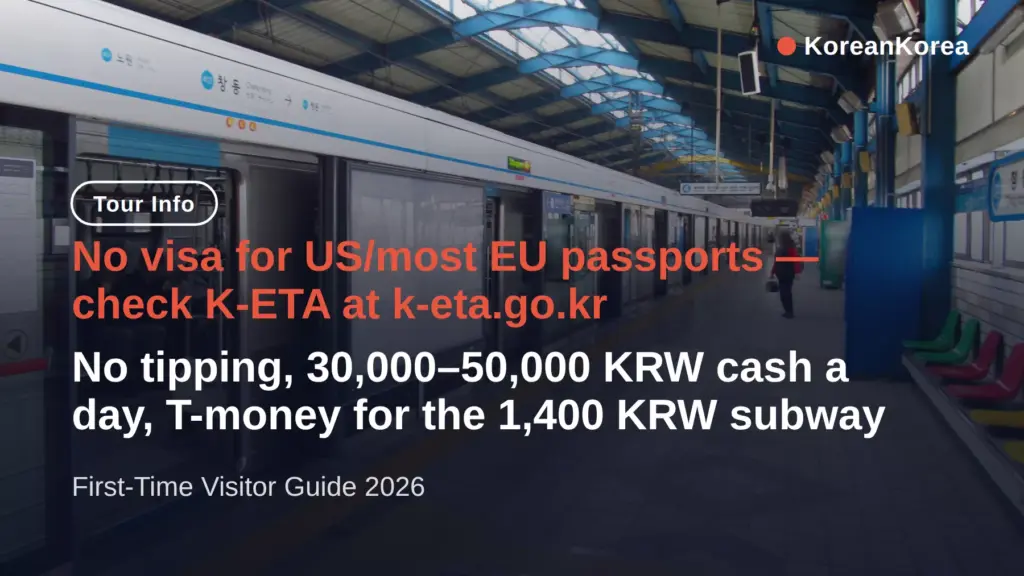
For most first-time visitors in 2026: no visa needed for US and most EU passports (check K-ETA at k-eta.go.kr), no tipping anywhere, 30,000–50,000 KRW cash per day, and a T-money card for the 1,400 KRW subway fare.
First Time in Korea Travel Tips: Visa, K-ETA and Who Needs What
| Do I need a visa? | No for US and most EU passports — up to 90 days; K-ETA by nationality |
|---|---|
| Do I tip? | No — restaurants, taxis and hotels do not expect tips |
| How much cash? | 30,000–50,000 KRW per day as backup |
| Which transit card? | T-money — or WOWPASS if you want a foreign-currency wallet |
| KTX Seoul–Busan | From 59,800 KRW, about 2.5 hours |
US and most EU passport holders enter Korea visa-free for tourism, for up to 90 days — the exact limit depends on your nationality.
What changes the picture is K-ETA, the electronic travel authorization that applies to visa-free nationalities.
The temporary K-ETA exemption was extended in phases, and the nationality-by-nationality list for late 2026 could not be confirmed from a government page — so check k-eta.go.kr yourself before booking, because that page is the only thing that decides whether you apply.
If your nationality does need a K-ETA, 2026 guides put the application at k-eta.go.kr at least 72 hours before departure, with a 10,000 KRW fee (about USD 7–8).
If your nationality needs an actual visa, the C-3-9 short-term tourist visa is the usual route.
The first things I check before a trip like this are exactly these two: whether your passport needs a K-ETA right now, and what the current rules are — because both change, and no fixed list you read, including this one, replaces the official page.
Do You Tip in Korea?
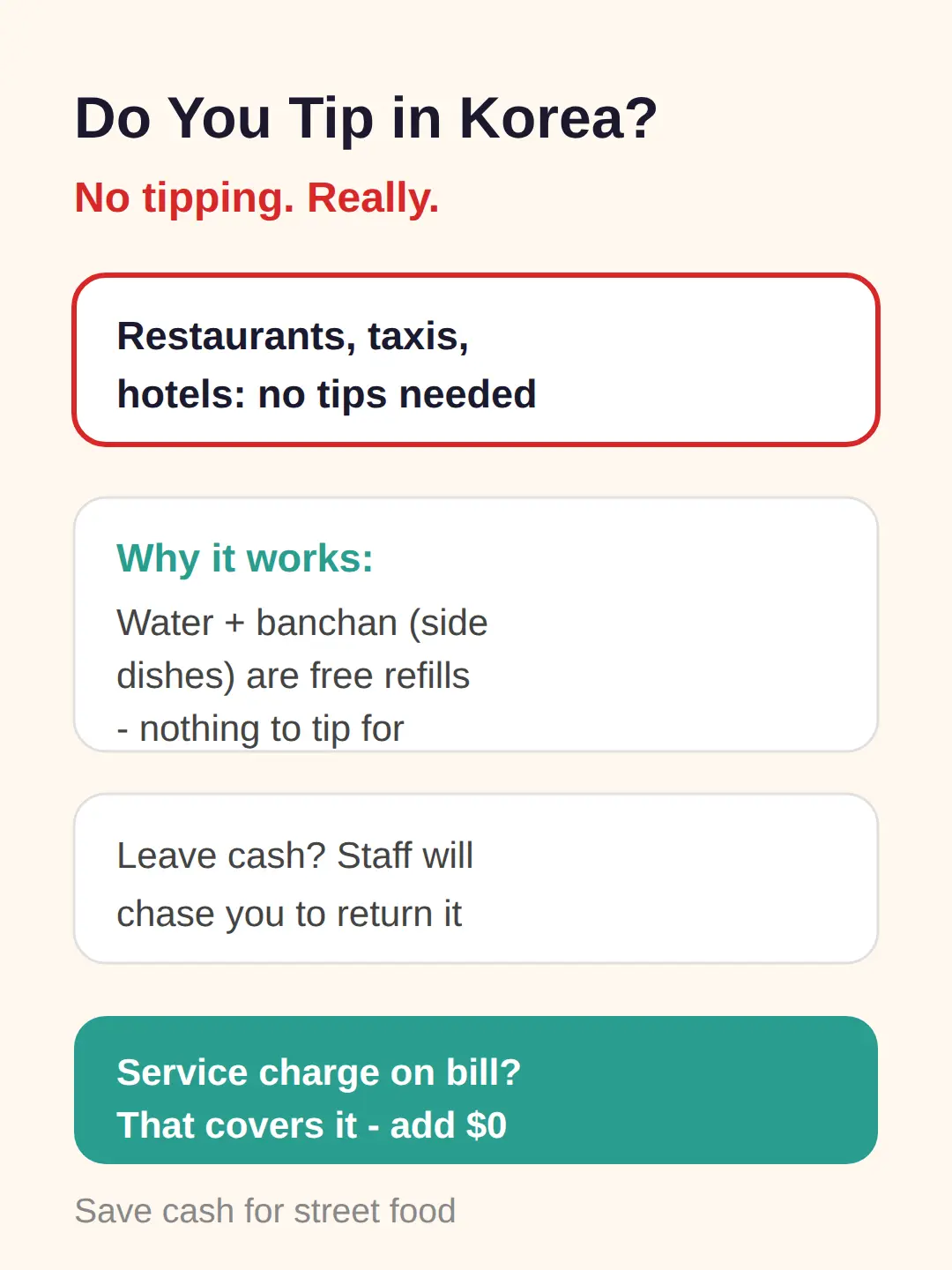
No — there is no tipping in Korea, and restaurants, taxis and hotels do not expect tips.
Two things prove this is the rule, not politeness.
Water and side dishes (banchan) are free and refillable at Korean restaurants, so there is nothing to reward with extra money.
And if you leave cash on the table, staff will chase you down the street to return it.
If a bill already shows a service charge, that line covers it — add nothing.
Keep the money for markets and street food instead, which is where your cash is actually needed (see the next section).
How Much Cash Do You Need in Korea?
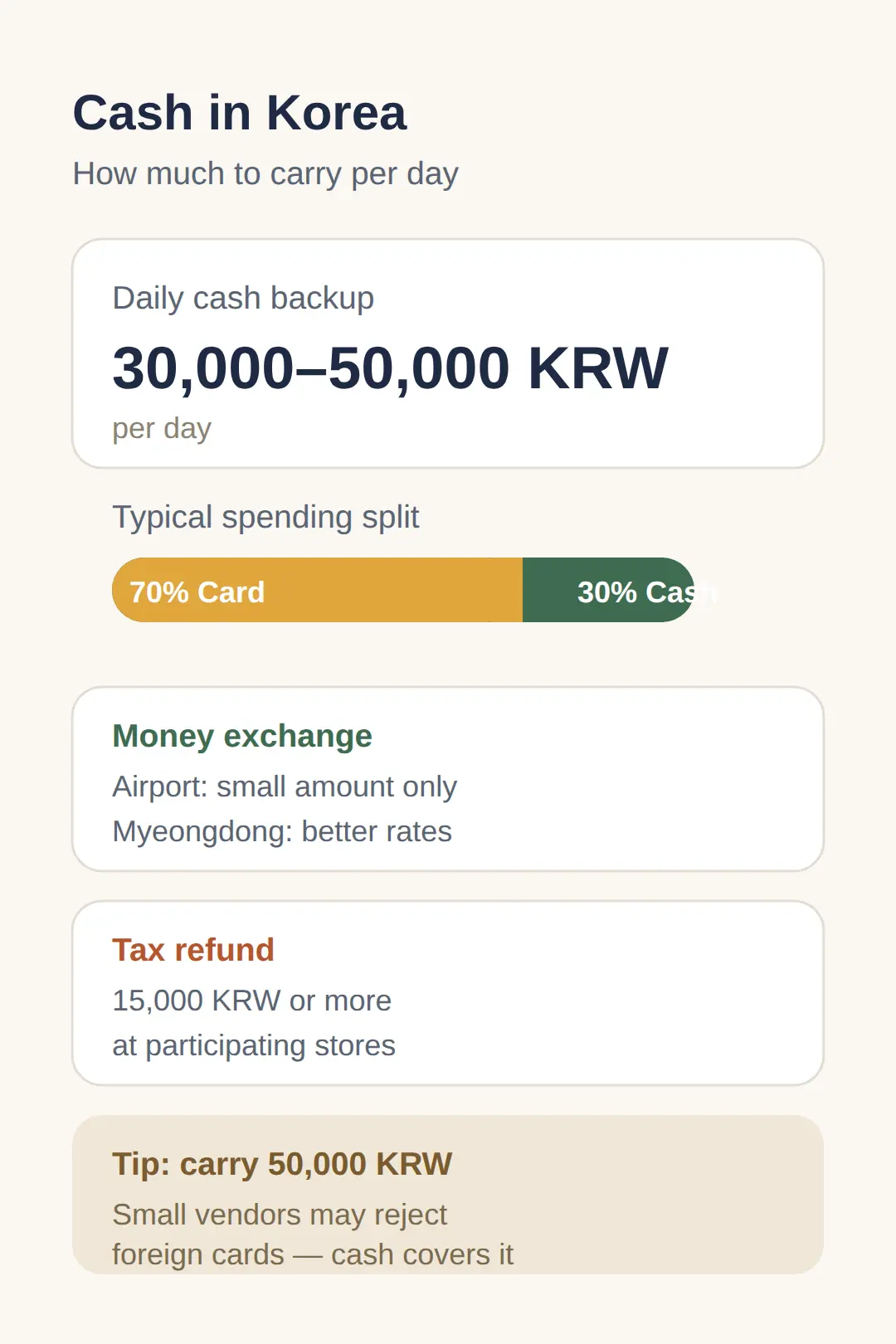
Carry 30,000–50,000 KRW cash per day as backup — a workable split for a typical visitor’s spending is about 70% card and 30% cash.
Foreign Visa and Mastercard cards work widely at stores, but small vendors and traditional markets often reject foreign cards, and that is exactly the failure case the daily cash covers.
On exchange, 2026 guides generally advise changing only a small amount at Incheon Airport and doing the rest at Myeongdong or other Seoul money changers, which are widely reported to give better rates — though no 2026 primary rate comparison confirms the size of the gap.
Purchases of 15,000 KRW or more at participating stores qualify for a tax refund, with instant refund counters in Myeongdong and kiosks at Incheon.
If I were landing tomorrow I would carry 50,000 KRW rather than 30,000, because traditional markets and small vendors are exactly where foreign cards fail, and the whole point of the cash is those moments.
T-money vs WOWPASS: Which Card Should a First-Timer Buy?
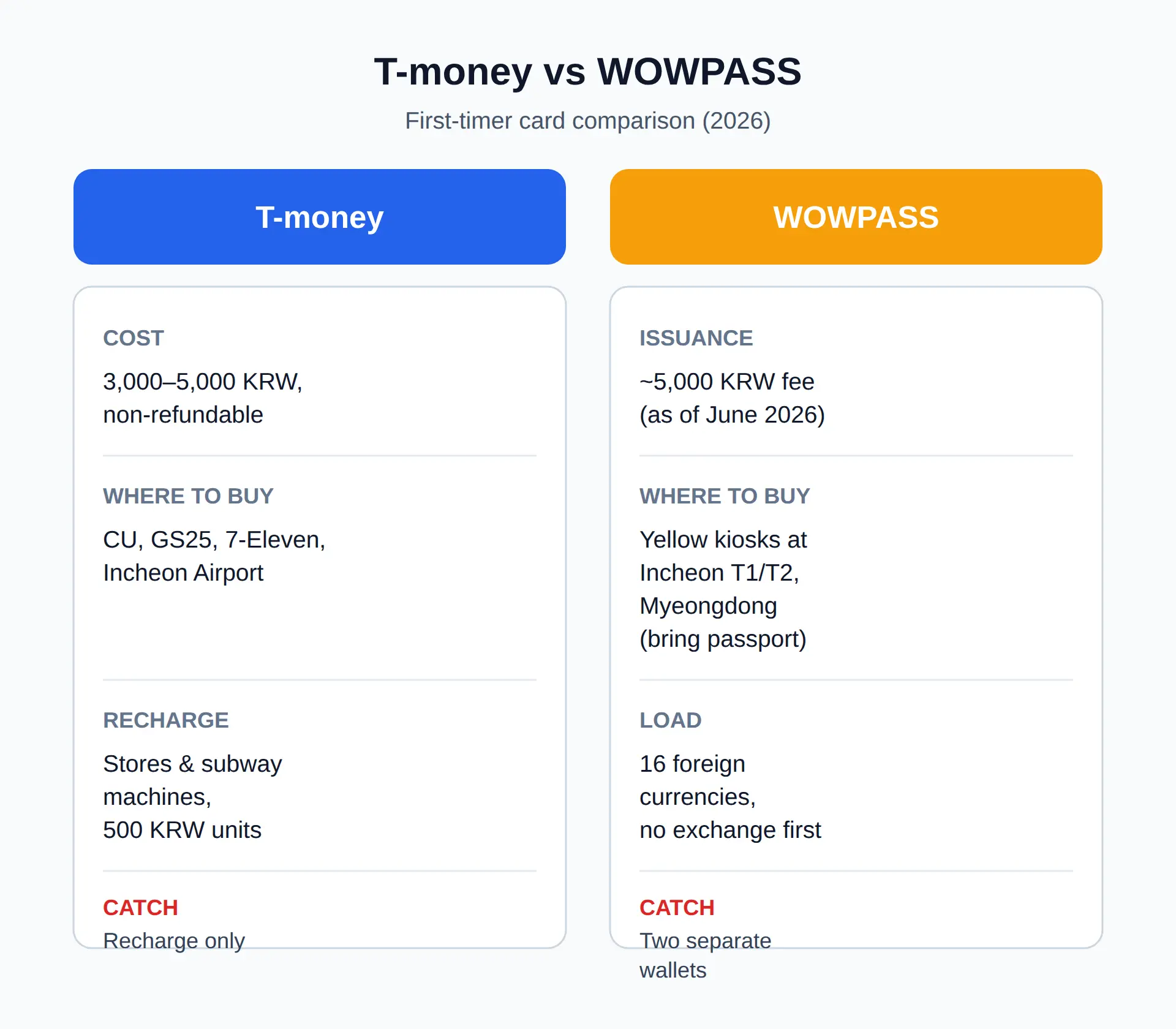
Buy T-money if you just want transit and simple top-ups; buy WOWPASS if you want to load foreign currency without exchanging it first.
Both cards work on the subway and bus, and you tap on and off with one card per person.
| T-money | WOWPASS | |
|---|---|---|
| Card cost | 3,000–5,000 KRW, non-refundable (2026 guides — not confirmed on the official T-money page) | About 5,000 KRW issuance fee (as of June 2026) |
| Where to get it | CU, GS25, 7-Eleven, Incheon Airport | Yellow kiosks at Incheon Airport T1/T2 and Myeongdong, with passport |
| Recharge | Convenience stores and subway machines, in 500 KRW units (secondary sources) | Loadable in 16 foreign currencies without exchange |
| One catch | Recharge only | Shopping balance and T-money balance are separate wallets |
If your days are subway-and-convenience-store heavy, T-money is the simpler card.
If you want to skip exchange counters entirely and pay shops from a foreign-currency balance, WOWPASS earns its kiosk queue — just remember the two balances do not mix.
Getting Around: Subway Fares, AREX, KTX and Taxi Apps
The Seoul subway base fare is 1,400 KRW for adults within 10 km, and the airport express from Incheon to Seoul Station is listed by 2026 guides at about 13,000 KRW — roughly 9.3 times the subway base fare.
| Route | Fare | Notes |
|---|---|---|
| Seoul subway (base) | 1,400 KRW | Adult, within 10 km |
| AREX express, Incheon ↔ Seoul Station | About 13,000 KRW | All-stop train cheaper |
| KTX Seoul–Busan | From 59,800 KRW | About 2.5 hours — 46,800 KRW more than the airport express |
| Seoul regular taxi | From about 4,800 KRW | Night surcharge after midnight (exact rate not verified) |
These fares come from 2026 secondary guides, not official Seoul Metro, AREX or Korail pages — treat them as close, not exact, and recheck on Naver Map for your own route.
Apps to install: Naver Map for navigation, Kakao Metro for subway routes, and Kakao T or k.ride for taxis — Kakao T works with a foreign phone number if you select ‘Pay the driver directly’, and k.ride is the foreigner-only taxi app with foreign-card payment.
The subway runs roughly 05:30–24:00, so do not plan to rely on trains after midnight — taxis take over.
Before You Fly: Apps, eSIM, Emergency Numbers and Daily Budget
Set these up before boarding, because two of them will not work on arrival:
- Install Naver Map and Papago — Google Maps does not give walking or driving directions in Korea, so without Naver Map you will be standing on a corner with no route.
- Buy a prepaid tourist eSIM or SIM online, or get one at Incheon Airport — guides put unlimited-data plans at roughly 5,000–10,000 KRW per day, and pricing varies by vendor.
- Install KakaoTalk (messaging) and Kakao T or k.ride (taxis).
- Save 112 (police), 119 (fire and ambulance) and 1330 — the Korea Travel Hotline, with 24/7 interpretation, is the first number to keep after those two.
- Load your T-money card (or get a WOWPASS at the airport kiosks) at Incheon before heading into the city.
Budget planners can anchor on about 60,000 KRW per day for a mid-range first visit, excluding lodging — your daily cash of 30,000–50,000 KRW covers 50% to 83% of that, and the rest rides on cards.
Related posts
📎 Seoul — everything we know
📎 📅 Upcoming Dates — Release & Event Calendar
Sources
- C-3-9 visa / K-ETA rules, ~60,000 KRW daily budget (travlists.com)
- 20-FAQ guide: no tipping, cash 30,000–50,000 KRW, subway 1,4 (visit-korea-guide.tistory.com)
- Payment pain point for foreigners (github.com)
Dates to Put on Your Calendar
- Check whether your nationality needs K-ETA before booking flights — the temporary exemption list changes
- Confirm your passport’s visa-free limit (90 days is the most common, but it varies by country)
- Install Naver Map, Kakao T and Papago before landing
- Write down 112 (police), 119 (fire/ambulance) and 1330 (travel hotline with interpretation)
FAQ
Q. Do I need a visa for Korea as a US citizen?
No — US passport holders enter visa-free for tourism for up to 90 days. Whether you also need a K-ETA depends on the current exemption list, so check k-eta.go.kr before booking.
Q. Do you tip in Korea?
No. Restaurants, taxis and hotels do not expect tips, and staff will return money you ‘left’ on the table.
Q. How much cash should I bring to Korea?
30,000–50,000 KRW per day. Cards cover most stores, but traditional markets and small vendors often reject foreign cards.
Q. T-money vs WOWPASS — which one should a first-timer buy?
T-money for simple transit and recharges; WOWPASS if you want to load foreign currency and skip exchange counters. Both work on subway and bus.
Q. How much is the subway in Seoul in 2026?
The base fare is 1,400 KRW for adults within 10 km (2026 guides — recheck on Naver Map or the Seoul Metro page for your route).
Two things to verify before you book: your nationality’s K-ETA status at k-eta.go.kr, and current fares on the official Seoul Metro, AREX or Korail pages — every fare in this guide comes from 2026 secondary guides.
Cover photo: Seoul-metro-412-Chang-dong-station-platform-20181126-120822 by LERK — CC BY-SA 4.0
#firsttimeinkorea #koreatraveltips2026 #k-eta #t-money #wowpass #koreatipping #seoulsubwayfare
📅Upcoming Schedule — this week 23 · D-1 Autumn season = post-summer brightening demand window (UV drSee all →