No — Korean food is not all spicy: the everyday chili base, gochugaru, measures only about 4,000–10,000 Scoville units, milder than cayenne, and regular Shin Ramyun sits at roughly 3,400 SHU, about jalapeño level.
That means most everyday dishes are closer to a mild salsa than to Thai or Sichuan heat, and Buldak 2X (~8,700–10,000 SHU) is the extreme outlier, not the norm.
This post gives Scoville numbers dish by dish, explains why Shin Ramyun got twice as hot since 1986, and lists what a first-timer can order without burning.
Contents
- Is Korean Food Spicy Hot? The Short Answer
- Korean Food Spice Levels in Scoville Units, Dish by Dish
- How Spicy Is Shin Ramyun, and Is It Spicier Than Before?
- Is Buldak Dangerous for Beginners?
- How Did Koreans Get Used to Spicy Food?
- What to Order at a Korean Restaurant If You Can’t Eat Spicy
Is Korean Food Spicy Hot? The Short Answer
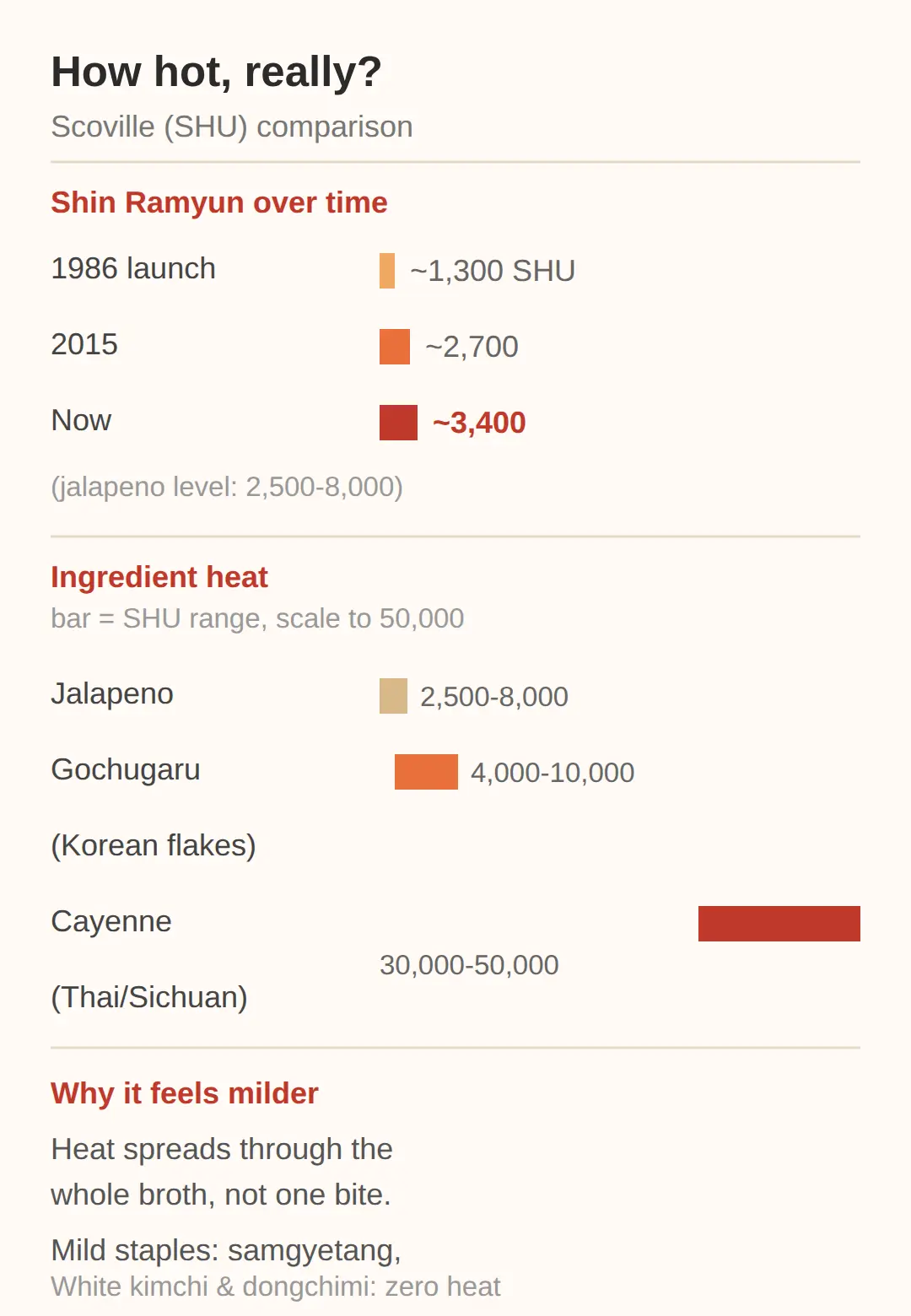
Everyday Korean spice starts from gochugaru, the Korean red pepper flakes used in kimchi and most stews, and gochugaru itself is only about 4,000–10,000 SHU — milder than the cayenne (30,000–50,000 SHU) used in Thai or Sichuan cooking.
The heat in Korean food is spread through the dish rather than packed into one bite: Shin Ramyun’s heat model, built in the 1980s, minces chili, garlic, ginger and pepper into the broth itself, and that template shapes most Korean soups and stews.
There is also a long list of staples with no chili heat at all — samgyetang (ginseng chicken soup), doenjang jjigae (soybean-paste stew), gimbap, bulgogi, seolleongtang (ox-bone soup).
Kimchi works the same way for a cautious eater: its capsaicin sits in the gochugaru coating on the leaf surface, so rinsing takes most of it off, and white kimchi (baek kimchi) and water kimchi (dongchimi) are zero-heat versions that appear at most restaurants.
Treat Buldak and ‘spicy challenge’ clips as the extreme end of the scale, not the everyday reference point.
| Tteokbokki (snack-stall style) | ~1,000–2,000 (approximate) |
|---|---|
| Shin Ramyun Black | ~2,829 |
| Regular Shin Ramyun (today) | ~3,400 |
| Buldak Carbonara | 3,861 |
| Jalapeño pepper (comparison) | 2,500–8,000 |
| Buldak original | 4,404 |
| Buldak 2X Spicy | ~8,707 (Samyang FAQ, as cited in Korean press) |
Korean Food Spice Levels in Scoville Units, Dish by Dish
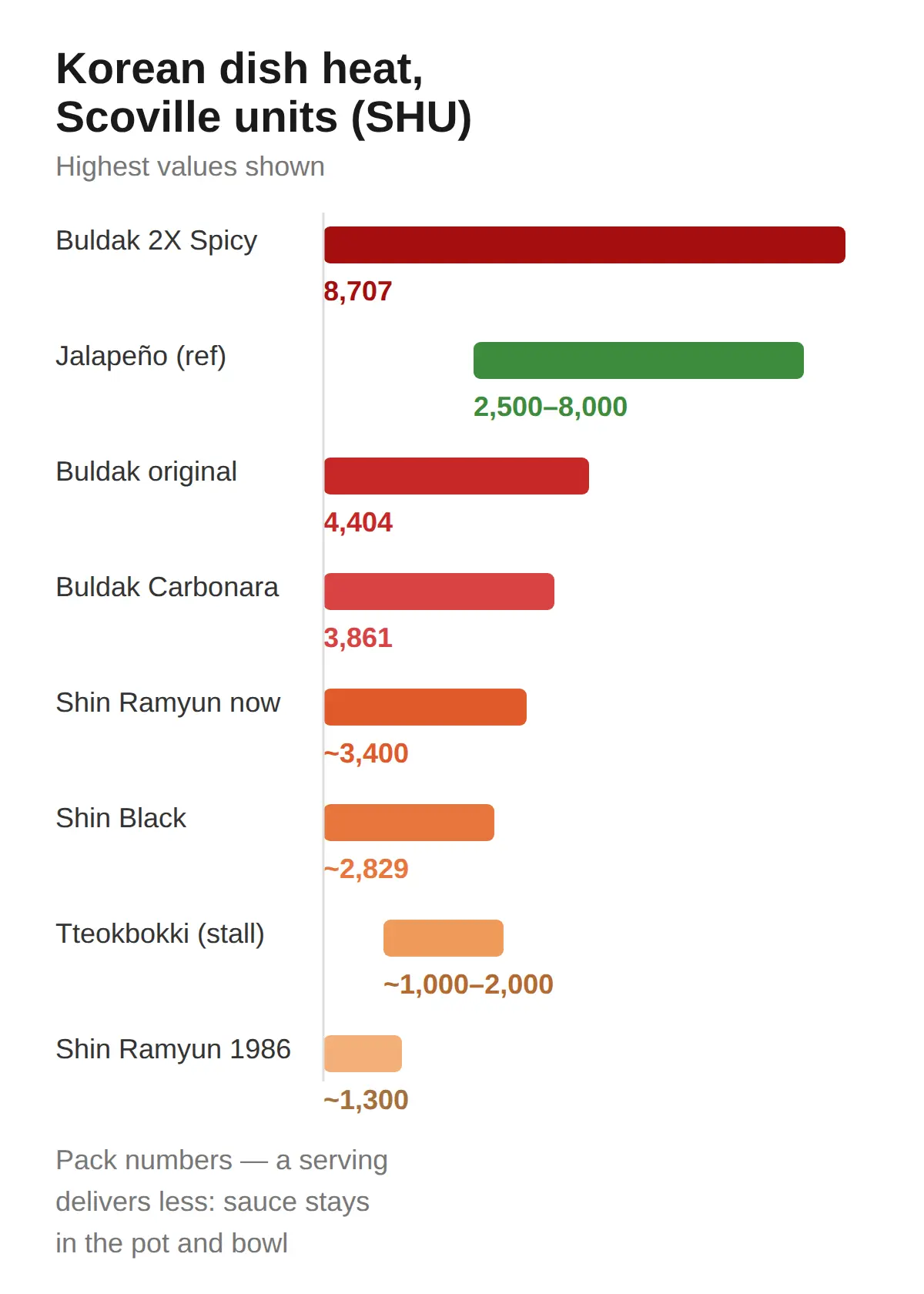
The reliable numbers run from roughly 1,000–2,000 SHU for snack-stall tteokbokki up to 8,707 SHU for Buldak 2X Spicy, against a jalapeño’s 2,500–8,000 and pure capsaicin’s 16,000,000 ceiling.
| Dish | Scoville (SHU) |
|---|---|
| Tteokbokki (snack stall) | ~1,000–2,000 (secondary estimate) |
| Shin Ramyun at 1986 launch | ~1,300 |
| Shin Ramyun Black | ~2,829 |
| Jalapeño pepper (reference) | 2,500–8,000 |
| Shin Ramyun today | ~3,400 |
| Buldak Carbonara | 3,861 |
| Buldak original | 4,404 |
| Buldak 2X Spicy | 8,707 |
Some of these figures are stronger than others.
Samyang’s own FAQ lists original Buldak at 4,404 SHU, 2X Spicy at 8,707 and Carbonara at 3,861, while the tteokbokki range is a secondary estimate and no official figure exists for restaurant dishes such as kimchi jjigae or maeun-tang — heat in those varies freely by restaurant, so skip any single number you see for them.
Use the table to place a dish before you order, and remember a normal serving delivers far less capsaicin than the pack number, because sauce stays in the pot and bowl.
When I judge how spicy something is, the first thing I check is whether the figure is per-pack or per-bite — that difference is where most of the fear comes from.
How Spicy Is Shin Ramyun, and Is It Spicier Than Before?
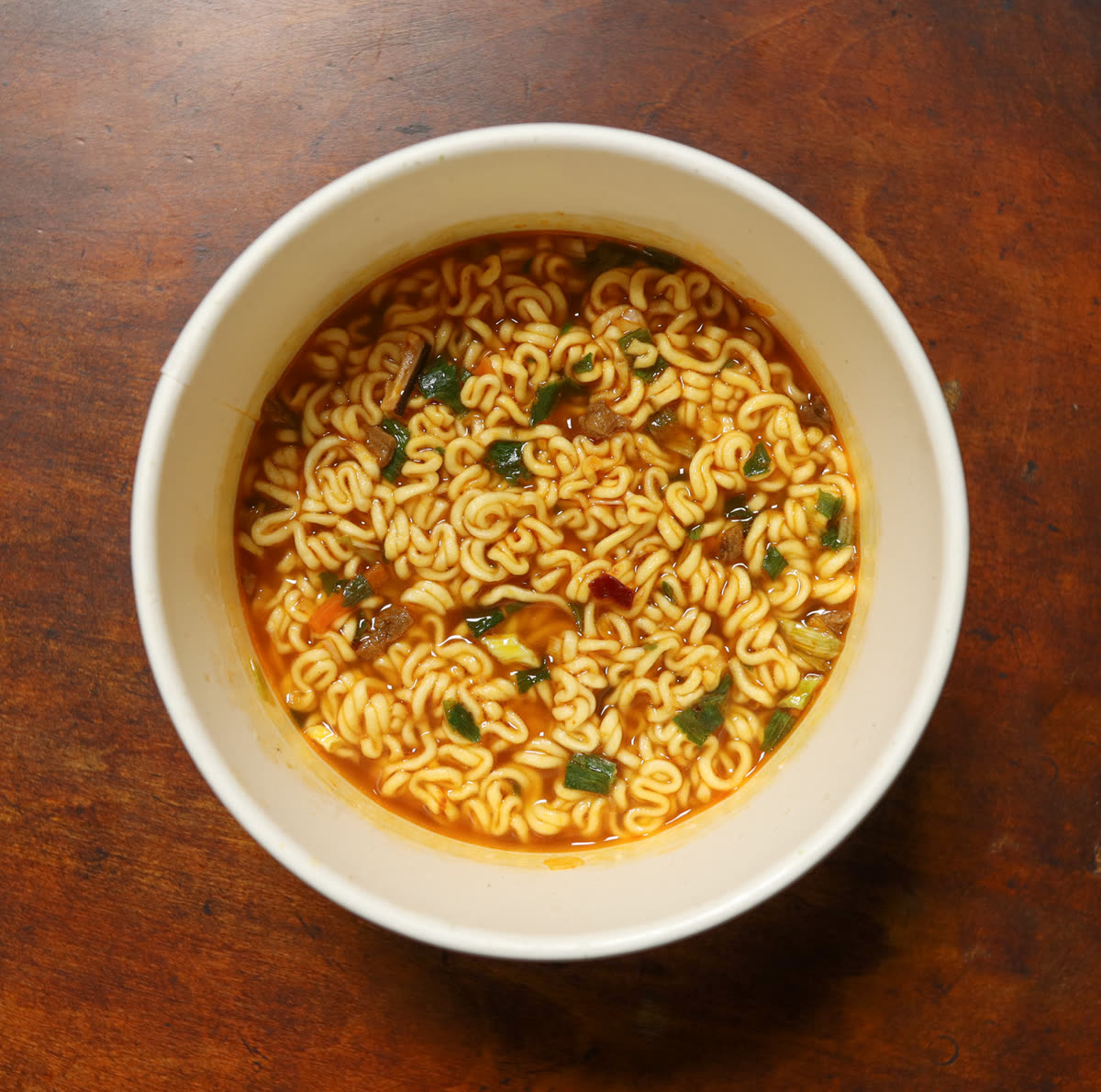
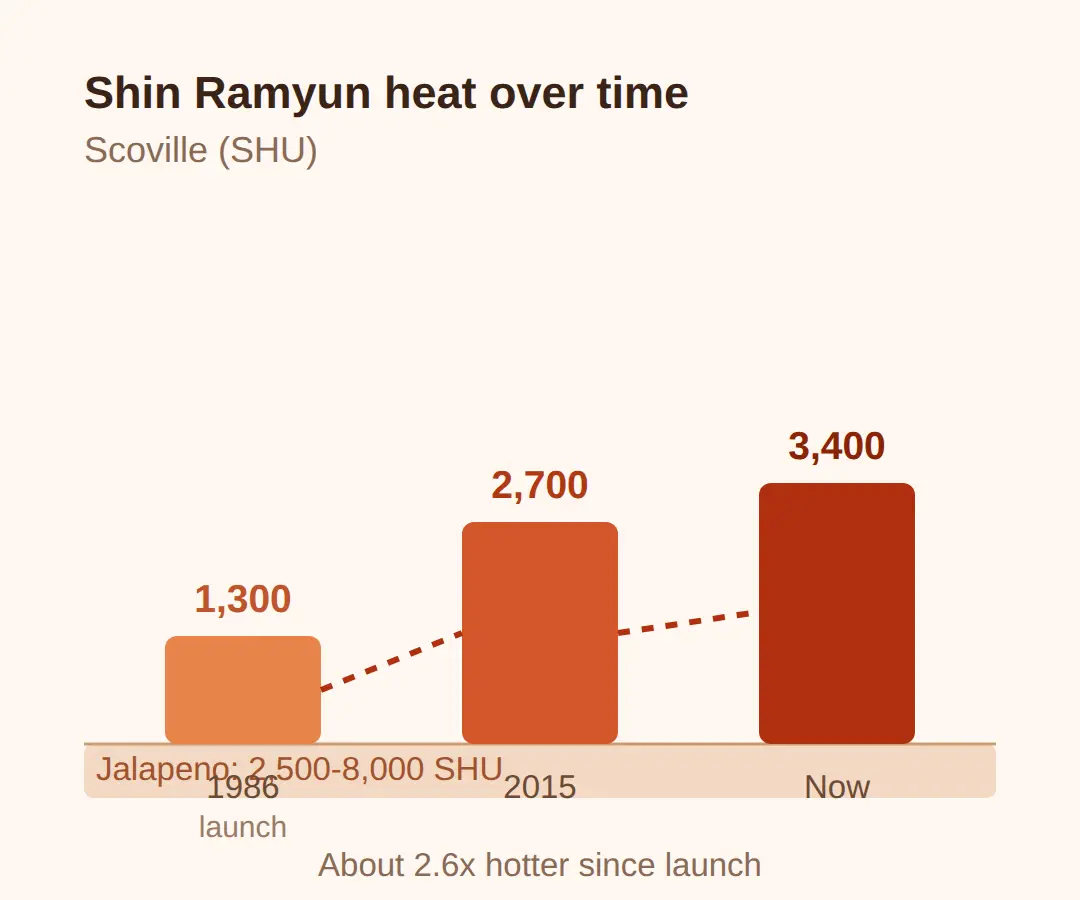
Yes — Shin Ramyun measured about 1,300 SHU at its 1986 launch but stands at about 3,400 SHU now, roughly 2.6 times hotter, or jalapeño level on the Scoville scale.
It climbed in steps: about 2,700 SHU by 2015, then about 3,400 today, as consumer tolerance grew alongside spicier products like Buldak and Yeopgi Tteokbokki.
Nongshim built the original heat model at its 1980s Ansung factory by testing more than 200 noodle types and tasting broth twenty times a day, and it does not publish an official SHU figure, saying the heat comes from garlic, ginger and pepper in a broth base, not chili powder alone.
It has been Korea’s No.1 instant noodle since 1991, with 383.6 billion won in retail sales in 2024.
If regular Shin Ramyun sounds too much, the same line-up already has milder answers: Black rates about 2,829 SHU, and Tomba, a cream-and-cheese variant, sold 25 million packs in four months because dairy softens the burn.
Is Buldak Dangerous for Beginners?
Buldak is the extreme end of Korean spice, and Denmark’s food agency (DVFA) briefly treated it as a health risk — then reversed most of the recall.
| When | What happened |
|---|---|
| 2012 | Buldak launches |
| June 2024 | Denmark’s DVFA recalls 3 Buldak stir-fried noodle products over capsaicin levels, citing risk when eaten as a ‘spicy challenge’ rather than a normal meal |
| Within a month | DVFA reverses 2 of the 3 recalls after Korea’s food ministry showed the sauce stays in the pot and bowl, so real intake per meal is far lower |
| July 12, 2025 | Buldak 2X Spicy and Buldak Stew type return to Danish shelves |
| Mid-2025 | Cumulative sales pass 8 billion units since launch, exported to 100+ countries |
The scale is real either way — over 8 billion packs sold since the 2012 launch, exported to more than 100 countries.
The safer route in is the table sauce: Buldak sauce is sold separately in more than 50 countries, so you can keep a mild base and add the heat on the side instead of committing to 2X in one bowl.
How Did Koreans Get Used to Spicy Food?
Korean spice tolerance was trained, not born — Shin Ramyun’s heat quietly doubled from 1,300 to about 3,400 SHU over forty years while it stayed the national default meal.
That means a local’s ‘this is barely spicy’ is calibrated to a scale you have not lived on, so copying a Korean friend’s order is the fastest way to a bad first meal.
The same adjustment is visible inside Korea’s imported spice: maratang chains have cut the numbing Sichuan peppercorn and shifted toward a gochujang-based, Shin-Ramyun-style broth, and one September 2026 report put overseas Google Trends growth for a Korean food term at +5,000% — a sign of how many first-timers are researching before their first bite.
Order like your own tongue, not the table’s, and treat local spice talk as a start line one ladder above yours.
What to Order at a Korean Restaurant If You Can’t Eat Spicy
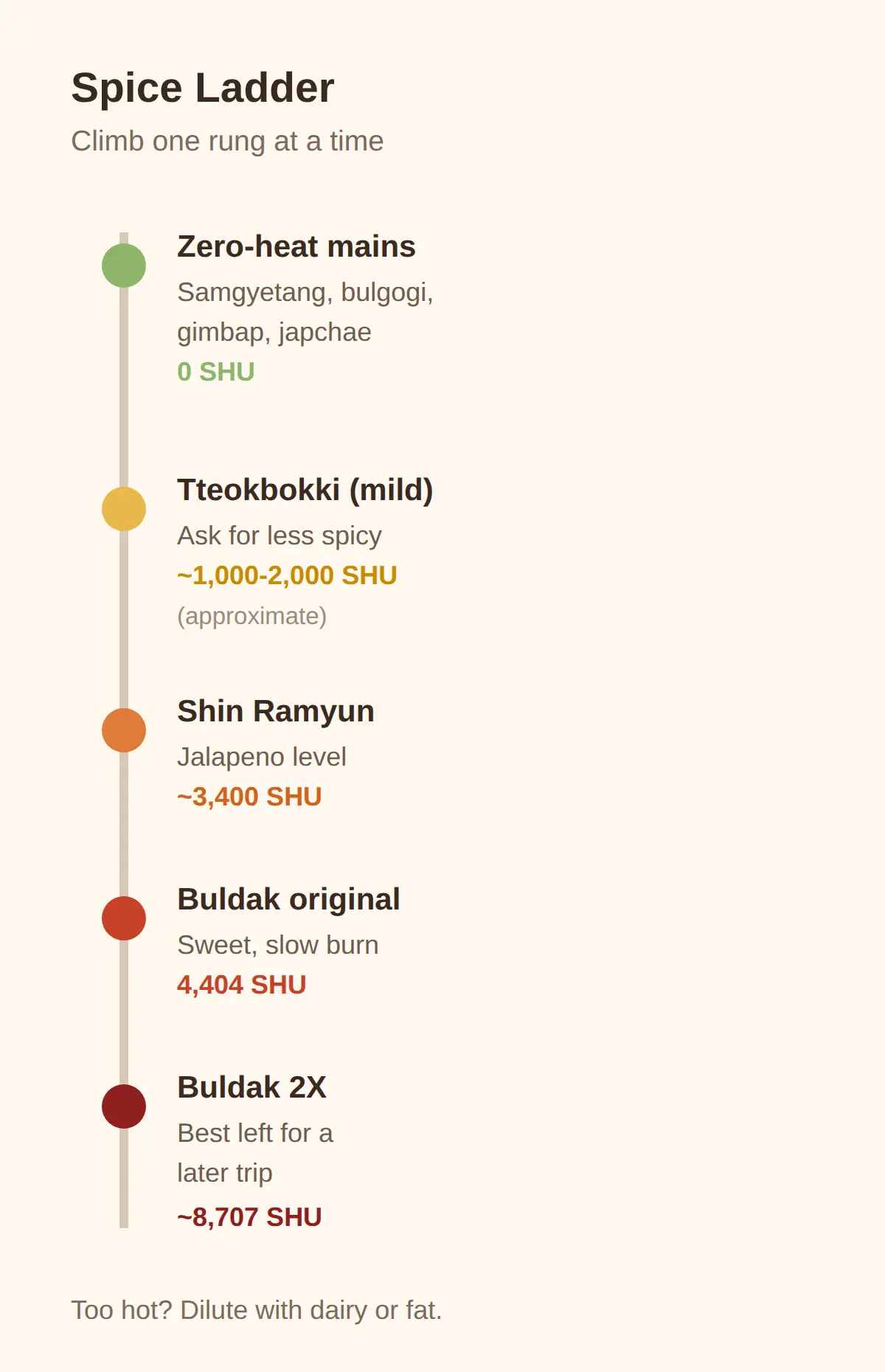
Start from a no-chili staple, then climb — the ladder runs tteokbokki (roughly 1,000–2,000 SHU, an approximate figure) → Shin Ramyun (~3,400) → original Buldak (4,404), with Buldak 2X (~8,707) best left for a later trip.
- Pick a zero-heat main: samgyetang, doenjang jjigae, bulgogi, gimbap, japchae or seolleongtang.
- Treat kimchi as optional — rinse it, or ask for white kimchi (baek kimchi) or water kimchi (dongchimi), which have no chili heat.
- Ask for ‘less spicy’ at the counter; spice-level selection (mild to hot, often 1–5 steps) is standard practice at tteokbokki and maratang chains, though no specific chain policy has been verified for this post.
- Move up one rung at a time, and remember the two heat types: gochujang gives a sweet, slow burn, while mala adds a numbing feel — Korean maratang is milder than the Sichuan original because the numbing peppercorn is reduced here.
- Dilute with dairy or fat if a dish is too hot — cream variants like Shin Ramyun Tomba exist for exactly that reason.
If you are ordering once and want zero risk, stop at step 2; if you want to build up before a trip, work the ladder over a few weeks and let the tteokbokki step tell you whether Shin Ramyun is worth it.
If I were eating Korean food for the first time, I’d climb the ladder in exactly this order, because the zero-heat mains and adjustable kimchi cost you nothing while the tteokbokki rung tells you your real tolerance before you commit to a 4,404 SHU pack.
Related posts
Sources
- SHU ladder and mild-dish guidance from existing facts; no ne (v.daum.net)
- Recall lifted for 2 of 3 products, sales resumed 2025-07-12 (joongang.co.kr)
- 8 billion units by mid-2025, 100+ countries (g-enews.com)
What to Remember Before You Order
- Use gochugaru (4,000–10,000 SHU) and Shin Ramyun (~3,400) as your everyday reference, not Buldak.
- Check whether a spice number is per-pack or per-bite — sauce left in the pot cuts real heat a lot.
- Zero-heat staples exist everywhere: samgyetang, doenjang jjigae, gimbap, bulgogi, seolleongtang.
- Say ‘less spicy’ at tteokbokki and maratang counters — level selection is standard there.
- Add heat with Buldak sauce on the side instead of ordering 2X in the bowl.
FAQ
Q. Is Korean food spicy hot for beginners?
Mostly no. Everyday heat comes from gochugaru at about 4,000–10,000 SHU — milder than cayenne — and staples like samgyetang, doenjang jjigae and gimbap have no chili heat at all.
Q. How spicy is Shin Ramyun in Scoville units?
About 3,400 SHU now, versus about 1,300 at its 1986 launch — roughly 2.6 times hotter, and about the same level as a jalapeño (2,500–8,000 SHU). Nongshim does not publish an official figure.
Q. How much SHU is Buldak spicy chicken ramen?
Samyang’s FAQ lists original Buldak at 4,404 SHU and Buldak 2X Spicy at 8,707 SHU; the 2X figure circulates as ~8,700–10,000 in secondary sources, so treat it as approximate.
Q. What Korean dishes are not spicy?
Samgyetang (ginseng chicken soup), doenjang jjigae (soybean-paste stew), bulgogi, gimbap, japchae and seolleongtang are standard zero-chili options, plus white kimchi and water kimchi on the side.
Q. Can I ask for less spice in Korean restaurants?
At tteokbokki and maratang counters, yes — choosing mild, medium or hot (often 1–5 steps) is normal practice there; whether individual BBQ restaurants offer levels was not verified.
Not sure where to start? Save the Scoville table above and work the mild-to-hot ladder on your next Korean food order.
Cover photo: Gochugaru by Stacy Spensley — CC BY 2.0
#koreanfood #spicykoreanfood #shinramyunshu #buldakscoville #koreanfoodforbeginners #tteokbokki #maratang
📅Upcoming Dates — 이번 주 32 · D-day Chuseok holiday period — rice cake interest peaks전체 보기 →