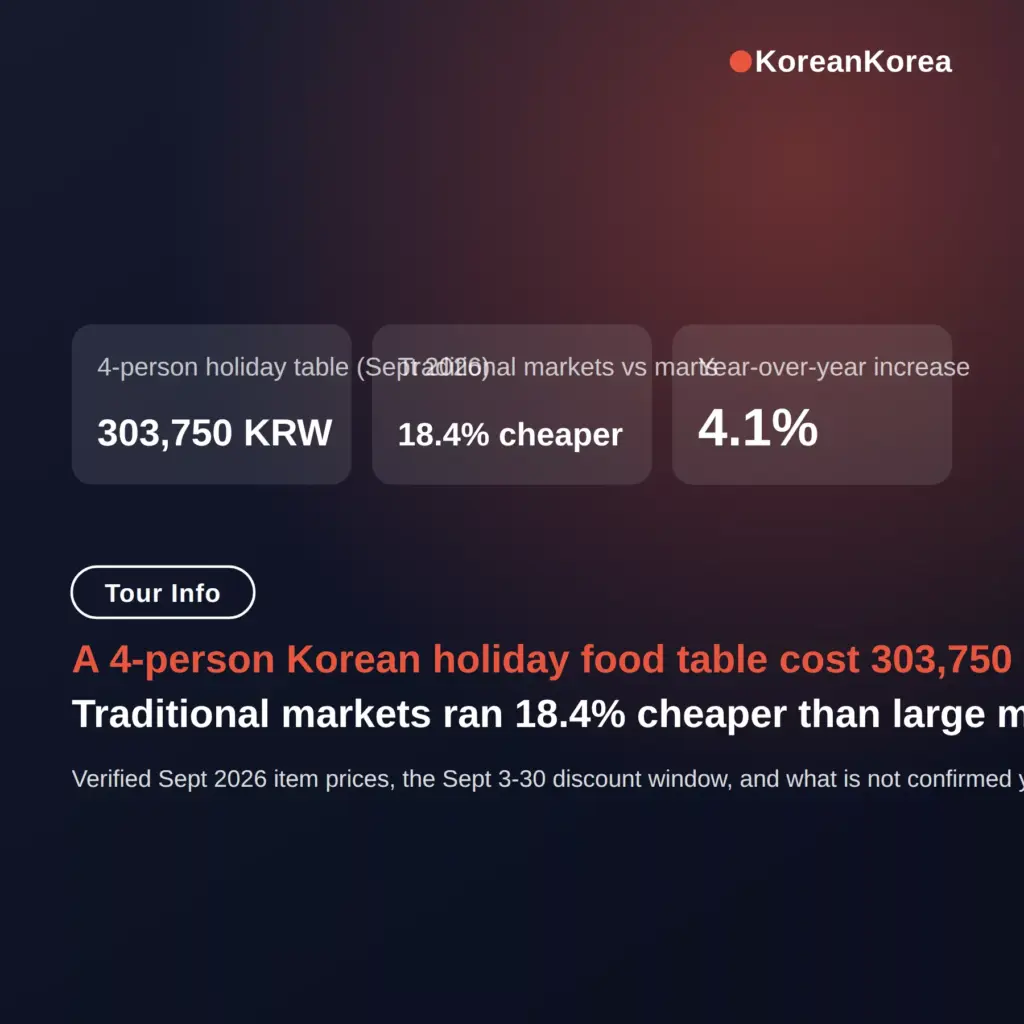
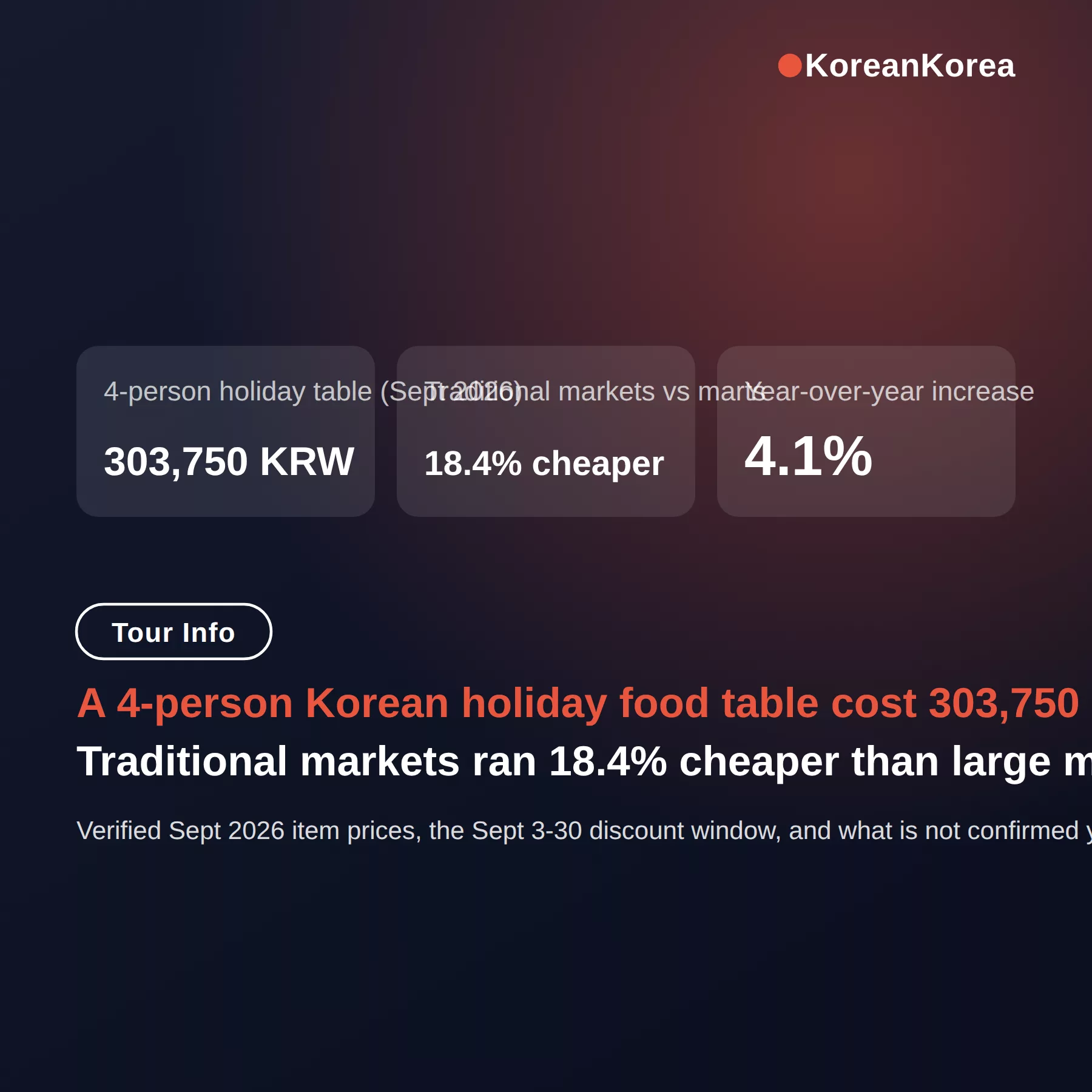
A 4-person Korean holiday food table cost 303,750 KRW at traditional markets in the Sept 2026 survey — about 76,000 KRW per person, up 4.1% from last year.
For visitors and new residents, that means food in Korea costs real money but not extreme money, and shopping at a traditional market instead of a large mart cuts the same basket by 18.4%.
This post gives the verified Sept 2026 prices item by item, the Sept 3-30 government discount window, and the numbers that could not be confirmed yet.
Contents
- Is korean food expensive in korea? What Sept 2026 prices actually say
- What a Korean grocery basket costs: Sept 2026 prices
- Are traditional markets cheaper than marts in Korea?
- Is the Korean government discounting food in Sept 2026?
- How much did Korean food prices go up?
- What this article can’t tell you yet
Is korean food expensive in korea? What Sept 2026 prices actually say
Korean food sits in the middle range for a household basket: a full 4-person holiday table came to 303,750 KRW at traditional markets in the Sept 2026 survey, which works out to about 76,000 KRW per person (303,750 ÷ 4).
That survey covered 28 items across 6 cities and was published Sept 16, 2026 by the Korea Price Research Association.
The same table was 4.1% cheaper last year, so the rise is real but single-digit.
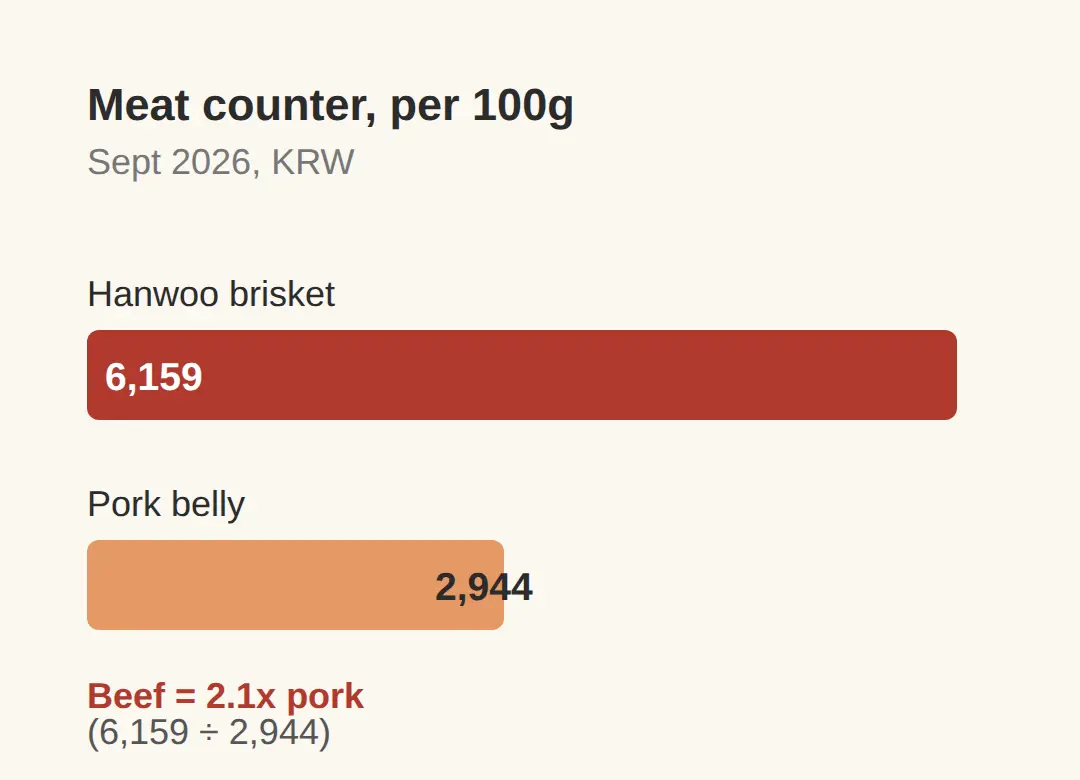
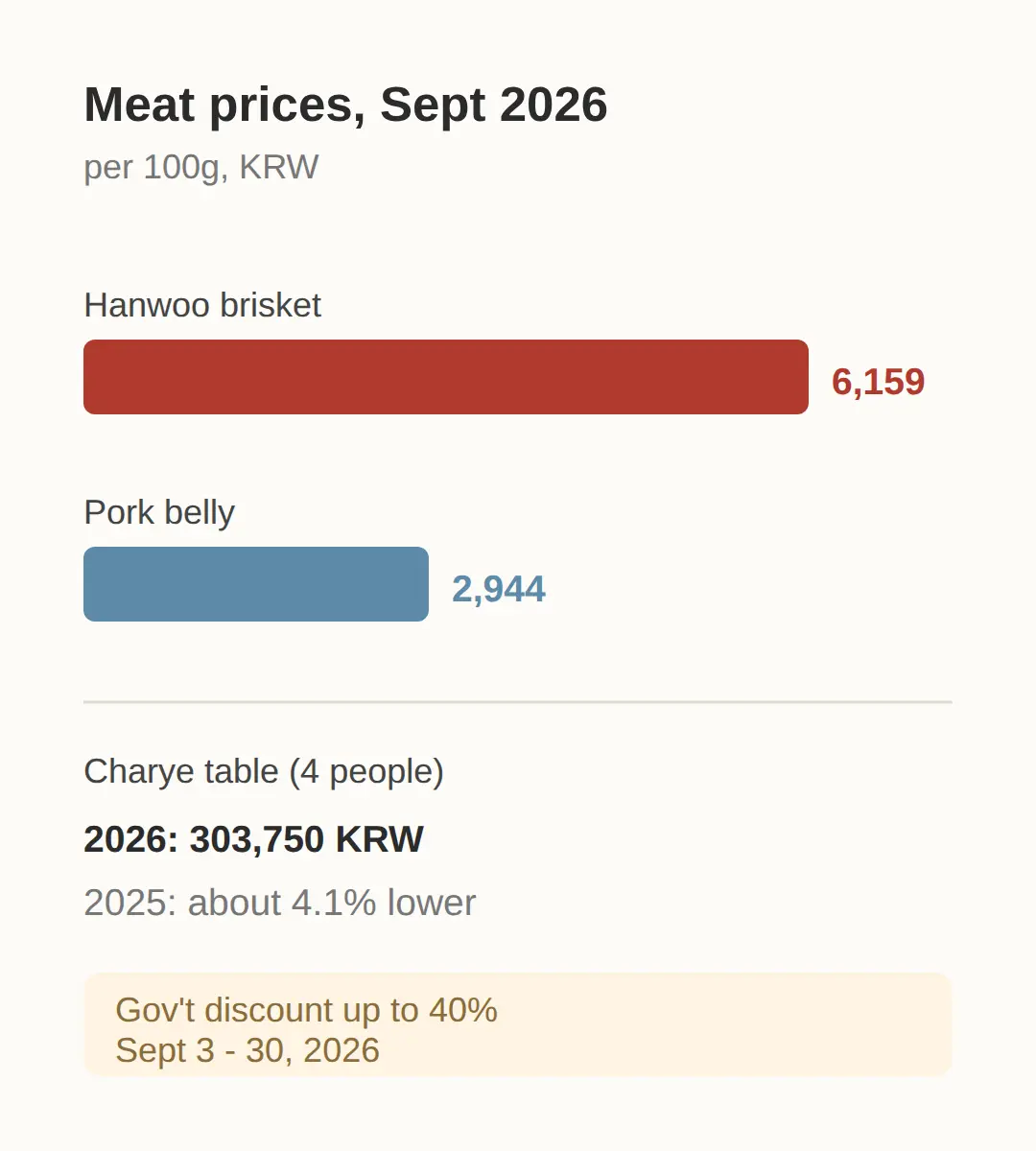
What makes the answer split is the item: a single Korean pear costs 27,300 KRW and hanwoo beef brisket runs 6,159 KRW per 100g, while pork belly is 2,944 KRW per 100g — so a table heavy on beef and fruit feels expensive, and one built on pork does not.
When I check a food price claim about Korea, I first look at where the buyer shopped, because the same item moves 18.4% between traditional markets and large marts.
| 4-person charye (holiday ancestor-rite) table, 28 items, traditional markets | 303,750 KRW (about 76,000 KRW per person) |
|---|---|
| Change from 2025 | 4.1% higher |
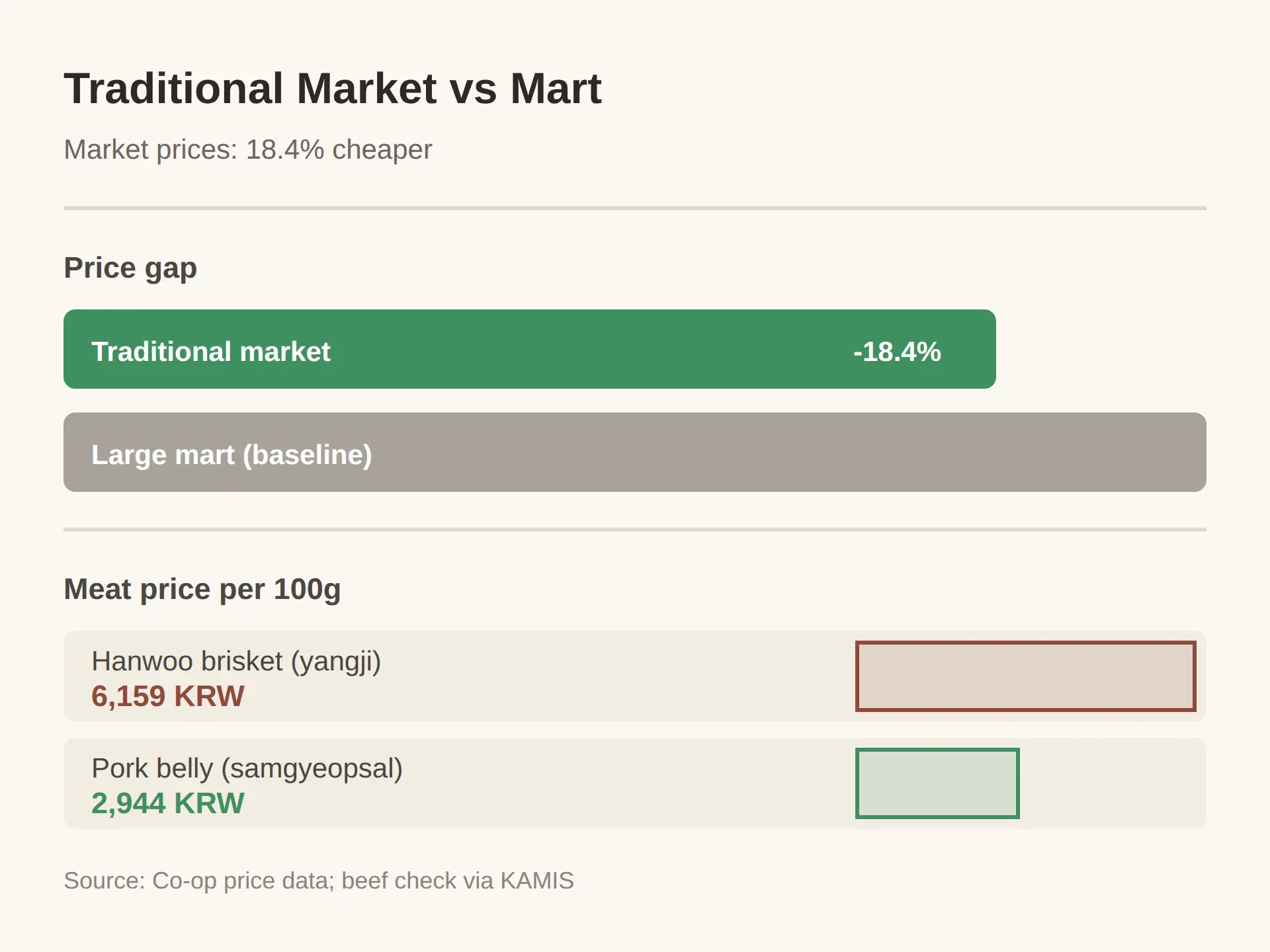
| Traditional markets vs large marts | Traditional markets 18.4% cheaper |
| Hanwoo beef brisket (yangji) | 6,159 KRW per 100g |
| Pork belly (samgyeopsal) | 2,944 KRW per 100g |
| Korean pear | 27,300 KRW per pear |
| Government discount on farm and livestock products | Up to 40% off, Sept 3-30, 2026 |
What a Korean grocery basket costs: Sept 2026 prices
The verified numbers as of Sept 16, 2026 are these four: pear 27,300 KRW each, hanwoo brisket 6,159 KRW per 100g, pork belly 2,944 KRW per 100g, and the full 4-person table at 303,750 KRW.
Table: verified Sept 2026 prices
| Item | Price | Source |
|---|---|---|
| Korean pear (1 each) | 27,300 KRW | Sept 2026 charye table survey |
| Hanwoo beef brisket, yangji (per 100g) | 6,159 KRW | Sept 2026 charye table survey |
| Pork belly, samgyeopsal (per 100g) | 2,944 KRW | Sept 2026 charye table survey |
| Full 4-person charye table (28 items) | 303,750 KRW | Korea Price Research Association, Sept 16, 2026 |
Beef costs about 2.1 times pork at the counter (6,159 ÷ 2,944), which is why pork-heavy shopping keeps a basket down.
Only these prices are broken out from the 28-item survey, so treat any other per-item figure you see elsewhere as unverified.
👉 Is Korean Food Gluten Free? Rice Cakes Are — What to Order in Korea
Are traditional markets cheaper than marts in Korea?
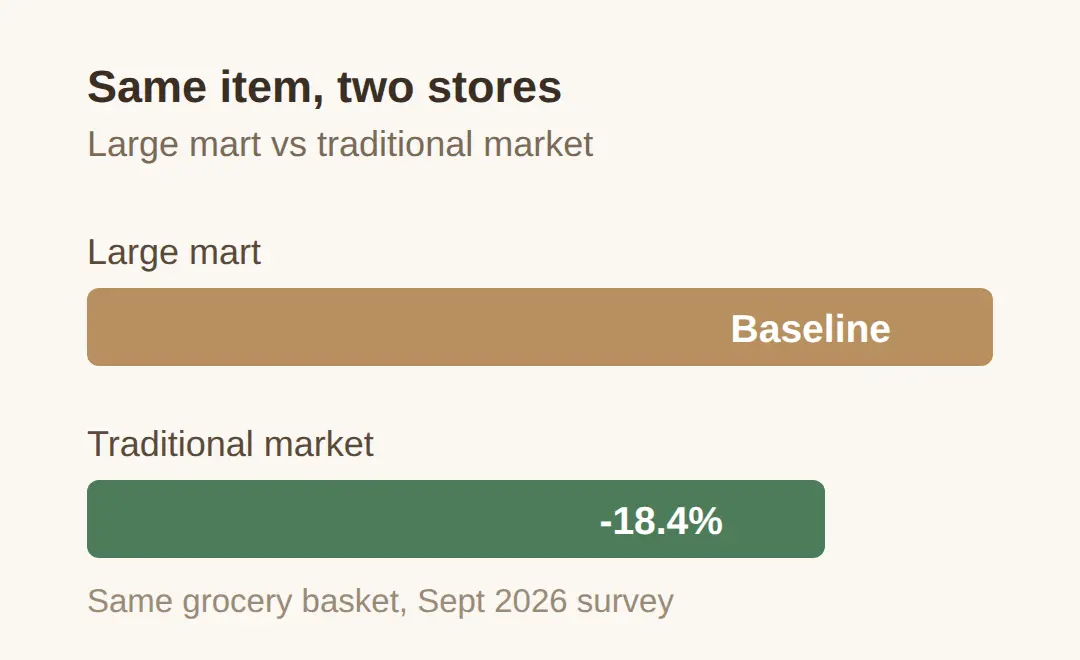
Traditional markets were 18.4% cheaper than large marts in the Soomin Consumer Forum price comparison.
The comparison comes from the Co-op’s published consumer price data for traditional markets, which is collected as a market-vitalization measure rather than a one-off check.
For hanwoo beef, the official consumer price to cross-check against is on KAMIS (Korea Agricultural Marketing Information Service), which posts daily retail prices.
If you are buying meat and produce for a group meal, the traditional market is the 18.4% cheaper route; if you need one missing item late at night, the mart premium is what you pay for it.
Is the Korean government discounting food in Sept 2026?
Yes — the government ran up to 40% discounts on agricultural and livestock products from Sept 3 to Sept 30, 2026, at participating retailers.
Alongside the discount, the government raised beef supply 1.3 times to stabilize prices, which is the measure behind the Sept 14 report on hanwoo prices.
Which retailers participate in the event was not confirmed in this run, so ask at the store or look for the event notice at the counter before assuming a discount applies.
If your trip or grocery run falls inside the Sept 3-30 window, do the meat and produce run then; outside that window, the 18.4% market-vs-mart gap is the discount you can still count on.
How much did Korean food prices go up?
The holiday table went up 4.1% from 2025 to 2026, based on the Korea Price Research Association survey of 6 cities.
The two levers visible in the Sept 2026 reporting are the government’s 1.3x beef supply increase and the Sept 3-30 discount event, both aimed at holding prices down through the holiday season.
What changed most at the item level was expensive produce and beef — a 27,300 KRW pear and 6,159 KRW-per-100g brisket are the items pushing the table total up.
If you are planning a holiday grocery budget for 2027, adding roughly 4% to this year’s 303,750 KRW table is the baseline the survey supports.
👉 Must Eats in Korea 2026: The Answer Right Now Is Tteok, Not BBQ
What this article can’t tell you yet
Several commonly quoted Korean food numbers are not verified for 2026, and this post leaves them out rather than guessing.
The ‘eggs around 3,000 KRW’ figure circulates in topic discussions but no primary source confirmed it, so do not treat it as a verified 2026 price.
Restaurant meal prices for travelers — cheap gimbap or gukbap runs — have no verified 2026 data, and street food prices at places like Myeongdong or Gwangjang Market were not found in dated 2026 sources either.
Only the pear, brisket, and pork belly prices are broken out from the 28 charye items; the rest of the table was not retrieved.
For beef, the place to watch is KAMIS’s daily consumer price page; for the discount event, the store’s own notice is the check.
If I were shopping this month, I would do the meat and produce run at a traditional market inside the Sept 3-30 window — the 18.4% market gap stacks with the up-to-40% event discount, so the same basket can swing hard.
What I check first before any grocery run is the KAMIS hanwoo price that morning, because beef is the single biggest line on the table and it moves.
Related posts
📎 Is Korean Food High in Sodium? Twice the WHO Limit, and How to Cut It
📎 Is Korean Food Sweet? The Answer Depends on the Dish, Not the Cuisine
📎 📅 다가오는 일정 — 발매·개봉·발표 캘린더
Sources
- 4-person charye table 303,750 KRW, 28 items, pear 27,300 KRW (viva100.com)
- Sept 3-30 discount event, beef supply 1.3x increase (etnews.com)
- Official daily hanwoo price tracking system (kamis.or.kr)
Dates to note for Sept 2026 Korean food prices
- Check KAMIS’s daily hanwoo consumer price page the morning you shop for beef — it is the primary source the Sept 2026 reporting points to.
- Before buying produce or meat, compare a traditional market price against the large mart: the Sept 2026 survey put traditional markets 18.4% cheaper.
- If the Sept 3-30 discount window is still open, look for the up-to-40% event tags on agricultural and livestock products at participating retailers — which stores join is not verified here, so check the store’s own notice.
- For the rest of the 28-item holiday table (fruits, fish, vegetables), the full item-by-item breakdown was not published in what we could retrieve — verify those prices in person before budgeting.
- Do not rely on the ‘eggs around 3,000 KRW’ figure floating around — no primary source confirmed it for 2026.
FAQ
Q. Is Korean food expensive for tourists in 2026?
Grocery prices are moderate and shoppable: a 4-person holiday table was 303,750 KRW (about 76,000 KRW per person) at traditional markets in Sept 2026. What is not yet verified is the per-meal restaurant cost for visitors — no dated 2026 source confirmed those numbers.
Q. How much does a Korean grocery basket cost in Sept 2026?
Verified Sept 2026 item prices: pear 27,300 KRW each, hanwoo brisket 6,159 KRW per 100g, pork belly 2,944 KRW per 100g, and a full 4-person charye table of 28 items at 303,750 KRW.
Q. Are traditional markets cheaper than marts in Korea?
Yes — traditional markets were 18.4% cheaper than large marts in the Soomin Consumer Co-op price comparison. The same 303,750 KRW-scale basket therefore changes with where you shop, not just what you buy.
Q. Is the Korean government discounting food prices in Sept 2026?
Yes — up to 40% discounts on agricultural and livestock products ran from Sept 3 to Sept 30, 2026, alongside a 1.3x beef supply increase. The participating-retailer list was not confirmed, so check the store’s own notice.
Q. How much did Korean food prices go up in 2026?
The Sept 2026 charye table survey put the 4-person table at 303,750 KRW, up 4.1% from the previous year, driven most visibly by a 27,300 KRW pear and 6,159 KRW-per-100g beef brisket.
Prices in this post are as of Sept 16, 2026.
#Koreanfoodprices #Koreatravelbudget #charyetablecost #Koreangroceryprices2026 #traditionalmarketvsmart #KAMIShanwooprice
📅Upcoming Dates — 이번 주 16 · D-day 'The Scandal' global Netflix release전체 보기 →