A traditional market was the cheapest place to buy a full Chuseok charye basket in all three 2026 surveys, with the Korea Price Information survey putting it at 302,500 KRW against 397,700 KRW at hypermarkets.
That headline number hides the real answer, though, because eggs, new-crop fruit and songpyeon were cheaper somewhere else.
This post breaks the basket down by channel so you can split your list instead of guessing.
Contents
- Korean traditional market vs mart chuseok groceries: is the market always cheaper?
- How much cheaper is a traditional market for meat, vegetables and seafood?
- What Chuseok items are cheaper at hypermarkets or online?
- Why did Chuseok charye costs fall this year?
- When should I shop, and does the Onnuri certificate discount still apply?
- Does the city I’m in change the price?
Korean traditional market vs mart chuseok groceries: is the market always cheaper?
For the full 2026 Charye basket, yes — three separate surveys put traditional markets first, but the totals they report differ because each used a different basket.
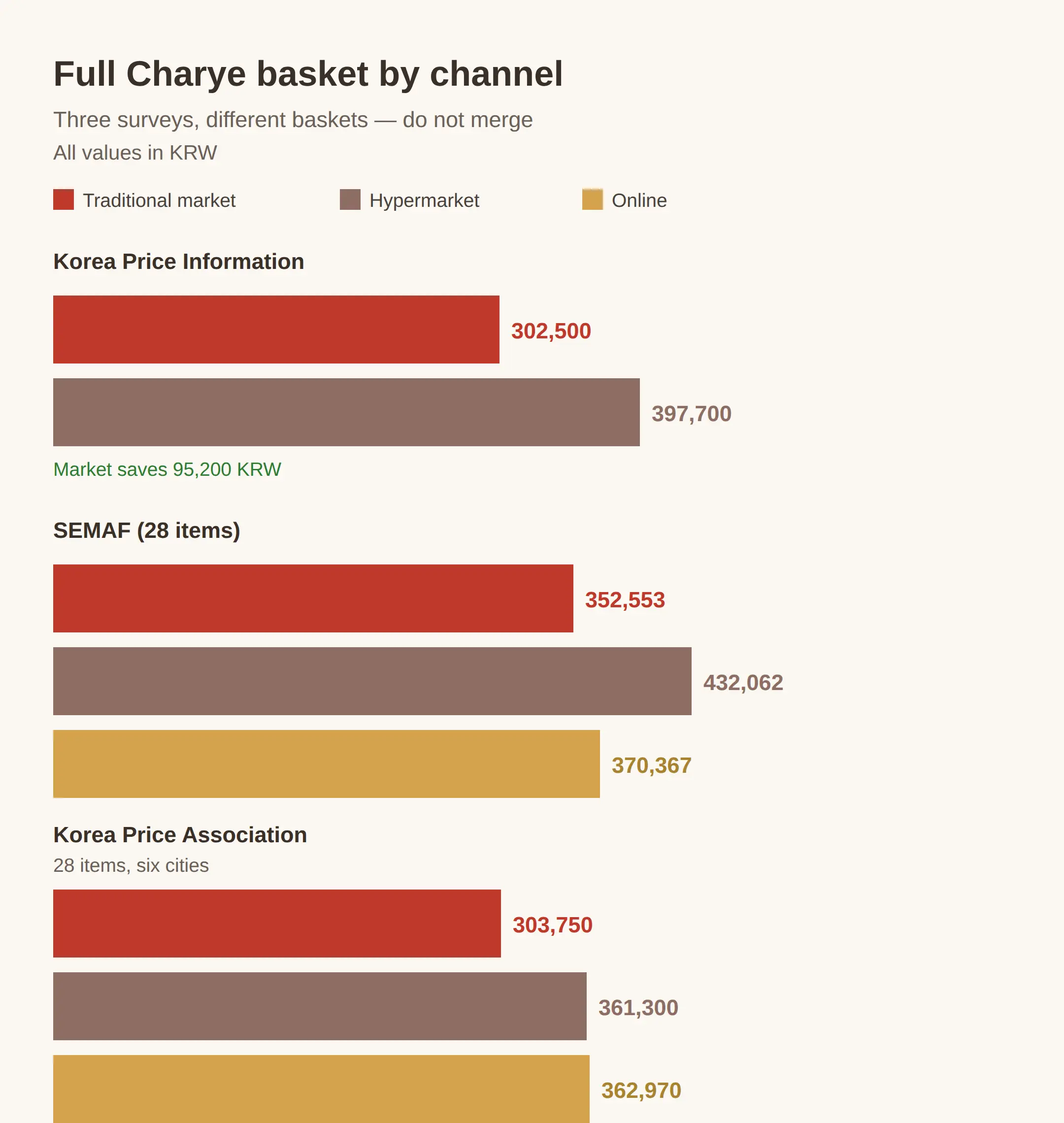
Korea Price Information surveyed the market at 302,500 KRW versus 397,700 KRW at hypermarkets, saving about 95,200 KRW.
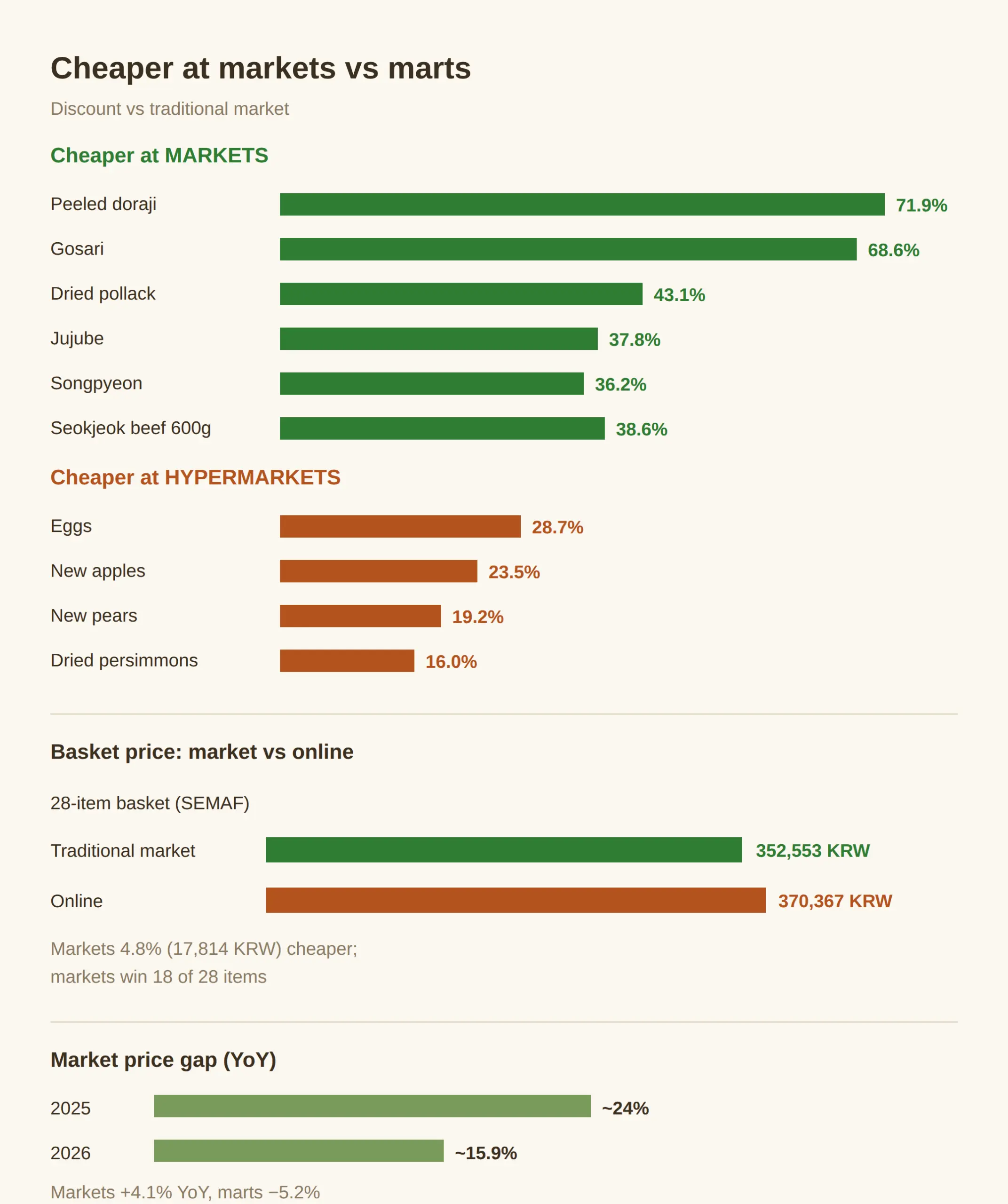
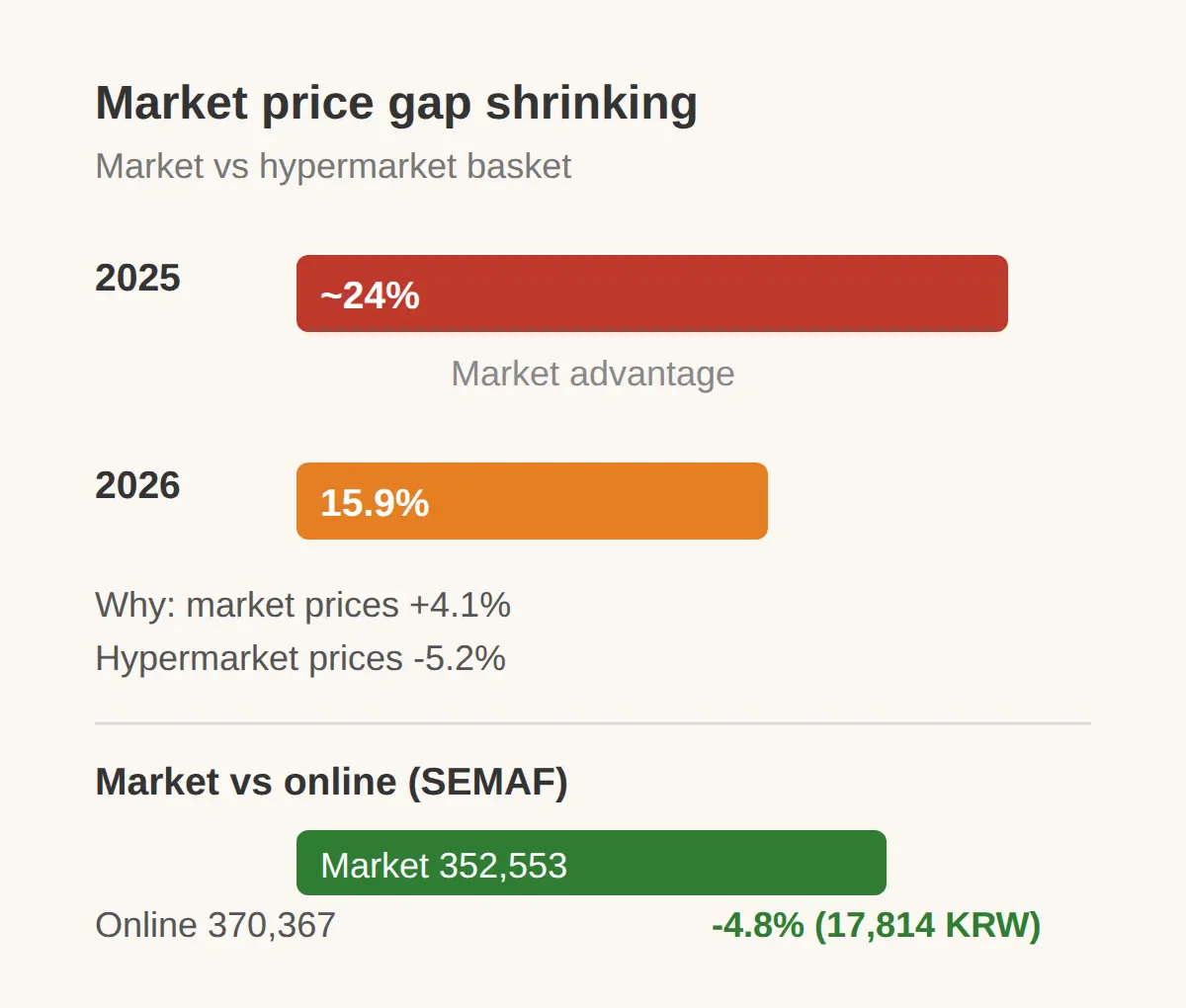
A 28-item survey by SEMAF, the small-business market agency, put it at 352,553 KRW for markets versus 432,062 KRW at hypermarkets and 370,367 KRW online.
The Korea Price Association, surveying 28 items in six cities, got 303,750 KRW at markets, 361,300 KRW at hypermarkets and 362,970 KRW online.
Do not blend these three totals into one number — each survey priced a different basket.
Before comparing channels, I check which survey a figure comes from, because market totals ranged from about 302,000 to 352,000 KRW depending on who counted.
If you plan one trip and value simplicity, the traditional market still wins.
If you can split the list, the item-level gaps below are worth more than the headline.
The average charye table for a four-person household cost 310,890 KRW across 25 items this year, down 2.3% from 320,370 KRW — the first year-over-year drop in five years, according to the Korea Consumers’ Federation survey.
| Beef, namul greens, spinach | Traditional market (beef 38.6% cheaper, vegetables up to 52.7% cheaper) |
|---|---|
| Fish and seafood | Traditional market (32.2% cheaper than hypermarkets) |
| Eggs, new apples/pears, dried persimmons | Hypermarket (eggs 28.7% cheaper) |
| Songpyeon, yakgwa, cooking oil | Online platforms (3 of 28 items) |
| Flour, tofu, cheongju (rice wine) | Hypermarket (7 of 28 items) |
| Everything in one trip | Traditional market, still — cheapest overall in all three surveys |
How much cheaper is a traditional market for meat, vegetables and seafood?
For beef and namul greens, the market gap is large enough to plan a trip around.
| Item or group | Traditional market | Hypermarket | Market advantage |
|---|---|---|---|
| Skewer beef (domestic, 600g) | 33,751 KRW | 54,948 KRW | 38.6% cheaper |
| Soup beef | — | — | 36.0% cheaper |
| Boiled gosari (400g) | 11,100 KRW | 14,688 KRW | — |
| Livestock as a group | — | — | 30.7% cheaper |
| Vegetables and forest products | — | — | 26.0% cheaper |
| Peeled doraji (SEMAF survey) | — | — | 71.9% cheaper |
| Gosari (SEMAF survey) | — | — | 68.6% cheaper |
| Dried pollack (SEMAF survey) | — | — | 43.1% cheaper |
| Jujube (SEMAF survey) | — | — | 37.8% cheaper |
| Songpyeon (SEMAF survey) | — | — | 36.2% cheaper |
| Vegetables as a group (SEMAF survey) | — | — | 52.7% cheaper |
Domestic seokjeok beef (600g, for skewers) averaged 54,948 KRW at hypermarkets versus 33,751 KRW at traditional markets — 38.6% cheaper, per the Korea Consumers’ Federation 2026 Chuseok survey.
The same survey found soup beef 36.0% cheaper at markets, boiled gosari (fernbrake, 400g) at 11,100 KRW in markets versus 14,688 KRW at hypermarkets, livestock as a group 30.7% cheaper, and vegetables and forest products 26.0% cheaper.
The SEMAF survey, using its own basket, put market advantages even higher: peeled doraji (bellflower root) 71.9% cheaper, gosari 68.6%, dried pollack 43.1%, jujube 37.8%, songpyeon 36.2%, and vegetables as a group 52.7% cheaper, with seafood 32.2% cheaper.
If your basket is heavy on beef, namul and fish, start at the market.
If it is mostly eggs and fruit, hypermarkets and online channels are usually the cheaper stop instead.
What Chuseok items are cheaper at hypermarkets or online?
Eggs are the clearest exception: 28.7% cheaper at hypermarkets than at traditional markets in the consumer council survey.
New-crop apples (23.5% cheaper), new pears (19.2%) and dried persimmons (16.0%) also favored hypermarkets.
The Korea Price Association’s 28-item survey split the winners three ways: 18 items were cheapest at markets (fruit, namul, fish, beef, eggs), 7 at hypermarkets (flour, tofu, cheongju), and 3 online — songpyeon, yakgwa and cooking oil.
FN News’s 17-item comparison published September 21 reached the same split: seafood cheapest at markets, eggs and large green onions at hypermarkets or online.
Buy processed items at a hypermarket or online, not at the market.
If you want the absolute lowest total, split the list — that is also what the Korea Consumers’ Federation advises, since single-item channel gaps run over 30%.
Why did Chuseok charye costs fall this year?
Charye costs fell this year because 14 of 23 comparable items dropped in price from last year, in a survey covering 25 items for a four-person household.
Fruit led the decline at -7.3% (new pears -12.9%, new apples -8.7%), and seafood fell 6.8% on hairtail -24.5%.
Two things pushed prices down.
The government supplied a record 183,000 t of seasonal goods — 1.6 times normal volume, with fruit above 3x and eggs 2.4x — and backed it with a record 103.0 billion KRW in discounts, including up to 40% off agricultural and livestock products and up to 50% off key seafood items.
Some items still rose: boiled gosari +12.0%, dried pollack +7.3%, seokjeok beef +4.1% and eggs +3.9% from last year.
Weather drove sharp moves on vegetables — market radish +20% and zucchini +33% after heatwaves and rain, while hypermarket green onions fell 25.31% as cooler weather improved greenhouse supply.
If you saw last year’s prices, don’t assume they still hold; beef and eggs in particular are higher than 2025.
When should I shop, and does the Onnuri certificate discount still apply?
Buy storable items now and fresh items on the morning you need them, because charye costs tend to rise as the holiday approaches.
Fruit and seafood are best bought in the morning, when the selection is widest and vendors have more room to bargain.
The digital Onnuri gift certificate promotion ran September 16–20, 2026, offering a 10% discount on purchases up to 200,000 KRW — that window has passed.
A separate reported measure refunds about 30% of purchases at traditional markets in Onnuri certificates; the exact period and limits were not confirmed in official releases as of this writing, so ask at the market before you count on it.
If the holiday is days away, prioritize the market run for beef and greens first, since those are the items with the biggest gaps and the most price movement.
Does the city I’m in change the price?
Barely — the city-to-city spread was only about 4.1% across six cities in the Korea Price Association survey.
Incheon was most expensive at 310,360 KRW for the traditional-market basket, Gwangju cheapest at 298,220 KRW.
What changed more than location is the market-versus-hypermarket gap itself: it narrowed from about 24% in 2025 to 15.9% this year, because market prices rose 4.1% while hypermarket prices fell 5.2%.
The old rule that "the market is always much cheaper" needs a discount applied.
If you’ve been skipping hypermarkets for your whole list on the assumption they lose every time, check fruit and eggs there — that is where the narrowing showed up.
If it were my basket, I would buy meat, namul, and seafood at a traditional market in the morning and pick up eggs, fruit, and songpyeon at a hypermarket or online, because that is exactly where the surveys still show the remaining price advantages.
Related posts
Sources
- Consumer council: 310,890 KRW avg, market cheaper for meat/n (insight.co.kr)
- Market 302,500 vs hypermarket 397,700 KRW; weather-driven ra (mt.co.kr)
- SEMAF 28-item survey incl. online platforms; market 352,553 (m-i.kr)
Summary: how to split your Chuseok shopping list
- Meat, namul greens and seafood: traditional market, in the morning.
- Eggs, new-crop apples and pears, dried persimmons: hypermarket.
- Songpyeon, yakgwa and cooking oil: online platforms.
- Flour, tofu and cheongju: hypermarket.
- One-trip shopping is still cheapest at the traditional market, but the gap over hypermarkets narrowed from 24% to 15.9% this year.
FAQ
Q. Is a traditional market always cheaper than a hypermarket in Korea for Chuseok groceries?
For the full basket, yes — all three 2026 surveys put the traditional market first. But for individual items it is not: eggs were 28.7% cheaper at hypermarkets, and songpyeon, yakgwa and cooking oil were cheapest online.
Q. How much cheaper is a traditional market for Chuseok groceries?
The Korea Price Information survey put the market basket at 302,500 KRW versus 397,700 KRW at hypermarkets — about 95,200 KRW cheaper. SEMAF’s 28-item survey found an 18.4% gap, and the Korea Price Association a 15.9% gap.
Q. Which Chuseok items are cheaper at hypermarkets than at traditional markets?
Eggs (28.7% cheaper), new-crop apples (23.5%), new pears (19.2%) and dried persimmons (16.0%), per the Korea Consumers’ Federation 2026 survey. Flour, tofu and cheongju were also cheapest at hypermarkets in the Korea Price Association survey.
Q. Why did Chuseok charye costs fall this year?
A four-person household’s charye table averaged 310,890 KRW across 25 items, down 2.3% from last year — the first drop in five years. The Korea Consumers’ Federation credited government price-stabilization efforts, including a record 183,000 t supply and 103.0 billion KRW in discounts.
Q. Do Onnuri gift certificate discounts apply at traditional markets for Chuseok 2026?
A 10% digital Onnuri discount on purchases up to 200,000 KRW ran September 16–20, 2026, and has ended. A reported ~30% refund in certificates at markets could not be confirmed in detail — check current terms at the market before relying on it.
Prices move through the holiday week — check beef and egg prices at your own market the morning you shop, since those are the items that rose most this year.
Cover photo: HK 柴灣公園 Chai Wan Park Football pitch temp market Korean vegetable food two bages of Kimchi Feb 2017 IX1 by Chinegallae — CC BY-SA 4.0
#Chuseok #Koreangroceryshopping #traditionalmarketvsmart #charyetable #Koreapricecomparison
📅Upcoming Dates — 이번 주 23 · D-day Final two episodes drop on Disney+/Hulu전체 보기 →