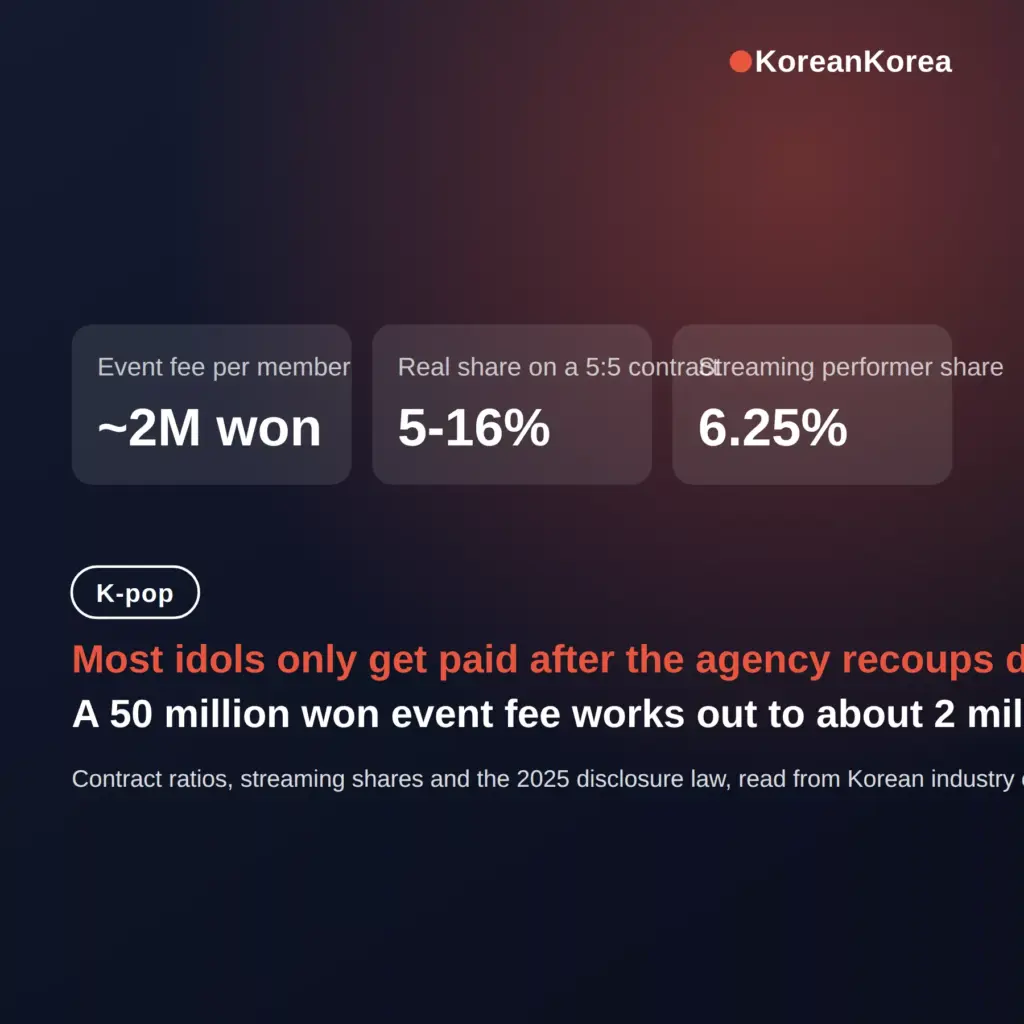
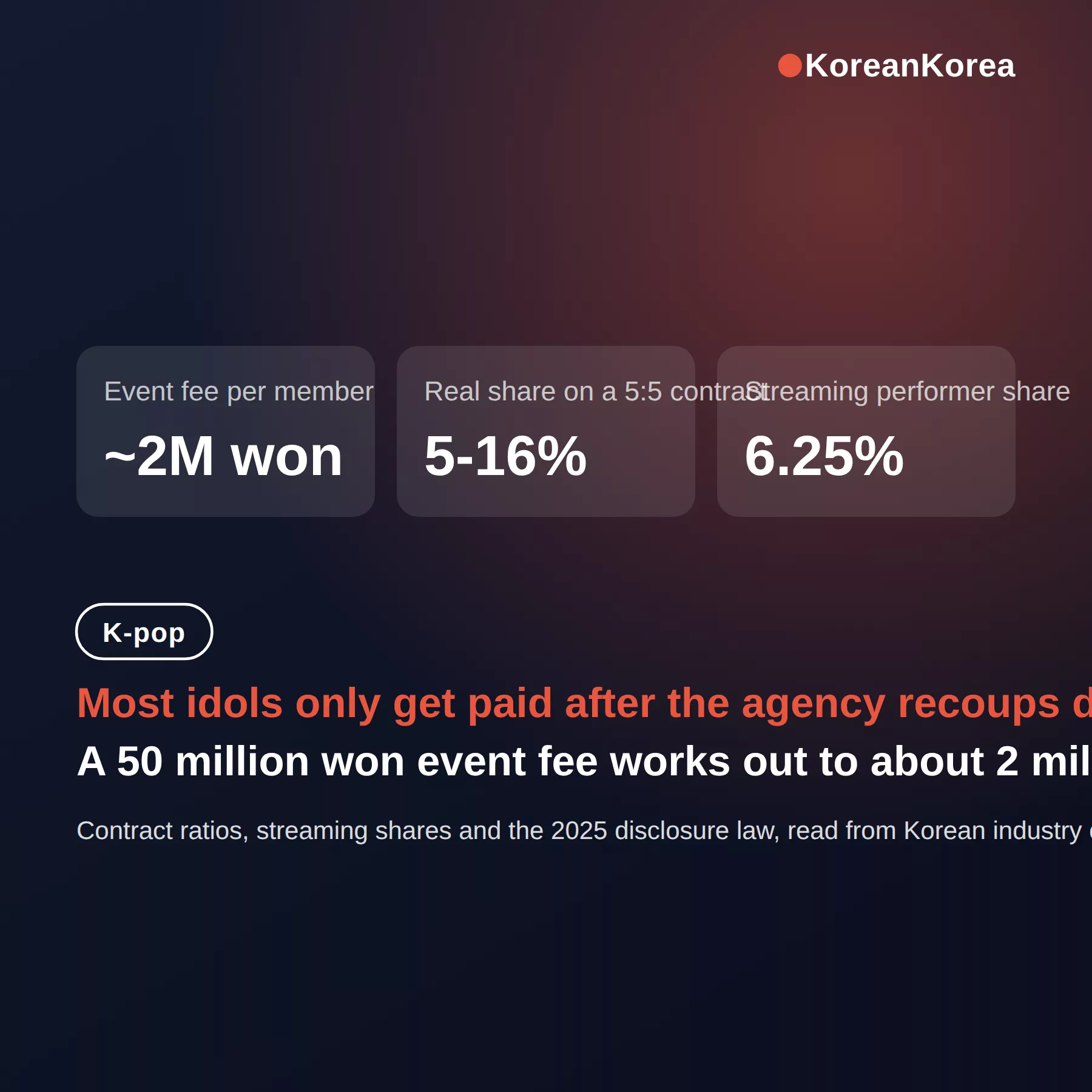
Most idols get paid only after the agency recoups costs first: trainee debt, half the music-video budget, and event fees split 50/50 then divided by members.
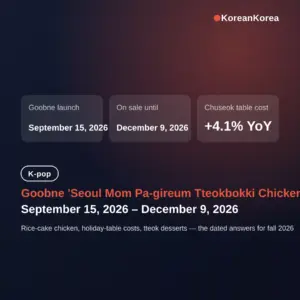
A 50 million won event fee works out to about 2 million won per member, and settlement can stay at zero for years.
This post walks through the payment order, the debut-debt system, streaming and album splits, and when money actually reaches an idol.
Contents
- How do kpop idols get paid: the payment order, from debt to split
- Do idols pay back trainee debt after debut?
- What percentage do kpop idols get from album sales?
- When do kpop idols start earning money?
- Did Lee Seung-gi get zero settlement for 18 years?
- Can idols see their own settlement records?
How do kpop idols get paid: the payment order, from debt to split
All income goes to the agency first, costs are deducted, the remainder is split by the contract ratio, and trainee debt is repaid before any settlement reaches a member.
Under the standard exclusive contract, distribution-fee, copyright and performance-fee costs come off before the split.
The contract also allows deducting vehicle upkeep, room and board, transport, advertising fees, and other costs the artist agreed to, before splitting event and ad income.
Group income is then divided equally by member count, so a 9:1 contract on a 10-member group leaves a per-person ratio of 90:1.
- Album, streaming, event and ad income is collected by the agency.
- Distribution, production and activity costs are deducted.
- The remainder is split by the agreed ratio and divided by member count.
- Trainee debt and other billed costs are repaid before settlement.
When I read an idol pay claim, the first thing I check is whether the number is the contract ratio on paper or what actually landed in a settlement sheet, because those are not the same thing.
| 1. All income reaches the agency first | Album, streaming, event and ad money lands at the agency, not with the members |
|---|---|
| 2. Costs are deducted | Distribution fees, production costs, manager salary, vehicle and fuel come off the top |
| 3. The remainder is split by contract | Reported ratios run 9:1 to 5:5; recent contracts often start 7:3 and shift toward 5:5 from year 3-4 |
| 4. Trainee debt is repaid before settlement | Lesson, food, dorm and practice-room costs billed after debut must be cleared before any payout |
Do idols pay back trainee debt after debut?
At most small and mid agencies, yes — trainee-period lesson fees, food, housing and practice-room rental are billed to the artist after debut.
Momoland’s Hyebin described it as ‘debting several hundred million won at debut.’ The standard contract says these training costs are the agency’s burden by default, but with the artist’s consent they can be charged to the artist and deducted later, limited only by ‘reasonable range’ wording.
Music-video costs add to this: members bear half of an MV budget that runs into the hundreds of millions of won.
Under the standard exclusive contract (MCST notice No.
2024-0021, revised June 3, 2024), trainee training costs are nominally the agency’s burden unless the artist consents to repayment.
In practice, Hyebin says every MV filming ‘loses me tens of millions of won,’ and settlement stays blocked until the debt is fully repaid.
If your group is on a big agency with a stated support policy, this billing may not apply, but that has not been confirmed from a company statement; for small and mid agencies, assume the debt exists until a settlement sheet says otherwise.
👉 How to Become a Kpop Trainee as a Foreigner: E-6 Visa Guide
What percentage do kpop idols get from album sales?
For streaming, performers get a regulated 6.25% of streaming revenue, split among all singers and players on the track; for physical albums, there is no statutory split and the ratio is a private contract matter.
Under the MCST rules in force since January 1, 2019, 65% of streaming revenue goes to rights holders, split as producer 48.25%, songwriter 10.5%, and performer 6.25%.
A hit with many credited singers and session players dilutes that 6.25% further.
Physical albums work differently: the distribution method and the artist’s share are whatever the contract says, so no reliable per-album per-member figure can be computed.
Reported contract ratios run 9:1 to 5:5, with recent contracts starting 7:3 or 6:3 and adjusting to 5:5 or 6:3 from year 3-4.
If you are reading a streaming chart, the performer share is a fixed regulated slice; if you are reading album sales, the members’ cut is contract-specific and cannot be estimated from the chart number alone.
When do kpop idols start earning money?
Only after debt is repaid and costs stop offsetting income.
Momoland’s Hyebin says her group hit No.1 on music shows two years after debut and settlement was still zero, because costs kept offsetting income.
Even the roughly 2 million won left per event is reinvested into the next music video, so ‘the money turns around before it reaches my bank account.’
The event math explains why.
A typical event appearance fee is about 50 million won; after the 50% agency split, division by members, and deductions for hair and makeup, stylist, food and fuel, roughly 2 million won reaches one member — about 4% of the fee (2,000,000 ÷ 50,000,000).
One former idol frames the odds as three stacked 1% filters: the top 1% of applicants become trainees, the top 1% of trainees debut, and only the top 1% of debuted idols actually make money — ‘I was not that 1%.’
If a comeback sells 500,000 copies, expect the income to first offset debut debt and production costs rather than become a paycheck.
Did Lee Seung-gi get zero settlement for 18 years?
Yes — Lee Seung-gi received no music settlement for 18 years, and a court awarded him 581 million won in 2023.
In the ruling on Lee Seung-gi v.
Hook Entertainment (Seoul Central District Court, 2023gahap49200), the court found 648 million won had to be recovered as costs before settlement obligations began, and called the withholding of payments and data an act destroying a relationship of high trust.
Tablo of Epik High has likewise revealed a 2003 contract under which the group received zero settlement even for the hit ‘Fly.’
The paper-ratio problem shows up in a real settlement sheet too.
In a 6-member group’s sheet obtained by Biz Hankook, a 5:5 contract paid one member 5-16% of net profit per quarter; in the best quarter (2.926 billion won in sales), the member received 126.88 million won — about 5%.
Reported deductions have included 6 million won of water for one member per quarter, CEO travel expenses, staff car leases, and sponsored stage outfits.
If you quote a debt amount, quote what an artist actually said — Hyebin’s ‘several hundred million won at debut’ — rather than turning it into an industry-wide number.
👉 BTS ARIRANG cinema screening: tour dates, 75 countries and how to find your showtime
Can idols see their own settlement records?
Since April 23, 2025, agencies must provide accounting records and compensation details in writing at least once a year, without the artist having to request them.
Before that, agencies were not required to show records voluntarily; artists reported receiving only numbers on an A4 sheet with no receipts, and one member said requesting settlement data effectively meant activity suspension.
In a November 2022 civil ruling, an idol who requested settlement data for 3 years and received only formal records without receipts won, and the court voided the exclusive contract.
An earlier amendment bill requiring disclosure — often called the ‘Lee Seung-gi Act’ — failed to pass the National Assembly after the 2022 case.
The 2025 amendment to the Popular Culture and Arts Industry Development Act is now the rule that forces written annual disclosure.
If I were tracking a dispute like this, the first thing I would check is whether the annual written disclosure actually arrived — because past cases show courts void contracts the moment agencies withhold it.
Related posts
📎 kpop dance tutorial for beginners bts: songs to start with
📎 📅 다가오는 일정 — 발매·개봉·발표 캘린더
Sources
- 50M won event fee → ~2M won per member; MV costs reinvested (starnewskorea.com)
- Trainee costs billed after debut; event-fee math (50M won → (sports.khan.co.kr)
- Court ruling recognized added payment of 581M won; settlemen (bizhankook.com)
Reading an idol pay claim — what to check first
- Check whether the number is the contract ratio on paper or the real settlement rate — on a real 5:5 sheet, members received 5-16% of net profit per quarter.
- Treat album sales figures as recoupment input, not member income — income first offsets debut debt and production costs.
- Quote trainee debt only as the artist’s own words (‘several hundred million won at debut’), not as an industry-wide figure.
- Compare streaming and album money differently: streaming has a regulated 6.25% performer share; album splits are private contract terms.
FAQ
Q. How do kpop idols get paid?
All income goes to the agency first, costs are deducted, the remainder is split by the contract ratio and divided by members, and trainee debt is repaid before any settlement arrives.
Q. Do idols pay back trainee debt after debut?
At most small and mid agencies, yes — Hyebin of Momoland described debting several hundred million won at debut from lesson, food, dorm and practice-room costs, though the standard contract makes these the agency’s burden unless the artist consents.
Q. What percentage do kpop idols get from album sales?
For streaming, performers share a regulated 6.25% of revenue (MCST rules since January 1, 2019). Physical albums have no statutory split — the ratio is whatever the private contract says.
Q. When do kpop idols start earning money?
Only after debt and costs are repaid — Momoland won music shows two years after debut with settlement still at zero, and a 50 million won event fee leaves about 2 million won per member.
Q. Did Lee Seung-gi really get zero settlement for 18 years?
Yes — the 2023 court ruling found 648 million won in costs had to be recovered first and awarded him 581 million won in unpaid settlement.
The date to watch next is the first annual written disclosure an agency sends under the April 23, 2025 law.
#kpopidolssalary #kpoptraineedebt #kpopsettlement #kpoprevenuesplit #leeseung-gisettlement
📅Upcoming Dates — 이번 주 16 · D-day 'The Scandal' global Netflix release전체 보기 →