Yes — you can audition to become a K-pop trainee from outside Korea, through official agency audition pages, online applications or video submissions.
A contract afterwards requires an E-6 (Arts & Entertainment) visa, and debuting is never guaranteed no matter how long you train.
This post covers where non-Koreans can actually apply, how long training lasts, the visa steps, and the contract and scam checks before you sign anything.
Contents
- How to become a kpop trainee as a foreigner — and what changes for you
- Which agencies run auditions open to non-Koreans?
- How long is trainee training, and how are trainees evaluated?
- What visa does a foreign trainee need?
- What should you check before signing — and what are the scam red flags?
- What do judges actually assess at the audition?
How to become a kpop trainee as a foreigner — and what changes for you
You apply through an agency’s official audition channels — in-person open auditions by region, online application, or a video submission — or you get scouted from cover videos posted online.
All of these routes are open to non-Koreans, and none of them require you to be in Korea first.
- Find the agency’s official audition page and read the current notice.
- Apply online or submit a performance video through that page.
- If you post covers on TikTok, Instagram or YouTube, keep posting — agencies scout directly from those platforms.
- If you pass and receive a contract offer, the agency sponsors your E-6 visa before training in Korea begins.
Agencies recruit trainees through open auditions and direct scouting, and video or online application is an official channel, not a shortcut made up by middlemen.
TikTok, Instagram and YouTube have become discovery channels on par with open auditions, and cover videos have led to scouted trainees.
If you are applying from abroad, start with the official page or a video submission; a recruiter’s DM is not an application route.
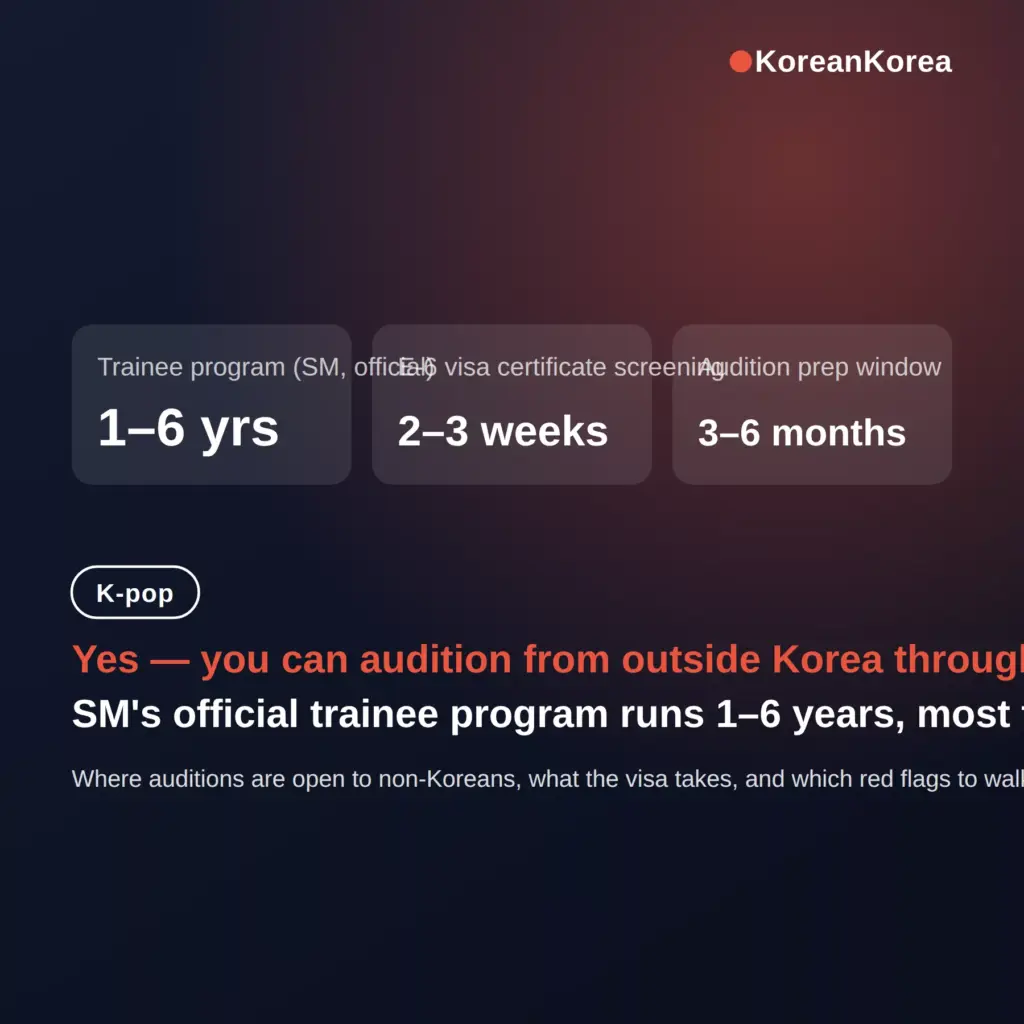
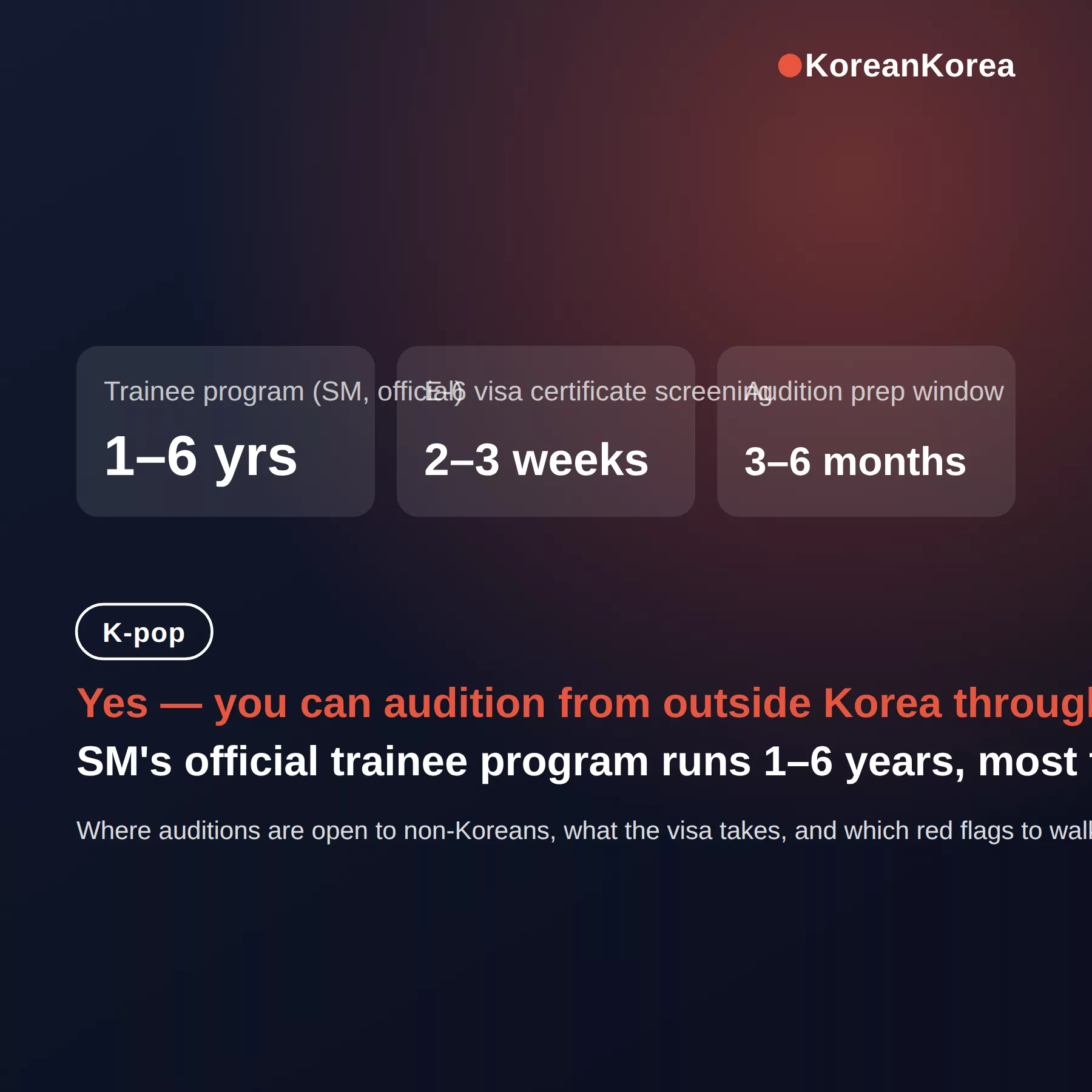
| Trainee program length (SM, official) | Minimum 1 year, maximum 6 years |
|---|---|
| Audition prep window | 3–6 months (demo re-recorded every 3–6 months) |
| Vocals + dance share of trainee evaluation | 60–80% (each 30–40%) |
| E-6 visa certificate screening | About 2–3 weeks |
| Foreigner registration after entry | Within 90 days |
| Full road from first prep to debut readiness | Roughly 2.5–7.5 years |
Which agencies run auditions open to non-Koreans?
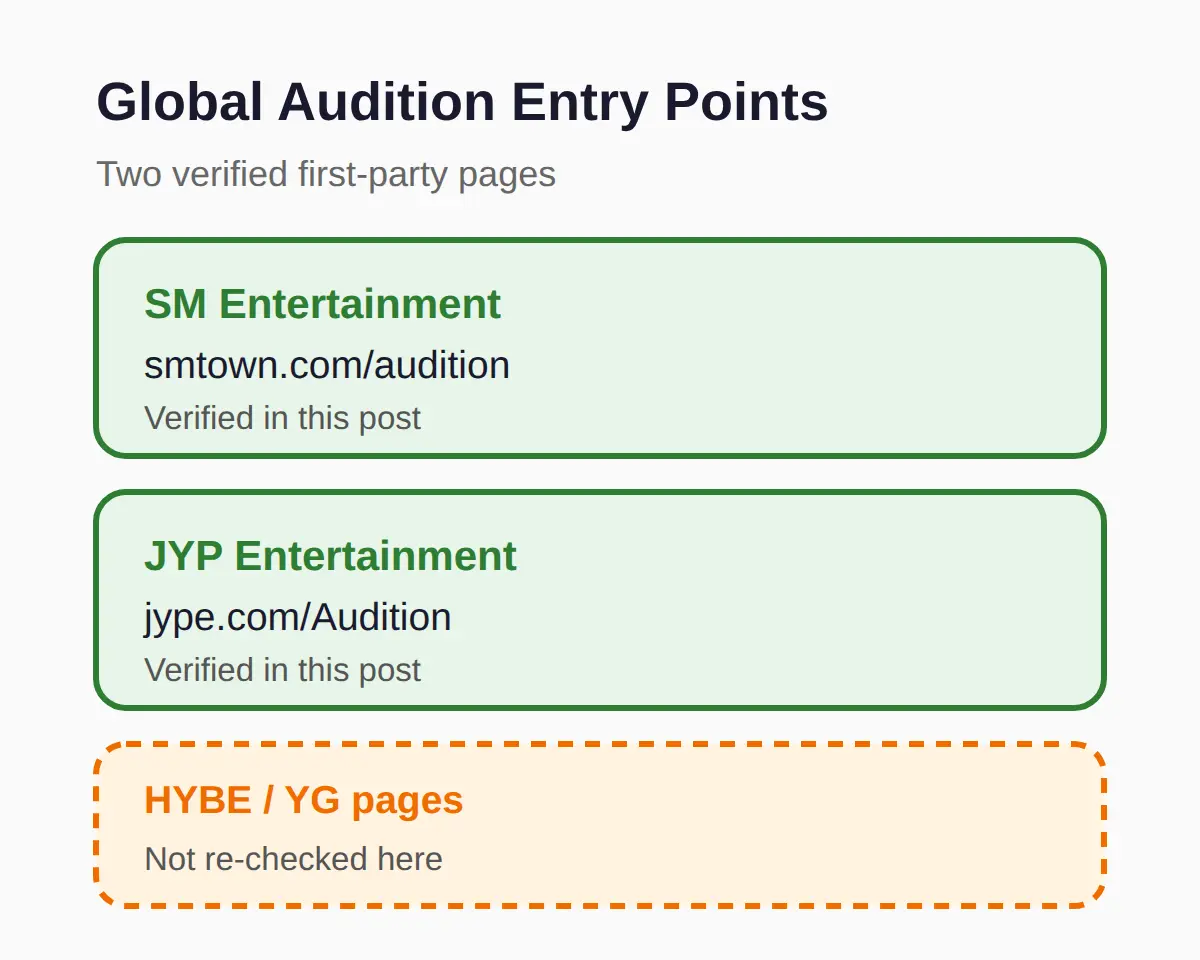
SM runs an official global audition page at smtown.com/audition, and JYP lists an audition page at jype.com/Audition — those are the two entry points this post could trace to first-party pages.
Mid-size agencies outside HYBE, SM, JYP and YG also run rolling auditions you can enter from abroad.
The agencies still run regular global auditions alongside casting agents’ direct scouting, so an in-person regional audition is another route when one is scheduled near you.
What was not re-checked here are HYBE’s and YG’s official global audition pages, and the current age limits or language conditions stated in each live notice.
Before you send anything, open the agency’s official page and read the current notice yourself — application windows and eligibility change, and the notice on that page is the version that counts.
👉 BTS ARIRANG cinema screening: tour dates, 75 countries and how to find your showtime
How long is trainee training, and how are trainees evaluated?
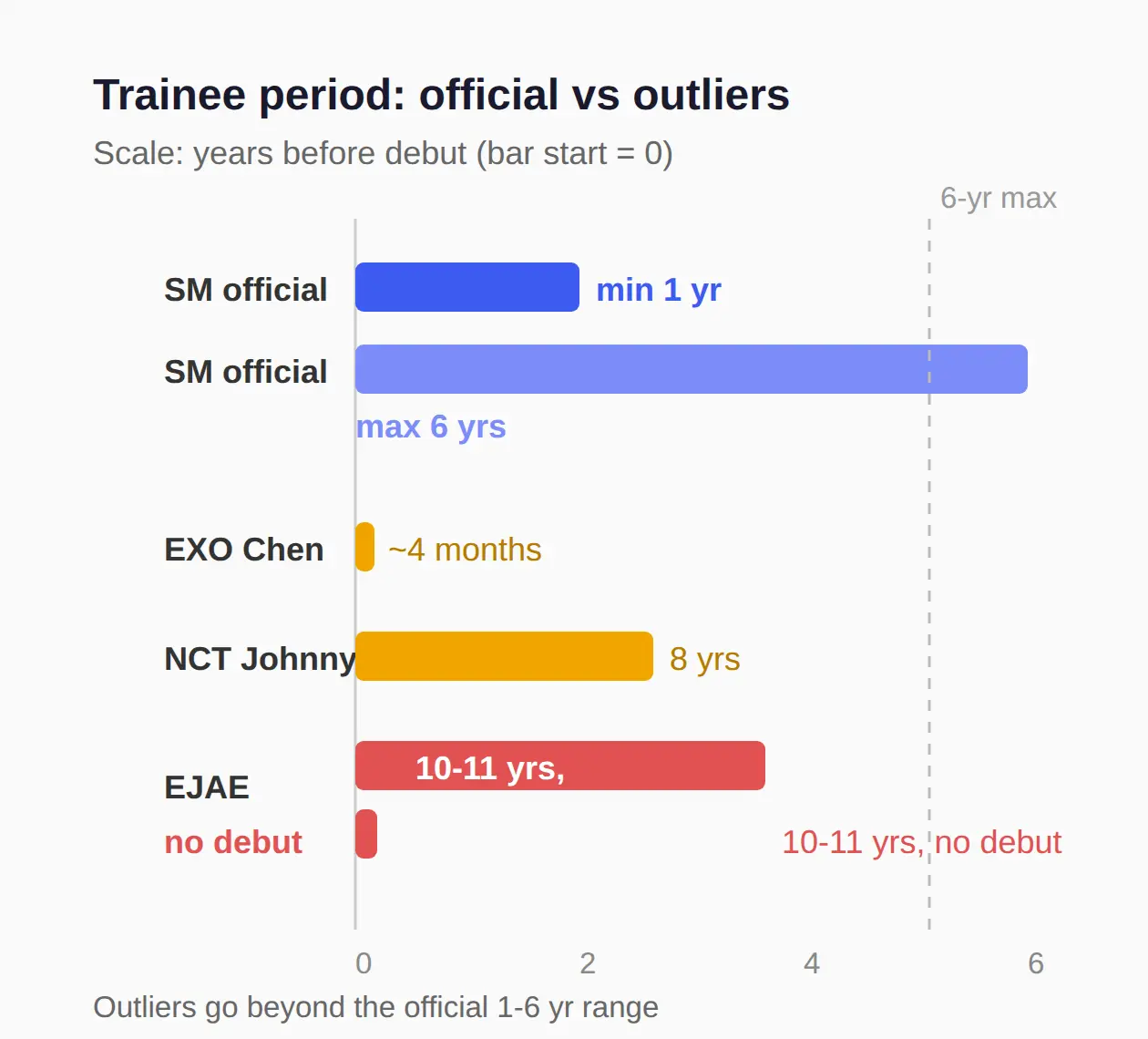
SM states its trainee program runs a minimum of 1 year to a maximum of 6 years — yet EXO’s Chen trained about 4 months and NCT’s Johnny trained 8 years before their debuts, and singer-songwriter EJAE spent around 10–11 years at SM without debuting.
The official range and the real cases do not line up, so treat them as separate numbers and never blend them into one.
How trainees are scored is straightforward: vocals and dance each count 30–40% — together 60–80% — while looks and image are 15–20%, attitude 10–15%, and foreign languages earn bonus points.
Training covers vocals, dance, foreign languages, acting and expression, fitness, and media training for interviews and social media.
Agencies sit trainees down for a monthly or quarterly check on how they are doing, the results feed into debut-line selection, and failing them can void the trainee contract.
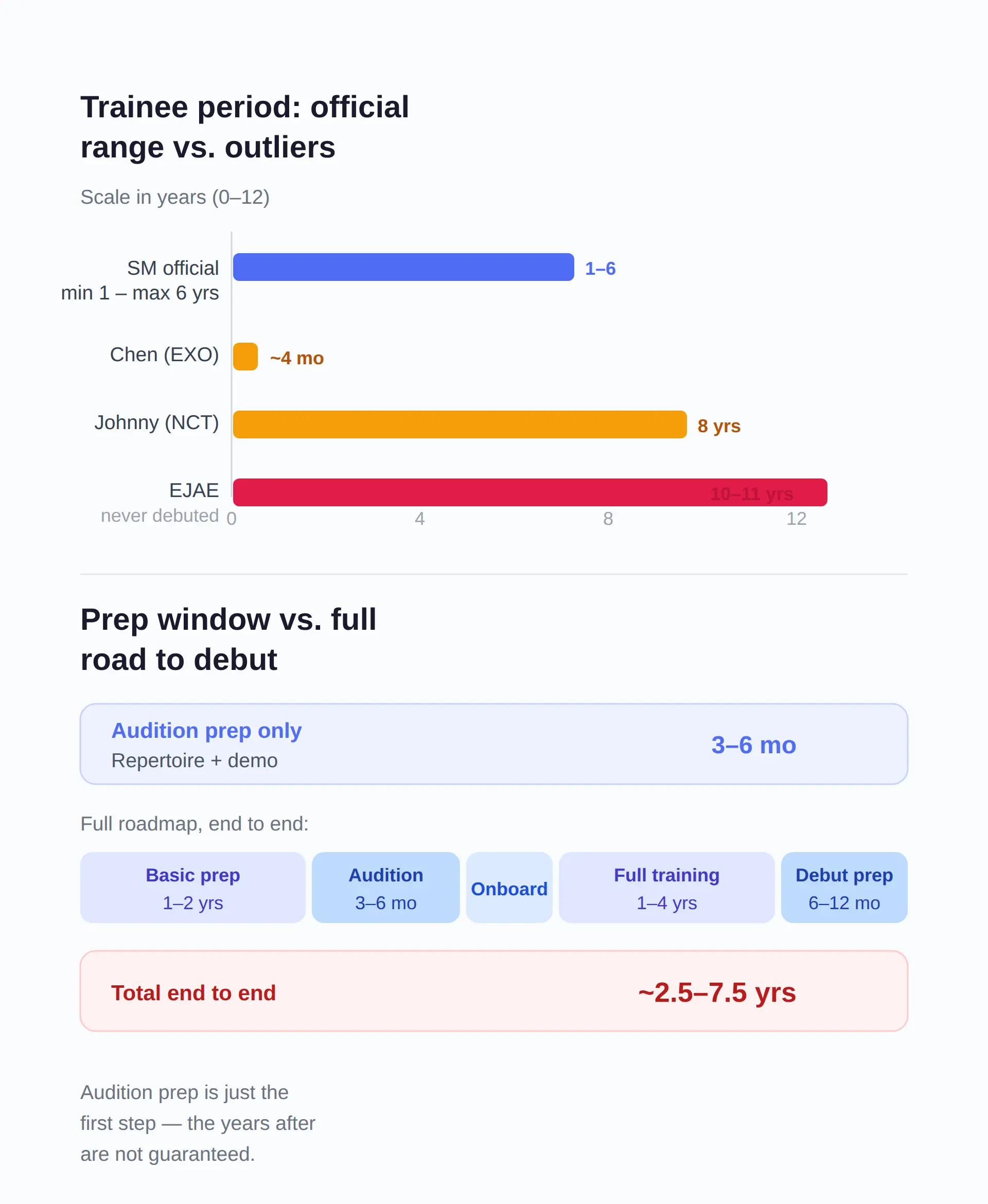
Counting basic prep, audition prep, full training and a 6–12 month debut phase, the whole road runs roughly 2.5–7.5 years — plan your timeline around that range, not around the shortest case you have read about.
What visa does a foreign trainee need?
A foreign trainee needs an E-6 (Arts & Entertainment) visa — the E-6-1 category covers idol trainees, singers, actors and models in popular culture arts.
The basic stay period is 2 years and it is renewable, and minors need a legal guardian’s consent form.
- Sign an exclusive or employment contract with the agency.
- Obtain the employment recommendation — for singers and trainees it is issued by the Ministry of Culture, Sports and Tourism.
- Apply for the certificate of visa issuance at the immigration office; screening takes about 2–3 weeks.
- Get the visa itself at a Korean embassy or consulate.
- Register as a foreign resident within 90 days of entry.
The document list includes the application form, passport copy, photo, employment contract, the agency’s business registration certificate, the employment recommendation, a performance plan where needed, a guarantee letter, and guardian consent for minors.
Approval rates and processing times beyond the stated 2–3 weeks are not documented, so build your schedule with room to spare.
If an agency offers you training in Korea but no visa sponsorship, that is a contract with no legal way for you to actually take it up.
What should you check before signing — and what are the scam red flags?
Any upfront payment is a red flag — audition fees, registration fees, profile-shooting fees, training fees — because legitimate agencies do not charge applicants.
A debut guarantee is a second red flag, since most trainees never debut even after years of preparation.
The scale of what goes wrong is documented: a Japanese trainee paid about 3 million yen (roughly 27 million won) for a 6-month academy course where the promised agency auditions never happened, according to reporting carried by BBC.
Training companies registered as entertainment agencies face far lighter regulation — an industry source told BBC these programs are "not subject to regulation or supervision" — so nobody else is screening the contract for you.
Before signing, compare the contract against the Korea Fair Trade Commission’s standard exclusive contract for popular-culture artists: contract term and start date, revenue split by activity (music, performances, ads, merch), who pays training and dorm costs and whether they are recovered from later settlements, the penalty for early withdrawal, and minor protections such as schooling and rest rights.
KOCCA-related counseling bodies offer contract review support, and signing before a review is not advised.
If a company demands money before any audition or refuses to give you a contract copy, walk away — and check the pressure signs too, like rushed signing, opaque company information or avoiding contact with your guardian.
👉 kpop dance tutorial for beginners bts: songs to start with
What do judges actually assess at the audition?
Judges assess more than singing and dancing: first impression, facial expression, self-introduction, stage manner and potential all count.
Practically, that means your expression on camera, the first 3 seconds of your performance, your self-introduction, your movement, and your pronunciation and breath control.
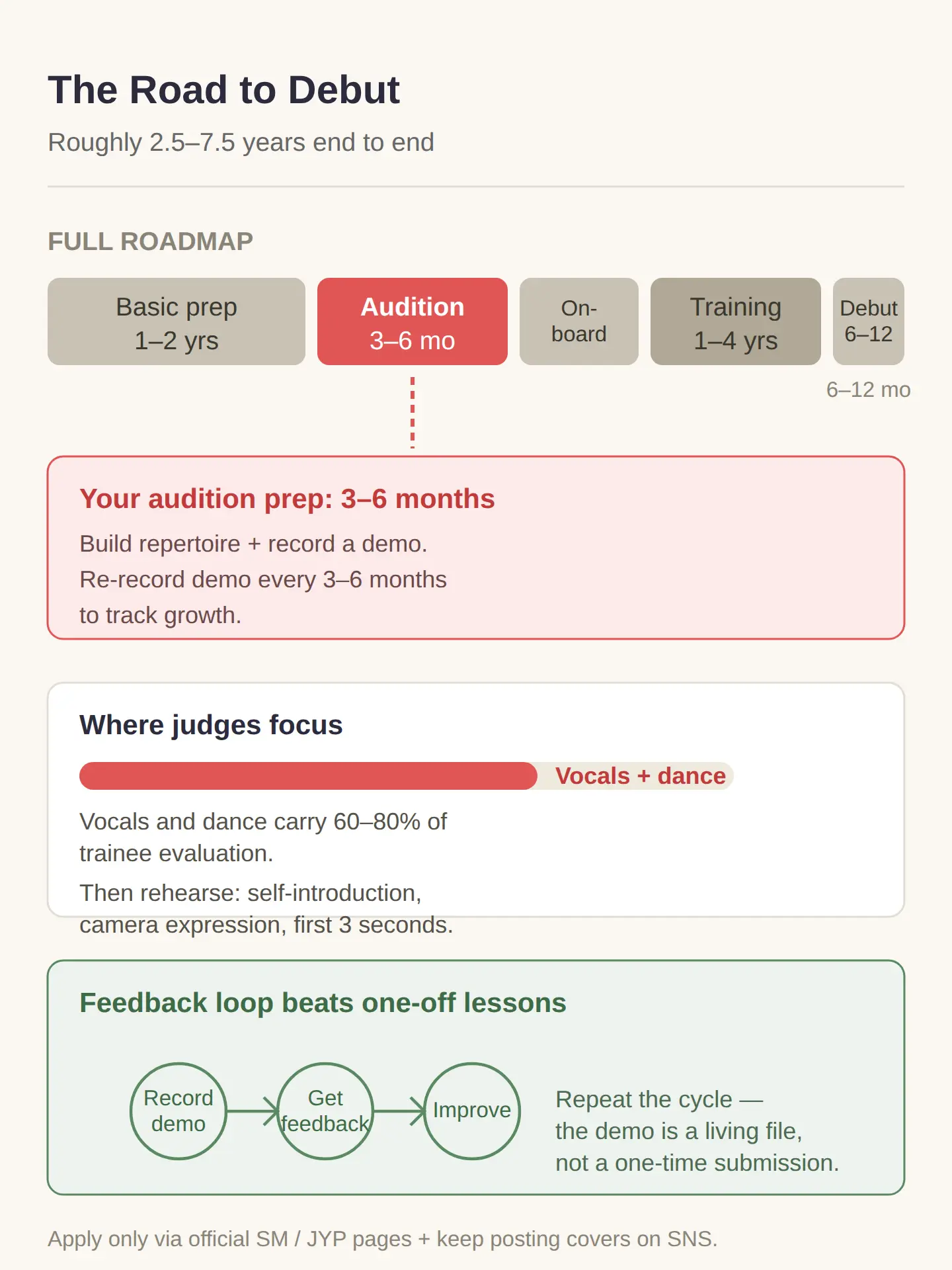
The typical preparation window is 3–6 months of dedicated prep — building a repertoire and recording a demo — with the demo re-recorded every 3–6 months to track growth.
Repeating feedback cycles raises skill more than one-off lessons, so the demo tape is a living file rather than a one-time submission.
Since vocals and dance carry 60–80% of trainee evaluations, spend most of your prep there, then rehearse the self-introduction and camera expression that decide the first impression.
I would apply only through the official SM or JYP audition pages, and in parallel keep posting covers — because SNS costs nothing and reaches the same scouts.
👉 How K-pop stars are made (KPOPWORLD)
Related posts
Sources
- Training 2-5 years avg; vocals 30-40% of evaluation; demo re (studionol.co.kr)
- KFTC standard contract check points; upfront-payment and deb (mytipsguide.com)
- Not verified in this run — primary page not opened (smtown.com)
Summary: what to do next
- Apply only through official agency audition pages or a video submission — keep posting covers, because SNS is a scouting channel in its own right.
- Prepare an alternative path alongside training — most trainees never debut even after years of preparation, so keep school or another career option open.
- Never pay upfront fees, and treat any debut guarantee as a red flag.
- Compare any contract against the KFTC standard exclusive contract and get a review before signing.
- If you are under 18, guardian consent is required and the contract must protect schooling, sleep and rest.
FAQ
Q. Can foreigners audition to become a K-pop trainee, and how?
Yes — through official agency audition pages, online applications, video submissions or SNS scouting. You do not need to be in Korea to apply, but a contract afterwards requires an E-6 visa.
Q. Which agencies run global or online auditions open to non-Koreans?
SM runs an official global audition page and JYP lists an audition page, and mid-size agencies run rolling auditions as well. Read the current notice on each official page, because windows and eligibility change.
Q. What visa is needed, and how long does it take?
An E-6 (Arts & Entertainment) visa, category E-6-1 for trainees and singers. The certificate of visa issuance takes about 2–3 weeks to screen, and you must register as a foreign resident within 90 days of entry.
Q. How long is trainee training?
SM’s official range is 1–6 years, with documented cases from about 4 months to 8 years — and around 10–11 years for one singer who never debuted. Most trainees never debut at all.
Q. What are the scam red flags?
Any upfront payment — audition, registration, profile shoot or training fee — plus debut guarantees, rushed contracts, no contract copy, opaque company information and avoiding your guardian. Legitimate agencies do not charge applicants.
Apply through the official audition page, keep your cover videos going, and put the contract review before any signature.
#kpoptrainee #kpopauditionforforeigners #e-6visakorea #smaudition #jypaudition #kpoptraineetraining #kpopscamredflags
📅Upcoming Dates — 이번 주 16 · D-day 'The Scandal' global Netflix release전체 보기 →