Yes — Seoul’s municipal tap water, branded Arisu, is tested on 172 water-quality parameters and has no recorded case of exceeding the standards.
Contents
- Is Seoul Tap Water Safe to Drink? Yes — Here Are the Official Numbers
- How does Seoul tap water compare with bottled water?
- Why do so many Seoul residents still avoid tap water?
- Can I get tap water tested for free in Seoul?
- Where can visitors refill water bottles for free in Seoul?
Is Seoul Tap Water Safe to Drink? Yes — Here Are the Official Numbers
Yes — Seoul’s tap water, branded Arisu, is tested on 172 water-quality parameters, which is more than the World Health Organization recommends, and the city records no case of exceeding the standards from raw water through to the tap.
Those figures come from the Arisu quality page run by Seoul Waterworks.
The table above shows the 2021–2022 averages against each legal limit, and every detected value sits well inside it.
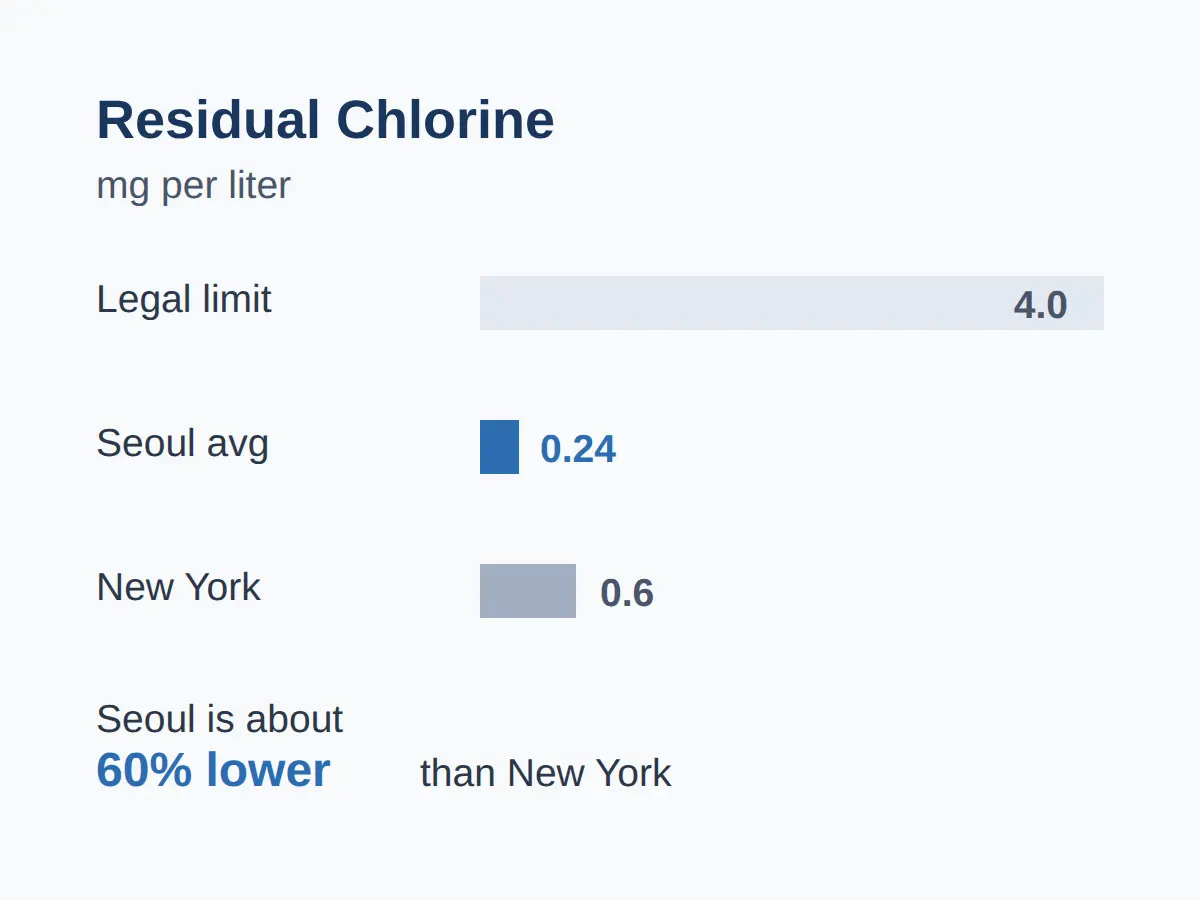
Residual chlorine is one example: the limit is 4 mg per L and Seoul’s average is 0.24, which is about 60% lower than New York’s 0.6 mg per L.
To keep the supply stable, the city maintains residual chlorine all the way to the tap to prevent bacterial growth, while keeping the mineral balance intact; Arisu is produced at six purification centers — Gwangam, Gui, Ttukdo, Yeongdeungpo, Amsa, and Gangbuk.
If you are staying in central Seoul in a building with reasonably maintained plumbing, the water that comes out meets drinking standards as supplied.
If the building is old or you remain uneasy, boiling it first or filling up at a public fountain both work.
| E. coli | Not detected per 100 mL / Not detected |
|---|---|
| Lead | 0.01 mg per L / Not detected |
| Turbidity | 0.5 NTU / 0.05 NTU |
| Residual chlorine | 4 mg per L / 0.24 mg per L |
| Total trihalomethanes | 0.1 mg per L / 0.024 mg per L |
How does Seoul tap water compare with bottled water?
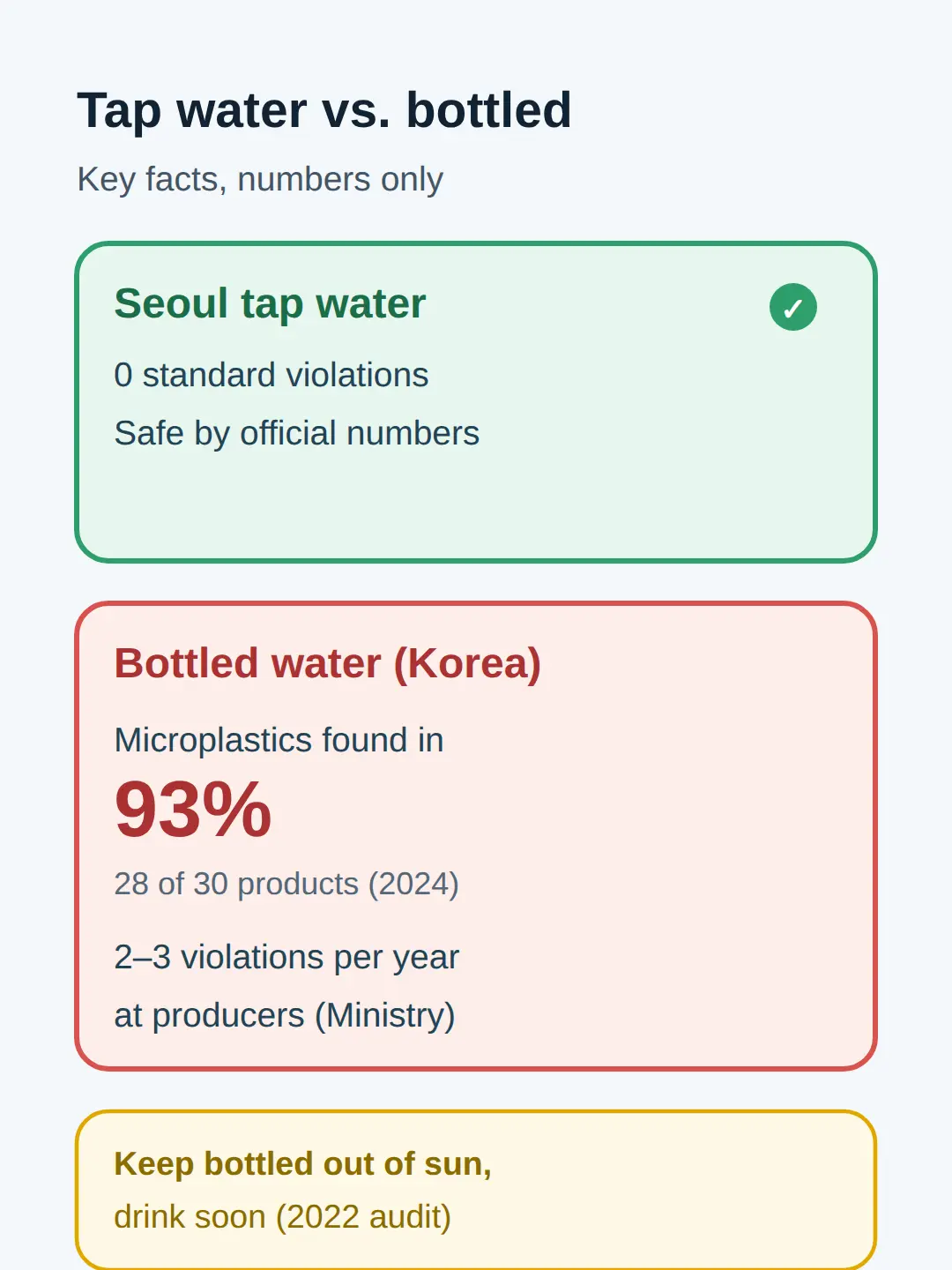
On the recorded numbers, Seoul tap water has no standard violations, while bottled water in Korea has shown both microplastics and repeated quality violations.
A September 2024 survey by the National Institute of Environmental Research found microplastics in 28 of 30 bottled-water products sold in Korea — 93% of the sample.
The Ministry of Environment reports 2 to 3 bottled-water standard violations per year at producers.
A 2022 government audit also confirmed that bottled water left in direct sunlight for a long time can leach harmful substances from the PET bottle, so bottled water should be kept out of the sun and drunk soon after opening.
If you want to cut plastic and cost, refilling from the tap or a public fountain is the safer-documented choice; if you prefer bottled water anyway, store it cool and dark and finish it quickly.
👉 Seoul bus strike September 2026: will buses run, is the subway normal?
Why do so many Seoul residents still avoid tap water?
The main reason is distrust of old pipes, not the treated water itself.
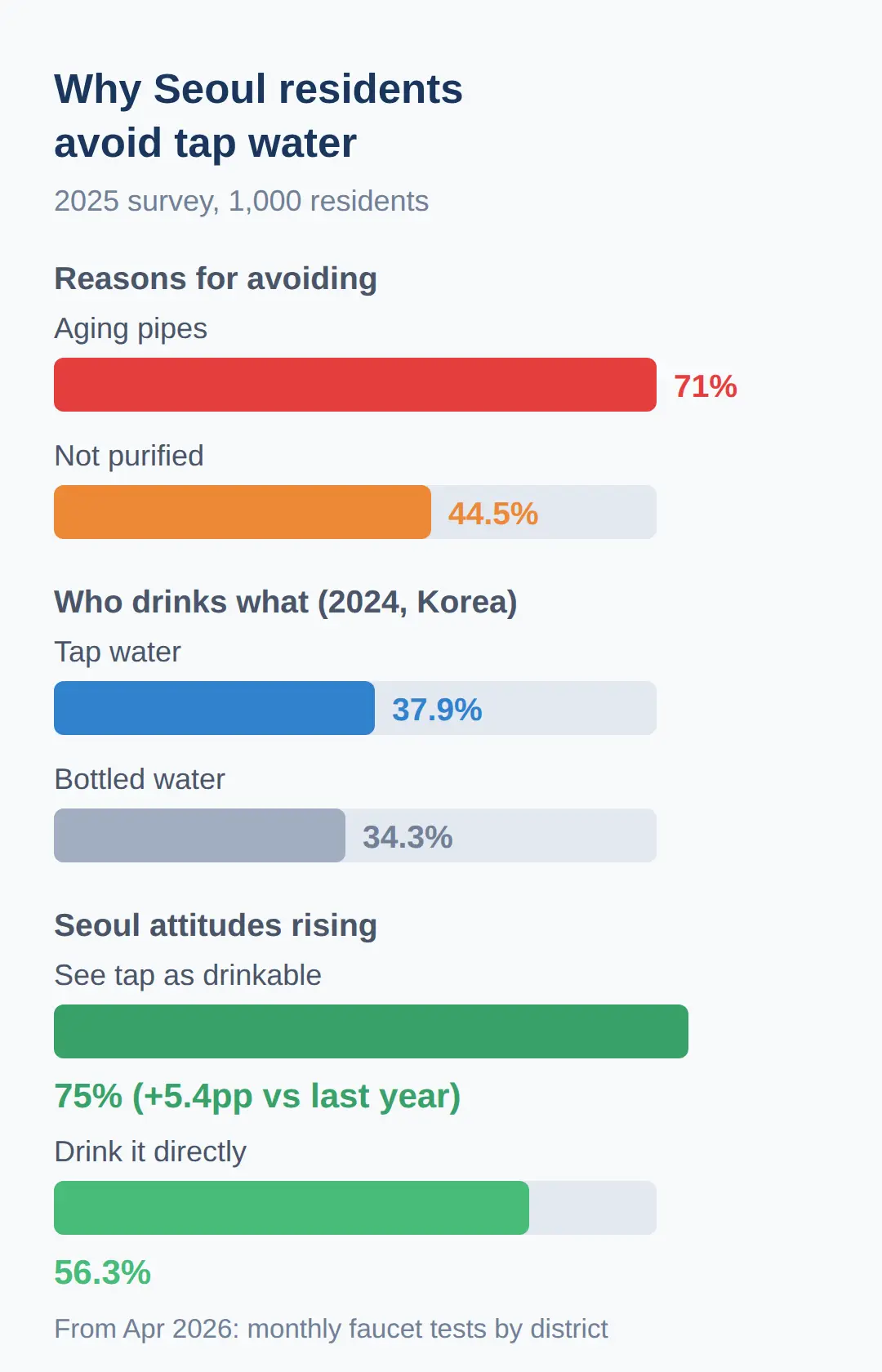
In a 2025 Seoul survey of 1,000 residents, 71% of those who avoid tap water cited worry about impurities in aging pipes, and 44.5% worried the water was not properly purified.
Nationally, a 2024 government survey found only 37.9% of Koreans drink tap water, including boiled, versus 34.3% who drink bottled water.
Attitudes in Seoul are shifting faster than the national average: 75% of surveyed residents now see tap water as drinkable, up 5.4 percentage points from the previous year, and direct drinking rose to 56.3%.
Since April 2026 the city also publishes monthly test results from 100 household taps and multi-use facilities on a district map, so you can look up your own area before deciding.
If your concern is the building you are staying in rather than the supply, the published faucet results by district are the thing to check.
Can I get tap water tested for free in Seoul?
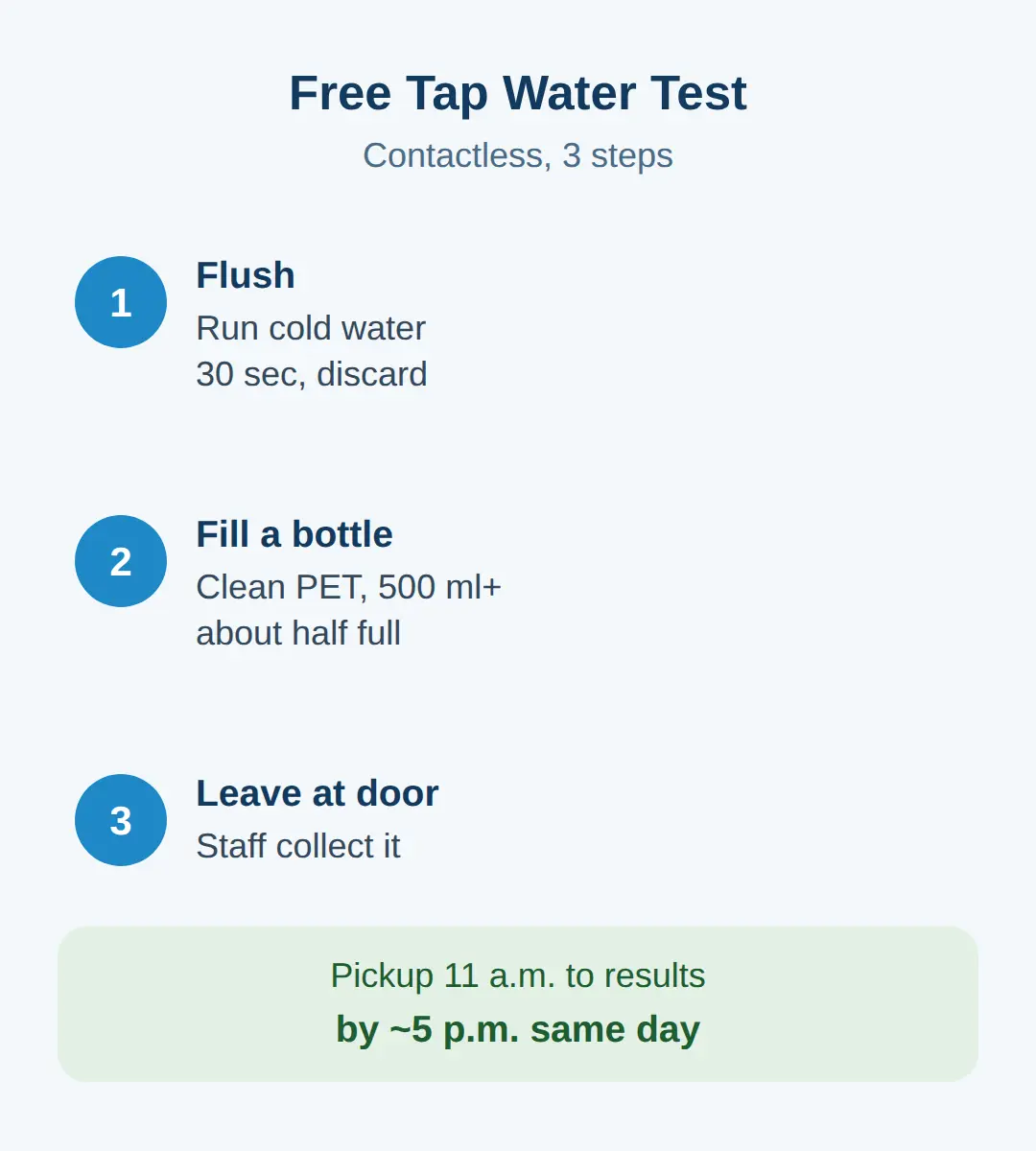
Yes — Seoul runs a free faucet water test, and it also offers a contactless version.
The contactless procedure has three steps: 1.
Run cold water for at least 30 seconds and discard it.
2.
Fill a clean PET bottle of 500 ml or larger about halfway.
3.
Leave the bottle outside your door for staff to collect.
A reported case in 2026 went from an 11 a.m. pickup to results by around 5 p.m. the same day, under six hours in total, and the service runs on weekdays (day and night) and weekends — book it through the Dasan Call Center at 120 or the Arisu website.
If a test finds a problem, the city follows up with a precise on-site diagnosis and guidance on pipe cleaning or replacement.
The service is described for residents, and the same free testing is now available nationwide through the Ministry’s ‘Drinking Water Assurance’ program on the water portal.
If a failure worries you more than reassurance, the published monthly map of 100 faucet results, released on the 15th of each month, answers most questions without booking anything.
👉 Seoul fireworks festival 2026 subway: Which Stations to Use Tonight
Where can visitors refill water bottles for free in Seoul?
Seoul installs free water fountains and purifiers at public spots, including libraries, parks, and subway stations, and visitors can use them.
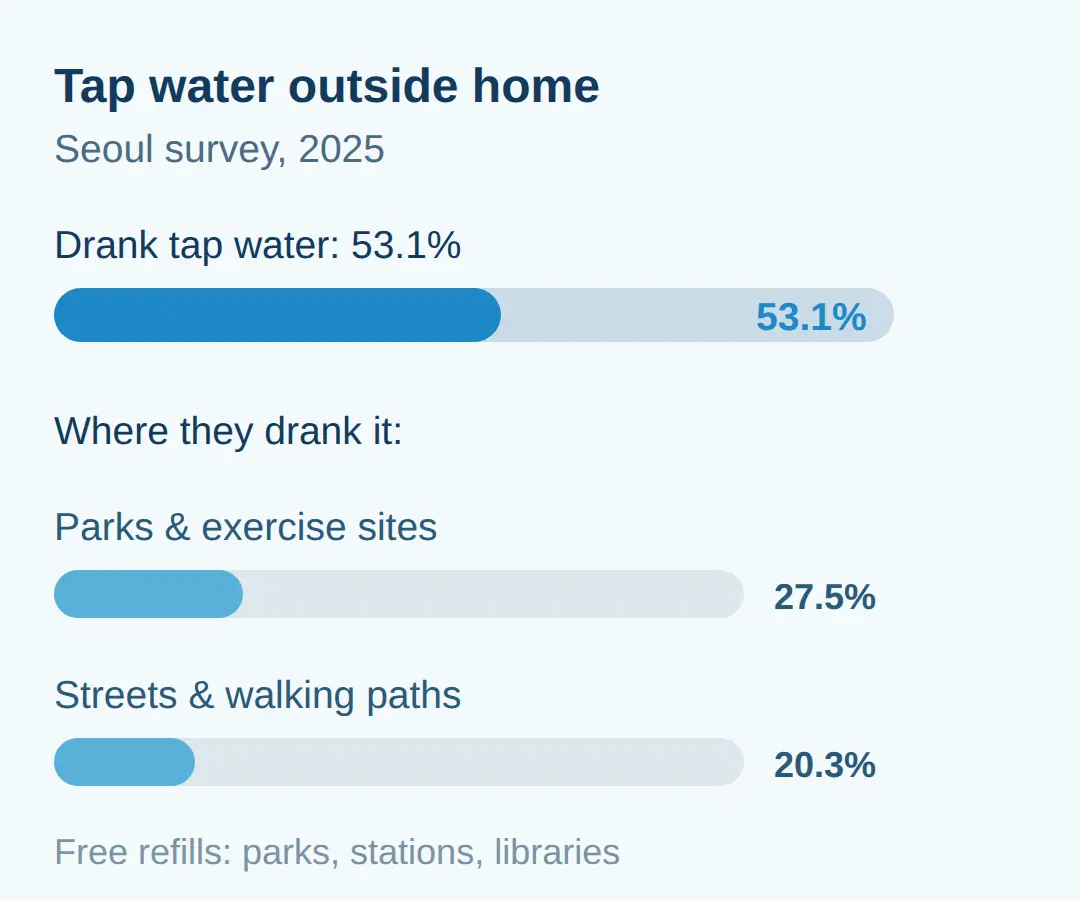
The habit is common among residents too: 53.1% of Seoulites surveyed in 2025 said they drank tap water outside the home in the past year, most often at parks and exercise facilities (27.5%) and on streets, trails, and walking paths (20.3%).
Water from a purifier has one caveat: activated-carbon filters breed bacteria if the filter is not replaced often, and reverse-osmosis purifiers strip out minerals that the city supply keeps.
For a day of walking between districts, plan refills at parks and stations along your route instead of buying bottles; a map or app listing specific refill points for travelers could not be verified from a primary source, so the published fountain locations on site signs are the reliable guide.
👉 Seoul’s official Arisu water-quality page: testing scope, standards, and average results
👉 How Seoul residents can book the free tap-water test and the district waterworks offices
👉 Seoul’s announcement of monthly public water-quality results from 100 taps
👉 Korea travel guide hub with practical tips for visitors
Related posts
📎 Seoul — everything we know
📎 Korea navigation apps: why Google Maps fails and 4 to install before landing
📎 Seoul itinerary Chuseok 2026 — why staying put beats the 10-hour KTX crawl
📎 📅 다가오는 일정 — 발매·개봉·발표 캘린더
Sources
- Six centers: Gwangam, Gui, Ttukdo, Yeongdeungpo, Amsa, Gangb (arisu.seoul.go.kr)
- Herald Biz reporter test with concrete figures (biz.heraldcorp.com)
- 100 locations, published on the 15th monthly with map lookup (ajunews.com)
Before your next refill
- Refill from the tap or a public fountain — the supply meets 172 tested parameters with no recorded violations.
- Check your district on the monthly faucet results map, published on the 15th of each month.
- If you buy bottled water, keep it out of sunlight and drink it soon after opening.
- Staying hydrated matters on long walking days, and Seoul residents increasingly agree — 53.1% of Seoulites reported drinking tap water outside the home in the past year, most often at parks, sports grounds, and walking trails.
FAQ
Q. Is Seoul tap water safe to drink straight from the tap?
Yes. Arisu, Seoul’s municipal water, is tested on 172 parameters with no recorded case of exceeding standards as of September 2026.
Q. Should I boil Seoul tap water first?
The supplied water meets drinking standards without boiling; boiling is a personal precaution if the building’s plumbing is old or you prefer it.
Q. How does Arisu compare with bottled water?
Seoul records no standard violations, while a 2024 survey found microplastics in 28 of 30 Korean bottled-water products and violations occur 2–3 times a year.
Q. Can I get my tap water tested for free in Seoul?
Residents can book a free test, including a contactless bottle-drop option, via the Dasan Call Center 120 or the Arisu website; booking eligibility for short-term visitors was not confirmed.
Q. Where can I refill a bottle for free in Seoul?
Public fountains and purifiers are installed at libraries, parks, and subway stations and are open to visitors.
Tap is safe — refill for free and skip the plastic bottle on your Seoul trip.
Cover photo: Untitled — CC0 1.0
#Seoultapwater #Arisu #Koreatraveltips #drinkingwaterinKorea #Seoultravel #tapwatersafety #refillwaterbottle #Seoulsubway
📅Upcoming Dates — 이번 주 16 · D-day 'The Scandal' global Netflix release전체 보기 →