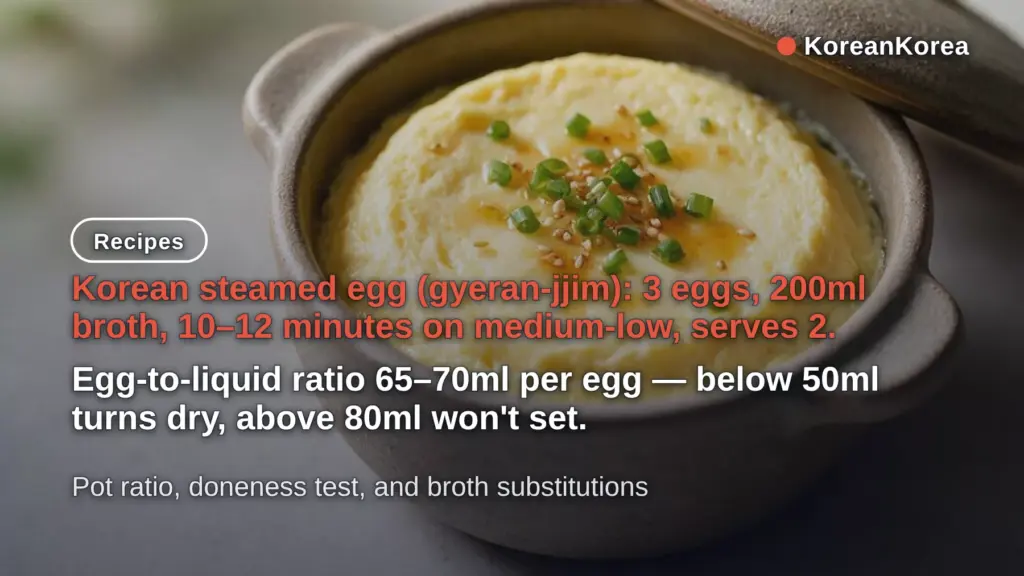
Korean steamed egg (gyeran-jjim) is made by whisking 3 large eggs with 200ml anchovy broth, 1 tsp fish sauce and 1 tsp sesame oil, then cooking it covered on medium-low heat for 10–12 minutes.
The whole dish takes about 15 minutes and serves 2 as a side dish.
This post covers the exact liquid ratio, what to use when you can’t find dashi or anchovy broth, and the four mistakes that turn it rubbery.
The 3-Egg Gyeran-Jjim Recipe: 15 Minutes, Serves 2
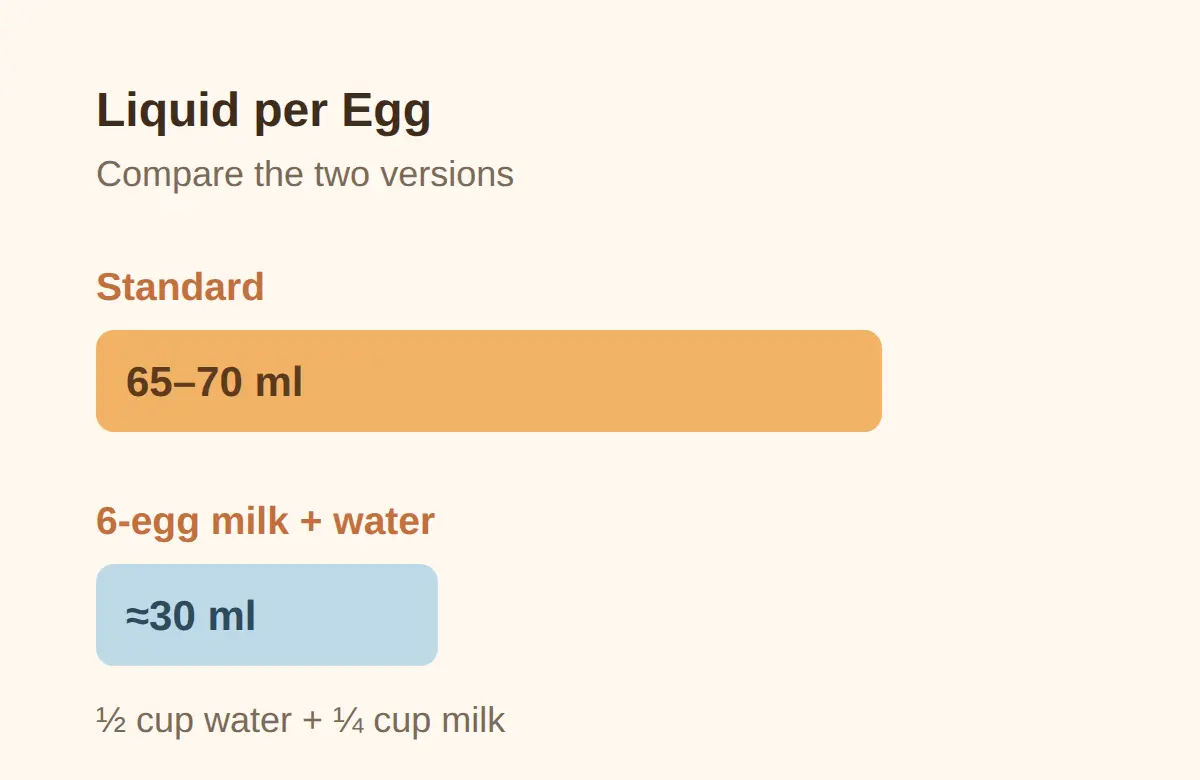
| Standard (this post) | 3 eggs + 65–70ml per egg |
|---|---|
| Milk-and-water home version | 6 eggs + ~30ml per egg (½ cup water + ¼ cup milk) |
| 4-egg steamer version | 4 eggs + 45ml per egg |
The recipe: whisk 3 large eggs with 200ml anchovy broth (or 1 tsp dashi granules in hot water), 1 tsp fish sauce and 1 tsp sesame oil, strain, then cook covered on medium-low heat for 10–12 minutes.
It serves 2 as a side dish and takes about 15 minutes end to end.
Ingredients:
| Ingredient | Amount | Note |
|---|---|---|
| Large eggs | 3 | room temperature works best |
| Anchovy broth or dashi | 200ml | 1 tsp dashi granules in hot water |
| Fish sauce | 1 tsp | soy sauce or a pinch of salt works |
| Sesame oil | 1 tsp | plus more to brush the pot |
| Green onion | 1 | thinly sliced |
| Toasted sesame seeds | to finish | optional but standard |
Steps:
- Whisk the 3 eggs with the 200ml broth until fully combined.
- Mix in 1 tsp fish sauce and 1 tsp sesame oil.
- Strain the mixture through a fine mesh sieve — this 20-second step removes chalazae and air bubbles for a noticeably smoother texture.
- Brush a small pot with sesame oil and pour the mixture in; it should fill the pot at least one-third.
- Cover and cook on medium-low heat for 10–12 minutes — do not lift the lid.
- At 10 minutes, tilt the pot: if the mass moves as one with a faint center jiggle, it is done; liquid sloshing means 2 more minutes.
- Top with sliced green onion and sesame seeds, and serve immediately while it is still puffed.
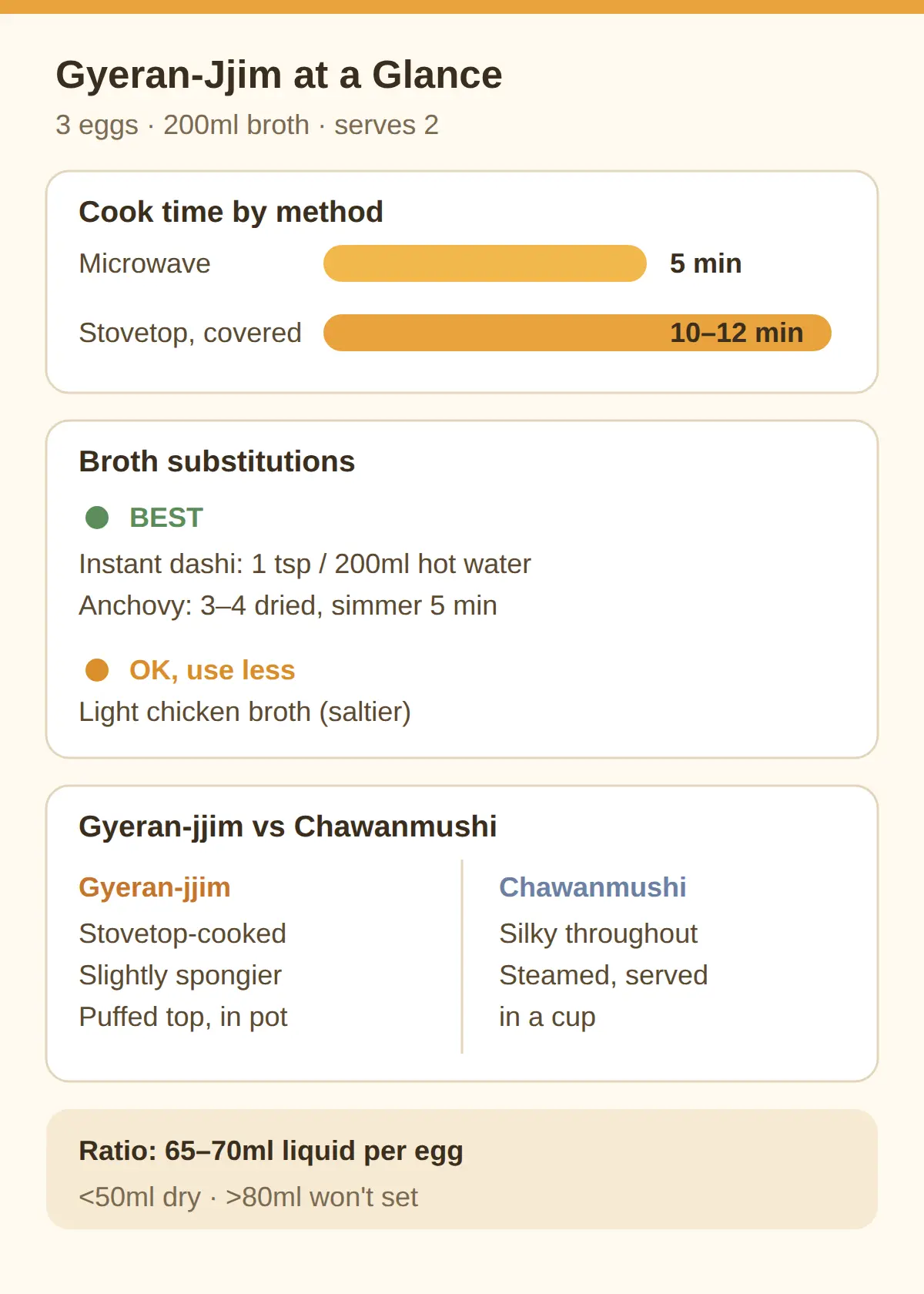
The standard ratio is 65–70ml liquid per large egg — below 50ml per egg turns dry, above 80ml won’t set.
I’d strain the mixture before cooking every time — it’s the step most people skip, and it’s the difference between scrambled-looking and smooth.
Ingredients
Main
- 3 Large eggs — room temperature works best
- 200ml Anchovy broth or dashi — or 1 tsp dashi granules in hot water
Sauce & seasoning
- 1 tsp Fish sauce
- 1 tsp Sesame oil — plus more to brush the pot
To finish
- 1 Green onion — thinly sliced
- to finish Toasted sesame seeds — optional but standard
Amounts are the ones used in this recipe; where the recipe gives no amount, adjust to taste.
Steps at a glance
-
1Whisk the 3 eggs with the 200ml broth
-
2Mix in 1 tsp fish sauce and 1 tsp sesame oil.
-
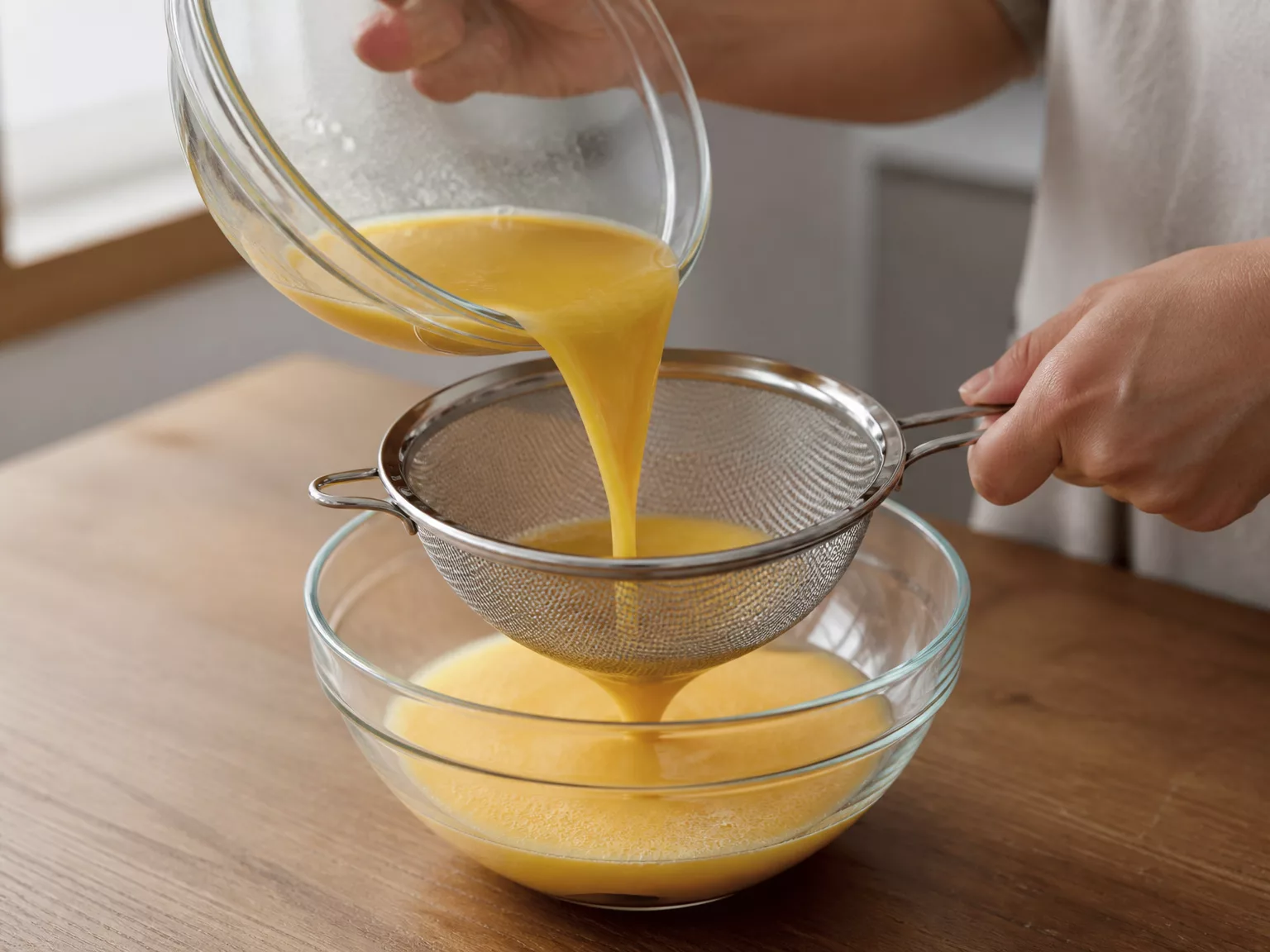 AI-generated photo
What it should look like — AI-generated image of this step, made from the recipe text — not a photo of our kitchen. 3Strain the mixture through a fine mesh sieve -
4Brush a small pot with sesame oil and pour the mixture in
-
5Cover and cook on medium-low heat for 10–12 minutes⏱ 10–12 minutes🔥 medium-low heat
-
6At 10 minutes, tilt the pot: if the mass moves as one with a faint…⏱ 10 minutes
-
7Top with sliced green onion and sesame seeds, and serve immediately…
Can I Make It Without Dashi or Anchovy Broth?
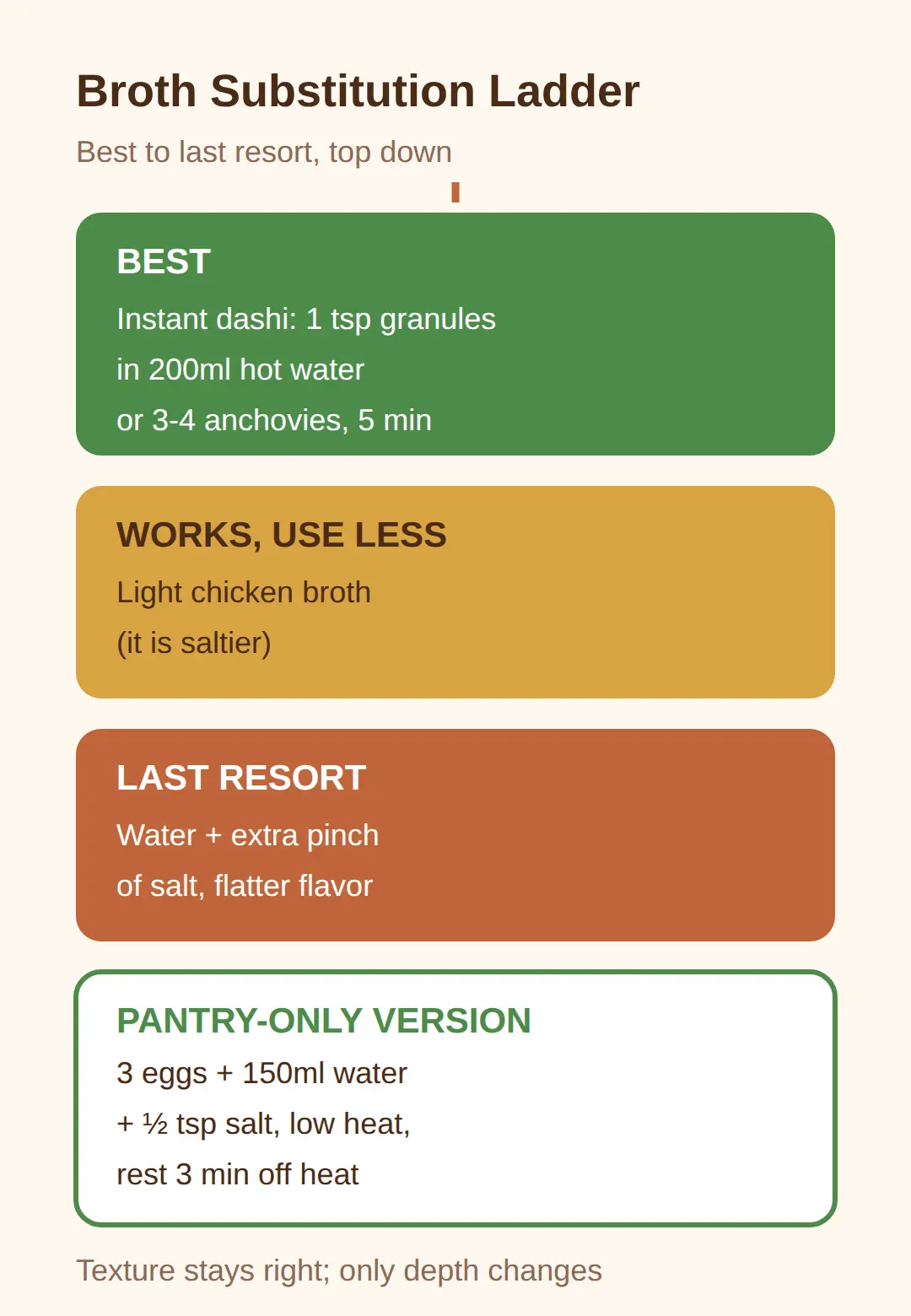
Yes — instant dashi or a 5-minute anchovy broth comes first, then light chicken broth, then water with extra salt.
Instant dashi is 1 tsp granules dissolved in 200ml hot water, and quick anchovy broth is 3–4 dried anchovies simmered in water for 5 minutes.
The texture stays right in every case; only the flavor depth changes.
Chicken broth works but use less of it, because it is saltier.
Water is the last resort — add an extra pinch of salt, and the flavor is flatter.
For a pantry-only version, the 3-ingredient version is 3 eggs + 150ml water + ½ tsp salt, cooked on low heat, stirred gently as it clumps, then rested 3 minutes off the heat.
If the missing item is fish sauce, 1 tsp soy sauce or a pinch of salt replaces it with slightly less depth.
An online calculator confirms 200ml broth plus 3 eggs lands at roughly 67ml liquid per egg — inside the 65–70ml target.
Why Did My Korean Steamed Egg Turn Out Rubbery?
Four causes: lifting the lid, high heat, an under-filled pot, and less than 50ml liquid per egg.
Lifting the lid releases steam, drops the temperature, and costs you the soufflé puff for good — set a timer and leave it covered.
High heat makes the eggs rubbery and eggy-smelling; if your stove runs hot, use a heat diffuser or simmer ring.
The mixture should fill the pot at least one-third — in a wide pot the egg spreads thin and cooks fast into rubber.
And stay at 65–70ml liquid per egg; below 50ml the custard dries out.
Don’t lift the lid, don’t use high heat, don’t under-fill the pot, don’t go below 50ml per egg — that’s the whole list.
If the top doesn’t puff at all, raise the heat to medium for the last 90 seconds with the lid on, then pull it off and serve immediately.
Do I Need a Ttukbaegi (Earthenware Pot)?
No — a ttukbaegi (Korean earthenware pot) costs about $10–15 at Korean grocery stores or on Amazon, but a ramekin or small saucepan with a tight lid works instead.
The pot matters for the presentation, not for the method.
If you do use a ttukbaegi: brush it with sesame oil, pour the mixture to 80%, boil 3 minutes over medium-high heat, then lower the heat, cover, and simmer 10–15 minutes.
Whatever you use, brush the inside with sesame oil first — it prevents sticking and adds nutty aroma.
Small pot, tight lid — that is the equipment requirement.
Microwave and Steamer Versions (With Times)
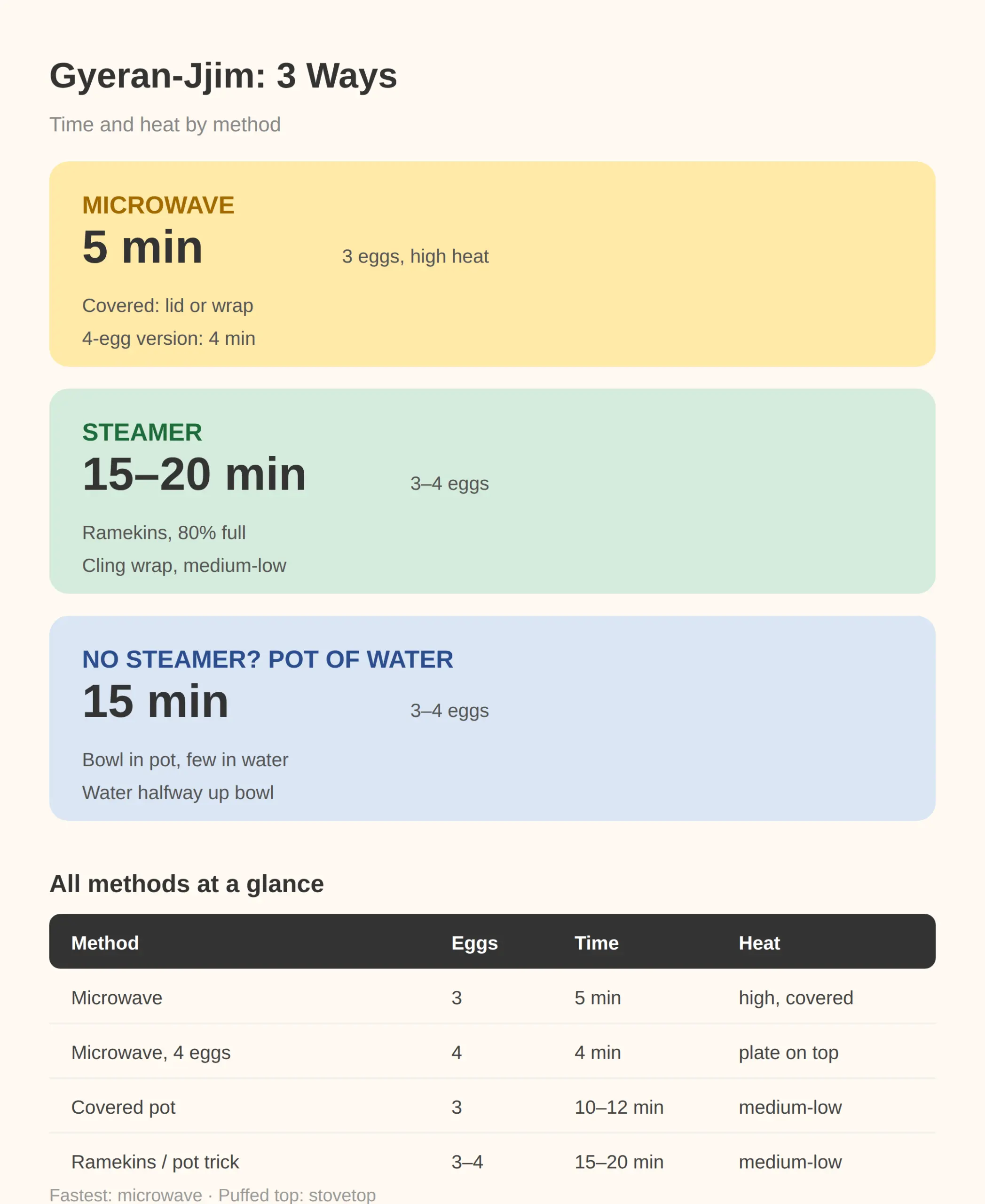
Microwave: 5 minutes, covered.
Steamer: 15–20 minutes.
No steamer: 15 minutes in a pot of water.
| Method | Eggs | Time | Heat |
|---|---|---|---|
| Microwave | 3 | 5 min | high, lid or wrap |
| Microwave (4-egg version) | 4 | 4 min | covered with a plate |
| Stovetop, covered pot | 3 | 10–12 min | medium-low |
| Steamed ramekins | 3–4 | 15–20 min | medium-low steam |
| Pot-of-water trick | 3–4 | 15 min | medium-low |
Steps:
- Microwave: pour the mixture into small heatproof bowls filled to 80%, cover, and microwave 5 minutes.
- Steamer: fill ramekins to 80%, cover with cling wrap, and steam 15–20 minutes — that’s the chawanmushi style, silky throughout.
- No steamer: place a heatproof bowl in a large pot with a few inches of water, water halfway up the bowl, and steam 15 minutes over medium-low heat.
The microwave is the fastest option and the stovetop gives the puffed top; a 4-egg version covered with a plate needs only 4 minutes.
Variations, Storage, and How Koreans Eat It
Common add-ins are minced shrimp, diced zucchini, and mushrooms — stir them in before cooking and keep additions small so the cook time stays consistent.
Two other liquid bases work: kelp water (soak 20g dried kelp in water 15 minutes, discard the kelp) or a milk-and-water version with sweet white rice powder for a bouncy, pudding-like texture.
For a chilled version, a school-lunch style variant is served cold in summer instead of hot.
| If you want… | Use… |
|---|---|
| Deeper savory flavor | kelp water + 1 tsp anchovy sauce |
| Bouncy, pudding-like set | ½ cup water + ¼ cup milk + 1 tsp sweet rice powder |
| A cold summer side | chilled school-lunch style, served cold |
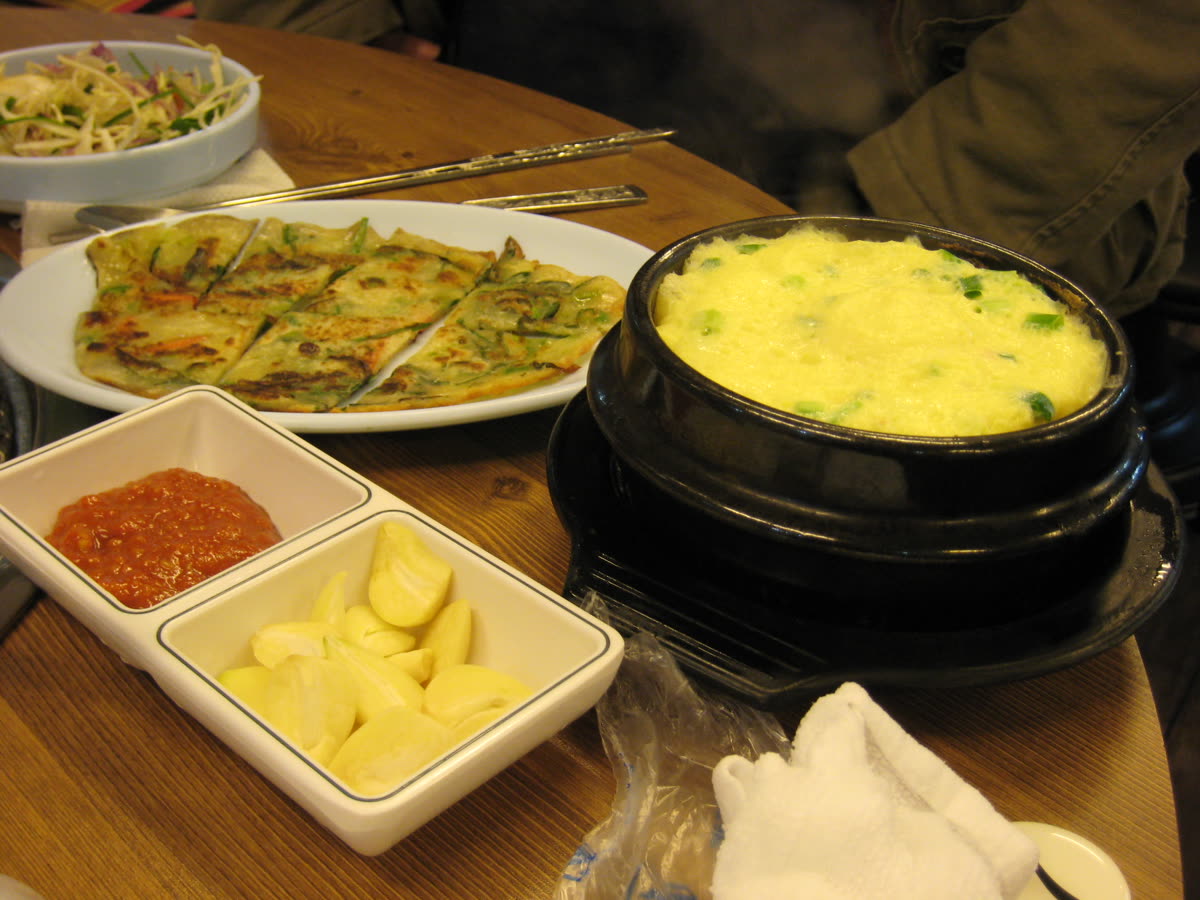
Gyeran-jjim is eaten communally straight from the pot and deflates as it cools, so serve and eat it immediately.
Leftovers keep covered in the fridge up to 1 day — reheat gently in a covered pot with 1 tbsp water over low heat.
It pairs with plain white rice, kimchi, kimchi-jjigae, or tteokbokki, and some Korean BBQ restaurants serve it free when you order rice.
Unlike Japanese chawanmushi, which is silky throughout and served in a cup, gyeran-jjim is stovetop-cooked, slightly spongier, and comes to the table puffed — like a soufflé without the baking.
Related posts
📎 📅 Upcoming Dates — Release & Event Calendar
Sources
- Master recipe page with three cooking methods (microwave, st (mykoreankitchen.com)
- Full recipe, ratio 1 egg : 65–70ml liquid, 10–12 min medium- (asianfoodsdaily.com)
- 5 full recipes compared: ModernPepper, Asian Foods Daily, Su (modernpepper.com)
Summary
- Whisk 3 eggs + 200ml broth + 1 tsp fish sauce + 1 tsp sesame oil; strain, cover, 10–12 min on medium-low.
- Keep 65–70ml liquid per egg — below 50ml dries it out, above 80ml won’t set.
- Check doneness at 10 minutes by tilting the pot: one mass with a faint center jiggle means it’s done.
- No dashi? Instant dashi or 5-minute anchovy broth first; chicken broth (less); water + extra salt last.
- Serve immediately — the puff deflates as it cools.
FAQ
Q. How long does Korean steamed egg take to cook?
About 15 minutes total: 10–12 minutes covered on medium-low heat on the stovetop, or 5 minutes in the microwave.
Q. Can I make gyeran-jjim without dashi or anchovy broth?
Yes. Use 1 tsp instant dashi granules in 200ml hot water, or a quick broth from 3–4 dried anchovies simmered 5 minutes; chicken broth works with less, and water plus extra salt is the last resort.
Q. Why did my Korean steamed egg turn out rubbery?
Usually one of four causes: you lifted the lid, ran high heat, used a pot the mixture filled less than one-third, or went below 50ml liquid per egg.
Q. Do I need a ttukbaegi to make Korean steamed egg?
No. A ttukbaegi costs about $10–15, but a ramekin or small saucepan with a tight lid works.
Q. How do I store and reheat leftover gyeran-jjim?
Cover and refrigerate up to 1 day, then reheat gently in a covered pot with 1 tbsp water over low heat.
none
Cover photo: AI-generated illustration (steamed egg pot) — AI-generated image, illustrative only
#koreansteamedegg #gyeran-jjim #koreansidedish #banchan #eggrecipe
📅Upcoming Schedule — this week 4 · D-day Series launch at stores nationwide + 25% NH Nonghyup card diSee all →