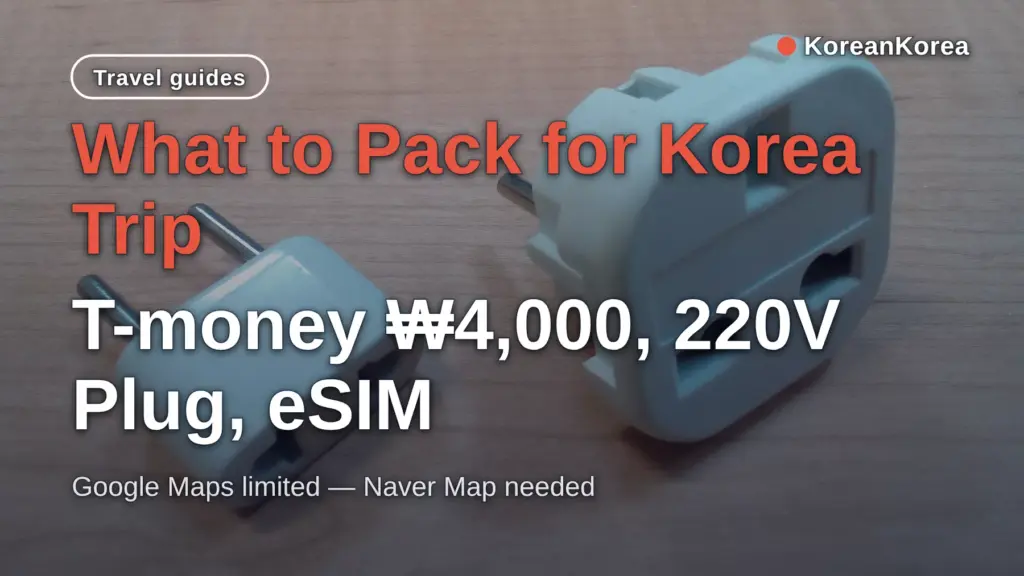
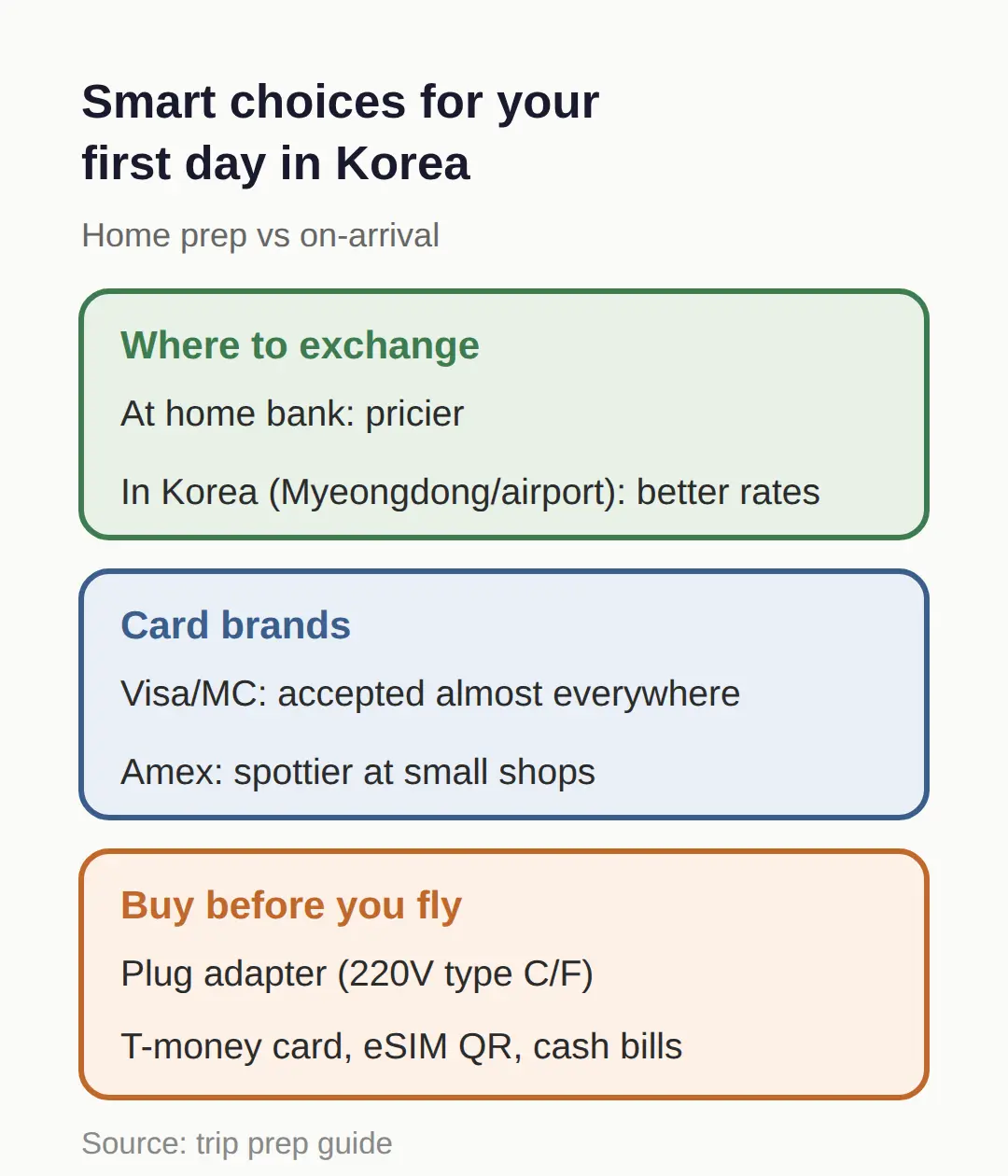
Skip these and you feel it on day one: a type C/F round-pin adapter (US and Japan flat pins do not fit), a T-money card that costs ₩4,000 at any convenience store, about ₩30,000–50,000 in small bills for markets, and an eSIM running about $3–5 a day.
What to Pack for Korea Trip: The Items You Won’t Want to Miss
| Plug adapter (type C/F, round pin) | Lendable at many hotel front desks; buy one before flying if you rely on it |
|---|---|
| T-money card | ₩4,000 at GS25, CU or 7-Eleven; loads and works nationwide |
| Cash for markets | About ₩30,000–50,000 in small bills per person |
| eSIM | About $3–5/day from Korean providers; save the QR code offline before you fly |
| Power bank under 160Wh | Max 2 per person, carry-on only under the rule effective April 20, 2026 |
| 1–2 ziplock bags | For trash — public bins are hard to find |
The Korea-only items are a plug adapter, a T-money card, small-bill cash, an eSIM, a power bank under the 2026 flight rule, and a bag for trash.
Generic lists cover clothes and toiletries.
They do not cover what actually breaks a first day in Seoul.
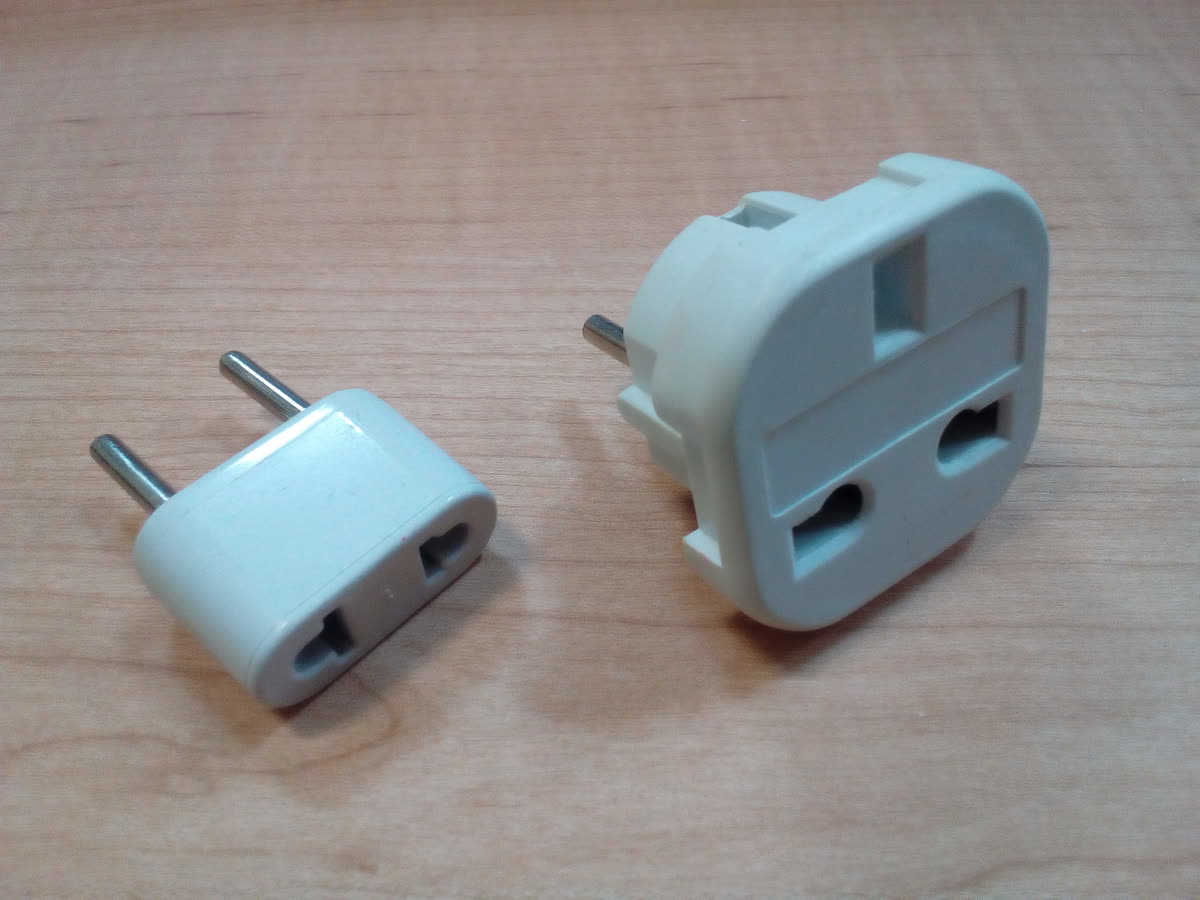
Korea runs 220V on type C/F Europlug round-pin sockets.
US and Japan flat-pin plugs go in nowhere without an adapter.
Cards work almost everywhere — subway, convenience stores, cafes.
Traditional markets and some small restaurants stay cash-only.
I look first at what you have to buy or set up before you fly — the adapter, the T-money card, the offline eSIM QR code — because those are the steps that fail from outside Korea.
If your trip starts in an airport convenience store, everything else can be bought on arrival.
Do Korean Outlets Work With US Plugs?
No — US flat-pin plugs need a type C/F round-pin adapter, and a converter is a separate question from an adapter.
Korea uses 220V on the Europlug Cee 7 standard, so the shape of your plug is the first problem.
For any single-voltage device you plan to plug in, check the label for a 100–240V rating before relying on the adapter alone, since dual-voltage chargers handle 220V safely while 120V-only devices can overheat.
Hair dryers and straighteners bought for 120V countries are the exception — check for a 100–240V label before packing one, because a 120V-only tool can overheat on 220V.
Many Korean hotels also keep a hair dryer in the room and lend plug adapters at the front desk.
If your only 220V risk is a hair tool, the adapter plus the hotel’s loaner usually settles it.
If the label says 100–240V, pack it without worry; if it does not, leave it home.
How Much Cash Should I Bring to Korea?
About ₩30,000–50,000 in small bills per person covers what cards cannot — markets and small restaurants.
The largest Korean note is ₩50,000 (about $37), so a stack of small bills is easy to carry.
Cards are accepted almost everywhere in cities, and Visa and Mastercard are near-universally taken; American Express acceptance is spottier at small shops.
On exchange, bringing your home currency in cash and exchanging it in Korea — at Myeongdong private exchanges or Incheon airport — generally beats buying KRW at your home bank.
As of late September 2026, ₩1,000 is roughly $0.75.
If you travel in early October, note that Chuseok closures can hit markets and some restaurants, so check the dates before planning around card-only spots.
If your days are convenience stores, subways and cafes, less cash is fine.
If market street food is the point of a day, carry the full ₩30,000–50,000 in small bills.
How Much Does a Korea eSIM Cost Per Day?
Traveler eSIM data plans run about $3–5 a day, or as 1GB/10GB short packages from Korean providers.
For a 5-day trip that is about $15–25 — often less than renting pocket wifi for one.
You have three ways to get connected: an eSIM bought online, a physical SIM at Incheon airport, or a pocket wifi unit, with pocket wifi usually the pricier option for a solo traveler.
Korean eSIMs typically activate only when you connect on arrival, so save the QR code offline before departure.
Seoul subway and most cafes offer free public WiFi, but coverage weakens outside Seoul, so a data plan is your backup.
Buy the eSIM online before you fly and screenshot the QR code.
If your phone does not support eSIM, the Incheon airport SIM counter is the fallback.
What Can You Skip? Hotels, Trains and Lockers Cover More Than You Think
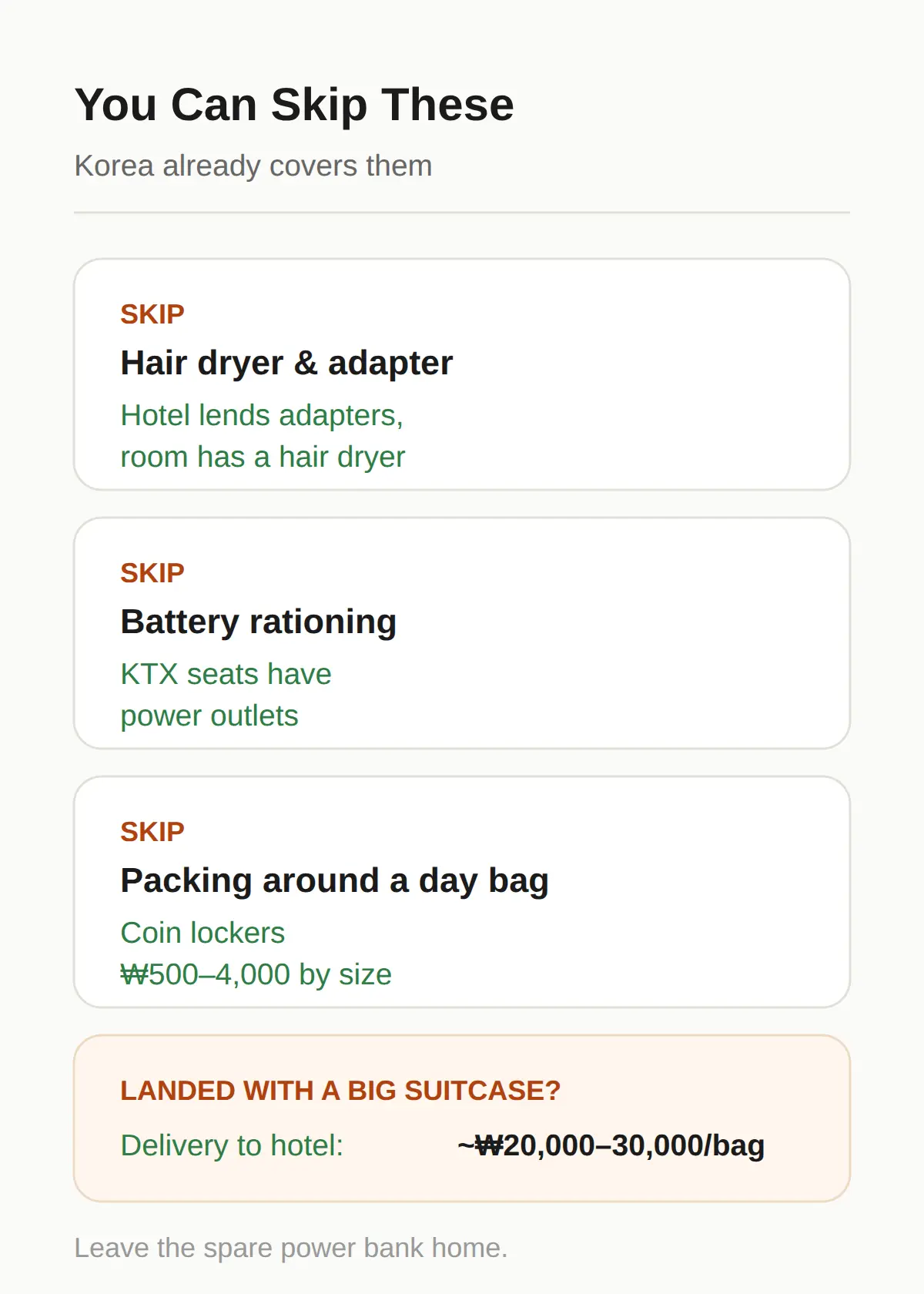
Skip packing hair tools, a second adapter, a huge suitcase and a battery stockpile.
The hotel front desk usually lends plug adapters and the room has a hair dryer.
KTX standard and economy seats have power outlets, so intercity train days do not need battery rationing.
Station and subway coin lockers run ₩500–4,000 by size, so storing a day bag is not a packing problem.
If you land with a big suitcase you regret, airport-to-hotel delivery services (TGO, Smart Luggage) charge roughly ₩20,000–30,000 per bag.
If you travel light on battery, the KTX outlets and locker fees mean you can leave the spare power bank home entirely.
What Changes by Season — and What You Only Learn on the Ground
Layers for autumn, a real coat for winter, a KF94 mask for spring — plus three ground rules: no tipping, scarce trash cans, and Korean apps.
Late September in Seoul runs roughly 15–25°C by day with cool evenings, so layers beat heavy gear.
December through February drops to roughly -10 to 5°C with wind chill, which is when thermal layers and a proper coat replace the light-jacket advice.
March to May can bring fine-dust days, and a KF94 mask earns its bag space.
There is no tipping culture, so do not carry extra cash for it.
Public trash cans are scarce — a ziplock or two in a pocket is the practical fix.
If it were me, I’d buy the T-money card at the first convenience store I see in the airport, because the card price is the same everywhere and I’d rather have it working on the airport train than hunt for a shop later.
Set up Naver Map and Papago before leaving home, because Google Maps walking directions barely work in Korea.
And do not build your plan around Kakao T or Coupang Eats until you confirm they accept your phone number — many Korean apps require a Korean number.
Related posts
📎 📅 Upcoming Dates — Release & Event Calendar
Sources
- March–May dust season, KF94 mask advised (breezekorea.com)
- Power bank rule (info.fandit.net)
- Checklist method (how-toai.com)
Quick checklist before you close your suitcase
- Adapter for type C/F round-pin sockets — one per person, plus the hotel loaner as backup.
- T-money card ₩4,000 at the first airport convenience store; loads nationwide.
- ₩30,000–50,000 in small bills per person, changed in Korea rather than at home.
- eSIM data runs about $3–5 per day, and the card activates only when you connect on arrival.
- Power banks: max 2 per person, each under 160Wh, carry-on only, never charged in flight.
FAQ
Q. What should I pack for a trip to Korea that I wouldn’t pack elsewhere?
A type C/F round-pin plug adapter, a T-money card (₩4,000), about ₩30,000–50,000 in small bills, and an eSIM. A ziplock for trash and a 160Wh-compliant power bank cover the rest of the Korea-specific list.
Q. Do Korean outlets work with US plugs?
Not without an adapter. Korea uses 220V on type C/F round-pin sockets, so US flat-pin plugs need an adapter, and 120V-only hair tools need a 100–240V label to be safe.
Q. How much cash should I bring to Korea?
About ₩30,000–50,000 in small bills per person. Cards cover subways, convenience stores and cafes; traditional markets and some small restaurants remain cash-only.
Q. How much does a Korea eSIM cost per day?
About $3–5 a day from Korean providers, or 1GB/10GB short packages. Pocket wifi works too but usually costs a solo traveler more.
Q. Is T-money worth it, or should I just use my credit card on the subway?
A T-money card costs ₩4,000 at GS25, CU or 7-Eleven and works on subways, buses and most taxis nationwide, plus payment at some convenience stores — for ₩4,000 it is the easier default.
Check the Chuseok dates if you fly in early October, and recheck airline power-bank rules within a week of departure.
Cover photo: Two AC Converter Adapters by Fructibus — CC0 1.0
#Koreatrippackinglist #Koreaplugadapter #T-moneycard #KoreaeSIM #Koreatraveltips #firsttimeinKorea
📅Upcoming Schedule — this week 21 · D-day Global rollout / overseas restock of September launches typiSee all →