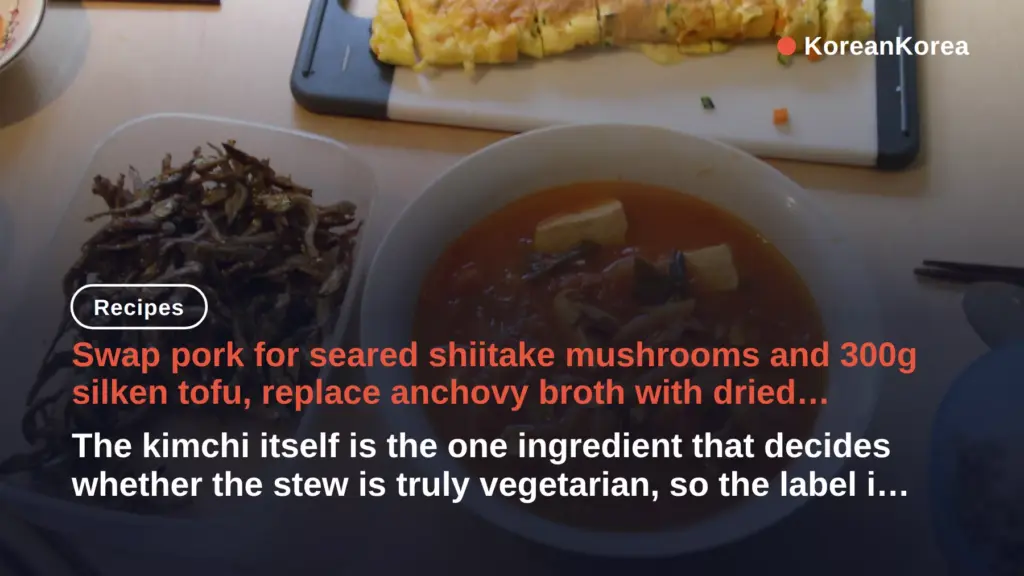
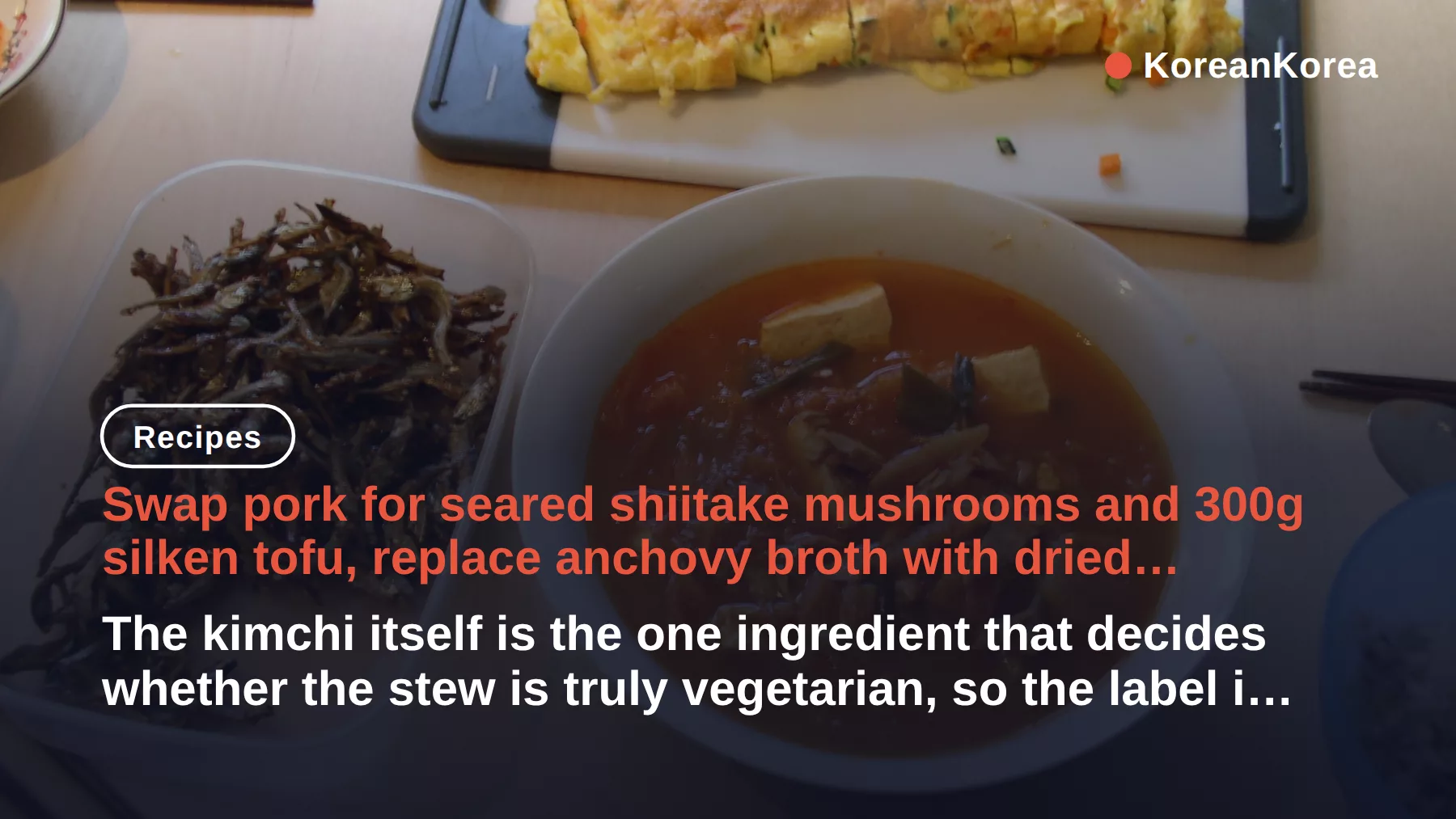
Vegetarian kimchi jjigae works when mushrooms and tofu carry the savory depth, dried shiitake plus kombu replaces the anchovy broth, and the kimchi itself is fish-sauce-free — the whole pot takes about 30 minutes and serves 4.
The one ingredient that decides everything is the kimchi, because most jarred kimchi already contains fish sauce or salted shrimp.
This post gives the full step order, the ingredient amounts, the timing that keeps the tofu soft, and what changes in taste without pork.
Contents
- Kimchi Jjigae Recipe Vegetarian: What Replaces Pork and Anchovy Broth
- Is regular kimchi vegetarian? (fish sauce and salted shrimp)
- Vegetarian kimchi jjigae ingredients (metric amounts, serves 4)
- When to add tofu (and egg) so it stays soft
- What changes in taste without pork
- Common mistakes and backup options
Kimchi Jjigae Recipe Vegetarian: What Replaces Pork and Anchovy Broth
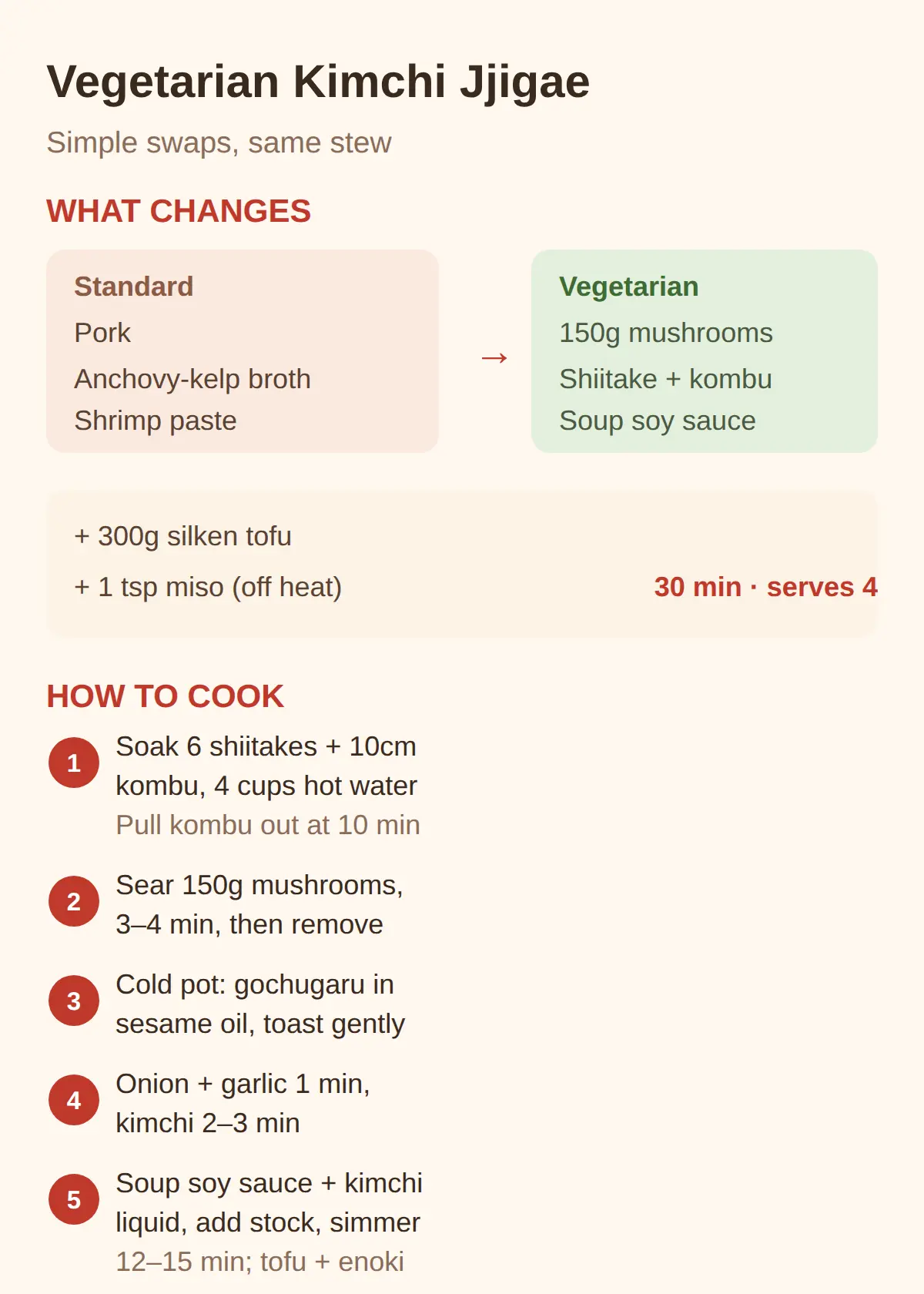
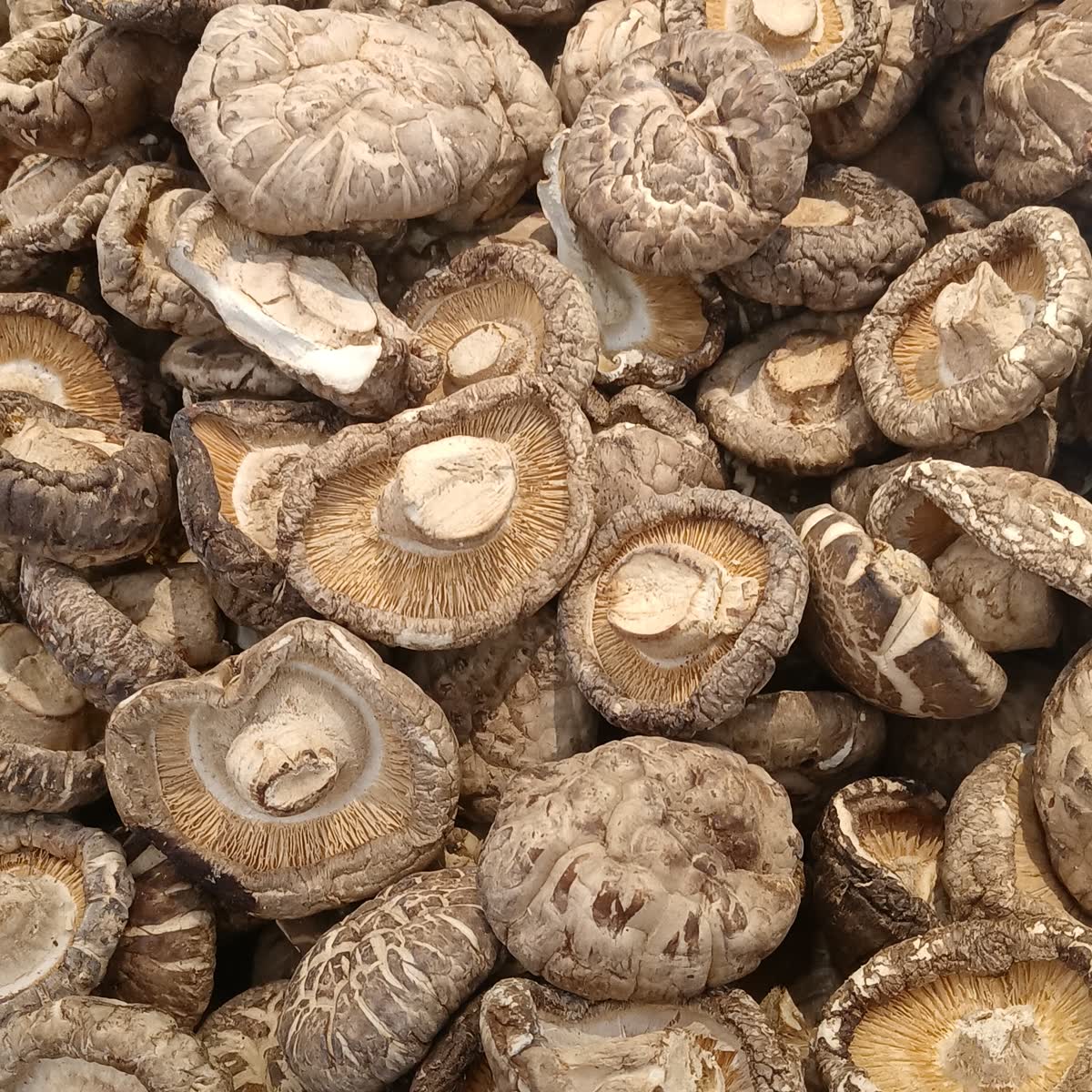
Pork is replaced by 150g of seared mushrooms (shiitake plus king oyster) and 300g of silken tofu, and the anchovy-kelp broth is replaced by a stock of 6 dried shiitakes and a 10cm piece of kombu soaked in 4 cups hot water.
Salted shrimp paste becomes soup soy sauce, and 1 teaspoon of miso or doenjang stirred in off the heat adds the fermented depth that fish sauce would have supplied.
The full pot finishes in about 30 minutes and serves 4.
Cook it in this order:
- Soak 6 dried shiitakes and 10cm of kombu in 4 cups hot water for 20–30 minutes; pull the kombu out after 10 minutes so the stock does not turn bitter, then slice the shiitakes.
- Sear 150g of mixed mushrooms in a little oil for 3–4 minutes until golden, then remove them from the pot.
- Start gochugaru in sesame oil in a cold pot and let it toast as the pot heats, which removes the raw chili flavor.
- Saute chopped onion and garlic for 1 minute, then cook the chopped kimchi 2–3 minutes, scraping up the browned bits.
- Deglaze with a splash of soup soy sauce plus the kimchi liquid, then pour in the shiitake-kombu stock.
- Simmer covered for 12–15 minutes, add the tofu and enoki for the last 3–5 minutes without hard stirring, and finish off the heat with 1 tsp sesame oil and sliced spring onions.
If you only change one thing from a standard recipe, change the broth — the shiitake-kombu stock is what keeps the stew tasting like kimchi jjigae rather than vegetable soup.
| Silken or soft tofu | 300g, sliced thick |
|---|---|
| Dried shiitake mushrooms | 6, plus a 10cm piece of kombu |
| Hot water for stock | 4 cups |
| Gochugaru (Korean chili flakes) | 1 tbsp |
| Gochujang | 1 tbsp |
| Soup soy sauce (guk-ganjang) | 1 tbsp |
| Garlic, minced | 3 cloves |
Is regular kimchi vegetarian? (fish sauce and salted shrimp)
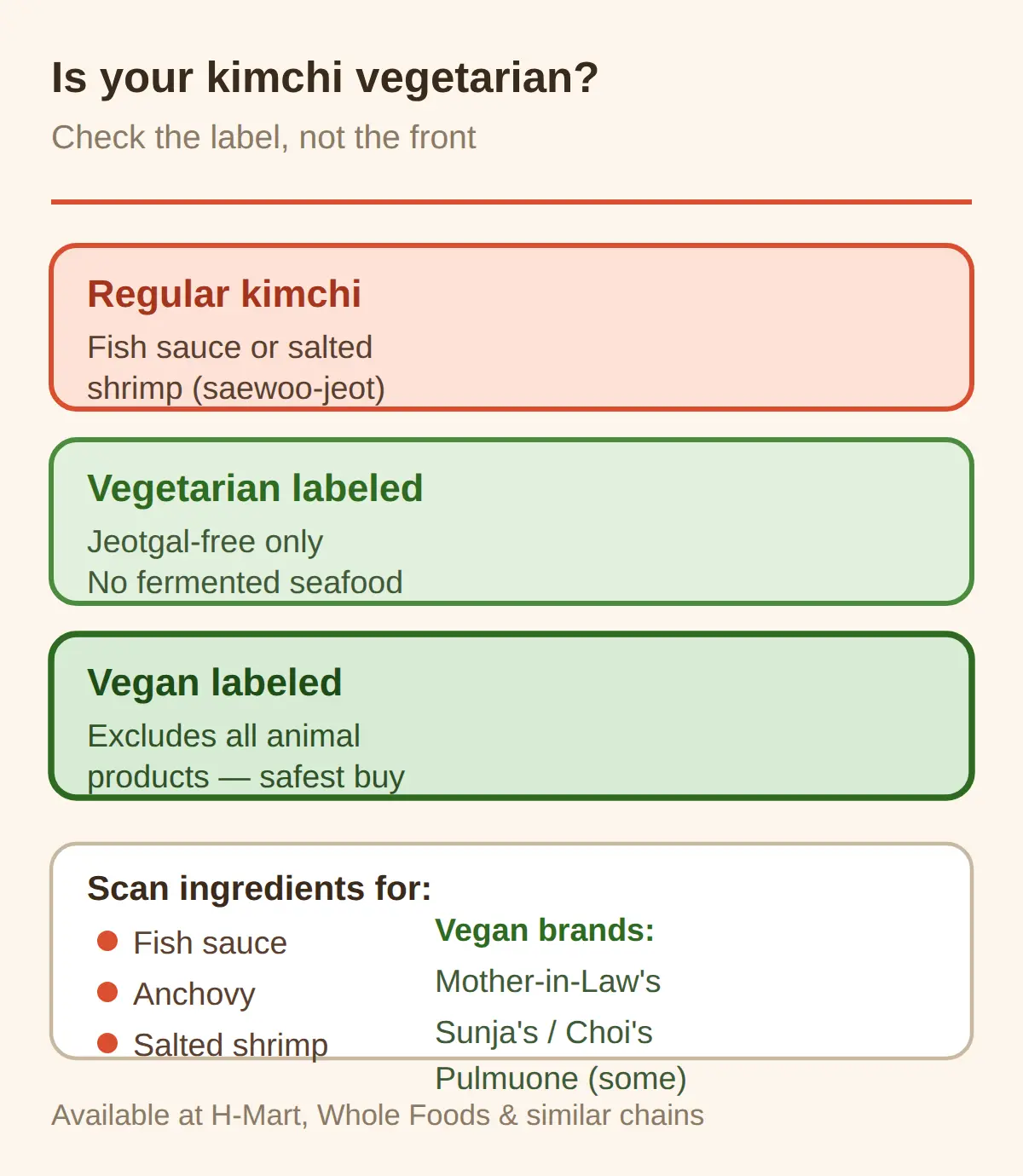
Most jarred kimchi is not vegetarian, because it is made with fish sauce or salted shrimp (saewoo-jeot).
That means the kimchi — not the broth — is the ingredient that decides whether your jjigae is actually meatless, and the front label alone is not enough to go on.
When I look at a jarred kimchi for a vegetarian jjigae, the first thing I check is the ingredient list for fish sauce, anchovy, or salted shrimp — not the word ‘kimchi’ on the front.
Kimchi labeled vegan specifically is the safer buy, because a vegan label excludes all animal products, while a vegetarian-labeled (jeotgal-free) kimchi only guarantees no fermented seafood.
Several dedicated vegan kimchi lines are stocked at H-Mart, Whole Foods, and similar chains: Mother-in-Law’s, Sunja’s, Choi’s Kimchi Company, and certain Pulmuone products.
A vegan label is a stricter check than a vegetarian one, and even then the ingredient list is worth a scan.
If your store carries only regular kimchi, the stew will still taste right — it just will not be fully vegetarian, so that is a call about how strict you need the dish to be.
Vegetarian kimchi jjigae ingredients (metric amounts, serves 4)
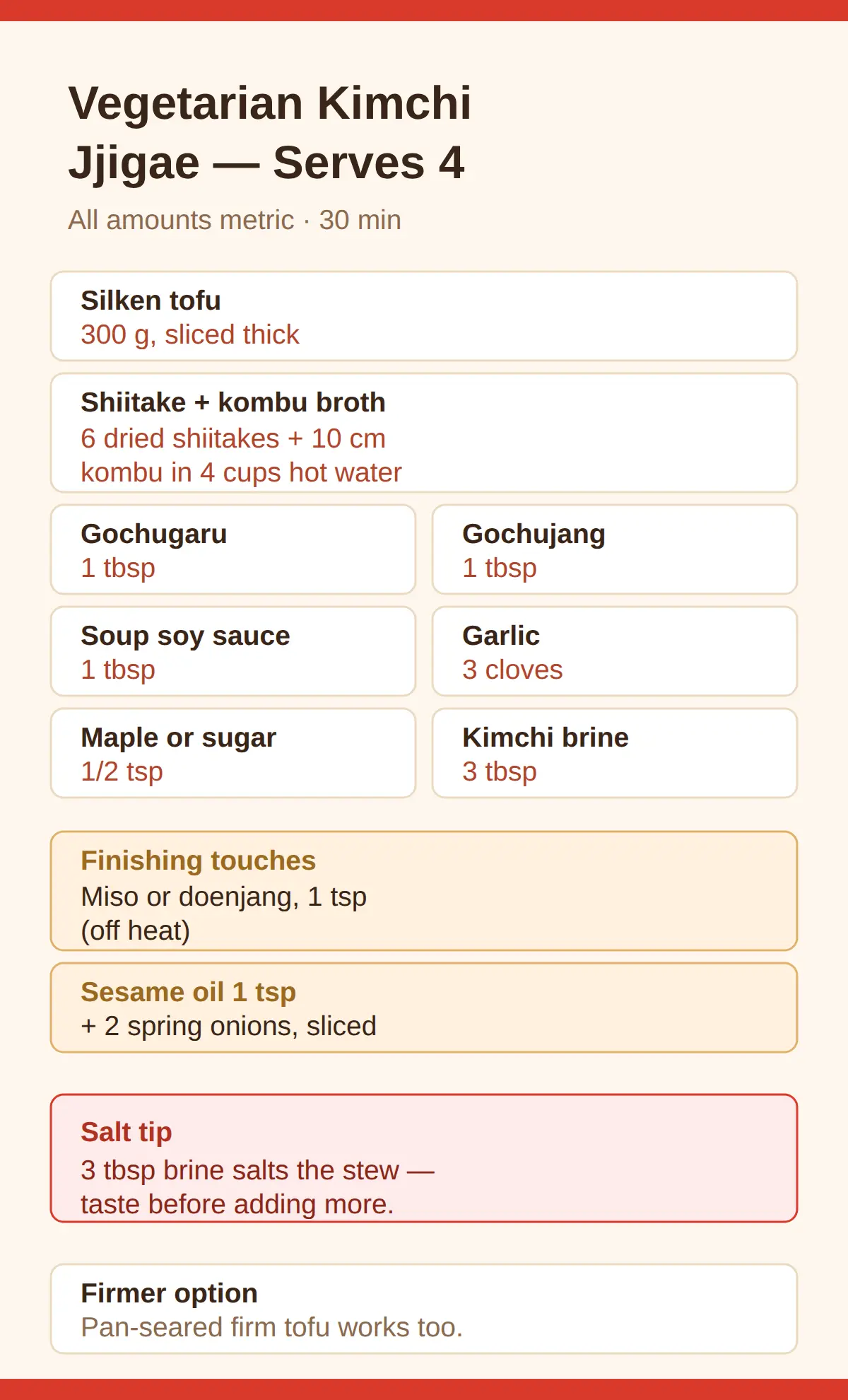
The full list is 300g silken tofu, a stock of 6 dried shiitakes plus 10cm kombu in 4 cups hot water, 1 tbsp gochugaru, 1 tbsp gochujang, 1 tbsp soup soy sauce, 3 cloves garlic, 1/2 tsp maple syrup or sugar, and 3 tbsp kimchi brine.
Two finishing touches complete it: 1 tsp miso or doenjang stirred in off the heat, and 1 tsp sesame oil with 2 sliced spring onions at the end.
| Ingredient | Amount (metric) |
|---|---|
| Silken or soft tofu | 300g, sliced thick |
| Dried shiitake + kombu | 6 mushrooms + 10cm, in 4 cups hot water |
| Gochugaru | 1 tbsp |
| Gochujang | 1 tbsp |
| Soup soy sauce (guk-ganjang) | 1 tbsp |
| Garlic | 3 cloves |
| Maple syrup or sugar | 1/2 tsp |
| Kimchi brine | 3 tbsp |
| Miso or doenjang (off heat) | 1 tsp |
| Sesame oil + spring onions (finish) | 1 tsp + 2, sliced |
The 3 tbsp of brine supplies most of the salt, so taste at the end before adding any extra salt.
If you prefer firmer tofu in the broth, pan-seared firm tofu is a listed variation — but silken is the type that absorbs the fiery broth.
When to add tofu (and egg) so it stays soft
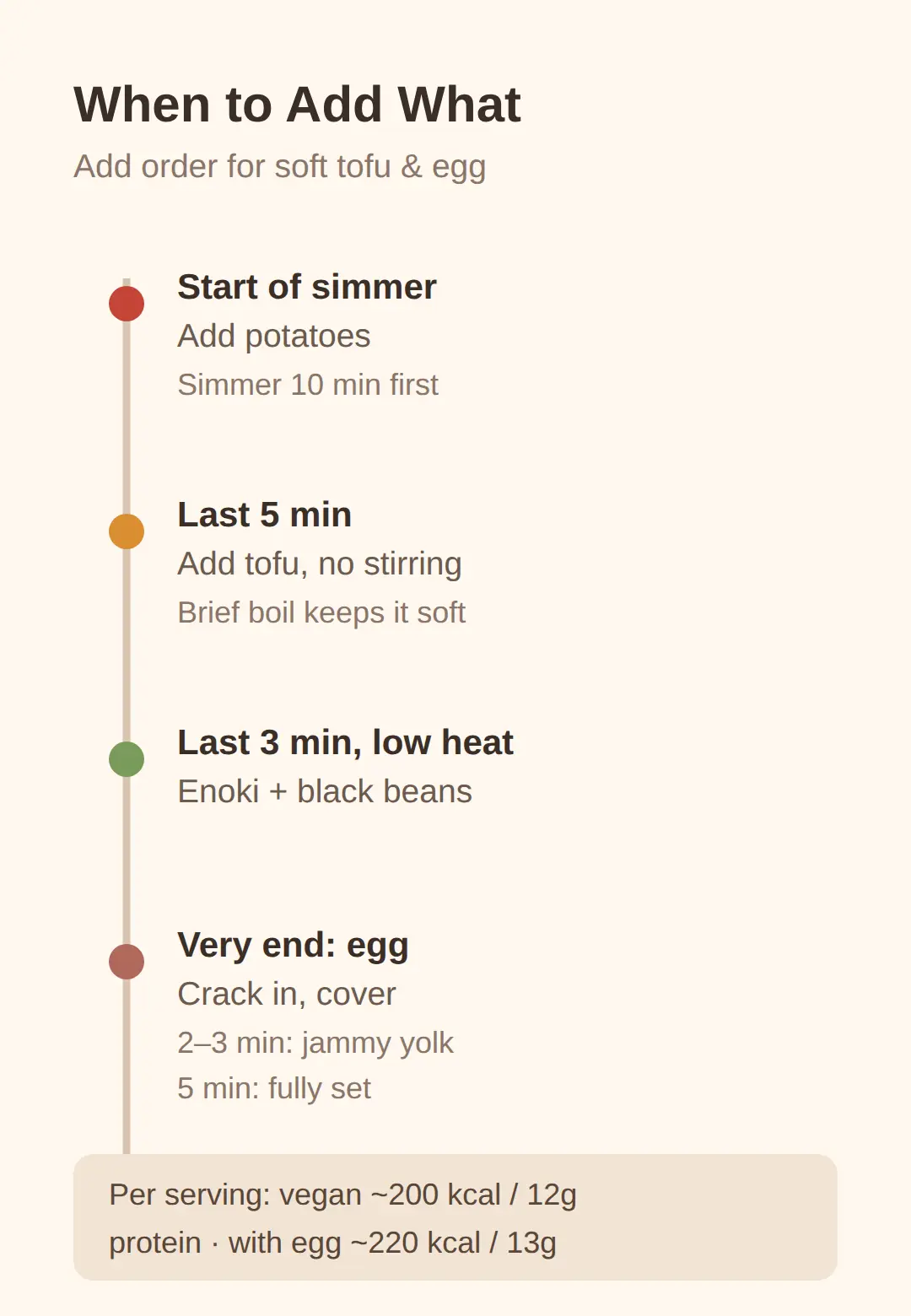
Tofu goes in during the final 3–5 minutes of simmering, without hard stirring, and an egg (vegetarian version) is cracked in at the very end.
An official jjigae recipe from Korea’s culture center gives the reason: tofu should boil only briefly to stay soft, which is why it always goes in last rather than at the start.
Enoki mushrooms and black beans join in the last 3 minutes on low heat so they absorb the broth without falling apart.
For the egg, cover and simmer 2–3 minutes for a jammy set or 5 minutes for a fully set yolk.
One full pot of the vegan version serves 4 at about 200 calories and 12g protein per serving — roughly 800 kcal and 48g protein for the whole pot — while the egg-allowed vegetarian version lands at about 220 calories and 13g protein per serving.
If you are adding potatoes, they need about 10 minutes of simmering before the quick-cooking items go in, so start them right after the stock goes in.
What changes in taste without pork
Without pork you lose the rendered fat and meaty chew, and mushrooms seared like browning meat are what hold both — they are seared separately for 3–4 minutes until golden, removed, then returned with the stock.
Three substitutions cover the rest: saewoo-jeot (salted shrimp) becomes soup soy sauce, fish sauce’s depth comes from 1 tsp miso or doenjang stirred in off the heat, and the anchovy-kelp broth becomes the shiitake-kombu stock.
The sourness backbone stays the same, because it comes from aged kimchi plus 3 tbsp of kimchi brine rather than from any meat.
| Standard jjigae | Vegetarian jjigae | |
|---|---|---|
| Main protein | Pork, stir-fried first | Mushrooms seared 3–4 min like browning meat, plus tofu |
| Broth | Anchovy-kelp | Dried shiitake + kombu stock |
| Shrimp paste | Saewoo-jeot | Soup soy sauce (guk-ganjang) |
| Fish sauce depth | Fish sauce | 1 tsp miso or doenjang, off heat |
| Sourness backbone | Aged kimchi + brine | Aged kimchi + 3 tbsp brine (same) |
Both versions finish in about 30 minutes and serve 4, with tofu and enoki going in only during the final 3–5 minutes.
If you have eaten the standard version before, expect a lighter pot — one of the lightest jjigae variants at about 200 calories and 12g protein per serving — but the same sour, spicy backbone.
Common mistakes and backup options
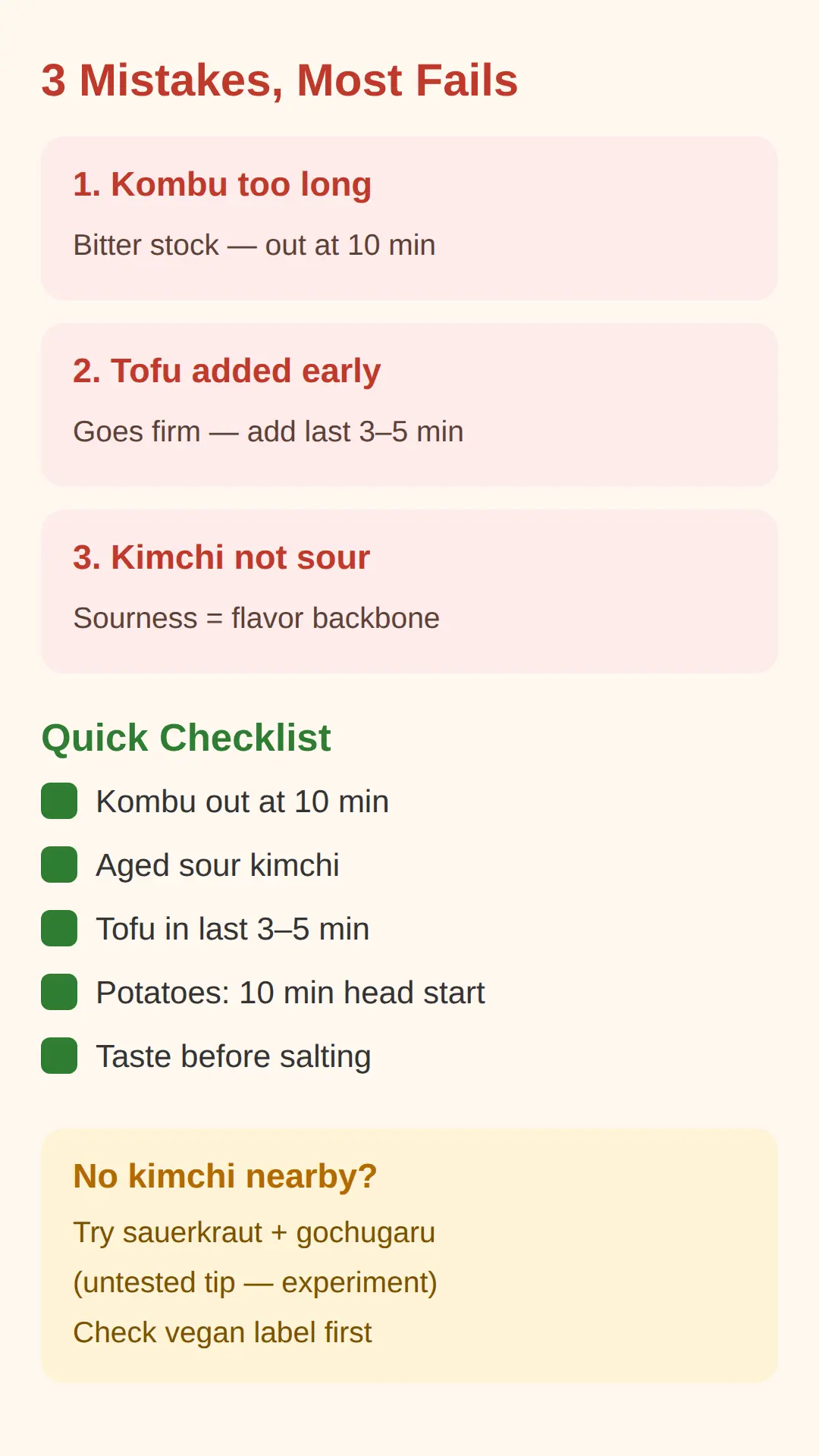
Three mistakes account for most failed pots: kombu left in past 10 minutes (the stock turns bitter), tofu added early (it goes firm instead of staying soft), and kimchi that is not sour enough (the whole flavor backbone is missing).
Use kimchi that is more sour than you would eat plain — sourness is the flavor backbone of jjigae, not a flaw.
If your kimchi is still fresh, one recipe suggests a little more sugar or a very small amount of vinegar to balance it, though that single-source tip is not confirmed by a second recipe.
- Remove the kombu after 10 minutes of soaking.
- Use aged (sour) kimchi — sourness is required, not optional.
- Hold the tofu until the last 3–5 minutes.
- If potatoes are in the pot, give them about 10 minutes before anything quick-cooking goes in.
- Taste before salting — the 3 tbsp of brine already carries most of the salt.
If Korean kimchi itself is hard to find where you live, one recipe suggests sauerkraut or pickled cabbage from an Asian market as a base with gochugaru added, but that substitution comes from a single untested source, so treat it as an experiment rather than a settled swap.
If I were cooking this for a vegan guest, I would pick the kimchi first — verify the vegan label and the ingredient list — because everything else in the pot can be built from pantry staples in 30 minutes, but a fishy kimchi cannot be fixed afterward.
Related posts
Sources
- Vegan-labeled kimchi brands at H-Mart/Whole Foods; silken to (kimchiguide.com)
- Tofu timing rule (official) (korean-culture.org)
- Roast gochugaru in cold pot, deglaze with soy sauce + kimchi (thekoreanvegan.com)
What to check after you finish reading
- Read the kimchi ingredient list for fish sauce, anchovy, or salted shrimp — never trust the front label alone.
- Vegan-certified kimchi brands to look for at H-Mart and Whole Foods: Mother-in-Law’s, Sunja’s, Choi’s Kimchi Company, some Pulmuone products.
- Pull the kombu out after 10 minutes of soaking so the stock stays sweet instead of bitter.
- Tofu goes in for the last 3–5 minutes only; a vegetarian egg cracks in at the very end — 2–3 min jammy, 5 min fully set.
- Taste before salting: the 3 tbsp of kimchi brine usually covers the pot.
FAQ
Q. What do I substitute for pork and fish sauce in kimchi jjigae?
Seared shiitake and king oyster mushrooms (150g) replace the pork, dried shiitake plus kombu stock replaces the anchovy-kelp broth, and soup soy sauce with 1 tsp miso or doenjang replaces salted shrimp and fish sauce.
Q. Is store-bought kimchi vegetarian?
Usually not — most jarred kimchi contains fish sauce or salted shrimp, so check the ingredient list. Vegan-labeled brands like Mother-in-Law’s, Sunja’s, and Choi’s Kimchi Company are stocked at H-Mart and Whole Foods.
Q. What can I use instead of anchovy broth in kimchi jjigae?
A stock of 6 dried shiitakes plus a 10cm piece of kombu soaked in 4 cups hot water for 20–30 minutes, with the kombu pulled out after 10 minutes to keep it from turning bitter.
Q. When do I add tofu so it stays soft?
In the final 3–5 minutes of simmering, without hard stirring — an official jjigae recipe says tofu should only boil briefly to stay soft.
Q. How long does vegetarian kimchi jjigae take, and how much does it make?
About 30 minutes and it serves 4 — one full pot of the vegan version is roughly 800 kcal and 48g protein, at about 200 calories and 12g protein per serving.
Check your kimchi jar for fish sauce or salted shrimp before you start — that single line on the label decides whether this pot is truly vegetarian.
Cover photo: Korean cuisine-Gyeranmari, Kimchi stew, Myeolchi bokkeum by Jens Ohlig — CC BY-SA 2.0
#kimchijjigae #vegetariankoreanfood #tofustew #mushroombroth #vegankimchi #30minuterecipe
📅Upcoming Dates — 이번 주 32 · D-day Chuseok holiday period — rice cake interest peaks전체 보기 →