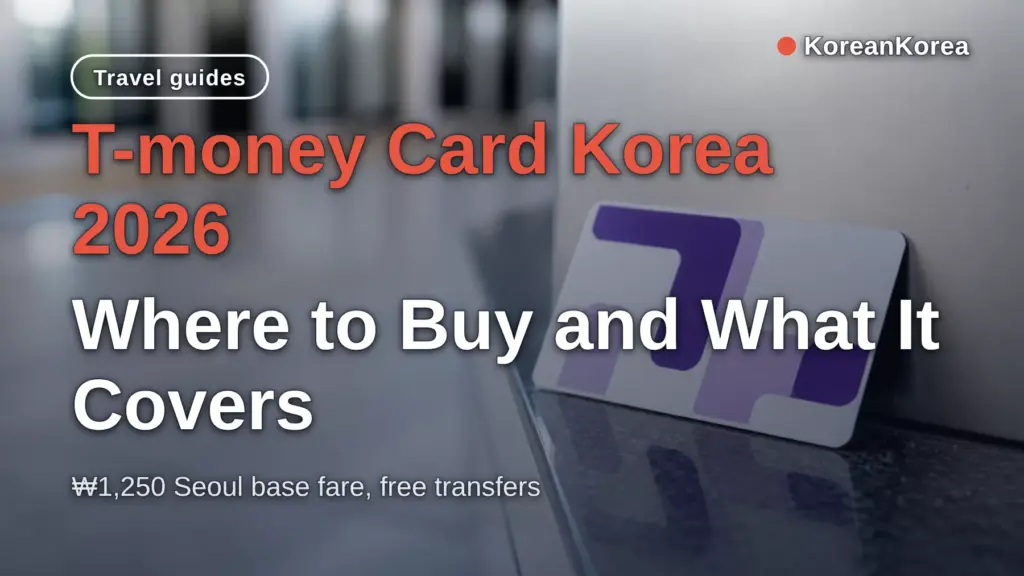
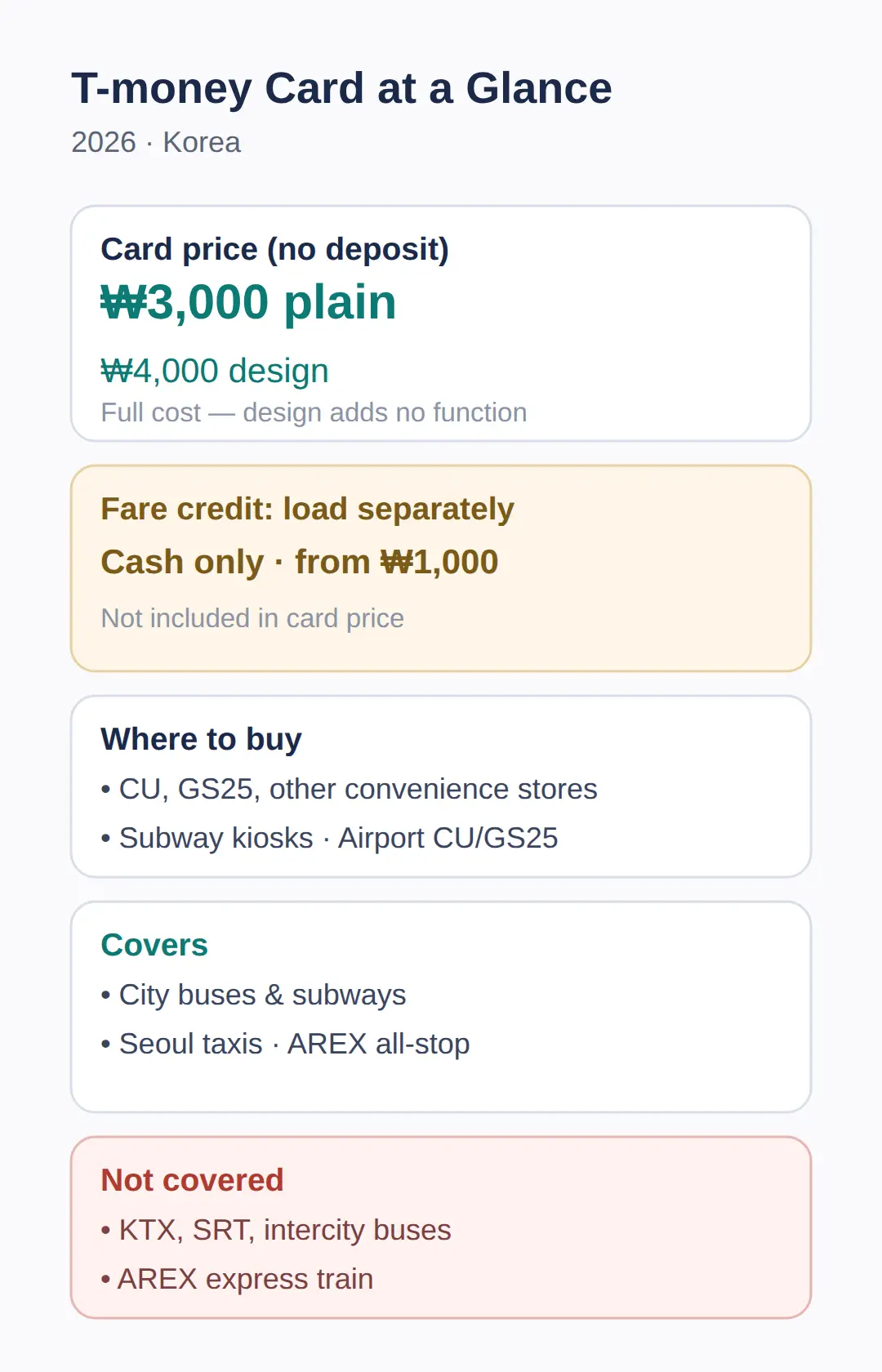
A standard T-money card costs ₩3,000 (branded designs ₩4,000) with no separate deposit, per the official T-money site as of 2026.
Top-up is cash only at CU, GS25 counters and subway reload machines, so bring bills when you buy the card.
This post covers the price, where to buy and top up, subway and bus fares and transfer rules, and the trains T-money does not cover.
Key facts — As of 2026-10-13
- A standard T-money card costs ₩3,000 (branded designs ₩4,000) with no separate deposit, per the official T-money site as of 2026.
- Top-up is cash only at CU, GS25 counters and subway reload machines; card payment is generally not accepted as of 2026.
- The Seoul subway and city bus base fare is ₩1,250 with T-money, and a free or discounted transfer within 30 minutes applies when tapping the same card.
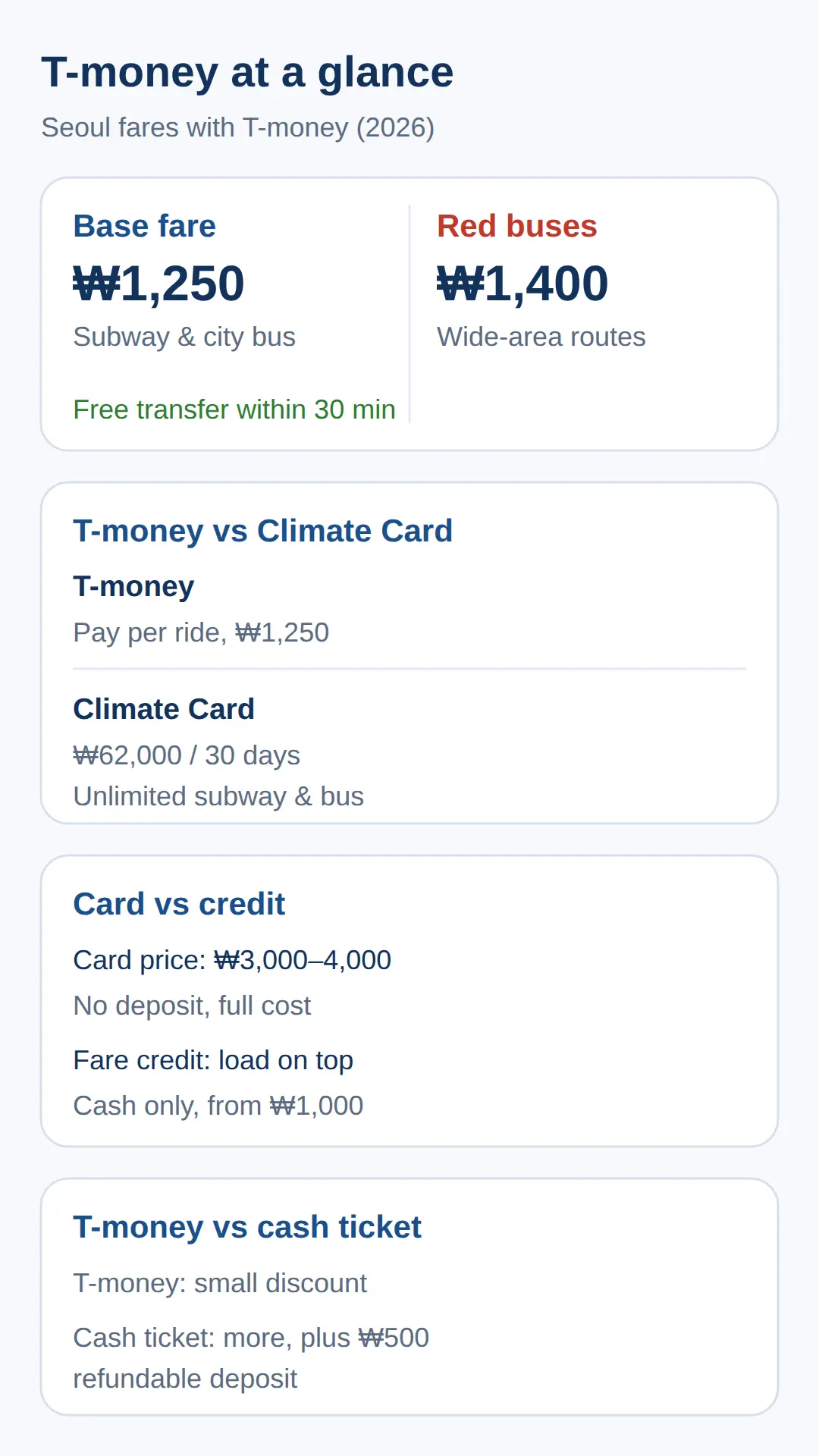
- Seoul’s Climate Card costs ₩62,000 for 30 days of unlimited subway and bus rides (2026 price — re-check the official page before publishing).
How to Use a T-money Card: What It Costs and Where to Buy It
| Standard card | ₩3,000, no deposit |
|---|---|
| Branded / character design card | ₩4,000, no deposit |
| Top-up | Cash only, ₩1,000 minimum |
| Seoul subway base fare | ₩1,250 |
| Seoul city bus base fare | ₩1,250 (₩1,400 red wide-area buses) |
| Seoul Climate Card | ₩62,000 for 30 days, unlimited subway and bus |
A standard T-money card costs ₩3,000 and branded or character designs cost ₩4,000, with no separate deposit (official T-money site, 2026).
The ₩3,000–4,000 is the card cost only — no fare credit is included, so you load money separately.
Cards are sold at CU, GS25 and other convenience stores, at subway station kiosks, and at CU and GS25 stores inside Incheon Airport.
First thing I check before anything else is where you buy it and whether you can top it up with a card, because the cash-only top-up is what catches people at the store counter.
If you just want a plain card, pay ₩3,000; pay ₩4,000 only if you want a design, because the extra money buys nothing functional.
How to Top Up: Cash Only, Step by Step
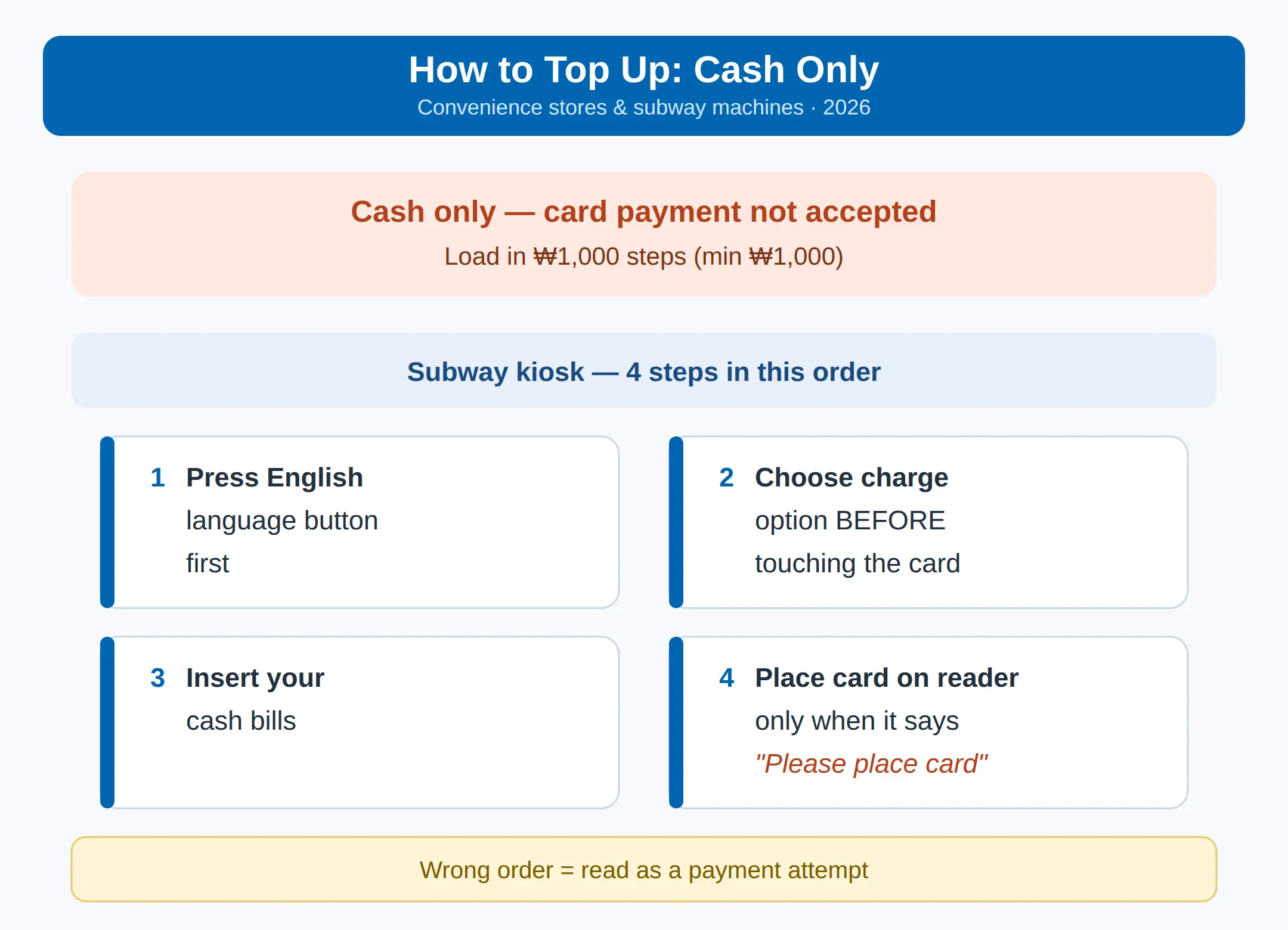
Top-up is cash only at convenience store counters and subway reload machines; card payment is generally not accepted (2026).
Reload machines and store counters add value in ₩1,000 increments, so the smallest load is ₩1,000.
At a subway kiosk, do it in this order:
- Press the English language button first.
- Choose the charge (reload) option before touching the card.
- Insert your cash bills.
- Place the card on the reader only when the machine says "Please place card".
The recurring problem is skipping the English menu or putting the card on the reader before choosing charge — the machine then reads the card as a payment attempt.
If you land with no won cash, withdraw at the airport before buying the card, or buy the card at an airport CU and get cash at the same time.
How to Use It on the Subway and Buses
The Seoul subway and city bus base fare is ₩1,250 with T-money, and red wide-area buses cost ₩1,400 (Seoul Metro and TOPIS, 2026).
Free or discounted transfers between subway and buses in the Seoul capital area apply when you tap the same card, typically one free transfer within 30 minutes.
On buses, tap the reader when you board AND when you get off — the exit tap is required for the transfer discount and the correct fare.
Each rider needs their own card; a single card cannot be tapped twice for two people, so a family of four needs four cards.
Ride less than a few times a day and the pay-per-ride card is the simple choice; riding in a group means counting cards, not sharing one.
Where T-money Does NOT Work
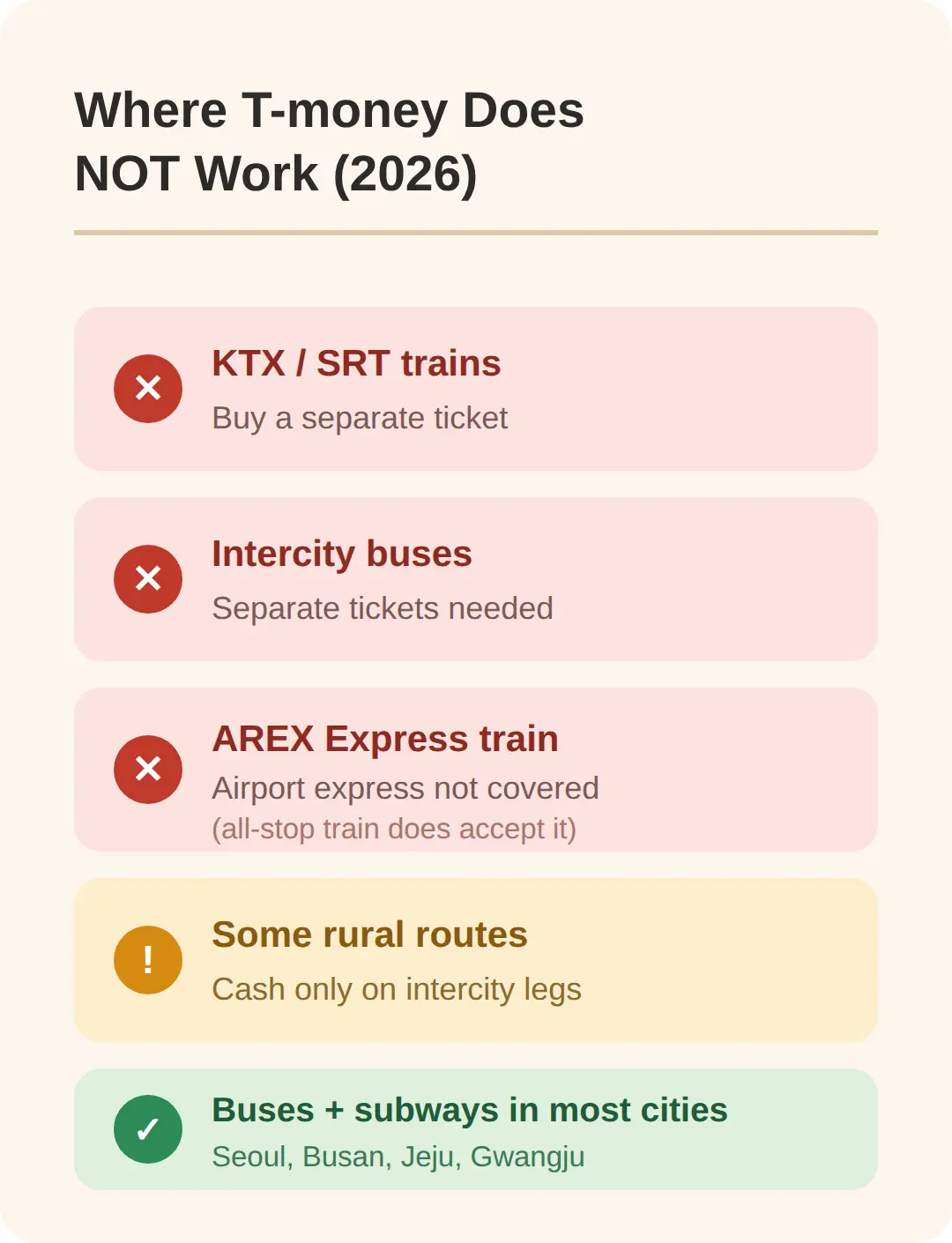
T-money does not cover KTX, SRT high-speed trains or intercity buses — those need separate tickets (2026).
The AREX airport express train to Incheon Airport is not covered either; the slower all-stop commuter train on the same line does accept T-money.
T-money works on buses and subways in most Korean cities including Seoul, Busan, Jeju and Gwangju, but some rural intercity routes are cash-only.
The AREX split is the trap most visitors hit: with luggage and a schedule, decide before boarding whether the express ticket is worth it, or budget extra minutes for the all-stop train.
If you have not bought a KTX or SRT ticket yet, buy it separately at the station or online — tapping T-money at the gate will not open it.
Refunds and the Climate Card Alternative
Unused stored value is refundable at card-refund machines and affiliate stores; the card purchase price itself is not refunded (2026).
So ₩2,000 left on the card is worth claiming, but the ₩3,000 card cost is spent.
Seoul’s Climate Card costs ₩62,000 for 30 days of unlimited subway and bus rides (2026 price — check the official page before your trip).
At the ₩1,250 base fare, ₩62,000 buys about 50 T-money rides, or roughly ₩2,067 per day over 30 days.
For a short first visit I would just buy the ₩3,000 standard card and load small amounts; the Climate Card only pays off if you ride more than about twice a day for a full month, which is rare on a 5–7 day trip.
Related posts
📎 Seoul — everything we know
📎 apple pay korea subway
📎 📅 Upcoming Dates — Release & Event Calendar
Sources
- Source page lists ‘T-money card guide’ as a separate travel- (touristsinsider.com)
- Official site card type/price pages — dynamic, not opened th (tmoney.co.kr)
- 2026-dated travel guide covering transit card real-use persp (travlists.com)
T-money Card Tips
- Buy the ₩3,000 standard card and carry cash — the card price includes no fare and top-up is cash only.
- Tap off the bus when you get off, or the transfer discount will not apply.
- For the airport, use T-money on the AREX all-stop train only; the express train and KTX need separate tickets.
FAQ
Q. Where do I buy a T-money card and can I top it up with a card?
Buy it at CU, GS25 or other convenience stores, subway station kiosks or inside Incheon Airport. Topping up is cash only at store counters and subway reload machines; card payment is generally not accepted as of 2026.
Q. How much does a T-money card cost in Korea?
A standard card costs ₩3,000 and branded designs ₩4,000, with no separate deposit. The price is the card only — you load fare credit on top, starting from ₩1,000 in cash.
Q. Can I use T-money on the AREX airport train?
Yes on the AREX all-stop commuter train, no on the AREX express. KTX, SRT and intercity buses are not covered either and need separate tickets.
Q. How do I get a refund on my T-money card?
Refund unused stored value at card-refund machines or affiliate stores; the card price itself is not refunded. Balance is shown on subway gates and station kiosks after tapping.
Next on the calendar: Seoul Climate Card prices occasionally change, so re-check the official page before a trip longer than two weeks.
Cover photo: AI-generated illustration (subway card) — AI-generated image, illustrative only
#koreatravel #t-moneycard #seoulsubway #koreatransportation #firsttriptokorea
📅Upcoming Schedule — D-10 MAMA 2026 ceremony (exact date/venue not yet confirmed in thSee all →Last updated 2026-11-14. Editorial policy