Cook Korean fried chicken in an air fryer at 400F (about 200C) for 15 minutes, flip and cook 5 more minutes, cool 5 minutes, spray with oil, then a final 5 minutes at 400F before tossing in sauce.
That schedule replaces the double deep-fry, and the whole recipe — 1 lb of wings, sauce included — finishes in about 30 minutes for two people.
This post covers the stage-by-stage timing, the starch coating, the sweet-spicy sauce, the oil-spray and basket setup, storage, and how the texture compares to deep-fried.
Contents
- Korean fried chicken recipe air fryer: 400F two-stage timing
- Coating: corn starch or flour?
- The sweet-spicy gochujang sauce
- Getting it crispy: oil spray and basket setup
- Storing and reheating leftovers
- Compared to deep-fried, and what to serve
Korean fried chicken recipe air fryer: 400F two-stage timing
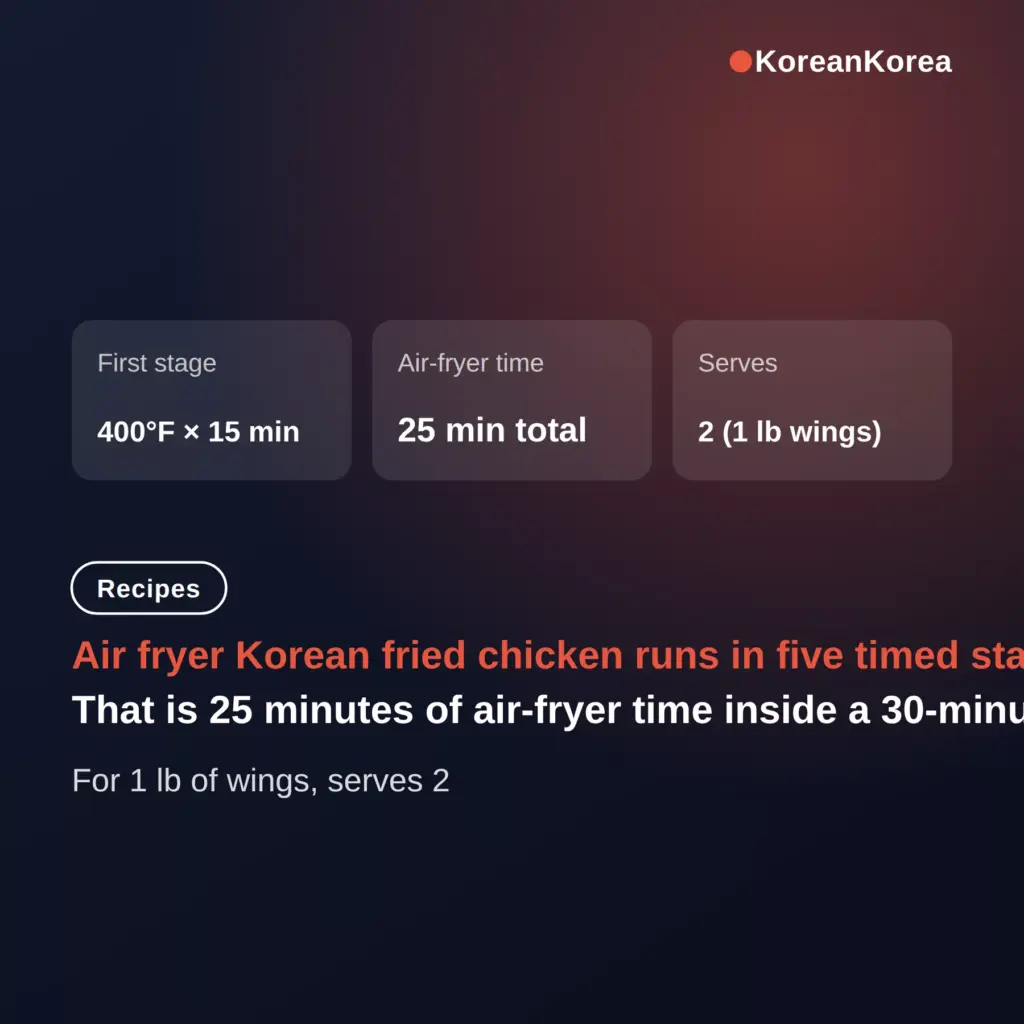
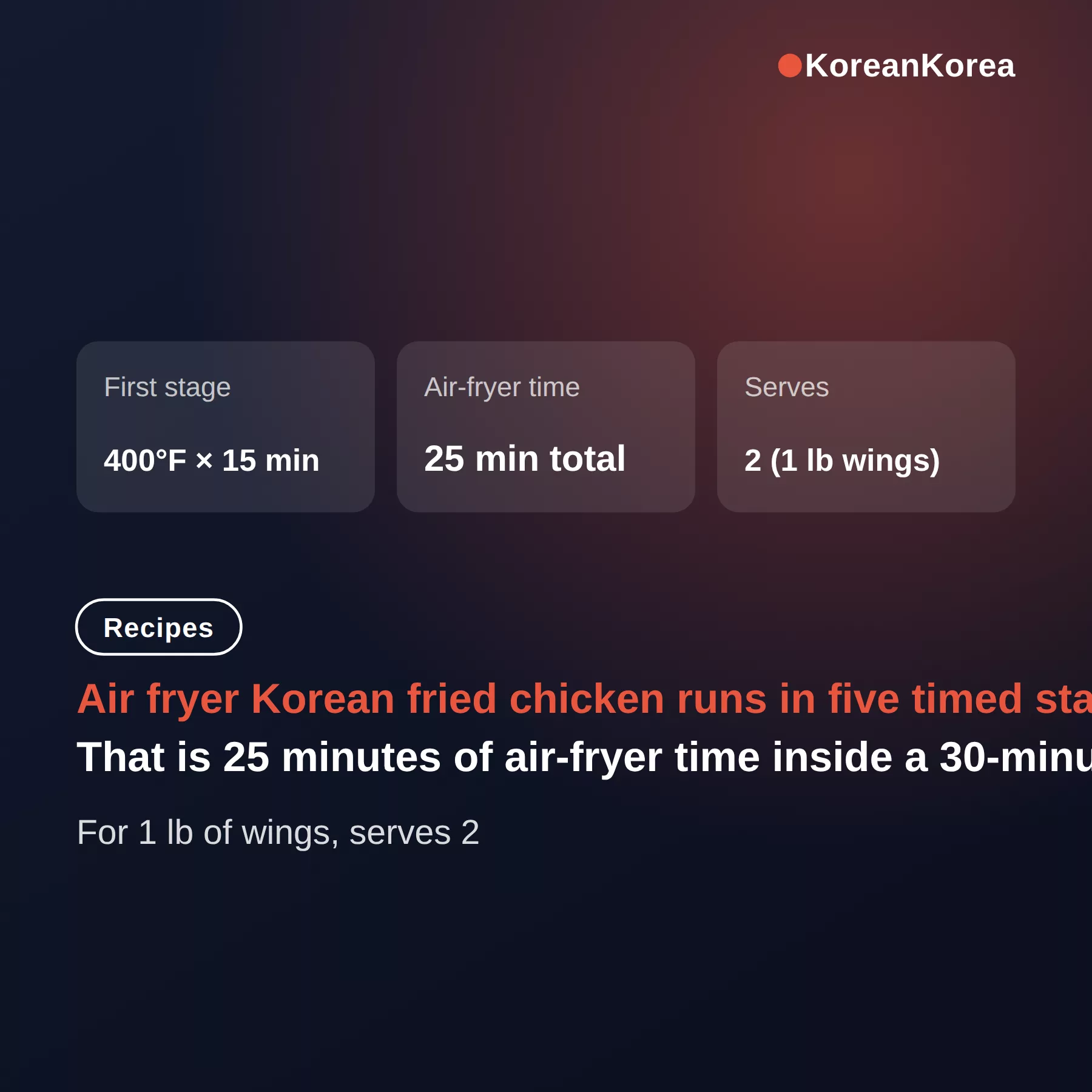
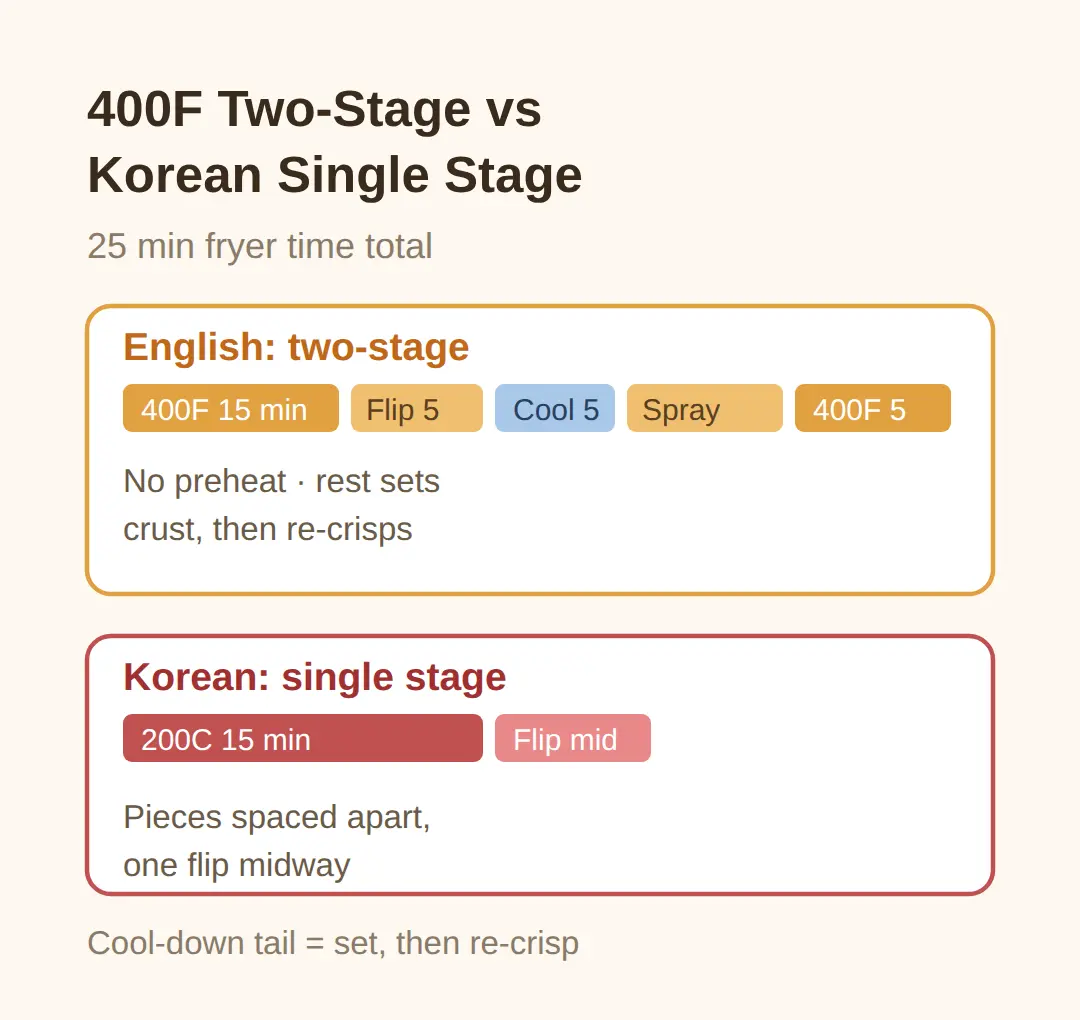
The two-stage method runs 400F (about 200C) for 15 minutes with no preheat, then flip and 5 more minutes, a 5-minute rest, a light oil spray, and a final 5 minutes at 400F — 25 minutes of fryer time total.
That adds up inside a 30-minute recipe: 5 minutes of prep while the sauce comes together in parallel.
Start with the chicken coated in oil, salt, pepper, and corn or potato starch, arranged in a single layer.
The 5-minute rest between the second and final fry is not idle time — it mimics the cool-down that Korean fried chicken gets between its two deep-fry rounds, so the crust sets and then re-crisps.
Both the English and the Korean-language recipes put the first stage at 200C for 15 minutes, with pieces spaced apart.
The English recipe adds the cool-and-refry tail; the Korean one stops at a single 15-minute cook with one flip midway.
When I look at an air-fryer fried chicken recipe, the first thing I check is whether the timing is split into stages — a single 25-minute block will not give you the crust that a set-then-re-crisp schedule does.
The no-preheat 400F schedule was not tested on lower-wattage machines, so watch the first batch on your own air fryer.
If your basket is small, run the same five stages in rounds rather than stacking pieces.
| Stage 1 — cook | 400F (about 200C), 15 minutes, no preheat |
|---|---|
| Stage 2 — flip | Flip, 5 more minutes at 400F |
| Stage 3 — rest | 5 minutes off heat |
| Stage 4 — oil | Light oil spray on the surface |
| Stage 5 — re-crisp | 400F, 5 minutes, then toss in sauce |
| Total air-fryer time | 25 minutes (15 + 5 + 5) |
Coating: corn starch or flour?
Coat the chicken with oil first, then salt and pepper, then corn or potato starch — the oil moves heat into the coating and the starch builds the light, crunchy shell.
Potato starch is the traditional Korean fried chicken coating, and cornstarch is its listed substitute; both appear in recipes for the same dish.
A flour-heavy dredge is not the default here — the recipes treat starch as the shell and flour only in a wet-batter variant.
If you prefer a wet batter, the Korean-language version mixes 200g flour, 100g starch, 100mL water, and 1 egg, dips the chicken, then dredges it in the remaining flour before a 15-minute cook at 200C with one flip.
Whether the wet-batter version crisps as well as the dry-starch coating has not been quantified by either source, and no direct cornstarch-versus-potato-starch comparison was found either.
What the sources do agree on is the ratio for the dry version: 3 tbsp corn starch per 1 lb of wings, a 3:1 wings-to-starch ratio by the tablespoon.
You only have cornstarch but the recipe says potato starch — use it; it is the listed swap, and both are traditional coatings.
Do not expect a measured answer on which is crispier in an air fryer, because that comparison has not been tested.
👉 Samgyetang Recipe Without a Spring Chicken: Supermarket Substitutions That Work
The sweet-spicy gochujang sauce
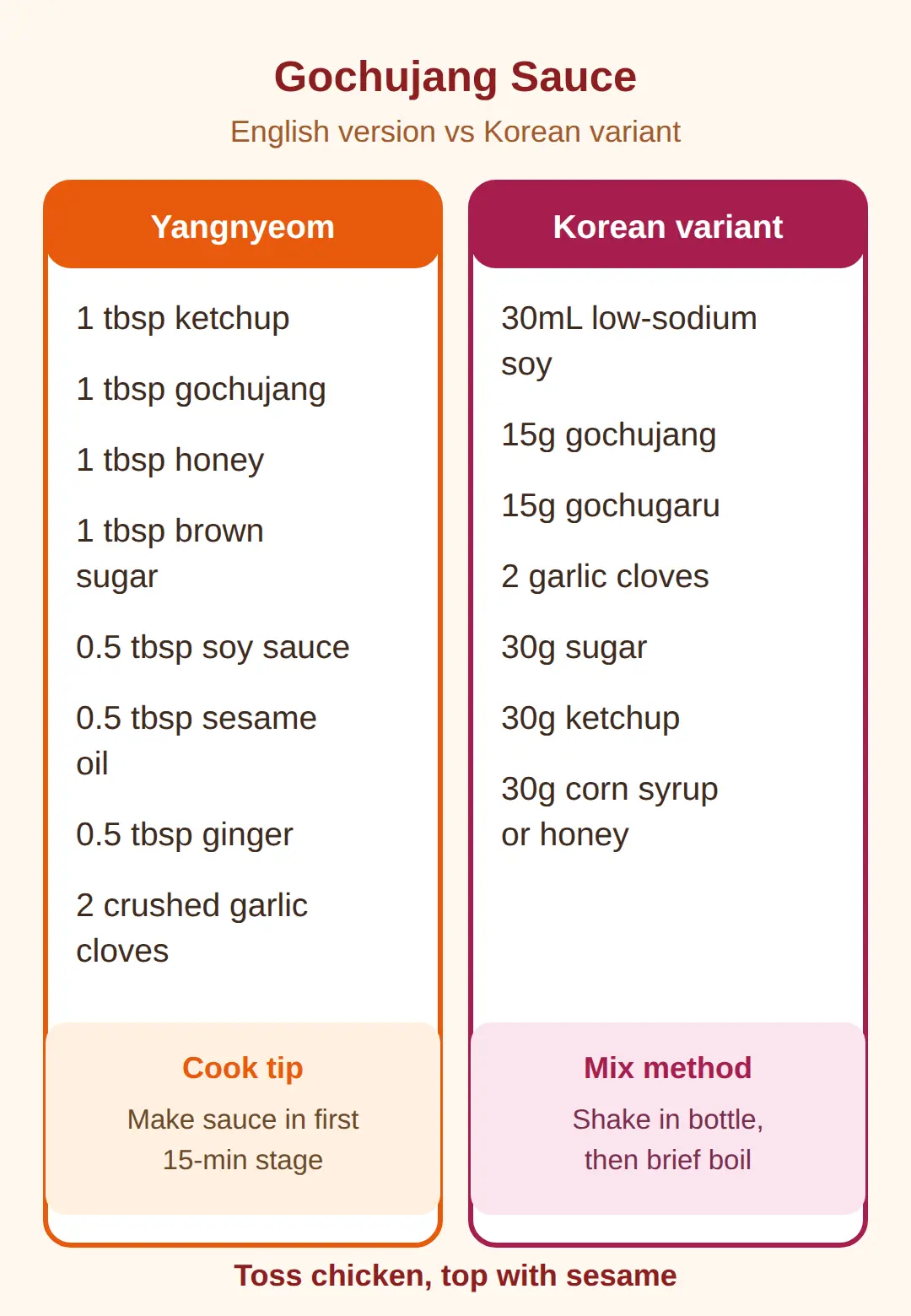
The sweet-spicy yangnyeom sauce is 1 tbsp ketchup, 1 tbsp gochujang, 1 tbsp honey, 1 tbsp brown sugar, 0.5 tbsp soy sauce, 0.5 tbsp toasted sesame oil, 0.5 tbsp grated ginger, and 2 crushed garlic cloves, boiled briefly while the chicken cooks.
Gochujang is the Korean chili paste that carries the sauce; it now comes in squeeze bottles in the Asian aisle of most grocery stores.
Ketchup is part of the authentic American-restaurant-style yangnyeom sauce, described as a very important ingredient for that flavor.
A Korean variant builds the same sweet-spicy family differently: 30mL low-sodium soy, 15g gochujang, 15g gochugaru (Korean chili flakes), 2 garlic cloves, 30g sugar, 30g ketchup, and 30g corn syrup or honey.
The Korean version adds gochugaru and swaps honey-plus-brown-sugar for corn syrup or honey, and mixes the sauce in a shaker bottle before a brief boil in a pan.
Another alternate yangnyeom sauce simmers 2 tbsp gochujang, 2 tbsp ketchup, 1 tbsp soy sauce, 3 tbsp oligosaccharide, and 1 tbsp minced garlic, then air-fries the sauced chicken at 180C for 3 minutes so the coating sets.
Toss the fried chicken in the sauce to coat every nook, and finish with toasted sesame seeds or lime wedges and sliced green onion.
Make the sauce during the first 15-minute stage and the whole recipe still lands at about 30 minutes.
Getting it crispy: oil spray and basket setup
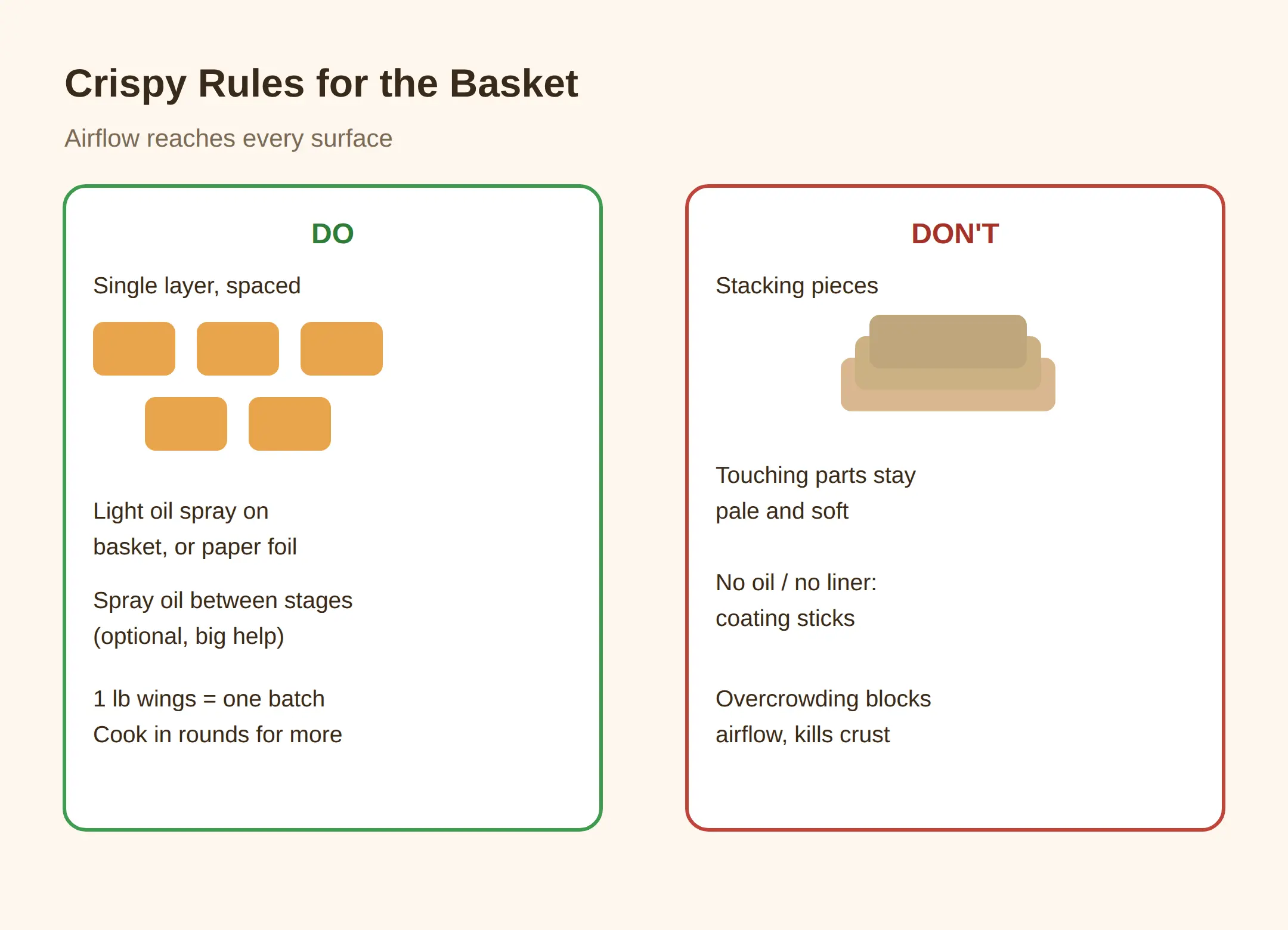
Spray a light coat of oil on the chicken between stages — it is optional, but it is the step that pushes the crust toward fried texture.
The basket itself needs a thin coat of oil or a sheet of paper foil so the coated chicken does not stick.
Pieces must sit spaced apart in a single layer; the golden crust depends on airflow reaching every surface.
1 lb of wings fills one single-layer batch in a typical basket, so feeding more than two people means cooking in rounds.
Stacking pieces is the main way this recipe fails — the parts touching the basket or each other stay pale and soft while the exposed surfaces brown.
Both the English and Korean recipes recommend the spray between stages, and the English one calls it a trick that really helps with only a very light coating.
I would spray oil between the stages even though it is optional — both recipes recommend it, and it is the cheapest way to push the crust toward fried texture without submersion oil.
The exact spray amount is not quantified anywhere, so treat ‘a very light coating’ as the target rather than counting pumps.
Storing and reheating leftovers
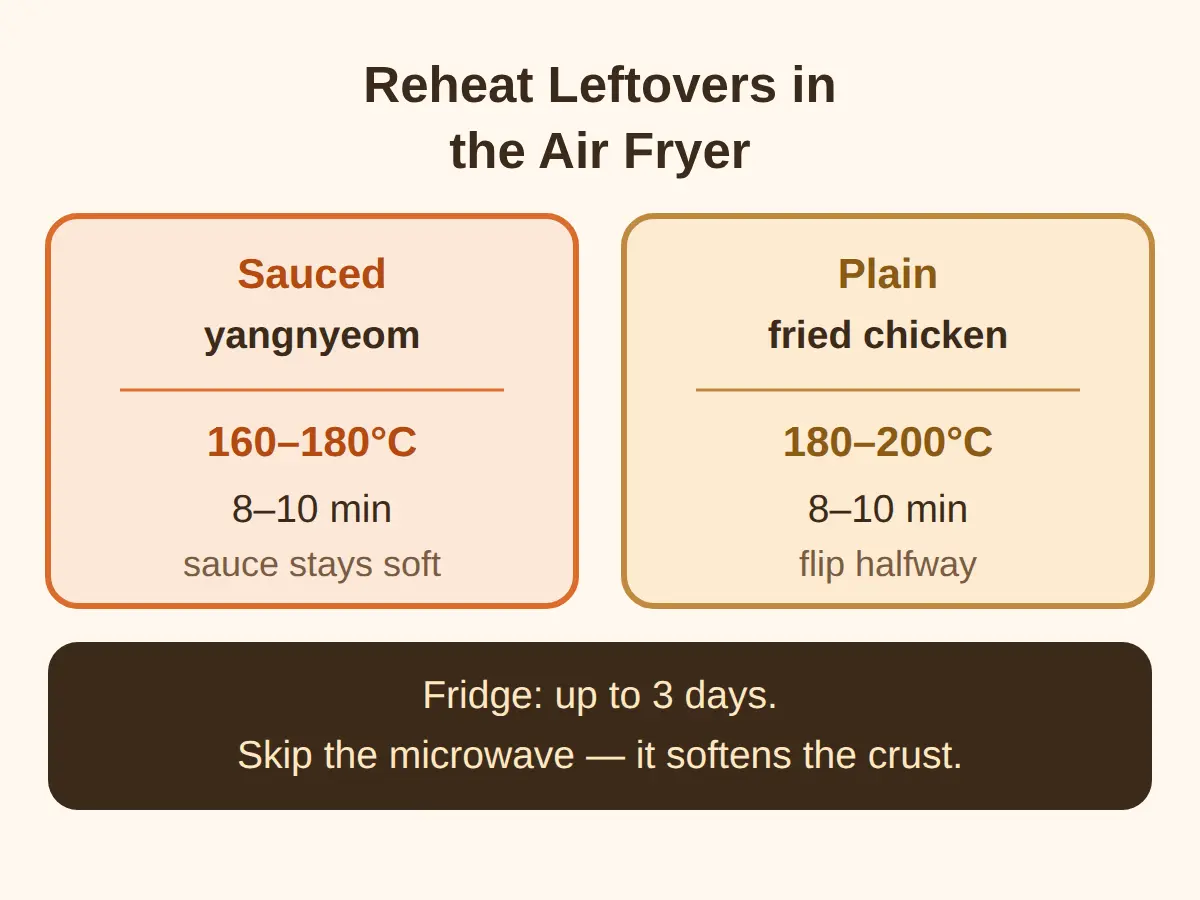
Sauced yangnyeom chicken reheats at 160-180C for 8-10 minutes, while plain fried chicken goes hotter, 180-200C for 8-10 minutes with a flip.
The lower range for sauced pieces keeps the sauce from burning while the crust re-crisps.
Leftovers keep in the fridge for up to 3 days.
Reheat in the air fryer rather than the microwave, which softens the starch shell you spent 25 minutes building.
If your leftovers are the sauced-and-caramelized kind, expect the crust under the sauce to stay softer — that is a moisture effect, not a timing error.
Fridge-stored sauced chicken from last night — 160-180C, 8-10 minutes.
Plain pieces from a double batch — 180-200C, 8-10 minutes, flip halfway.
👉 Kimbap Recipe: 45 Minutes, One Mat, No Special Ingredients
Compared to deep-fried, and what to serve
Traditional Korean fried chicken is double (sometimes triple) deep-fried in submersion oil, and the two-stage air-fryer schedule is built to imitate that in about 1 tbsp of coating oil plus a basket wipe per 1 lb of wings.
The air-fryer recipe’s own writer claims the result rivals the best deep-fried versions while being far healthier.
That claim is a first-person description, not a measured comparison — no side-by-side texture test or nutrition data for the two methods was found.
In Korea this chicken is served with pickled radish (chicken-mu) and beer or soju; the chicken-plus-beer pairing is common enough to have its own word, chimaek.
Finish with lime wedges and sliced green onion, or the Korean version’s 1 tbsp toasted sesame seeds — the garnish difference is a per-source choice, not a rule.
A related air-fryer variant is spicy double-fried chicken tenders made karaage-style, and Taiwanese popcorn chicken serves the same way.
If you want the closest thing to a fried crust without a pot of oil, follow the five-stage schedule and spray between stages.
If a thinner crust would bother you more than the oil, the deep-fried original is still the reference point.
Related posts
📎 Tteokbokki Recipe: Why Broth Instead of Water Keeps It From Turning Gummy
📎 tteokguk recipe: easy rice cake soup with frozen tteok
📎 📅 다가오는 일정 — 발매·개봉·발표 캘린더
Sources
- Double air-fry method: 400F 15 min, flip + 5 min, cool, spra (iamafoodblog.com)
- Korean-language confirmation: 200C for 15 minutes with one f (marcwiner.com)
- yangnyeom sauce 180C 3min finish; preheat 200C 5min, cook 18 (cookpick.kr)
Quick summary
- 400F (about 200C): 15 min, flip + 5 min, rest 5 min, oil spray, final 5 min — 25 minutes total, no preheat.
- Coat: oil first, then salt and pepper, then 3 tbsp corn or potato starch per 1 lb wings.
- Sauce while it cooks: ketchup, gochujang, honey, brown sugar, soy, sesame oil, ginger, garlic — brief boil.
- Single spaced layer, lightly oiled basket; 1 lb fills one batch, cook in rounds for more.
- Fridge up to 3 days; reheat plain at 180-200C, sauced at 160-180C, 8-10 minutes.
FAQ
Q. Can you make Korean fried chicken in an air fryer?
Yes — a two-stage cook at 400F (about 200C) with a 5-minute rest and oil spray in between stands in for the double deep-fry, and 1 lb of wings takes 25 minutes of air-fryer time.
Q. What temperature and time for air fryer Korean fried chicken?
400F (about 200C) for 15 minutes with no preheat, flip and 5 more minutes, rest 5 minutes, spray with oil, then a final 5 minutes at 400F.
Q. Corn starch or flour for air fryer Korean fried chicken?
Corn or potato starch is the default coating — oil first for heat transfer, then salt, pepper, and the starch. Flour appears only in a wet-batter variant with egg and water.
Q. Can I use potato starch instead of cornstarch?
Yes — potato starch is the traditional Korean coating and cornstarch is listed as its substitute, so the substitution works in both directions. Which one is crispier in an air fryer has not been directly compared.
Q. How do you reheat leftover Korean fried chicken in an air fryer?
Plain pieces: 180-200C for 8-10 minutes with a flip. Sauced yangnyeom pieces: 160-180C for 8-10 minutes, so the sauce does not burn. Fridge storage is up to 3 days.
When I look at an air-fryer fried chicken recipe, the first thing I check is whether the timing is split into stages — a single 25-minute block will not give you the crust that a set-then-re-crisp schedule does.
#koreanfriedchicken #airfryer #yangnyeomchicken #gochujangsauce #chickenwings #Koreanrecipes
📅Upcoming Dates — 이번 주 16 · D-day 'The Scandal' global Netflix release전체 보기 →