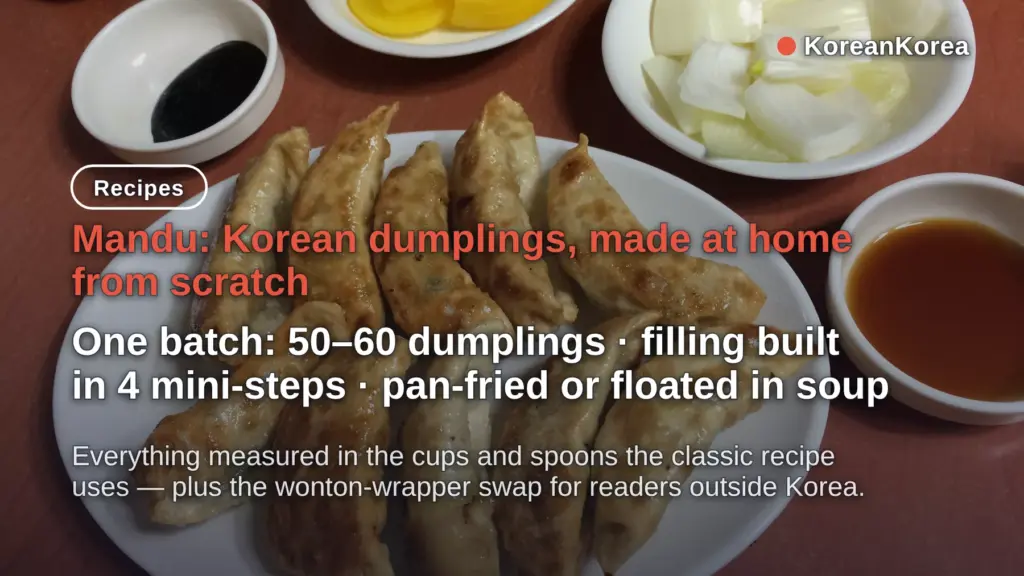
Classic Korean mandu (Korean dumplings) make 50 to 60 dumplings from 60 skin discs, filled with pork, beef, Asian chives, mushrooms and tofu — and square wonton wrappers work if mandu skins are hard to find near you.
Korean Dumplings Recipe at Home: Season 4 Filling Steps, Then Fold and Fry
| Yield | 50–60 mandu from 60 skin discs |
|---|---|
| Base filling | 1 cup ground pork + 2 cups ground beef |
| Vegetables | 2 cups chopped Asian chives, 4–5 soaked shiitake, half an onion |
| Tofu | Half a package, squeezed dry in a cloth |
| Garlic | 3 cloves, minced, into the final filling |
| Pan-fry (gunmandu) | Oil, lid on low-medium, flip, 2–3 tbs water, lid back on until golden |
| Soup (manduguk) | 6 cups water, 8 dried anchovies, shiitake stems + onion, simmer 20–30 minutes |
This korean dumplings recipe builds mandu in four separately seasoned mini-steps — meat, mushrooms and onion, chives, tofu — then folds them into 60 skins.
The filling is not one big bowl; each component gets its own seasoning first, and that is what keeps the mix juicy instead of soggy.
If you buy round mandu skin discs, count out 60 for one batch.
Start with the meat: mix 1 cup ground pork and 2 cups ground beef by hand with 1 tsp kosher salt, 1 tbs toasted sesame oil and ½ tsp ground pepper.
Toss the soaked shiitake mushrooms and half an onion with 1 tsp soy sauce, 1 tsp sugar and 2 tsp toasted sesame oil.
Coat the 2 cups of chopped Asian chives with 1 tbs oil, squeeze the half-package of tofu dry in a cloth with a pinch of salt and 1 tsp sesame oil, then combine everything by hand with 3 cloves of minced garlic.
When folding, brush one edge of each skin with cold water as the sealant, fold the skin in half over a spoonful of filling, and press the edges into a ripple shape.
For the pan-fried version (gunmandu), the method runs in five steps:
- Heat oil in a pan.
- Put the lid on at low-medium heat.
- Flip the dumplings.
- Add 2–3 tbs water.
- Lid back on and cook until golden brown.
If the filling components feel like a lot of bowls, that is the point: the separate seasoning is the recipe, not extra fuss.
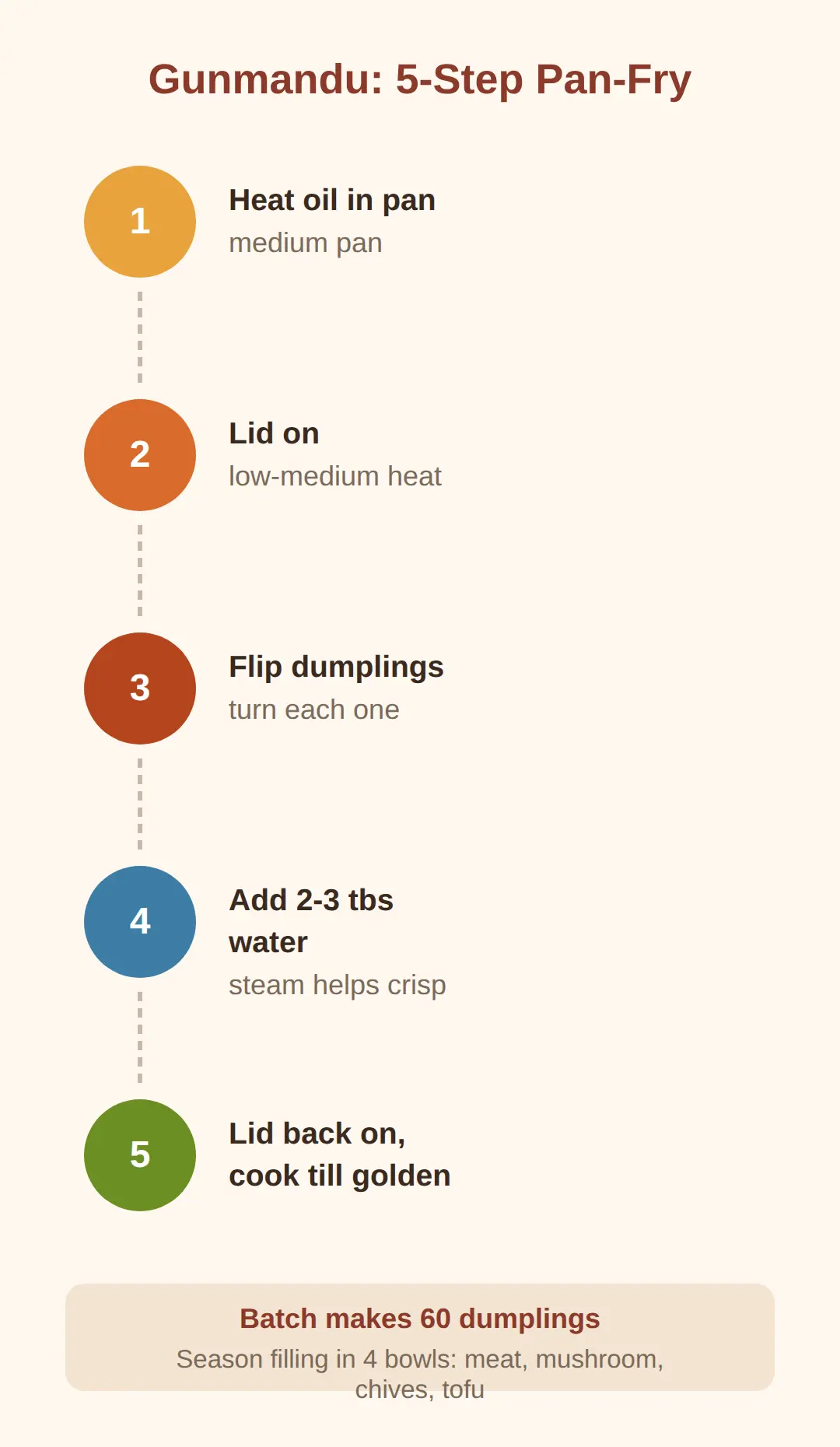
Steps at a glance
-
1Heat oil in a pan.
-
2Put the lid on at low-medium heat.🔥 medium heat
-
3Flip the dumplings.
-
4Add 2–3 tbs water.
-
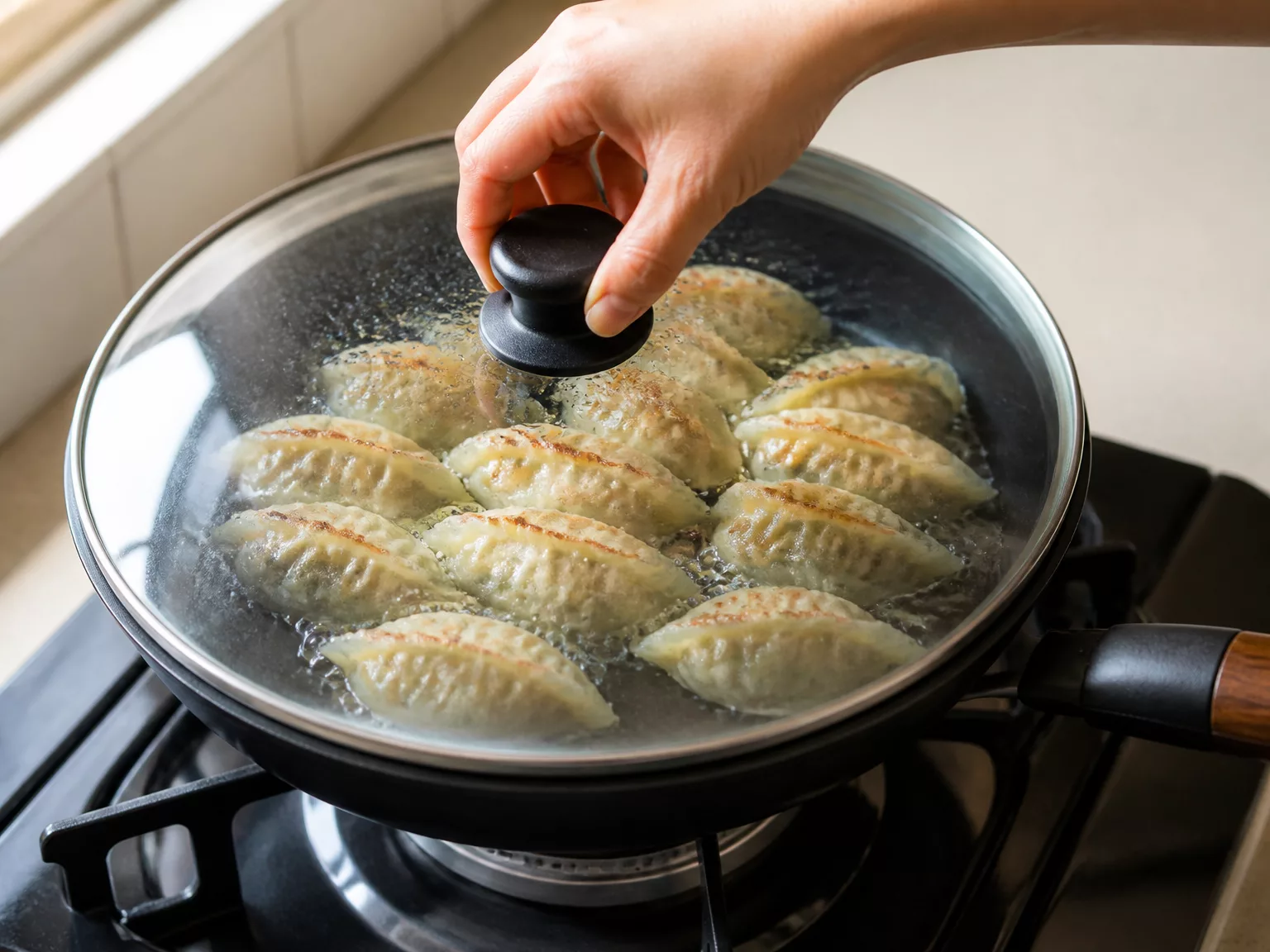 AI-generated photo
What it should look like — AI-generated image of this step, made from the recipe text — not a photo of our kitchen. 5Lid back on and cook
Mandu Filling Ingredients: What Goes In and How Much
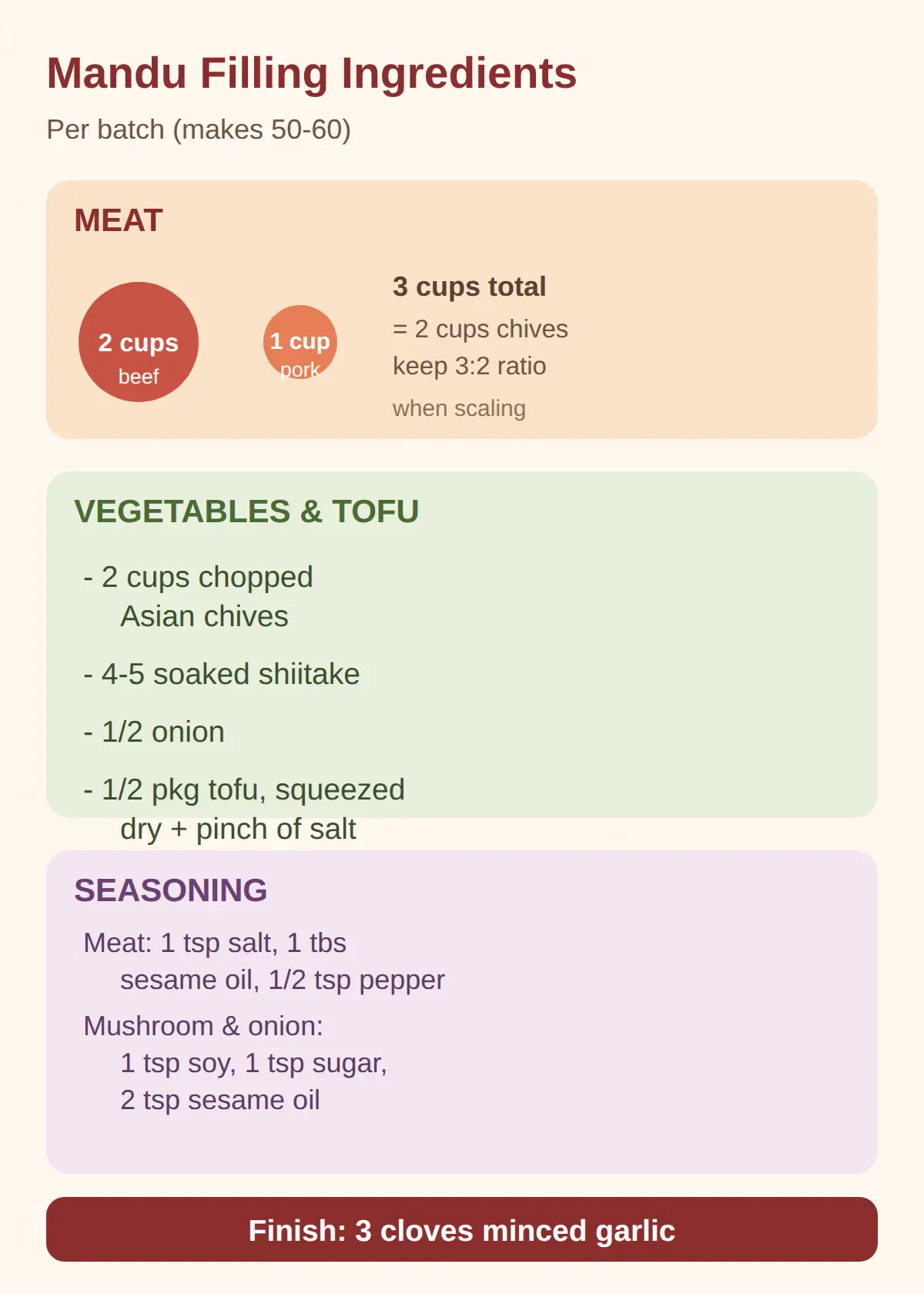
The base filling is 1 cup ground pork plus 2 cups ground beef, with vegetables measuring roughly two-thirds of the meat volume: 2 cups chopped chives against 3 cups meat.
That meat-to-chive balance is the classic proportion, so keep it if you scale the batch up or down.
2 cups chopped Asian chives (buchu), 4–5 soaked shiitake mushrooms and half an onion make up the vegetable side.
Half a package of tofu goes in too — squeezed dry in a cloth, with a pinch of salt and 1 tsp sesame oil.
Tofu in the filling is a traditional Korean trick: it lightens the meat mix and keeps it juicy, which also helps when pork or beef is scarce where you shop.
Each component carries its own seasoning.
The meat takes 1 tsp kosher salt, 1 tbs toasted sesame oil and ½ tsp ground pepper, mixed by hand.
The mushrooms and onion take 1 tsp soy sauce, 1 tsp sugar and 2 tsp toasted sesame oil.
Then 3 cloves of minced garlic go into the final combined filling.
The amounts here are cup- and spoon-based, and no metric conversions are published in the recipe itself — so measure as written rather than converting on your own.
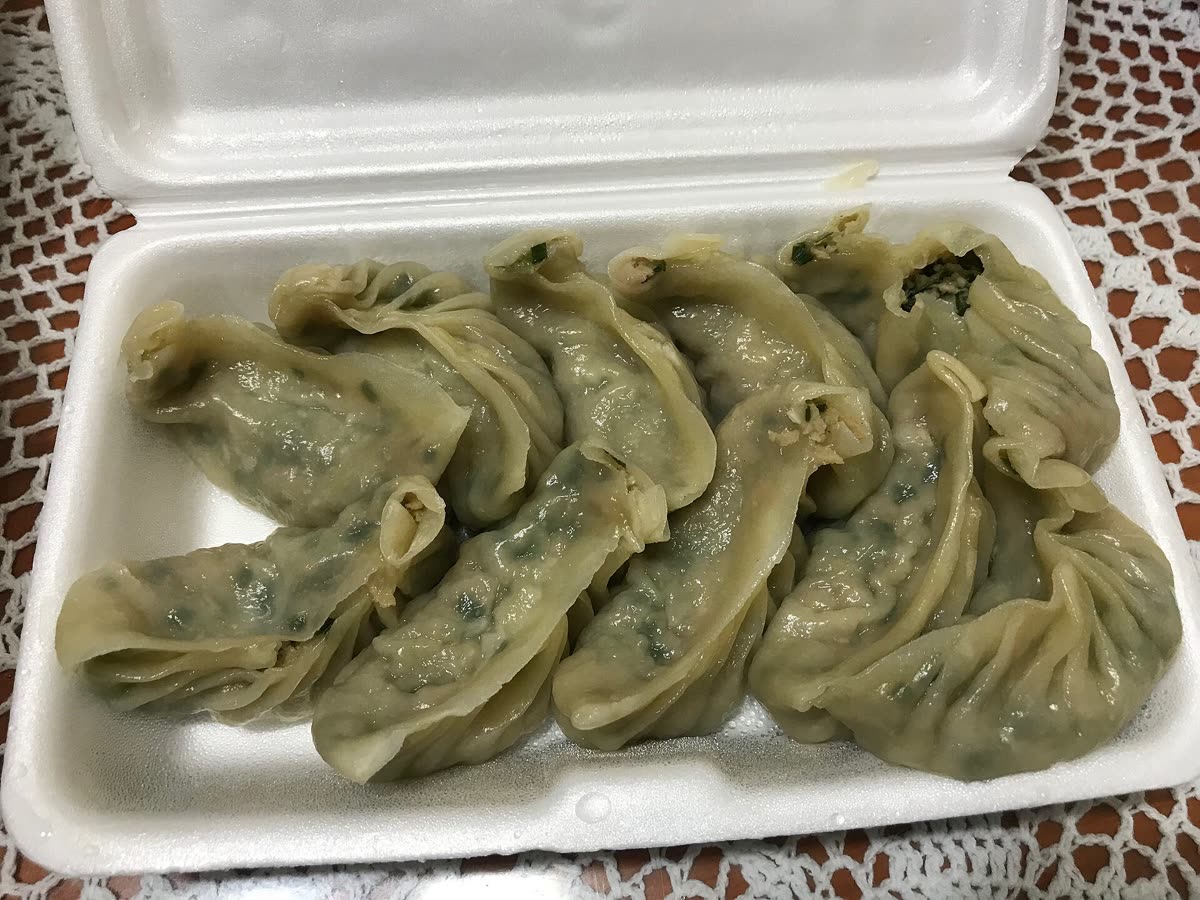
How to Keep Mandu Filling From Getting Watery
Two moves keep the filling from going wet: toss the chopped chives with 1 tbs oil before mixing, and squeeze the tofu dry in a cloth.
The oil coats the chives so they hold their moisture instead of releasing it into the mix.
The dry-tofu step works the same way.
Squeezing removes the water the tofu would otherwise weep into the filling, while the tofu itself keeps the mix juicy but not wet — a pinch of salt and 1 tsp sesame oil season it in the same step.
The separate-seasoning rule also protects texture.
Because the mushrooms and onion are seasoned and tossed on their own, their liquid stays bound to them instead of pooling in a shared bowl.
Mix components in sequence rather than all at once, and the filling stays firm enough to fold.
Can I Use Wonton Wrappers Instead of Mandu Skins?
Yes — square wonton wrappers are a confirmed substitute for mandu skins, and folding them into triangles gives you more surface area and more crunch than round skins.
This is the base of the Daegu street-style napjak mandu: flat dumplings with less filling, traditionally shaped as half moons but often folded into triangles from square wrappers.
Napjak mandu are finished with a flourish of gochugaru (Korean chili flakes), sea salt and scallions instead of being drowned in sauce.
The recipe for that style also yields 50 to 60 dumplings, so the wrapper count stays similar.
If your store carries only square wonton wrappers, make the triangle fold and fill lightly — the style depends on the crisp edge, not a packed center.
When I shop for mandu ingredients abroad, the first thing I check is which wrapper is actually on the shelf, and whether buchu is anywhere in the produce aisle, because that decides which version I am making.
Mandu Variations: Steamed, Boiled, Kimchi and Napjak
Mandu are named both by cooking method — gunmandu (pan-fried), jjinmandu (steamed), mulmandu (boiled) — and by filling: vegetable, meat, kimchi, plus specialty fish-skin and pheasant versions.
So one filling can end up pan-fried tonight and boiled tomorrow, and both are the same dumpling family.
Kimchi mandu is a standard home variant, with kimchi and chopped dangmyeon (Korean sweet potato glass noodles) in the filling.
The Daegu-style napjak version is the flat, crisp-edged dumpling from the wonton-wrapper section, dipped in its own sauce.
The two dipping sauces are different, and they do not merge into one ratio:
| Sauce | Ratio |
|---|---|
| Classic dipping sauce | 1 : 1 vinegar and soy sauce |
| Napjak dipping sauce | ¼ cup soy sauce + 2 tbs rice vinegar + 2 tsp sugar (about 2 : 1 : 0.4) |
Pan-fried flat mandu also eat like jeon, the pan-fried fritters that fill Korean party tables — especially around Seollal, Korean New Year.
Pan-frying and soup are fully documented below; exact steaming minutes and boiling steps for the classic version are not stated in the recipe sources, so check the link on the recipe page for any timing it adds.
Mandu soup in 6 cups of anchovy stock: dumplings are done when they float
Mandu soup (manduguk) starts with a stock of 6 cups water, 8 dried anchovies, the leftover shiitake stems and the onion, simmered 20–30 minutes.
The stock uses parts you would otherwise throw away after building the filling, which is why I would make the soup version first — and "the dumplings float" is an easy doneness check for a first-timer.
While the stock simmers, add more water if too much evaporates over the 20–30 minutes.
When the stock is ready, season with 1 tsp fish sauce and 2 cloves of garlic, then drop the mandu in.
They are done when they float.
Finish with 1 beaten egg stirred through and sliced green onions on top.
Serve the soup hot, with a bowl of kimchi and ground pepper to taste at the table.
Related posts
📎 📅 Upcoming Dates — Release & Event Calendar
Sources
- Daegu-style kimchi flat dumplings, dangmyeon filling, gochug (cooking.nytimes.com)
- Wikipedia: Goryeo-era transmission, named by filling/cooking (ko.wikipedia.org)
- Korean home guide for steamed and pan-fried mandu with tofu (record2057.tistory.com)
What to Check Before You Shop
- Check the wrapper shelf first: mandu skins or square wonton wrappers decide which version you can make.
- Keep the cup and spoon measures as written — no metric conversions are published in the recipe sources.
- Chives plus tofu are the two moisture risks; oil-coat the chives and squeeze the tofu dry.
- No confirmed substitute ratio for buchu (Asian chives) appears in the sources found — the recipe specifies buchu itself.
- Napjak mandu from Daegu uses less filling and square wrappers folded into triangles for extra crunch.
- Season the soup with fish sauce and garlic, and finish it with a beaten egg and sliced green onions.
FAQ
Q. What are mandu dumplings filled with?
The classic filling is 1 cup ground pork, 2 cups ground beef, 2 cups chopped Asian chives, 4–5 soaked shiitake mushrooms, half an onion and half a package of dry-squeezed tofu, seasoned separately and combined with 3 cloves of garlic.
Q. How do you keep mandu filling from getting watery?
Toss the chopped chives with 1 tbs oil before mixing and squeeze the tofu dry in a cloth — the oil coat keeps the chives from releasing moisture.
Q. Can I use wonton wrappers instead of mandu skins?
Yes. Square wonton wrappers are a confirmed substitute; folded into triangles they give more surface area and more crunch, which is the base of the Daegu-style napjak mandu.
Q. How long do you boil mandu before it floats?
The soup recipe gives no fixed minute count — the documented doneness check is that the mandu are done when they float in the seasoned anchovy stock.
Q. Why is tofu in the filling?
Tofu is a traditional Korean trick that lightens the meat mix and keeps it juicy — useful when pork or beef is scarce.
Anchor sources for this recipe: the classic mandu recipe (first posted May 3, 2008, updated January 23, 2023), the NYT napjak mandu recipe, and the Korean-language mandu reference — linked above.
Cover photo: Korean Chinese dumplings 4 by chomjong — CC BY 2.0
#Koreanfood #mandu #Koreandumplingsrecipe #gunmandu #manduguk #wontonwrappersubstitute #napjakmandu #Koreanhomecooking
📅Upcoming Schedule — this week 23 · D-1 Autumn season = post-summer brightening demand window (UV drSee all →