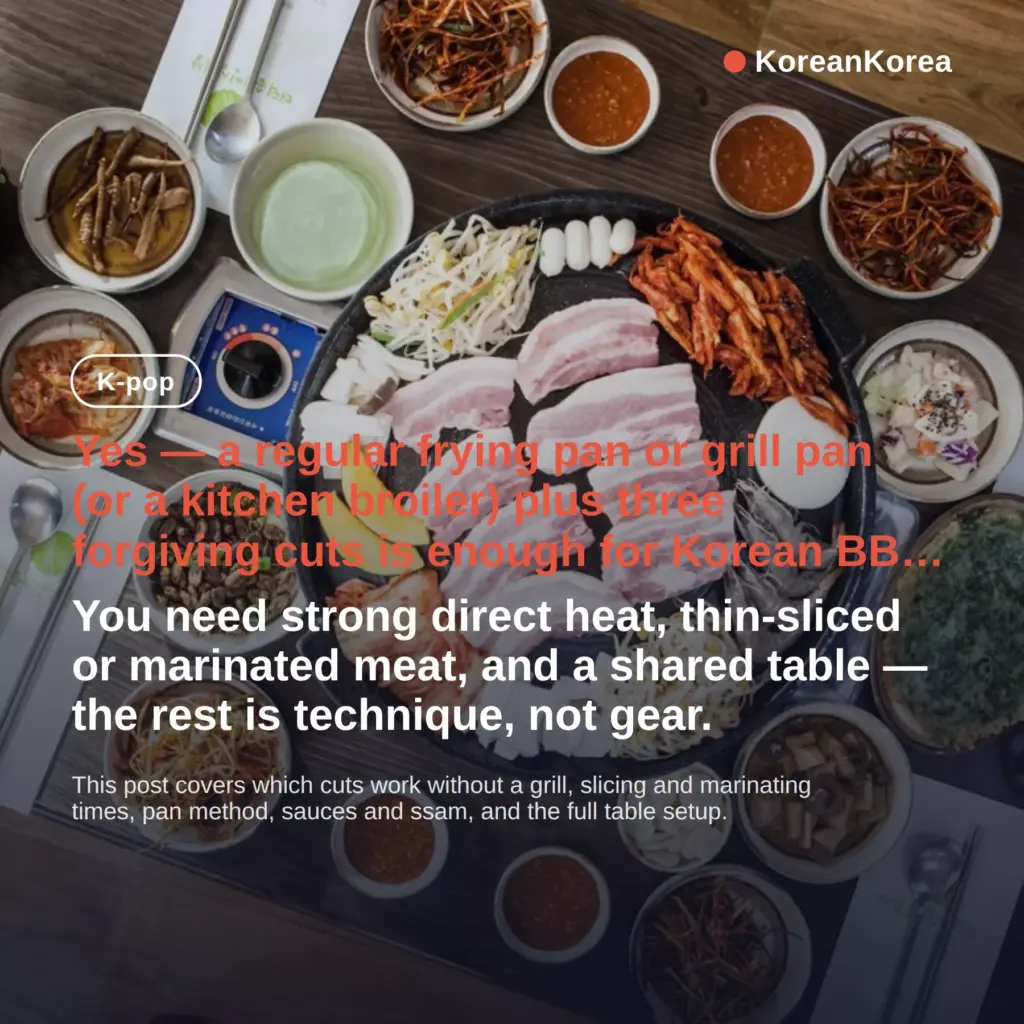
Yes — a regular frying pan or grill pan (or a kitchen broiler) plus three forgiving cuts is enough for Korean BBQ at home, with no restaurant equipment needed.
What matters is strong direct heat to crisp the meat surface, not a special grill.
This post covers which cuts work indoors, how to slice and marinate them, the pan method, three sauces and ssam, and how to set the shared table.
Contents
- korean bbq at home grill: pan, broiler, and the 3 cuts that work
- The 3 cuts that work without a grill
- How to slice thin and how long to marinate
- How to cook it in a pan without a grill
- Three sauces and the perfect ssam
- Setting the shared table
korean bbq at home grill: pan, broiler, and the 3 cuts that work
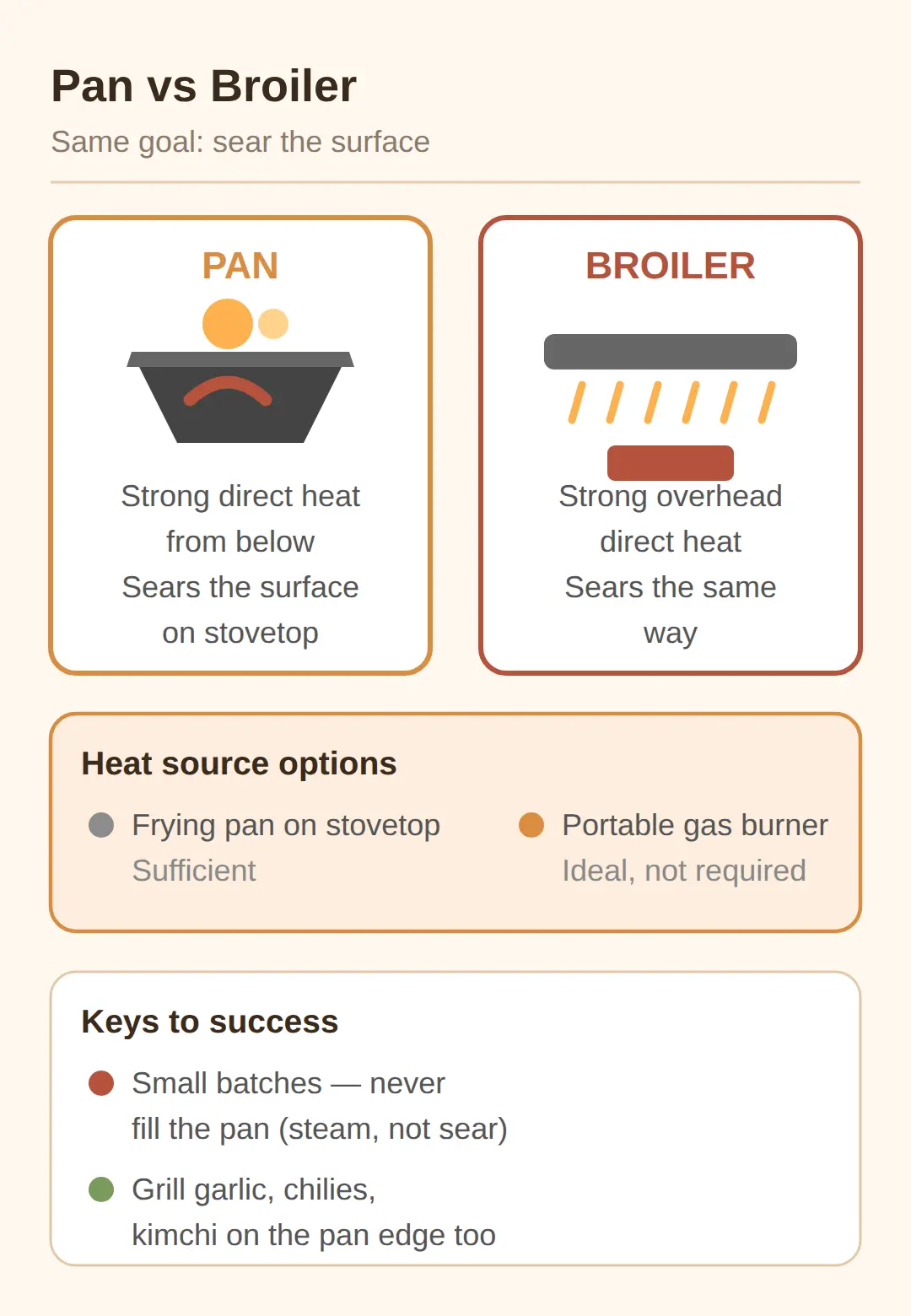
Yes — a regular frying pan or grill pan on the stovetop is enough, and a kitchen broiler works as an alternative.
The core technique is searing the meat surface over strong direct heat so it crisps, which is what a restaurant grill does anyway.
A broiler applies the same strong direct heat from above and sears the meat surface the same way a tabletop grill would.
A portable gas burner with a grill pan on the dining table is the ideal setup, not a requirement.
When I plan home Korean BBQ, I check which cuts forgive having no grill first, because the meat matters more than the equipment.
| Only a stovetop and a plain frying pan | Use it — the pan just needs to deliver strong direct heat |
|---|---|
| A kitchen broiler but no grill | Use the broiler’s overhead heat to sear the meat like a tabletop grill |
| No paper-thin pre-sliced meat nearby | Freeze the meat 30–60 minutes, then slice thin with a home knife |
| Only a couple of hours to marinate | At least 2 hours works; overnight is better with pear juice as tenderizer |
| Meat turns grey and watery in the pan | Cook in small batches instead of filling the pan |
| Unsure which sauce for which cut | Ssamjang for wraps, sesame oil + salt for pork belly, soy-vinegar for fatty cuts |
The 3 cuts that work without a grill
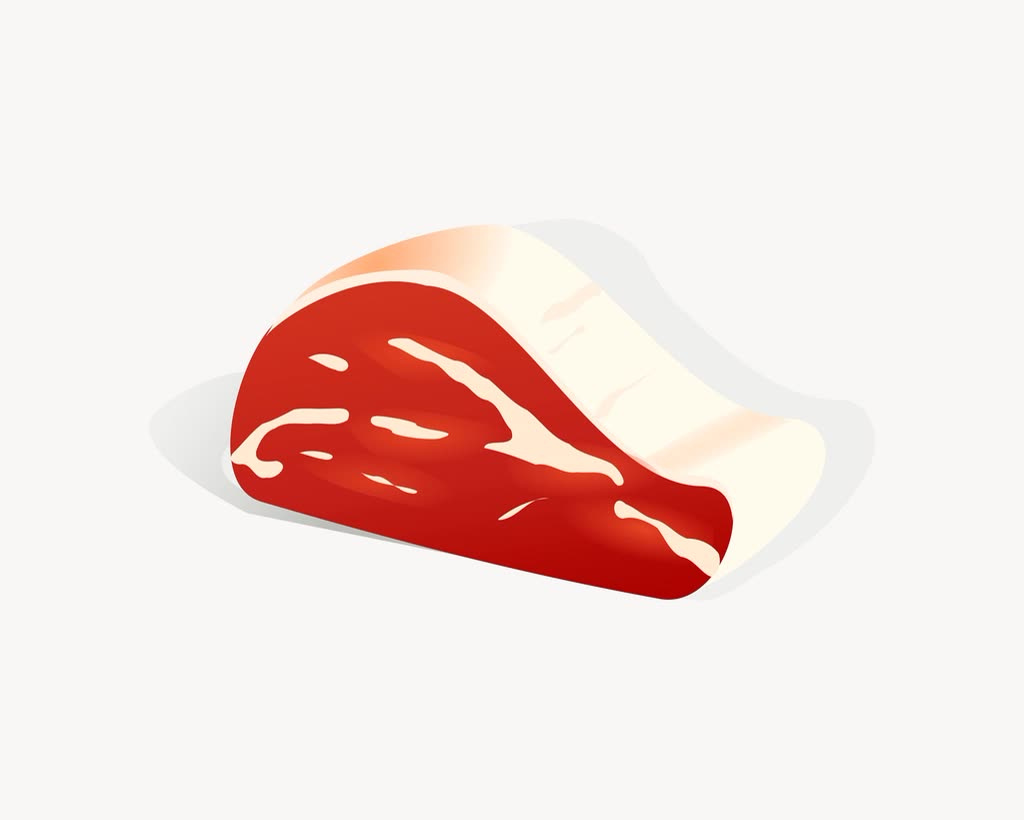
Three cuts work indoors without a grill: thinly sliced marinated cuts (bulgogi style), LA galbi, and samgyeopsal (pork belly).
Thin, marinated cuts like bulgogi cook fast on a flat surface, so they brown before they overcook.
Samgyeopsal is one of the most commonly table-grilled cuts in Korean BBQ, and it needs nothing but heat and a dip.
LA galbi carries its marinade in the meat, so a pan can’t take much away from it.
The blog already has full recipes for bulgogi and LA galbi, so start there for amounts and steps.
How to slice thin and how long to marinate
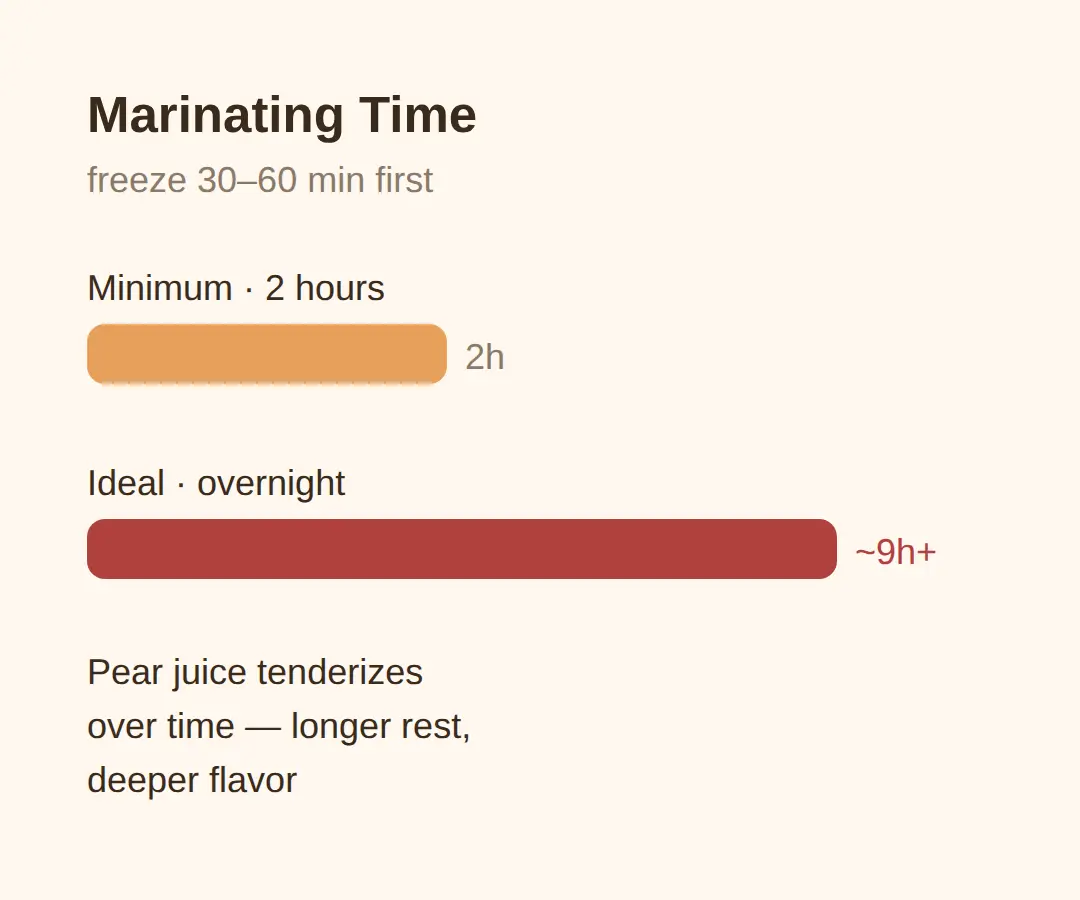
Freeze the meat for 30–60 minutes, then slice it paper-thin with a home knife.
Marinate for at least 2 hours, ideally overnight, for deep flavor.
Pear juice in the marinade acts as a natural tenderizer, which is why the long rest matters.
Total prep is about 2.5 hours minimum — freeze 30–60 minutes plus at least 2 hours of marinating — and overnight pushes it past 9 hours.
Short on time?
2 hours of marinating still works, but overnight gives noticeably deeper flavor.
How to cook it in a pan without a grill
Sear the meat over strong direct heat in small batches — never fill the pan.
Overcrowding makes the meat steam instead of sear, which is why it turns grey and watery.
Grill whole garlic cloves and green chilies on the same pan alongside the meat.
Kimchi grilled on the pan caramelizes and picks up a smoky flavor, so put some on the edge of the pan too.
Strong ventilation helps, and keeping the batches small keeps smoke under control.
Three sauces and the perfect ssam
Three sauces cover every cut: ssamjang for wraps, sesame oil with coarse salt and pepper for samgyeopsal, and soy-vinegar for fatty cuts.
Ssamjang is a thick paste of doenjang mixed with gochujang, used when wrapping.
The soy-vinegar dip (optionally with a little wasabi or mustard) cuts through fattiness of rich cuts.
For the ssam itself: lettuce leaf on the palm, one piece of grilled meat, a garlic slice, a bit of ssamjang, then scallion salad or kimchi.
Fold it and eat it in one bite — two bites is considered a breach of ssam etiquette.
Setting the shared table
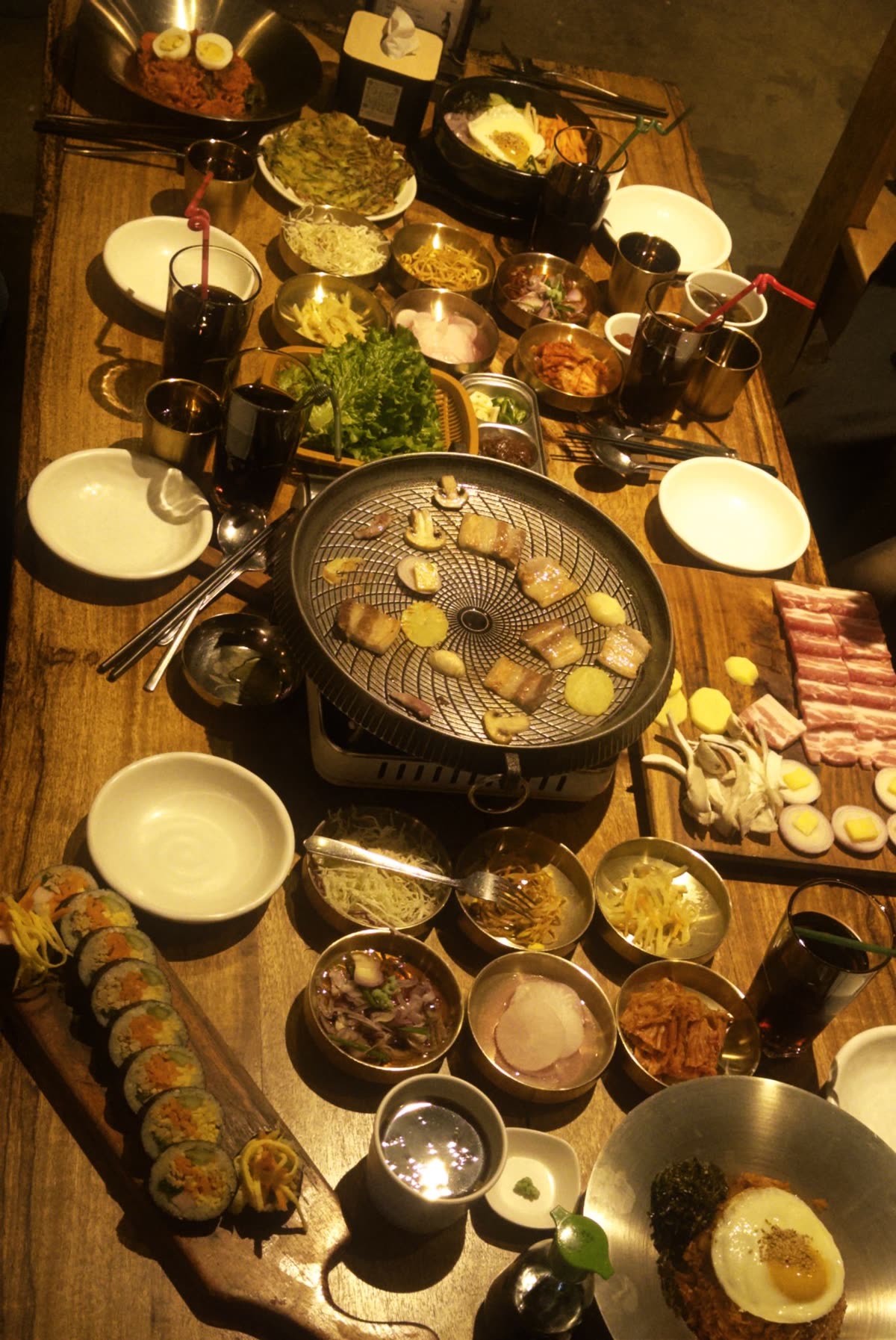
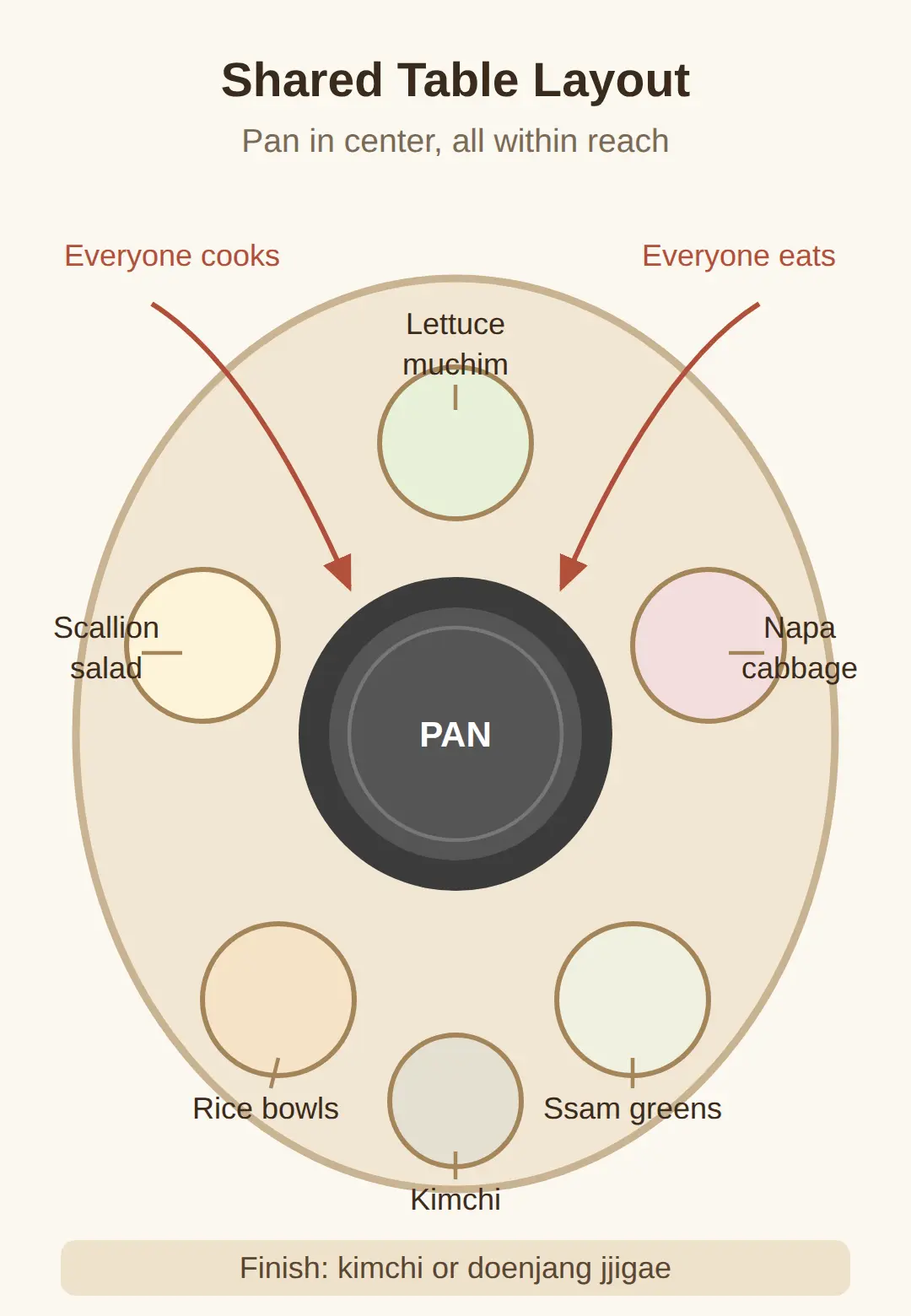
Put one pan in the center of the table with everything within arm’s reach — that is the standard Korean BBQ layout.
Essential sides are lettuce muchim (sangchu geotjeori), scallion salad (pa muchim), napa cabbage muchim, rice, and kimchi; ssam greens are red and green lettuce, perilla leaves (kkaennip), and thinly sliced raw garlic.
White rice in individual bowls and kimchi are mandatory table items alongside the pan.
Korean BBQ is shared cooking — everyone cooks and eats together from the same pan.
End the meal with kimchi jjigae or doenjang jjigae to clean the palate after the fatty meat.
If I were setting this table for the first time, I would start with bulgogi and LA galbi in a plain pan, because thinly sliced marinated cuts cook fast and forgive the missing grill.
Samgyeopsal I would save for once the pan heat is under control — it releases more fat and needs steadier batch work.
Related posts
Sources
- Home guide: pan/broiler technique, 3 sauces, ssam steps, thi (charim.soundedfun.dev)
- Korean Wikipedia: table-grilling custom and shared-meal cont (ko.wikipedia.org)
- Authoritative institutional Korean cooking series available (korean-culture.org)
Quick recap
- First check which cut you have: thinly sliced marinated cuts, LA galbi, or samgyeopsal — the method differs slightly for each.
- If your butcher’s slices are too thick, freeze the meat 30–60 minutes and slice it paper-thin at home.
- Before cooking, mix the three dips: sesame oil with coarse salt, soy-vinegar, and ssamjang.
- Set the ssam tray within reach: lettuce, perilla leaves, sliced raw garlic, pa muchim, kimchi.
- After the meat, put kimchi jjigae or doenjang jjigae on the stove to finish the meal.
FAQ
Q. What are the 3 cuts that work without a grill?
Thinly sliced marinated cuts (bulgogi style), LA galbi, and samgyeopsal (pork belly). All three cook well on a flat pan or under a broiler.
Q. Can you do Korean BBQ at home without a grill?
Yes. A regular frying pan or grill pan on the stovetop is enough, and a kitchen broiler’s overhead direct heat sears the meat the same way a tabletop grill does.
Q. How long should I marinate bulgogi?
At least 2 hours, ideally overnight. Pear juice in the marinade acts as a natural tenderizer, so the longer rest deepens both flavor and texture.
Q. Why does my meat turn grey and watery in the pan?
The pan is overcrowded. Cook in small batches so the meat sears over strong direct heat instead of steaming in its own juices.
Q. How do you make the perfect ssam?
Lettuce leaf on the palm, one piece of grilled meat, a garlic slice, ssamjang, then scallion salad or kimchi — fold and eat it in one bite.
The blog already has full recipes for bulgogi and LA galbi — start with one of those for your first home Korean BBQ night.
Cover photo: Grilled pork belly bbq — CC0 1.0
#KoreanBBQathome #bulgogi #LAgalbi #samgyeopsal #ssam #Koreanrecipes
📅Upcoming Dates — 이번 주 19 · D-2 Final two episodes drop on Disney+/Hulu전체 보기 →