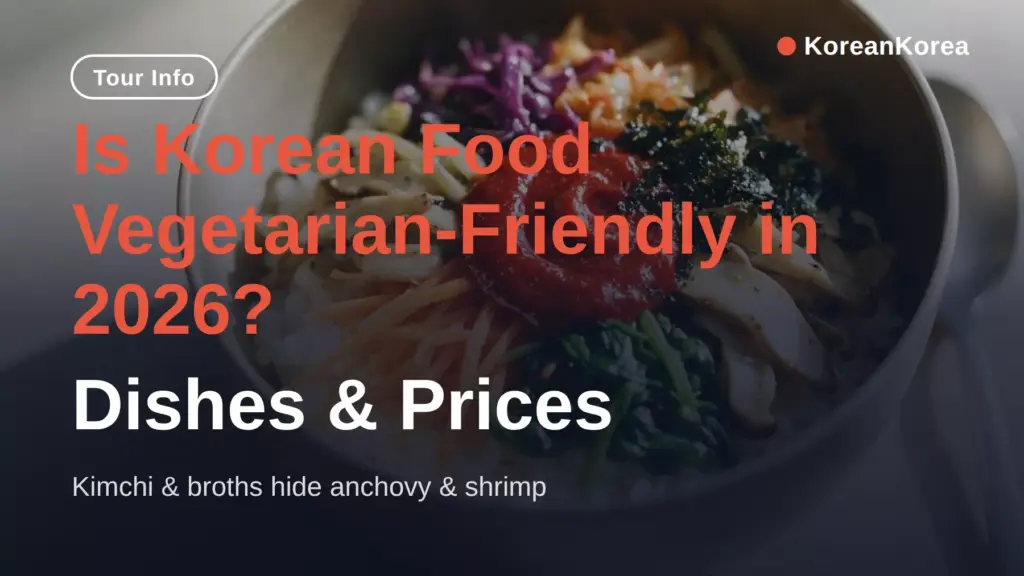
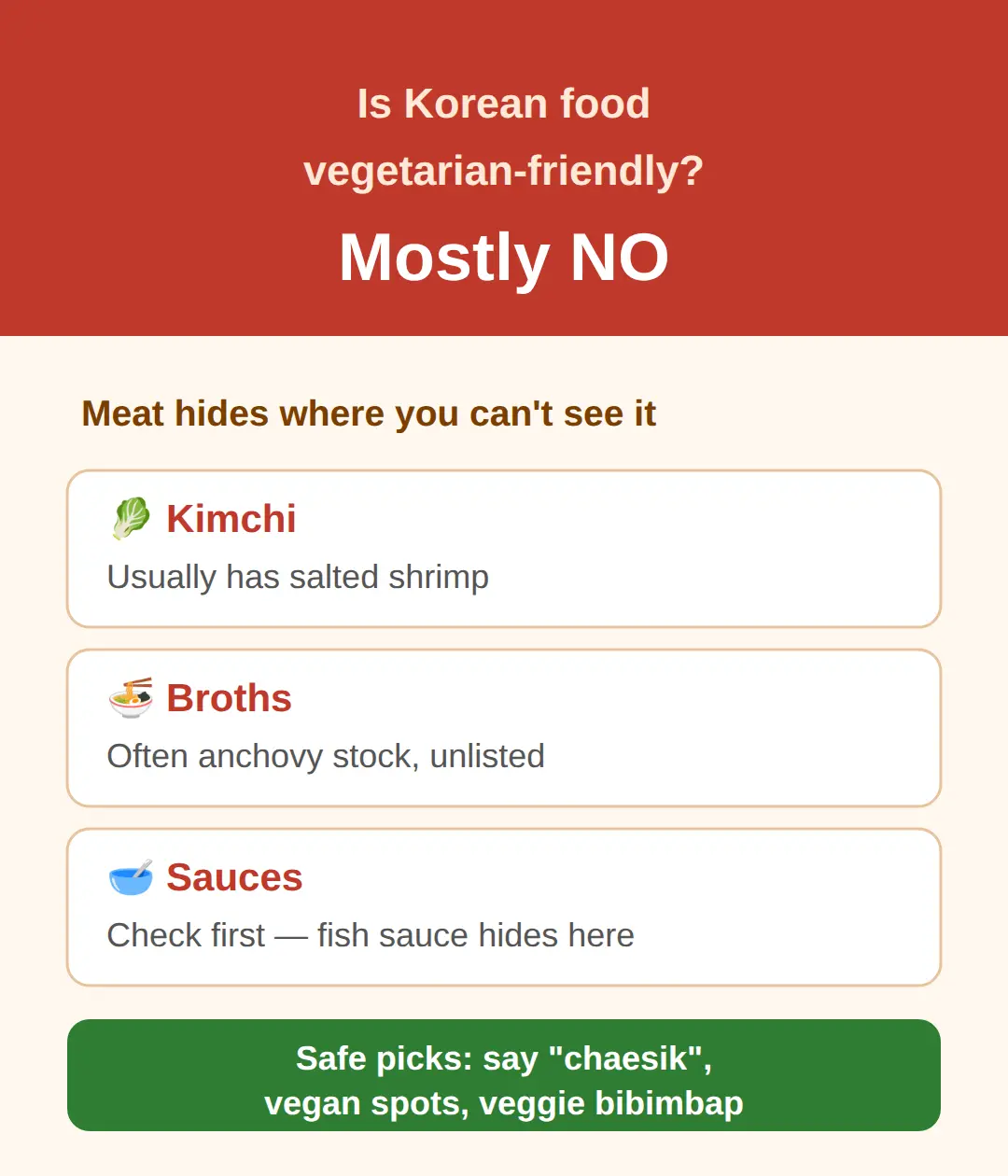
Mostly no — Korean food is not vegetarian-friendly by default: kimchi usually contains salted shrimp, and most soups and stews are built on anchovy or meat stock.
That means the dish you can point at is rarely the dish you can eat, and the deciding factor is the broth or sauce, not what you see.
This guide covers the dishes you can order safely, the street foods that look vegetarian but aren’t, and the fully vegan places in Seoul with prices as of September 2026.
Is Korean Food Vegetarian-Friendly in 2026? The Short Answer
| A regular restaurant, nothing vegan nearby | Veggie bibimbap (yachae-bibimbap), ₩9,000–15,000 — the one dish that can arrive without meat or seafood |
|---|---|
| Street food — tteokbokki, odeng, kimchi | Assume it is not vegetarian: odeng broth is fish-based, tteokbokki sauce often uses anchovy stock, kimchi usually has salted shrimp |
| Insadong, want a sit-down vegan meal | Osegyehyang — 11:30–21:00 with a 16:00–17:00 break, year-round, 02-735-7171, about ₩6,500–13,000 per dish |
| Insadong, want a cheap vegan snack | Maru Jayeonsik Gimbap — vegan odeng ₩4,000, yubu gimbap ₩7,000, tteokbokki ₩8,000, outdoor seating only |
| A splurge or a full course | Sanchon temple food in Insadong, ₩33,000 per person for a full course, or Mahina Vegan Table’s art-and-music course in Garosu-gil |
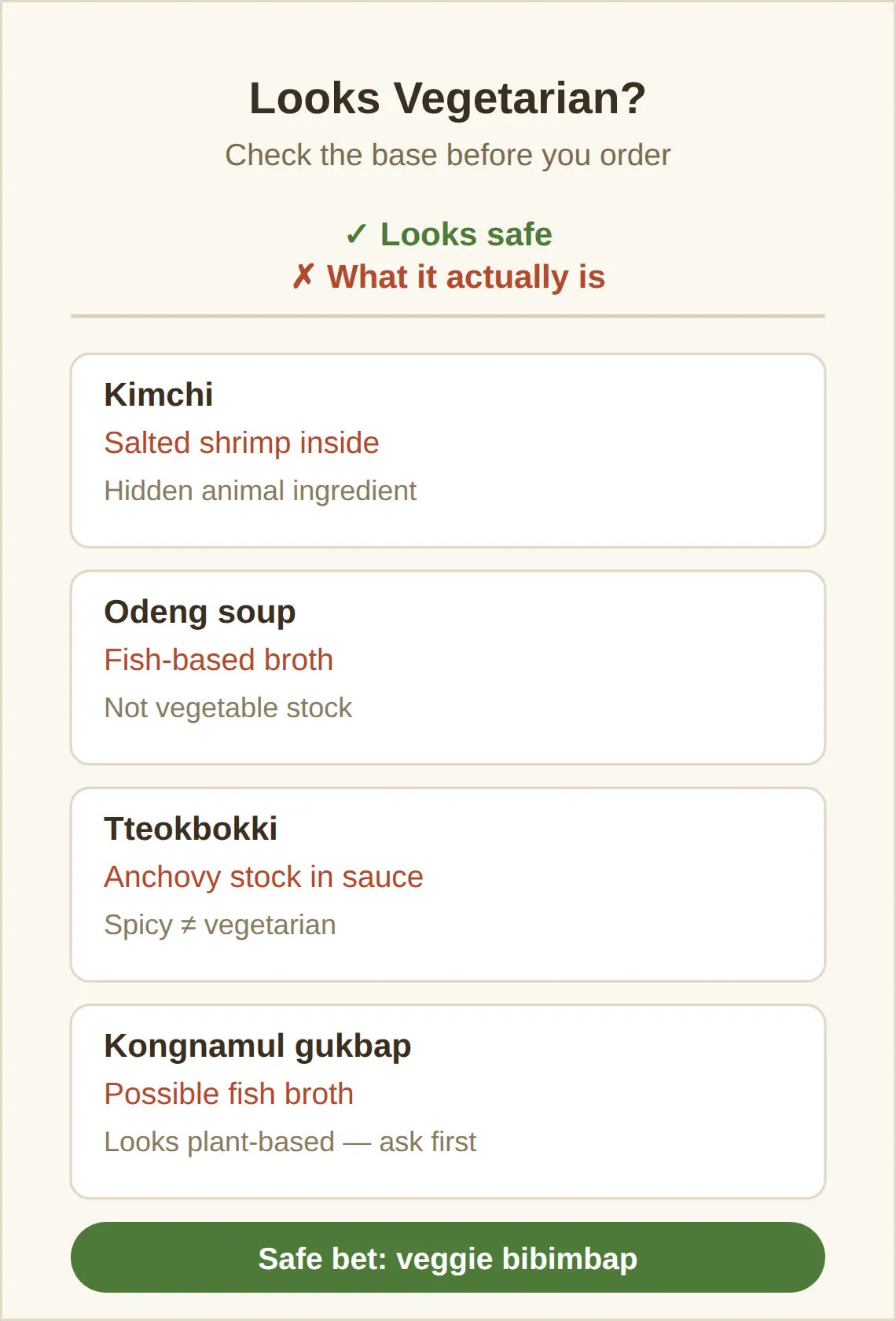
| Kongnamul gukbap or sundubu, because they look plant-based | Ask first — kongnamul gukbap can use fish broth, and sundubu is vegetarian only if made without anchovy or meat stock |
Mostly no — by default, almost every Korean dish contains meat or seafood stock.
Kimchi, the side dish that arrives with everything, usually contains salted shrimp, and ‘is kimchi vegetarian’ is such a common question that it shows up in Google autocomplete on its own.
Broths are the other half of the problem: soups, stews, and even noodle dishes are commonly built on anchovy stock, which never appears on the menu.
When a dish looks vegetarian, the thing to check first is the broth and the sauce — that’s where the anchovy and salted shrimp hide, not in the visible ingredients.
If you say the word ‘chaesik’ (vegetarian) when ordering, target fully vegan restaurants when you can, and default to veggie bibimbap when neither is nearby, you can eat well in Korea without breaking the diet.
Not every kitchen will cook without fish sauce on request, and that has not been verified recently — treat it as something to ask, not to assume.
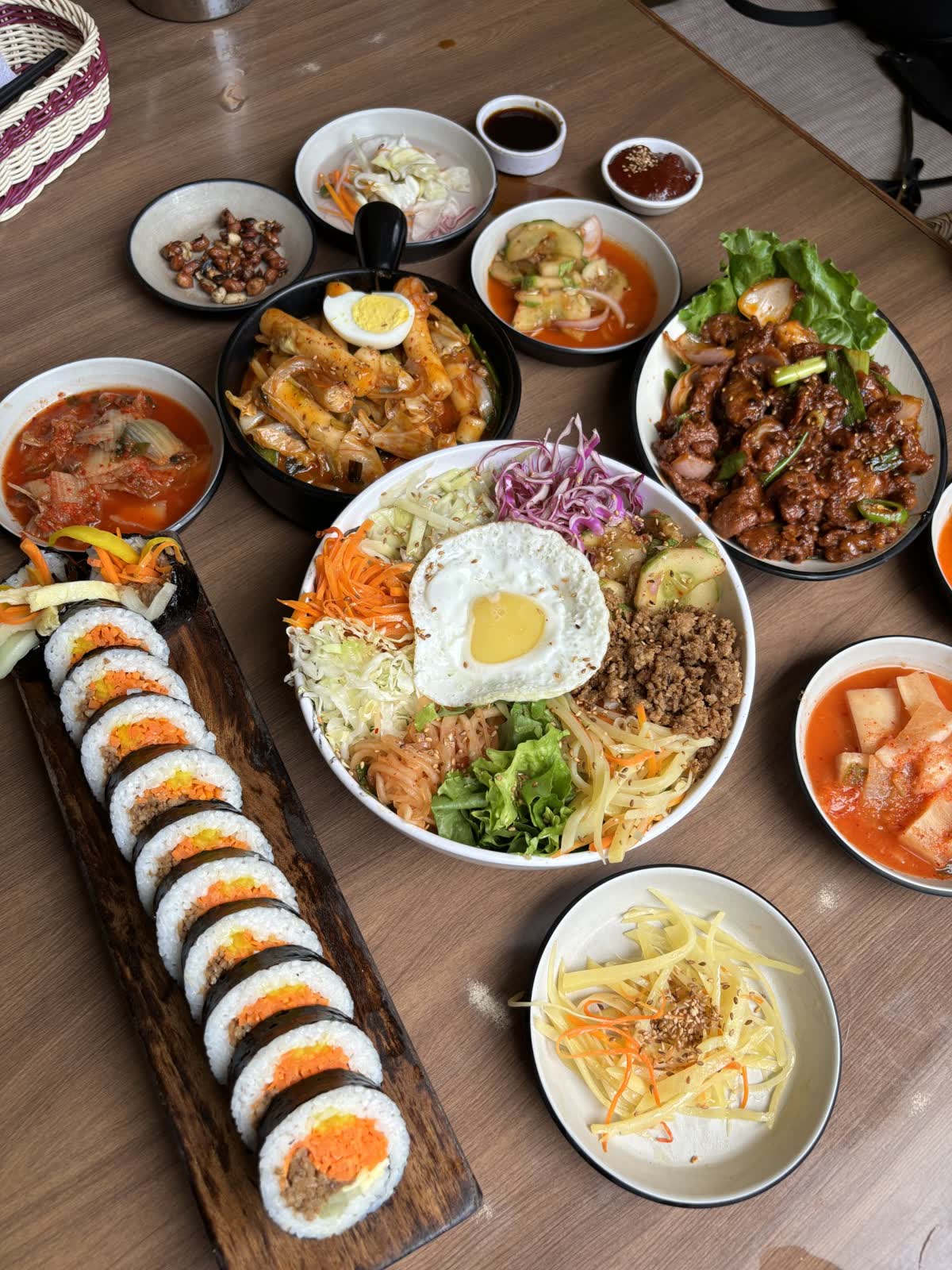
What Can Vegetarians Order at a Regular Korean Restaurant?
The safest default is veggie bibimbap at ₩9,000–15,000, and two more dishes can pass with one question each.
| Dish | Price | Vegetarian status |
|---|---|---|
| Veggie bibimbap | ₩9,000–15,000 | Safest default order anywhere in Korea |
| Plain pajeon (no seafood) | Ask | Reliably vegetarian as ordered |
| Sundubu (non-spicy) | Ask | Vegetarian only without anchovy or meat stock |
| Kongnamul gukbap | Ask | Can use fish broth — confirm first |
Plain pajeon (scallion pancake) can be ordered without seafood and comes out vegetarian as-is.
Non-spicy sundubu (soft tofu stew) is vegetarian only if it is made without anchovy or meat stock, so ask before ordering.
If you order kongnamul gukbap (soybean sprout soup) because it looks plant-based, ask first — it can be made with fish broth even though it looks like a vegetable soup.
If the restaurant has no English menu, point at the dish and say ‘chaesik’ — and if the answer about the stock is unclear, veggie bibimbap is the order that cannot go wrong.
Which Korean Street Food Looks Vegetarian but Isn’t?
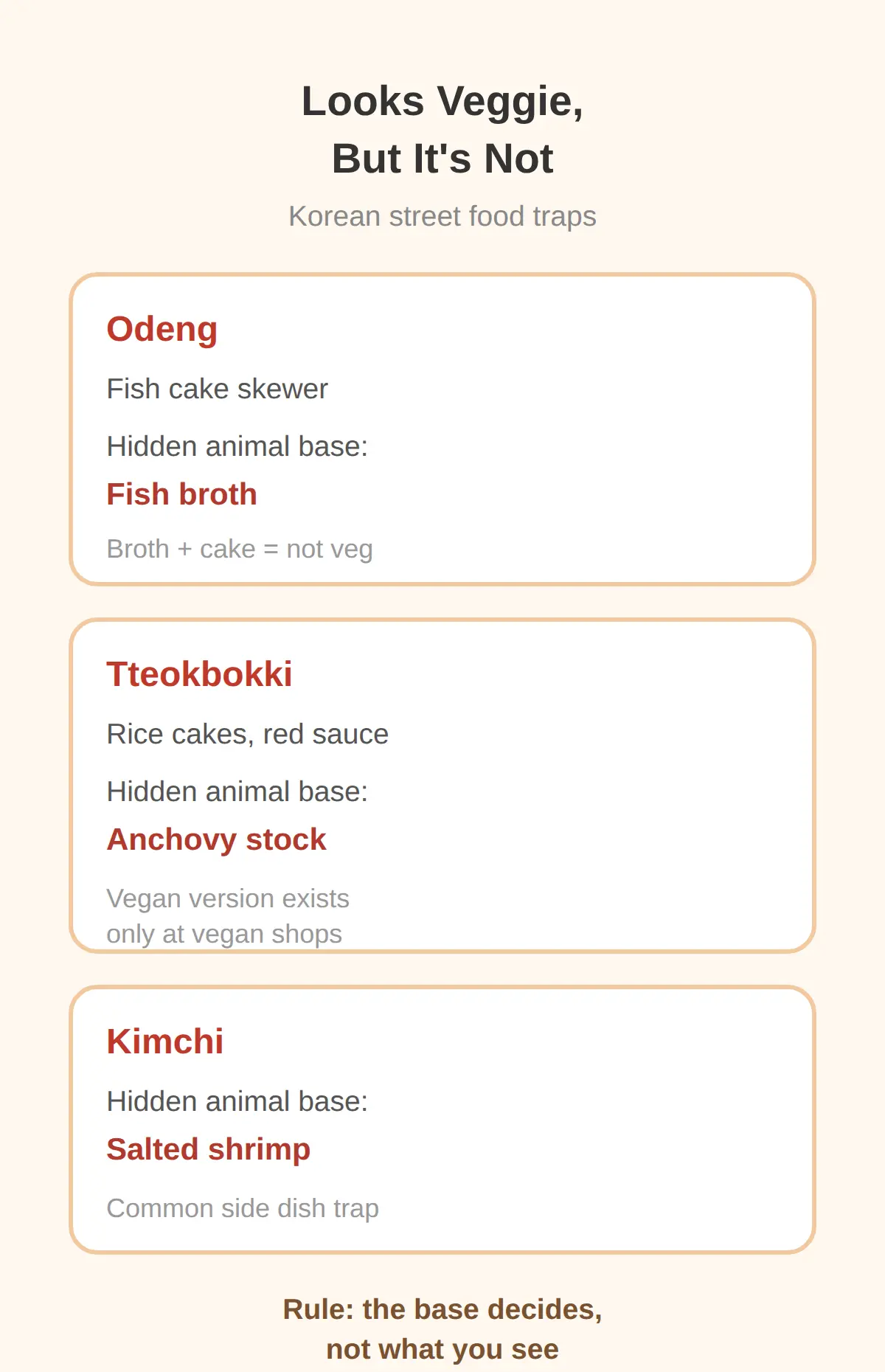
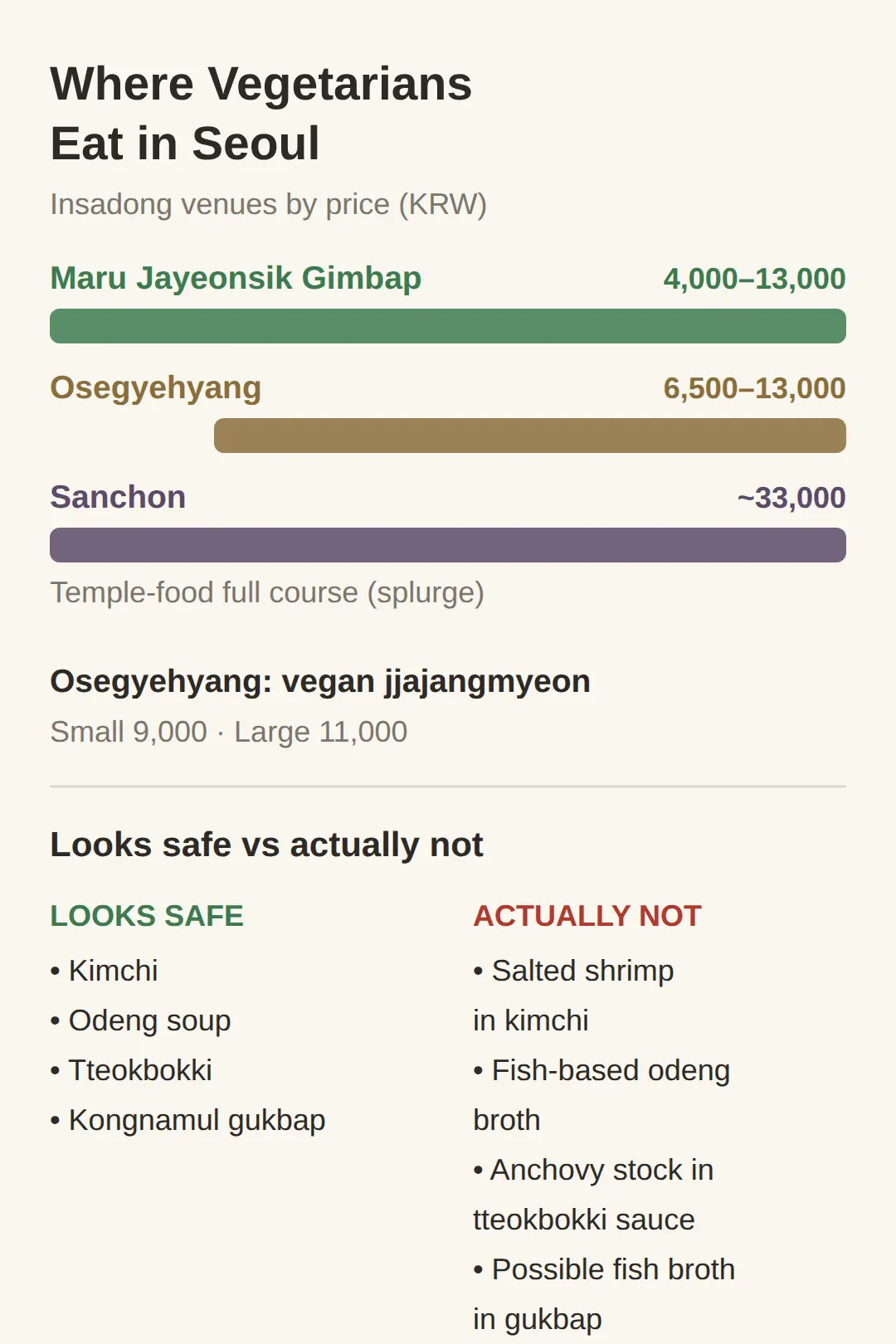
Assume street food is not vegetarian: odeng broth is fish-based, tteokbokki sauce often contains anchovy stock, and kimchi usually has salted shrimp.
Odeng (fish cake on a skewer) is served swimming in broth that is made from fish, so the soup around it is off-limits as well as the cake itself.
Tteokbokki looks like rice cakes in red sauce, but the sauce is commonly built on anchovy stock; vegan tteokbokki exists, though only at dedicated vegan shops.
The rule that covers all of it: the broth and sauce base decides whether a street food is vegetarian, not the visible ingredient.
If you want tteokbokki as a vegetarian, save it for a vegan restaurant — Maru Jayeonsik Gimbap in Insadong sells a vegan version for ₩8,000.
Where Do Vegetarians Actually Eat in Seoul?
Three vegetarian spots sit within walking distance in Insadong, plus a fine-dining option in Garosu-gil.
| Venue | Area | What it is | Price |
|---|---|---|---|
| Osegyehyang | Insadong, 14-5 Insadong 12-gil, Jongno-gu | Fully vegan hanok restaurant, 11:30–21:00 (break 16:00–17:00), year-round, phone 02-735-7171 | About ₩6,500–13,000 per dish |
| Maru Jayeonsik Gimbap | Insadong | All-vegan snack shop, outdoor seating only, small portions | ₩4,000–13,000 (odeng ₩4,000, kalguksu ₩13,000) |
| Sanchon | Insadong | Temple-food full course | About ₩33,000 per person |
| Mahina Vegan Table | Garosu-gil, 2F, 75 Nonhyeon-ro 175-gil, Gangnam-gu | Vegan pasta, burgers, pizza, art-and-music course | Not confirmed in the past 6 months |
It is a fully vegan hanok restaurant near Ssamzigil, with chair seating and a self-order kiosk, and reviewers put the price band at roughly ₩6,500–13,000 per dish.
Signature dishes are maesil tang-su-chae and shiitake mushroom rolls, alongside vegan tteokbokki, vegan chicken, and bibimbap; it also offers options without onion and garlic, which matters for Buddhist-style vegetarians.
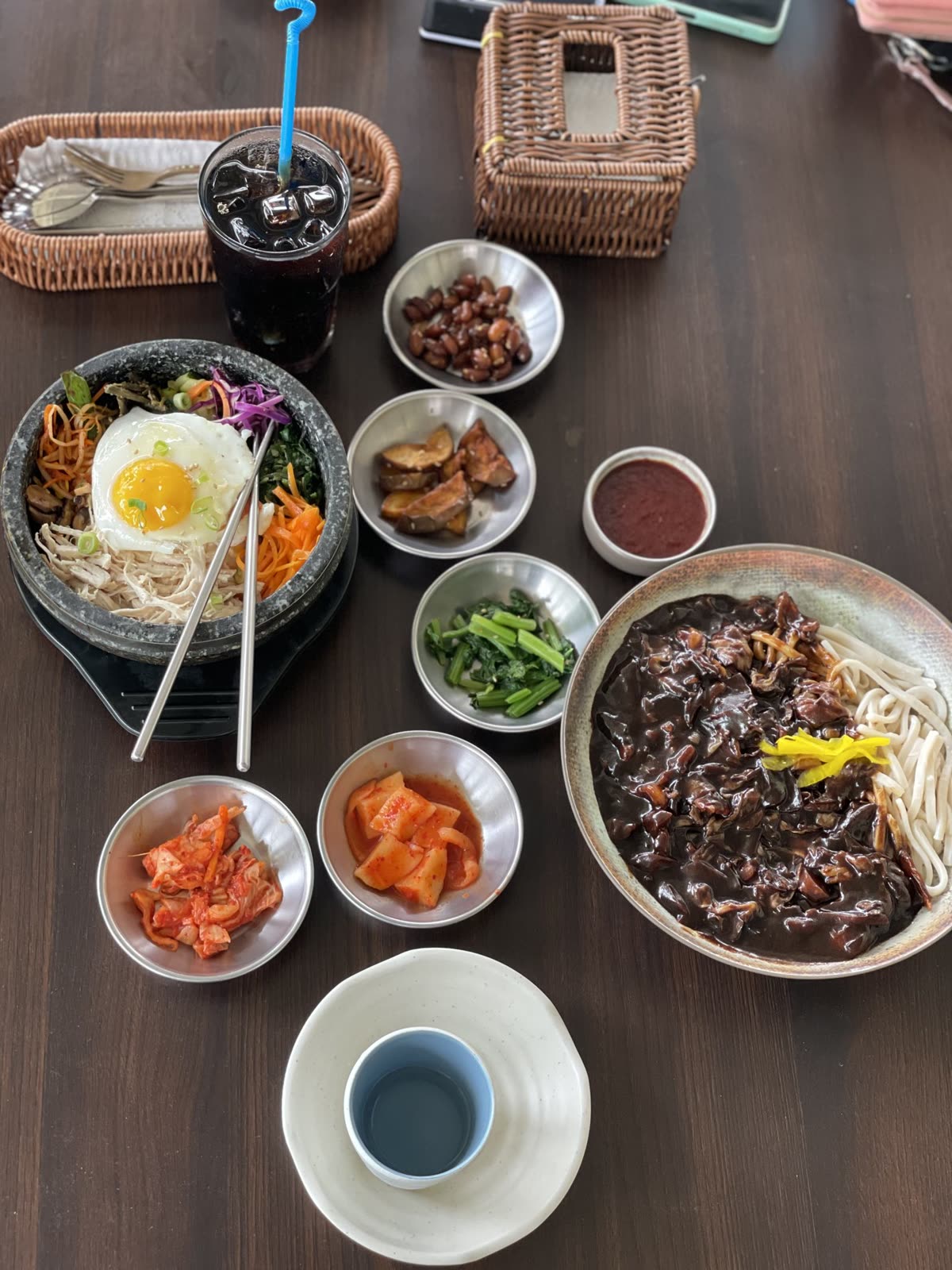
The vegan jjajangmyeon is worth noting — Korean jjajangmyeon normally contains pork, but here it is ₩9,000 (small) or ₩11,000 (large) and fully plant-based.
Maru Jayeonsik Gimbap sells an all-vegan snack menu from ₩4,000 (vegan odeng) to ₩13,000 (kalguksu), cheaper than the restaurants around it.
Plan for eating outside — Maru has no indoor seating, and portions are small.
For a splurge, Sanchon temple-food restaurant in Insadong charges about ₩33,000 per person for a full course, and Mahina Vegan Table in Garosu-gil runs vegan pasta, burgers, pizza, and a special art-and-music course — its current hours and prices have not been confirmed within the past six months, so check before going.
If I were planning a vegetarian day in Seoul, I would spend one afternoon in Insadong — Osegyehyang, Maru Jayeonsik, and Sanchon are all within walking distance — and default to veggie bibimbap anywhere else in the city.
Can You Eat Vegan Korean Temple Food?
Yes — temple cuisine (sachal eumsik) is vegan by design, and the easiest way in is a Templestay program through templestay.com.
Sachal eumsik is the cooking style from Buddhist temples, so it contains no meat, fish, or usually onion and garlic — but which temples serve a vegan meal varies by program, so check the program page on templestay.com before booking.
In Seoul, ‘Maji’ in Jongno is a temple-food restaurant with an English menu and reservations required, though the reservation requirement comes from a single source and should be confirmed by phone before you go.
If price is the deciding factor, here is the comparison from the 2026 guide sources: Sanchon temple food in Insadong charges about ₩33,000 per person — 2.2 to 3.7 times a veggie bibimbap (₩9,000–15,000) — and that price buys a full course, not a single dish.
If you want the full temple-cuisine experience, Sanchon or a Templestay meal is the way; if you want a vegetarian dinner for the price of a normal restaurant dish, veggie bibimbap or Osegyehyang does the job.
Related posts
📎 Seoul — everything we know
📎 📅 Upcoming Dates — Release & Event Calendar
Sources
- 33,000 KRW per person via discoverkorea.info blog — no prima (discoverkorea.info)
- Veggie bibimbap 9,000–15,000 KRW; sachal eumsik ‘Maji’ Jongn (korealocally.com)
- Odeng broth fish-based; tteokbokki sauce often anchovy stock (eastasiaexplorer.com)
Vegetarian Eating in Korea — Summary
- Before you go, re-check hours and prices on each restaurant’s own page — Sanchon and Mahina can change course menus seasonally.
- Check the broth and sauce first — that is where fish and shrimp hide.
- Odeng, tteokbokki, kimchi, and kongnamul gukbap all look vegetarian and usually are not.
- Insadong covers a full vegetarian afternoon: Maru Jayeonsik (snack, from ₩4,000), Osegyehyang (meal, about ₩6,500–13,000), Sanchon (course, about ₩33,000).
- Say ‘chaesik’ (vegetarian) when ordering, and ask about anchovy or meat stock in stews.
FAQ
Q. Can vegetarians eat Korean food?
Yes, but not by default — kimchi usually has salted shrimp and most broths use anchovy, so vegetarians should order veggie bibimbap (₩9,000–15,000) or eat at fully vegan restaurants like Osegyehyang in Insadong.
Q. Is kimchi vegetarian?
Usually not — most kimchi contains salted shrimp, and it is a common enough question that it appears in Google autocomplete.
Q. Which Korean dishes have no meat or fish sauce?
Veggie bibimbap and plain pajeon are reliably safe; non-spicy sundubu is safe only if made without anchovy or meat stock, so ask first.
Q. What is the cheapest vegetarian meal in Seoul?
The vegan snack menu at Maru Jayeonsik Gimbap in Insadong starts at ₩4,000 (vegan odeng), with yubu gimbap at ₩7,000 — cheaper than the restaurants around it.
Q. Is the Sanchon ₩33,000 price current for 2026?
It comes from 2026 guide sources, but Sanchon’s own price page was not reachable to confirm — check with the restaurant before going.
Planning a vegetarian day in Seoul? Save this guide and start with Insadong — Osegyehyang, Maru Jayeonsik, and Sanchon are all within walking distance.
Cover photo: AI-generated illustration (vegetarian korean bibimbap) — AI-generated image, illustrative only
#Koreanfood #vegetarian #veganSeoul #travel #Koreafoodguide
📅Upcoming Schedule — this week 23 · D-1 Autumn season = post-summer brightening demand window (UV drSee all →