No — Squid Game is fiction, but the debt desperation behind it is real: creator Hwang Dong-hyuk has said the premise comes from his own economic hardship and Korea’s class inequality.
The death game itself, the prize-accumulation rule and the VIPs are invented.
This post separates what the show gets right from what it made up, and what you can still see in Seoul.
Contents
- Is Squid Game realistic? What’s real and what’s not
- What the show gets right about debt
- What Squid Game invents: the prize rule and the death game
- The games are real — the death part is not
- Can you visit Squid Game in real life?
- How real is the creator’s connection to the story?
Is Squid Game realistic? What’s real and what’s not
The debt desperation is grounded in real Korean economic pressure, and the death games, the 100-million-won-per-player prize rule and the VIPs are invented.
Creator Hwang Dong-hyuk has said the idea came from his own economic hardship and South Korea’s class disparity, not from a documented event.
Treat the series as fiction built on real pressure.
The show ran 3 seasons and 22 episodes from September 17, 2021 to June 27, 2025, and Season 1 became Netflix’s most-watched series, winning 6 Primetime Emmy Awards and 1 Golden Globe.
By October 2, 2021 it was #1 on Netflix in every country where Netflix operates — the first Korean series to do that.
When a show this big gets called "realistic," the first thing worth checking is what the creator actually said it is based on.
Here that is his own financial struggle and observed inequality, not a real death game.
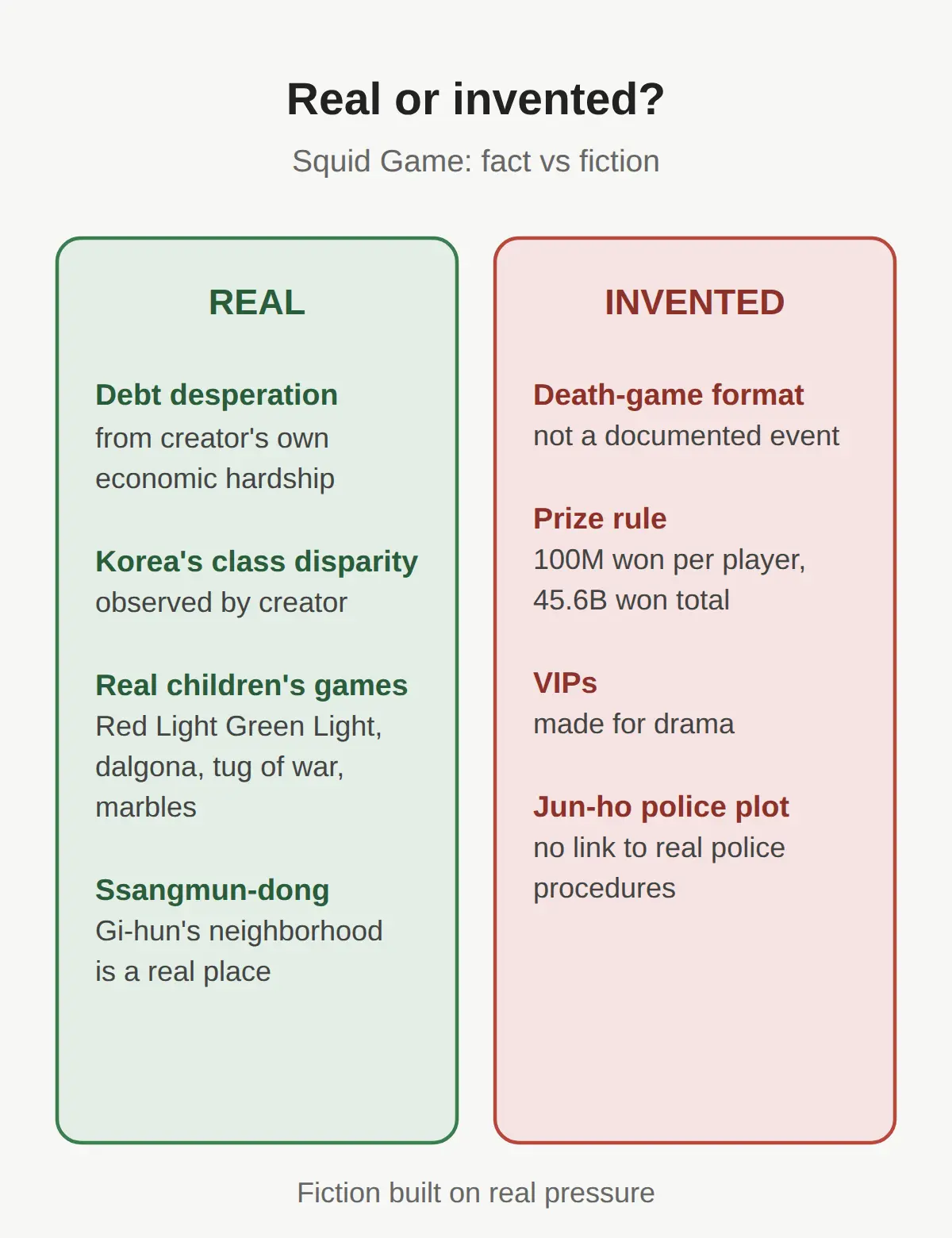
| Debt-driven desperation of the players | Real grounding — based on the creator’s stated own economic hardship and Korea’s class disparity |
|---|---|
| Red Light Green Light, dalgona, tug of war, marbles | Real Korean children’s games |
| Gi-hun’s Ssangmun-dong neighborhood | Real place in Seoul (Dobong-gu) |
| Death-game format (losing = dying) | Invented for drama |
| +100 million won per eliminated player (45.6 billion total) | Invented — no real-world equivalent |
| Hwang Jun-ho police infiltration subplot | Invented — no official link to real police procedures |
What the show gets right about debt
The premise — 456 people so deep in debt they risk their lives for money — comes from Hwang Dong-hyuk’s own experience of economic hardship and from class inequality he saw in South Korea.
That grounding is why the desperation reads as familiar to Korean viewers even inside a violent game.
The debt-driven pressure of the players mirrors real pressures; the death game on top of it does not exist.
How far the debt depiction matches actual Korean household-debt figures is a harder claim to check, because verified statistics behind the creator’s statements are not pinned down here.
What is confirmed is the creator’s own-statement inspiration, so use that as the line between grounded and invented.
If you are quoting the show’s premise to someone, the safe version is: the financial desperation is the creator’s stated real-life inspiration, and everything staged around it is drama.
What Squid Game invents: the prize rule and the death game
The rule that each eliminated player adds 100 million won to the pot — building to the 45.6 billion won final prize — is a fictional mechanic with no real-world equivalent.
The 45.6 billion won converts to roughly US$39.86 million, but that conversion is the only factual part of the prize.
Do not describe the accumulation rule as a real practice.
Two more invented elements sit alongside it.
The Hwang Jun-ho subplot — a police officer disguising himself as a guard to find his missing brother — is a dramatic device with no official statement linking it to real Korean police procedures.
Some game rules were also deliberately simplified and carried by visuals, so global viewers would not lose the plot over a language barrier.
If you are explaining the series to someone, present the death stakes, the prize math and the police storyline as invented, and anchor the realism in the debt premise instead.
The games are real — the death part is not
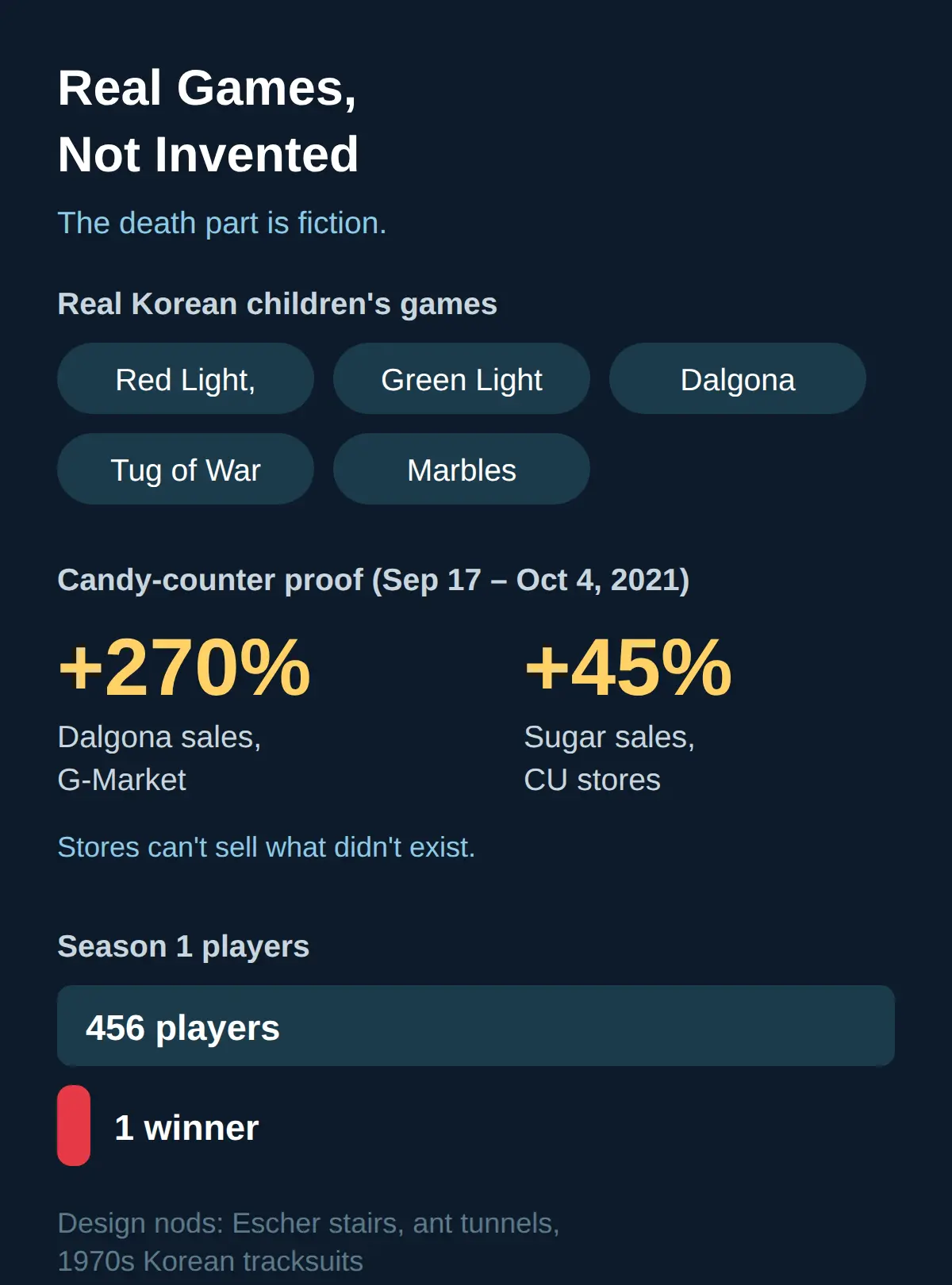
Red Light Green Light, dalgona (the honeycomb sugar candy you carve), tug of war and marbles are real Korean children’s games, and the show did not invent them.
After release, G-Market dalgona sales rose 270% and CU convenience-store sugar sales rose 45% between September 17 and October 4, 2021 — demand for games that already existed.
The design around the games is also drawn from real references.
The maze corridors borrow M.C.
Escher’s impossible stairways, the tunnel layout follows ant colonies, and the green tracksuits reference 1970s Korean sportswear.
Across Season 1’s six games, 456 players were reduced to 1.
If someone tells you the games were made up for the show, the candy-counter number settles it: Korean stores could not have sold 270% more dalgona if the game did not already exist.
Can you visit Squid Game in real life?
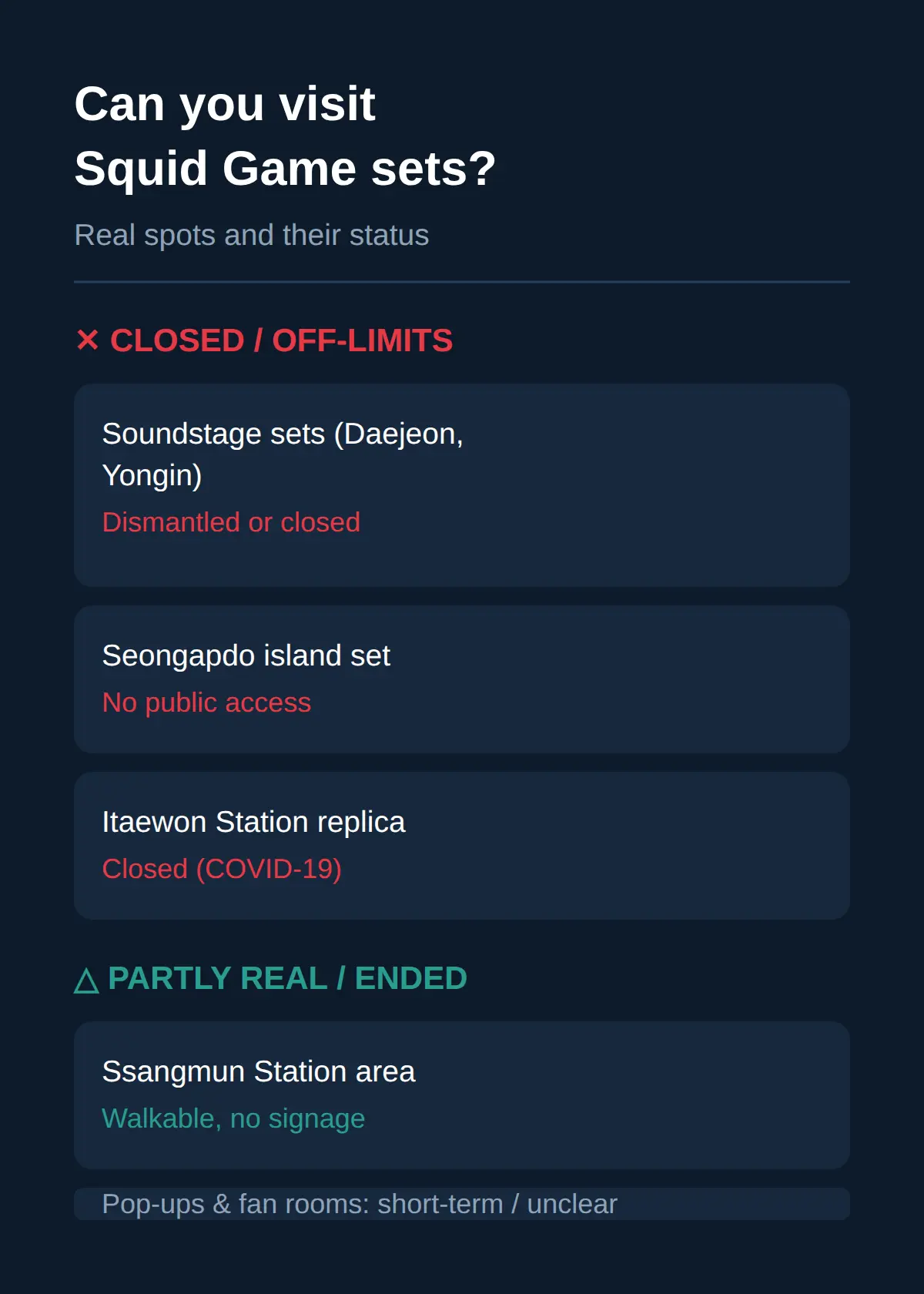
| Spot | Status |
|---|---|
| Soundstage sets (Daejeon, Yongin) | Dismantled or closed |
| Seongapdo island compound | Real filming site, no public access |
| Itaewon Station set replica | Closed early under COVID-19 rules |
| Ssangmun Station (Line 4, Dobong-gu) | Real neighborhood, free to walk, no signage |
| COEX pop-ups, Netflix Experience (NY, Sydney, Madrid) | Short-term, ended |
| Unofficial challenge rooms | Fan tributes, unclear licensing |
How real is the creator’s connection to the story?
Very real: Hwang Dong-hyuk was born and raised in Ssangmun-dong in Dobong-gu — the same neighborhood as debt-ridden Gi-hun — so the protagonist’s home turf mirrors the director’s own background.
He wrote the first script in 2009 and no investor picked it up.
Netflix picked it up in 2019, more than 10 years later, and he spent 12 years total from first script to screen.
The production itself ran June–October 2020, including a mandatory one-month COVID-19 pause.
Season 2 (December 26, 2024) brought Gi-hun back into the game for revenge on the Front Man, and Season 3 — shot back-to-back with it — closed the series on June 27, 2025.
If you are judging how much of the show is autobiography, the confirmed overlap is the neighborhood and the economic hardship.
A 1,349-day run from first episode to finale also makes it one of the longer spans a Netflix Korean series has covered.
Related posts
Sources
- Series overview, 3 seasons 2021-2025, prize rules, cast (ko.wikipedia.org)
- Filming Jun-Oct 2020, Daejeon/Seongap Island, Escher-inspire (ko.wikipedia.org)
- Dobong-gu official ‘Ssangmun-dong Game’ YouTube tour incl. B (asiae.co.kr)
Real or invented — the one-line version
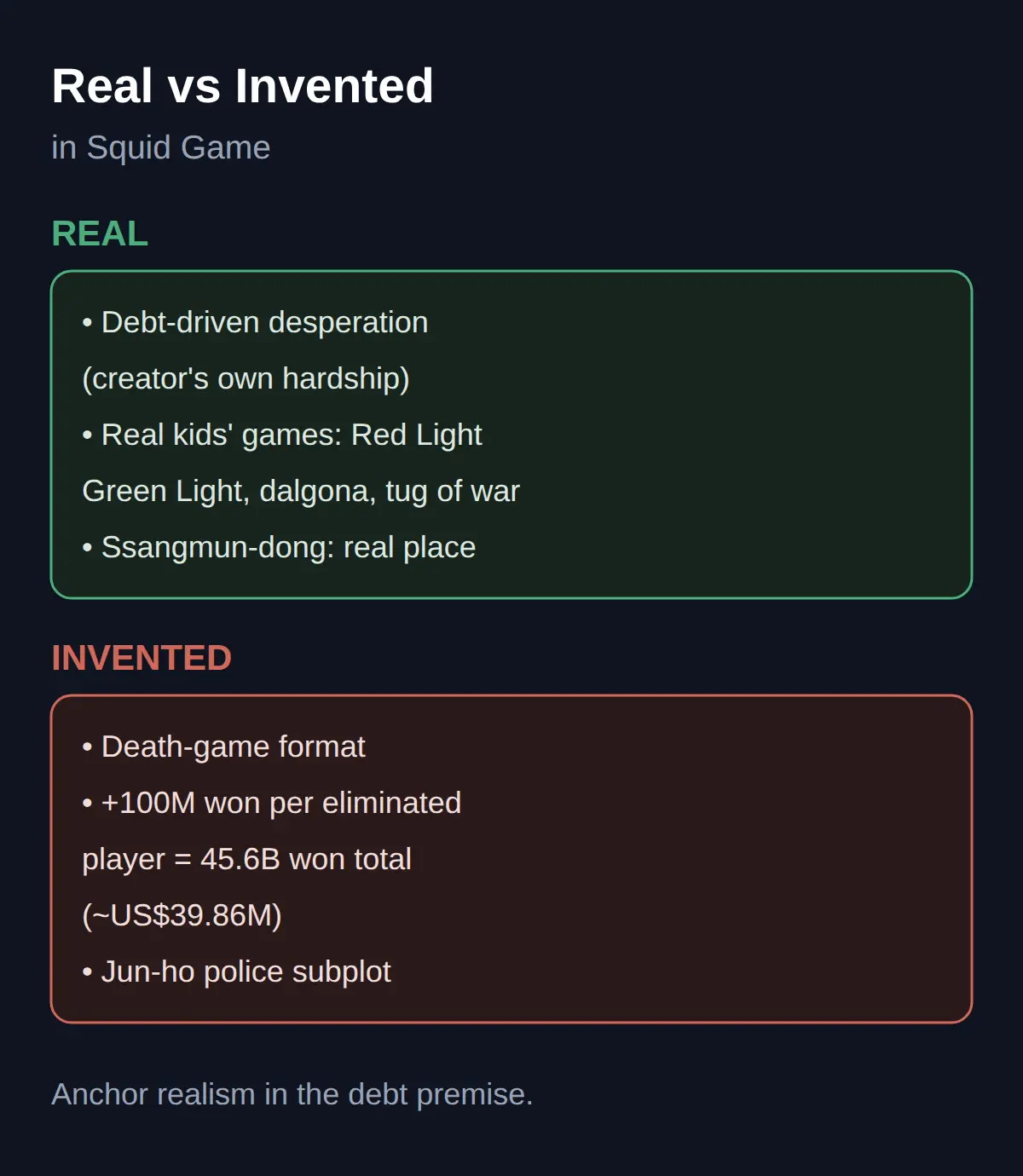
- The debt desperation is real grounding; the death game, the +100-million-won-per-player rule and the VIPs are invented.
- The games — Red Light Green Light, dalgona, tug of war, marbles — are real Korean children’s games.
- The show has 3 seasons and 22 episodes, ending June 27, 2025.
- Season 1 won 6 Primetime Emmy Awards and 1 Golden Globe.
- 45.6 billion won ≈ US$39.86 million — but the prize-accumulation rule behind it is fiction.
FAQ
Q. Is Squid Game realistic?
The debt-driven desperation is grounded in creator Hwang Dong-hyuk’s own economic hardship and Korea’s class inequality, but the death game, the 100-million-won-per-player prize rule and the VIPs are invented.
Q. Is Squid Game based on a true story?
No documented death game exists behind it. The realistic layer is the creator’s stated inspiration — his own financial hardship and observed class disparity in South Korea.
Q. How much is 45.6 billion won in USD?
The final Squid Game prize of 45.6 billion won is roughly US$39.86 million. The rule that each eliminated player adds 100 million won to reach that total is a fictional mechanic.
Q. Are the games in Squid Game real Korean games?
Yes. Red Light Green Light, dalgona, tug of war and marbles are real children’s games — G-Market dalgona sales rose 270% after release because the candy already existed.
Q. Can you visit Squid Game filming locations in Seoul?
Skip the game sets — they were soundstage builds that have been dismantled or closed. Visit Ssangmun Station on Line 4 instead: it is the real neighborhood from the show, and a fan walk takes about 60–90 minutes.
Dates to keep in mind
Cover photo: Dalgona by 도자놀자 — CC BY 4.0
#SquidGame #NetflixKoreandrama #HwangDong-hyuk #Ssangmun-dong #dalgona
📅Upcoming Dates — 이번 주 19 · D-2 Final two episodes drop on Disney+/Hulu전체 보기 →