Tipping confusion and waiting for a bill that never comes are among the moments travelers most often regret in Korean restaurants.
A 2026-09 Wikitree report, citing Korea Tourism Organization materials, listed no tipping, counter payment, and transit card tapping as the mistakes foreign tourists regret most.
This guide answers the questions behind them: do you tip in Korea, how do you pay, and what should you expect at the table.
All of it applies the same way in a neighborhood gukbap shop or a hanjeongsik restaurant.
Contents
- Korea restaurant etiquette: no tipping, counter payment, and what to expect
- How to get seated: guided, free seating, pay-first, or kiosk
- Calling the staff: the table bell and ‘Jeogiyo’
- Self-serve water and free banchan refills — what costs money and what does not
- How to pay at Korean restaurants: the counter, not the table
- Table manners that differ from Japan and China
Korea restaurant etiquette: no tipping, counter payment, and what to expect
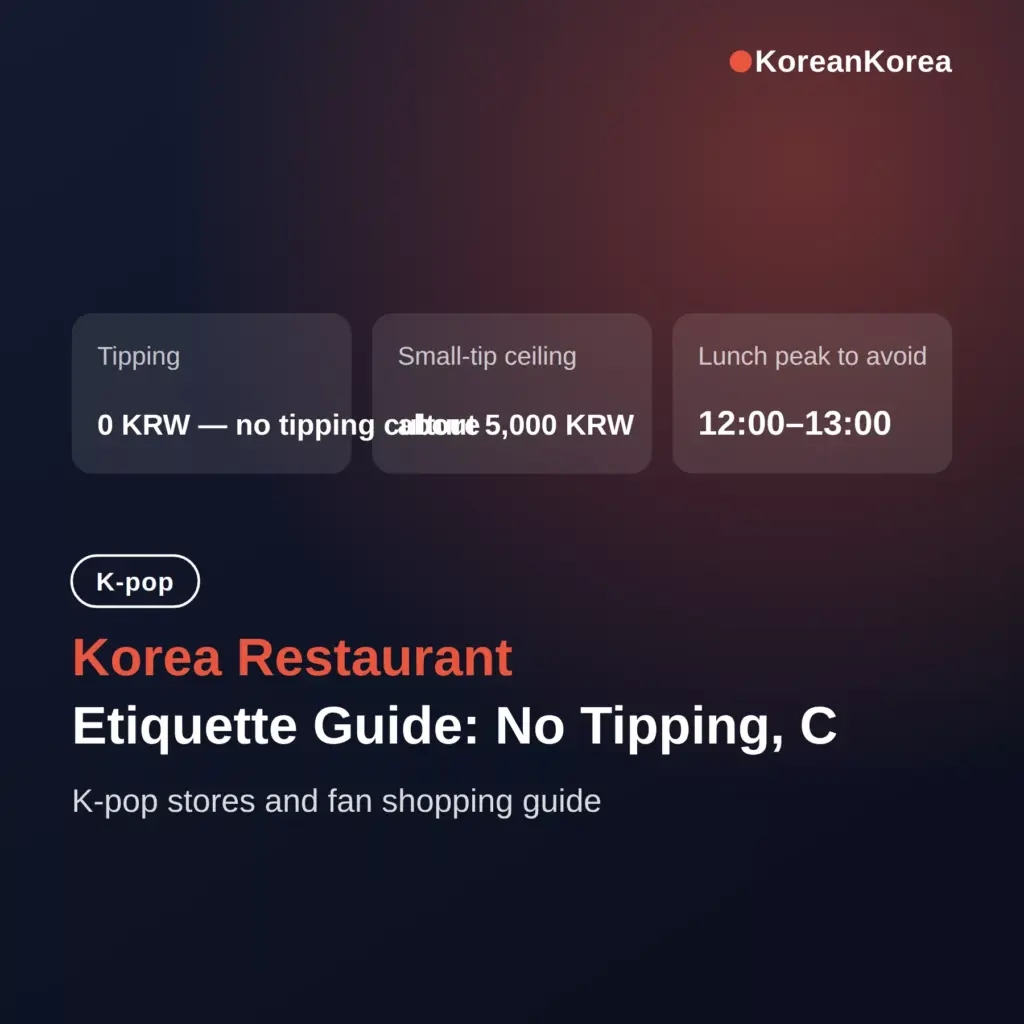
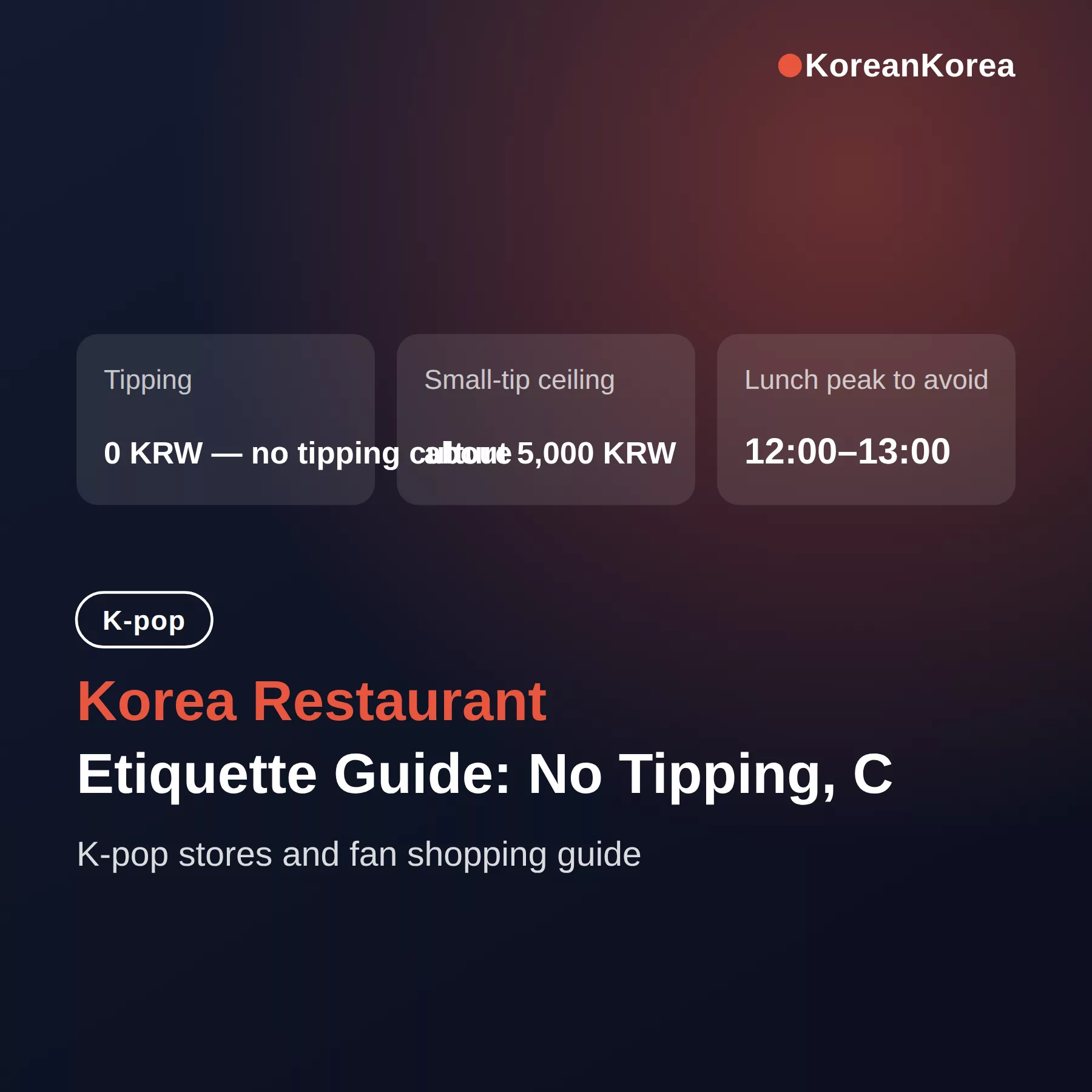
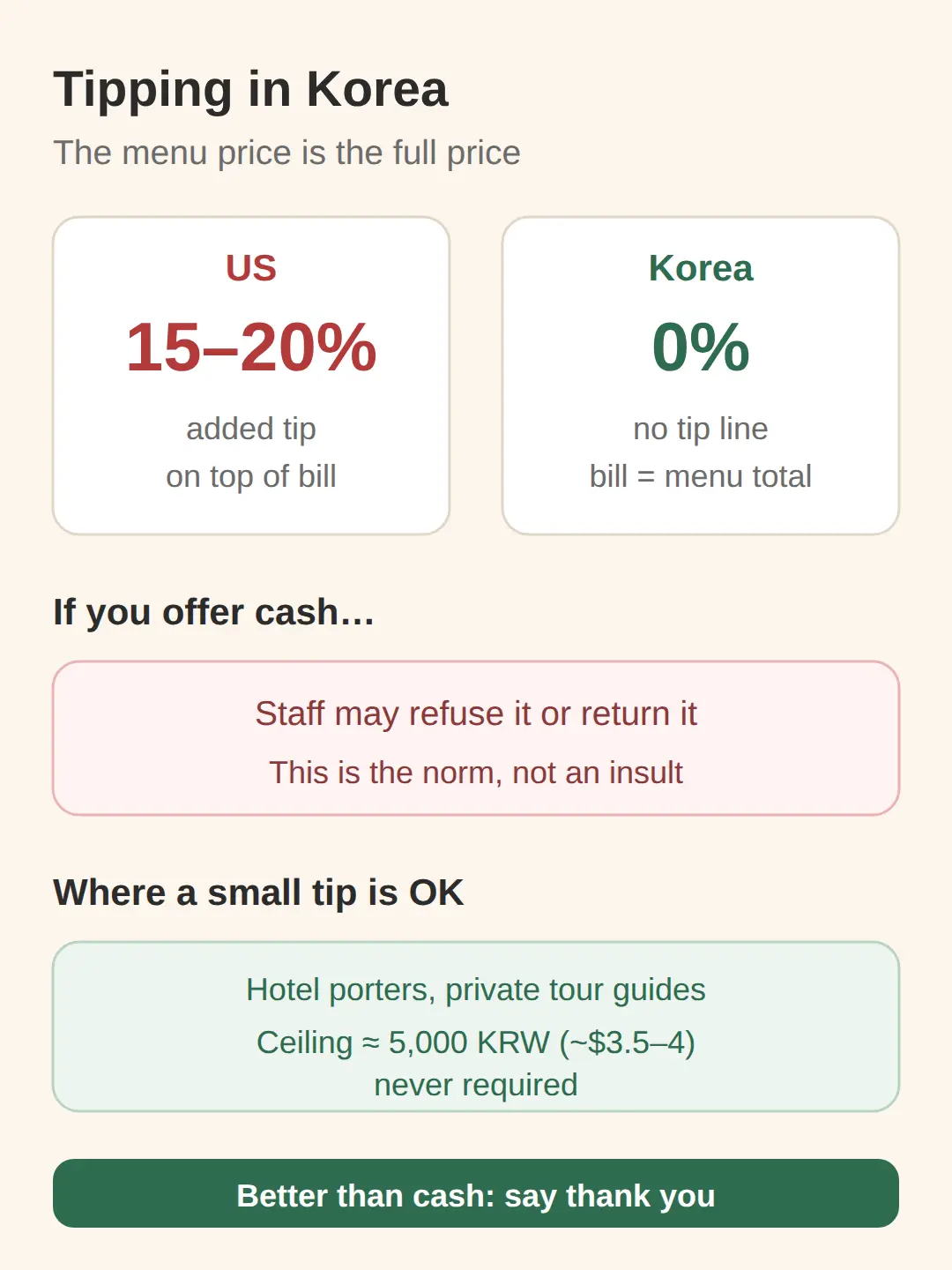
Tipping is not part of Korean restaurant culture.
The price printed on the menu is the full amount, so there is no mental math to do at the end of a meal.
Staff may refuse a tip or return it, because accepting one can feel awkward to them.
A short ‘jal meogeosseumnida’ (thank you for the meal) at the door works better than cash.
The only places where a small tip is tolerated are hotel porters and private tour guides, and even there it is never required.
A tip of around 5,000 KRW, roughly 3.5–4 dollars, is the usual ceiling in those cases.
So budget your meals at menu price exactly — there is no 15–20% buffer to add on top.
This also explains why restaurant etiquette in Korea feels different from Western fine dining.
In the US, diners typically budget a 15–20% tip at restaurants.
In Korea that line item is simply zero, so the bill matches the menu total exactly.
If a server refuses your cash, that refusal is the norm rather than an insult.
| Mistake | What to do instead |
|---|---|
| Leaving a tip on the table | The listed price is the full amount. Skip the tip entirely. |
| Waiting at the table for a bill | Most restaurants ask you to pay at the entrance counter on the way out. |
| Waiting for table service | Water is usually self-serve, and basic side dishes refill for free. |
How to get seated: guided, free seating, pay-first, or kiosk
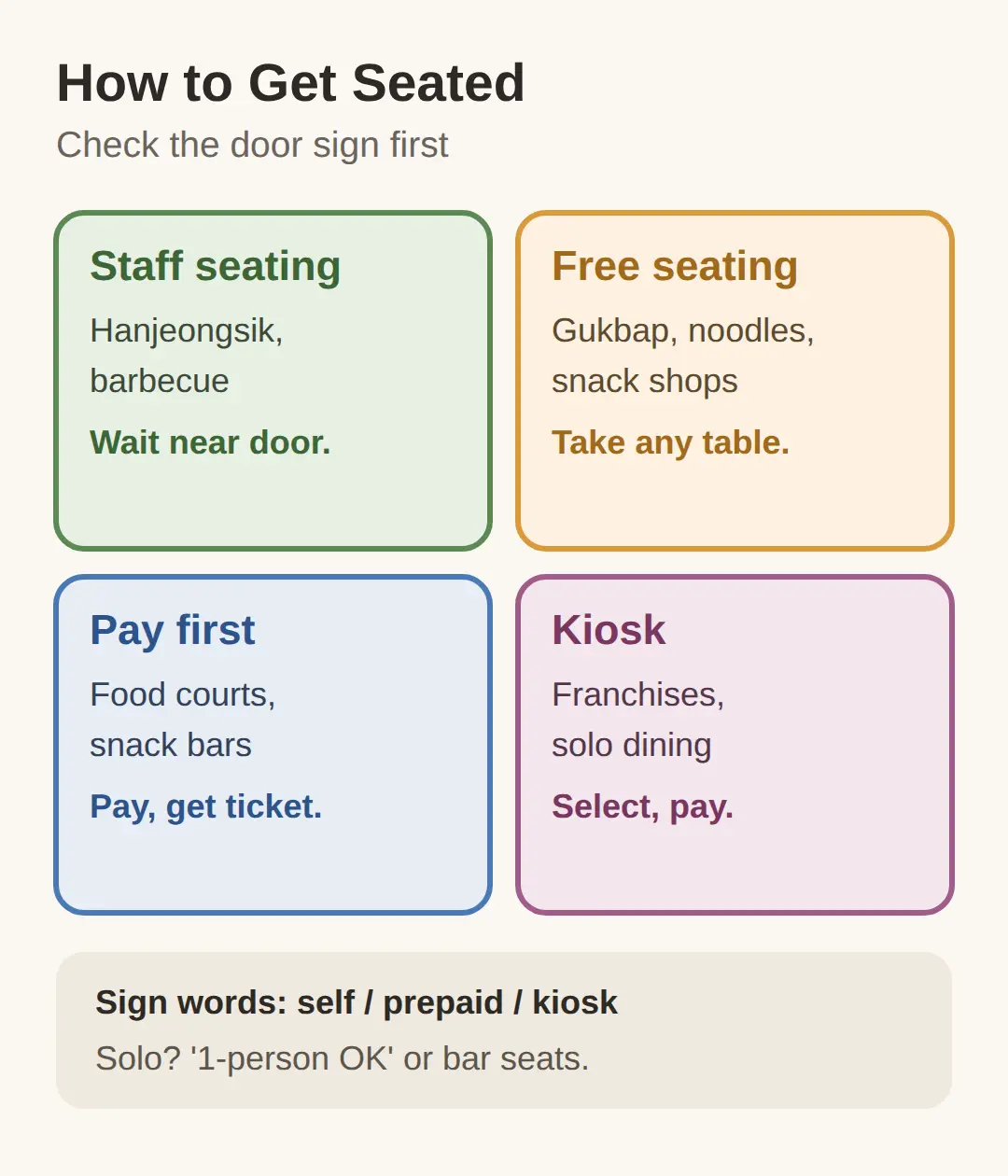
Korean restaurants use four entry styles, and the fastest mistake is picking the wrong one.
Hanjeongsik and barbecue houses have staff who seat you, so wait near the door.
Casual spots like gukbap, noodle, and snack shops are free seating — take any open table.
Food courts and some snack bars are prepaid: order and pay at the counter first, then take a number ticket.
Many franchises and solo-dining spots use kiosks instead, where you select, pay, and receive a number ticket in one step.
A quick glance at the entrance sign for words like ‘self’, ‘prepaid’, or ‘kiosk’ settles which type you are in before you sit down.
Solo dining is broadly welcome in Korea.
Look for menus marked ‘1-person OK’ or ‘honbap welcome,’ and barbecue houses with single portions or bar seating are the safest bets.
Avoid the weekday 12:00–13:00 rush and the weekend 18:00–20:00 peak if you want a table without waiting.
👉 Busan travel guide 2026: why Taiwanese tourists are flying in and booking longer stays
Calling the staff: the table bell and ‘Jeogiyo’
Most restaurant tables have a call button on the wall or table edge.
Press it and a server comes over — that is the normal way to order or ask for anything.
There is no expectation that you wait to make eye contact.
If a table has no button, slightly raising a hand and saying ‘Jeogiyo’ (excuse me) is not considered rude.
Shouting across the room or waving both arms is, so keep the signal small.
Spoons and chopsticks usually sit in a drawer at the side of the table or in a stainless container on top, so check there before asking for utensils.
Self-serve water and free banchan refills — what costs money and what does not
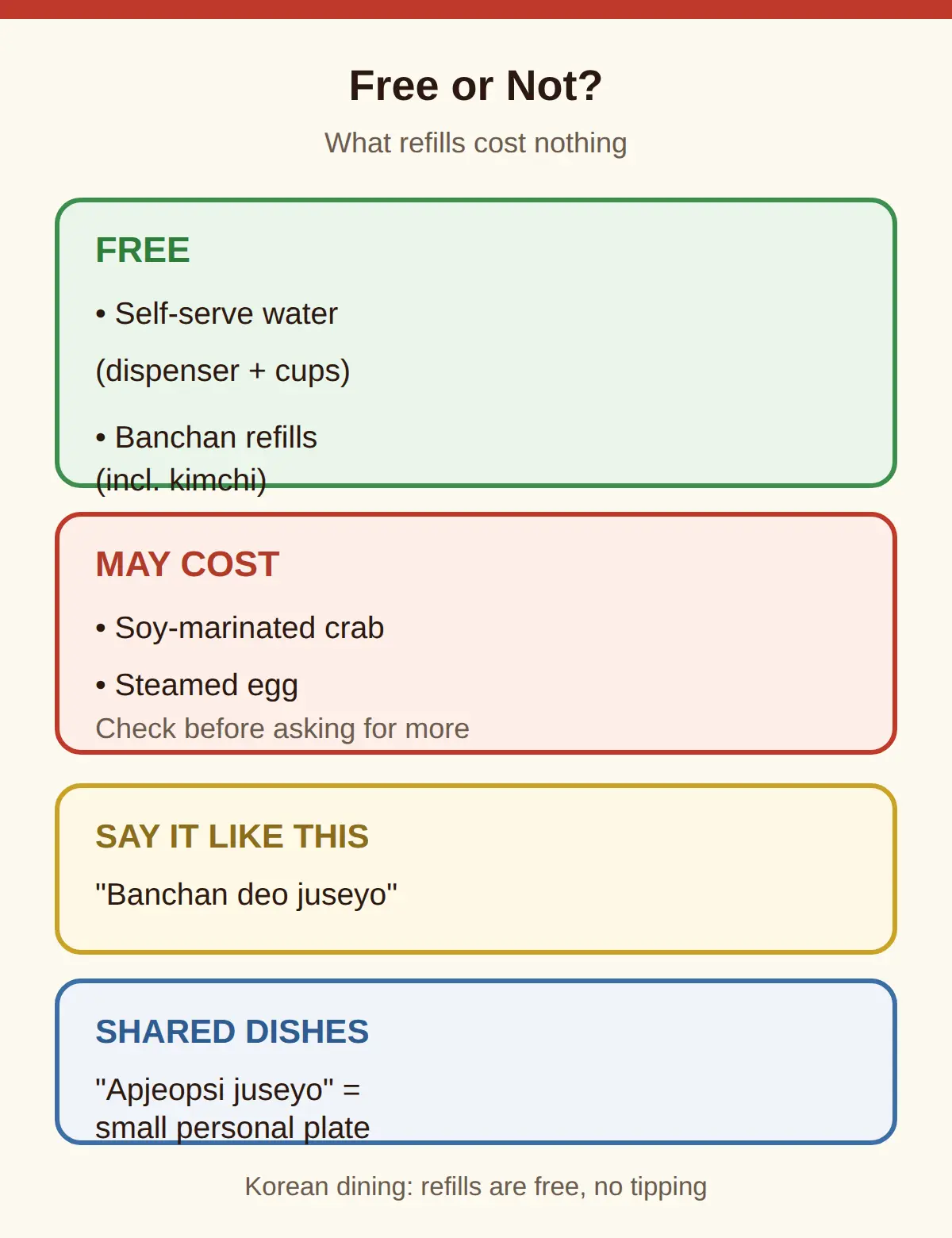
Water is typically self-serve in Korean restaurants.
Look for a dispenser near the entrance or along a wall, often grouped with cups in a corner station.
A sign reading ‘self-serve water’ confirms it, so there is no need to request a glass.
Basic side dishes, called banchan, including kimchi are usually free to refill.
Ask with ‘banchan deo juseyo’ and the server brings more.
Premium items like soy-marinated crab or steamed egg are the exception — some restaurants charge for those or do not refill them, so check before requesting seconds.
Sharing plates work the same way in both directions: taking portions onto your own plate, called apjeopsi, is the normal way to eat from shared dishes.
Ask ‘apjeopsi juseyo’ and you will get a small personal plate.
How to pay at Korean restaurants: the counter, not the table
The most common payment style is paying at the entrance counter after you finish eating.
The bill does not arrive at your table, so waiting for a server to bring one is the mistake — the payment step happens on your way out.
Some restaurants do offer table payment if you ask for ‘gyesanseo juseyo,’ but counter payment is the default.
At counter-style places, say ‘gyesan-halgeyo’ (I’ll pay) at the register rather than calling a server over first.
Cards are accepted at virtually every restaurant, so asking ‘card doenayo?’ is rarely necessary.
For splitting, ‘gakja gyesan-halgeyo’ means pay separately, and ‘gachi gyesan-halgeyo’ means one bill together.
Adding ‘receipt juseyo’ gets you a receipt if you need one for expenses.
As you leave, ‘jal meogeosseumnida’ is a natural way to close the meal.
It costs nothing, needs no tip, and is understood everywhere from barbecue houses to food courts.
Staff will often return a tip left on the table anyway, so a spoken thank-you is the cleaner substitute.
👉 Korea navigation apps: why Google Maps fails and 4 to install before landing
Table manners that differ from Japan and China
Korean dining etiquette keeps the rice and soup bowls on the table while eating.
Lifting a bowl to your mouth, normal in Japan or China, is the biggest dining-culture difference for travelers from elsewhere in Asia.
Do not stick chopsticks upright into rice — the gesture resembles funeral offerings and is considered a real taboo.
Rice and soup are eaten with a spoon, and side dishes with chopsticks, so do not hold both utensils in one hand at the same time.
When dining with older Koreans, wait for the oldest person to pick up their spoon first.
This rule does not apply when eating alone or with friends.
If you need to blow your nose, leave the table — doing it at a Korean dining table is considered very impolite.
Slurping noodles or ramyeon, by contrast, is naturally accepted.
👉 Korea travel etiquette guide covering tipping and table customs
👉 Korean restaurant etiquette guide with seating and payment phrases
👉 Wikitree report on the 3 mistakes foreign tourists regret most
Related posts
📎 Gyeongbokgung night tour 2026: 3,000 won, Sept 2-Oct 2, and how booking works
📎 Korea golden routes: 5 airport hubs, and when foreign travelers can actually use them
📎 📅 다가오는 일정 — 발매·개봉·발표 캘린더
Sources
- Elders-first, no bowl lifting, spoon/chopstick split, no tab (comeonkorea.com)
- Comprehensive guide: call bell, self-serve water, banchan re (mywebring.com)
- Wikitree 2026-09 report on 3 regrets of foreign tourists, ci (wikitree.co.kr)
Pocket phrases that cover a full meal
- More side dishes: ‘Banchan deo juseyo’
- One more of this: ‘Igeo han beon deo juseyo’
- I’ll pay: ‘Gyesan-halgeyo’ (say it at the register in counter-payment places)
- Pay separately: ‘Gakja gyesan-halgeyo’
- One bill together: ‘Gachi gyesan-halgeyo’
FAQ
Q. Do you tip in Korea at restaurants?
No. The menu price is the full amount, and staff may refuse or return a tip. Small tips are only tolerated for hotel porters or private tour guides.
Q. How do you pay at Korean restaurants?
Most restaurants ask you to pay at the entrance counter after eating. Cards are accepted almost everywhere, so ‘gyesan-halgeyo’ at the register is all you need.
Q. Why is there no table service in Korea?
Water, cups, and basic side dishes are set up as self-service stations. A call button on the table replaces flagging down a server, so staff come to you when summoned.
Q. Can I eat alone in Korea?
Yes. Look for ‘1-person OK’ or ‘honbap welcome’ on menus, and choose barbecue houses with single portions or bar seating. Avoid weekday 12:00–13:00 and weekend 18:00–20:00 peaks.
Keep this etiquette checklist open on your phone during your first few meals in Korea.
#Korearestaurantetiquette #Koreantablemanners #doyoutipinKorea #Koreanrestaurantpayment #banchanrefill #Koreandiningcustoms #travelinginKorea #Koreanfoodguide #solodiningKorea
📅Upcoming Dates — 이번 주 16 · D-day 'The Scandal' global Netflix release전체 보기 →