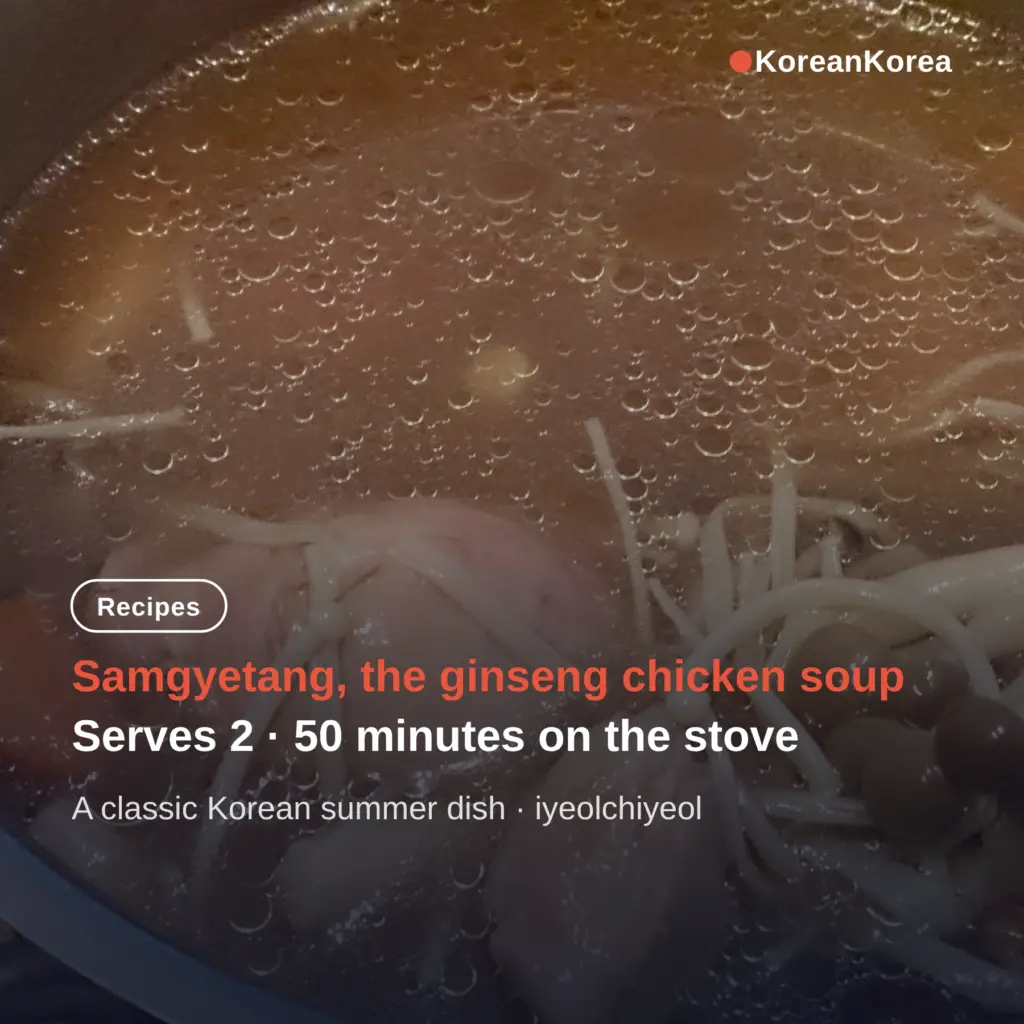
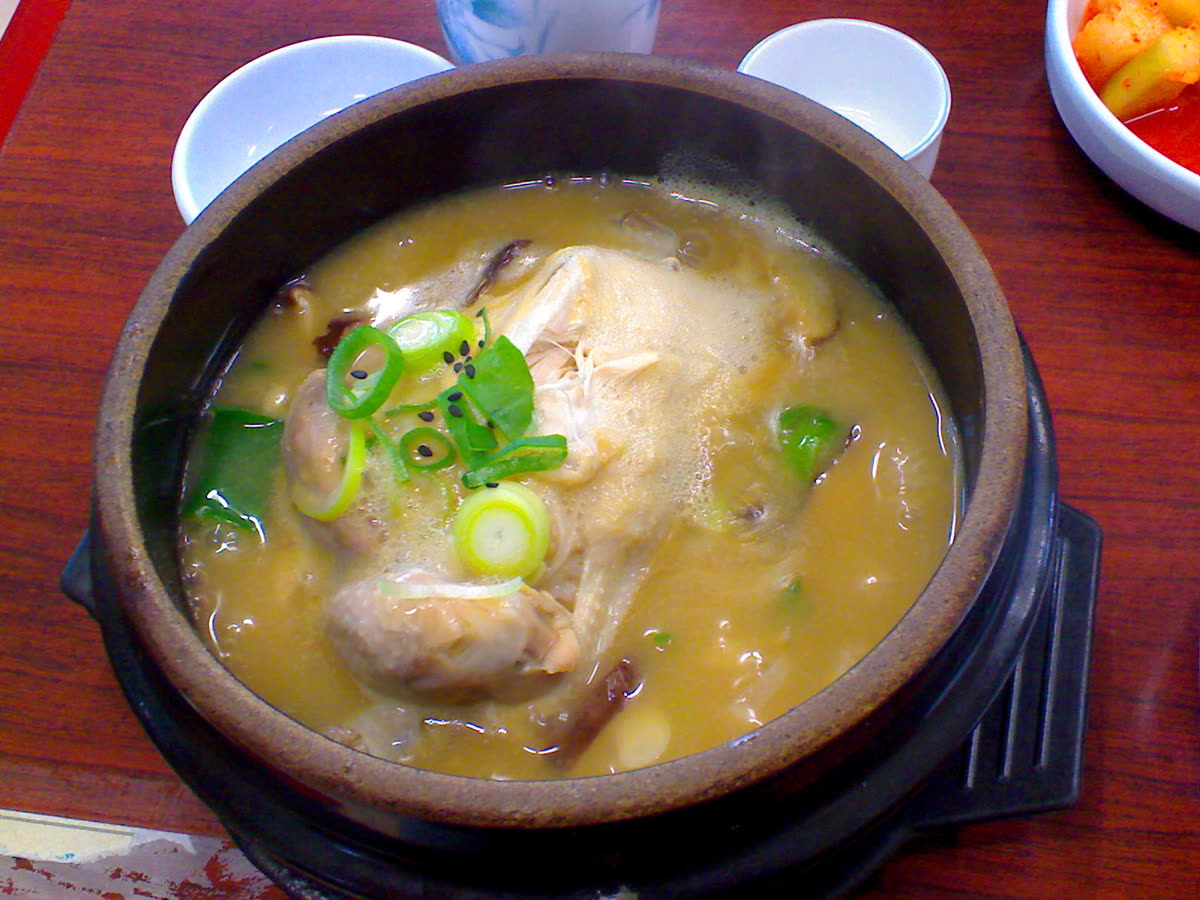
Samgyetang is a whole young chicken stuffed with sweet rice and simmered with ginseng, garlic, and jujubes until the broth turns milky.
Koreans eat it on the hottest days of summer, and the reasons why explain how the dish is cooked.
This post walks through the rice-stuffing rule, the simmer timing, and the substitutions that work when fresh ginseng or small chickens are hard to find.
A few numbers up front, before the steps:
Contents
- Samgyetang recipe: what the name means, and why it is eaten in the worst heat
- Ingredients and substitutions for cooks outside Korea
- Stuffing the rice and sealing the cavity
- Cooking: the simmer, and how to thicken the broth
- Baek Jong-won’s pressure-cooker variation
- Seasoning and serving: salt at the table, not in the pot
Samgyetang recipe: what the name means, and why it is eaten in the worst heat
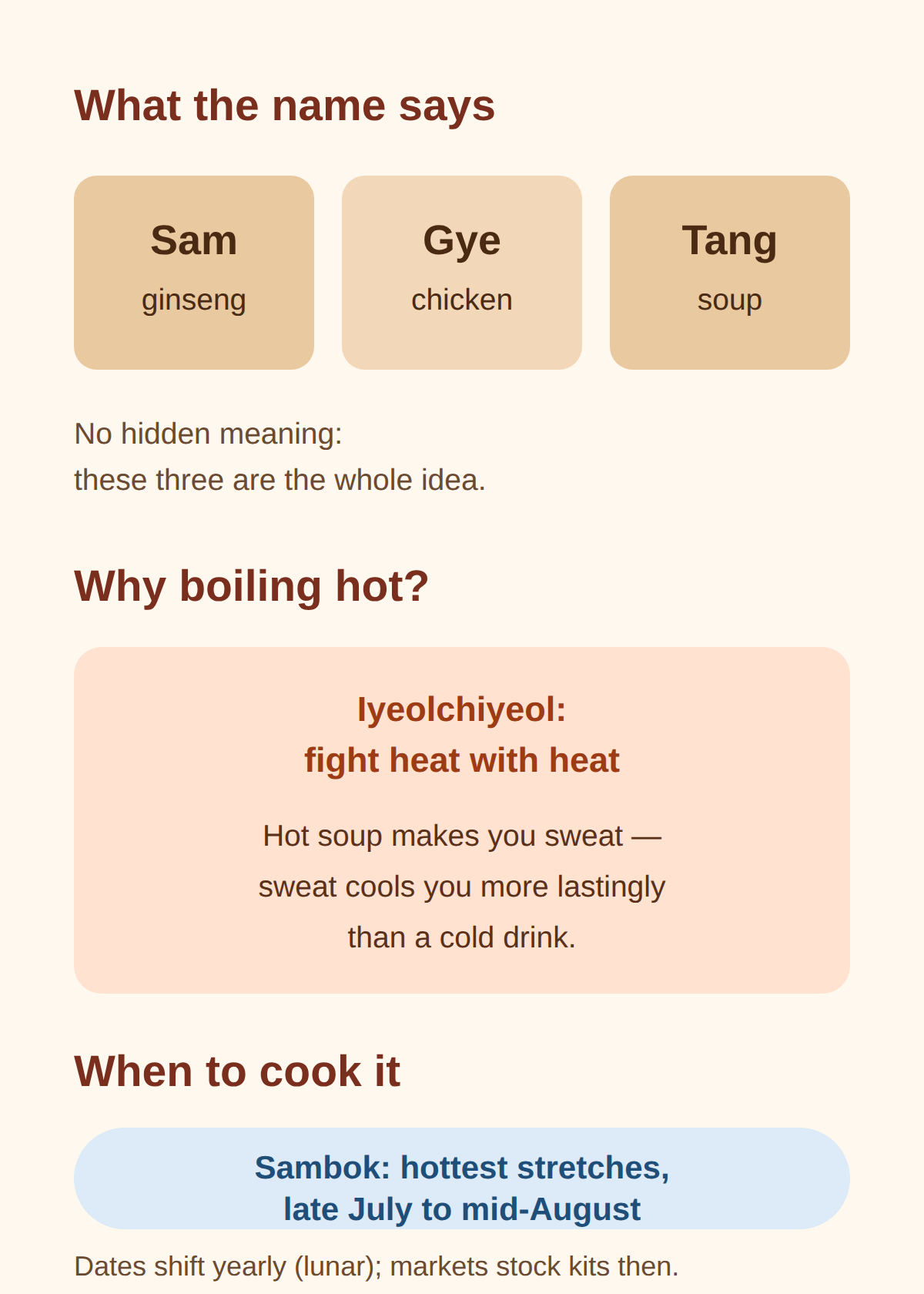
The name spells out the dish: sam (삼) is ginseng, gye (계) is chicken, and tang (탕) is soup.
There is no hidden second meaning — the three ingredients are the whole idea.
The timing looks strange at first.
On the sambok days, the three hottest stretches of the Korean summer, people line up for a soup served boiling hot.
The reasoning is a Korean idea called iyeolchiyeol — fight heat with heat.
A scorching soup makes the body sweat, and that sweat cools it down more lastingly than a cold drink would.
For a first-time cook, this timing matters in a practical way.
Fresh Korean ginseng is at its best at summer markets, and a samgyetang kit — dried ginseng, jujubes, chestnuts, and sweet rice in one packet — is easy to find exactly when the dish is in season.
A note on the sambok calendar: the exact dates shift every year because they follow the lunar calendar, so they cannot be listed as fixed days here.
For most readers the practical marker is simply ‘late July to mid-August’, which is when Korean groceries stock the ingredients.
| Servings | 1 whole chicken or Cornish hen serves 2 |
|---|---|
| Glutinous rice | About 2–2.5 tbsp per pound of bird, soaked 30–60 min |
| Water | 5–6 cups, enough to cover most of the chicken |
| Simmer | 30–40 minutes, longer for a larger bird |
| Seasoning | None in the pot — salt and pepper at the table |
Ingredients and substitutions for cooks outside Korea
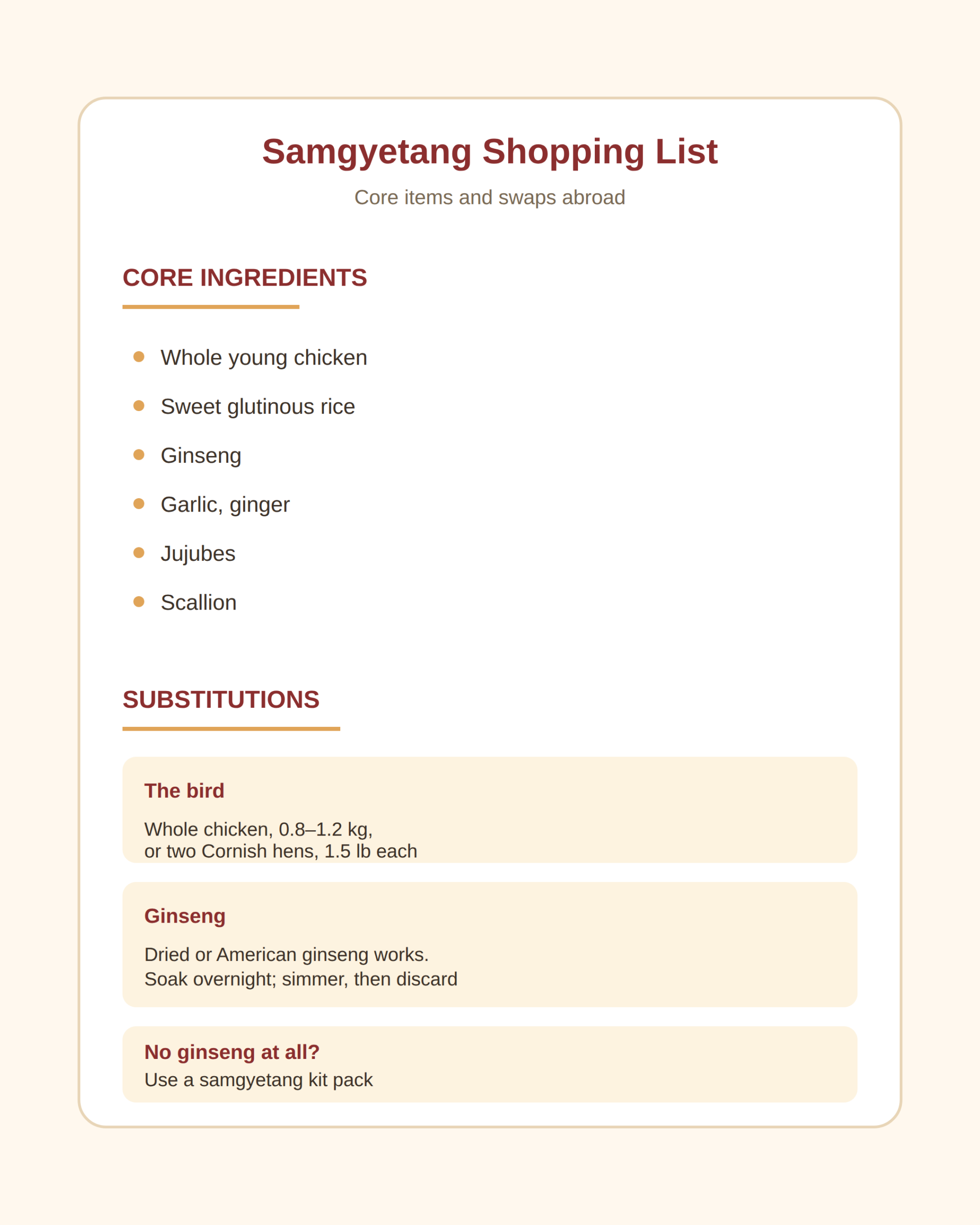
The core list is short: one whole young chicken, sweet (glutinous) rice, ginseng, garlic, ginger, jujubes, and scallion.
The substitutions are what decide whether the dish works abroad.
For the bird, a 0.8–1.2 kg whole chicken or two Cornish game hens of about 1.5 lb each both work.
A single Cornish hen is the classic Korean single serving — one small bird, one clay pot, one diner.
For the ginseng, dried ginseng replaces fresh, and dried American ginseng is a workable overseas stand-in.
Soak it overnight to soften it before it goes into the pot.
One thing dried ginseng will not do is turn tender.
Even after a long simmer it stays tough and fibrous, so the practical approach is to let it infuse the broth, then discard it before serving.
Keep it in the pot as a flavor source, not an ingredient to eat.
If even dried ginseng is out of reach, the samgyetang kit route closes the gap.
Korean markets sell packets containing the dried aromatics, and following the package instructions (including any soaking) covers the seasoning base.
Stuffing the rice and sealing the cavity
The rice is the part where most first attempts go wrong, and the failure mode is physical: glutinous rice expands as it cooks.
If the cavity is packed full, the swelling rice can split the bird open in the pot.
The rule is to fill the cavity only about three-quarters full, leaving roughly a quarter of it empty.
Two ratios from established recipes land in the same range: 3 tablespoons of soaked rice for a 1.5 lb Cornish hen (Korean Bapsang), and 5 tablespoons (60 g) for a 1.7–2.3 lb whole chicken (Beyond Kimchee).
That works out to roughly 2 to 2.5 tablespoons of soaked rice per pound of bird.
The rice needs rinsing and at least 30 minutes of soaking, up to an hour, before it goes in.
Dried rice measures bigger by volume after soaking — 3 tablespoons dry becomes about 4 tablespoons soaked — so measure after soaking, not before.
To keep the rice inside during the simmer, there are two standard moves.
Thread one leg through a small cut in the thick skin near the opposite thigh, or simply cross the legs and tie them with kitchen twine.
If the neck and tail are still attached, leave them on: folding the neck into the cavity helps seal the opening.
Cooking: the simmer, and how to thicken the broth
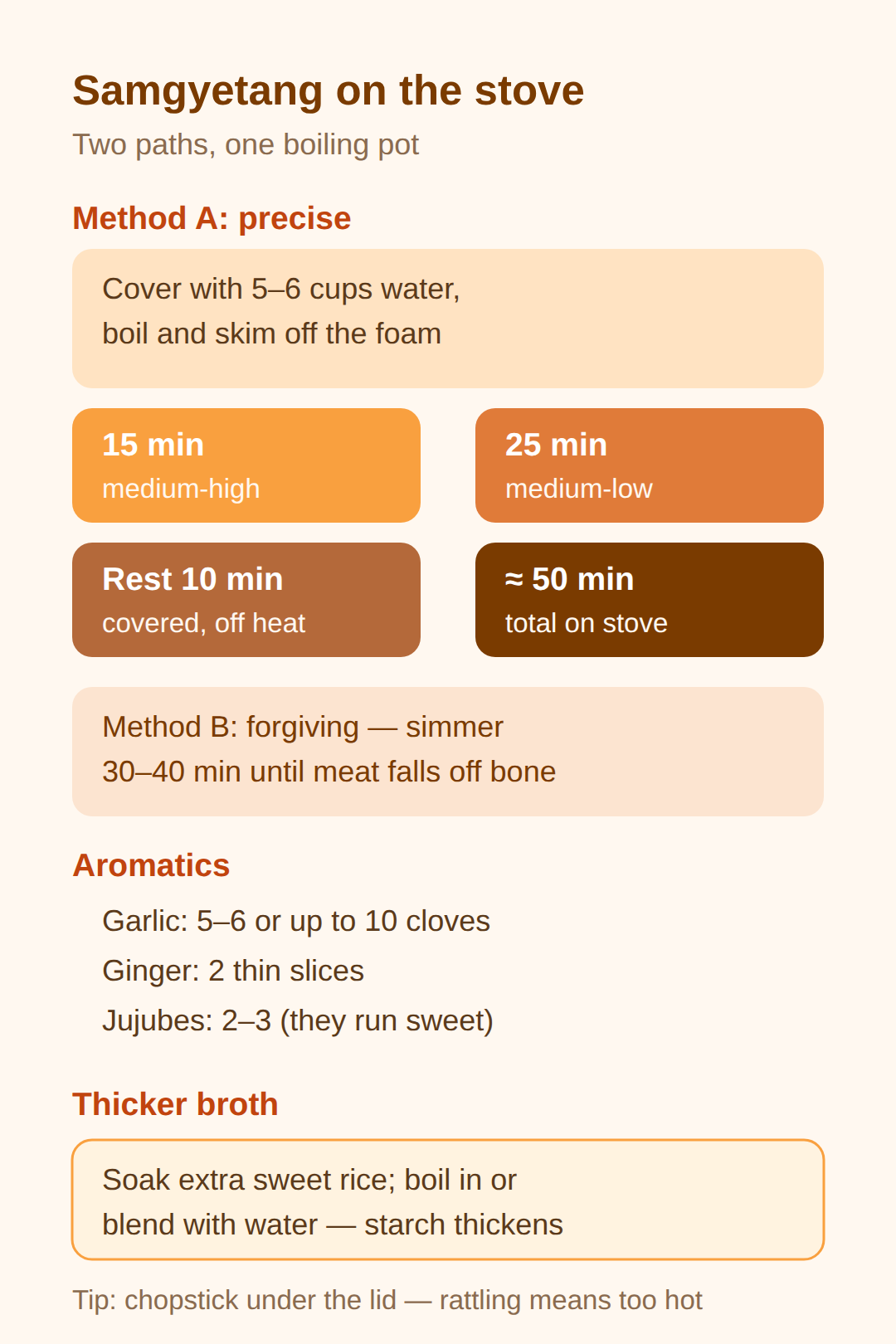
One stovetop method, adapted from Korean Bapsang: cover the chicken with 5–6 cups of water, bring it to a boil and skim off the foam, then boil 15 minutes on medium-high.
Turn down to medium-low for 25 minutes, then let the whole pot rest, covered and off the heat, for about 10 minutes before serving.
Total time on the stove lands near 50 minutes.
A second approach runs longer: simmer 30–40 minutes until the meat falls off the bone, stretching toward the high end for a larger bird.
Both paths reach the same place; the first is more precise, the second more forgiving.
Keep the pot at a steady simmer with the lid on, adjusting the heat if it boils too hard.
Garlic is a judgment call, not a fixed number.
Recipes run from 5–6 cloves (Korean Bapsang) to 10 cloves split between the cavity and the broth (Beyond Kimchee).
Add two thin slices of ginger alongside the garlic and 2–3 jujubes for sweetness — jujubes run sweet, so more than a few takes over the pot.
For a creamier, thicker broth, there is a trick worth knowing: soak extra sweet rice beyond the stuffing amount, then either boil it straight in the broth or blend it with a little water before adding.
The released starch thickens the soup and adds a faint sweetness.
Cooking the extra rice and herbs in a mesh bag keeps the broth clean while still gaining the flavor.
Baek Jong-won’s pressure-cooker variation
For cooks with a pressure cooker, Baek Jong-won’s version from the Korean show Altoran is a popular shortcut.
His ingredient list, translated: two young chickens of 400–500 g each, half a cup of glutinous rice, two ginseng roots, 4–6 jujubes, 10 garlic cloves, one scallion, and 10–12 cups of water, with abalone as a common addition.
The steps follow the same logic as the stovetop version — stuffed cavity, aromatics, liquid — but the pressure cooker changes the cooking time.
The exact pressure setting and cook time for this specific recipe are not documented in the sources checked for this post, so treat his published video and recipe card as the authority for the timing.
Seasoning and serving: salt at the table, not in the pot
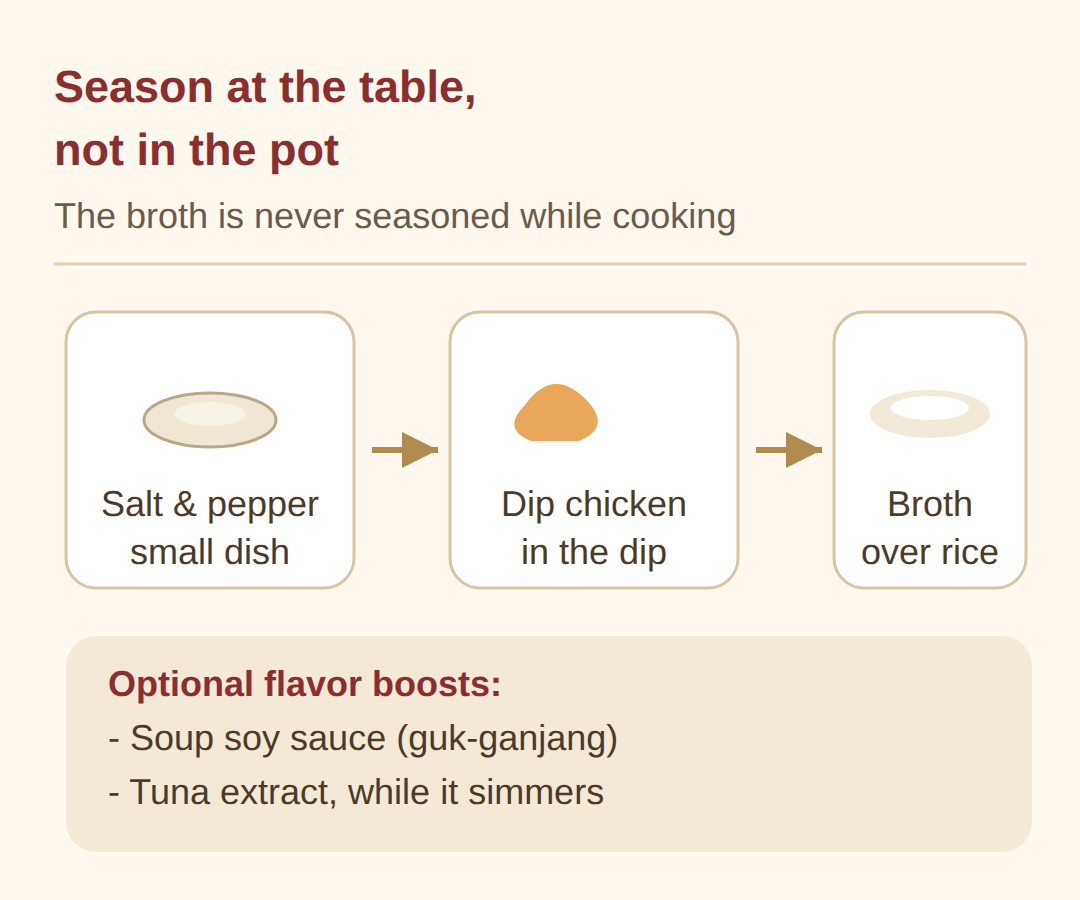
The broth is never seasoned while it cooks.
This is the single most counterintuitive step for first-timers, and skipping it is what separates home-style samgyetang from the restaurant version.
Instead, each diner seasons at the table: salt and pepper in a small dish, the chicken meat dipped into it, then eaten with broth ladled over rice.
Restaurants serve the whole uncut chicken as one portion — big enough to share between two — with chopped scallion scattered on top and the broth still boiling.
If the homemade broth tastes thinner than a restaurant’s, that is expected: specialty restaurants build depth with a pre-made chicken stock plus a long list of herbs.
Two optional boosts close some of the gap — a small splash of Korean soup soy sauce (guk-ganjang) and a bit of tuna extract added while the pot simmers.
The traditional side is the balance: freshly made cabbage kimchi or well-fermented radish kimchi (kkakdugi).
The cold, tangy crunch against the hot, herbal broth is the point of the pairing, so it is worth planning the kimchi before the chicken goes in the pot.
👉 Korean Bapsang’s samgyetang walkthrough with the stovetop timing and cavity-sealing steps
👉 Beyond Kimchee’s version with simmer times and overseas ingredient swaps
👉 Cookpick’s breakdown of Baek Jong-won’s pressure-cooker samgyetang
Sources
- Chopped scallion garnish; blending extra soaked sweet rice f (koreanbapsang.com)
- Active overseas Korean-food recipe-seeking community observe (reddit.com)
- Restaurants serve ~1 lb spring chickens in individual clay p (beyondkimchee.com)
Quick tips for first-timers
- Soak the rice 30–60 minutes and measure after soaking, not before.
- Fill the cavity only three-quarters full — expanding rice can split the bird.
- Tie or thread the legs so the rice stays inside during the simmer.
- Simmer 30–40 minutes; add time for a larger bird.
- Discard dried ginseng before serving — it stays fibrous no matter how long it cooks.
FAQ
Q. Can dried ginseng replace fresh ginseng in samgyetang?
Yes. Soak dried ginseng overnight to soften it, and use dried American ginseng if Korean ginseng is unavailable. Dried ginseng stays tough even after simmering, so use it to flavor the broth and remove it before serving.
Q. How much room should I leave when stuffing the rice?
Fill the cavity about three-quarters full. Glutinous rice expands as it cooks, and a packed cavity can burst the bird. A safe working ratio is 2 to 2.5 tablespoons of soaked rice per pound of bird.
Q. Is a samgyetang kit from a Korean market okay, or do I need fresh herbs?
A kit is fine. Most packets contain dried ginseng, jujubes, dried chestnuts, and sweet rice. Follow the package instructions, including any soaking, and treat it as a complete substitute for the loose aromatics.
Q. Should I salt the broth while it cooks?
No. The broth is left unseasoned in the pot, and each diner seasons their own bowl with salt and pepper at the table.
Try it on the next sambok day — make a pot, season at the table, and enjoy the way the rice turns out.
Cover photo: Chicken and mushroom soup with ginseng extract by ProjectManhattan — CC BY-SA 3.0
#samgyetangrecipe #koreanginsengchickensoup #koreansummerfood #glutinousricestuffing #cornishhenrecipe #koreanhomecooking #iyeolchiyeol
📅Upcoming Dates — 이번 주 4 · D-day Changdeokgung Moonlight Tour start (Sept 10–Oct 17, 30,000 K전체 보기 →