Seonji haejangguk keeps surfacing in English-language Korean food communities, and the question is almost always the same: what are the dark cubes in the soup?
A r/KoreanFood thread on September 11, 2026 is the most recent instance of that recurring question.
The short answer is that the cubes are seonji — cattle blood that is salted until it sets, then cut up and added to soup.
This guide covers what seonji actually is, what goes into the bowl, why it became the classic morning-after dish, and the phrases needed to order it in Seoul.
Contents
- What seonji haejangguk actually is
- What goes into the bowl
- Why Koreans eat it after drinking
- How to order it in Seoul without speaking Korean
What seonji haejangguk actually is
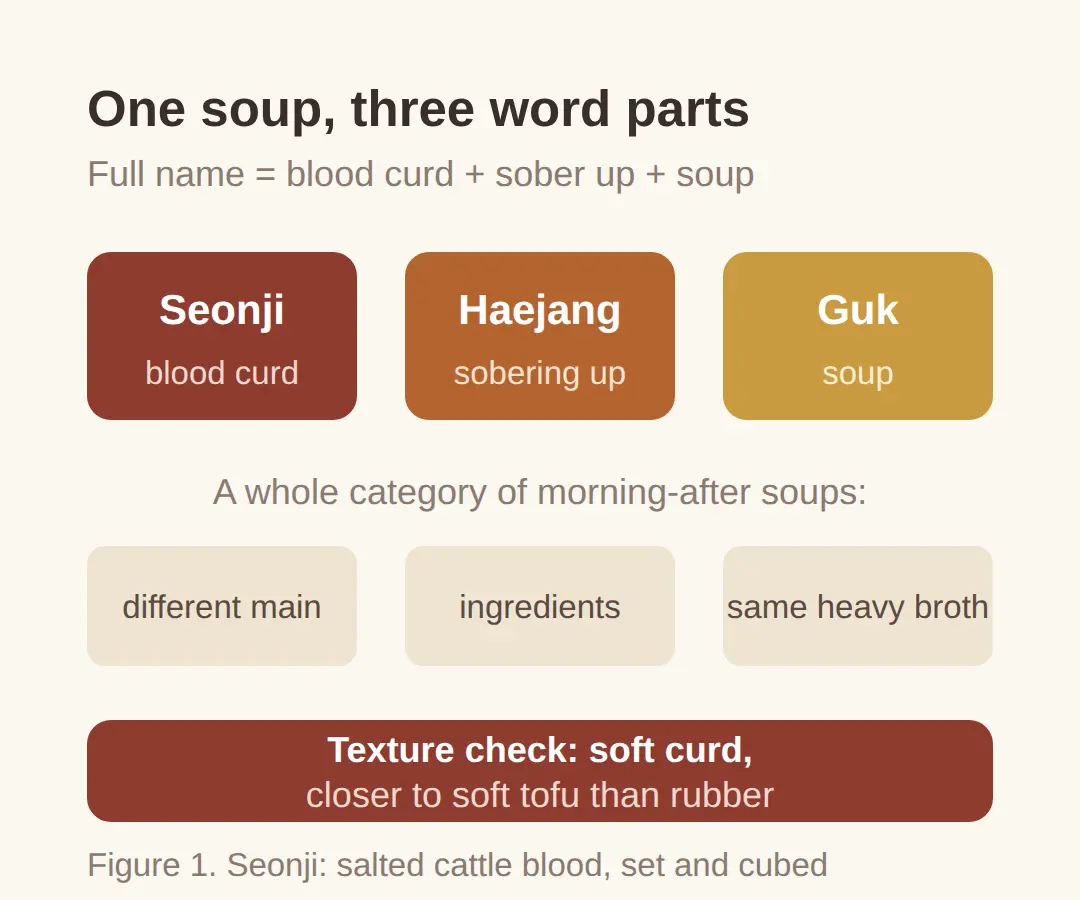
The name splits into two parts.
Haejangguk combines haejang (sobering up) and guk (soup), so it is the generic name for hearty morning-after soups in Korea.
Seonji is the part that puzzles newcomers.
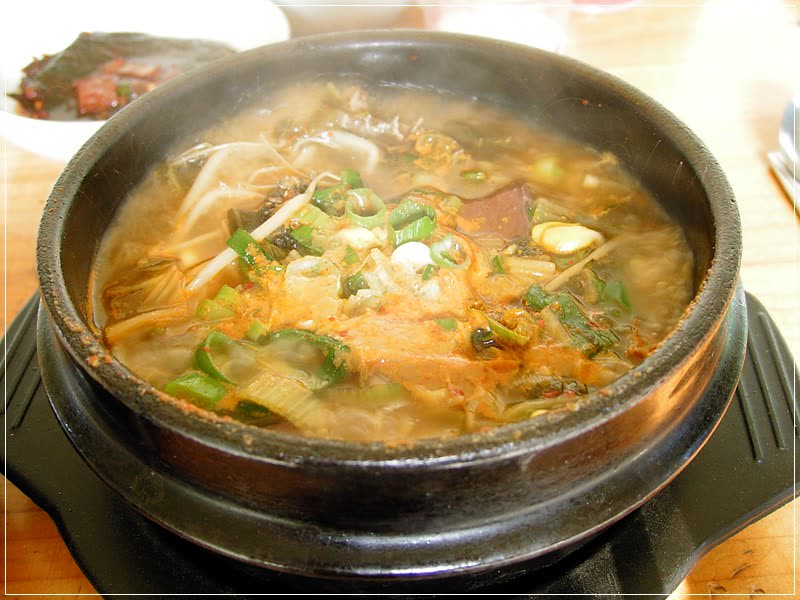
It is fresh cattle blood salted so it coagulates into a soft curd, then cut into cubes.
The texture lands closer to soft tofu than to anything rubbery, which is not what most first-timers expect from the word blood.
Put together, the full name parses as blood-curd sober-up soup — and that is exactly what a bowl of it does.
It is one entry in a wider haejangguk category, where different regions and restaurants swap the main ingredients and keep the same heavy-broth idea.
*Figure 1.
Seonji: salted cattle blood, set and cubed for soup*
| Seonji haejangguk | Soup with blood curd cubes |
|---|---|
| Seonji-gukbap | Same curd and rice in one bowl |
| Sundae | Sausage stuffed with the same blood |
| Haejangguk | Any hearty sober-up soup |
What goes into the bowl
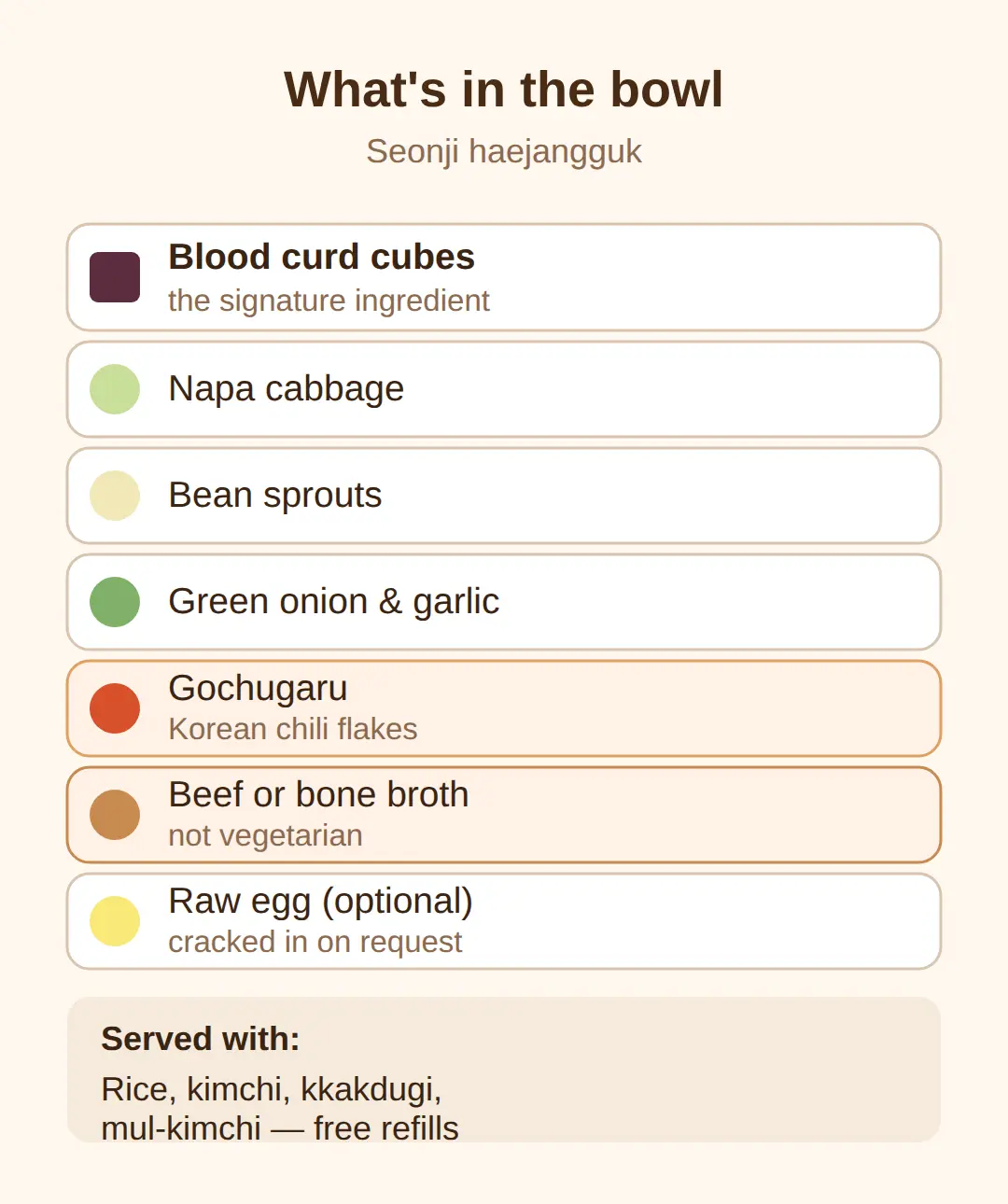
A typical seonji haejangguk contains blood curd cubes, napa cabbage, bean sprouts, green onion, and garlic in a beef or bone broth, seasoned with gochugaru (Korean chili flakes).
It arrives boiling hot in a stone or metal pot called a ttukbaegi, and a raw egg can be cracked in on request.
Rice and free, refillable side dishes come with it — usually kimchi and kkakdugi, the cubed radish kimchi.
Many places also serve mul-kimchi, a cold kimchi broth, on the side.
One thing worth knowing before ordering: the broth itself is beef-bone based, so the dish is not vegetarian even before the blood curd goes in.
The customary way to finish is to add rice to the remaining broth near the end, eating the last of it gukbap-style.
*Figure 2.
What a standard bowl contains*
👉 pizza rice cake Korea: the pizza seolgi trend hitting 98 on Google Trends
Why Koreans eat it after drinking
The folk explanation has three parts: the hot broth rehydrates, the sodium and electrolytes replace what alcohol depleted, and blood curd adds iron and protein.
Blood curd is rich in heme iron specifically, which is the reason locals most often give for reaching for this soup after a night of drinking.
These are folk explanations, not clinical evidence — no clinical source backs the hangover-cure claim, and the soup should not be read as medicine.
The eating pattern itself, though, is settled.
It is the classic late-night-after-drinking dish and the next-morning dish, and haejangguk houses near traditional markets open early precisely to catch that crowd.
So the practical takeaway for a visitor is simple: this is the bowl locals reach for the morning after, and joining that line is part of the experience.
*Figure 3.
The folk logic behind the hangover soup*
👉 Hanjungsun Yogurt Chapssaltteok GS25: the 3,900-Won Dessert That Sold 100,000 in One Day
How to order it in Seoul without speaking Korean
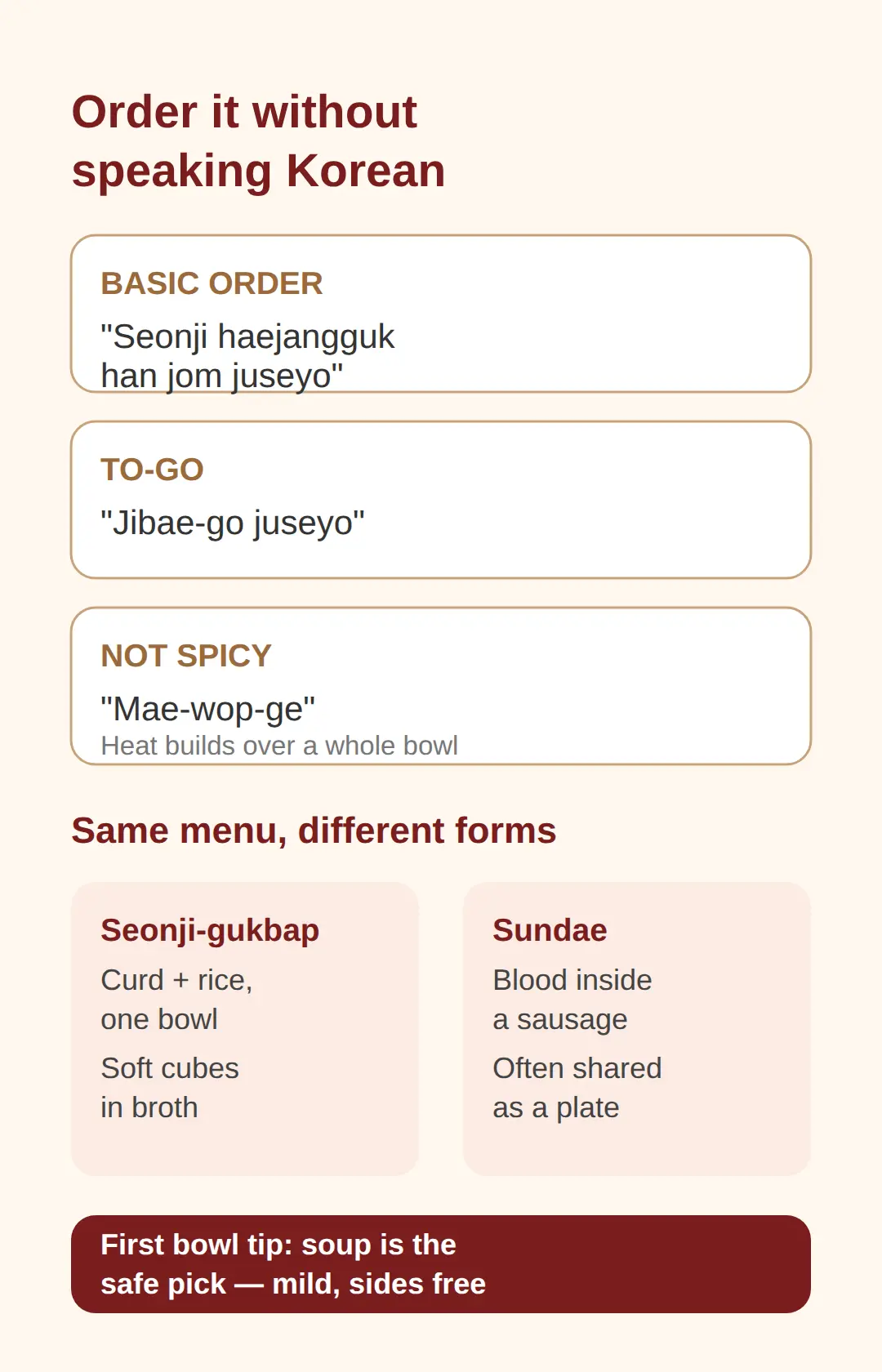
One phrase covers most situations: seonji haejangguk han jom juseyo — one seonji haejangguk, please.
If the plan is to take it back to the hotel, jibae-go juseyo means to-go.
Spice is adjustable at most haejangguk houses, and an mae-wop-ge means not spicy — a phrase worth memorizing because gochugaru heat builds over a whole bowl.
The menu around it is worth a second look.
Seonji-gukbap puts the same blood curd and rice together in one bowl, which suits anyone who wants a single, self-contained dish.
Sundae, the Korean sausage, often appears on the same menu or as a shared plate.
Sundae contains blood too, but it is stuffed inside the sausage rather than served as soft cubes in broth — the same coagulated blood, eaten in a completely different form.
For a first bowl, the soup itself is the safer entry point: the curd is mild, the spice is adjustable, and the side dishes come free.
Related posts
📎 Seoul — everything we know
📎 Chipotle Gangnam, first store in Asia — what to know before you join the line
📎 Korean Mexican Food: Chipotle Gangnam’s 3-Hour Wait, Cucharra’s 12,900 Won K-Mex Pop-Up and Where to Try It
📎 📅 다가오는 일정 — 발매·개봉·발표 캘린더
Sources
- Reddit r/KoreanFood post (2026-09-11) explains seonji as coa (reddit.com)
- morning_opening_pattern (english.visitkorea.or.kr)
- Available on Baemin/Coupang Eats under haejangguk category (baemin.com)
Ordering cheat sheet
- Expect around 8,000–12,000 KRW per bowl at casual Seoul spots, though prices shift — check the menu board before sitting down
- Many haejangguk houses near traditional markets open around 7–9 AM for the morning-after crowd
- Most places serve kkakdugi and mul-kimchi broth on the side with a bowl of rice
- Rice goes into the leftover broth at the end — that is how locals finish the bowl
FAQ
Q. Is the dark stuff in Korean hangover soup really blood?
Yes. Seonji is cattle blood salted until it sets into a soft curd, then cut into cubes and added to the soup.
Q. Is seonji the same blood as in sundae?
Both come from the same coagulated blood, but seonji is served as soft cubes in soup while sundae stuffs the blood into a sausage.
Q. Is seonji haejangguk suitable for vegetarians?
No. The broth is typically beef-bone based, so the dish is not vegetarian even before the blood curd itself.
Want more Seoul food guides? See our Tteokbokki Spice Levels guide.
#seonjihaejangguk #Koreanhangoversoup #haejangguk #bloodcurd #Koreanfoodguide #Seoulfood #Koreansoup #morning-afterfood
📅Upcoming Dates — 이번 주 16 · D-day 'The Scandal' global Netflix release전체 보기 →