Yes — September and October are one of Jeju’s two best travel windows, alongside April–May, with green hills and early silvergrass instead of summer heat.
For a traveller booking this month, the trade-off is concrete: the island sits on the typhoon track through September, so the weather check and a travel insurance decision come before anything else.
This post covers what September actually looks like on the ground, a 3-day timetable, Hallasan booking, typhoon backups, and what the trip costs.
Is September a Good Time to Visit Jeju?
| Day 1 east — Seongsan Ilchulbong | 09:30 or 10:30 climb, about 1 hour |
|---|---|
| Day 1 east — Udo or lunch | 11:30 Udo ferry, or 12:00 haenyeo-house lunch |
| Day 1 east — Seopjikoji | 13:30 coastal walk, ocean-view cafe after |
| Day 1 east — Hamdeok Beach | 15:30 |
| Day 1 east — Dinner | 18:30 Dongmun Market, or Seogwipo black pork |
| Day 2 west — Handam, Aewol | 09:00, cafe street best 17:00–19:00 at sunset |
| Day 2 west — Gwakji, O’sulloc | 11:00 Gwakji, 13:30 O’sulloc (free entry) |
Yes — travel guides name September–October one of the two best windows to visit Jeju, together with April–May.
The reason is what the season does to the price and the weather: the same sources put the best price-and-weather window at September through November, away from the July–August peak.
For a 2-night, 3-day trip, one 2026 guide benchmark puts the cost at about ₩500,000–700,000 per person including flights, lodging, rental car and food, and it calls the rental car essential.
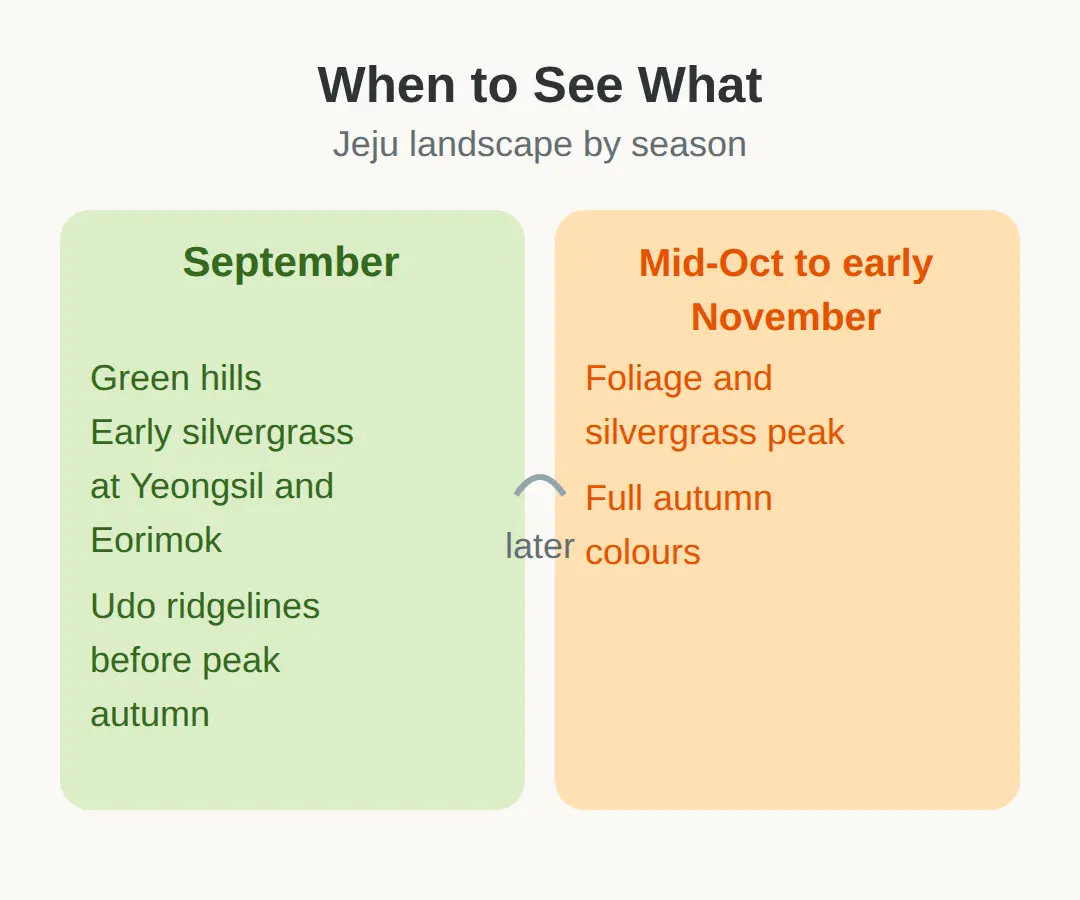
The September landscape is not yet autumn foliage.
Silvergrass and foliage on the island peak from mid-October through November, so in September the draw is green hills and early silvergrass on the Yeongsil and Eorimok trails.
If you want turned leaves in your photos, wait until mid-October or November; if you want the pre-peak landscape and fewer people, September works.
The condition attached to the window is the typhoon track.
Jeju sits on that track roughly July through September, and one or two typhoons affect island weather in a typical year.
That means a weather check before you book and travel insurance on top of the booking — the details are in the typhoon section below.
Things to Do in Jeju in September
The official September picks are the Yeongsil and Eorimok silvergrass trails on Hallasan, the Udo ridgelines, the Jeoji-ri village walk, the Mulyeongari Oreum wetland walk, and the Iho Tewoo running route.
On September 6, 2026, the Jeju Tourism Organization and the province released the 2026 recommended content, organizing the fall season into 7 themes: trekking, food, village travel, wellness, culture and arts, coastline, and islands.
If you are building the trip around one of those themes, each pick below sits inside a different theme.
Trekking: the Yeongsil–Witse Oreum and Eorimok–Witse Oreum routes are the recommended fall routes for foliage and silvergrass, with the short Eoseungsaengak trail as an easier option.
Village travel: Jeoji-ri in Hangyeong is the official September pick — a Jeoji Oreum walk paired with the Jeju Museum of Contemporary Art and the Kim Chang Yeul Art Museum.
Wellness: Mulyeongari Oreum is a crater wetland reached by a short stair climb through pasture and cedar forest, with slippery stairs in rain.
On the coast, climb Udo Peak for silvergrass ridgelines over the east sea, and run or walk the Iho Tewoo Beach to Dobong course near the airport, which is best at sunset.
For running shoes versus a camera, the choice is simple: Iho Tewoo is the running pick, Yeongsil and Udo are the photo picks.
![[Jeju Special Self-Governing Province Tourism Association] Jeju Mi(Taste) Haeng Vol. 11-12 (September 2026 / Limited spots available) — Things to Do in Jeju in September](https://koreankorea.com/wp-content/uploads/2026/09/things-to-do-in-jeju-september-2026-02.jpg)
3-Day Jeju Itinerary for September: East, West, and the Airport Run
The working structure is Day 1 east (Seongsan, Udo, Seopjikoji), Day 2 west and south (Aewol, O’sulloc, Hyeopjae), Day 3 north-west ending at the airport.
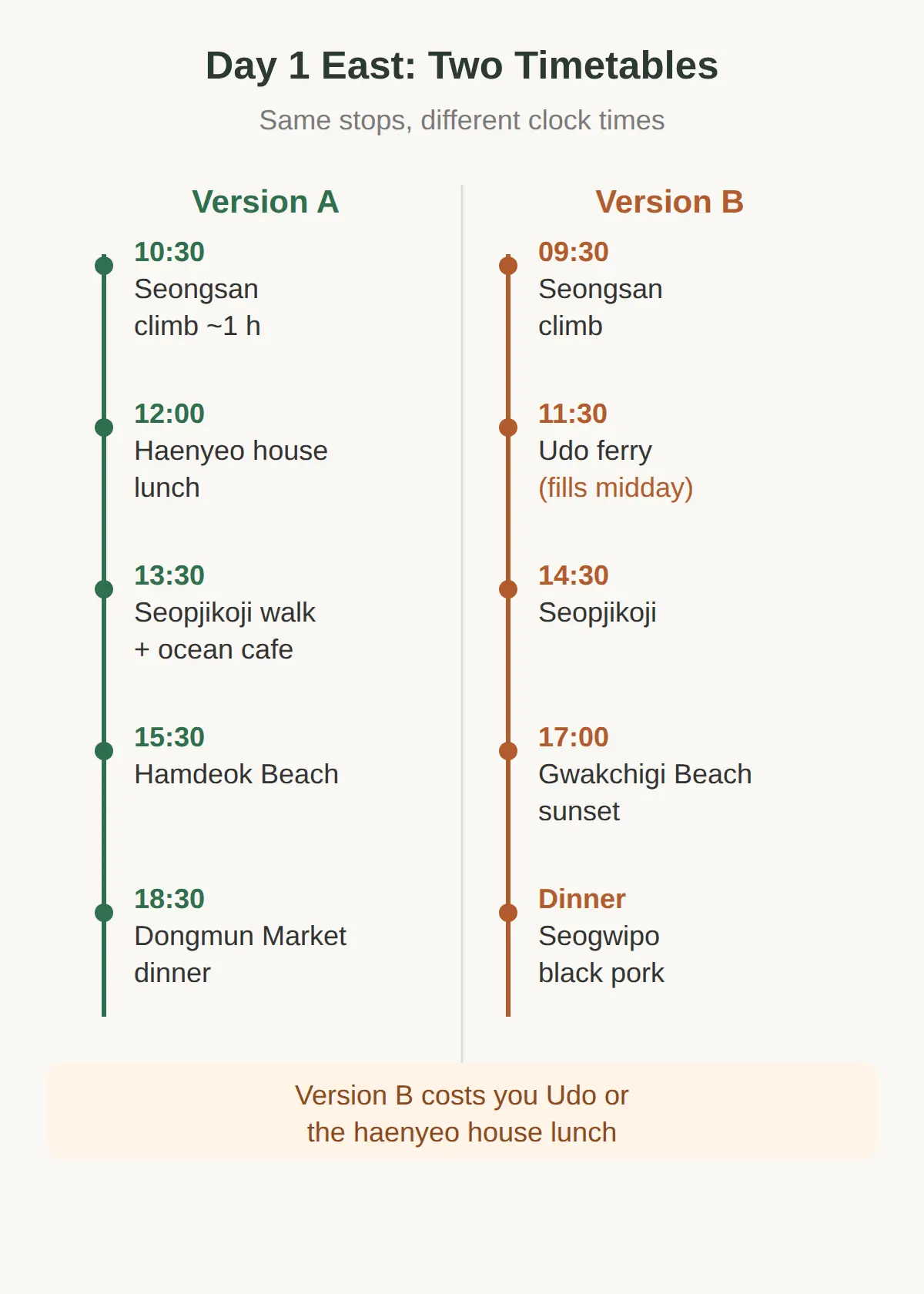
Two published versions of the east day exist, with the same stops at different clock times — both are ready-made options, so pick one rather than blending them.
The detail below fills in the rest of each day.
Version A of Day 1 runs 10:30 Seongsan Ilchulbong climb, 12:00 lunch at a haenyeo house (sea-urchin seaweed soup), 13:30 Seopjikoji walk plus an ocean-view cafe, 15:30 Hamdeok Beach, 18:30 Dongmun Market dinner.
Version B starts an hour earlier: 09:30 Seongsan climb, 11:30 Udo ferry, 14:30 Seopjikoji, 17:00 Gwakchigi Beach sunset, then a Seogwipo black pork dinner — it costs you Udo or lunch, because the ferry day fills the middle.
Day 2 in the published timetable runs 09:00 Handam Beach and the Aewol cafe street (1.5 hours), 11:00 Gwakji, 13:30 O’sulloc Tea Museum (free entry, about 1 hour), 15:00 the Sanbangsan–Yongmeori coast, 17:00 toward the airport or your Aewol lodging.
| Time | Day 1 east (Version A) | Day 2 west/south |
|---|---|---|
| 09:00 | — | Handam Beach and Aewol cafe street (1.5 h) |
| 10:30 | Seongsan Ilchulbong climb (~1 h) | — |
| 12:00 | Haenyeo house lunch (sea-urchin seaweed soup) | — |
| 13:30 | Seopjikoji walk + ocean-view cafe | O’sulloc Tea Museum (free entry, ~1 h) |
| 15:30 | Hamdeok Beach | Sanbangsan–Yongmeori coast |
| 17:00 | — | Head to Aewol lodging or the airport |
| 18:30 | Dongmun Market dinner | — |
Day 3 has two shapes: a south-coast run (09:00 Cheonjiyeon Falls, 11:00 Seogwipo Maeil Olle Market brunch, 13:00 the Daepo Jusangjeolli coast, 14:30 Jungmun beach or the Teddy Bear Museum, 16:00 car return) or a north-west run (08:00 Handam Coastal Walk, 09:30 Hallim Park or Saebyeol Oreum, 11:30 Aewol cafe brunch, 13:30 airport).
The west coast is the closest to the airport — Hyeopjae is about 35 minutes by car, Gwakji about 30, Handam about 20.
If your flight leaves early, the north-west Day 3 is the safer shape; if it leaves late, the south coast fits.
Two anchors make the schedule concrete: at O’sulloc, arrive early because the line for green-tea drinks and ice cream gets long, or just use the tea-field photo zone.
On the Aewol cafe street, sunset runs roughly 17:00–19:00 in September, and the west-coast sunsets into the sea are the highlight of that day.

Hallasan in September: Which Routes Need a Reservation
Two of Hallasan’s routes need an advance online reservation — Seongpanak and Gwaneumsa, the two summit courses — and September weekends sell out.
Eorimok, Yeongsil and Donnaeko need no reservation, and Eorimok and Yeongsil are also the recommended fall routes for foliage and silvergrass.
Per the national park booking requirement, you cannot enter Seongpanak or Gwaneumsa without a prior booking, so the reservation is the constraint a September plan is built around.
The summit courses to Baengnokdam are the long options, with difficulty selectable per route, and the reservation portal’s URL and booking cutoff were not confirmed this run — check the national park’s reservation site for the exact lead time before you lock your dates.
If your dates are late September on a weekend, book the summit course as soon as the portal allows.
If the summit slots are gone, Yeongsil or Eorimok still give you the September landscape without the booking step.
A warning worth writing down: do not book a September summit course casually.
Selling out is the normal state on September weekends, not the exception.
If you would rather not gamble on a slot, the no-reservation routes are the plan, not the fallback.
Typhoon Risk in September: What Changes and the Rainy-Day Backups
September is inside the typhoon window: Jeju sits on the track roughly July through September, and one or two typhoons affect island weather in a typical year.
No 2026-specific storm outlook was found, so the working rule is the general one — check the forecast before booking and again during the trip.
Travel insurance is advised for a September trip, and the typhoon picture decides the ferry days, the Hallasan booking and whether the plan needs indoor swaps.
For rainy days, the west coast has the weather-independent cluster: Hallim Park’s lava caves and gardens, and Gimmaya Park’s indoor equestrian hall.
Those two sit within 10 minutes of the Hyeopjae–Hallim cluster, so a wet afternoon does not cost you the whole day.
If a typhoon warning lands on your dates, the Udo ferry — a 15-minute crossing from Seongsan Port — is the kind of link that stops under warnings, though the exact suspension rule was not confirmed this run, so check the operator’s notice that day.
Beach swimming is the other open question: Hamdeok, Hyeopjae and Gwakji still appear in September plans, but the exact end dates of the swimming season vary by beach and by year.
Check the posted notices at each beach rather than assuming the lifeguard season still runs.
If your trip centers on swimming rather than trails, late September is the riskier choice.
Jeju Trip Cost for 2026: Food Prices and Entry Fees
The benchmark to plan around is ₩500,000–700,000 per person for a 2-night, 3-day trip including flights, lodging, rental car and food.
That works out to about ₩165,000–235,000 per person per day at the guide’s own range.
The table below carries the per-meal numbers that fill that daily figure.
| What you buy | Price range |
|---|---|
| Gogi guksu (pork noodle soup) | ₩8,000–10,000 |
| Haemul ttukbaegi or sea-urchin ramyeon | ₩8,000–12,000 |
| Galchi (hairtail) stew or grilled | ₩15,000–25,000 |
| Heukdwaeji (black pork) barbecue | ₩20,000–30,000 per person |
| Souvenirs (omegi tteok, hallabong juice) | ₩5,000–10,000 |
The meal ranges come from the Seogwipo market and restaurant listings: gogi guksu at the Olle Market alley shops is called Jeju’s number-one breakfast, black pork is cheapest as a shared grill, and the hairtail and seafood pots cluster near Seogwipo Fish Market.
For black pork and gogi guksu, budget shared-grill black pork as the cheaper per-person option, with gogi guksu in the ₩8,000–10,000 range at the Olle Market alley shops.
Treat the rental car as essential and budget the full ₩500,000–700,000 rather than the lower end; without it, the east and west days in the timetable stop being practical in one trip.
Souvenirs are cheapest at Seogwipo Maeil Olle Market, not at the airport.
If I were booking now, I would take the September window but structure the trip around the typhoon check first — weather and insurance, then Hallasan reservations.
Related posts
📎 📅 Upcoming Dates — Release & Event Calendar
Sources
- Best seasons Apr-May and Sep-Oct; typhoon track Jul-Sep; ins (thesouthkoreaguide.com)
- 7-theme official autumn content, village picks by month, eve (joongang.co.kr)
- travelmapjourney.com
Summary: How to Lock a September Jeju Plan
- Check the typhoon forecast for your exact dates first — it decides the ferry days, the Hallasan booking and the indoor backups.
- Book Seongpanak or Gwaneumsa online as soon as the portal allows if you want the summit; September weekends sell out.
- Do not expect foliage in September — the draw is green hills and early silvergrass at Yeongsil, Eorimok and Udo.
- Budget ₩500,000–700,000 per person for 2 nights 3 days with flights and a rental car, about ₩165,000–235,000 per day.
- Keep one west-coast rainy-day block ready: Hallim Park lava caves and Gimmaya Park’s indoor equestrian hall.
FAQ
Q. Is September a good time to visit Jeju?
Yes — September–October is one of the two best windows alongside April–May, with green hills and early silvergrass. The condition is the typhoon track, which runs through September, so build in a weather check and travel insurance.
Q. How do I book Hallasan for late September?
Reserve the Seongpanak or Gwaneumsa summit course online in advance — September weekends sell out, and you cannot enter without a booking. Eorimok, Yeongsil and Donnaeko need no reservation.
Q. How much does a 3-day Jeju trip cost?
The 2026 guide benchmark is about ₩500,000–700,000 per person for 2 nights and 3 days including flights, lodging, rental car and food.
Q. Does typhoon season affect September Jeju trips?
It can — one or two typhoons affect island weather in a typical year within the July–September window. No storm-specific outlook for 2026 was available, so check the forecast and carry travel insurance.
Q. Can you still swim at Jeju beaches in September?
Hamdeok, Hyeopjae and Gwakji still appear in September plans, but the exact season end dates vary by beach and year. Check the posted notices at each beach for lifeguard status.
If booking now, take the September window but structure it Day 1 east, Day 2 south and west, Day 3 north-west to the airport — and pick the no-reservation Yeongsil or Eorimok route instead of gambling on a sold-out summit slot.
Cover photo: File:UNESCO Global Geoparks Network (Jejudo-Coast) WV banner.jpg by Martin Chen — CC BY 2.0
#JejuinSeptember #Jeju3-dayitinerary #Hallasanreservation #Jejutyphoonseason #Jejutripcost
📅Upcoming Schedule — this week 23 · D-1 Autumn season = post-summer brightening demand window (UV drSee all →