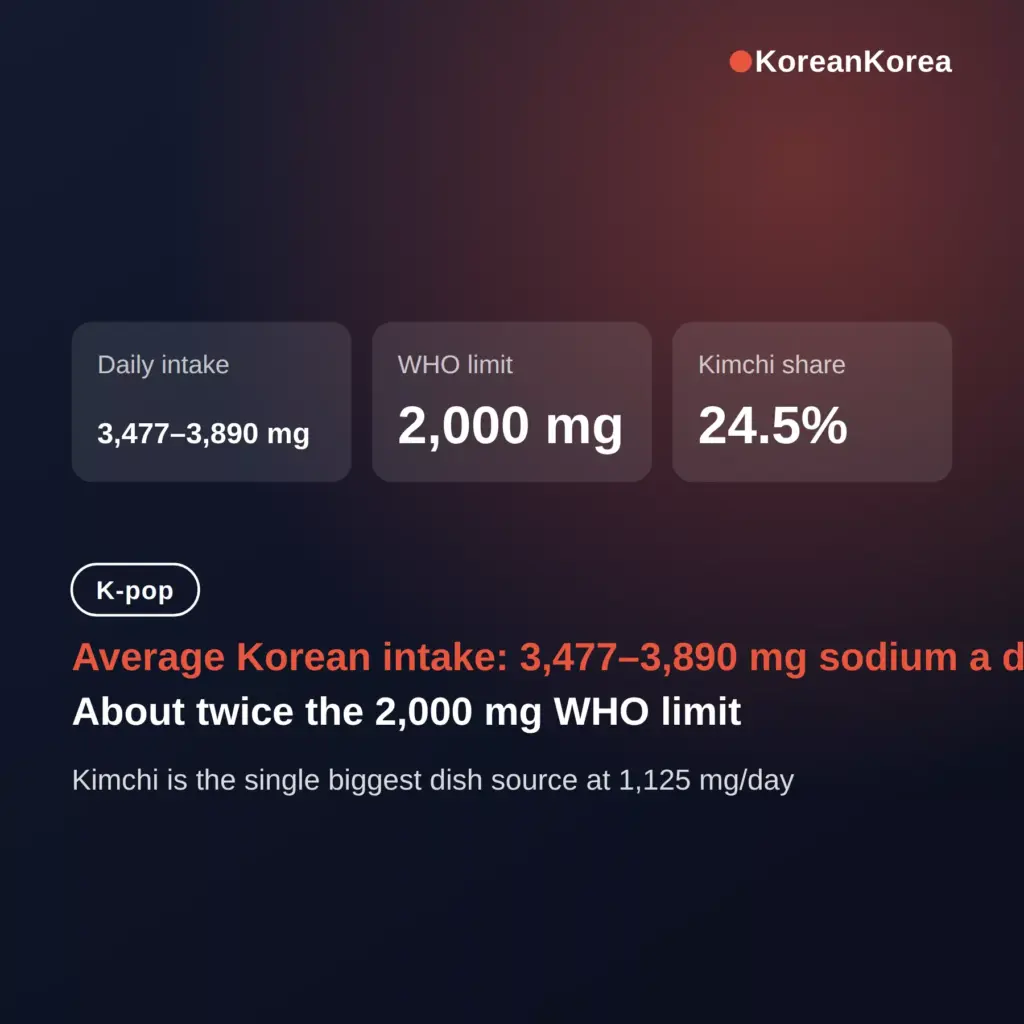
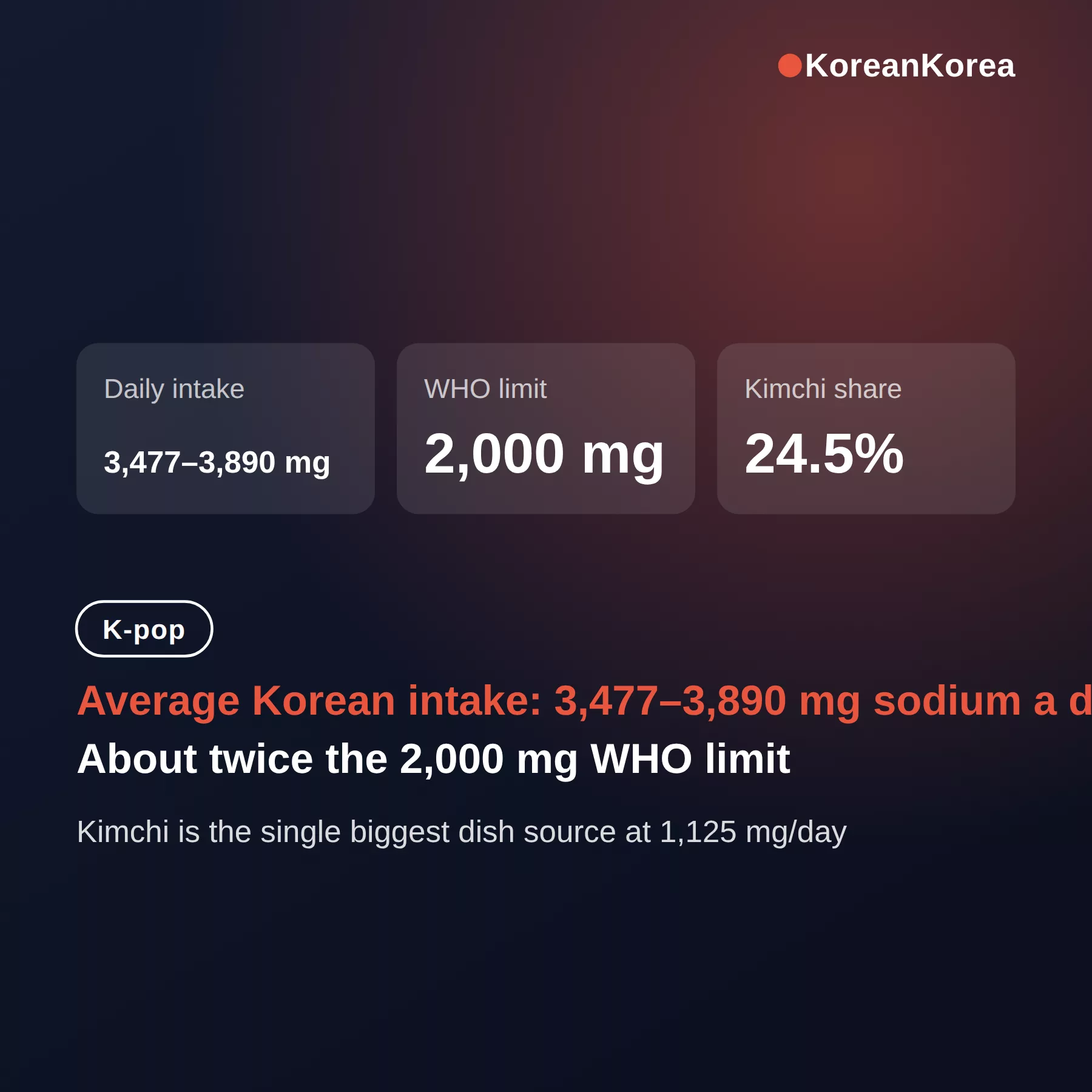
The average Korean eats 3,477–3,890 mg of sodium a day (KNHANES 2013–2017) — roughly twice the WHO limit of 2,000 mg.
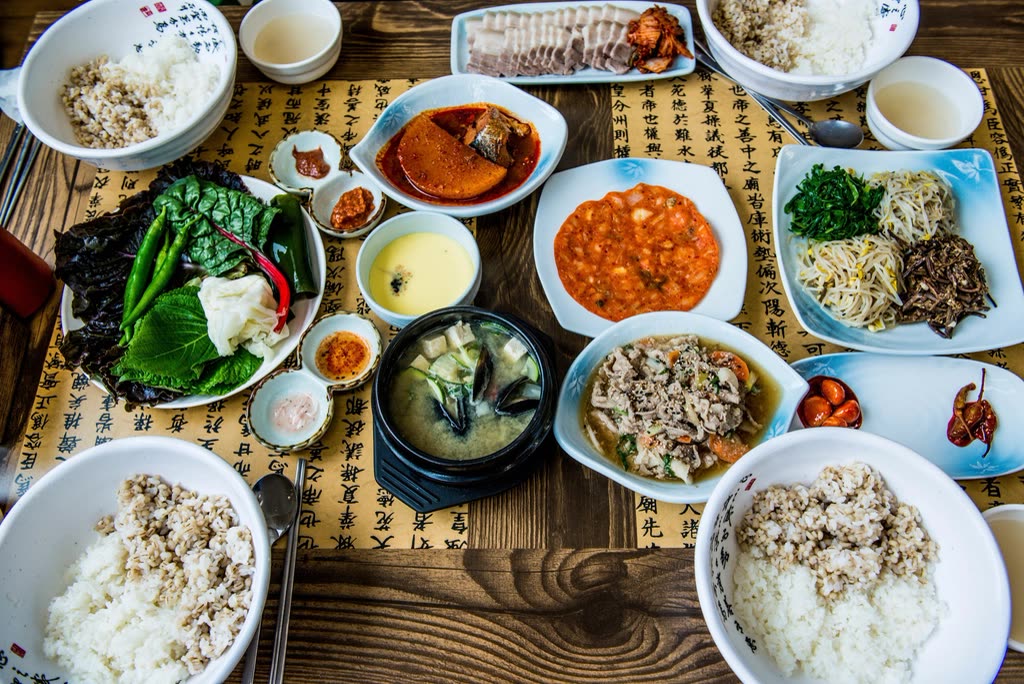
If you cook or eat Korean food often, kimchi and broth-heavy soups are where most of that sodium sits, not the rice or the grilled meat.
This post gives the intake numbers, the sodium in kimchi and the saltiest Korean dishes, and the two levers that cut a Korean meal’s sodium the most.
Contents
- Is Korean food high in sodium? Twice the WHO limit
- How much sodium is in kimchi?
- Which Korean dishes have the most sodium?
- Restaurant vs home vs school: where the sodium sits
- How to reduce sodium in kimchi, soup and jjigae
- Did Korea’s sodium reduction campaign actually work?
Is Korean food high in sodium? Twice the WHO limit
Yes — the average Korean eats 3,477.2–3,889.6 mg of sodium a day, based on national dietary surveys from 2013–2017.
The WHO sets an adult upper limit of 2,000 mg a day, so Korean intake runs about 1,890 mg above it at the 2017 level.
About half the population eats more than 4,000 mg a day — twice the limit.
The numbers come from KNHANES, the national health and nutrition survey that tracks sodium intake and its food sources.
For comparison, the same surveys recorded 4,600 mg a day in 2008–2009, so intake has fallen roughly 15–20% between the two survey periods.
If you eat Korean food a few times a week, a single salty meal will not put you over the limit — daily patterns will.
The next section shows which dishes carry the load.
| WHO adult limit | 2,000 mg sodium/day (about 5 g salt) |
|---|---|
| Korean average (2013–2017 surveys) | 3,477.2–3,889.6 mg/day |
| Share of Koreans over 4,000 mg/day | About half |
| 2017 intake above the WHO limit | About 1,890 mg/day |
How much sodium is in kimchi?
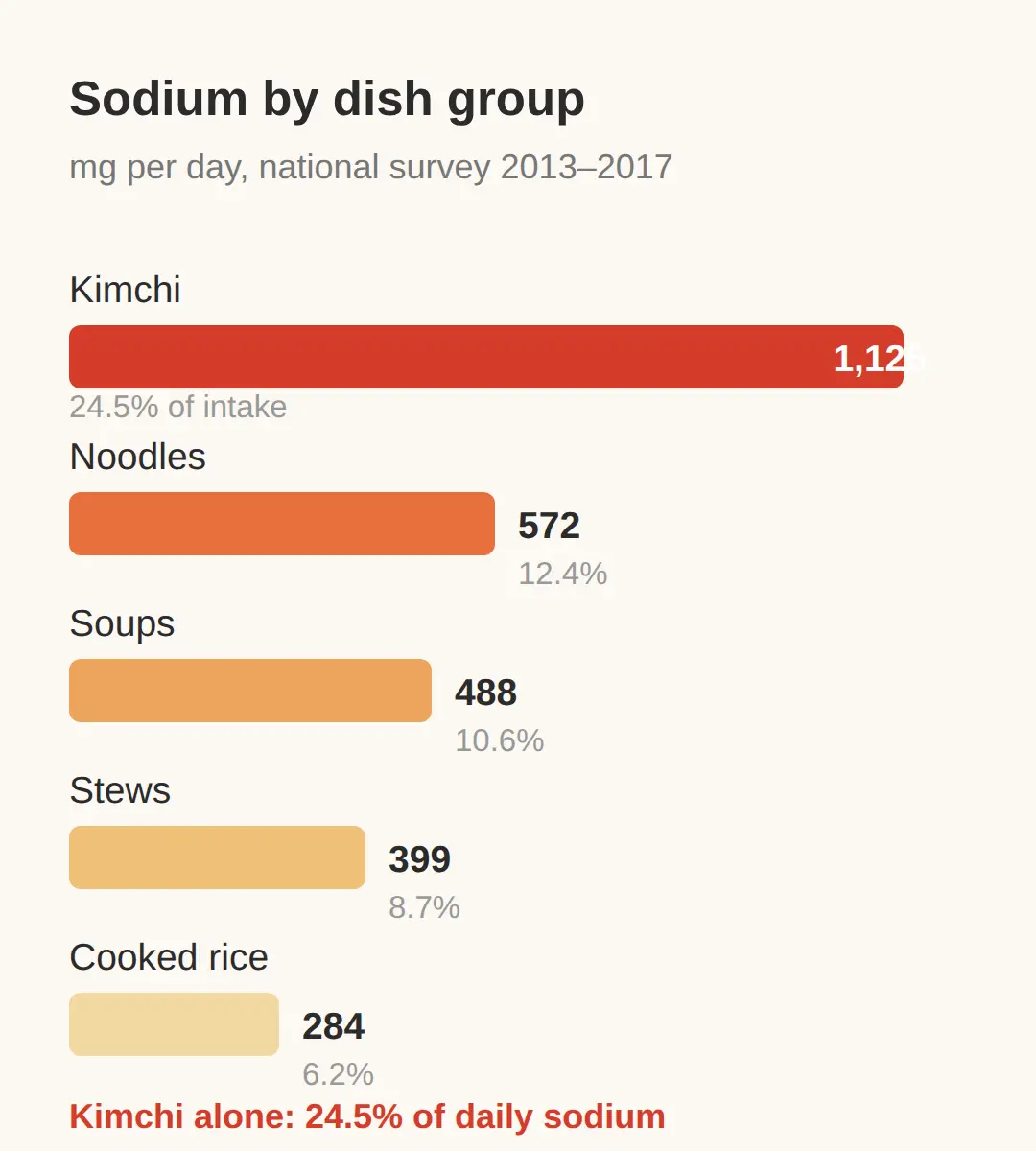
Kimchi was the largest single dish source of sodium at 1,125 mg/day (24.5% of intake), ahead of noodles (572 mg) and soups (488 mg), per national dietary survey data from 2013–2017.
After kimchi, the next groups were noodles at 572 mg (12.4%), soups at 488 mg (10.6%), stews at 399 mg (8.7%) and cooked rice at 284 mg (6.2%).
Those four dish groups alone add up to 2,584 mg a day.
The gap between people who eat kimchi and people who don’t is large: 2,343 mg a day for men and 1,452 mg a day for women in the same survey data.
Among 480 analyzed Korean foods, kimchi and braised dishes had the highest sodium per 100 g.
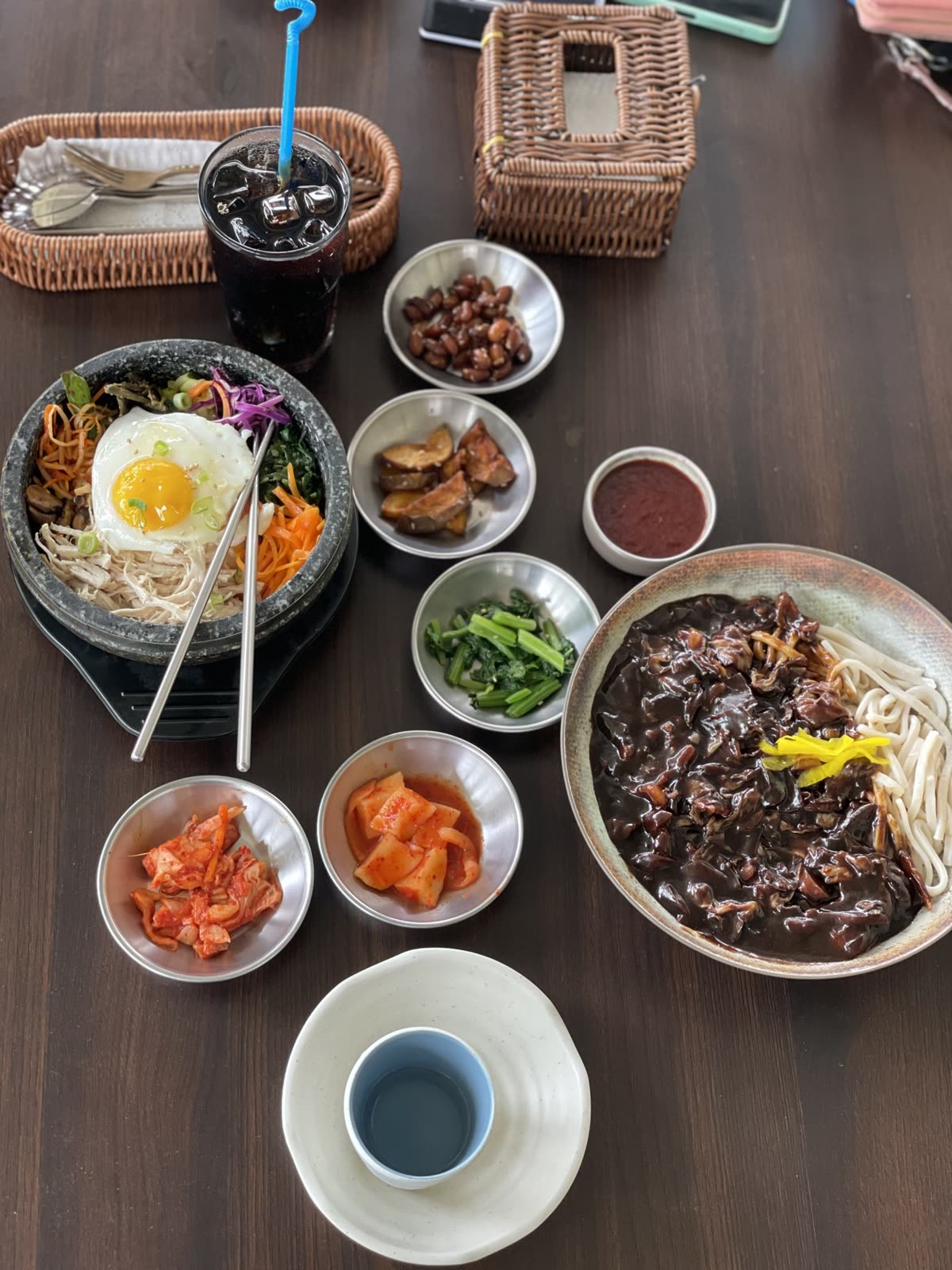
When I read a Korean menu abroad, the first thing I check is how many kimchi and broth dishes land on the table at once — a set with cabbage kimchi, kkakdugi and a stew stacks three of the top sources in one meal.
Portion the kimchi side down to one and the numbers fall fast.
Which Korean dishes have the most sodium?
Restaurant spicy beef soup contained 3,273.2 mg sodium per serving — about 8.2 times the published 400 mg reduced-sodium target for clear soup.
Restaurant pollack stew followed at 2,930.2 mg per serving.
Away from restaurants, home-cooked steamed short ribs hit 1,429.6 mg and food-service bibimbap 1,074.1 mg.
| Dish | Source | Sodium per serving |
|---|---|---|
| Spicy beef soup (yukgaejang) | Restaurant | 3,273.2 mg |
| Pollack stew (bugo-guk) | Restaurant | 2,930.2 mg |
| Steamed short ribs | Home | 1,429.6 mg |
| Bibimbap | Food service | 1,074.1 mg |
Per 100 g among the 480 foods analyzed, stir-fried anchovies led at 1,896.6 mg, followed by braised burdock and lotus root at 820.6 mg and pickled onions at 809.3 mg.
The top sodium source also changes with age: ramyeon for ages 10–29, napa cabbage kimchi for ages 40–59, and soybean-paste soup for ages 60+.
If you are under 30, the ramyeon is your number to watch; if you are cooking for parents or grandparents, it is the kimchi and the doenjang soup, not the noodles.
Restaurant vs home vs school: where the sodium sits
Restaurant soups and stews were significantly saltier than the same dishes from home kitchens and food service, both per 100 g and per serving.
Measured per 100 g of soup liquid, restaurants were the saltiest, home was next, and school meals were the lowest of the three.
The liquid does most of the damage.
The broth held 65.2–66.7% of the total sodium in soups, 49.8–61.2% in stews, and 48.7–56.7% in noodle and dumpling dishes.
If you leave the broth in the bowl, you leave half to two-thirds of the sodium there too.
Finishing the broth of a restaurant yukgaejang is a very different meal from stopping when the solids are done.
How to reduce sodium in kimchi, soup and jjigae
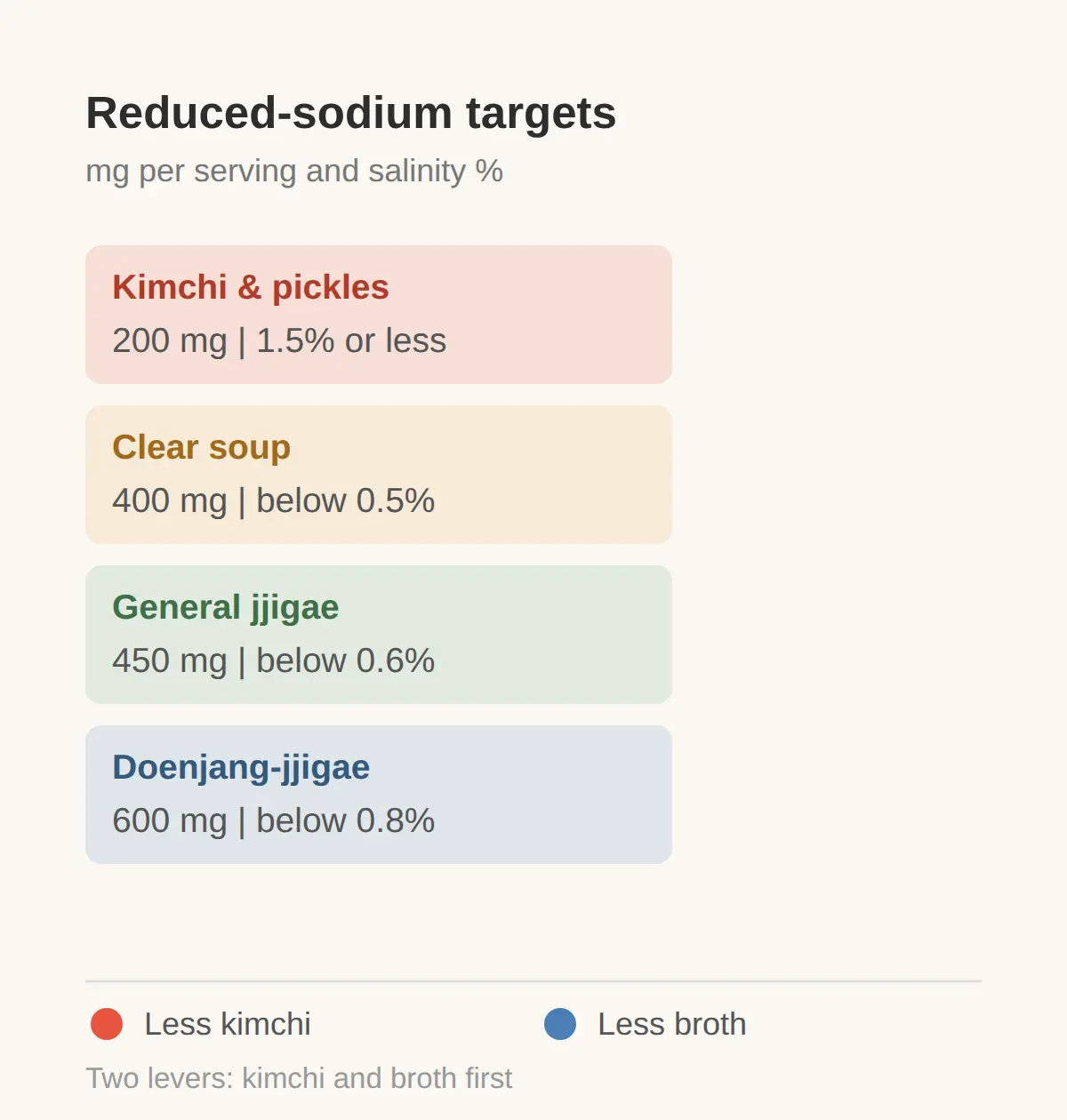
The published reduced-sodium targets are 200 mg per serving for kimchi and pickled vegetables, 400 mg for clear soup, and 450–600 mg for jjigae, depending on the type.
In salinity terms that is kimchi at 1.5% or less, clear soup below 0.5%, soybean-paste stew below 0.8%, and other stews below 0.6%.
| Item | Sodium per serving | Salinity per 100 g |
|---|---|---|
| Kimchi, pickled vegetables | 200 mg or less | 1.5% or less |
| Clear soup | 400 mg or less | Below 0.5% |
| General jjigae | 450 mg or less | Below 0.6% |
| Doenjang-jjigae | 600 mg or less | Below 0.8% |
If I were cooking Korean food abroad, I would control the two levers the data points to — less kimchi per meal and less broth drunk — before worrying about the rice or the other side dishes.
👉 Ottogi Han River ramyeon: what’s different and how to cook it
Did Korea’s sodium reduction campaign actually work?
Sodium intake fell 23.7% between 2010 and 2014 alongside the national reduction plan, with blood pressure and hypertension prevalence dropping at the same time.
The 2012 National Plan to Reduce Sodium Intake targeted a 20% cut, to 3,900 mg a day, by 2020, through five parts: a consumer awareness campaign, low-sodium school and worksite meals, low-sodium restaurant meals, voluntary food reformulation, and low-sodium home recipes.
The numbers line up in time, but a causal link between the program and the drop cannot be made.
Whether the 3,900 mg/day goal was met by 2020 is also not confirmed, and the most recent intake figures in the sources are 2017-vintage.
For a newer picture, watch for the next KNHANES release rather than any of the numbers here.
If you were wondering whether the campaign worked, the honest answer is: intake and blood pressure both fell during it, but the cause cannot be pinned down, and no post-2020 figure is available yet.
Related posts
📎 Chipotle Gangnam, first store in Asia — what to know before you join the line
📎 Ottogi’s ‘Han River ramyeon’ bagged noodle: October launch, and how the real Han River ritual works
📎 📅 다가오는 일정 — 발매·개봉·발표 캘린더
Sources
- Mean intake 3,477.2–3,889.6 mg/day; kimchi, noodles, soups t (kci.go.kr)
- kimchi 1,125 mg (24.5%), noodles 572 mg, soups 488 mg, stews (kjcn.or.kr)
- 2012 National Plan, 23.7% drop by 2014, ~half of population (pmc.ncbi.nlm.nih.gov)
Where that leaves you
- If you eat Korean food regularly, watch kimchi portions and whether you drink the broth — those are the two biggest levers.
- 2,000 mg sodium is about 5 g salt; Korean studies report both salinity (%) and mg, so the two numbers are not interchangeable.
- If you are under 30, ramyeon is your top source; 40–59, it is napa cabbage kimchi; 60 and over, soybean-paste soup.
- The intake figures here are from 2013–2017 surveys; nothing newer than 2017 was found in the sources.
- No post-2020 intake trend is confirmed — whether the 3,900 mg/day goal was met is not known.
FAQ
Q. Is Korean food high in sodium?
Yes. The average Korean eats 3,477.2–3,889.6 mg a day (2013–2017 surveys), roughly twice the WHO limit of 2,000 mg, and about half the population exceeds 4,000 mg a day.
Q. How much sodium is in kimchi?
Kimchi contributed 1,125 mg a day — 24.5% of total sodium intake and the largest single dish source — and kimchi eaters took in 1,452–2,343 mg more daily than non-eaters.
Q. How much sodium is in Korean jjigae and soup?
Restaurant versions are the saltiest: spicy beef soup at 3,273.2 mg and pollack stew at 2,930.2 mg per serving. The published reduced-sodium targets are 400 mg or less for clear soup and 450–600 mg for jjigae.
Q. What is the WHO sodium limit?
2,000 mg of sodium a day for adults, equal to about 5 g of salt.
Q. How can you reduce sodium in kimchi, soup and jjigae?
Cut kimchi to one portion per meal (target 200 mg or less per serving) and stop drinking the broth — the liquid holds 65.2–66.7% of the sodium in soups and 49.8–61.2% in stews.
Watch for the next KNHANES release to check for newer intake figures; otherwise nothing post-2017 is confirmed.
#koreanfood #sodium #kimchi #koreansoup #healthyeating
📅Upcoming Dates — 이번 주 16 · D-day 'The Scandal' global Netflix release전체 보기 →