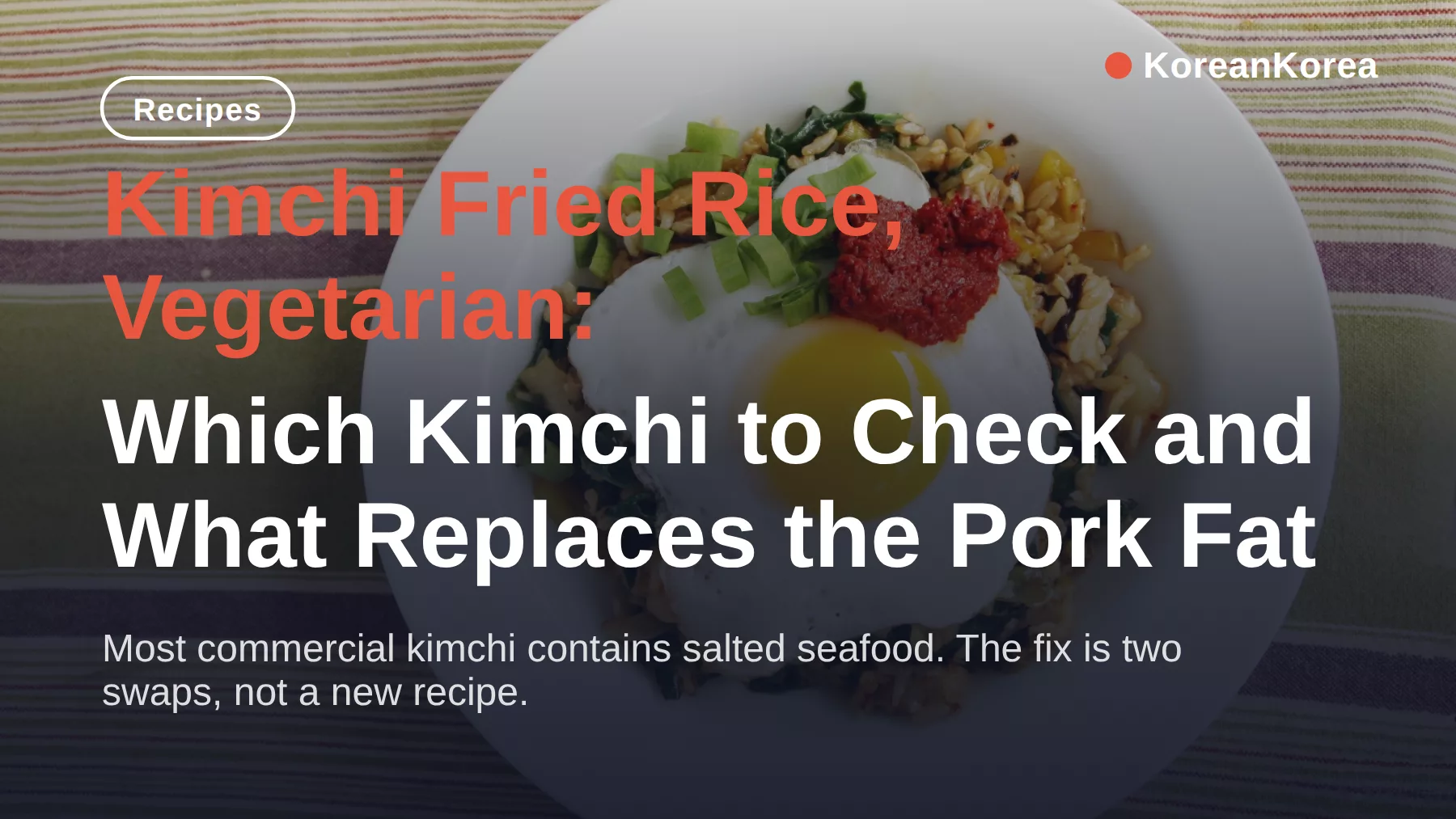
Yes — kimchi fried rice can be vegetarian, and it takes two swaps: a kimchi made without salted seafood, and perilla oil or butter instead of pork fat.
The classic recipe base of kimchi, rice, gochujang, and kimchi juice never contained pork, and the fried egg is an optional topping.
This post shows which label words to screen for, how the fat swap changes the taste, and the steps unchanged for vegans.
Contents
- kimchi fried rice recipe vegetarian — the short answer
- How to tell if store-bought kimchi is vegan
- What replaces pork fat — perilla oil vs butter
- The recipe steps, unchanged for vegans
- How old should the kimchi be, and is gochujang vegan?
- Is kimchi fried rice a good first Korean dish?
kimchi fried rice recipe vegetarian — the short answer
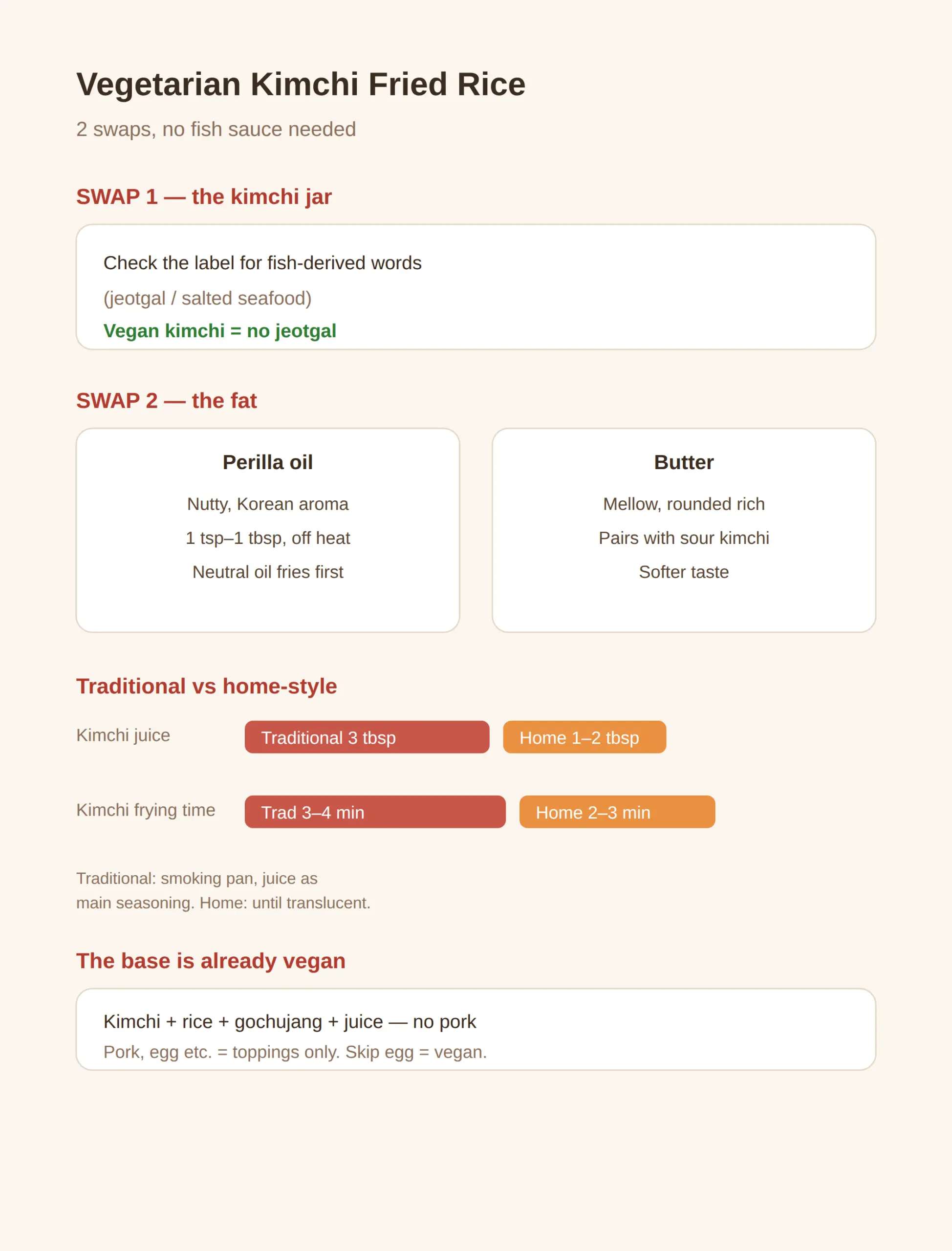
Yes, kimchi fried rice works as a vegetarian dish with two changes: use a kimchi with no jeotgal (salted seafood), and replace pork fat with perilla oil or butter.
Skip the egg and it is fully vegan.
The classic base — kimchi, rice, gochujang, and reserved kimchi juice — contains no pork at all.
Pork, spam, sausage, and tuna are optional add-ins layered on top, and the baste-fried runny-yolk egg is a topping, not part of the rice.
That is why the swap changes two things and nothing else.
When I pick up a kimchi jar abroad, the first thing I check is the ingredient list for fish-derived words, because the kimchi itself — not the recipe — is what usually breaks vegan status.
| Traditional cast-iron | About 25 minutes / 3 tbsp reserved kimchi juice / 3–4 minutes in a smoking pan |
|---|---|
| Beginner home-style | About 10 minutes / 1–2 tbsp kimchi liquid / 2–3 minutes until translucent |
| Vegan swap (either version) | Adds no extra step / Same quantity / Same cue: translucent, oil-coated |

How to tell if store-bought kimchi is vegan
Read the ingredient list and screen for five words: jeotgal (젓갈), saeujeot (새우젓, salted shrimp), myulchi (멸치, anchovy), aekjeot (액젓, fish sauce), and kanari jeotgal.
If any of them appear, the kimchi is not vegan.
Most commercial baechu kimchis contain salted seafood, and saeujeot is the most common, with kanari jeotgal in southern styles like Tongyeong and Masan.
Only a minority of napa kimchis are made without any seafood, sometimes called temple kimchi.
Some US brands voluntarily carry a vegan label on the front, so that is the fastest signal before you read the fine print.
If the label is only in Korean, look for 젓 characters anywhere in the ingredient list.
If none appear, the jar is very likely fish-free — then confirm on the maker’s page if the label is unclear.

What replaces pork fat — perilla oil vs butter
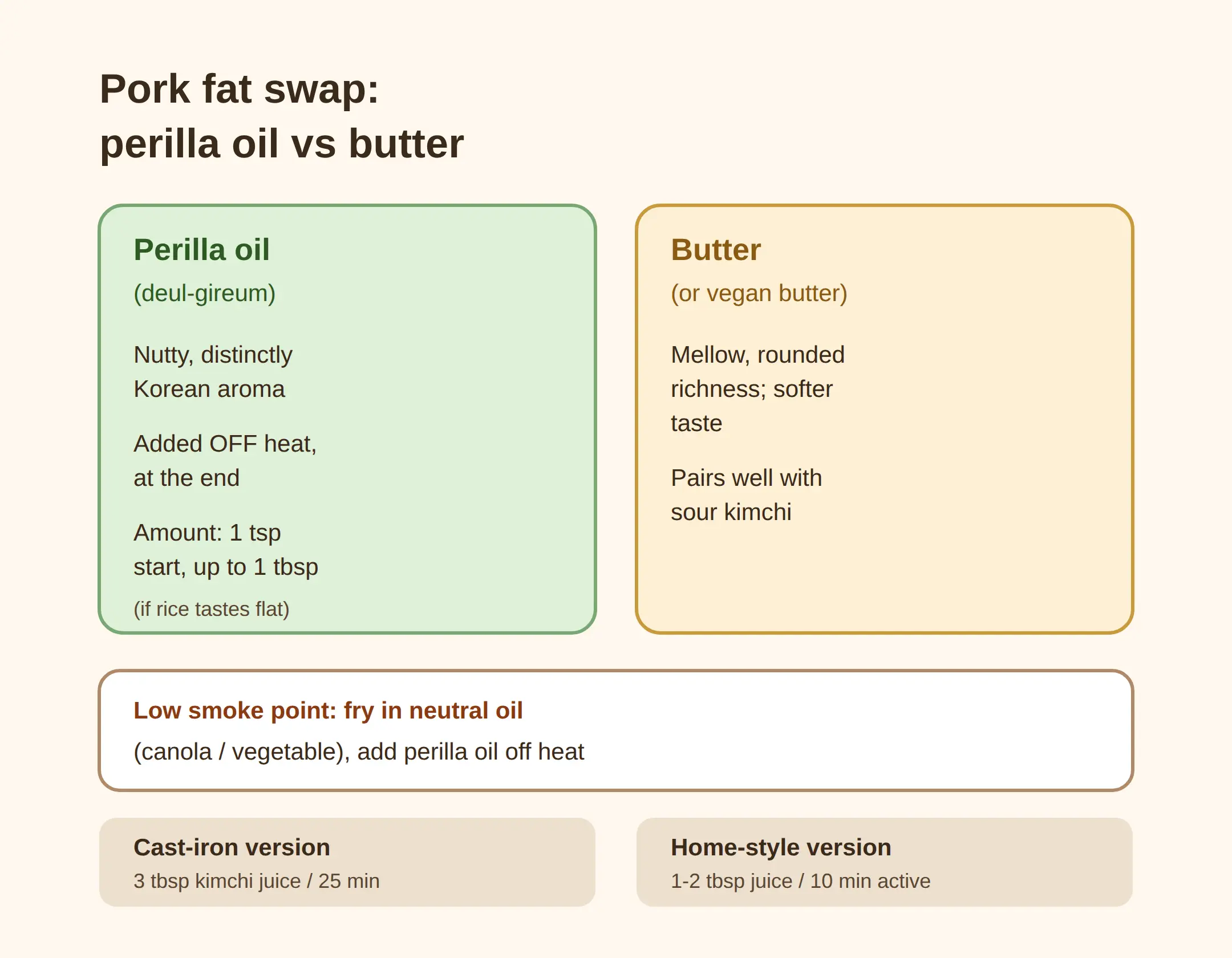
Perilla oil (deul-gireum, 들기름) gives a nutty, distinctly Korean aroma; butter or vegan butter gives a mellow, rounded richness that pairs well with sour kimchi.
Perilla oil has a low smoke point, so it is a finishing fat, not a frying fat: fry in neutral oil (canola or vegetable), then add 1 tsp to 1 tbsp of perilla oil off the heat at the end — the same off-heat rule the traditional recipe already applies to sesame oil.
Butter is used for a softer taste instead.
Recipes do not agree on a fixed amount, so treat 1 tsp as a starting drizzle and go up to 1 tbsp if the rice tastes flat.
If you want the dish to taste closest to a Korean diner version, use perilla oil; if you want it rounder and milder, use butter.
The recipe steps, unchanged for vegans
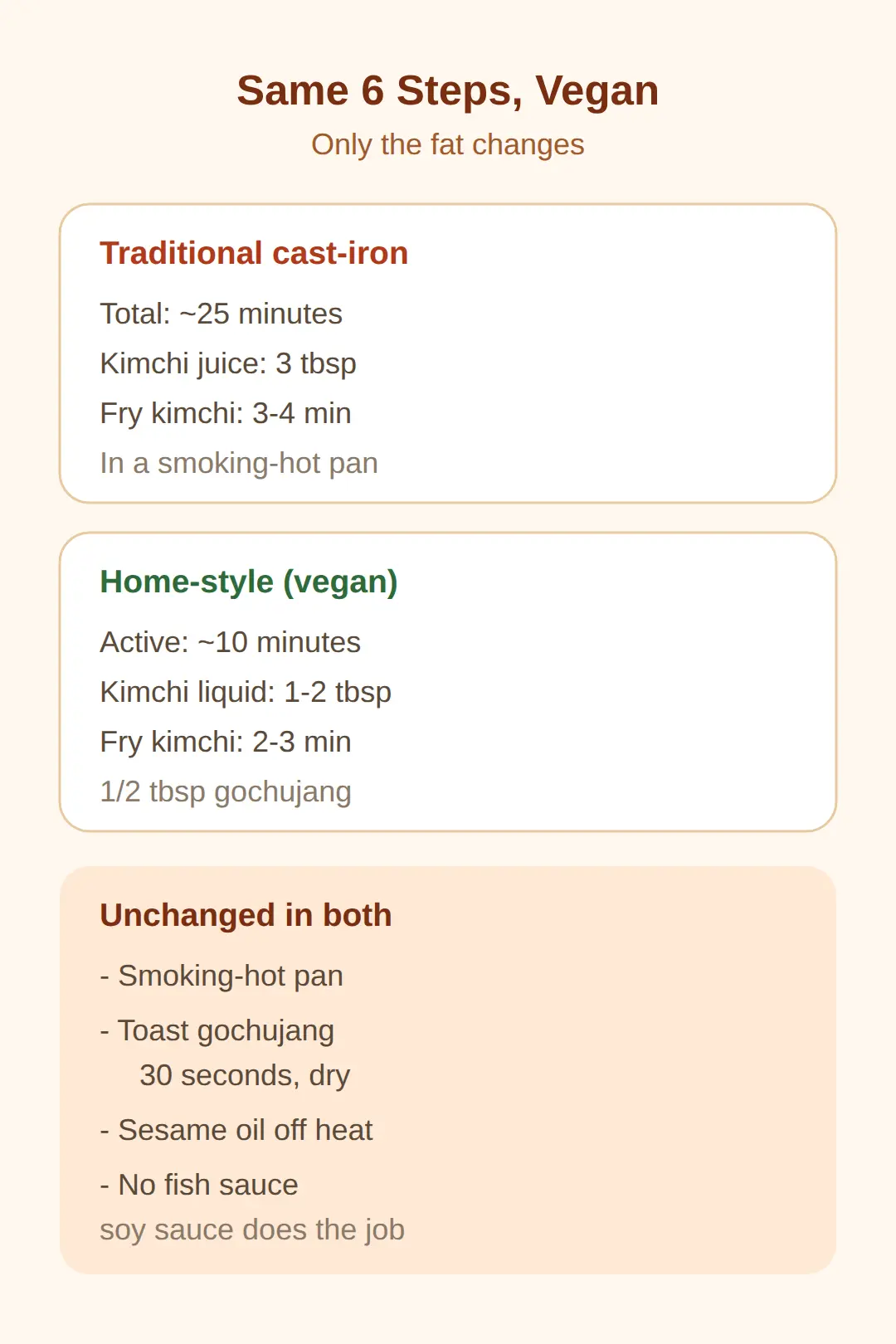
The vegan version follows the same six steps, in the same order, as the classic recipe:
- Fry chopped scallion (and onion) in neutral oil over medium heat until the scallion tips turn golden — this scallion oil base works identically with the vegan fats.
- Add the kimchi and fry 2–3 minutes until translucent and oil-coated (3–4 minutes in a smoking-hot pan for the traditional version).
- Push the kimchi aside, add gochujang, and toast it alone for 30 seconds — a dry step with no fat, so it needs no change.
- Add the reserved kimchi juice (3 tbsp traditional, 1–2 tbsp home-style), soy sauce, and a pinch of sugar to soften the sourness.
- Add cold day-old rice, press it flat with the spatula for 20–30 seconds every 30 seconds over high heat, and fold — 2 minutes total builds a nurungji (crispy rice) crust.
- Turn off the heat, then finish with sesame oil, toasted sesame seeds, and seaweed flakes.
Add the baste-fried egg only if you are not making it vegan.
Every non-negotiable of the classic recipe — the smoking pan, the 30-second gochujang toast, the off-heat sesame oil — survives the vegan swap, so nothing in the technique changes.
How old should the kimchi be, and is gochujang vegan?
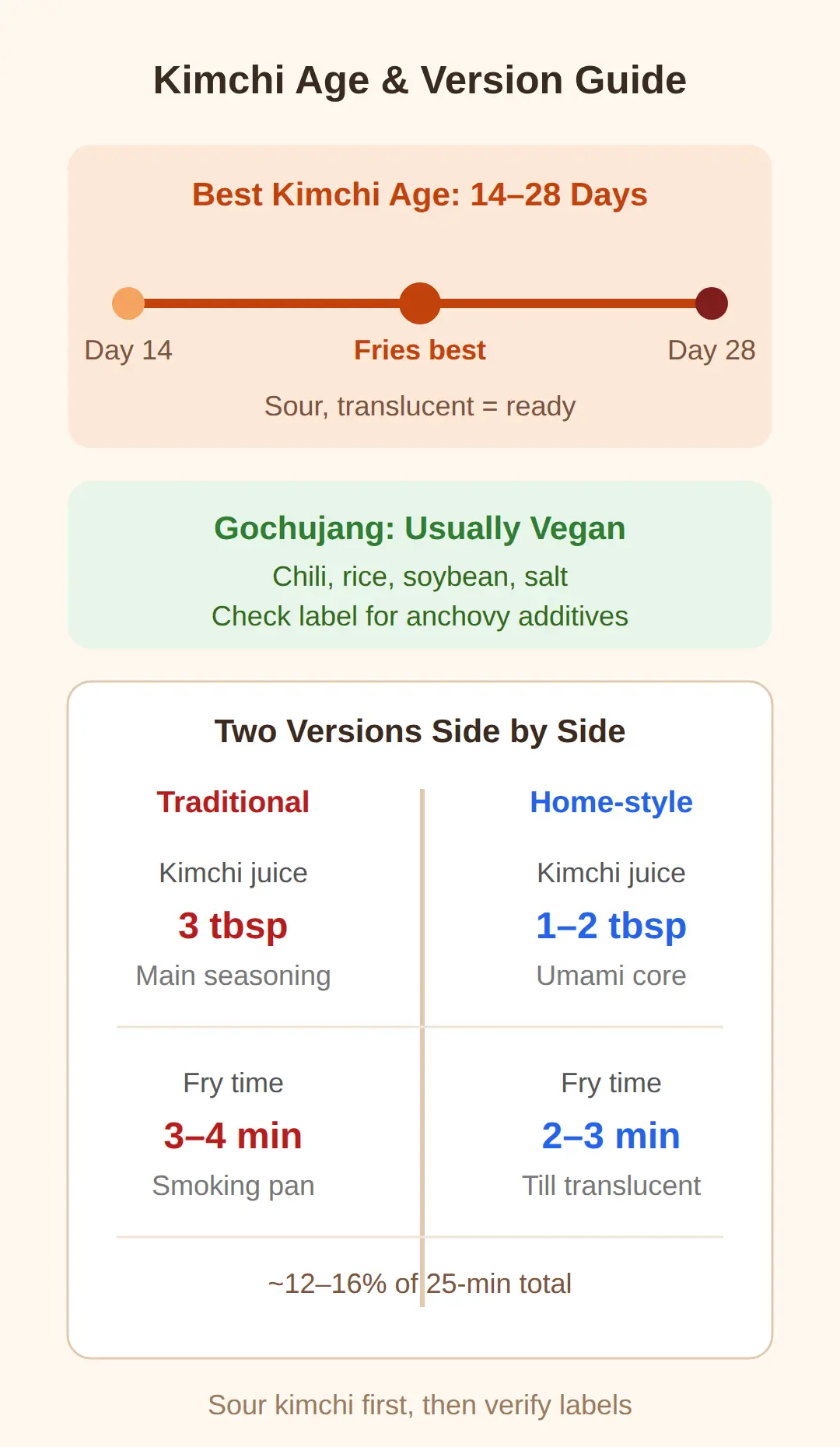
Use kimchi aged 14–28 days (2–4 weeks), sour and translucent — this is the correct base whether the version is vegan or not.
Well-soured stage-3 kimchi is the non-negotiable foundation of kimchi fried rice; fresh, sweet kimchi makes a flat-tasting fried rice.
Vegan kimchi follows exactly the same aging rule, and the 14–28-day window covers the sour-but-still-firm stage that fries best.
Standard gochujang is generally vegan — it is made from chili, glutinous rice, fermented soybean powder, and salt — but a few brand variants add anchovy-based additives, so verify the label the same way you checked the kimchi.
Is kimchi fried rice a good first Korean dish?
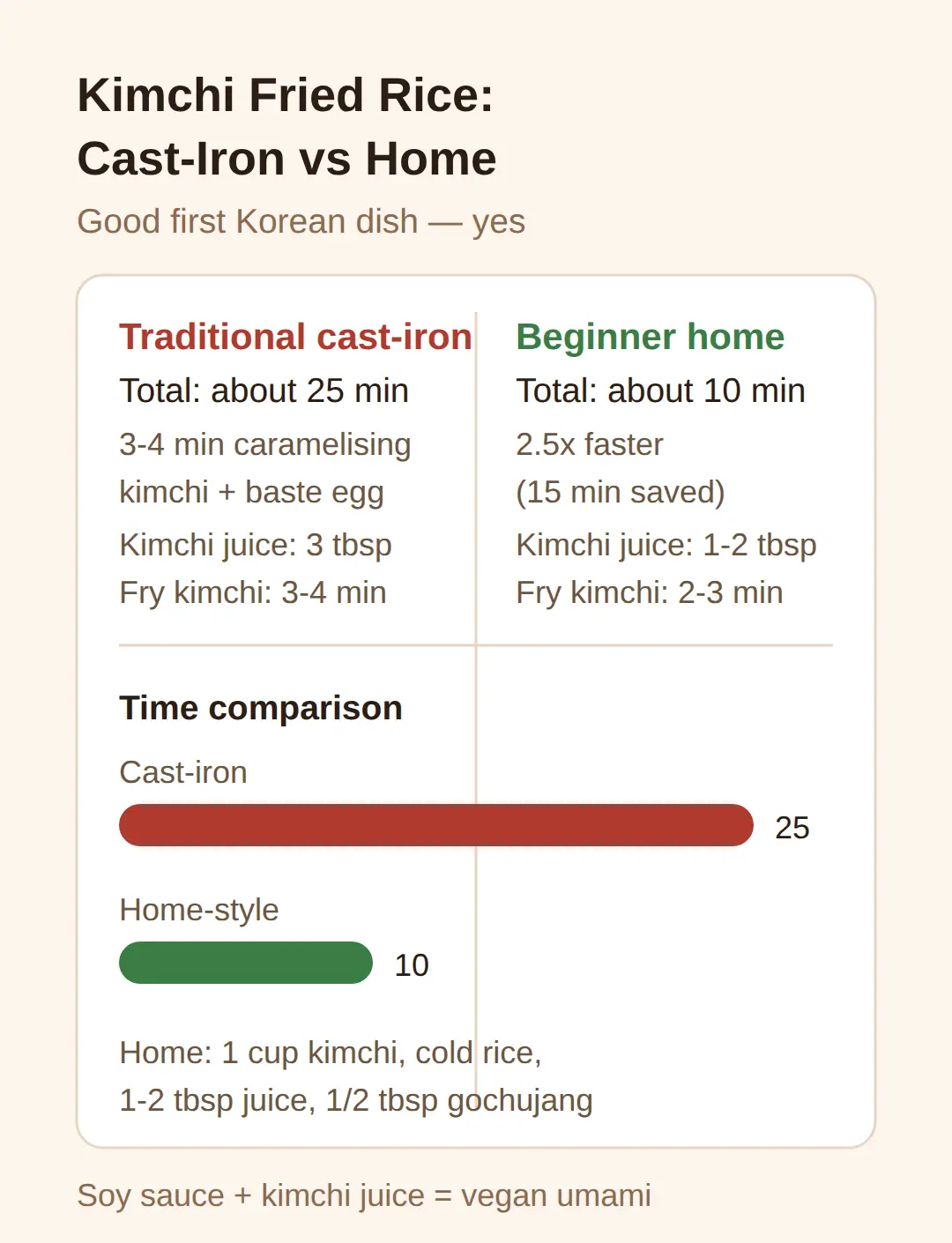
Yes — kimchi fried rice is rated beginner level and needs about 10 minutes of active cooking in the home style, which makes it a practical first vegan Korean dish.
The traditional cast-iron version runs about 25 minutes including 3–4 minutes of caramelising the kimchi and the baste-fried egg, so the home method is 15 minutes faster — 2.5× faster.
It is also considerably easier than kimchi jjigae (kimchi stew), and the vegan swap adds no extra step to either version.
The savory depth that jeotgal would supply comes from soy sauce plus the reserved kimchi juice, and kelp- or mushroom-based seasonings cover the rest.
If it is your first Korean dish, cook the home-style version first with store-bought vegan kimchi, and save the cast-iron 25-minute version for when the base steps feel automatic.
If I were cooking this for a vegan reader, I would start from the base recipe and change only the kimchi and the fat — the reason is that pork and egg are add-ins, not the foundation, so fewer edits mean fewer places to get it wrong.
What I check first is the kimchi label, because that single choice decides whether the dish qualifies at all.
Related posts
Sources
- Perilla oil low smoke point, finish off-heat; direction only (kimchiguide.com)
- 1 cup kimchi : 1 bowl rice, 1/2 tbsp gochujang, green onion (ksansuya.com)
- Fat replacement for pork fat (this blog’s angle) (projects)
What to remember
- Check the kimchi label first: jeotgal, saeujeot, myulchi, aekjeot, or kanari means it is not vegan.
- Use neutral oil for frying and add perilla oil off the heat at the end, 1 tsp to 1 tbsp.
- Skip the egg for a fully vegan bowl; the rice is complete without it.
- Kimchi aged 14–28 days, sour and translucent, is the base either way.
- Do not rush the kimchi fry — translucent and oil-coated is the cue, about 12–16% of the traditional recipe’s total time.
FAQ
Q. Is kimchi fried rice vegetarian?
It can be. Use a kimchi made without jeotgal (salted seafood), replace pork fat with perilla oil or butter, and skip the egg. The classic base recipe itself never contained pork.
Q. How do I know if store-bought kimchi is vegan?
Screen the ingredient list for jeotgal (젓갈), saeujeot (새우젓), myulchi (멸치), aekjeot (액젓, fish sauce), and kanari jeotgal — if any appear, it is not vegan. Some US brands carry a voluntary vegan label on the front.
Q. What replaces pork fat in kimchi fried rice?
Perilla oil for a nutty, traditional aroma (added off-heat at the end), or butter or vegan butter for a mellow, rounded richness. Neutral oil does the actual frying either way.
Q. Is gochujang vegan?
Standard gochujang is generally vegan — chili, glutinous rice, fermented soybean powder, and salt. A few brand variants add anchovy-based additives, so check the label.
Q. What can replace fish sauce in kimchi?
Kelp (dashima) broth or soy sauce are the standard non-fish replacements used in vegan kimchi making, giving savory depth without seafood. Verify a written vegan kimchi recipe for exact amounts.
Kimchi fried rice is always in season — no event needed. Cook it once with store-bought vegan kimchi, then stage a jar to age 2–4 weeks for the properly sour version.
Cover photo: Kimchi fried rice 1 by Stacy Spensley — CC BY 2.0
#kimchifriedricerecipevegetarian #vegankimchi #perillaoil #Koreanrecipes #kimchibokkeumbap
📅Upcoming Dates — 이번 주 23 · D-day Final two episodes drop on Disney+/Hulu전체 보기 →