

The core bulgogi marinade is five things: Asian pear, soy sauce, sugar, garlic, and sesame oil.
The pear is the part most home kitchens abroad struggle with, and it is also the part doing the real work.
This post covers what the pear actually does, the ratio for 1 lb (450 g) of beef, four substitutes that work when no pear is on the shelf, and how to slice thin and grill hot on a regular stove.
Contents
- Bulgogi recipe: what Asian pear actually does in the marinade
- The core marinade ratio for 1 lb of beef
- Pear substitutes: apple, kiwi, pineapple, onion
- No ribeye abroad: cuts and thin slicing
- Stove-top grilling: sear without charcoal
- Serving, mistakes, and the mushroom version
Bulgogi recipe: what Asian pear actually does in the marinade
Bulgogi is thin-sliced beef, usually ribeye or sirloin cut 2–3 mm thick, marinated in a pear-soy base and grilled fast.
The name means fire meat, and the dish traces back to the Goguryeo-era grilled skewer called maekjeok.
Today it is one of the most widely known Korean dishes outside Korea.
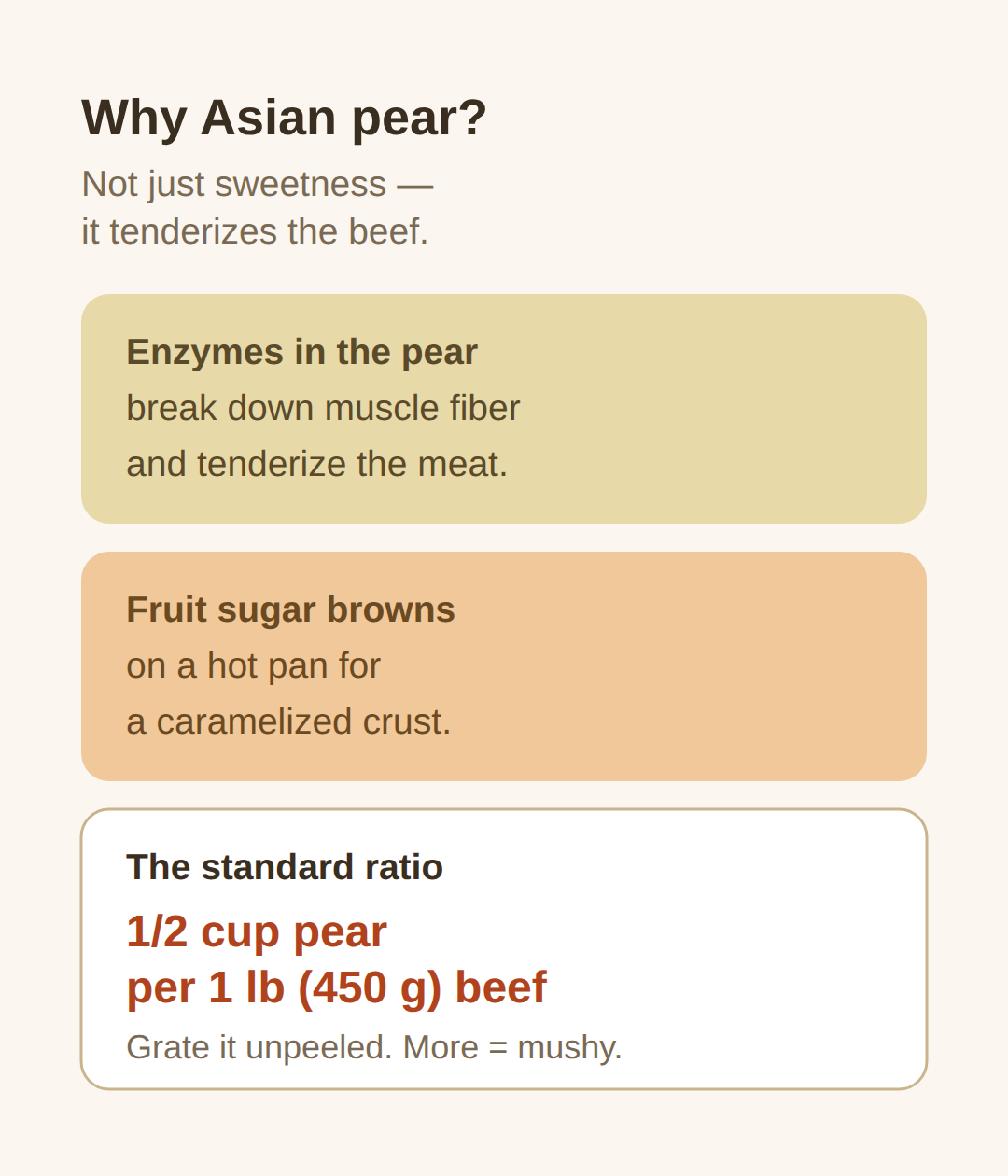
The pear is not just there for sweetness.
It carries enzymes that break down muscle fiber and tenderize the beef while the sugar in the fruit browns on a hot pan.
Grate it unpeeled — most of the tenderizing effect sits in and just under the skin.
About 1/2 cup of grated pear per 1 lb (450 g) of beef is the standard amount, and more than that turns the marinade mushy-sweet.
Regular brewed soy sauce works here.
Soup soy sauce (guk ganjang) is saltier and thinner and throws the ratio off.
A little grated onion is a normal addition alongside the pear — it adds sweetness and moisture, it does not replace the fruit.
One practical shortcut: bottled Korean pear juice, sold as ground pear drink (galamandeunbae), can stand in for fresh pear at the same 1/2 cup per pound.
Lemon-lime soda is a modern home-cook shortcut too — it adds sweetness and light tenderizing in place of part of the sugar.
| Grated sweet apple (Fuji) | Same as pear — about 1/2 cup |
|---|---|
| Kiwi | Same amount, marinate 30 min max |
| Pineapple | About 1/4 cup (half the pear amount), under 1 hour |
| Grated onion + extra sugar | Same amount, no enzyme tenderizing |
The core marinade ratio for 1 lb of beef
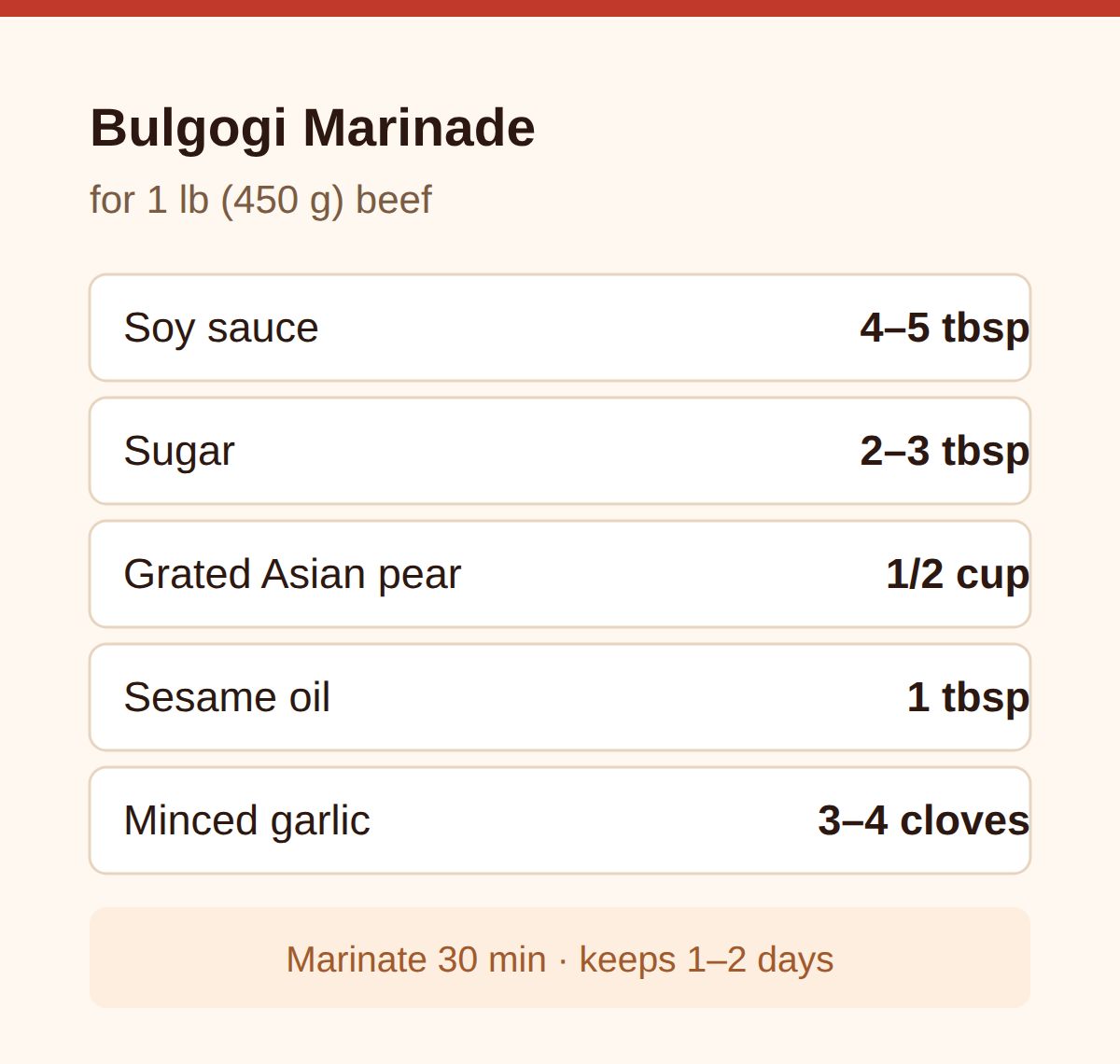
For 1 lb (450 g) of thin-sliced beef, the working ratio is 4–5 tablespoons soy sauce, 2–3 tablespoons sugar, 1/2 cup grated Asian pear, 1 tablespoon sesame oil, and 3–4 minced garlic cloves.
That works out to roughly 1 tablespoon of soy sauce per 100 g of beef, which is an easy way to scale the recipe up or down.
Korean rice syrup (mullyeot) or honey can replace the white sugar for a rounder, glossier sweetness.
Thin-sliced bulgogi needs only about 30 minutes in this marinade before cooking.
Longer soaking deepens the flavor, and the pear enzyme is mild enough that overnight in the refrigerator does not hurt the texture.
Raw marinated beef keeps 1–2 days refrigerated before cooking.
[ figures/01-marinade-ratio.svg | alt: Bulgogi marinade ratio card for 1 lb of beef | caption: Core ratio for 450 g (1 lb) of thin-sliced beef ]
For seasoning the meat itself rather than the marinade, baking soda is a separate option: sprinkle about 1/4 teaspoon over the sliced beef for 15–20 minutes, rinse, then marinate.
That is a quick tenderizer for days when no fruit is available.
Pear substitutes: apple, kiwi, pineapple, onion
No Asian pear?
Grated sweet apple (Fuji is the usual pick) is the most available substitute.
It has less tenderizing power than pear, so add a little grated onion to compensate.
The texture and flavor land closest to the original.
Kiwi works too, but it tenderizes faster than pear and can turn the meat mushy after about 30 minutes.
Pineapple is the most aggressive of the three — use about half the pear quantity, roughly 1/4 cup per pound, and keep marinating under 1 hour.
[ figures/02-pear-substitutes.svg | alt: Comparison of four Asian pear substitutes for bulgogi | caption: Four swaps ranked by how close they land to pear ]
When no fruit is on hand at all, grated onion plus extra sugar replicates the sweetness but not the tenderizing.
In that case, slice the meat thinner instead — thickness matters more than the enzyme when there is none.
Any crisp round pear can also stand in for the Korean nashi pear, grated with the peel on.
Soft pears mostly add water without much tenderizing effect.
No ribeye abroad: cuts and thin slicing
Ribeye or sirloin sliced 2–3 mm is the standard cut, and Korean markets sell it pre-sliced labeled for bulgogi.
At a regular Western supermarket, ask the butcher to slice ribeye or sirloin paper-thin on the deli slicer — many will do it on request.
Slicing at home works too, with one trick: freeze the beef block for 1–2 hours until firm, then hand-slice 2–3 mm with a sharp knife.
Slice against the grain so the short muscle fibers stay tender after quick high-heat cooking.
Any fast-cooking steak works if it is cut thin across the grain — flank, skirt, and sirloin all grill in the same 3–5 minutes as the original cut.
What matters is the thickness, not the name of the cut.
[ figures/03-slicing-flow.svg | alt: Flow of freezing, slicing against the grain, and marinating bulgogi beef | caption: From a supermarket steak to bulgogi-ready slices ]
Stove-top grilling: sear without charcoal
Thin-sliced bulgogi cooks in roughly 3–5 minutes on a hot pan or grill, so no charcoal setup is needed.
A cast-iron skillet or grill pan on high heat does the job.
Preheat until a drop of water skitters across the surface — the beef should sizzle on contact.
Cook in a single layer and in batches.
Crowding the pan releases water and boils the meat instead of searing it, which is the single most common mistake on a home stove.
The slices are done as soon as they are fully browned with no pink, and thin slices overcook in under a minute past that point, so pull them as soon as the color turns.
Reserve a portion of fresh marinade before the beef goes in if a pan sauce over rice sounds good.
Raw marinade that touched the beef should not be reused unless boiled for 2–3 minutes first.
👉 Samgyetang Recipe: Fight Summer Heat With a Boiling Soup, Not Ice
Serving, mistakes, and the mushroom version
The traditional way to eat bulgogi is as a wrap: a lettuce leaf, a piece of meat, ssamjang, and rice, with kimchi and other banchan on the side.
The pan drippings double as a sauce over rice, which is why the same meal works as a rice bowl at home.
For a meatless version, thick slabs of king oyster mushroom and tofu take the same pear-soy marinade.
Keep their marinating time at 20 minutes or less — the texture collapses beyond that.
Three mistakes cover most failed batches.
Overloading the pan so the meat steams instead of sears.
Using soup soy sauce instead of brewed soy sauce, which makes the marinade much saltier and throws off the ratio.
And leaving kiwi or pineapple in the marinade for hours, which turns the texture to mush.
Bulgogi is also a flexible protein beyond the grill — bulgogi tacos and rice bowls are common uses abroad, and the marinade alone is worth making.
Related posts
📎 bibimbap recipe: season every vegetable separately, then mix — 4 servings
📎 📅 다가오는 일정 — 발매·개봉·발표 캘린더
Sources
Bulgogi recipe essentials
- Check the meat at 30 minutes — with kiwi or pineapple it may already be at the mushy limit
- Rinse the baking soda off the beef before the marinade goes on
- Bottled marinade runs sweeter and thinner than homemade — taste before adding sugar
- Leftovers wrap well in lettuce with ssamjang and kimchi the next day
FAQ
Q. What can I substitute for Asian pear in bulgogi marinade?
Grated sweet apple is the closest swap, kiwi works but mushies the meat after about 30 minutes, pineapple needs half the quantity and under 1 hour, and grated onion with extra sugar covers sweetness without tenderizing.
Q. How long do I marinate thin-sliced bulgogi?
About 30 minutes is enough for thin slices. Overnight in the refrigerator deepens the flavor without hurting the texture, and raw marinated beef keeps 1–2 days before cooking.
Q. What cut of beef works if ribeye is unavailable?
Flank, skirt, or sirloin all work when sliced 2–3 mm against the grain. Freeze the block 1–2 hours first, or ask the butcher to slice it paper-thin on the deli slicer.
Q. Can I grill bulgogi on a stove-top pan instead of charcoal?
A cast-iron skillet or grill pan on high heat cooks thin-sliced bulgogi in 3–5 minutes. Keep the meat in a single layer and cook in batches so it sears instead of steams.
Try the marinade with half a grated pear on 1 lb of beef first, then test a substitute in the same batch and see which sear you like better.
#bulgogirecipe #bulgogimarinade #koreanbbqbeef #asianpearmarinade #bulgogipearsubstitute #howtomakebulgogi
📅Upcoming Dates — 이번 주 4 · D-day Changdeokgung Moonlight Tour start (Sept 10–Oct 17, 30,000 K전체 보기 →