September is when snow crab (daege) and swimming crab (kkotge) season opens in Korea, and demand for fall seafood ramps up from this month.
This guide answers the practical questions: which market to pick, how ordering works, what a meal costs, and how to avoid overpaying.
Prices change daily and current per-kilogram rates could not be confirmed, so this guide focuses on the system — hours, access, fees, and ordering steps.
Contents
- Korea crab season: why September is the start
- Jagalchi Market: hours, closing days, access
- How ordering works: buy on 1F, eat on 2F
- What to order: crab, sashimi, maeuntang
- Prices and bargaining: how not to overpay
- Noryangjin in Seoul: when to pick it instead
Korea crab season: why September is the start
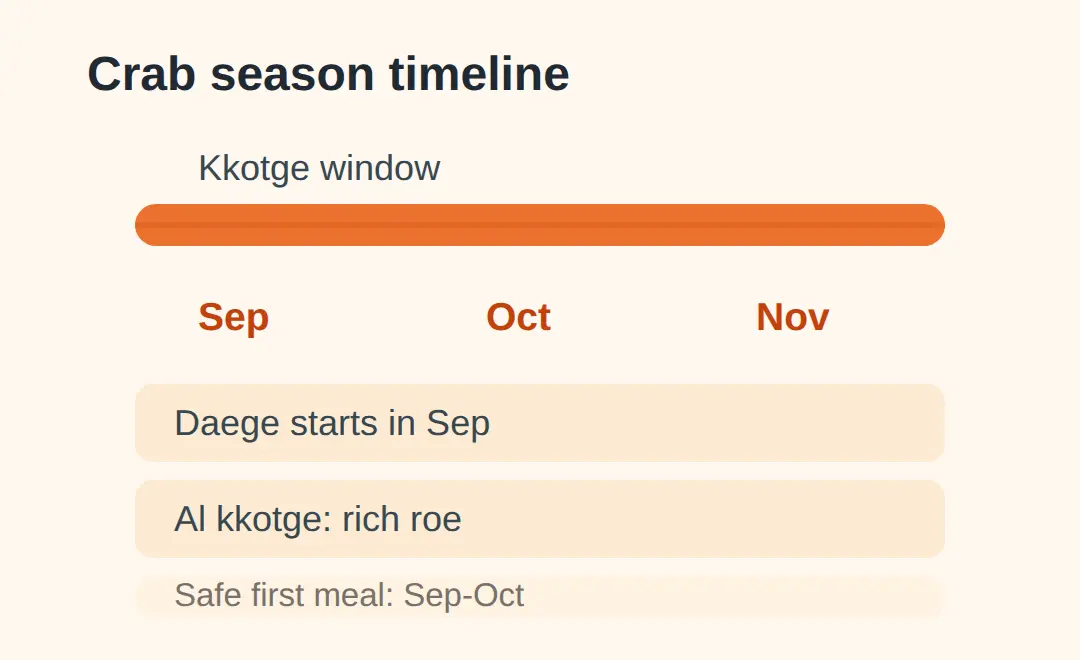
Snow crab (daege) and swimming crab (kkotge) season starts in September.
The kkotge window runs three full months, from September through November.
Autumn females, called al kkotge, are prized for rich roe.
Non-crab fall picks include gizzard shad (jeoneo) and large shrimp (daeha) through November.
Demand for fall seafood builds from September, so stalls stock the season’s catch early.
For a first crab meal of the season, September through October is the safe window.
| Market type | Consumer market, sells to diners and retailers |
|---|---|
| Location | Nampo-dong waterfront, Jung-gu, Busan |
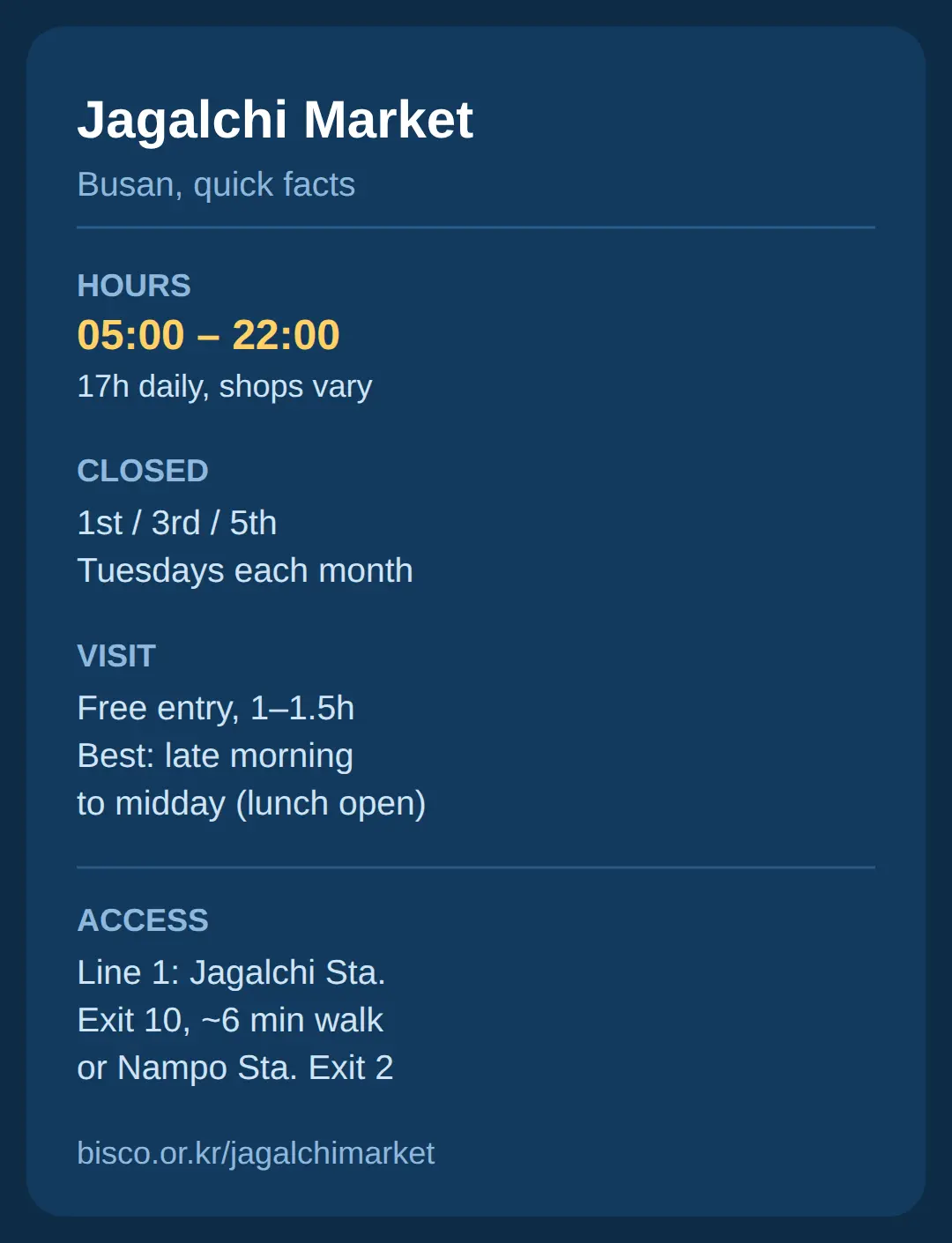
| Hours | 05:00 – 22:00 |
| Closed | 1st, 3rd (and 5th) Tuesdays monthly |
| Entry | Free; 1 – 1.5 hours recommended |
| Access | Metro Line 1, Jagalchi Station Exit 10, about 6 min on foot |
| Address | 52 Jagalchihaean-ro, Jung-gu, Busan |
Jagalchi Market: hours, closing days, access
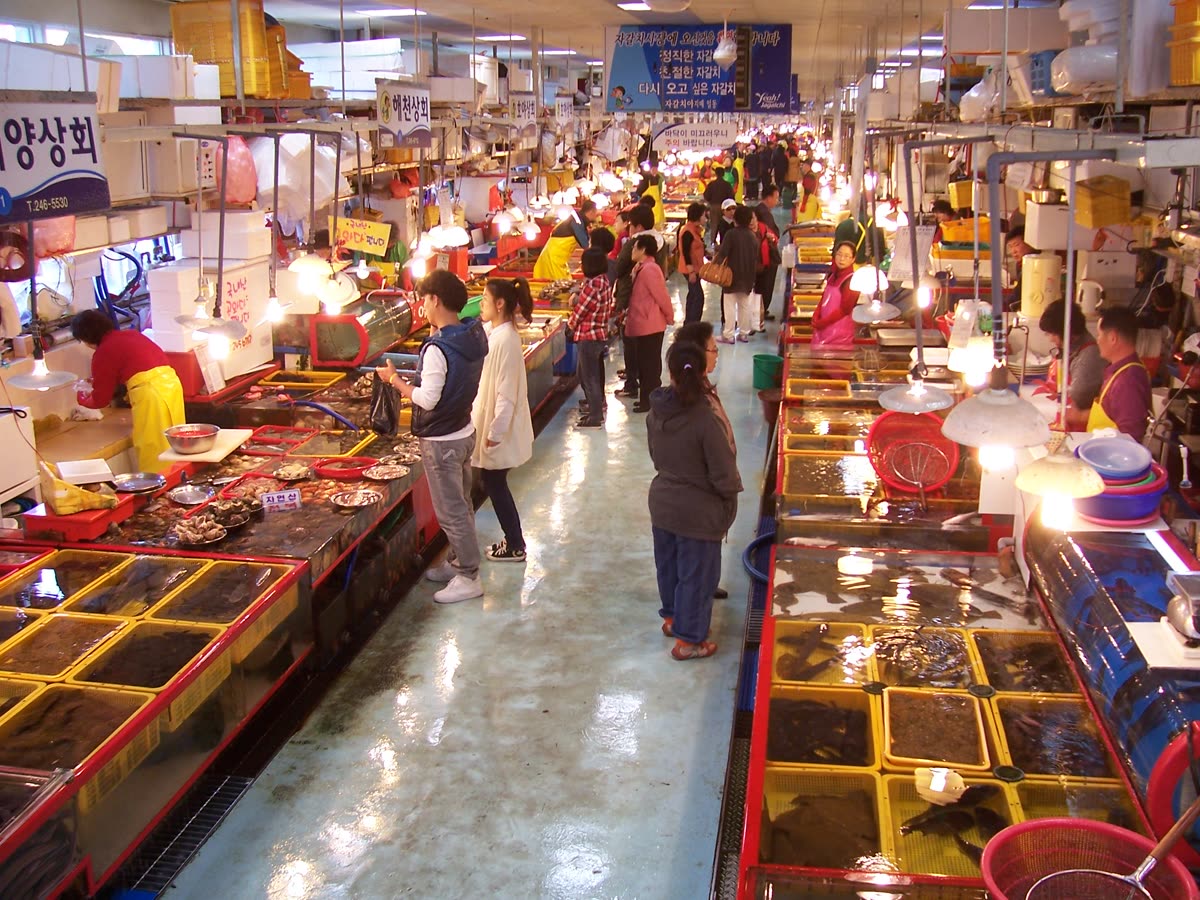
Jagalchi is Korea’s largest fish market, covering the Nampo-dong and Chungmu-dong harbor waterfront in Busan.
It is a consumption market — it sells directly to diners and retailers — unlike the wholesale auction market that ships nationwide.
Hours run 05:00 to 22:00, a 17-hour daily window, though individual shops vary.
Most stalls close on the 1st, 3rd and 5th Tuesdays of each month.
Entry is free, and 1 to 1.5 hours is enough for a visit.
Take Busan Metro Line 1 to Jagalchi Station Exit 10, about 6 minutes on foot; Nampo Station Exit 2 is a similar walk.
Buses 27, 41, 5-1, 61, 113, 30, 6, 7, 71 and 86 stop at Jagalchi Market.
The address is 52 Jagalchihaean-ro, Jung-gu, Busan, and the official site is bisco.or.kr/jagalchimarket.
Late morning to midday is the sweet spot — stock is freshest and the second-floor restaurants are open for lunch.
👉 Busan travel guide 2026: why Taiwanese tourists are flying in and booking longer stays
How ordering works: buy on 1F, eat on 2F
The standard routine has two floors.
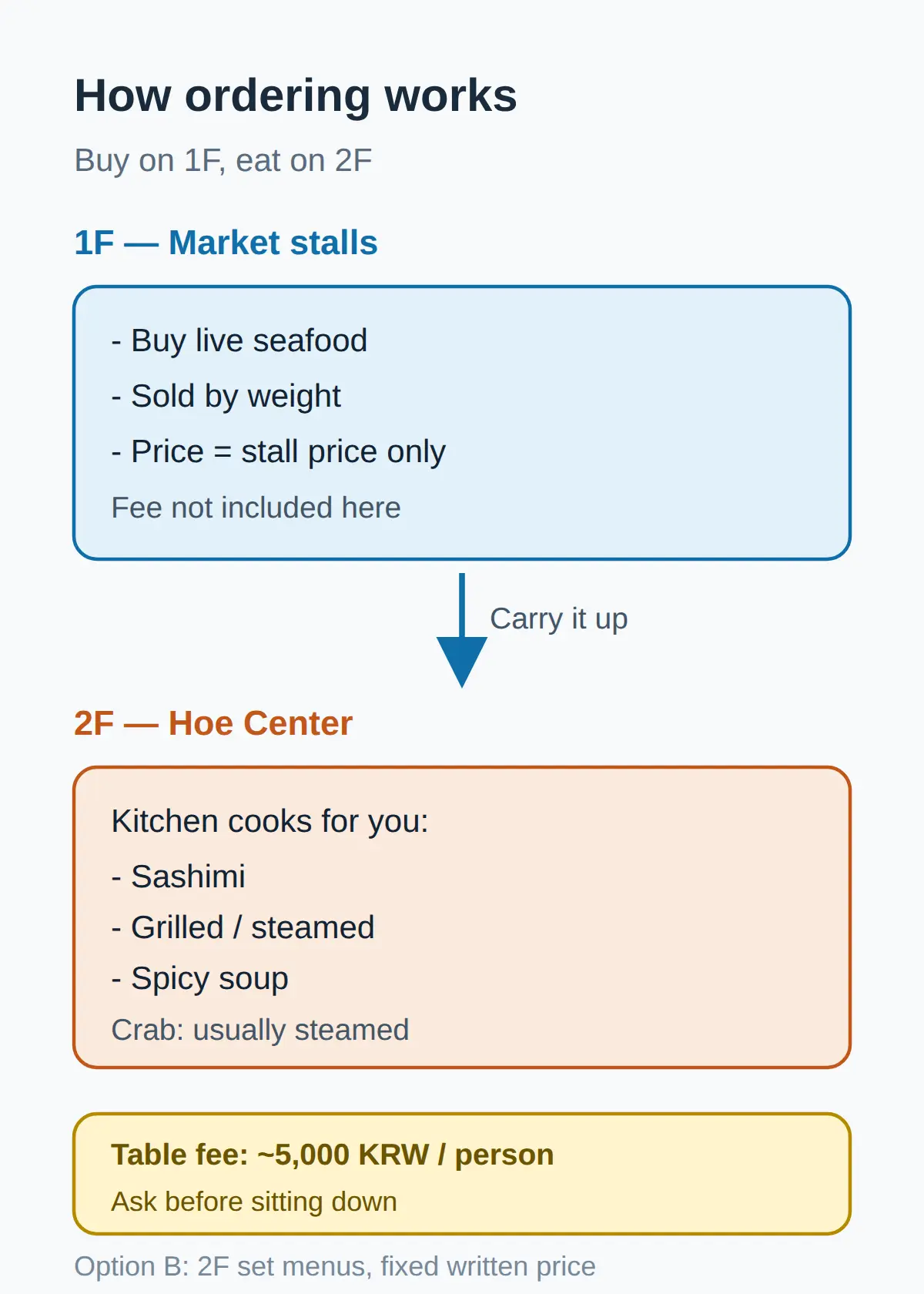
Buy live seafood at the stalls on the 1st floor, then carry it to a restaurant on the 2nd floor (the Hoe Center) to be cooked.
The kitchen prepares it as sashimi, grilled, steamed or as spicy soup.
Crab is sold by weight downstairs and most commonly steamed upstairs.
The restaurant charges a table-setting fee (sangcharim-bi) per person, separate from the seafood price, so ask for the exact amount on site before sitting down.
Ask for that fee before sitting down, because it is not included in the stall price.
A second path skips the stalls entirely: fixed-price restaurants upstairs sell set menus with written prices, so no weighing or bargaining is involved.
If weight-based pricing feels risky, the written-menu route is the simpler choice.
What to order: crab, sashimi, maeuntang
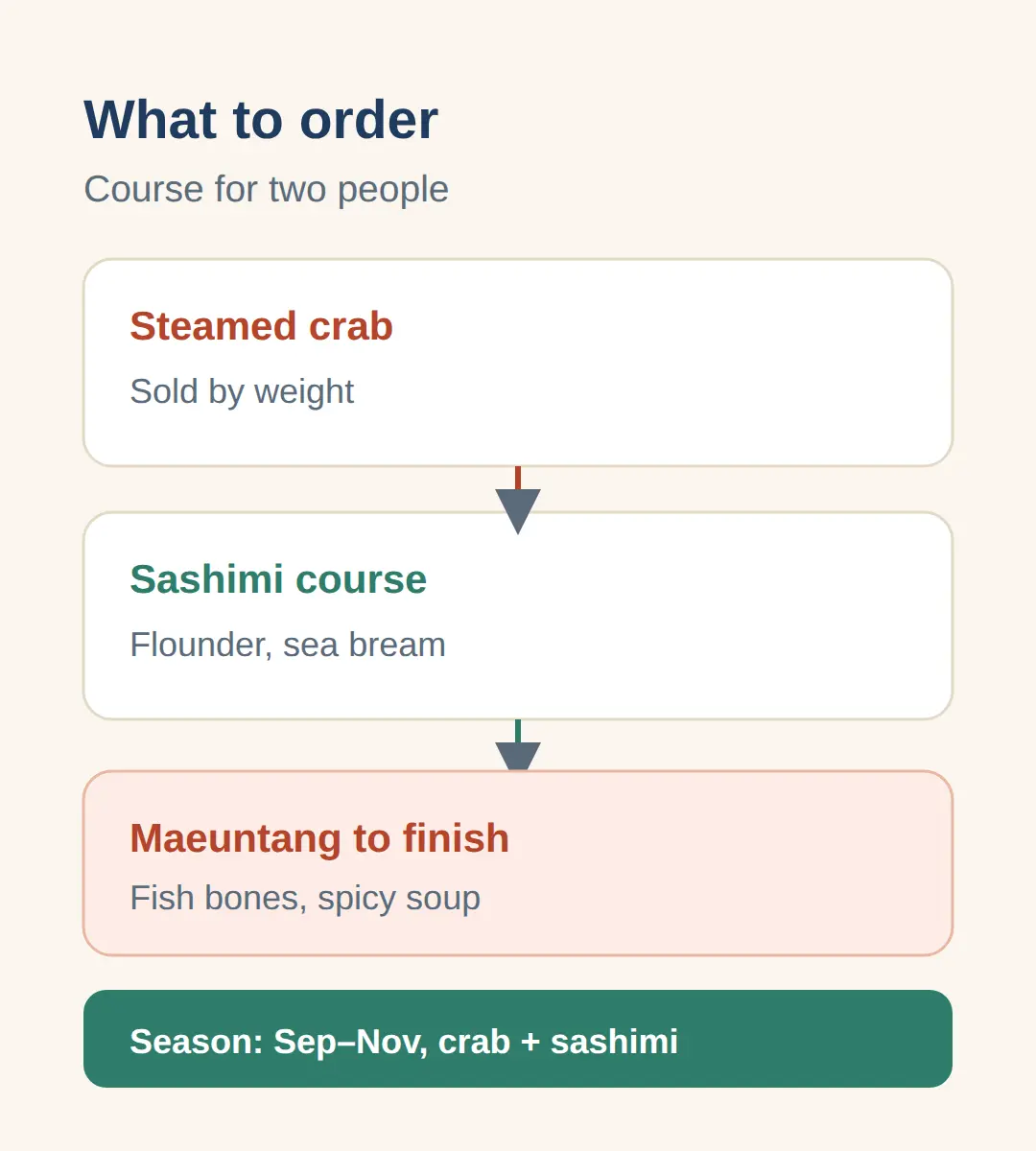
King crab and snow crab are sold by weight at the stalls and steamed upstairs.
Beyond crab, the market handles flounder and sea bream sashimi, abalone, grilled scallops and clams, live octopus (san-nakji), sea squirt, sea cucumber and spicy grilled conger eel (kkomjang-eo).
A common course runs sashimi first, then the leftover bones are boiled into maeuntang, a spicy fish soup, to finish the meal.
Seasonal September–November items at these markets include autumn gizzard shad and large shrimp.
Ordering one crab dish plus one sashimi course covers the season well for two people.
Prices and bargaining: how not to overpay
Crab prices are daily market rates set by that day’s catch, so no fixed per-kilogram figure applies.
The rule that matters: confirm the per-kg price AND the total before the fish is bagged.
Ask "how much all together?" and watch the weighing — cooking must not start before the price is settled.
Walk a few stalls first to gauge rates, since prices differ stall to stall by size and catch.
Haggling is part of the culture here, and larger purchases often get extras thrown in; some stalls offer tasting samples.
If bargaining feels uncomfortable, the fixed-price restaurants upstairs solve it — written prices, no negotiation.
The outdoor Grilled Fish Alley near the main building also serves fixed fish set meals with rice and side dishes.
👉 Chuseok 2026 Korea travel: free parking, what closes
Noryangjin in Seoul: when to pick it instead
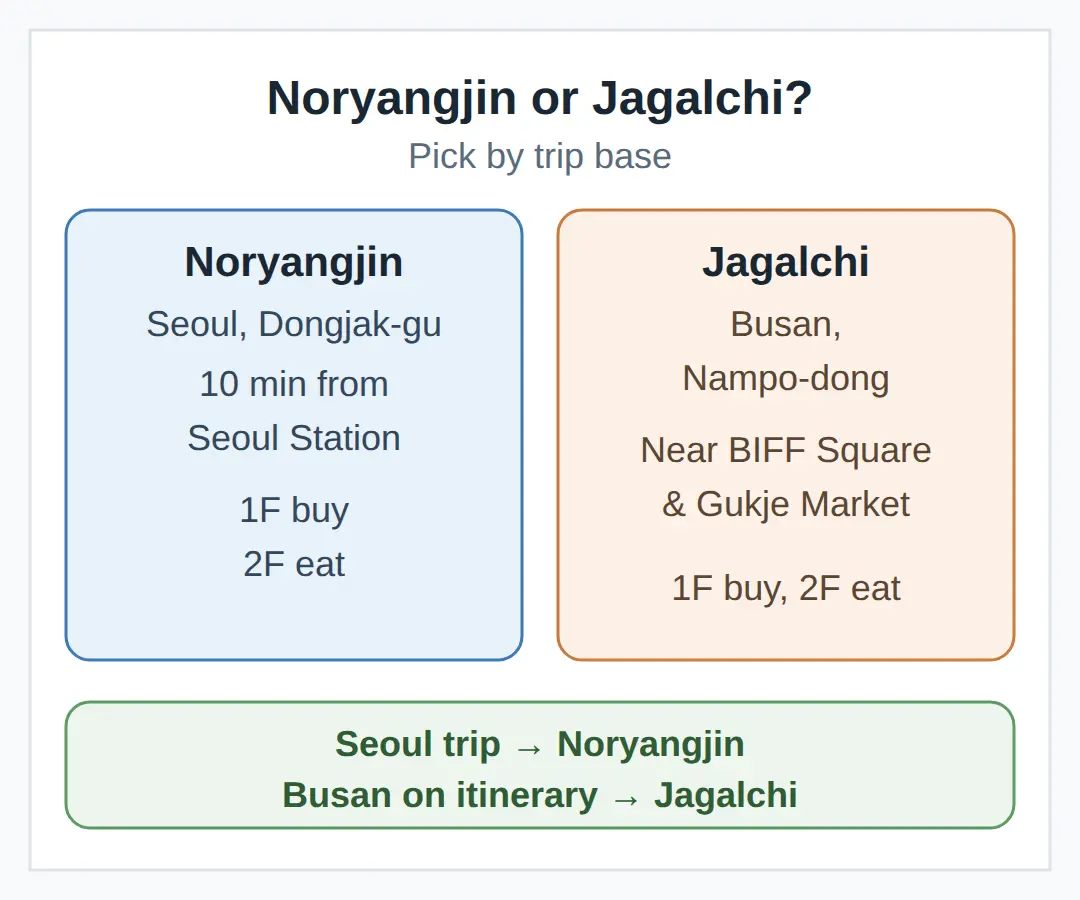
Noryangjin Fisheries Wholesale Market in Dongjak-gu is Seoul’s wholesale hub, about 10 minutes from Seoul Station.
Jagalchi is a consumer-facing waterfront market tied to Busan sightseeing; Noryangjin is the Seoul counterpart for the same 1F-buy, 2F-eat system.
If the trip is centered on Seoul, Noryangjin saves the KTX ride to Busan.
If Busan is already on the itinerary, Jagalchi pairs with BIFF Square and Gukje Market in the same Nampo-dong block.
Current Noryangjin hours, closing days and price ranges could not be confirmed from sources within the last six months, so check the official listing before going.
👉 Jagalchi Market official hours and closing days on Visit Busan
Related posts
📎 Korea navigation apps: why Google Maps fails and 4 to install before landing
📎 Korea eSIM travel tips: same trip, up to 33% cheaper eSIM
📎 📅 다가오는 일정 — 발매·개봉·발표 캘린더
Sources
- 1F buy / 2F eat system, table fee, price-check rules, restau (breezekorea.com)
- Two ordering styles, ~5,000 KRW table fee, grilled fish alle (realbusanguide.com)
- Address Jung-gu Jagalchihaean-ro 52; closed 1st/3rd/5th Tues (visitbusan.net)
First-timer’s checklist for crab season
- Go late morning to midday for the freshest stock and open 2F restaurants.
- Skip the 1st, 3rd and 5th Tuesdays — most stalls are closed.
- Agree the total price before the fish is bagged or the cooking starts.
- Ask the per-person table fee before sitting upstairs.
- No haggling confidence? Use the fixed-price set menus on 2F.
FAQ
Q. When is Korea’s crab season?
Snow crab (daege) and swimming crab (kkotge) season starts in September and runs through November. Autumn swimming crab, including roe-rich females, peaks in this window.
Q. Jagalchi or Noryangjin — which market is better?
Both use the same buy-on-1F, eat-on-2F system. Jagalchi suits a Busan sightseeing day; Noryangjin suits a Seoul itinerary. Current Noryangjin hours and prices are not recently confirmed, so verify before going.
Q. How much does crab cost at Jagalchi?
Prices are daily market rates and no recent confirmed per-kg figure is available. Confirm the per-kilogram price and the total on the spot before anything is bagged.
Planning a crab trip during Korea crab season? Save this guide and check the closing days before you go — Jagalchi shuts on the 1st and 3rd Tuesdays of each month.
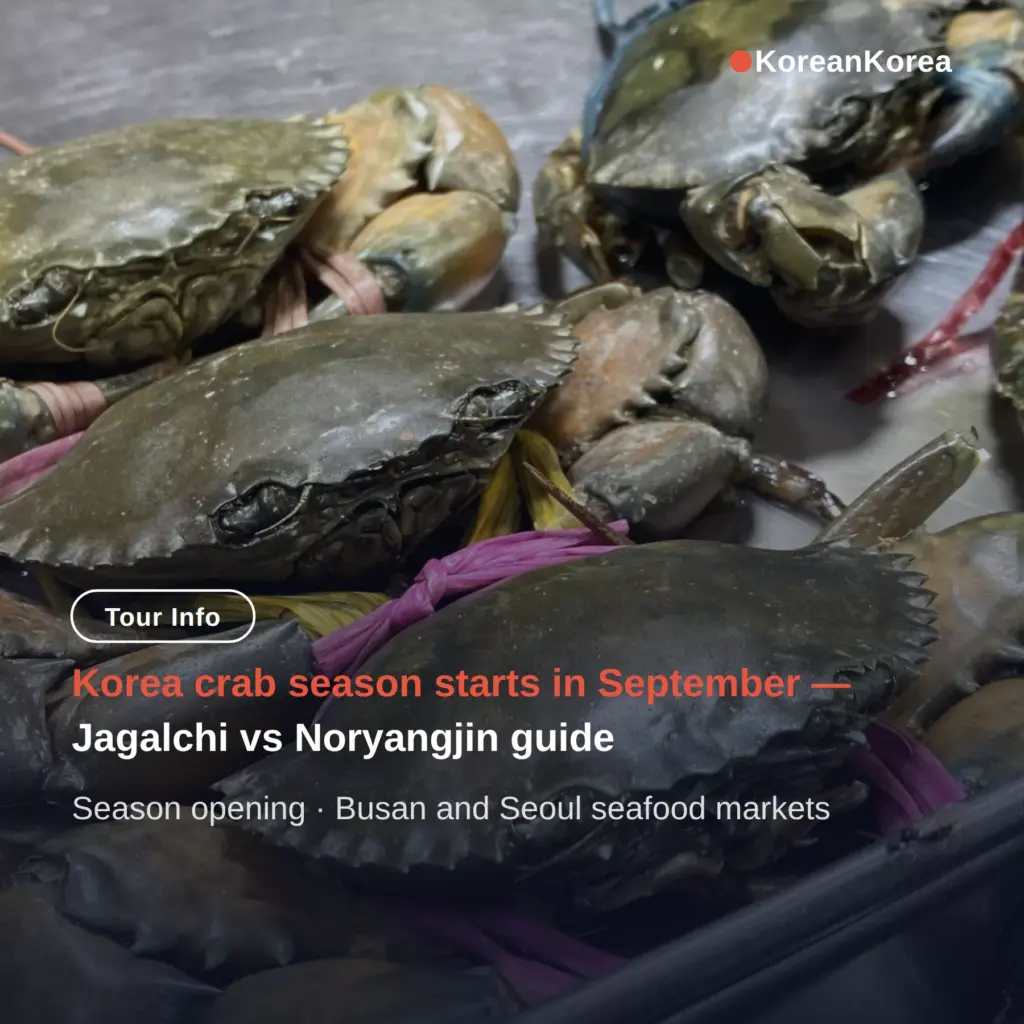
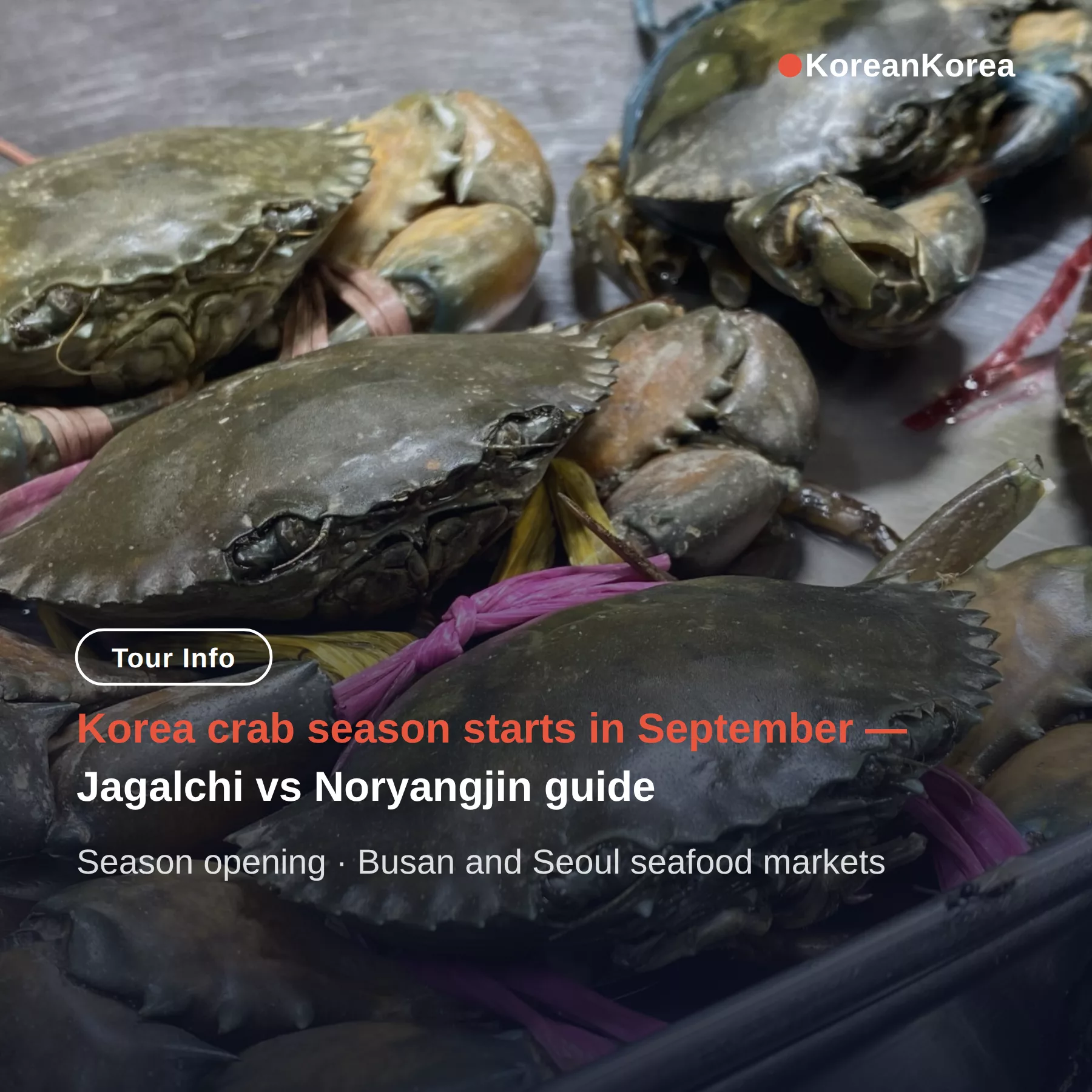
Cover photo: Green crabs on a metal tray with tied pincers, showing a fresh market setting. by Tawhid Sadman — CC0 1.0
#Koreacrabseason #JagalchiMarket #Noryangjinfishmarket #snowcrab #swimmingcrab #Busanfood #Koreaautumntravel #Koreanseafoodmarket #BusanJagalchiFestival
📅Upcoming Dates — 이번 주 16 · D-day 'The Scandal' global Netflix release전체 보기 →