On September 16, 2026, Seoul’s consumer agency compared a 28-item Chuseok basket across 37 traditional markets, 37 large marts, and 2 online stores.
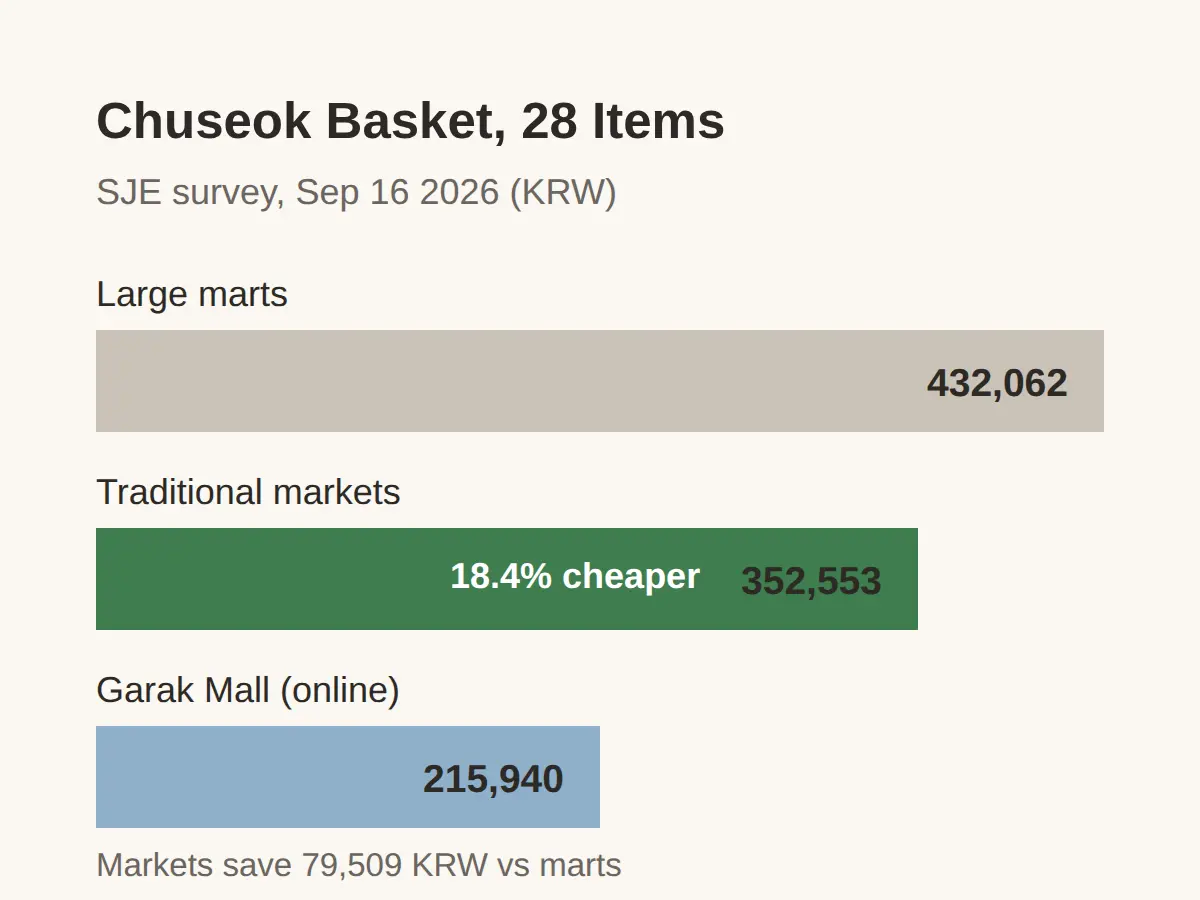
Traditional markets came in at 352,553 KRW for a four-person family — 79,509 KRW, about 18.4%, cheaper than large marts.
This post breaks down which items to buy where, how much each channel costs, which markets to visit, and how to check prices for your own district.
Contents
- Food price in Seoul traditional market: 18.4% cheaper than marts
- What should you buy at a market vs a mart in Seoul?
- Where to buy groceries cheap in Seoul: markets vs Garak Mall vs online
- Gwangjang vs Namdaemun vs Mangwon: which market should you visit?
- How to shop a Seoul traditional market: cash, timing, and a coin lunchbox
- How to check Seoul food prices yourself before you shop
Food price in Seoul traditional market: 18.4% cheaper than marts
In the September 16, 2026 survey of 37 traditional markets and 37 large marts, a four-person family’s 28-item Chuseok basket cost 352,553 KRW at traditional markets.
That is 79,509 KRW less than large marts, which works out to about 18.4% cheaper.
352,553 + 79,509 = 432,062 KRW at marts.
Vegetables drove most of the gap at 52.7% cheaper at markets, seafood was 32.2% cheaper, and meat 16.9% cheaper.
Markets won on 22 of the 28 items, and they were also 4.8% cheaper than the two surveyed online stores.
Peeled bellflower root and bracken showed the widest gaps, 71.9% and 68.6% cheaper at markets.
These category percentages come from one news summary of the survey, not the original release.
Before quoting exact per-item prices, check the agency’s own table.
Earlier surveys point the same direction: Seoul city’s 2025 Chuseok survey had markets 13.7% (37,598 KRW) cheaper, and aT’s February 2026 national survey of 40 markets and 36 large retailers had markets 18.7% cheaper (185,313 KRW vs 227,876 KRW).
Before trusting any market-vs-mart number, I check which survey it came from — Seoul’s agency, aT, and the Korea Price Association publish different totals with different market sets, and I never mix them in one sentence.
| 28-item Chuseok basket (Sept 16, 2026 survey) | 352,553 KRW at traditional markets |
|---|---|
| Same basket at large marts | 432,062 KRW (352,553 + 79,509 saved) |
| Vegetables | 52.7% cheaper at markets |
| Seafood | 32.2% cheaper at markets |
| Meat | 16.9% cheaper at markets |
| Items won by markets | 22 of 28 |
| Gap vs 2 online stores | 4.8% cheaper at markets |
What should you buy at a market vs a mart in Seoul?
Buy vegetables, seafood, and meat at a traditional market, and buy processed goods — rice, frying mix, crab sticks, dasik, cheongju, sikhye — at a mart or online.
That is the split both the 2026 and 2025 surveys support.
The market’s advantage comes almost entirely from fresh items.
| Item | Traditional market | Mart | Difference |
|---|---|---|---|
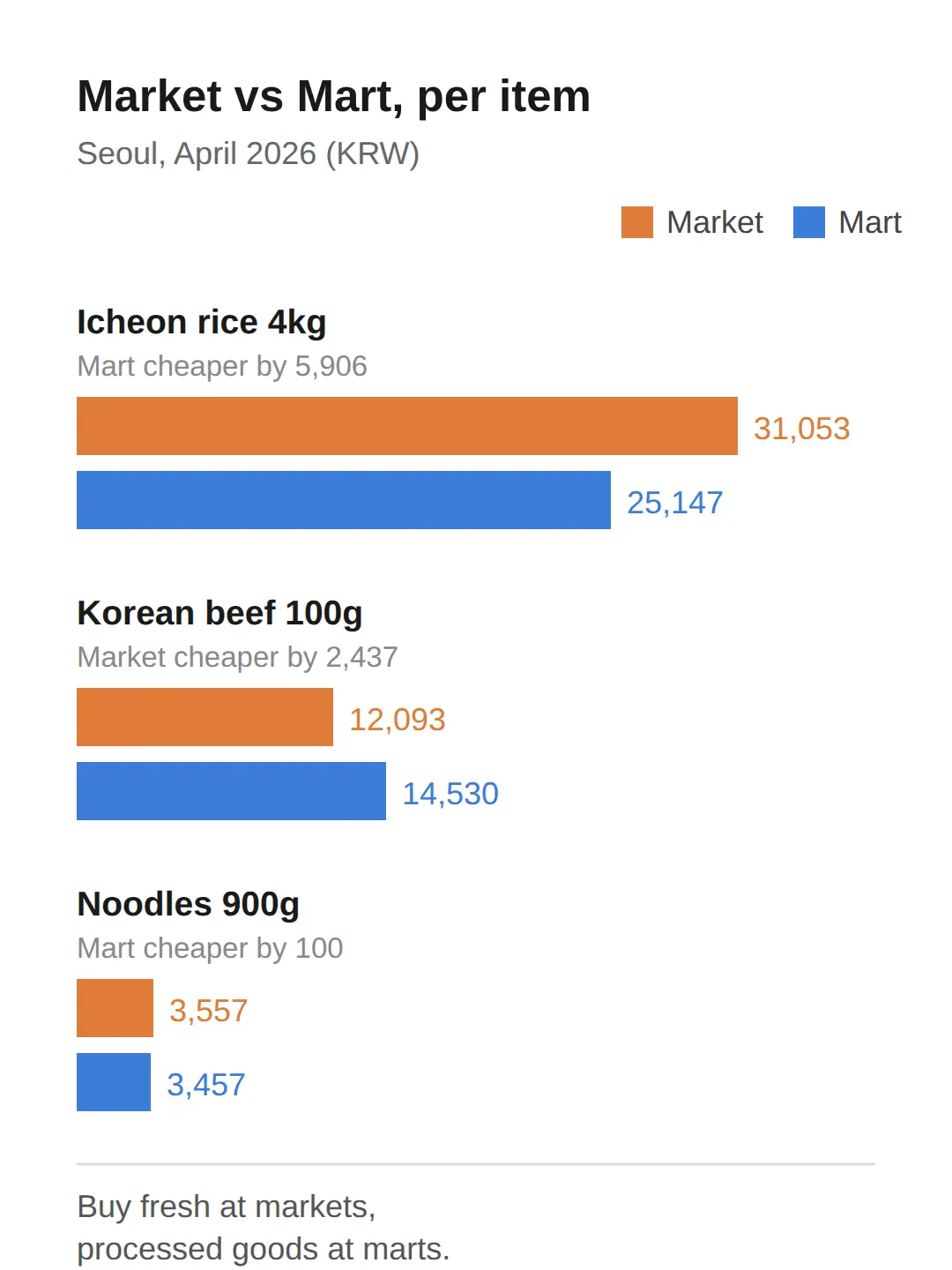
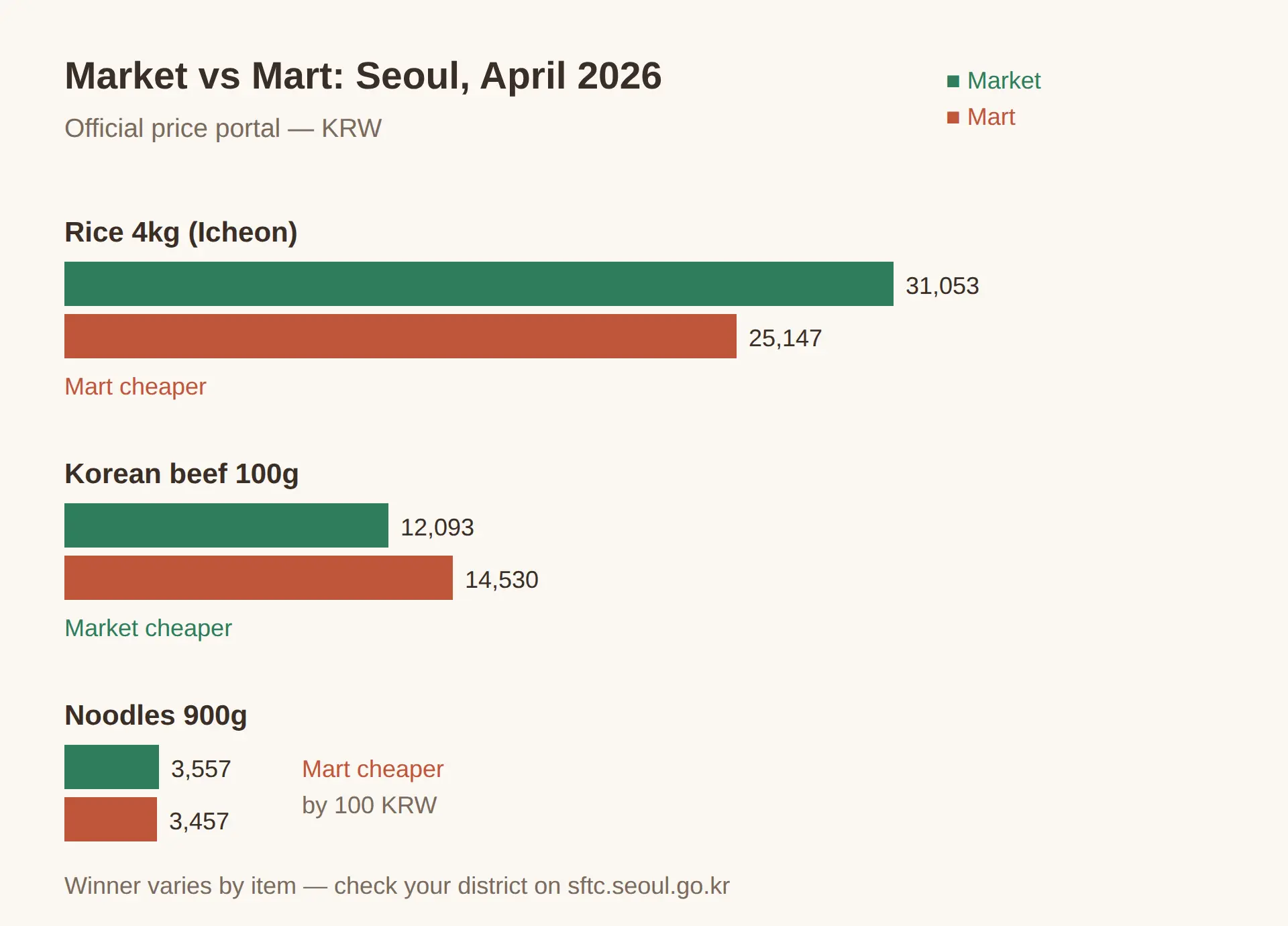
| Icheon rice 4kg | 31,053 KRW | 25,147 KRW | Market 5,906 KRW dearer (about 23.5% pricier) |
| Noodles 900g | 3,557 KRW | 3,457 KRW | Mart 100 KRW cheaper |
| Korean beef 100g | 12,093 KRW | 14,530 KRW | Market 2,437 KRW cheaper (about 16.8%) |
So the 52.7% vegetable saving does not transfer to everything on the shelf.
If your basket is mostly processed groceries, a mart or Garak Mall will cost less.
If it is mostly fresh produce for cooking, the market wins.
👉 Is Korean Food Gluten Free? Rice Cakes Are — What to Order in Korea
Where to buy groceries cheap in Seoul: markets vs Garak Mall vs online
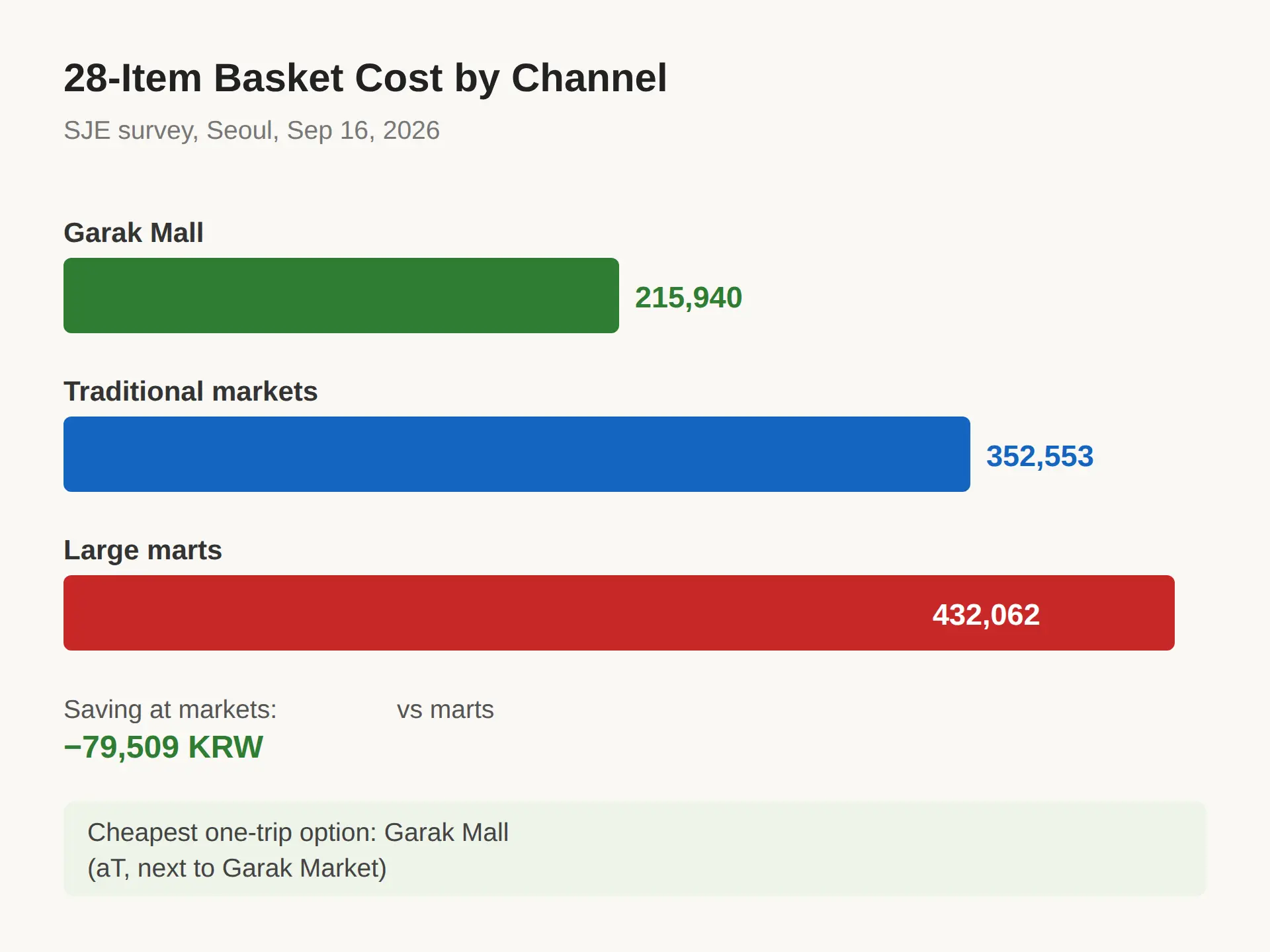
In Seoul city’s 2025 Chuseok survey, Garak Mall was the cheapest single place to buy everything at once — its full rites basket cost 215,940 KRW, below both traditional markets and marts.
That is well below both traditional markets and marts.
Garak Mall is run by aT, the food trade agency, next to Garak Market itself.
| Channel | 28-item basket cost |
|---|---|
| Garak Mall | 215,940 KRW |
| Traditional markets | 303,750 KRW |
| Large marts | 361,300 KRW |
| Online stores | 362,970 KRW |
Note that these figures come from different surveys and years — Garak Mall’s 215,940 KRW is from Seoul city’s 2025 Chuseok survey, while the market, mart, and online totals above are from a different survey — so the four rows cannot be compared as if they came from the same basket check.
If you want one trip and the lowest total, check Garak Mall first.
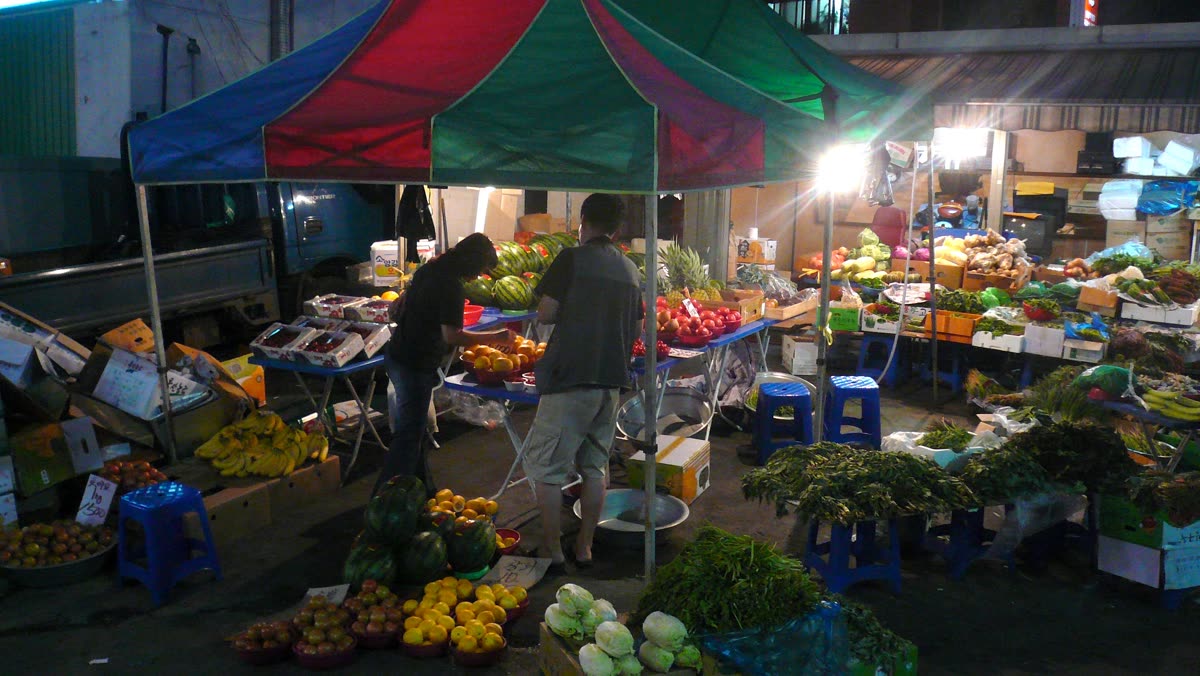
If you want to pick your own produce by hand and live near a market, the market still beats marts and online on fresh items.
Gwangjang vs Namdaemun vs Mangwon: which market should you visit?
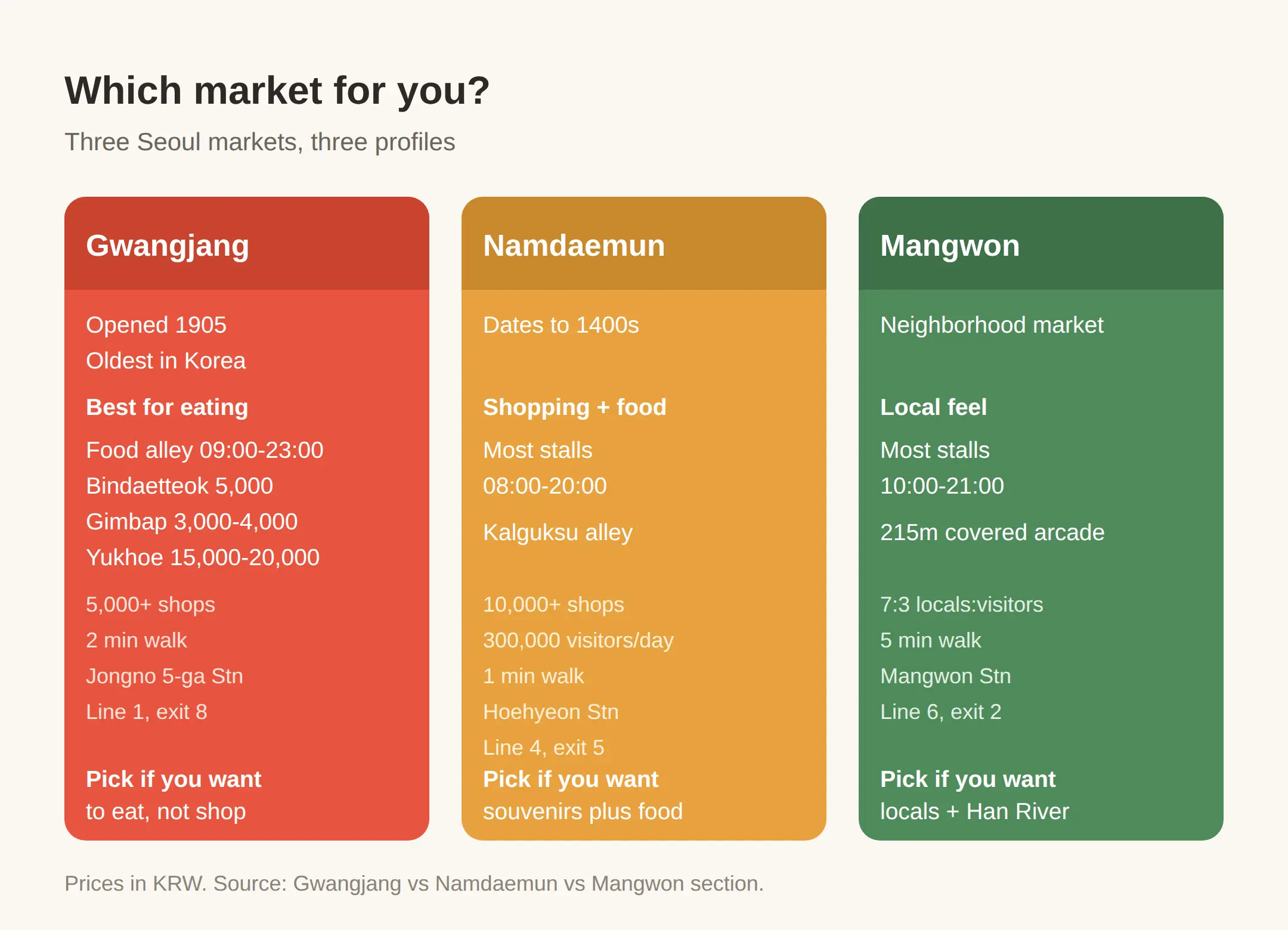
Pick Gwangjang for food-focused eating, Namdaemun for shopping plus food, and Mangwon for a local neighborhood feel.
Each has a different profile, so the right choice depends on what you want to do there.
Gwangjang Market opened in 1905 and is Korea’s oldest, with over 5,000 shops and a food alley running 09:00–23:00 nearly daily.
Named staples include Sunhui-ne Bindaetteok at 5,000 KRW per mung-bean pancake and Monyeo Gimbap’s mayak gimbap at 3,000–4,000 KRW; yukhoe runs 15,000–20,000 KRW.
Namdaemun dates to the 1400s, draws about 300,000 visitors a day across 10,000-plus shops, and mixes shopping with food alleys like kalguksu alley; most stalls run 08:00–20:00, 1 minute from Hoehyeon Station (Line 4, exit 5).
Mangwon is a neighborhood market with a 215m covered arcade, roughly 7:3 locals to visitors, most stalls 10:00–21:00, 5 minutes from Mangwon Station (Line 6, exit 2).
If you want to eat rather than shop, go to Gwangjang.
If you want souvenirs and clothes plus food, Namdaemun.
If you want to browse with residents and continue to the Han River park, Mangwon.
How to shop a Seoul traditional market: cash, timing, and a coin lunchbox
Bring cash in 10,000, 5,000, and 1,000 KRW notes, go Tuesday to Saturday around 10–11am, and point at what you want while saying ‘Igeo juseyo’.
Many small stalls are cash-only, and Sunday or Monday closures are common.
Tongin Market in Jongno runs a yeopjeon brass-coin lunchbox: 1 coin = 500 KRW, a strip of 10 = 5,000 KRW, and a full lunchbox typically costs 5,000–10,000 KRW (10–20 coins).
The lunchbox cafe runs weekdays 11:00–16:00 and weekends 11:00–17:00.
Fruit and side-dish stalls often offer tastings.
One note on Tongin: sources conflict on which weekday the cafe closes, so check the 1330 travel helpline before going.
Parking at these markets was not found in the sources used here, so plan to arrive by subway.
👉 Is Korean Food High in Sodium? Twice the WHO Limit, and How to Cut It
How to check Seoul food prices yourself before you shop
Use Seoul’s official price portal at sftc.seoul.go.kr to compare market vs mart average prices before you shop.
The steps: pick your district, pick the item, pick the month, and read the market and mart averages side by side.
The same portal publishes the city’s monthly price surveys, so you can see whether a gap is steady or a one-month spike.
If you are shopping tomorrow, check the portal the night before — that is how I would decide whether the market or the mart wins on my specific list.
Related posts
📎 Seoul — everything we know
📎 Hanjungsun Yogurt Chapssaltteok GS25: the 3,900-Won Dessert That Sold 100,000 in One Day
📎 Korean Mexican Food: Chipotle Gangnam’s 3-Hour Wait, Cucharra’s 12,900 Won K-Mex Pop-Up and Where to Try It
📎 📅 다가오는 일정 — 발매·개봉·발표 캘린더
Sources
- traditional markets 352,553 KRW, 79,509 KRW cheaper than mar (viva100.com)
- 2025 survey: 236,723 KRW traditional vs 274,321 KRW mart; Ga (khan.co.kr)
- aT national figure (m.edaily.co.kr)
Where to go from here
- Next dates to watch: Chuseok 2026 shopping coverage continues through mid-September; aT’s next seasonal basket survey and Seoul city’s follow-up typically arrive near the next holiday.
- Split the shopping: fresh vegetables, seafood, and meat at a traditional market; rice, frying mix, and other processed goods at a mart.
- Bookmark sftc.seoul.go.kr and check your district’s prices the night before you shop.
- Carry 10,000/5,000/1,000 KRW notes — many stalls are cash-only.
- This post’s numbers are current as of September 17, 2026.
FAQ
Q. How much is a 28-item Chuseok basket at a Seoul traditional market in 2026?
352,553 KRW at traditional markets in the September 16, 2026 survey — 79,509 KRW cheaper than large marts.
Q. How much cheaper are vegetables and seafood at Seoul traditional markets vs marts?
Vegetables were 52.7% and seafood 32.2% cheaper at markets in the same survey; meat was 16.9% cheaper.
Q. Which items are cheaper at large marts or online in Seoul?
Processed goods — rice, frying mix, crab sticks, dasik, cheongju, sikhye — were cheaper at marts. April 2026 official data shows Icheon 4kg rice at 25,147 KRW at marts vs 31,053 KRW at markets.
Q. Which Seoul traditional market should a visitor pick — Gwangjang, Namdaemun, or Mangwon?
Gwangjang for food-focused eating, Namdaemun for shopping plus food, Mangwon for a local neighborhood feel.
Q. What street food costs at Gwangjang and Mangwon markets?
Listed guides put Gwangjang staples at 5,000 KRW for bindaetteok and 15,000–20,000 KRW for yukhoe, and Mangwon snacks from 500 KRW for gimmari — treat these as indicative, not confirmed current.
Check your district’s market vs mart prices on Seoul’s official portal the night before you shop.
Cover photo: Ip1010 The Market of Korea.tif by Hinode-Shoko Seoul Korea — Public domain
#Seoulfoodprices #traditionalmarketvsmart #Chuseok2026 #GarakMall #GwangjangMarket #Seoulgroceryshopping
📅Upcoming Dates — 이번 주 16 · D-day 'The Scandal' global Netflix release전체 보기 →