Say ‘deol maepge haejuseyo’ (덜 맵게 해주세요) for less spicy and ‘gogi ppaego juseyo’ (고기 빼고 주세요) for no meat — the same phrases work at restaurants and street stalls.
How to Order Food in Korean: Saying ‘Less Spicy’ and ‘No Meat’
| Point at the menu and order | 이거 주세요 — igeo juseyo |
|---|---|
| Less spicy | 덜 맵게 해주세요 — deol maepge haejuseyo |
| Not spicy | 안 맵게 해주세요 — an maepge haejuseyo |
| Leave out the meat | 고기 빼고 주세요 — gogi ppaego juseyo |
| Ask for the menu | 메뉴판 주세요 — menyupan juseyo |
| Water | 물 주세요 — mul juseyo |
| More side dishes | 반찬 더 주세요 — banchan deo juseyo |
‘덜 맵게 해주세요’ (deol maepge haejuseyo) means ‘please make it less spicy’, and ‘고기 빼고 주세요’ (gogi ppaego juseyo) means ‘please leave out the meat’.
If you want it not spicy at all, the phrase is ‘안 맵게 해주세요’ (an maepge haejuseyo).
These are the two phrases that solve the most common visitor problems — heat level and hidden meat — at a single stroke.
Three independent 2026 Korean food guides repeat the same core phrase set — ‘deol maepge haejuseyo’, ‘chaeshik’, ‘igeo juseyo’ — which makes this the standard recommended set for visitors this year.
The timing rule matters more than perfect pronunciation: say the phrase when you order, before the food hits the pan.
Street stalls cook to order, so they can turn the heat down on the spot; a finished tteokbokki cannot be fixed at the table.
If your dish is already on the table and too hot, the realistic options are ordering a milder dish next time or asking for something that is not spicy at all — ‘맵지 않은 거 있어요?’ (maepjji anheun geo isseoyo?).
When I look at any ordering-phrase list, the first thing I check is whether it says when to say the phrase — before cooking, not after the dish arrives.
The 10 Phrases That Cover Every Ordering Situation
The 10 phrases in the table cover spice control, dietary limits, pointing, refills and payment — one row per situation.
| Situation | Korean | Romanization | English |
|---|---|---|---|
| Ask for the menu | 메뉴판 주세요 | menyupan juseyo | Please give me the menu |
| Point and order | 이거 주세요 | igeo juseyo | This one, please |
| Less spicy | 덜 맵게 해주세요 | deol maepge haejuseyo | Please make it less spicy |
| Not spicy at all | 안 맵게 해주세요 | an maepge haejuseyo | Please make it not spicy |
| No meat | 고기 빼고 주세요 | gogi ppaego juseyo | Please leave out the meat |
| Vegetarian | 저는 채식주의자예요 | jeoneun chaeshikjuuija-yeyo | I am vegetarian |
| Water | 물 주세요 | mul juseyo | Water, please |
| One more | 하나 더 주세요 | hana deo juseyo | One more, please |
| To go | 포장해 주세요 | pojanghae juseyo | Please wrap it up |
| Check | 계산해 주세요 | gyesanhae juseyo | Please bring the check |
Across the 2026 guides, the confirmed phrase set groups into 6 ordering situations with 4–5 phrases each, so a single 10-row table covers the whole meal from menu to bill.
The same short phrases work at street stalls and sit-down restaurants, so one set covers both.
Water (‘mul juseyo’) is worth memorizing separately because water is free and self-serve at most Korean restaurants — you pour it yourself.
Skim the table and pick the 3–5 rows that match your own trip: most visitors need ‘igeo juseyo’, one spice phrase and ‘gyesanhae juseyo’, and the rest the table can hold for reference.
One Pattern Builds Every Phrase: Verb + ‘Juseyo’
Every phrase above ends in ‘juseyo’ (주세요), which means ‘please give / please do’.
That single ending is why you can extend the set yourself.
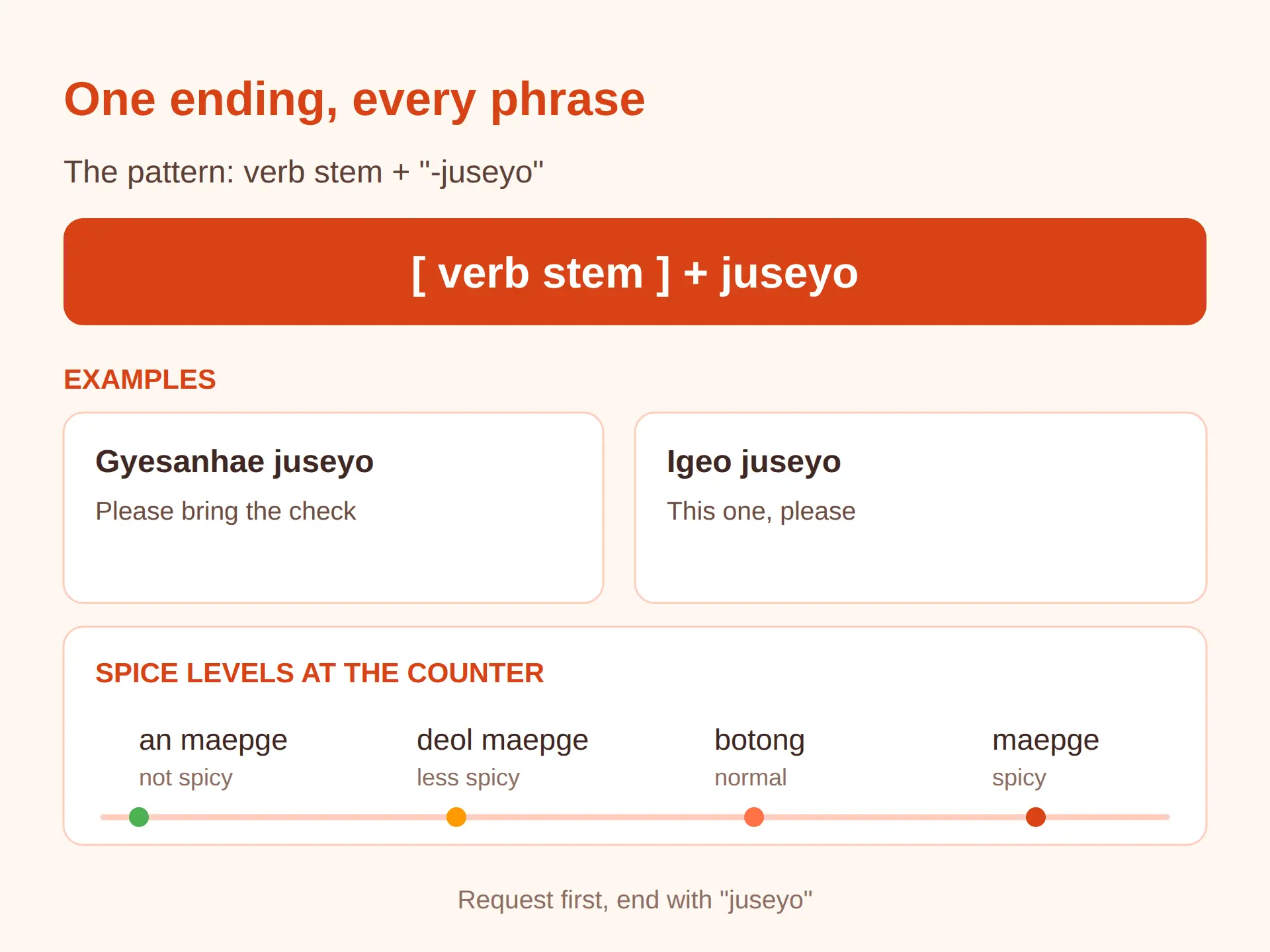
Orders open with ‘juseyo’ attached to the item name, and requests follow the same shape: verb stem plus ‘-juseyo’. ‘Gyesanhae juseyo’ (please bring the check), ‘deol maepge hae juseyo’ (make it less spicy) and ‘igeo juseyo’ (this one, please) all share the same ending.
Some restaurants also let you choose a spice level at the counter — ‘an maepge’ (not spicy), ‘deol maepge’ (less spicy), ‘botong’ (normal), ‘maepge’ (spicy) — so the same words come back as menu options.
If you remember only one grammar point, make it this one: put the request first, end with ‘juseyo’, and the sentence works at almost any counter.
Vegetarian, Allergy: What To Say Before Ordering
Say ‘저는 채식주의자예요’ (jeoneun chaeshikjuuija-yeyo, ‘I am vegetarian’) and then add ‘고기 빼고 주세요’ — the vegetarian line alone is not enough.
The 2026 vegan and vegetarian guide warns that meat or fish sauce hides in kimchi, doenjang broth and banchan side dishes, so dishes that look vegetable-only are often not.
A simpler present-tense statement also works at most restaurants: ‘고기 안 먹어요’ (gogi an meogeoyo, ‘I don’t eat meat’).
For allergies, state it before ordering with ‘알레르기가 있어요’ (allereugi-ga isseoyo) and fill the blank in ‘~ 들어있어요?’ (deureoisseoyo?, ‘does this contain ~?’) with the allergen — ‘ddangkong’ for peanut, ‘haesanmul’ for seafood.
If you eat no meat at all, lead with the full vegetarian sentence plus ‘gogi ppaego juseyo’ at every meal, because the hidden-broth problem shows up in side dishes you did not order.
Which Dishes You Can Ask To Make Less Spicy
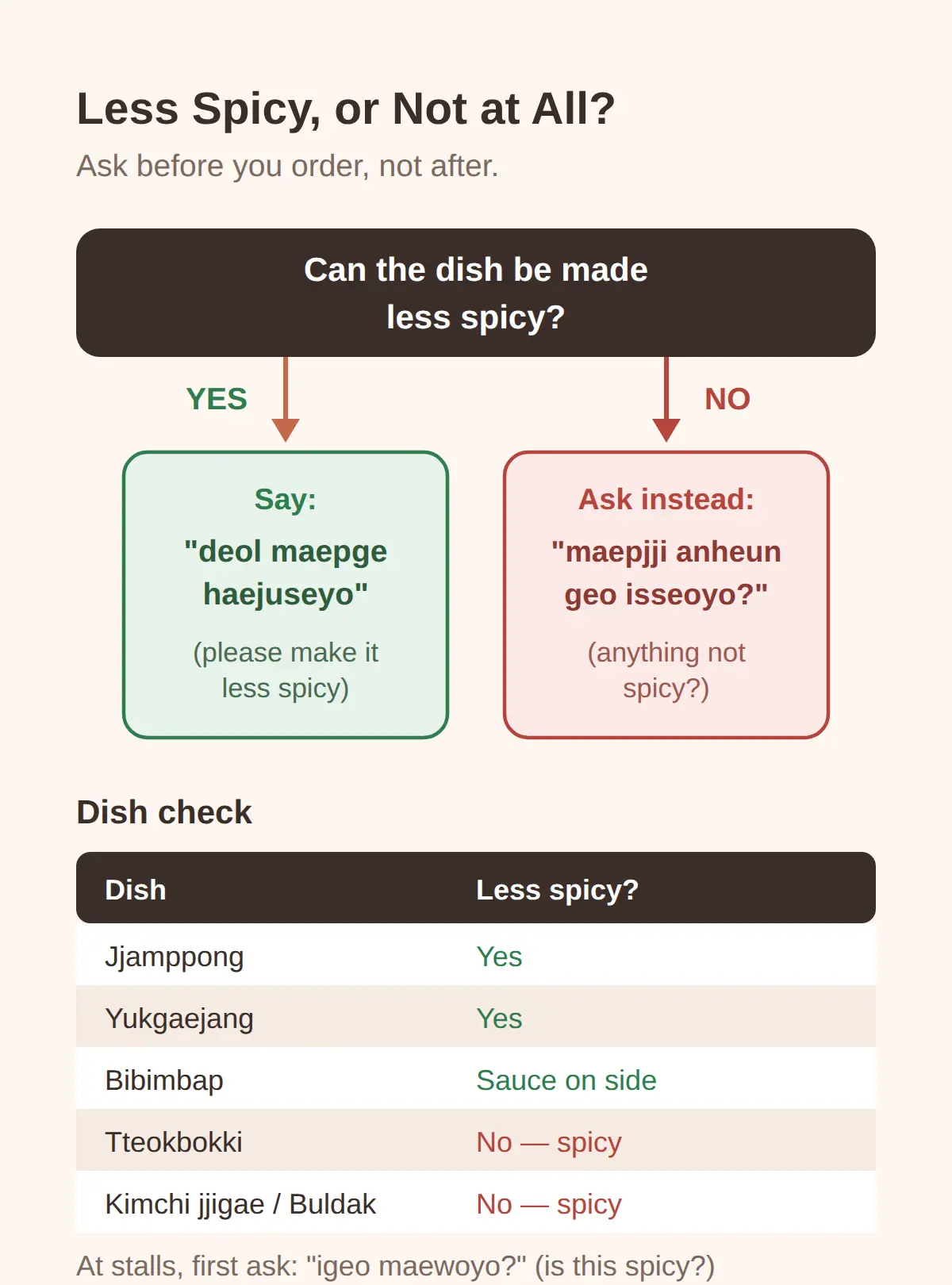
Ask for the spice change before you order, and if the dish cannot be changed, ask for a different option instead.
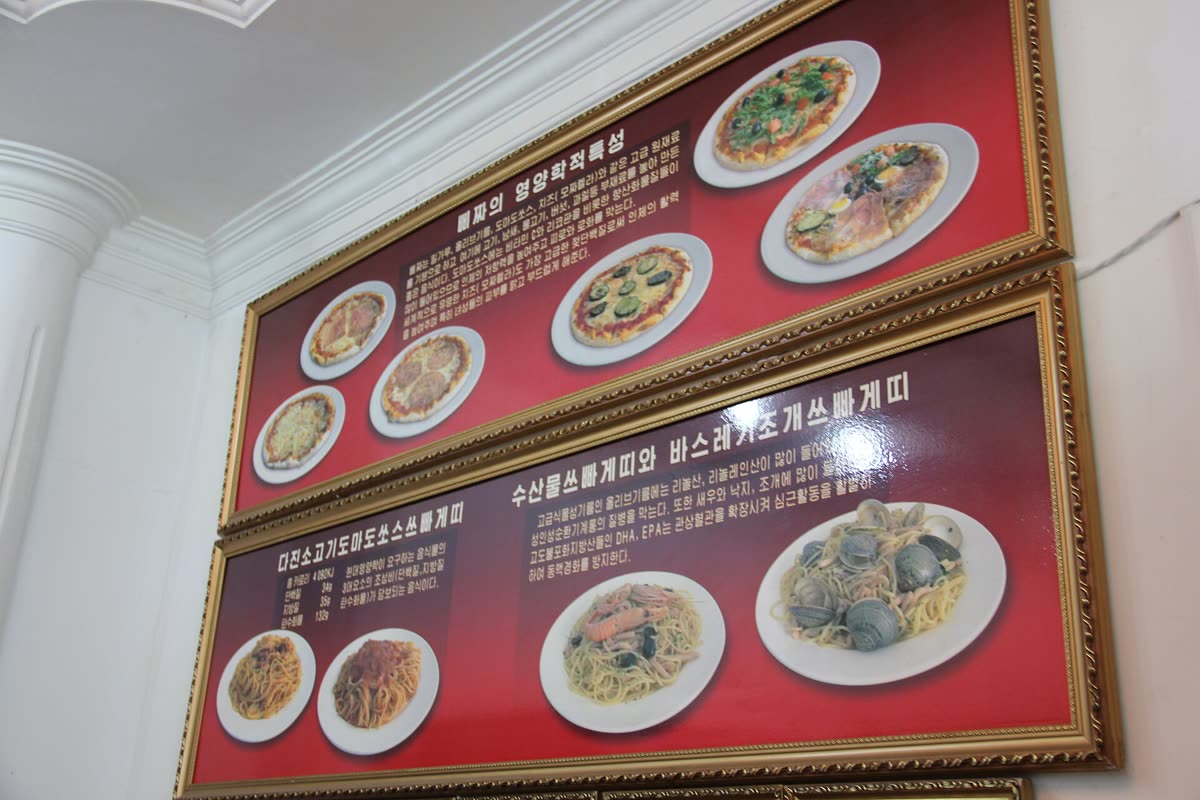
Some menus list spice-level choices — not spicy, less spicy, normal, spicy — so the phrase you practiced often just maps onto a menu button.
| Dish | Can you ask for less spicy? | What to say instead |
|---|---|---|
| Jjamppong | Yes | 덜 맵게 해주세요 (deol maepge haejuseyo) |
| Yukgaejang | Yes | 덜 맵게 해주세요 (deol maepge haejuseyo) |
| Bibimbap | Yes — sauce on the side | 고추장 덜 주세요 / sauce separate |
| Tteokbokki | No — spicy by definition | 맵지 않은 거 있어요? (maepjji anheun geo isseoyo?) |
| Kimchi jjigae | No — spicy by definition | 맵지 않은 거 있어요? (maepjji anheun geo isseoyo?) |
| Buldak | No — spicy by definition | 맵지 않은 거 있어요?
(maepjji anheun geo isseoyo?) | When a dish is cooked spicy by definition, asking ‘deol maepge’ gets you nowhere; the fallback question is ‘maepjji anheun geo isseoyo?’ (‘do you have anything that isn’t spicy?’).
At stalls, check before committing with ‘igeo maewoyo?’ (이거 매워요?, ‘is this spicy?’).
A dish in front of you that is already too hot is a lost cause — the reliable move is the spice question at the next order, so check with the picture menu or ask before paying.
When You Cannot Pronounce It: Pointing And Apps
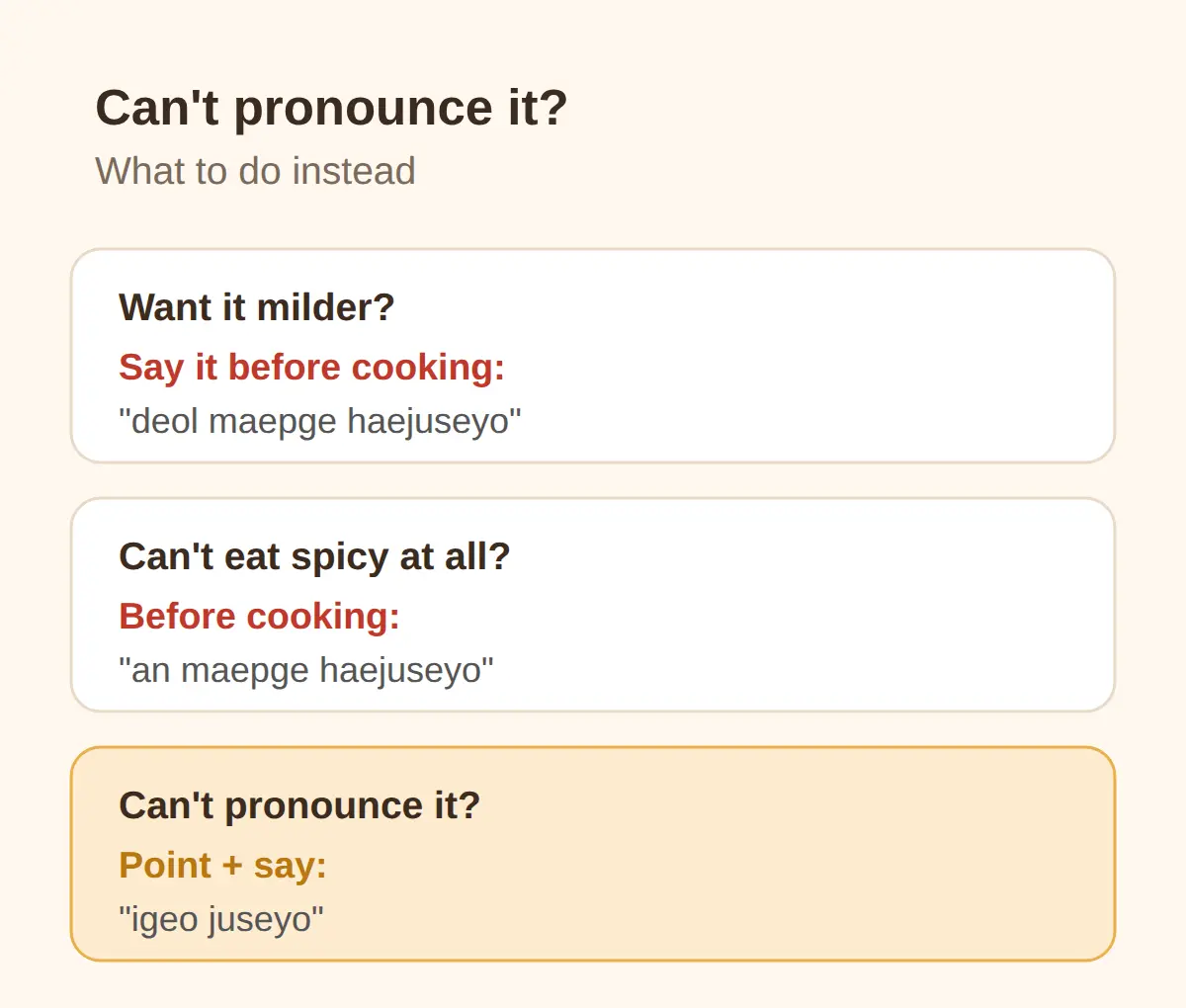
Point at the menu or display case and say ‘이거 주세요’ (igeo juseyo) — that alone is a complete order.
2026 guides confirm that pointing plus ‘igeo juseyo’ is fully acceptable, and they recommend installing a translation app such as Papago before meals, with the camera mode set up for menu photos.
If you want to soften the switch, open with ‘한국어 잘 못해요’ (hangugeo jal mothae-yo, ‘I don’t speak Korean well’) — servers then hand you an English menu or wait while you point.
Solo diners need nothing extra: ‘igeo juseyo’ plus ‘hana deo juseyo’ (one more, please) is the full set for eating alone.
Install the app before the trip rather than at the table, and treat pointing as the default rather than the emergency fallback — it covers most meals without a single hard word.
Related posts
Sources
If you only keep five phrases
- Memorize "igeo juseyo" first — it unlocks pointing at any menu or display case.
- Practice "deol maepge haejuseyo" out loud before your trip; it is the phrase you will use most.
- Install Papago before your first meal, not at the table.
- Check the picture menu or ask "igeo maewoyo?" before you commit to a dish.
- Save this page — the two tables below are worth reopening mid-meal.
FAQ
Q. How do you say ‘less spicy’ in Korean?
‘덜 맵게 해주세요’ — deol maepge haejuseyo — means ‘please make it less spicy’. Say it when you order, before the dish is cooked, and the same phrase works at restaurants and street stalls.
Q. How do you say ‘no meat’ in Korean?
‘고기 빼고 주세요’ — gogi ppaego juseyo — means ‘please leave out the meat’. Pair it with ‘저는 채식주의자예요’ (I am vegetarian), because meat or fish sauce can hide in kimchi, broth and side dishes.
Q. Does ‘gogi ppaego juseyo’ work at Korean BBQ places?
The guides confirm the phrase is accepted at most restaurants. At a BBQ grill the meat is the main dish, so the more useful move is ordering vegetable dishes and saying ‘고기 안 먹어요’ (I don’t eat meat) when staff offer to add meat.
Q. What if I can’t pronounce any of it?
Point at the menu or display case and say ‘이거 주세요’ (igeo juseyo). Install a translation app with camera mode before the trip, and open with ‘한국어 잘 못해요’ if you want to signal that you will be pointing.
Q. Do I need to call for the check in Korea?
Yes. Payment is not automatic — say ‘계산해 주세요’ (gyesanhae juseyo) at the table or counter. Water is free but self-serve, so ask ‘물 주세요’ only if the pitcher is empty.
Before your trip, save the 10-phrase table above and install Papago with camera mode — those two steps cover a full day of meals in Korea.
Cover photo: Korean street food-chicken by john wilbanks — CC BY-SA 2.0
#koreanfood #koreanphrases #orderingfoodinkorea #koreatraveltips #koreanfortravelers
📅Upcoming Schedule — this week 23 · D-1 Autumn season = post-summer brightening demand window (UV drSee all →