On September 9, 2026 a r/koreatravel post asked how to stop getting overwhelmed by all the zeros on Korean prices.
The same question keeps coming up in traveler communities, and it is mostly a counting problem.
This Korean won prices guide covers the four notes, a fast conversion trick, and what everyday purchases actually cost.
Ten minutes of reading removes most of the panic at the register.
Contents
- Korean won prices guide: the four notes and what is on them
- Korean won to USD: the drop-three-zeros trick
- What typical prices look like in Seoul
- Cash or card: how much won to carry
- Handling a 50,000-won bill without panic
- Travelers’ checklist before the trip
Korean won prices guide: the four notes and what is on them
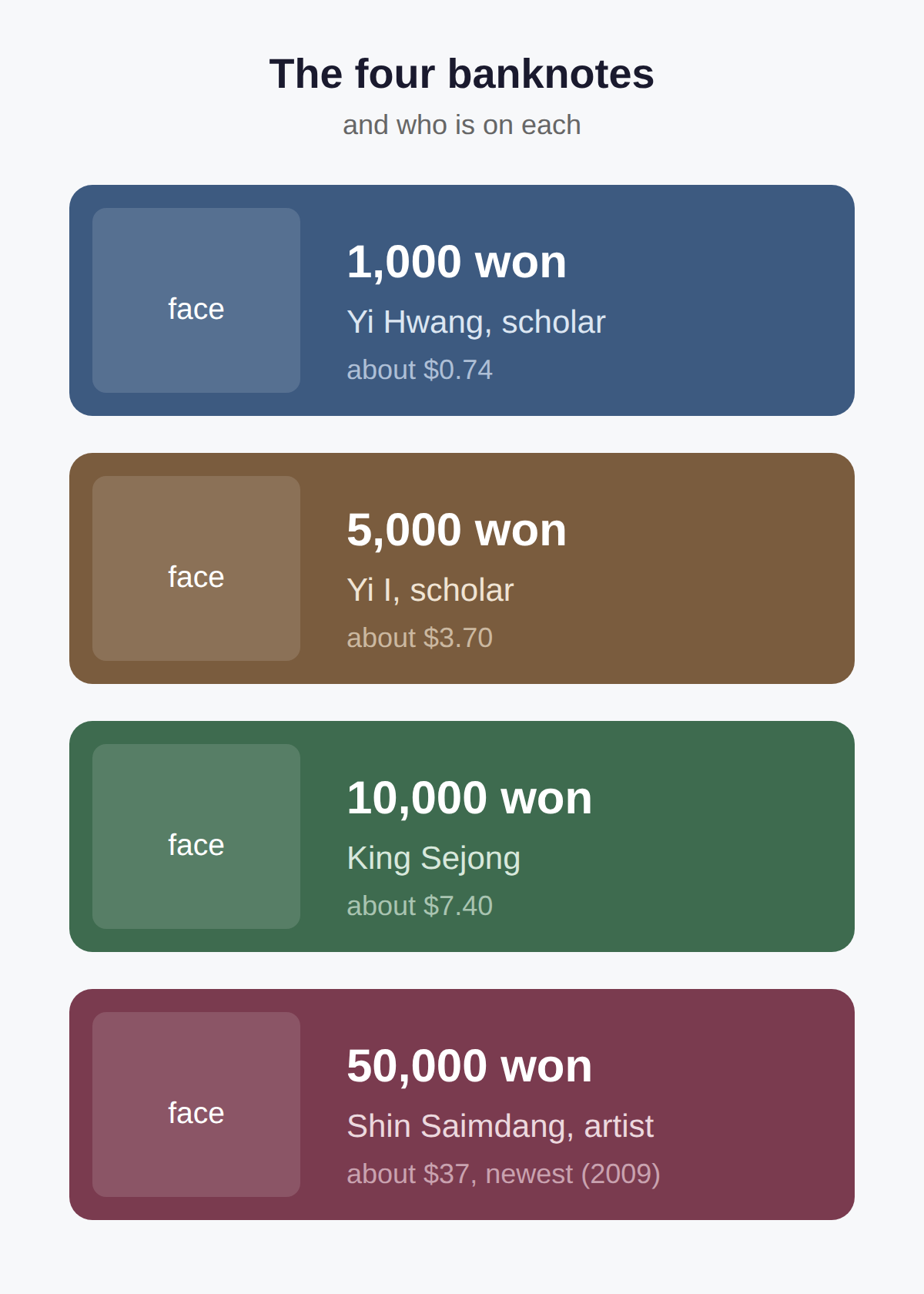
South Korean banknotes come in four denominations: 1,000 / 5,000 / 10,000 / 50,000 won.
The 50,000-won note is the largest bill in circulation and there is no 100,000-won note, according to the Bank of Korea note lineup.
A fresh ₩50,000 note is what an ATM hands out by default.
Each note carries a different figure, which makes bills quick to tell apart at the register.
₩1,000 shows scholar Yi Hwang, ₩5,000 scholar Yi I, ₩10,000 King Sejong the Great, and ₩50,000 artist Shin Saimdang.
The 50,000-won note arrived in 2009 and is the newest of the set.
Coins run 1 / 5 / 10 / 50 / 100 / 500 won, and the small ones mostly pile up unused as payments shift to cards.
Older-series ₩1,000 / ₩5,000 / ₩10,000 notes remain legal tender, so an older-looking bill is nothing to worry about.
Every note also has raised printing and a holographic strip, so bills can be sorted by touch at a busy counter.
At about 1,350 won per dollar the four notes convert to roughly $0.74 / $3.70 / $7.40 / $37, which is the anchor for the whole zeros problem.
One more scale check: the biggest coin, ₩500, is worth 100 times less than the biggest note.
| Cafe americano | ₩4,000–5,000 (~$3–3.70) |
|---|---|
| Tteokbokki | ₩4,000–6,000 (~$3–4.40) |
| Hotteok | ₩1,000–2,000 (~$0.75–1.50) |
| Gimbap, one roll | ₩3,500–5,000 (~$2.60–3.70) |
| Seoul subway base fare | ₩1,400–1,500 (~$1.00–1.10) |
Korean won to USD: the drop-three-zeros trick
The working rate through this guide is about 1,350 won per US dollar, so treat every dollar figure here as a ballpark.
The common traveler shortcut has two steps: drop the last three zeros from a won price, then divide by 1.35.
₩10,000 comes out near $7.40, ₩15,000 near $11, and ₩100,000 near $74.
Stopping after the first step overstates the price by about 35%, because ₩10,000 is $7.40 and not $10.
The same two-step math is what travelers already use for yen, so the habit transfers directly.
The won Wikipedia entry lists the symbol ₩ and the code KRW, which is what shows up on card receipts in Korea.
👉 Gyeongbokgung night tour 2026: 3,000 won, Sept 2-Oct 2, and how booking works
What typical prices look like in Seoul
A cafe americano is the best daily anchor: Seoul price data puts it at 4,000–5,000 won, or roughly $3–3.70.
Street food sits in the same band — Visit Korea lists tteokbokki at 4,000–6,000 won, hotteok at 1,000–2,000 won, and gimbap at 3,500–5,000 won a roll.
Transport is cheaper than most visitors expect.
The Seoul subway base fare is about 1,400–1,500 won for adults and rises with distance after 10 km.
Prices move by shop and district, so read the table as a ballpark rather than a quote.
Once the americano anchor is set, anything under ₩5,000 reads as cheap and anything over ₩30,000 reads as a proper dinner.
Cash or card: how much won to carry
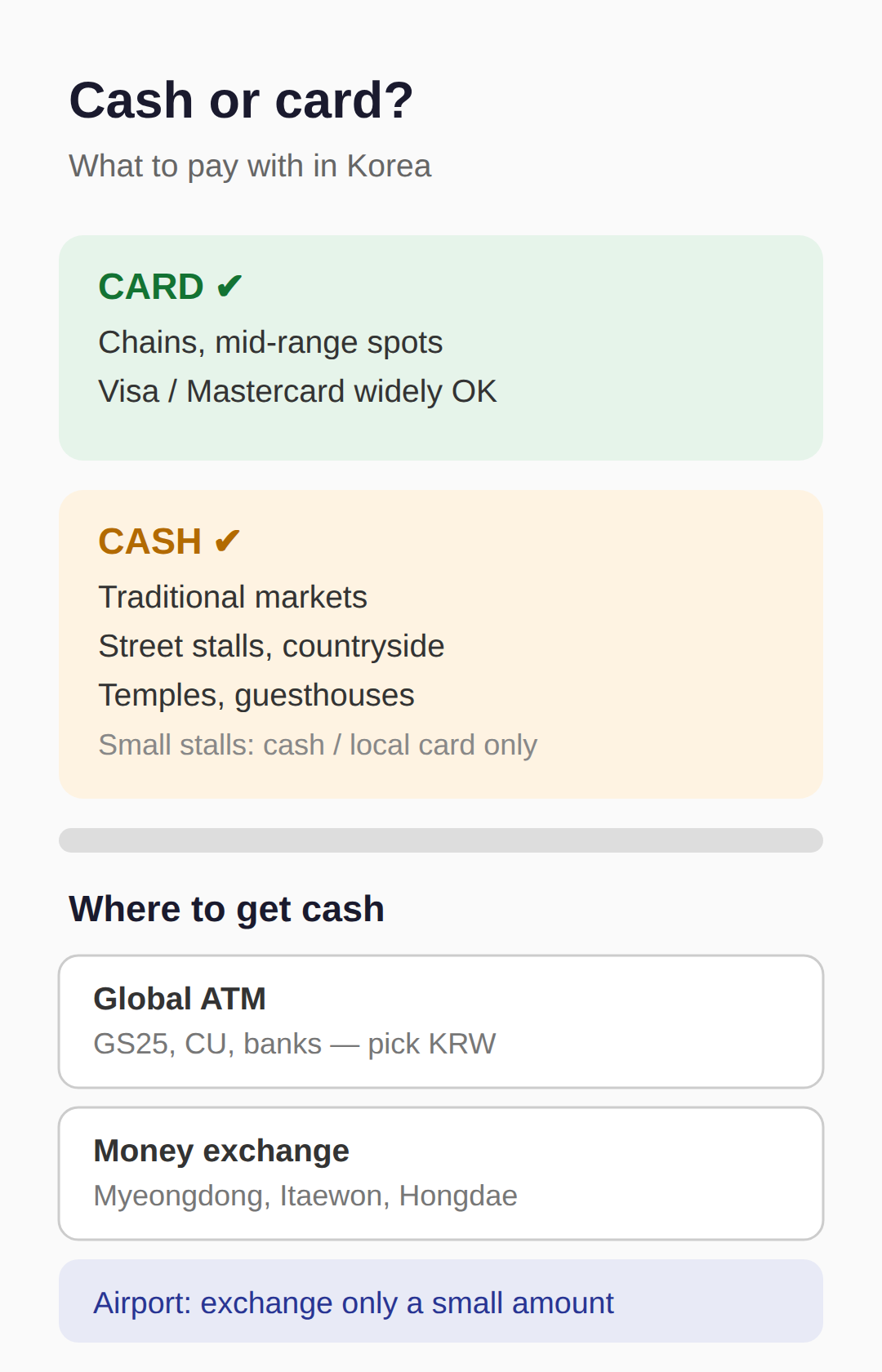
Visa and Mastercard are accepted at most chains and mid-range venues, so daily city spending rarely needs cash.
Cash is still worth carrying for traditional markets, street stalls, countryside restaurants, and some temples and guesthouses.
Very small stalls may be local-card or cash only.
Card terminals and receipts show the KRW amount only, so the conversion happens in the head at the till.
If the terminal offers a currency choice, pick KRW rather than the home currency.
Card payments settle near the mid-market rate, which can beat a bad airport exchange even after a 1–3% foreign transaction fee.
For cash, foreign-card-friendly ATMs sit in convenience stores such as GS25 and CU and at banks, under "Global ATM" signage.
Withdrawals can be set to come out in KRW.
Private money exchanges in Myeongdong, Itaewon, and Hongdae usually beat airport counters and hotel desks on rate.
Exchange only a small amount at the airport and do the bulk in town.
Handling a 50,000-won bill without panic
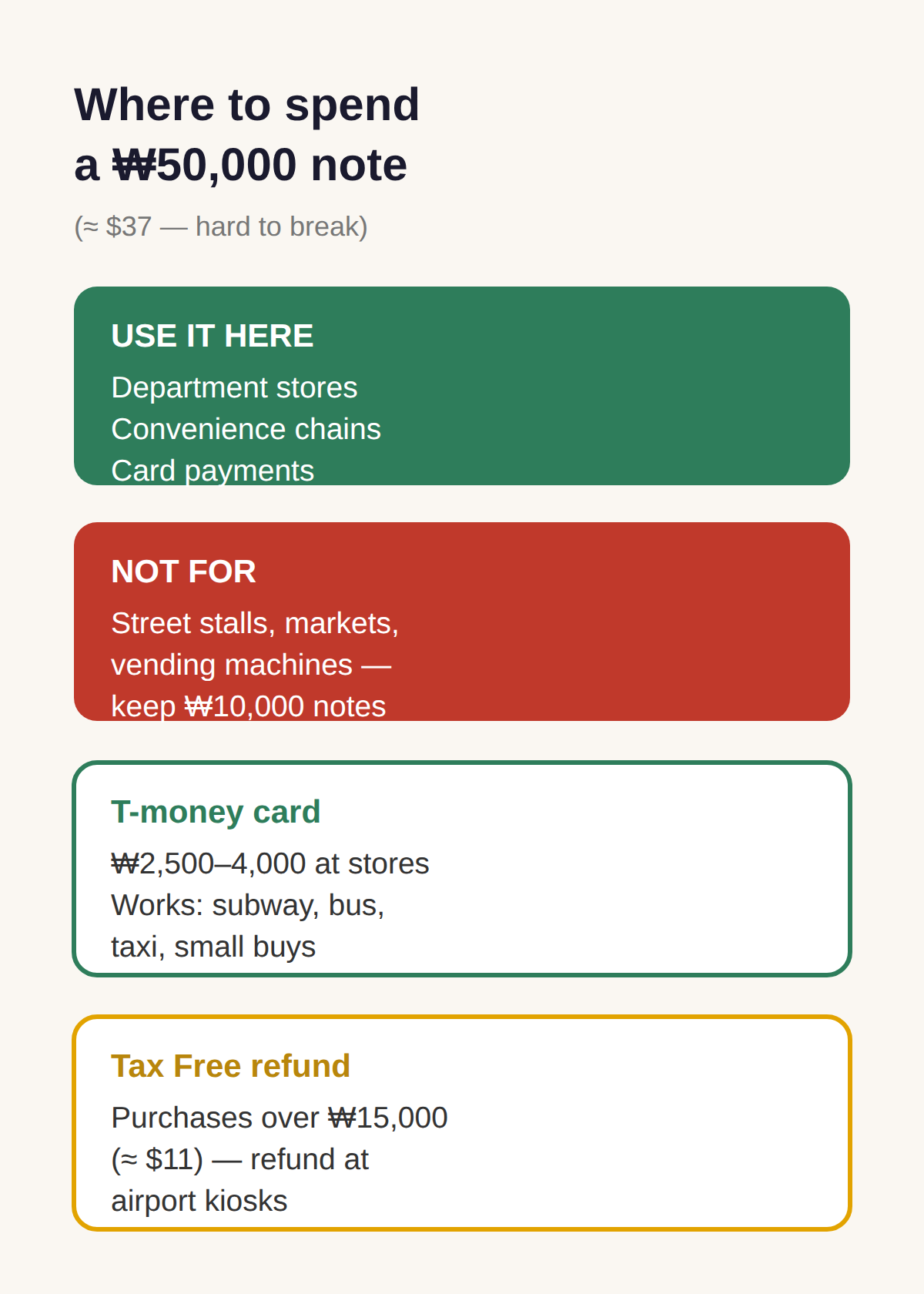
A ₩50,000 note is only about $37, but small stalls often cannot break one.
The fix is a sorting habit rather than more cash.
Keep ₩10,000 and smaller notes for markets, street food, and vending machines.
Hand the ₩50,000 note at department stores, convenience chains, or when paying by card anyway.
Convenience store chains and banks will change large notes without fuss.
The T-money card costs about 2,500–4,000 won at convenience stores and works on subways, buses, taxis, and increasingly small purchases.
One more money-back rule: purchases over ₩15,000 (about $11) at stores with "Tax Free" signs qualify for a VAT refund at airport kiosks, or instantly at some shops.
👉 Chuseok 2026 Korea travel: free parking, what closes
Travelers’ checklist before the trip
Learn the four notes by their faces — Sejong on ₩10,000 and Shin Saimdang on ₩50,000 cover most confusion at the register.
Memorize one number: drop three zeros, divide by 1.35.
Carry small notes for markets and let cards handle the rest.
Get a T-money card on day one and recharge it at any convenience store.
Check receipts stay in KRW, and keep receipts over ₩15,000 for the airport refund kiosk.
👉 Bank of Korea’s official page on the note lineup and figures
👉 Denominations and note/coin details of the won (Wikipedia)
👉 Seoul cost-of-living data with restaurant and hotel prices (Numbeo)
👉 Official tourist info on T-money, tax refunds, and markets (Visit Korea)
Related posts
📎 Busan travel guide 2026: why Taiwanese tourists are flying in and booking longer stays
📎 Seoul itinerary Chuseok 2026 — why staying put beats the 10-hour KTX crawl
📎 📅 다가오는 일정 — 발매·개봉·발표 캘린더
Sources
- Trigger post confirmed: ‘Local tip: how to not get overwhelm (reddit.com)
- ₩ symbol, ISO code KRW, notes issued by Bank of Korea, 50,00 (en.wikipedia.org)
- card_prevalence (en.wikipedia.org)
Before you land: money checklist
- Sort notes into a ₩50,000 pile and a small-notes pile before leaving the ATM.
- Do the bulk of exchanging in Myeongdong, Itaewon, or Hongdae, not the airport.
- Refund receipts go in one pocket until the airport kiosk.
FAQ
Q. How do I convert Korean won to USD quickly?
Drop the last three zeros from the won price, then divide by 1.35. ₩10,000 is about $7.40 and ₩50,000 about $37. Skipping the divide step overstates prices by roughly 35%.
Q. What can 10,000 won buy in Korea?
About $7.40. That covers a cafe americano plus a roll of gimbap, or a tteokbokki portion with a hotteok on the side.
Q. Do I need cash in Korea or are cards accepted everywhere?
Cards cover most chains and mid-range venues. Cash is still needed at traditional markets, small street stalls, countryside restaurants, and some temples and guesthouses.
Bookmark this Korean won prices guide and pull it up at the register — the zero anxiety fades once the four notes feel familiar.
#Koreanwon #wontoUSD #Koreatraveltips #Koreanprices #T-moneycard #Koreamoneyexchange #Koreataxrefund #Seoultravelbudget #Koreancurrency
📅Upcoming Dates — 이번 주 4 · D-day Changdeokgung Moonlight Tour start (Sept 10–Oct 17, 30,000 K전체 보기 →